← Mick Unplugged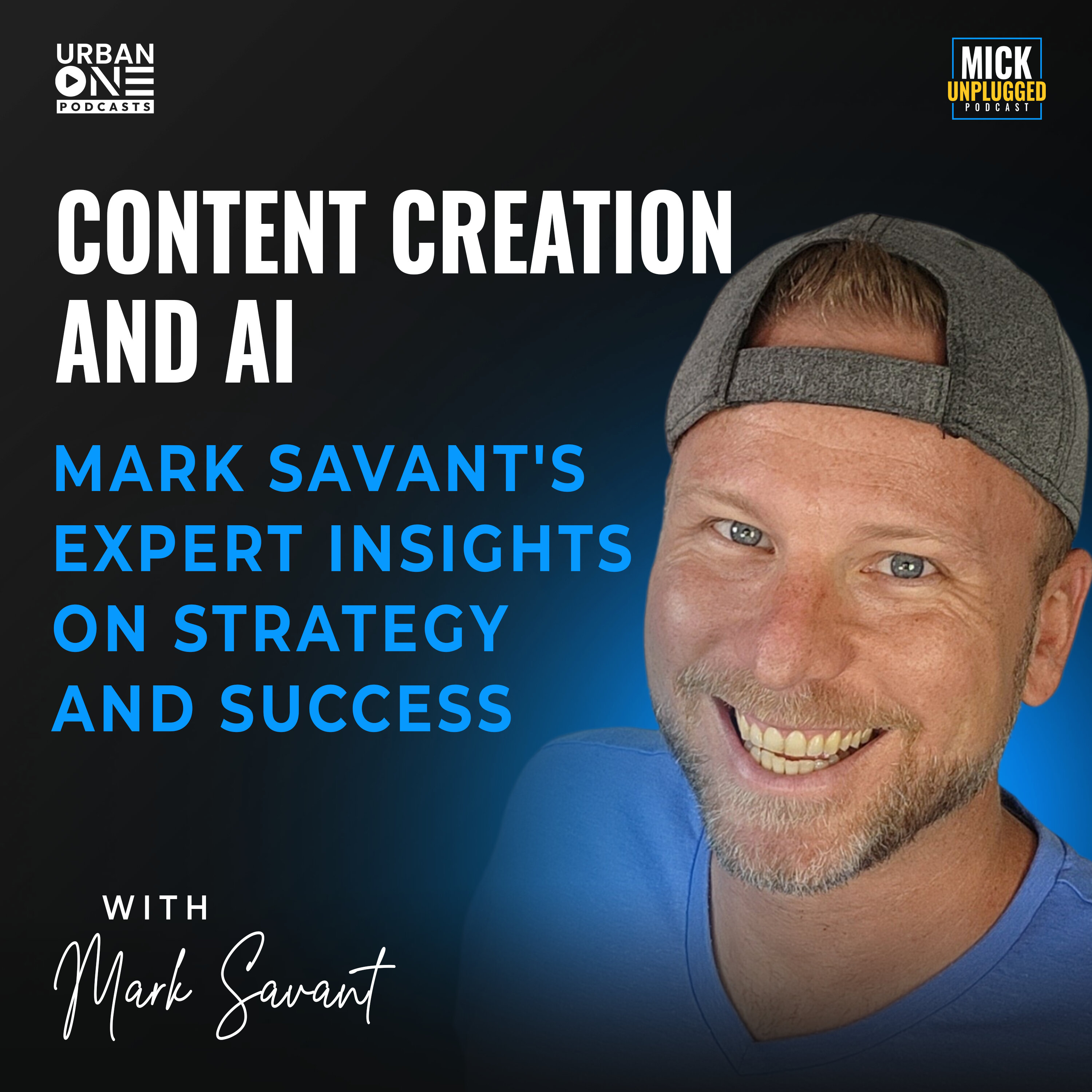
Mick Unplugged
Mark Savant | Content Creation and AI: Mark Savant's Expert Insights on Strategy and Success
00:34:31
Loading summary
Transcript54 lines
- [00:00]
A
When you first started, when this became a passion for you to where you are today.
- [00:04]
B
I come from an insurance background. I've been an employee my entire life. Eventually was like, I'm listening to podcasts all the time, let me try out a show. And within a month I was speaking to presidential candidates, NFL players locally, the mayor of my city. I was like, this is awesome. I want to do more of this. And now I've got a thriving YouTube channel with over 1.5 million views.
- [00:25]
A
I love the messaging that you have behind what you do. And to me, I think that's what creating really good content is about. Right.
- [00:33]
B
I think that there is some value in trying to go viral. And what I mean by that is, on YouTube specifically, the first thing I do before I hit record is I try to understand what the title of my episode is going to be.
- [00:44]
A
And what I love about what you said, Mark, is that there's a strategy to it. And where I see people failing is there's no strategy.
- [00:52]
B
One of the things I think is really important for everyone to be kind of hyper aware of what's going on in your industry are industry trends. And what I had noted is that more leads from our business were coming in through the corporate website and being closed in a call center. Corporate. Welcome to Mick Unplugged where we ignite potential and fuel purpose. Get ready for raw insights, bold moves and game changing conversations. Buckle up, here's Mick.
- [01:22]
A
Ladies and gentlemen, welcome to another exciting episode of Mick Unplugged. And today's guest is a trailblazing entrepreneur and media strategist known for his innovative approach to content creation and digital branding. His passion for empowering others and his visionary leadership have made him a sought after expert in the world of digital media. Please join me in welcoming the innovative, the visionary and the impactful my savant and soon to be your savant, Mr. Mark Savant. Mark, how you doing today, brother?
- [01:51]
B
Mick, I'm just so honored and blessed to be here on the mic with you. Your camera looks amazing. For someone who just started their podcast in March, you are free and crushing it, bro. Thanks for bringing me on the show.
- [02:01]
A
I am honored to have you on the show. And yeah, I did start it in March, man, and it's kind of taken this crazy cool journey because I get to meet amazing people like you and that's what I'm proud of the most, is to let my guests see and hear about these extraordinary people.
- [02:17]
B
Yeah, it's incredible the opportunities that you get. I mean, I've gotten the chance to talk to people like Pat Flynn, Sean Cannell, Patrick Bet David, Dave Rubin. I've talked to presidential candidates, the mayor of our city and our county down here in South Flor. Quick, funny story. I was president of the board in my condo association in Coral Springs, Florida, recently. And there was this weird rule, there's weird bureaucratic rule that you couldn't have shingles on your home in this particular little development. Although right across the street, all the homes had shingles. And we had a huge roofing project. We didn't have the budget for it, but shingles were recommended by a roofer, a, because they would be more effective, and B, they were going to cost about half as much to execute the plan. And the. The city building department was like, no, you can't do it. You can't do shingles. And so I said, you know what I'm going to do. I know the mayor. I'm friends with the mayor because I've had him on my podcast. I went into the next council meeting, went up, shook his hand, shook the hands of some commissioners. I got a chance to just say, hey, guys, this is the deal. This is what our roofer recommends. I kid you not, Mick. The very next day, we had approval for shingles for our community. Unbelievable. The connections you can make through podcasting and new media.
- [03:29]
A
Or you could just be Mark Savant and everybody owes you a favor. That's what I've been told. That's what I've been told.
- [03:35]
B
That works. That works. Or create your own AI agent that goes around and communicates and spreads love and word, you know?
- [03:41]
A
Absolutely, Mark. So again, man, honored to have you here. You are such a dynamic force in the world of digital media, social media, content creation, but it just didn't happen overnight. Right. So I'd love to hear a little bit about your journey to when you first started, when this became a passion for you, to where you are today.
- [04:02]
B
Well, I come from an insurance background. I've been an employee my entire life. My entire life was an employee. And then at about age 35, I was like, you know, I'm tired of being yelled at on the phone all the time. And I decided I was going to shift. And I've tried different sorts of businesses, Mick, but I eventually was like, I'm listening to podcasts all the time. I'm learning a lot. These are fun. Let me try out a show. And within a month, I was speaking to presidential candidates, NFL players locally, the mayor of my city. I was like, this is awesome. I want to do more of this, and I just kept doing more and more of it, and now I've got a premature agency. With nearly a dozen team members, we're producing some of the larger shows in the fatherhood space. We're doing a lot of YouTube. And now I've got a thriving YouTube channel with over 1.5 million views, over 5,000 subs. And it's just been a. It's been a real blessing and a real honor to just do this. It's so much fun.
- [04:57]
A
Yeah. And you crank it out, man. Like, I love not just the quality of your content production, I love the messaging that you have behind what you do. And to me, I think that's what creating really good content is about. Right. I feel like there's this trap of people that are like, I need to create something viral, and they spend so much time focusing on that that the quality of the actual content itself, the messaging itself is lost. So I applaud you for always having great messaging on what you do, brother.
- [05:29]
B
I appreciate that. And I will say, you know, on the idea of going viral, I think that there is some value in trying to go viral. And what I mean by that is, on YouTube specifically, the first thing I do before I hit record is I try to understand what the title of my episode is going to be. And, you know, on YouTube specifically, you want to make sure that there's alignment from curiosity driven by the thumbnail clarity delivered by the title, and then confirmation delivered in the first opening hook of your video. And, you know, while you shouldn't necessarily be chasing views, you should be aware of the market cap, how many people are searching for this? What's the chance I'm gonna get in front of more eyeballs so I can actually deliver my message? And I think that is important to understand that, that concept of search, volume, competition, all that matters with standing out in. In the YouTube world wholeheartedly.
- [06:22]
A
And what I love about what you said, Mark, is that there's a strategy to it. Right. And where I see people failing is there's no strategy. It's just, oh, I'm going to try and be funny for 25 seconds. But then the messaging behind that isn't there. And to your point, there's no brand theme that goes along with it. Right. And again, I applaud you for that and the strategy. And I know we're going to get into some of that today as well, too, but I want to back up a little bit, man. So you started in insurance. Tell me a little bit about that, because I don't know what you know about me, but that was kind of my path as well too, from day one of college.
- [06:59]
B
Well, God bless you, man. It's. It's a tough road. Basically when I graduated from college, I was trying to find a job. I just couldn't find a great job. Nothing I was excited about. My dad, who is a State Farm agent, said, hey, Mark, why don't you come kind of learn the insurance business? You can work for me. So I got licensed pretty quickly, certified pretty quickly, and it just started kind of running the things at the office. In short order, the agency was really successful. But there were a couple of things that I noticed, Mick, and one of the things I think is really important for everyone to be kind of hyper aware of what's going on in your industry are industry trends. And what I had noted is that every day, every week, every month that went by, more leads from our business were coming in through the corporate website and being closed in a call center. Corporate. And I said, hmm, well, this is interesting. How relevant am I going to be to this whole value proposition if I'm not actually closing the leads myself? Everyone was just going to statefarm.com and closing the leads and then we'd follow up with them the next day and kind of tweak things and fix things and be that face. So I think it's really important right now in the world of AI, in the world of robotics, in automation, in new media, where do I fit into this? Because things are going to change. The jobs that are here today are not necessarily going to be around in the next decade.
- [08:15]
A
No, I totally agree with that sentiment for sure. And you know, again, I'm in the insurance space, so shout out to some of my people like Chris Paradiso, Ryan Hanley, Darren Vermos, David Carruthers, Bradley Flowers. I'm giving everybody some shout outs right now. Scott Howell, I didn't forget you either. But, you know, starting in insurance, and I've been in the insurance space for 24 years now, you know this, the insurance world is decades behind, right? From a technology standpoint, from integrating with AI, but more importantly, your expertise today, which is, I'm going to say content and branding. Right? So I'd love for you to kind of talk about what you do today, specifically from a content creation branding strategy guide, because I know that there are several insurance folks that are listening to this podcast that are like, all right, my ears are perked. Let me hear this strategy that Mark's about to give me. But what should an insurance agency owner or leadership team be doing right now to focus on content strategy and digital branding?
- [09:20]
B
Well, I think the first thing that most agencies and most corporations get wrong is that they think that social media and content creation is about selling. You know, for example, I was just at a local chamber meeting, I'm going to be hosting an AI panel at the chamber next month. And I was kind of going through their Instagram. Every single Instagram post was an ad for an upcoming event or an upcoming sponsor. And I just don't know that that's the most effective way. I'll give you another example. I took on a client recently who's a hyper niche. He's one of the biggest Amazon sellers in the world. He's doing $20 million in sales on Amazon every year, in addition to his own SaaS program, in addition to his Mastermind program. And what we recognize when we got in there is we're watching his videos. In all the videos were just kind of talking about, join this new session, join this new program, sell this, sell that. And we went in there, we kind of revised the strategy to just be, let's teach people how to do the thing. We'll use your software. And what we found is that by demoing, by showing, by connecting people how to do something, it just completely transformed the channel. And I would say four times the views immediately. And the other thing that we switched up was the call to action. So he had had a call to action. And this kind of goes back to your original question about what should we be doing, what should our goals be? But the original call to action that we were sharing in pinned comments and in the description was get on a call with one of our sales team members. Right? Get on a call. And the problem with that seems so obvious, but we need to nurture people. People do business with people that they like. And when I think about content creation, that's like, how do I connect with someone and make people feel that, like they can actually like me and know me? And so we changed that up and immediately we're now we're generating about two quality leads every single day from his YouTube channel and this hyper niche program. The customer lifetime value for each lead is about $1,500. So it's kind of powerful when you stop thinking about it as an advertising tool. And is it a connection, entertainment or teaching tool?
- [11:18]
A
I totally agree with that sentiment because life, and I don't care if it's in person, through social, through whatever, life is about human connection and relationships, right? And people want to be felt. They want to be heard and they want to be seen. And so that's part of what my strategy is, is to make sure that whatever I do, there's that human connection involved. So it's not just, oh, well, here's Mick with another post, or here's Mick with another message. I try to make sure that everything has the intent of the human relationship and the human care. And again, another thing that I know, that is a part of your strategy as well, because your messaging man. Like, I feel like I know Mark through the things that you do and even, you know, your podcast production, I feel like I know you're a guest right through the way that you present them, through the final production. So I love for you to talk about how important is that just the human feel, the humanity of the things that you do.
- [12:17]
B
Well, it's. It's incredibly, incredibly important. Even more so in this AI world where everyone kind of feels somewhat disconnected. I want to actually talk about a kind of a really practical example. You know, we just had a presidential election and they're calling it the podcast election because all the views, like, you know, you look at the two candidates, Kamala and Trump, and see what was their media strategy, how were they connecting with the people. Trump's going on. Rogan, he's going on. I recorded video. He went on like the top four, four of the top five podcasts, right? And I think people feel like they really got to kind of know him. Whereas Kamala, she did some big shows. You know, she went on like the Breakfast Club. She went on Call Her Daddy, but most of the things that she was doing was like bite sized content. Like, right, you're gonna, you know, you're gonna hear me talk for 10 minutes on a particular topic, maybe 20 minutes. But you're. When you listen to someone talk for an hour, two hours, three hours, you. You start to feel like you're kind of getting to know them. And, you know, so that's kind of like a practical example of, like, what happened there. Probably give you even a more practical example, Mickey. And this is kind of funny. Every single time I go to a conference, somebody recognizes me. Yeah, every single time. I was at Patrick by David's Vault conference last year, and I was just talking to someone in. This guy Abraham comes up and goes, mark, Mark, is that you? I'm like, yeah, hey, I'm Mark. He's like, I listen to your podcast all the time. And I was like, cool, it's nice to meet you. It's really cool to Meet you a few months later. We were doing business together. He became kind of a student in one of my programs. And the following year, we were rooming together at another conference. And he's referring business. And so it's that kind of like you said, people like we talked about, people do business with people they like, they know, they trust. And when someone can watch you, hear you, listen to you, it paves that path forward. People are getting primed up. So we don't want to, I think, be selling in our programming. We want people to kind of get to know, to like us, say, I want to know a little bit more. And then we let our back end do the selling our websites, our landing pages, our emails, our lead magnets. That sort of.
- [14:17]
A
Yeah, you know, on MC Unplugged, we talk about your. Because that thing that's deeper than your. Why that thing that really is the core of who you are, the mission, the things that you stand for and stand by. And I'd love for you to kind of talk through what's your. Because, like, what makes Mark continue to do this? What makes Mark a giver? Because you could have easily just, you know, done your own content, focus on your own podcast, but you're such a giver and helper that you, at some point you decided, I want to help others and serve others in this. So what's Mark's. Because.
- [14:52]
B
Wow, that's a deep. That's a deep question. I think, you know, for me, the biggest impetus is legacy and being an example for my children. Like I said, I was an employee my entire life. And then when my daughter hit about two or three years old, I was like, I want to set a better example. I want to build something better. And so I think a lot of it comes down to setting an example for our children. I just remember growing, growing up seeing my dad building his agency, going to work early, coming home, dinner with the family, and then two, three hours opening up that Rolodex, making calls, making it happen. And he was able to carve out a great life for himself, for his family. It's empowered him to, you know, provide for various churches and homeless organizations. My parents actually had a homeless person living in their house for nearly a decade because they. They wanted to invest. To me, I think it's about giving more, so about giving back to the next generation, showing this is how we treat people, this is how we build up the world in a better way. And I think that the legacy is really where that because comes from. I want to feel valued. I Want to feel like every time people experience me, they walk away a little bit better than they were before.
- [16:01]
A
Yeah. That's awesome, brother. That is so awesome. And, you know, being an entrepreneur, the road isn't always easy. Right. Like, it's not always how we envision it starting. Right. There's always these obstacles that we have to overcome or challenges that we have to figure out. Going back to when you started the brand and the agency, what were some of the early obstacles or challenges that you didn't see coming but then you figured out, you know, how to overcome this?
- [16:29]
B
Well, I think, and this is something you talk about a lot, Mick, is leadership. And one of the most challenging things I think for me has been how do I surround myself with the right people, how do I bring on the right team members, how do I bring on the right customers? And you know, another challenge I think when you're new is you kind of have to say yes to every opportunity that's out there. And I ended up getting into bringing on clients that just weren't a great fit. They weren't a great fit. And for what it's worth, when you're starting out, you say yes to everybody because you just need to generate cash flow.
- [17:00]
A
Low hanging fruit, right?
- [17:02]
B
Exactly. But over the years through that learning, I can say, okay, out of all these clients I've worked with, who are the 20% that I meshed with the best that I was able to get the best result for that 20%, that's who I want to focus on. That's why I want to attract those other 80%. I can find other solutions for them, whether it's in online programs, free lead magnets, trainings, YouTube videos, or maybe I can say, hey, Jim, you're not a great fit for me, but Jill over here is awesome. Talk to Jill. I think she's going to be a better fit. And so I think focusing on that, I think again is a real challenge, is saying yes to everybody, finding yourself in the wrong situations, and then, like I said, learning from that, taking on the 20% that are going to be a good fit.
- [17:43]
A
Yeah, that's amazing. So you said you were an employee your entire life. Now you've got your own business and a team, a team of 12. What have you learned about yourself as a leader leading 12 people that you didn't either know about yourself before or you've learned to develop over time?
- [18:02]
B
You know, we're always learning. And I'm kind of in this growth phase of my life right now in that in order to Hit new milestones. It requires us to change as human beings. Right. And we kind of talked a little bit about this upfront. Where does God want me to go? Because there's so many different routes and avenues that I could take which are going to lead to all sorts of different outcomes. And it's not always clear what the right path is. So what I pray for, what I read, when I read the Bible, is, what's the direction? Where do you want me to go? And I don't know exactly what that looks like, Mick, but what I do know is that there's certain characteristics of that person, of my future self. There's going to be things that I'm. I'm going to need to be doing. I'm going to need to be lifting weights. I'm going to need to be reading daily. I'm going to need to be waking up early. I need to make my bad habits more difficult to accomplish. So, for example, I like to play video games. I like video games. I know that makes me unattractive to women or whatever. I like video games. But I also realized that that's more of a consumption when I should be creating. So. So what do I do if I find myself playing a video game too much? I delete it. I unsubscribe. I make it harder. It doesn't mean I can't go out and download the game again or resubscribe again. I could do that, but putting all those additional steps in the way make it less likely I'm going to do that because it's more difficult. I want to make my good habits easier to accomplish. I want me my bad habits harder. And I think that's been a big part of my personal growth path.
- [19:25]
A
No, I love that a lot, man. I love that a lot. You know, one of the things that I've learned for me, especially on the path of leadership, is the power of mentorship. Right? Having the right mentors in your life at the right times over different phases of mentorship. So how important has mentorship been for you through this journey?
- [19:47]
B
Mentorship is a tough one. It's very difficult to find good mentors. I was at a men's group at church the other day, and we're reading this book, become your future self now. And I remember I was just talking about, I had had a guy on my podcast, he's a billionaire. He's just like one of the biggest real estate investors in the world. I got invited out to his home in Fort Lauderdale. He's got a yacht in the Back. He's got like 12 people on staff inside his home. It's like a 12,000 square foot home. It's crazy. So I was kind of telling the story real quick. And afterwards, after the session was over, this guy comes up to me and basically hard sells me on becoming part of his coaching program. And I was like, that's, that's not the type of mentor I want, you know, and so it's tough, I think, you know, for me, Mick, and I don't necessarily know that I have any specific mentors. Like, the pastor at my church is great. My father's great. I can learn a lot from them. But I think one of the best ways for me to learn is working with clients that are farther ahead than me. So finding someone who's built something amazing that's doing millions of dollars in revenue, how can I add value to that organization? And then I get a chance to actually get paid to learn. Because now I'm generating income for me and for my team, but I'm also learning like, oh, wow, that's the way that he set up his organizational structure. That's really smart. I can kind of take that back to my team. Or, wow, that his tech stack is really working, or that that AI tool that they're using and the way they're integrating AI into their client, that's really good. I'm gonna, I'm gonna take that back. So, you know, I think for me, and again, kind of moving to this year, I wanted to surround myself with killers, people that are, that are farther ahead than me. And a lot of that has just been working with clients that are generating more cash or running bigger teams and bigger organizations. And taking that as a lesson, not just for me, but for my team and for the other clients that I'm working with. Because if something's working for this client, well, let's go and let's replicate it over for this client too, and then everyone shares in that growth.
- [21:35]
A
Got it. Got it. I love it, man. So throughout this, this conversation, you've mentioned several times about AI and robotics and utilizing technology to your advantage. What are some trends that you see coming that people need to be aware of as it relates to AI and marketing or content creation?
- [21:56]
B
And this is, I think, probably one of the most important topics of our, of our generation right now. We're going through something as dramatic as the printing press right now with AI. And where I think people should be focused on is a couple things. A, how can I train AI models and prompt AI models to give me the output that I want, and that is going to evolve over time. But I think that a couple things are going to be true is the more information that I have digitally on my business as far as vision, mission, ideal team members, ideal customer profiles, all the branding, the brand guides where I'm finding people, maybe have big spreadsheets full of financial data, marketing data, customer journey data. All that data has become very, very, very important because you're able to train AI models specifically within the context of your own organization. And the more streamlined and the more documentation that you have on your organization and what you're trying to accomplish, the faster you're going to be able to train models to accomplish different things. And honestly, this is one of the first things I do when I bring on a client. I say, send me over your brand guide. You know, if I'm doing, you know, YouTube, if I'm doing email marketing, give me all the information you have on your organization, let me see your customer, all that stuff that I mentioned, and I'm going to train an AI model on that specific business so that I'm able to give them results much more quickly, much more rapidly, and much more accurately. And then it becomes a sounding board that can ask questions. Hey, I'm thinking about running this type of campaign. What do you think? It'll help me see blind spots. It'll help me find opportunities that I didn't know. It'll help me find leaks in the business. It's kind of funny when you start leveraging this properly, you get results so quickly, Mick, that you. There's almost this temptation to say, I actually can't send this result to a client yet because he's going to think that it just. It devalues the work. When you can do something in 10 minutes that it used to take two days to do, it almost devalues what you're doing. And the flip side, I had Chris do on my podcast, we kind of talked about this, and he said, well, if the client is upset because you're sending them work too quickly, you say, oh, well, you know, if you like, I'd be happy to send it to you three days later. Would that. Do you want it? I could give it to you now because speed is actually the value that you're giving. Speed is the value that you give to your customers and your clients.
- [24:16]
A
Right? No, I love that, man. I love that. So for the. Not even insurance specific now, but for the company or the entrepreneur, the solopreneur, that's like, okay, I need to dip my toe into AI. Where does Mark Savant tell them to start?
- [24:33]
B
So it starts with starting. And I know that sounds obvious, but I'll go back to an example of Mr. Beast. Mr. Beast, one of the biggest YouTubers on the planet, is constantly asked, how do I grow a big YouTube channel? And the advice that Mr. Beast gives is make 100 YouTube videos and try to make each video better than the last video. And it sounds elementary, but what ends up happening is you just get better the more you do something right. And I think there's a lot of that. I think people are a little bit afraid. It's a big hamburger to just swallow in one bite. We have to take bite size chunks out of it. But I would start. Like I said, you could pop open ChatGPT, you should be opening up a ChatGPT every day. It's $20 for a premium account. That gives you better results, it gives you web search, it gives you the ability to create GPTs. And amongst other things, you get a greater, you can get more results. So a 20 chat GPT, it's, it's 20 bucks. It's the greatest tool that humankind has ever seen. So opening up something like that, implementing it using Automation is level 2. Starting to automate it with things like forms. I'll give you a cool example, Mick people. This will get juices flowing here. I had to hire a new position recently for an email copywriter, an email marketer, to help me out with my newsletter, AI update AI. And what I did is I put out a post on this job listing board, said, hey everyone, I'm hiring email copywriter. If you're interested, go fill out this Google form. It's a Google form. And I asked various questions that Google form that were very specific, that only someone in that realm would know, like, what are the KPIs I'm looking for? How would you improve open rates on emails if you were going to spam? How would you solve that problem? Some kind of technical stuff. And I automated that using zapier over to ChatGPT. And I said, hey ChatGPT, I want you to review all the people, all the responses that people send in and this is what I want you to specifically look for. And I prompted it, I trained it. Again, this is the skill of our generation is knowing how to train and prompt. Totally agree gave ChatGPT all the context that it needed to actually handle these prompts coming in or handle these responses coming in. And I said, for all the responses, I want you to give them a ranking. One being the worst ten being the best. And what it did is it was able to go through dozens and dozens and dozens of applicants, and I was able to narrow it down to the top three instantly. Instantly. And it is so hard to find good talent. It is very difficult. It's extremely time consuming. But when you can use some. I set this up in an afternoon, and now it's replicable. Anytime I want to bring on a new team member, boom, done. I can get it done. And so it's. It's unbelievable what you can start to do once you start using AI as a sounding board. And so to answer your question, start using it for 10 minutes a day, get comfortable with prompts, learn better prompts, and then eventually you can start automating with forms and information like that to just completely scale out any sort of system or process.
- [27:24]
A
No, totally agree, man. And I'm a huge fan of creating custom GPTs. I probably have 20 different ones for 20 different aspects of what I do. And I actually treat those custom GPTs like employees. I've got a speech editor. I've got, you know, one that reviews financials and looks at loopholes for me, Like, I truly. And I have a cfo, Right. But I also have this machine that can analyze faster. And now my CFO and I can have amazing conversations because we don't have to spend three days getting material or getting documents or getting spreadsheets and reviewing and forecasting. We let our CFO GPT do that, and then we have what we call C suite conversations. Right. Same thing with my coo. Like, I have a COO GPT that my coo, my human coo, actually uses to be a better coo, and we have better conversations. And so I love the power of custom GPTs, because what you can do with it is almost limitless. And I see you smiling over there, so I want to flip that back over to you.
- [28:29]
B
It gets me so excited. You know, any. Any team member that's. That's not using AI, they need to be using AI. And I think for a lot of team members, it's. It's kind of scary because they think, oh, gosh, if. If I'm using AI all the time, then I'm going to. My value is going to be lessened, but it's actually the opposite.
- [28:46]
A
You become stronger, you become more valuable when you know how to use your specific skill set with AI. I tell people that all the time.
- [28:53]
B
Exactly. Because what. What AI inexorably does is it turns beginners into proficient. Proficient in whatever their thing is you can go from beginner to proficient like that using AI. But what it, what it also does is it makes experts efficient. Because now all that little busy work stuff that you were doing and like, oh, I got to sit down and write an email. This is what news. Take me an hour now. Takes you two minutes.
- [29:15]
A
Yeah, wholeheartedly.
- [29:17]
B
It's unbelievable. Another thing that I just put out there when it comes to AI is everyone. If you walk away from this, here's one thing that I really want you to think about. If you are using zoom calls, you absolutely must have an AI zoom note taker that follows you around the Internet. It is absolutely life changing. There's a bunch of them out there. I'm using Fathom right now. That's the one that I like, but there's a bunch of different ones. But it's changed my life. I don't even barely do phone calls anymore. If I'm gonna do a phone call, I'm just gonna do an audio zoom call. Because this note taker will take away key highlights, objections, key moments in the call, next steps. You always wanna walk away from a zoom call with like, what's the next thing that I need to do? What's the next thing that this person should do? It lays all that out. It can automatically send the notes to the person who is on the other line. It's taking out a transcript, by the way. You can use all these transcripts, you can use all these notes to program and set up AI models. So if I know I've had all, if I'm keeping track of all the zoom calls that I'm having with a particular team, boom. Save all that. Use that to train my chat GPT prompt. Now you're going to system for training your GPT models. And additionally this, this program Fathom uses an API and it automatically adds all the notes to my CRM. So anytime I'm on a sales call, boom, automatically going into my CRM, I'm gathering data. That's the key here is we want to gather as much data as possible because as I gets better and more efficient, all the data that we have is going to be used to instantly program what the next thing is.
- [30:49]
A
Bro, I get so excited hearing you talk about this and following you like I do. Like I picked up some things from you too. So like one of my custom GPTs as a consultant, it builds out frameworks, right? For my clients. And so imagine what Mark is talking about. So now you've got that transcribed meeting, put it into your framework that Already has out a 12 month journey because as a consultant you're usually doing those journeys and now it's automatically programming next steps. And I've got one that creates workbooks and so now it's completing workbook. Like the things that you can do are endless and it should be one saving you time. And when you're doing it right as an entrepreneur, it should be making you more money than you could have ever done before. And now your roi, right, is crazy profitable because you're using things the right way. So, Mark, I love everything you just said, bro.
- [31:42]
B
Yeah. I will say that the number one objection I hear from people when they, when they start talking about AI is they say, well, a robot can't, can't replace what I do. I'm about human to human connection. That's what's important. I think what people miss is that the AI tools on the back end enable you to be more focused on the person that's in front of you.
- [31:59]
A
Right. It eliminates excuses. That's what I tell my team. You don't have an excuse not to be customer facing or client facing or prospecting because now all this stuff is happening in the background. All the things that you told me you don't like doing, we've solved. So now if you don't have other time, it could be a you problem. And that's what I tell a lot of folks too. So.
- [32:19]
B
Right. AI in implementing just some of the things we talked about today, Mick, is the best way to start working on your business instead of in your business because you can set up that GPT. Like you said, that COO one is brilliant. You set that up once and now you've got an executive assistant that you probably were going to be paying $75,000 a year for.
- [32:40]
A
Yeah, wholeheartedly, wholeheartedly. Mark, you've been gracious with your time. I appreciate you. What's going on with Mark? Like, what do you have going on that you want people to know about?
- [32:52]
B
I'm really excited about what I'm doing on YouTube right now on the Mark Savant channel. It just grows like crazy. I'm a YouTube partner. Like I said, over 1.5 million views. I'm just focusing a lot on these AI tools. What am I learning? What are other people learning? How can we leverage that? We're in a golden age. There's a lot of fear out there right now and I think that there's the. Some of the fear is warranted, but we're in a golden age of opportunity right now. It doesn't matter where you're born, where you come from. These AI tools are so inexpensive, a lot of them are free. And if you can find a lane, you can start to leverage it. And it's a very exciting time. So I would just encourage people, if you want to know more about some of these specifics, where I can actually do a screen share and go deeper on some of these tactics. I'm doing that all in the Marks Font YouTube channel.
- [33:40]
A
Perfect. I'll make sure I have links to you everywhere else. You also are on other social platforms. So what are your other social handles?
- [33:48]
B
You find Mark Savant Media all across the web. Mark Savant Media.
- [33:52]
A
As Mark says, just Google me. Mark Savant Media. Google him. He's there everywhere. Love it, brother Mark, thank you again so much for your time. This means the world to me to just be able to chit chat, learn more stories that I didn't know about you and then just share the great things you're doing with the world. So I appreciate you, brother.
- [34:08]
B
You too, Mick. Thanks for having me, bro.
- [34:10]
A
You got it. And for all the listeners and viewers, remember your because is your superpower. Go unleash it. Thank you for tuning in to Mick Unplugged.
- [34:22]
B
Keep pushing your limits, embracing your purpose and chasing greatness. Until next time, stay unstoppable.