Loading summary
Transcript66 lines
- [00:00]
Mick Hunt
When I started Mick Unplug, I had to figure everything out on my own. Scripts, setups, filming, branding, you name it. Every single day brought a new decision and an even longer to do list. It was overwhelming, but finding the right tools that simplify everything. Total game changer for millions of businesses. That tool is Shopify. Shopify is the commerce platform behind millions of businesses and 10% of all E commerce in the United States. With hundreds of templates, you can build a beautiful online store that matches your brand. They're packed with AI tools that write product descriptions and even enhance your product photos. Plus, Shopify handles everything from inventory to international shipping to returns. So you don't have to start your business today with the industry's best business partner, Shopify, and start hearing. Sign up for your $1 per month trial at shopify.com Mick go to shop shopify.com Mick that's S-H-O-P-I-F-Y.com M I C
- [01:08]
Shopify Advertiser
K early birds always rise to the
- [01:12]
Nir Eyal
occasion for summer vacation planning because early gets you closer to the action. So don't be late. Book your next vacation early on VRBO and save over $120. Rise and shine. Average savings $141 select homes only.
- [01:25]
Mick Hunt
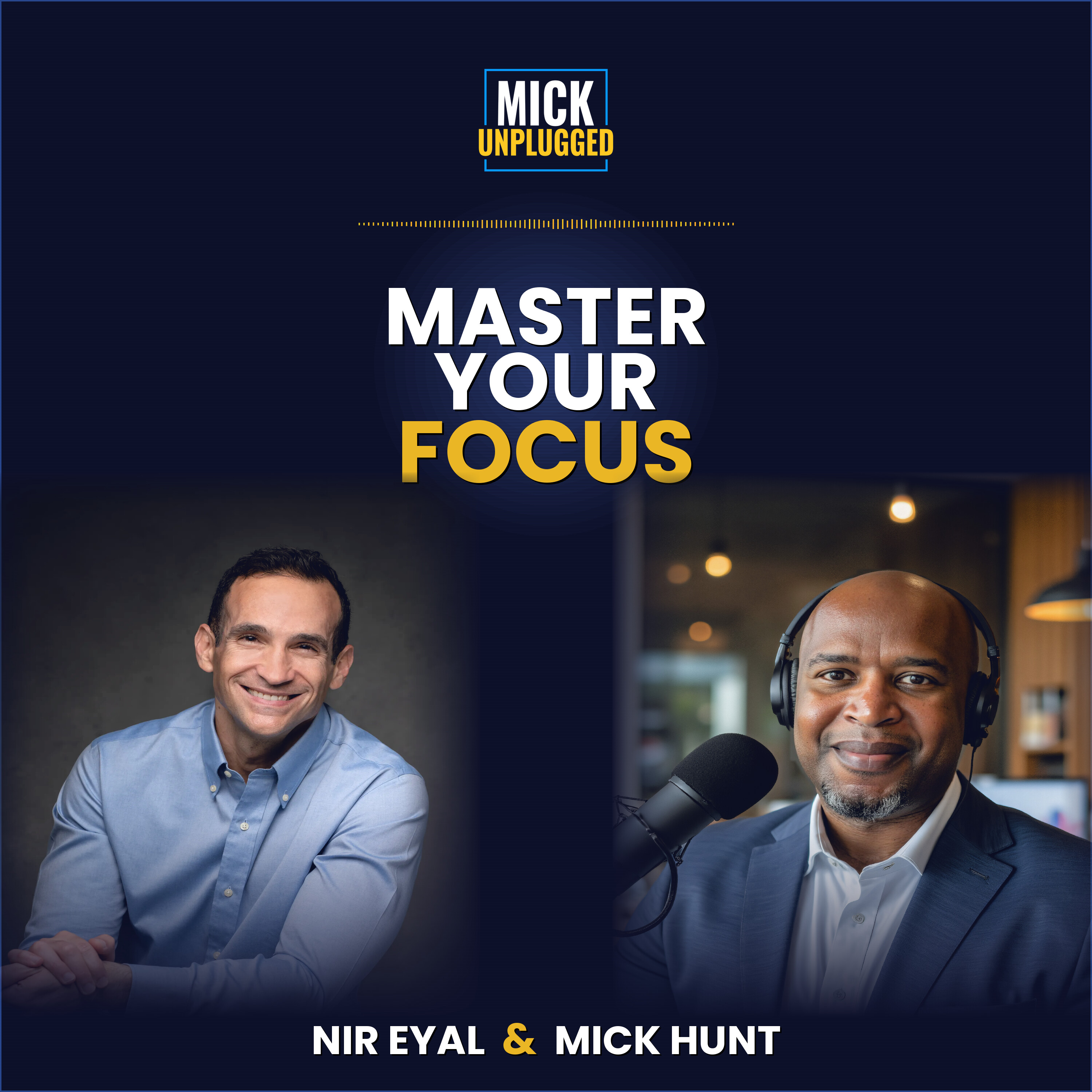
Ladies and gentlemen, welcome to another exciting episode of MC Unplugged. And today's guest is one of the brightest minds that I know and it's not because he went to Stanford Graduate School of Business. Literally. His books are game changing. His personal philosophies are those that they actually write books about. I'm honored to have this guy on. I've been a huge follower and fan of his for a very long time. So please join me in welcoming the insightful, the impactful, the unstoppable, Mr. Nir Eyal.
- [01:55]
Rudy Rush
You're listening to Mick Unplugged, hosted by the one and only Mick Hunt. This is where purpose meets power. And stories spark transformation, takes you beyond the motivation and into meaning. Helping you discover your because and becoming unstoppable. I'm Rudy Rush and trust me, you're in the right place. Let's get unplugged.
- [02:20]
Mick Hunt
Mir, how are you doing today, brother?
- [02:21]
Nir Eyal
Oh, my goodness, what an introduction. You are amazing. Thank you so much, Mick. It's so good to be here with you, man.
- [02:27]
Mick Hunt
You are the amazing one and every word that I said was true. I've been a huge follower, huge fan. A view in the work that you put out and more importantly, the action that you put behind the work. Like I think, and this isn't a knock on anyone. So I don't want anyone that's listening or watching to take it this way. But there are a lot of people that have been deemed because this is what society tells us as thought leaders or maybe even influencers. And when you go to study them and research them, it's like there's no substance to the things that they're actually saying. Near bro, the reason I love you is because I love substance. You make me think, you challenge me, and more importantly, like, you're that resource that I'd love to break down today. So just thank you again for being the gentleman and the human being that you are, man.
- [03:15]
Nir Eyal
Oh, my gosh. That means a lot to me coming from you. So thank you so much. And I'm so curious, what have you read of mine or what really got your juices flowing? Was there something in particular? Not to put you on the spot, but was there anything in particular?
- [03:25]
Mick Hunt
So you do some amazing workshops. You know, that Hooked and Beyond really taught me to introspect on me a little bit, I think. You know, I'm a leader's leader is what I like to. To be told. But a lot of things that we do and the decisions that we make start with us first. And you really force me to look at me. And then Indistractable, which we're going to talk about with all the. The challenges and the. The diversions that we have or the opportunities that we have, like, how do you live in focus. Indistractable, not just for you as a human, but with your business and business principles as well. So for me, what you've done is allowed me to take personal things into business and business things into personal.
- [04:12]
Nir Eyal
Very cool. I appreciate that. Thank you, man. You really made my day. Thank you.
- [04:16]
Mick Hunt
No, you are the great one, man. And so, Nira, I always ask my guests this opening question, and that question is, what is your because? That thing that's deeper than your why, like your true purpose, your true reasoning, that thing that really gets you out of bed in the morning. Right. Like, we could talk about your why, but it's really your because that does it for you. So if I were to say near today, 2026, what's your because? Why do you keep doing what you do?
- [04:47]
Nir Eyal
So this is a relatively easy question for me to answer because it's a mantra I repeat to myself every single day when I tell myself my purpose is to explain the world so that it can be made better. That's my. That's what I'm professionally there's other aspects of my life. Right. I want to be an available father. I want to be a great husband. I want to contribute to my community. But in terms of my professional aspiration, I don't need to make a lot of money. I don't. That's not my. My purpose. My purpose is to explain the world so that it can be made better.
- [05:17]
Mick Hunt
Yeah. That's why you are who you are. Near. That's why you are who you are. And speaking of who you are, for those that are watching and listening, man, you've co founded and sold tech companies. Then you transitioned into writing and teaching, which most people can't do, especially in the tech space. You've got that unique skill to have the tech, but then also the personality that people are attracted to. What was a pivotal moment that led you to focus on that intersection of psychology and technology and business.
- [05:52]
Nir Eyal
So my M.O. in doing my work these days and accomplishing my mission, my purpose to explain the world so they can be made better, is to follow my curiosity. I don't know about you, but when I read a book that's written by somebody who just wanted to write a book, I can tell right away. And I don't like to write books that way. I like to explore things that I want answers to.
- [06:17]
Mick Hunt
Yeah.
- [06:17]
Nir Eyal
And so my. My mantra that I repeat in terms of. Of when I'm having trouble writing, when I. When I feel like I'm stuck, I repeat to myself that I just need to follow my curiosity. So I don't write books about what I know. I write books about what I want to know. They're very personal problems. So with Indistractable. I wrote that book because I kept getting distracted. I was the most distracted person you've ever met. I've been getting diagnosed with adhd and I was struggling with too much phone use and too much this and too much that. And I. I wasn't focusing on my priorities and what really matters to me and keep staying true to my values. And so that's why I wrote Indistractable. And then when it came to Beyond Belief, my new book that's coming out, it was about this. This deeper challenge I had of knowing what to do. I had tons of great advice, tons of great information out there. Right? The. If you don't know the answer to something, you Google it, you ask ChatGPT. The information's out there, and I wanted the benefits of doing the things I needed to do, and yet I wasn't doing them, and I didn't know why. And I found that many of the people that I, I was speaking to, my, My, My readers of my work and people that I've done consulting with had the same problem. And so I wanted to understand this fundamental question. I was just curious, why is it that some people are able to accomplish their goals and others aren't? Is it just skill? Well, skill could be learned, so that can't be it. Is it information? Well, no, we're drowning in information. Maybe it's resources. And yet there are case studies after case studies of people who have every resource at their disposal and accomplish very little. And yet there's stories of people who have almost nothing and who go on to do great things. There's something deeper going on there, and I wanted to know what it was. And my conclusion was, after six years of research and writing, is that it's our beliefs. And so every one of all my work stems from that. Curiosity stems from I want to know the answer. And so that's why I keep digging and digging.
- [08:10]
Mick Hunt
You know, I talk about curiosity a lot in sales when I'm talking to sales leaders. And I say the best salespeople that I know are the most curious people that I know. Right. And I also, because of how you write your books, the structure of your books are so phenomenal. You write curiously as well, if that makes sense. Right. It's almost like I'm reading it from your viewpoint and you're taking me down journeys. And that's what I love about how you do that. Talk to us about just that, that setup. And we can start with indistractable if you want, before we get into. To the others. But like your process of just laying out your message, pen to paper, or, you know, hand, a keyboard, whatever you want to do, like, walk us through your process of how your brain works to structure, because you're one of the elites that I've ever seen at that time.
- [09:08]
Nir Eyal
Thanks. So, I mean, to be honest, it starts with a problem. And what you're not seeing, Mick, is that you're seeing the end result, but you're not seeing all the, you know, how the sausage is made. You're not seeing all the stupid stuff that I don't publish, all the rough drafts that never see the light of day, the, the. The words that end up on the cutting room floor. That's the stuff you don't see. So you're only seeing the, the good stuff that I let get out there. But for me, it always starts with the problem. Right. So with indistractable, there was a Very specific moment in my life that made me dive into this topic, which was my daughter and I had some. Some time together. Just some. Some quality time. And I remember we had this activity book of things that dads and daughters could do together. So they had, like, a little sudoku puzzle. There was a. You could make a paper airplane throwing contest, all kinds of little games we could play. And one of the activities was to ask each other this question. The question was, if you could have any superpower, what superpower would you want? And I wish I could tell you what she said, but I couldn't, because in that moment, I just had to just check this one thing on my phone real quick. And by the time I looked up from my device, she was gone. Because I was sending her a very clear message that whatever was on my phone was more important than she was. And she went to go play with some toy outside. And so that's when I realized that I had to do something, because it wasn't just with my daughter. It would happen when I would say, oh, today's gonna be the day I exercise and eat right? But I didn't, and I wouldn't. Today's gonna be the day I work on that big project. I'm really gonna focus on, you know, calling, calling the. That. That lead I'm working on or. Or writing that chapter in my book or doing that thing that's on my to do list. And yet somehow, 20, 30, 45 minutes later, here I am checking the news or scrolling Twitter or, you know, checking email, everything but the thing I said I was going to do. So that's when I decided if I could have any superpower, back to answering the question in the book with my daughter, I would want the power to be indistractable. I just want the power to do the things that I know I want to do, right? That. That. That I think is the most important skill of the century is that as the world is becoming more distracting and it's. It's not going to become less distracting, right? It's only with AI and virtual reality and all the stuff that's happening in reality, reality, the world is only going to become a more distracting place. So the superpower, the skill of the century, is going to be the ability to follow through. Because it turns out that people want to do business with those who follow through. People want to be in relationships with people who follow through. People want to be friends with people who follow through. We hate flakes. Flaky people suck. And so that's what I Wanted. I wanted to exercise if I said I would. I wanted to, you know, be there for my daughter if I said I would, to be there for my friends, to. For my business associates. I just wanted to follow through on the things I know I should do. So I wanted to stop getting distracted. And so that was the impetus for writing that.
- [12:05]
Mick Hunt
So I love that. And I know that there's people that are watching or listening right now that are, like, near. That's me, too. I want to stop being distracted. What are some things that people can do in a practical sense?
- [12:20]
Nir Eyal
Sure.
- [12:21]
Mick Hunt
To. To be that person or that entity that follows through.
- [12:26]
Nir Eyal
Yeah. So let's first start with what is distraction? We have to kind of define our terms. Okay, so what is distraction? Well, the best way to understand what distraction is is to understand what distraction is not. What's the opposite of distraction? The opposite of distraction is not focus. People think it's focus. It's not focus. The opposite of distraction is traction. It's right there in the word traction and distraction. Both words come from the same Latin root, trajare, which means to pull. And they both end in the same six letters. A, C, T, I, O, N. That spells action. So the first thing we need to realize is that. Is that distraction is not something that happens to me, okay? It's right there in the word. It ends with action. Distraction is an action that I take, okay, that pulls me away from my goals, away from my values, away from becoming the kind of person I want to become. Those are acts of distraction, acts of traction. The opposite of distraction is any action that pulls me towards what I said I was going to do, towards my values, towards becoming the kind of person I want to become. So the most important thing here is to realize that what separates traction from distraction is one word, and that one word is intent. As Dorothy Parker said, the time you plan to waste is not wasted time. So one of the biggest mistakes people make is that they beat themselves up because I scrolled Facebook or TikTok or I watched a YouTube video and I shouldn't. That's actually not the problem. It's not the medium. It's not what you're doing that's the problem. It's not. It's why you're doing it. If you want to watch something on Netflix or scroll on Instagram or whatever you want to do, do it. Why? Why is playing a video game somehow morally inferior to watching golf on tv? Whatever you want to do with your time, You're a grown up. You can do whatever you want. There's nothing wrong with any of that. So we need to stop vilifying the technology. We need to stop thinking that this is the reason for the problem. It's not our phones that are causing the problem. The problem is much deeper than all that. We're going to get to that in a second. So that's the first step, realizing that anything you plan to do ahead of time is traction. Anything that is not that is distraction. So one of the worst forms of distraction is when people justify to themselves. So they say, well, I'm doing something I have to do anyway, right? I'm checking my email because, you know, I'm at work and I need to check email. At some point I'm cleaning up my desk because, oh, you know, that's something I got to do anyway. I got to take out the trash, I got to clean the dishes or. But what? Turns out, if that's not what you said you were going to do ahead of time, it's just as much of a distraction. So what I used to do, I used to get into work and I'd say, okay, I had that big important project I need to work on, right? I need to work on this big important thing. But let me just check email for a minute. Let me just scroll that Slack channel. Let me just catch up on industry news, because I'm supposed to do that at some point. So what's the big deal if I do it now versus later? And what I didn't realize is that that is the most dangerous form of distraction because you don't even realize you're off track. You're justifying it to yourself because you're like, oh, I'm checking email. That's a work related task. But if it's not what you said you were going to do, it's the most dangerous form of distraction because you don't even realize you're off track because you've justified it to yourself. So you have traction, you have distraction. Now let's talk about what prompts us to take these actions. We have triggers. We have two kinds of triggers. The first trigger is what most people think of. It's called an external trigger. It's the pings, the dings, the rings, all these things in our outside environment. Okay? That's what we tend to blame. Turns out that studies find that external triggers, the pings, the dings, the rings, only account for 10% of your distractions. 10% of the time that you check your phone, it's because of an external trigger. So what's the other 90%. 90% of the time that we get distracted. It's not because of what's happening outside of us, but rather, it's because of what's happening inside of us. Exactly. It's those internal triggers. What are internal triggers? Internal triggers are uncomfortable emotional states that we seek to escape. Boredom, loneliness, fatigue, uncertainty, anxiety. Once you realize this, that distraction is not a moral failing. It's not a character. Flawless. There's nothing broken about you in any way, shape, or form. It's simply you haven't acquired the skill to deal with discomfort. That's all it is. You just haven't acquired the skill to deal with discomfort. You feel an urge, you feel discomfort, and you think that pain means suffering, that you have to escape that pain. No, it's not true. It's a lie that these internal triggers are the reason we get distracted. We're lonely, so we check Facebook or maybe Tinder. We're uncertain. We Google, we're bored. We check sports scores, stock prices, the news, whatever. We worry about people's problems 10,000 miles away so we don't have to think about our own lives. Once you appreciate that fact, once you understand that the vast majority of our distractions begin from within, you can stop blaming your technology and start finding practical solutions to deal with that emotional discomfort so that you can master the internal triggers so they don't become your master. So, to answer your question, a little bit long winded. Sorry. The first step, master the internal triggers. You have to find out, what am I going to do when I feel bored, lonesome, indecisive, fatigued? Am I going to escape it by smoking it away, by drinking it away, by clicking it away, by scrolling it away? Or am I going to figure out a way to use that same discomfort to propel me towards traction rather than trying to escape it with distraction? That's step number one. Step number two is making time for traction. So whatever it is that you find important in your life, you need to define that as part of your values. What are values? Values are attributes of the person you want to become. Okay? So if you want to know what someone's values are, don't ask them. They're going to lie. Why? Because they're lying to themselves. We tell ourselves, oh, health. Health is very valuable. Nothing more important than your health, Right? But have you scheduled time to exercise? No. Oh, my family. My family is number one. Oh, I'm a family man. Nothing I. Family's number one. Have you scheduled time to take your wife on a date or to spend Time with your kids or call your siblings or your parents or be active in your community. Is it on your schedule? No. Well, then it's not one of your values. How about, how about, you know, education? That's very important. You gotta, gotta stay with the mind, right? You gotta, gotta invest in your, in your mind and read and, you know, do things like that to get. Become more educated. Well, is it on your calendar? Is it on your schedule? No. Well, then it's not one of your values, because your values are determined by how you spend two things, your money and your time. Those are your values. So just like you have a checkbook or a credit card statement that accounts for how you spend all your money. Your calendar is how you spend your time. So if it's not on your calendar, it's not one of your values. So you have to turn your values into time. And so you can't say you got distracted unless you can tell me what did you get distracted from. You can't say you got distracted unless you know what you got distracted from. So if your calendar is open, you got lots of bunch of white space in your day. Maybe you got a dentist appointment or something. And that's it. You have no right to say you got distracted because what did you get distracted from? There's nothing on your calendar. So you have to turn your values into time by putting time boxes in your calendar for what you want to do. The third step is to hack back those external triggers. So this is where we talked about the 10% of the pings, dings and rings. It's kind of kindergarten stuff. You know, you clean up your cell phone that maybe takes 10 minutes, it's not a big deal. What takes longer is, what about those meetings that are nothing more than a distraction? What about those stupid emails that didn't need to be sent and received? Right? Those are the external triggers that we need to hack back each and every one of those external triggers that can be nothing more than a distraction. And then finally, the fourth step is to prevent distraction with pacts, which is where we decide in advance what we will do when we are tempted towards distraction. We create a firewall, if you will, against distraction. Once we do, these four steps, Master internal triggers, make time for traction, Hack back external triggers, prevent distraction with packs, anyone can become indistractable.
- [20:38]
Mick Hunt
Real talk, I'm always on the move, always jumping on some airport, WI Fi or hotel network without thinking twice. Then it hit me how exposed my passwords and banking information really were. And that is when I started using NordVPN. It locks down my data wherever I am, even on public WI fi. It's the fastest VPN out there. No buffering when I'm streaming. And one account covers up to 10 devices. And it's the price of a cup of coffee a month. Premium cybersecurity total. No brainer. To get the best discount off your NORDVPN plan, go to nordvpn.com/mc. Our link will also give you four extra months on the two year plan. There's no risk with Nord's 30 day money back guarantee. The link is in the podcast episode description box. Go check out nordvpn.com mcump so you know when you asked me earlier, like what specifically? And I told you to look internal, like, that's specifically what I was talking about. Because I have, I've had a method for 15 years now that in my companies, and it's a rule for all of us, we only check our email three times a day. I only check mine twice a day. All right. Because you condition people to distract you, meaning near. You email me at 8:05 and I respond at 8:10. Right? And we do that every day. Well, then you email me at 8:05 and 8:10 comes and I haven't responded to you. You're going to text me, call me, leave me a voicemail, send me an email that says, did you get my call, my text, my voicemail?
- [22:17]
Nir Eyal
Right.
- [22:17]
Mick Hunt
Like all of that. Because you've conditioned people that your desk or your headspace is the emergency room for someone else's problem. That usually is not your problem or priority. I shouldn't say problem. Someone else's priority has become your priority.
- [22:34]
Nir Eyal
Yeah, to do list.
- [22:36]
Mick Hunt
You helped me reinforce that in a much better way by not just on the email side, you know now. And phones are important, I get it. But I schedule time on my calendar when I'm going to do certain things right? So if I'm going to be on social media, because sometimes my business depends on me to do that, right? It's on my calendar of when I'm going to do that. But then I drill down, because you also taught me to drill down and be specific. I'm not just going to say, hey, from 10 to 10:15 I'm on social media. I'm going to say, hey, from 10 to 10:05 I'm going to go respond to DMs, and from 10:05 to 10:10 I'm going to put out a new post. And from 10:10 to 10:15, I'm going to do engagement. I'm going to go like and comment back. So I'm structured so that now I'm creating this habit. I'm forming habits. I'm forming mental blocks so that I know exactly what I'm doing. And so. And what most people will see as distraction is very intentional for me. And now my laser focus on my other things are there. So again, I love it. I applaud you because those are things that I got from you.
- [23:51]
Nir Eyal
That's fantastic. I mean, you said a lot there, which is really worth reinforcing. One thing that you said is in terms of how we're conditioned by our companies, you know, distraction in the workplace is a symptom of dysfunction. Distraction is a symptom of dysfunction. That the reason we see people so distracted at work these days and it is taking a huge economic toll on our productivity. We could do so much more if we could work without distraction. Right? We all know this intuitively. How much time are we spending wasting on stupid meetings that we didn't need to go to, pointless emails that didn't need to be answered and checked? You know, spending time on nonsense that's nothing more than a distraction. We can be so much more productive. The problem is, is that it is part of the company culture, that a sick company culture where you can't raise your hand and say, hey boss, I can't do my best work when you constantly expect me to reply to Every email in 30 seconds. If you can't raise your hand and say this isn't working, I can't do my best work like this. If you can't say that, that's the problem. It's not the technology. People love to blame technology, not the technology. The technology is a tool. The problem is that you have a crappy company culture where people are scared to talk about this problem, but once they do talk about the problem, they fix it just like any other problem. We fix problems for our clients all day long. We can fix problems for ourselves as well. But it's the company culture where you can't talk about this problem because you're afraid people will think you're not a team player or you're not putting in the work because you don't check your cell phone every 30 seconds. That's exactly the problem. The second thing you said that I think was super interesting is that a lot of people misunderstand how to time box properly. And, and this is why time boxing is so much better than to do lists. A lot of people use stupid to do lists to do. You know, I like, I like to, to make sure I understand the research. I don't just go on, you know, what everybody else says to do. For example, the two minute rule. A lot of people say if a task takes less than two minutes, do it. That is terrible advice because everything takes two minutes. So every email is two minutes. Two minutes. Two minutes. Two minutes. You spent three hours now checking email for two minutes. Terrible advice. Another super bad piece of advice. Just say no. If you want to prioritize, tell people no. Are you nuts? That's the kind of advice that a professor gives who's got tenure, you know, can't get fired. If you tell your boss no, the person who cuts your checks, they're going to fire you. You can't just say no. That's stupid. There's a much better way to do it. To do list. Another piece of stupid advice. Keep your to do list. Turns out to do lists are one of the worst things you can do for your personal productivity. Why? Because to do lists have no constraints. You can always add more to a to do list. So what do we do when we get affirmation from, oh, look how many cute boxes I check off? Do we do the important stuff? No. Do we do the hard stuff? No, we do the easy stuff. We do the fun stuff. We, we do the, the urgent stuff, not the hard and important work we have to do to move our careers and our lives forward. So because careers, because to do lists have no constraints. There's no feedback loop. So what you've done, and the right way to use these, these time boxes is to have a feedback loop. So the goal of time boxing. This is what most people misunderstand about time boxing. You, you get it, but I think most people don't is that they think time boxing is about finishing a task. Time boxing is not about finishing anything. Okay? It's not about finishing. To do lists are about finishing. That's how you get reinforcement. I crossed off a bunch of cute little boxes. No, in fact, I used to, I'm embarrassed to admit, I used to do a task and then realize, oh, I didn't write on my to do list. So let me go back and write on my to do list just so I can check it off. Right? How stupid is that?
- [27:26]
Mick Hunt
Because you needed. You needed. Maybe not you, but people that do this, and there's someone dear to me and I'll just say that. So I'm not saying name likes to quantify busyness by what's on a. A to do list has been marked off. And it's like, at the end of the day, I don't care. I don't need. I don't need to know that it took 15 steps to get this one thing done right. Like, I don't care how it got there.
- [27:50]
Nir Eyal
Like, right, right. But why do you think. Perfect? Exactly. Exactly. But people do this because that's how they measure their productivity.
- [27:58]
Mick Hunt
Right.
- [27:59]
Nir Eyal
But rather what. Here's what happens when you keep a to do list and you run your life. There's nothing wrong with getting things out of your head and onto a piece of paper. That's fine. The problem is when you run your life on a to do list, that's the problem. Because you're. You're what? Here's what happens. You look at a task and you say, okay, I gotta make this presentation. All right, well, let me prepare the slides for this presentation. So I start working on it. I'm working on it for five minutes, and then I get some email notification. Let me just check that real quick. And then I get some. My slack notification. And then I gotta. You know what? Let me go get a cup of coffee. And then. Oh, Janet's at the water cooler. Hey, Janet. How you doing? And wait, what was I working on again? No, I totally forgot. Right. And so now I have to get back into what was I doing? I don't even remember. Here's what happens with someone who keeps a timebox calendar rather than a to do list. The goal of a time box calendar is not to finish anything. What? It's not to finish anything. What does that mean? What's the goal of a time box calendar? The goal of a timebox calendar is to work on or do whatever you said you were going to do. Whatever you said you were going to do. Whether that's that big presentation, making those sales calls, being with your daughter, it doesn't matter. Whatever you said you were going to do for that time period without distraction for as long as you said you would, why is that so much better?
- [29:07]
Mick Hunt
Traction and action.
- [29:08]
Nir Eyal
That's exactly right. So what you're going to do by doing that is by saying, hey, I'm going to work on this presentation for 30 minutes. Okay? That's it. I'm going to work on it. No more, no less, 30 minutes. Nothing else am I going to do. Then I can say, hey, I worked on this presentation for 30 minutes. The slide presentation needs to be 30 slides long. And I got done three slides. Well, that means I need nine more time boxes to finish the entire task. So for the first time, you know how long things take you. So what you've learned over time is that, hey, it takes me five minutes to respond to my DMs. It takes me 10 minutes to do this, 10 minutes to that. But you've only learned that by having time boxes so that you can assess how long things take. Most people never figure that out because they work on a test for five minutes, get distracted, forget what they were working on, do something else. Check email, because email will always tell you what to do next. And then they have no idea how long these things take. And then at the last minute before the deadline, they stay up all night and do a crappy job at the last minute. That's what most people do. We don't have to live that way. There's a much lower stress way to be, which is to become indistractable, to learn how long things take you by time boxing by using this, this fantastic technique.
- [30:13]
Mick Hunt
And what that did for me, near. And we're going to talk about the next book coming up, I promise. I just, I just love indistractable so much that it's become a way of life for me. But people use the term multitasking like it's a badge of honor. Like, I'm great at multitasking. I can do 10 things at once. And I tell people this, no, you can't. You're switch tasking, but you're never multitasking. And you know, I guarantee there's somebody that's listening to this episode right now that has multiple screens or tabs. And one of those tabs, I promise you, is email or Slack or something. That's a communication channel and your eyes are just right there most of the time. And when that alert goes off like Nir's talking about, switch what you're doing. And you go over there, you were not responding to an email, talking to a client and doing a purchase order all at the same time. Like, that is not humanly possible because our brains can't do that. Let me tell you about Chime. I switched over in just a few minutes and it was honestly the easiest move I've made. I didn't just switch banks. I upgraded to a smarter fee free way of managing my money. I use it and you should too. Chime lets you Access up to $500 of your paycheck anytime with MyPay and get paid up to 2 days earlier with direct deposit. Forget overdraft fees, minimum balance fees, monthly fees. They even help you build credit history stress free with the new Chime card. No annual fees, no interest plus your savings earn up to 3% APY. That's seven times higher than a traditional bank. Chime is just not smarter banking. It's the most rewarding way to bank. Join the millions who are already banking fee free today. It just takes a few minutes to sign up. Head to Chime.com Mick that's Chime.com Mick
- [32:09]
Chime Advertiser
Chime is a financial technology company, not a bank. Banking Services A secured Chime Visa credit card and MyPay line of credit provided by the Bancor Bank NA or Stride Bank NA. MyPay eligibility requirements apply and credit limit ranges $20 to $500. Opt services and products may have fees or charges. See chime.com feesinfo advertised annual percentage yield with Chime plus status only. Otherwise 1.00% APY applies. No min balance required. Chime Card on time payment history may have a positive impact on your credit score. Results may vary. See chime.com for details and applicable terms.
- [32:31]
Shopify Advertiser
Starting or growing your own business can be intimidating and lonely at times. Your to do list may feel endless with new tasks and lists can easily begin to overrun your life. So finding the right tool that not only helps you out but simplifies everything as a built in business partner can be a game changer for millions of businesses. That tool is Shopify. Shopify is the commerce platform behind millions of businesses around the world and 10% of all e commerce in the US from household names like Gymshark, Rare Beauty and Heinz to brands just getting started. Shopify has hundreds of ready to use templates that can help you build a beautiful online store that matches your brand's style and you can tackle all the important tasks in one place from inventory to payments to analytics and more. No need to save multiple websites or try to figure out what platform is hosting the tool that you need. And if people haven't heard about your brand, you can get the word out like you have a marketing team behind you with easy to run email and social media campaigns to reach customers wherever they're scrolling or strolling. Start your business today with the industry's best business partner, Shopify, and start hearing. Sign up for your $1 per month trial today at shopify.com realm. Go to shopify.com realm that's shopify.com realm.
- [33:56]
Nir Eyal
That's right. Now what you can do. That's that's absolutely right. You can't multitask at the same thing at the same time, so you can't do two math problems at the same time. You can't listen to two podcast episodes at the same time. You can'T watch two television shows at the same time. You canT answer two emails at the same exact time. What you're doing is exactly what you described. It's called task switching. You're going back and forth and you're losing something in that process. You're losing focus, you're losing concentration. What you can do, there is a, a small hack here. You can do what I call multi channel multitasking. So that's when you engage different sensory channels. So, for example, you can absolutely listen to a podcast while you're driving, no problem, because one is, you know, the, the, the physical channel where you're driving the car and you have to pay attention with your eyes. But then you can also listen to something, have a conversation, listen to a podcast, have a phone call while you're driving. So you can do multi channel multitasking. So what I do it, what, what I do is I'll engage the physical channel. For example, in the gym, I'll listen to audiobooks. So I'll, I'll check two boxes off at once. I check my value of, of educating myself, of always, you know, learning more as I'm doing. One of my other values, which is taking care of my health or maybe if I go on a walk with a friend or, you know, that, that you can actually do, but you can't do the same sensory channel at the same time. You're absolutely right.
- [35:18]
Mick Hunt
Good stuff. All right, Near. I dominated because selfishly, I just wanted to talk about Indistractable.
- [35:26]
Nir Eyal
You can see how much I mind it, right? I love it.
- [35:28]
Mick Hunt
It's my favorite book out there. But the floor is yours now. What does near want to talk about? What do you have going on? What's going on in Near's world?
- [35:37]
Nir Eyal
Well, I. I've been, after six years of working hard on trying to uncover another layer deeper. Right. So here's what happened after Indistractable is published. You know, I do these office hours where anybody can call me and for 15 minutes we can talk about whatever you want to talk about. If you've read one of my books, I love to hear reader feedback and I love to help people with, with whatever challenges they might face that I might have done some research into. And every once in a while, maybe like one out of every 20 calls, somebody would call me and say, hey, I read Indistractable. I really loved it. But here's the problem. You see, it didn't work. I'd say, oh, wow, it didn't work. Tell me more. You know, I, I spent five years writing it. There's 30 pages of citations to peer reviewed studies. I know. It changed my life and sold half a million copies. I hear from people all the time why it works. But I'm so curious. You tell me more like, I want to learn what didn't work for you. Let's talk about step one. How did step one go? Mastering internal triggers. Tell me how that went for you. Ah, you know, you know, near. I. I read it. I read it. They tell me, I just, I just didn't do it. Was the problem okay? I'd say, no problem. That happens. Maybe you skipped a step two, Right? Making time for traction. How'd that go? Tell me about how that went. You know, I also read that too. I, I just didn't, I just didn't do that either. And so people would wait for months to tell me that the book that they read but didn't implement didn't work for them. And I thought for a while, like, wow, what's, what's wrong with me? Like, what, what did I do wrong in this book? And what's, you know, what? And then I realized, actually, I do this too. I have books on the shelf that I've read but haven't put into practice. I've paid gurus and experts to give me advice that I haven't done anything with. So why is that? Like, isn't that super interesting that we know what to do, we know the behavior, we know the benefit we want, and yet we don't do it right? Like, so what's going on? What's deeper there? And so what I realized is that motivation is something that we don't understand. Well, that I certainly didn't. I thought the motivation was, if I know what to do and I want the benefit, I just do it. But there's clearly something else here, that what's missing are beliefs that I can know what to do. I can know the behavior and I can know the benefit. I can know why I'm doing it. But if I don't believe in the outcome, I won't sustain my motivation. It turns out that that is the crucial element of who succeeds and who fails. It's about who persists. And in order to persist, we have to believe that we are doing the right thing and that we will get the benefit. So, for example, if you're working for a boss who you don't believe has your best interests at heart, well, how Motivated are you going to be if you don't believe you're going to get that benefit of that promotion, that raise because you don't trust your boss? Not very. Right. You're not going to sustain your, your motivation. Or conversely, what if I know I need to exercise or whatever the case might be. I know I need to persist at this job. I know I need to make those sales calls, but I don't believe that I can do it. But I believe I can do it. I'm also going to lose motivation. So knowing what to do, even if I know it conceptually, here's what I need to do. And I want the reward, I want the benefits. It's not enough. I have to have that belief. So motivation is not a straight line, it's a triangle. You have to have the behavior, the benefit and the belief. So when I was looking into wow, you know, the research shows how important beliefs are, I was looking for where's the book to tell me how to engineer my beliefs? How do I figure out what beliefs to adopt and which ones to let go of? And all I found was a lot of gobbledygook around positive thinking and manifesting. And none of it's really supported by good research. In fact, a lot of it shows that a lot of the stuff that people are doing these days are, is actively backfiring, just thinking positive or even manifesting. Most people are doing it completely wrong in a way that actually hurts you. And so I really wanted a science backed approach to figuring out how do you break through your limitations so that you can achieve extraordinary results.
- [39:32]
Mick Hunt
Love it, brother. I freaking love it. You know, near, I also want to give you the floor really quick too because you have some of the most amazing workshops that you put on. How can people find out about those? And what are a couple that you have going on or that people can go, just go either purchase or, or self, self study on their own.
- [39:52]
Nir Eyal
I appreciate it. So, yeah, so at the moment it's just the books. I'm not doing any workshops at the moment. I probably will at some point, but you can, uh. The most important thing is if, if it's an interesting topic. If you found that, you know, you have aspirations in your life that you know you're capable of, that you can do more, but for one reason or another, it's not happening. Maybe there are relationships in your life that aren't repaired. Maybe you have goals that you haven't met. You know, that New Year's resolution that keeps coming up year after year and you say, okay, next year I'll do it. Next year I'll do it. What's underlying that? What's. What's. What's. Can I tell? A quick research study, real quick, that blew my mind. I have a minute. I love. I love this study. It's so this. This is the one that really blew my mind. So in the 1950s, there was a biologist by the name of Kurt Richter. And Richter wanted to. He had a very simple question. He wanted to figure out how long a wild rat could swim. Okay, Pretty simple. So he took a rat, put it in a cylinder of water. He sat there with a timer, turns out 15 minutes. 15 minutes before the rat gave up and died and drowned underwater. 15 minutes. Then he had an idea for another experiment. He wanted to see what would happen if he took a new group of wild rats, put them in the water, and this time, right before the 15 minute mark, when he knew they were starting to struggle and would soon give up. What would happen if he reached in, pulled out the rat, dried it off, let it catch its breath, and then plunk, put it back inside the water? Now, he did this a few times, and he wanted to see how much longer the rat would swim for. What would happen if the rat knew that salvation might be possible, that this hand might reach in and save it? How much longer would the rat swim for? It started with 15 minutes. 15 minutes, it gave up and died. How much longer would the rat swim for? When it was conditioned to be hopeful, to think that maybe something would save it. What do you think, Mick? How much longer did the rat swim for? Maybe you already know this study. I don't know.
- [41:45]
Mick Hunt
Tell me.
- [41:46]
Nir Eyal
What. What do you think? Take a guess.
- [41:48]
Mick Hunt
I have no idea. I'm gonna make a fool myself.
- [41:51]
Nir Eyal
How much longer? 15 minutes was the first trial. How much longer after he saved the rats?
- [41:56]
Mick Hunt
30 minutes.
- [41:58]
Nir Eyal
That would be amazing, right? If it could double the persistence of the rat. That'd be incredible. Higher. Keep going.
- [42:05]
Mick Hunt
An hour.
- [42:07]
Nir Eyal
An hour. Oh, my goodness. If I could give you some kind of intervention, that could make you four times more persistent, right? You're working on that hard project. I can make you work four times harder. You're making those sales calls. I can help you sustain. Make four times the sales calls. That would be incredible, Right? Unbelievable. Keep going.
- [42:26]
Mick Hunt
Four hours near.
- [42:28]
Nir Eyal
I'll tell you the answer. They didn't swim for double. They didn't swim for 60 minutes. They didn't swim for two hours. They didn't swim for four hours. They swam for 60 hours, Mick. They went from 15 minutes to 60 hours of straight swimming. Why? What happened? What changed? Same bodies, right? They didn't all of a sudden become super rats. Same exact physical strength, same exact environment, same experiment. That didn't change. We can't ask the rats what changed in their minds, but the only variable left is that something was unlocked in their brain. They suddenly had a hope, a belief that something might save them if they kept trying, if they kept persisting. And this is the lesson for us, that when we change our beliefs, we come more, we become more persistent. We unlock something that is always there within us. And we can achieve things that we never even imagined. And that's what becoming beyond belief is on all about.
- [43:27]
Mick Hunt
I love it, brother. I love it. Can't wait. Super excited near, man, like, this has been a true master class. I again, selfishly, I asked the questions because there are some things I needed today. You have no idea what that meant. I'd love you on again, bro. Like we can, anytime. We can go much deeper for sure.
- [43:51]
Nir Eyal
Oh, we didn't scratch the surface. There's so much to be unbelief. But it was. It was fun. We should do it again.
- [43:55]
Mick Hunt
Yes, sir. Yes, sir. Well, again, bro, I'm honored to have you on. I know you're busy, so I appreciate all that time. Enjoy hopping around. I know you're. You're living the life right now, so enjoy that, man. And whenever you need me, you just know I'm here for you, brother.
- [44:12]
Nir Eyal
I appreciate that very much. Great to see you, Mick. And reach out anytime as well. Looking forward to talking again soon.
- [44:17]
Mick Hunt
You got it. To all the viewers and listeners, remember your because is your superpower. Go unleash it.
- [44:24]
Rudy Rush
That's another powerful conversation on Mick Unplugged. If this episode moved you, and I'm sure it did, Follow the show wherever you listen. Share it with someone who needs that spark. And leave a review so more people can find there. Because I'm Rudy Rush. And until next time, stay driven, stay focused, and stay unplugged.
- [44:54]
Nir Eyal
And Doug, there's nowhere I wouldn't go to help someone customize and save on car insurance with Liberty Mutual.
- [45:00]
Mick Hunt
Even if it means sitting front row
- [45:02]
Nir Eyal
at a comedy show. Hey, everyone. Check out this guy and his bird. What is this, your first date? Oh, no.
- [45:08]
Mick Hunt
We help people customize and save on car insurance with Liberty Mutual together.
- [45:11]
Nir Eyal
We're married. Me to a human, him to a bird. Yeah, the bird looks out of your league. Anyways, only pay for what you need@libertymutual.com Liberty. Liberty Liberty. Liberty.