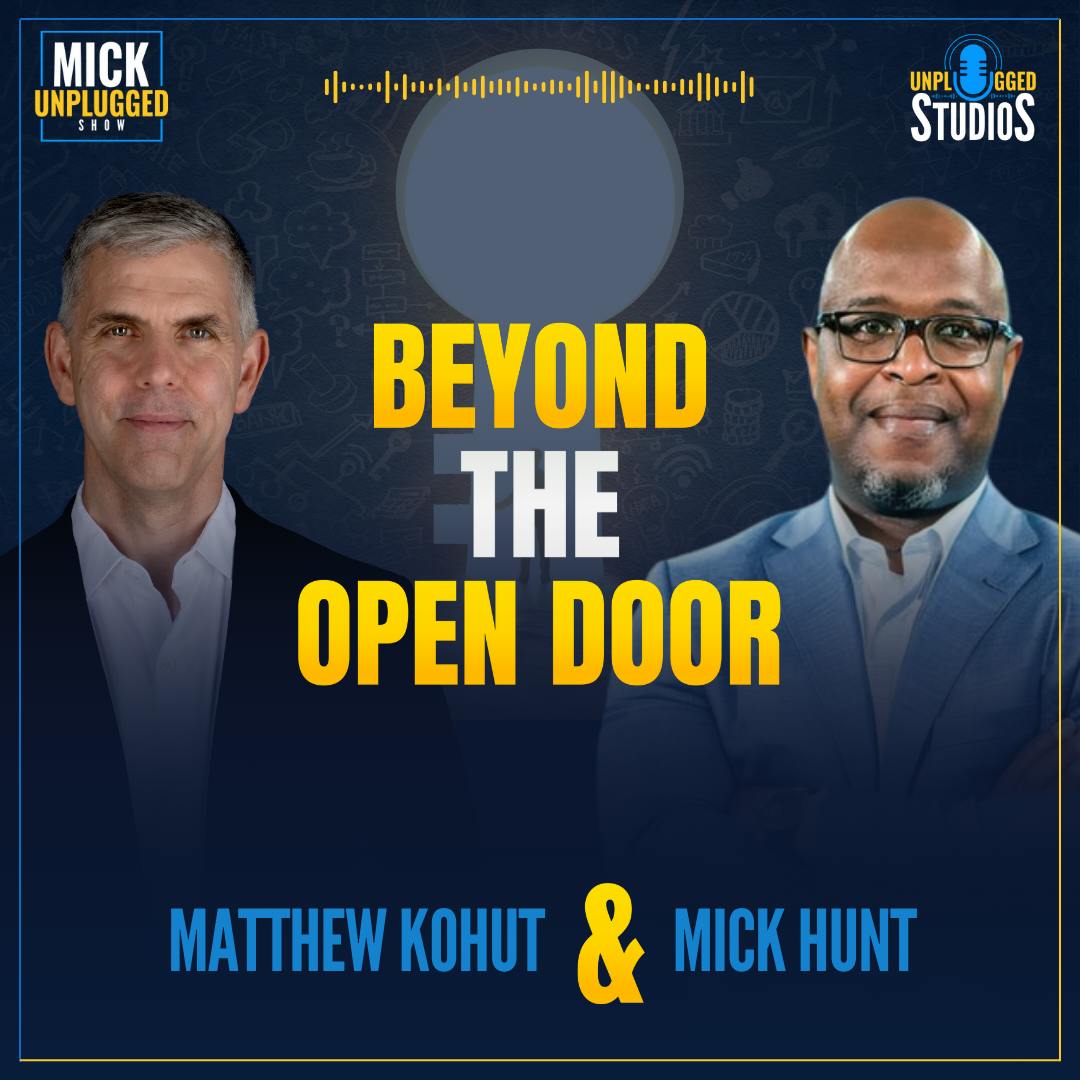
Loading summary
Transcript52 lines
- [00:00]
Mick
Because if you're present for your team, you don't need an open door policy because they see you.
- [00:05]
Matthew Kohut
You know, either you're there for people and they know they can have a direct line with you, or you're not. And yeah, I also think it's just not true. Usually.
- [00:18]
Podcast Intro
Welcome to Mick Unplugged, the number one podcast for self improvement, leadership and relentless growth. No fluff, no filters, just hard hitting truths, unstoppable strategies, and the mindset shifts that separate the best from the rest. Ready to break limits? Let's go.
- [00:42]
Mick
Ladies and gentlemen, welcome to another exciting episode of Mech Unplugged. And today's guest helps leaders speak with clarity when the world feels chaotic. He's coached presidential candidates, Fortune 500 CEOs, and TED speakers, and today he's here with us. Ladies and gentlemen, please help me in warming and welcoming my friend, Matthew Kohut. Matt, how you doing today, brother?
- [01:05]
Matthew Kohut
Very good, Mick. Thanks so much for having me.
- [01:07]
Mick
I am the honored one, brother. Been a huge follower of you for a while now. I think we connected virtually back in March, and ever since March, I've been going deep into all things Matt Kohep. Man. So one again, just honored to have you on the show.
- [01:23]
Matthew Kohut
Well, likewise. Right back at you.
- [01:25]
Mick
Good stuff. Well, Matt, you know, on Make Unplugged, the first question I love to ask is about your because. For me, it's that thing that's deeper than your why. It's the burning fuel that makes you deliver when you're supposed to deliver. So if I were to say for you today, Matt, what's your because? Why do you keep doing all the amazing things that you do?
- [01:44]
Matthew Kohut
For me, the because is communication is at the heart of everything that, that we do as human animals. It's how we get along with our friends, our family, our people. We work with the people who enable us to do the things that inspire us to reach whatever heights we're seeking to climb. And so communication gets me out of bed in the morning. Just the commitment to making people as good at it as they can possibly be is always something that makes me. It just hasn't. Hasn't bored me yet.
- [02:19]
Mick
I. I love that, man. When did that become or not not? When did it become? When did you realize that you had that gift? Because it is a gift that you have, dude, and, and it's something that obviously everyone needs. You've helped a ton of influential people along the way, but when did you know that that was a gift that you had?
- [02:38]
Matthew Kohut
You know, it emerged for Me, I. I don't want to make it sound like it was just something that I had. The same way that great athlete knows in high school, they've got this thing. I was a writer by training, if you will, first and foremost, and that came pretty naturally. But the thing that really changed that or shifted that for me was when I was sort of baby speechwriter for a couple of different folks. I knew a couple other speechwriters who were struggling, and we kept wondering, why are some people good at speaking? Why are other people struggling with it? And it led us on a little bit of a journey together to try and figure that out. And that mystery unlocked the bigger question of communication for me. You know, public speaking is one thing, and it's a very specific thing, but just more broadly, how we relate to each other through the way we talk to each other, it just became this lifelong interest. And the more I dug into it, the more I understood about it, of course, and the more I talked to hundreds and then thousands of people about their challenges with just became something that I got deep in, but it wasn't something that I innately knew I had a depth in.
- [03:53]
Mick
I like that, man. I like that. And I love the honesty in there, too, because most things that we're gifted at still takes time to develop into harness to where we can get to a level of greatness. Right. And so I appreciate the honesty there. You know, Matt, you've worked with a ton of leaders and speakers and coaches, and you name it, right? CEO, what's one habit or trait that you could say all great leaders have when it comes to communication?
- [04:24]
Matthew Kohut
Well, the ironic part is the great quality they have is they're great listeners. And it's not about what they say. It's about the fact that they listen first and they're really attentive to the people they're with. I'm sure you've had this experience a million times because of the caliber of the guests you attract. You get people who hang on your every word. You can tell they are the best listener. You know, one of the challenges I often, often offer to people is to try to be the best listener in the room. And not to make it a competition or anything, but what does it mean to be the best listener in any room that you're in? And look, if everybody's vying to be the best listener, that's a pretty good problem to have.
- [05:04]
Mick
No, totally agree. I mean, you know, when I work with leaders and we do work on emotional intelligence, I always tell them the first recipe to emotional intelligence is just listening. Right. Because if you're in your head or if you're trying to think of how a conversation should go or a decision that you should make, you shut down everything that the person or people in front of you are actually saying or trying to get across, even if they're not saying it verbally. Right. So you're right, like listening. And as my mentor Les Brown says, listen to the listening. Because everything that people say, say isn't verbal. Right. And so you've got to be very cerebral. And so again, one of the things that I know about you is just that, how emotional intelligence matters. But you're just also a very cerebral person. Again, I think that's why I connect.
- [05:52]
Matthew Kohut
With you well to a fault. You know, I find myself rerolled to the point where I think, wait, hey, get back in your body a little bit. Get out of your head. So, you know, sometimes you develop one thing to the detriment of the other.
- [06:06]
Mick
Yeah, yeah. You know, Matt, you're an amazing author, and we're going to get to your. Your new book, your latest book in a moment. But, you know, in compelling people and I have these notes written down. You know, you break down strength and warmth. How can modern leaders. Because, you know, I like speaking to the modern leader on the show. How can modern leaders find the right balance of. Of strength and warmth while they're under pressure?
- [06:31]
Matthew Kohut
Well, let me just give a little bit of a picture of what I call strength and warmth. So strength to me is the capability to get things done. And it can show up in a lot of different ways. It can be skill. It can be social skill. It can be anything that allows you to accomplish what you're trying to do. And it's usually a combination of competence and assertiveness. So it's not enough to just know stuff. You also have to be able to put yourself out there a little bit. It.
- [06:59]
Mick
Yeah.
- [07:00]
D
And it can be overwhelming to manage a business, especially when you're first starting out. Your to do list just keeps growing every day with new tasks, and that list can easily begin to overrun your life. Finding the right tool not only helps you out, but can simplify problems you haven't even encountered yet. And for millions of businesses, that tool is Shopify. Shopify is the commerce platform behind millions of businesses around the world and 10% of all e commerce in the US from household names like Mattel and Gymshark to brands just getting started with hundreds of ready to use templates, Shopify can help you easily build a Beautiful online store to match your brand's style. And best yet, Shopify is your commerce expert with world class expertise in everything from managing inventory to international shipping, to processing returns and beyond. If you're ready to sell, you're ready for Shopify. Turn your big business idea into with Shopify on your side, sign up for your $1 per month trial and start selling today at shopify.com realm. Go to shopify.com realm shopify.com realm.
- [08:18]
Matthew Kohut
That'S one of these judgments that people really prioritize when they're figuring out, hey, are you worth my time? Should I listen to you? Should follow you. But the other judgment, warmth is just as important. And I think this is one where it's really tricky sometimes to think about what does that look and feel like in a work setting, for instance, because warm sounds, well, warm, right. The way I define it is that you're showing people you share their concerns, their interests and their emotions, or at least you understand those things and you're accounting for them. You know, it's one thing to be really strong and all about yourself, and it's a very different one to show people that you are other centered as well and you can really put yourself in their shoes. And most of us tend to lead with one of these or the other as a default. The same way some people are lefty or righty, and the other hand's got to be reasonably coordinated. So you can pick things up with both, but one will always come more naturally. And so when I talk to people about this, I often say, you know, I describe what I think of as this strength axis or this warmth axis and say, which one of these comes more naturally to you? And invariably people know either they're a people person or they're kind of skill first. And then the question is, how do you strike the balance that your context requires of you? Because every context is different. You know, if you're a leader of a scientific organization, it's really different than if you're a leader in, say, a shipping company. And you know, you're talking to people differently. You're, you have different concerns and they're just different qualities that leaders need in different places. Leadership is so context specific. And I think you can look at great leaders and say the balance of strength and warmth that worked in one place absolutely wouldn't work in another.
- [10:03]
Mick
I love that and I love the story and the breakdown for the viewer. Listener right now, that's like, Matt, that sounds great. Strength and warmth. I know, I need it. What are some Practical pieces of advice from you, some pieces of wisdom from you of how they can get started, how they can start to recognize these things in their everyday leadership responsibilities.
- [10:25]
Matthew Kohut
Well, the first question I already mentioned, which is, which of these comes more naturally to you? Which one is there a little bit of a deficit in? And a couple of different ways to try and size this up. One is if you have friends or colleagues, people you trust, and you can have this conversation with them about, say, you know, I think I'm pretty good at this thing, but I might be lacking in that, obviously. It's great to get some feedback on that. Another thing, and this is going to sound a little crazy, but it's one of the best ways to see how you're doing is if you have a chance to record yourself. If you catch yourself in the wild on video and you see yourself as others see you, suddenly you realize, wait, I'm coming across like a Mack truck at people, or I'm coming across as a little uncertain and tentative or whatever it is that you're so specific challenges are. And that's a great way to try and get a read on how you're either combining that skill plus will on the strength axis or how you're demonstrating to other people you understand what matters to them rather than just your own concerns.
- [11:27]
Mick
I love that. I love that. So let's go to Speaking out, the new book, Man. Like, I want to get the backstory of what compelled you to write it, because me as a writer, you know, my first book is coming out later this fall. I saw that there was, like, a void in modern leadership. I felt like everything was antiquated, and we were telling really good stories from the past, and there was never a bridge to today. And so that compelled me to write. So for you, speaking out, like, what was the compelling reason that said, I've got to put this on paper?
- [12:01]
Matthew Kohut
Well, you know, I've been watching and studying how leaders in all sectors speak for 15 years or so. And at one point, I noticed that corporate leaders specifically were addressing political and social issues in a way that they never had when I was growing up. And I thought, this is a really interesting phenomenon. I had started a little bit of a folder for myself where I was just kind of keeping stuff in Evernote thinking. Huh, that's interesting. I've never seen a CEO say that. And this continued to grow or crest in some way over the 2010s. And finally, at some point, I saw, you know, people were writing about it here and there in an article in this thing or that thing. But I'd never seen anybody really try and unpack what was going on here about why corporate leaders were being asked to weigh in on these issues, why it might matter. You know, there's a compelling argument to say that they shouldn't. And I wanted to try and understand, is there a place for corporate leaders to talk about political and social issues? If so, when, why and how?
- [13:05]
Mick
I dig that. And you're so right. I mean, today when we talk about social and political issues, they're everywhere. Right. And people are able. Maybe I shouldn't say able. People can form their own opinions. Right. And so if you're the leader of a corporation, you've got social issues, political issues that can not saying that purposely maliciously, but can be divisive because they're in front of us for the first time. Where before, and I said this in a speech last week, a lot of people don't realize we used to get today's news tomorrow, Right? Right. Well, now we get today's news as it happens and it triggers any and everything that we do. So what's your advice, actually, to the leader that's seeing this for the first time, that doesn't understand how the world used to be, where you could take your time and prepare your team message and have a rally around, you know, an idea or a thought, where today something happens at lunch and you've got 100 people that have 100 different opinions and you as a leader have to control that a little bit?
- [14:11]
Matthew Kohut
Absolutely. Well, you have to do some really quick risk reward in your head when you're thinking about this, because you can really step in it when you're talking about a political or social issue in a way that can be very damaging to your reputation, to your leadership abilities, as well as to the organization and the company itself. So you have to do some pretty quick calculating and pedaling here. And I don't mean to sound so conniving by using the word calculating, but I mean, you need to do some quick thinking on your feet and say, who's the audience here that really needs to hear from me on this? Is it my employees? Is it my customers? Is it some other supplier? Is it some key stakeholder that really needs to know I've got their back here? And if that's the case, then you're probably going to find a place where there's a solid ground from which you can say something. But you also have to really quickly also say how. What are the 10 different ways this could blow up in my face and be clear about that. I mean, in reality, with the large Fortune 500 style company, this styro stuff is a team sport. Now, as you said, if you're at lunch with a bunch of people and there are a hundred people in the room, you could be put on the spot, of course.
- [15:24]
Mick
Right.
- [15:24]
Matthew Kohut
But as far as taking a position more broadly or what happens in your conversation with a journalist out at an outlet, that stuff is, you know, like I said, there are a whole lot of people informing you about that and giving you perspective on where the landmines are. But you do need to have that kind of nimble judgment. So when some reporter surprises you or somebody asks that question in all hands meeting, whether you're going to weigh in on it or not. And I think there are times where strategic silence is the right way to go and say, you know, this is not in our lane. We're focused on, here's our mission. And there are other times when you absolutely have to say to people, you know what, I hear you about this. We've got your back.
- [16:05]
Mick
Yeah, totally. And Matt, I know you like I work with Fortune 500, Fortune 100 companies, right? And there are times where there is a social stance or political stance that as leaders, we have to publicly have a position on. Right? Again, I'm not saying that every political or social stance, there needs to be a position, but there are some that do affect major corporations. And I don't think enough people understand that. Talk to us about that when there is, whether it's a social stance, political stance, or whatever, and that time is needed as the leader to have it. How do you coach leaders to take personal versus business? And sometimes those are polar opposites. Right. What's good for me personally might not be the best stance for the business. And how do you coach people through that? How do you coach leaders through that?
- [16:58]
Matthew Kohut
I do think it's really all about the. I mean, you have to be about the business first. When you're a corporate leader. I don't think there's any other way around that. You can have strong feelings about something, but you have to be thinking about. I mean, we're talking about Fortune 500, Fortune 100. These are companies that have shareholders and they have a fiduciary duty to the shareholders so that you can't ever walk away from thinking that way at the same time. I'll give you an example from not too distant history where we had the CEO of Dick's Sporting Goods after the mass shooting at Marjory Stone in high school back in, was it 27, 2017 or 2018? And we're not going to be carrying these kind of rifles anymore. And that was a deeply felt personal belief that was going to have an effect on sales, on an effect on the stock price. But he was going to sleep better knowing that he wasn't helping to make that kind of thing happen again. And so I think you can find examples all over the map of leaders who clearly would have steered clear of an issue like that that was going to have a detrimental effect on the business. And leaders who thought, you know what, every now and then you actually just need to plant your feet and take the stand and take the hit.
- [18:19]
Mick
That's deep. And I totally respect that as well too. Again, diving into speak out a little bit. You talk around clarity and decision making. You talk about how to use. These are my words, not the words of Matt, but I took it as using your voice as a leader as well too. What are some really good points that you want the listeners and viewers to. To take away from the book?
- [18:43]
Matthew Kohut
Well, I think that we mentioned one of them first, which is if you're the leader and you're thinking, do I say something? You do have to listen. You have to. So let's say it's your employees. I think that's really where this is most important, is you need to be willing to spend time just listening and not coming in with a point of view about something you don't know or haven't experienced in your own lived. You don't have the lived experience to understand what other people are going through. So that's a huge part of it. But then I also think being values driven is really critical here. So you know what the North Star is for your organization, you know why you do what you do, and you can articulate a position based in values. Now, values can sound to some people like some sort of feel good thing, but to me it's actually much more important than that. It's really the thing that allows you to say, this is why we do what we do. And then the cherry on top for me, and this is where I think you really separate the good from the great, is the great leader. If they're taking a position on something that's political or social, isn't just saying something. They're actually going to put their money where their mouth is and they're going to have some accountability steps for the organization. The organization is going to put their weight behind something or they're going to do something differently as a result of this. And not every issue lends itself to that. But when that is something that is part of the profile of the issue, either you do something or why. Why bother saying anything at all? Otherwise? It's just. It's pr.
- [20:13]
Mick
No, I. I totally believe that. And you segued into something. I was going to say also about the book, which is using communication as an accountability tool. Right. You talk a lot about accountability in the book. So for the listener, the viewer, and I don't care if you're seasoned or new. Like, how important is communication as an accountability component for your business as well, too, or for you as a leader?
- [20:38]
Matthew Kohut
Well, I think it's everything. I mean, ultimately, you stand behind what you say, and if people don't see that you do what you say or that you're gonna follow through, then ultimately your brand as a leader becomes hollow. Because it's one thing for you to say something, but then if you're always sort of whisked away onto the next thing thing, and they don't see the follow through, then you lose credibility. And it really comes down to that. And it's not just your credibility. It's the whole company's credibility as well.
- [21:11]
Mick
Yeah. Yeah. You know, Matt, you and I both are on this journey of modern leadership. Right. I think that there are a lot of outdated concepts or cliches that I want your help in debunking a few of these. Right.
- [21:25]
Matthew Kohut
Go for it.
- [21:26]
Mick
I'm going to start with this one. I hear a lot of leaders today in 2025 say, oh, I've got an open door policy. My challenge to that is, if you're not present, then what are you? Right. Because if you're present for your team, you don't need an open door policy because they see you. I love your take on that as well.
- [21:47]
Matthew Kohut
I love the way you're putting it. I can improve on that. I think that makes perfect sense. Ultimately, it comes back to what we said about listening again, you know, either you're there for people and they know they can have a direct line with you, or you're not. And, yeah, I also think it's just not true usually.
- [22:07]
Mick
Absolutely. Absolutely. A huge fan of your books. And so I'm going to use my next myth or challenge because your books are very easily read. And so my next thing is, you never have to tell people as a leader how smart you are, because to me, that becomes intimidating. Right. Like when you're using words just to tell people, you know, what those words mean, it's intimidating to the People that look to you as their leader. And I know from a communication standpoint that is also a thing never over talk or out talk the people that you are the leader of. So what's your take on that piece?
- [22:48]
Matthew Kohut
Well, first, thanks for the compliment. The greatest thing anyone ever said about one of my books was that it was short and fast to read and I thought I succeeded. But yeah, to your point, using the language of the people you talk to is critically important. And I think this is the warmth thing. That's the fundamental of warmth, is if you're not speaking their language, how can they possibly understand you? You might as well drop them into a foreign country and just start babbling at them. So the way I look at it is whether the language is simple or complex, generally simple is going to be the way to reach the largest group of people. But I also think that to your point, if you're using complex multisyllabic words, you're going to just seem more abstract. And that's just a little bit about the nature of English too, that we, you know, the words that are longer are the more abstract ones just because of the way the language is constructed. And so what you can do to try and use the short 12 syllable word makes a huge difference in terms of punch and impact in what you're saying. This is one of my favorite things to pick on when I see something that I know is written by ChatGPT because it's never in the short words. It's always in those long Latinate four syllable words.
- [24:00]
Mick
Absolutely, absolutely. Or in a world of.
- [24:05]
Matthew Kohut
Exactly.
- [24:07]
Mick
Absolutely, Matt. And then the last one isn't necessarily a myth to debunk. I just think it's a tip for the modern leader. I've studied a lot of great leaders in the history of the world, and I will say one of the things that from my viewpoint, all great leaders have done is they know their teams, their individuals better than those individuals know them from a business, from a relationship standpoint. And it goes back to a point that you made about communication, is you have to listen. So in order to know your team, you kind of got to talk to them, right? You kind of got to talk to them. And I think I see this with a lot of the Fortune 500 leaders that I work with. The moment that they realize five minute conversations with your team can go a long way, they break down a lot of walls and a lot of barriers. But again, I'd love your take on just getting to know your people as a strategy.
- [25:03]
Matthew Kohut
Oh, I couldn't agree more. I'm going to tell the story of one of my co authors in a book I wrote called the Smart. Co wrote called the Smart Miss. And my late co author and mentor Larry Pruszak was probably one of the world's leading authorities on the whole idea of knowledge in organizations. And he told me this story. It's apocryphal, but I know the person who this worked with, who, you know, actually had this happen. A knowledge expert was talking to the leader of a Japanese corporation, CEO of a large company there, a tech company back in the 80s 90s. And the leader gave this consultant carte blanche to spend time anywhere in this giant organization over a week to try and figure out how they could do better at sharing what they know to spark innovation across the organization. And after a week this guy comes for his little 15 minute chat with the CEO and he says more tea. And CEO said excuse me, Japan's a tea drinking culture. And what he meant was more conversations of the informal type that people have while they're taking their tea break. Yeah, and it's that exact same thing with the leader as well. It's breaking bread with people, it's having that cup of coffee and just getting to know people when they have their guard down a little bit. And there's no better way to do that than to break bread with people. So I think that this is a hugely valuable thing that a lot of leaders just kind of leave off the calendar and it's a real missed opportunity.
- [26:41]
Mick
Totally agree, Totally agree. Well Matt, I know you're, you're a busy individual. Where can people one purchase the book? I've, I've got your website so. I know, but I want you to give it and I'll make sure we have it in the show notes and description as well too.
- [26:56]
Matthew Kohut
Sure. Yeah. Well, matthewkohut.com is where everything is centered. But I'm in all the usual places as far as where you can find the book. It's at Amazon, Barnes and Noble, all the rest of the outlets, bookshop, et cetera. And look, I've really appreciated this conversation, Mick.
- [27:11]
Mick
Absolutely, Matt. And where can people find and follow you?
- [27:15]
Matthew Kohut
I'm on LinkedIn and Instagram and Blue sky and all the rest of those places.
- [27:20]
Mick
There you go. And again, we'll have links to all those in the show notes. Matt, brother, thank you so much for your time. Thank you for the wisdom and thanks for being a person. That inspired me as well too, brother. I really do mean that.
- [27:33]
Matthew Kohut
Oh, I really appreciate it. It's been super fun talking to you.
- [27:36]
Mick
You got it. And for all the viewers and listeners, remember your because is your superpower, Go unleash it.
- [27:43]
Podcast Intro
Thanks for tuning in to this episode of Mick Unplugged. If today hits you hard, then imagine what's next. Be sure to subscribe, rate and share this with someone who needs it. And most of all, make a plan and take action, because the next level is already waiting for you. Have a question or insight to share? Send us an email to hellocunplugged.com until next time, ask yourself how you can step up.