Loading summary
Transcript38 lines
- [00:01]
Progressive Insurance Announcer
Insurance isn't one size fits all. That's why customers have enjoyed Progressive's name your Price Tool for years now. With the Name youe Price Tool, you tell them what you want to pay and they'll show you options that fit your budget. So whether you're picking out your first policy or just looking for something that works better for you and your family, they make it easy to see your options. Visit progressive.com, find a rate that works for you with the name your price tool. Progressive Casualty Insurance Company and affiliates price and coverage match limited by state law.
- [00:32]
VRBO Advertiser
You know what they say. Early bird gets the ultimate vacation home. Book early and save over $120 with VRBO because early gets you closer to the action, whether it's waves lapping at the shore or snoozing in a hammock that overlooks, well, whatever you want it to. So you can all enjoy the payoff come summer with Vrbo's early booking deals. Rise and shine. Average savings $141. Select homes only.
- [01:02]
Mick Hunt
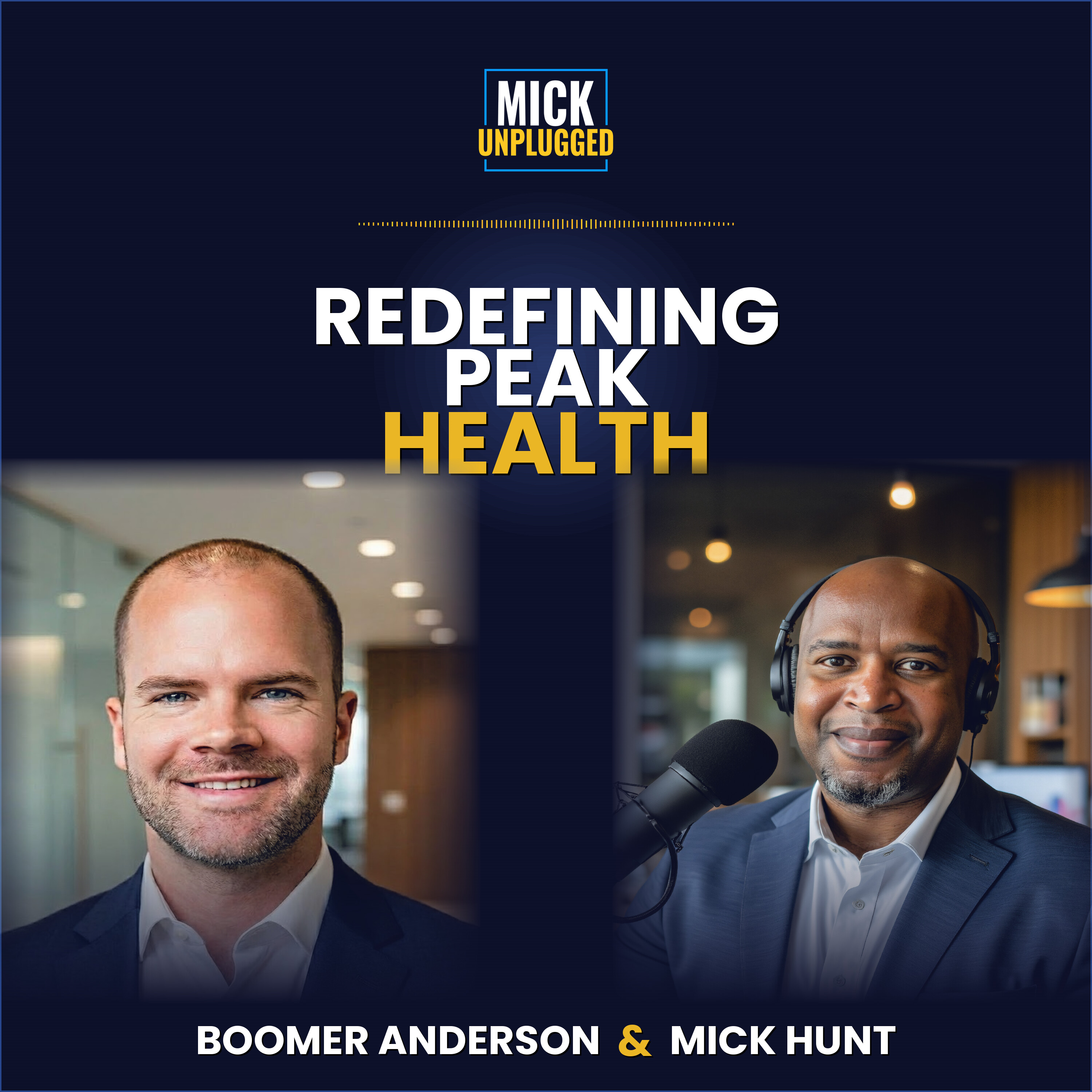
Ladies and gentlemen, welcome back to another exciting episode of MC Unplugged. And today we are joined by a transformative force in leadership and personal development. He is a true pioneer in blending peak performance with a holistic well being approach. I am truly honored to join a guy whose parents live just 45, 50 minutes away. So please join me in welcoming the insightful, the groundbreaking, the incomparable My guy, Mr. Boomer Anders.
- [01:30]
Rudy Rush
You're listening to Mick Unplugged, hosted by the one and only Mick Hunt. This is where purpose meets power and stories spark transformation. Mick takes you beyond the motivation and into meaning, helping you discover your because and becoming unstoppable. I'm Rudy Rush, and trust me, you're in the right place. Let's get Unplugged.
- [01:54]
Mick Hunt
Boomer. How you doing today, brother Mick?
- [01:55]
Boomer Anders
I. I'm doing so great, but like, that introduction was fantastic. I, I thank you for putting a smile on my face ear to ear. It's gonna really, really bring out my chipmunk cheeks today.
- [02:07]
Mick Hunt
That's what I am here for, I promise you. And ladies and gentlemen, I also have to let everyone know Boomer is going to be an expecting father, like literally any moment now. So if this episode is only 3, 3 minutes, it is because I am making him get off and go tend to his wife who might be screaming in the background.
- [02:28]
Boomer Anders
But boom, I hope that doesn't happen. But if, if it does and I sprint around, I sprint out. You'll know why. So, Mick. And again, thank you so much for having me here. It's going to be a lovely conversation, bro.
- [02:41]
Mick Hunt
I'm the honored one, Boomer. You know, on this show, I always start by asking my guest about their. Because that thing that's deeper than your why I call your because your true passion, your true purpose. And it changes from time to time, right. We all have different seasons. And so if I were to say Boomer right now, you know, early 2026, what is your.
- [03:04]
Boomer Anders
Because, brother, the through line for everything that I do is challenging the process. And if it's okay, I want to elaborate on that for a second.
- [03:13]
Mick Hunt
Absolutely.
- [03:14]
Boomer Anders
So if you read into my background, you'll see that I grew up the son of both a yoga teacher and a person who worked in operations and finance, went into investment banking and then had one of these hockey stick type type careers in investment banking. Decided at the age of 30, looking around and seeing everybody doing my job, was 60 years old, that I wanted to do something else. Left and ironically, as soon as I resigned, was serving out my resignation period and went in for a series of health tests. And at that moment, which was sort of the pivotal moment in the transition into this health world, I found out that I had cardiovascular disease at the age of 30, which is actually the leading preventable cause of death in the world. And what the doctors at that time asked of me was to take a statin, which again, I have nothing wrong. There's nothing wrong with the current healthcare system. I think it does some things well. I think health as its core is something that, like true health is not something that does well. But they asked me to take a statin and come back in 10 years, and that just didn't sit well with me and actually set me off on this exploration for what is health. And so that is really how the whole through line of challenging the process is kind of carried over from finance into health.
- [04:44]
Mick Hunt
My first question after your recalls was going to be, what was the catalyst of everything? And you know, because I do know your story, I'd love for you to go a little bit deeper, man. Take us to that moment of you sitting at the doctor and hearing that. Because I personally have tried to put myself in those shoes. Right. Because when you talk about hearing it and then taking a moment to understand the weight of what you really were just told, I don't think you gave that enough, enough impact, man. So I'd love for you to take a moment and just go to that impact.
- [05:21]
Boomer Anders
So the doctor, I was living in Singapore at the time and I'VE had the great fortune of living overseas for 14 years, have been to over 65 countries at this point, and done business in many of them. And I remember going into the doctor's office, and nobody expected this to happen. It was one of those things where I was doing CrossFit six times a week at that point. My goal was to really look good naked, right? And so I had sub 10% body fat. I wasn't really the archetype of what people think of when they think of cardiovascular disease. And so you can imagine I'm sitting there at the doctor's office, and the doctor's opening up these files. Doctor clearly hasn't looked at it, because I'm usually the patient that, like, a doctor can skip over because they know everything is fine. Right? And so he opens it up and he starts going through the test results. Okay, okay, okay. And then that. That page comes up, and I'll. I'll bleep myself here. But his reaction. His name's Dr. Steven Tucker. He's a still good friend, and he runs a great clinic in Singapore. Opens it up, flipping through. Okay, okay, okay. Looks at. He's like. Grabs his hair and looks at it and goes, holy. You know, expletive. You have calcium. And so for those people who aren't aware of this test, it's a coronary CT scan for calcium or cardiac CT scan for calcium. Basically, what it is is picture. It's a picture of your heart, and you're looking for the presence of calcium in your heart, which means that you have basically pierced the artery and caused an inflammatory reaction that has hardened over time and has narrowed your artery. Right. And so the technical term for this is atherosclerosis. And so when he grabs his hair like this. And at that time, I had hair, Mick. So it was like I did one of these things where I was like,
- [07:24]
Mick Hunt
oh, no, you followed what he's doing, right?
- [07:26]
Boomer Anders
Yeah. And so I don't know if people have ever experienced this feeling. I. Hopefully, if you've experienced this feeling, it's been in a good way, like going skydiving. But when the floor drops out and, like, everything kind of goes black in your peripheral vision, and you're like, whoa, oh, my God, what just happened here? And my initial reaction was like, how is this possible? Right? Because I was doing everything that society told me to do, Right. I was exercising. I'll get into why that might have been a problem. I was following whatever the diet of the day was. And if you follow Men's Health magazine, which don't get me wrong, like, it keeps people interested in health and I'm grateful that they publish it. But if you follow diet and exercise, that's health right there. And how did this happen? Floor drops out, peripheral blinders. Go on. And for the next almost six months, I want to say I just went into anything and everything that I could find, starting with cholesterol and then kind of winding my way around health. It actually led me to actually start podcasts because I, I started a podcast at that time. It was called Decoding Superhuman. And in all fairness, Mick, I started that podcast because I didn't want to pay for consults. But I wanted to ask people all these questions, these experts around the world who are doing this cutting edge research to try and figure out what went wrong. Because to me, nothing made sense. And that was really that moment for me. It was just like floor drops out, tunnel vision for at least the next six months. And ultimately it kind of led me to where I am today.
- [09:18]
Mick Hunt
I love it. And so you hit on something. I'm just going to keep going deeper with my guy Boomer. It's almost like we're teeing all of this up. So. Ah, I can't wait to hear this. Boomer, you're telling me I don't have to exercise anymore, bro? You said exercise was part of the problem. So I need the, I need this to be tuned in because you, you brought up Men's Health. And my best friend, celebrity chef Robert Irvine, is grace the COVID of Men's Health. He's told me I got to start exercising more. Boomer, go ahead and tell me I don't need to exercise anymore, brother.
- [09:47]
Boomer Anders
No, I can't tell you that. That's unfortunately, like, that would be the single worst health advice that anybody could give you is to like, not exercise anymore. Because exerc exercise itself has so many benefits, especially for mental health. It's one of those things that for, for depression and for particularly like I sit in the entrepreneurial world, a lot of my friends are entrepreneurs. Entrepreneur level mental health is a very big discussion that needs to see the, the light of day more. And that would be the worst recommendation in the world is to say, don't exercise. But I was exercising too much. So let's. Everybody who's listening to this. You can picture a bucket, right? And the bucket, you can pick your size of bucket. And the size of the bucket is ultimately determined by your resilience, right? But your, but it's the stress bucket. And you put in some stress, right? Stress can come from job. Hopefully it doesn't come from a relationship, but it can. Can come from the types of food you eat, the environment that you live in, that boss you have, et cetera. And your job is to manage that bucket so that it doesn't overflow. Exercise is also a stressor, and so it creates an inflammatory reaction in the body, generally speaking, a good one. But if your bucket is already full, and at this time, Mick, I was having panic attacks and issues that really showed that my stress bucket was more than full. It was actually broken. And if your stress bucket's overflowing, then things like exercise become a different discussion. So ultimately, one of my good friends, Marcus Philly, he talks to people about actually the recovery equals the stimulus. And so one of the things that I wasn't doing well then, diet, exercise was fine, wasn't sleeping well. I was out drinking five nights a week. I was traveling all around the world. Switching time zones is certainly a stressor to the system.
- [11:51]
Mick Hunt
Yeah.
- [11:52]
Boomer Anders
And so when I add on to that CrossFit high intensity interval training six times a week, you can see how very quickly my adrenals, my poor adrenals were, like, throwing the white flag way before this cardiovascular disease came up.
- [12:12]
Mick Hunt
Yeah, crazy, brother. Crazy. But everything's okay now, right?
- [12:18]
Boomer Anders
Everything's fine. Yeah. So the interesting thing about cardiovascular disease is that I now have a marker that I can point to. And with cardiovascular disease, if you get calcium, it generally progresses at 15 to 20% per year. If you do nothing. And that's a good progression. I'm stable at the levels where I was on that day. And so what that means is that I've sort of halted it. Cardiovascular disease is very, very hard to reverse. And so I'm working with some of the cutting edge scientists, researchers in the world to do that, but I've halted it. And I've now kind of rebuilt my life around the idea that the recovery equals the stimulus.
- [13:07]
Mick Hunt
That's great, brother. Well, again, learning a lot from you. And now I want to talk about Boomer Anderson, the. The leader, the. The change maker, all the great and amazing cool things that you're doing out here in the world. So, Boomer, like, you're known for dissecting, and this is why I love you so much, dissecting complex ideas into actionable insights. Right. I think today a lot of people look to be a thought leader, and it stays in thought. But you are a person who can take thought leadership, take ideas, and then give them out to people as actionable insights. Could you take a moment and just share a few things about the work that you do, the work that you're doing, and why it's important for everybody that's watching or listening. Real Talk I'm always on the move, always jumping on some airport wifi or hotel network without thinking twice. Then it hit me how exposed my passwords and banking information really were. And that is when I started using NordVPN. It locks down my data wherever I am, even on public wifi. It's the fastest VPN out there, no buffering when I'm streaming, and one account covers up to 10 devices and it's the price of a cup of coffee a month. Premium cybersecurity total no brainer. To get the best discount off your NORDVPN plan, go to nordvpn.com MCump Our link will also give you four extra months on the two year plan. There's no risk with Nord's 30 day money back guarantee. The link is in the podcast episode description box. Go check out nordvpn.com mcunplugged sure.
- [14:54]
Boomer Anders
So it goes back to that question that we talked about earlier, that sort of cruise that I've been on since of what is health? And that podcast that I mentioned that I started, it led me to meet a couple of doctors, Dr. Ted Achicoso, Dr. Scott Scher. And around that time they were putting together some things and it looked all really interesting and ultimately became our nonprofit. So our nonprofit is Health Optimization Medicine and practice there, we teach doctors and healthcare practitioners how to optimize for health rather than treat disease. One thing I said earlier was that healthcare itself right now is pretty good, but it's really good at disease management. If you are a type of person who's sitting there listening to this and saying, I have brain fog, my energy levels aren't great, I can't sleep very well. You need another role. You need another coach, if you will. And so what we do is we train those people. And so this has been both from my learnings, but also Dr. Ted has been practicing health optimization medicine for 20 years with some of the leading political figures both in the United States and the Philippines, as well as some political figures in Europe, as well as business owners, tycoons, those types of people. And so that framework answers the question, what is health? And so when people now ask me, what is health? I say, it's a simple algebraic equation. A plus B equals C. If I were to pull the sort of 8 billion people in this world, wherever we are right now, most people Would answer A, which A in this equation is absence of disease. That's great. B is balance of anabolic and catabolic processes in the body. You both grow and break down. But we want to make sure that those body's processes are in balance. And then C, we say it's through the life cycle of the organism. But what that means is really for the age you are right now. And then how do we get you, Mick, into optimal health or anybody listening to this? We take the age you are now, then we bring you back to what was the evolutionary optimized human ages 21 to 30. And so we look at things like biomarkers. And so hormone replacement therapy is a huge thing right now. But we take your hormones and we look at the entire hormone pathway rather than something like testosterone, and we take those levels and we try and bring you back to those optimal levels. Between the ages of 21 to 30, we do the same thing for other processes in the body and nutrients. So your vitamin B, C, D, all of that. And so what that does is it allows for your cell and we're just made up of trillions of cells to be optimized and balanced. And so then what actually happens is if you get the basic cell right, everything else that we call symptoms tend to fall away. And so that's really where health starts, is by getting that basic cell right. But you know, in order to do that and to work with a home hope practitioner, Health optimization medicine and practice is home hope. We usually say it takes about six to nine months to reach that level in the most diligent of patients. But Mick, if I tell you it takes six to nine months to reach those optimal levels, and then you say like, hey Boomer, I'm stressed today, what do I do? Or I can't sleep today, what can I do? We needed a solution for that too. And so that's how we started troscriptions. And so what troscriptions does, aside from being the number one donor to our nonprofit, you know, nonprofits need a support, right? Troscriptions actually builds products that solve common issues that come through healthcare practitioners door. Stress, sleep, focus. Who doesn't need help with focus these days? Immune system function. And so what we're doing at transcriptions is providing you that point in time solution so that you can work with your practitioner over those six to nine months to make the behavior changes and some of those nutrient changes that are needed so that you can live that more healthy, more health optimized life. So that's really the sum of what I do, I also see clients on the side because over this journey I've had a lot of friends. I call them the three Fs, right? Friends. Friends, family and freaks that have asked me like, hey, you've done this to yourself. Can you help me too? And you know, I love taking a really complex topic like biochemistry or even my previous life, finance, and saying, all right, you want to talk about the DVO1 of a swap, which is just an esoteric term that finance traders like to use. Well, here, let me break that down for you into something that's a little bit more digestible. And so that's really become my life's work.
- [20:05]
Mick Hunt
Amazing brother. And so proud of the work that you're doing, but more importantly, the impact that you're making. I don't want to gloss over that. I love giving people their kudos and their flowers when they're deserved and when they're earned. And you definitely have earned that, man, because you're a trailblazer in this. There's a lot of people that talk about, you know, what I'll call business wealth and business health. But you're someone that's making sure that it's there. And so I've wanted to ask you this question and I was going to send it to you on social media, but I knew that we were going to have a conversation soon. And it's for me, but it's also for entrepreneurs and CEOs like me. You know, we all have blind spots in the things that we do because we want to run hard and we've got problems to solve or revenue to go generate. And we always have the intent to have that slowdown moment. But if you're like me, it rarely happens. Right. Because the moment there's space on my calendar, it gets eaten up by something and then I'm continuous in this loop. What are some blind spots that me as a CEO, as an entrepreneur have? And what's one thing that I can do to make sure that I'm paying attention to my personal well being, which then affects my business health as well.
- [21:32]
Boomer Anders
Such a good question and I'm really glad you asked this. And I'm actually going to demonstrate this through roi, because business leaders, entrepreneurs can all sort of hone in on that topic, right?
- [21:50]
Mick Hunt
Yeah.
- [21:51]
Boomer Anders
So within the business community, when we're talking entrepreneurs, executives, anybody who's aspiring, ambitious, individual, there are two common issues that are usually the biggest blind spots. Number one is sleep and number two is stress. Number two usually feeds number one and so stress is ubiquitous. Now, if I could get everybody to reframe stress as a good thing in an instant like this would solve all the problems. But a lot of us don't see stress as a good thing. And it's very hard to. If I tell you to reframe something, it's very hard to make that instant change. Most people can't do that. So there needs to be one. An acknowledgement of stress, but also some practical steps to dealing with it. And so you asked me to give you one, I'm gonna give you two. Because I have to answer a sleep question. Number one is actually ending the day. And I talk about ending the day in particular. Cause it's gonna tie into our sleep recommendation. Ending the day with a gratitude practice. This is actually a mental reframe, right? Because you as a business owner, an entrepreneur, you are a professional problem solver. And every day you're getting hit with new events, new things that cause cortisol spikes in your body. Yes, cortisol gets demoned as the stress hormone. Has a lot of very practical aspects too. But you need to kind of reframe that mindset, especially going into the evening. So last hour before you go to bed, writing down five things that you're grateful for. This is actually something that Dan Sullivan teaches, right?
- [23:44]
Mick Hunt
We talk a lot about trends on this show and AI is the one that just won't quit. But here's the thing, talking about AI doesn't make you more productive. Actually putting it to work does. And that's what Zapier did for me. Zapier is an AI orchestration platform that connects top AI models like ChatGPT and Claude to the apps your team already uses. No coding, no IT bottleneck, no complexity. You just plug AI into your workflow wherever you need it. Whether that's enriching leads, coaching, sales reps, or automating tasks that used to eat your whole day. 3.4 million companies are already on it and they're running over 300 million AI tasks. This isn't hype, it's results. My team uses Zapier to connect the platforms we already use. Forms, CRMs, content, workflows, follow ups and more. It just runs in the background while we focus on leading. Join the 3.4 million companies already automating with Zapier and transform how you work with Zapier in AI. Get started for free by visiting zapier.com that's Z-A P I E R.com M I C K
- [25:01]
Progressive Insurance Announcer
this episode is brought to you By Progressive Insurance. Do you ever think about switching insurance companies to see if you could save some cash? Progressive makes it easy to see if you could save when you bundle your home and auto policies. Try it@progressive.com Progressive Casualty Insurance Company and affiliates. Potential savings will vary. Not available in all states.
- [25:22]
Boomer Anders
That actually happened throughout the day. Five good events. And you may say to yourself like, hey, I can't think of five good events. Sure you can. Right? You're still breathing. That's one. Number two, there's probably, look around your house. There's probably an object there that you worked your tail off for and was a reward. You know, you have this beautiful background, Mick. Like that is something that you worked your tail off for. That room that you're sitting in, right? You're grateful for that room. We can go through another like another three pretty easily. The place that you live in, the fact that you might have good relationships, the meeting that you had that day, something that you checked off your to do list that day. And there you have five. Because why do I start with stress? Because you start with stress an hour before time and all of a sudden I'm in a positive mindset going into sleep. Now here's the ROI component of this. They did a study a couple of years ago about the benefits of sleep and cognitive performance. You know, an entrepreneur is essentially a cognitive ninja or a cognitive athlete, right? And they looked at the cost of sleep deprivation versus somebody drinking beer. And so they looked at the brain waves of these two people. And it wasn't two people. It was actually done across a number of people. But they looked at the effects of sleep deprivation versus drinking beer. Getting six hours of sleep a night versus eight is the cognitive impact of drinking two to three 12 ounce beers. Imagine what that does to you. For certain people it actually unleashes a little bit of creativity. But if I take that all the way down to an all nighter, I didn't get to sleep last night. Just as an example, that's the equivalent of drinking 10 to 1212 ounce beers. Now there might have been a time in college where I could have done that, but I certainly wasn't functional and I certainly wouldn't want to run a business in that manner. So why do we as entrepreneurs sacrifice our sleep so easily? So if you can see the two recommendations that I'm making, it's actually this positive mindset going into sleep and then the recommendation on the back of the science. So you now see the ROI from a cognitive standpoint of getting sleep. If I Want to have my best brain, I need to dedicate those eight hours. So the actual recommendation around sleep is let's flip your schedule around in the sense that your day doesn't start with when you wake up in your morning routine. It actually starts with your evening routine. It's actually called the sleep anchoring technique. And so putting into your schedule, this is my hour wind down time. It starts with this gratitude. I perhaps mix in some chamomile tea. Maybe I take some troz with this. Maybe I'm reading a book that is not super cognitive load. Like you're not studying quantum physics at night. You're reading something that's more fiction and you're using that to anchor your day. And then your day really starts with sleep. You get those eight hours and then you as the entrepreneur go out and just absolutely rock the world because your brain is at its best performing state.
- [28:43]
Mick Hunt
Boomer, man, I feel like we've only been talking for a couple of minutes and I, I know we gotta, we gotta wrap up and we should probably, when the, the newborn is arrived and settled, we should probably do part two because I have several more questions and you're giving us a master class in, in, in our personal health and our business health as well too. And it is definitely needed, bro. Like, I want to thank you for the time that you've given us. If you're open to it, I would love to to do part two because yeah, I think we can go places for sure. Those insights were amazing. So I want to open up the floor for you really quick. Where can people find, follow, connect with you? What do you want people to do with you from here?
- [29:31]
Boomer Anders
So the companies that I mentioned, Troscriptions, as well as Home Hope, Troscriptions.com, it's also Troscriptions on every single social media channel. The reason why I point people there is not just because of our products, but we strive to provide the best health optimization education on the planet. And, and it's for free. So especially go and check out Troscription's YouTube channel. Dr. Scott, myself hope hosts an episode of something called don't look up on YouTube every week where we dive into topics like sleep, stress and certain more esoteric parts of health. And we're really trying to give you those science backed tips and tactics so that you can go out and implement them in the world. Home Hope is the nonprofit health optimization, medicine and practice. Mick, if you're around in October and want to come up to Chicago and join us, we have our annual conference. I'd love to have you there there. Anybody who wants to join, please feel free to reach out home hope.org you know, tickets are available. Again, a lot of education there that can be directly applicable to you and generating ROI for you and your business. For me, you can reach out to me on LinkedIn or @boomer Snh on any social media channel.
- [30:47]
Mick Hunt
I will personally make sure that we have links to everything in the show, notes in the descriptions. I'm also going to make sure that I am resharing some of the content that you have because it's amazing for sure. Everyone check out the socials, check out YouTube. There's a lot of really cool, valuable information that Boomer is sharing with his doctor with Dr. Scott. Like, it's an amazing, it's an amazing channel. You're going to take notes, I promise you. But more importantly, you're going to put things into your life immediately because it's all about action. Boomer brother, more than you know. I thank you. I'm honored and I will definitely see you in October and hopefully I see you before that in the Carolinas.
- [31:33]
Boomer Anders
Thank you. Mick, I really appreciate all the work that you're doing in the world and really bringing these points, these thought leaders and people who are really just on the cutting edge, doing great things and sharing it with your audience because it means a lot. Thank you.
- [31:51]
Mick Hunt
I appreciate you brother. And to all the viewers and listeners, remember your because is your superpower. Go unleash it.
- [31:59]
Rudy Rush
That's another powerful conversation on Mick Unplugged. If this episode moved you, and I'm sure it did, follow the show wherever you listen. Share it with someone who needs that spark and leave a review so more people can find there because I'm Rudy Rush and until next time, stay driven, stay focused and stay unplugged.
- [32:27]
Progressive Insurance Announcer
Insurance isn't one size fits all. That's why customers have enjoyed Progressives name your price tool for years now, with the name your price tool, you tell them what you want to pay and they'll show you options that fit your budget. So whether you're picking out your first policy or just looking for something that works better for you and your family, they make it easy to see your options. Visit progressive.com, find a rate that works for you with the name your price tool. Progressive Casualty Insurance company and affiliates price and coverage match limited by state law.