← Mick Unplugged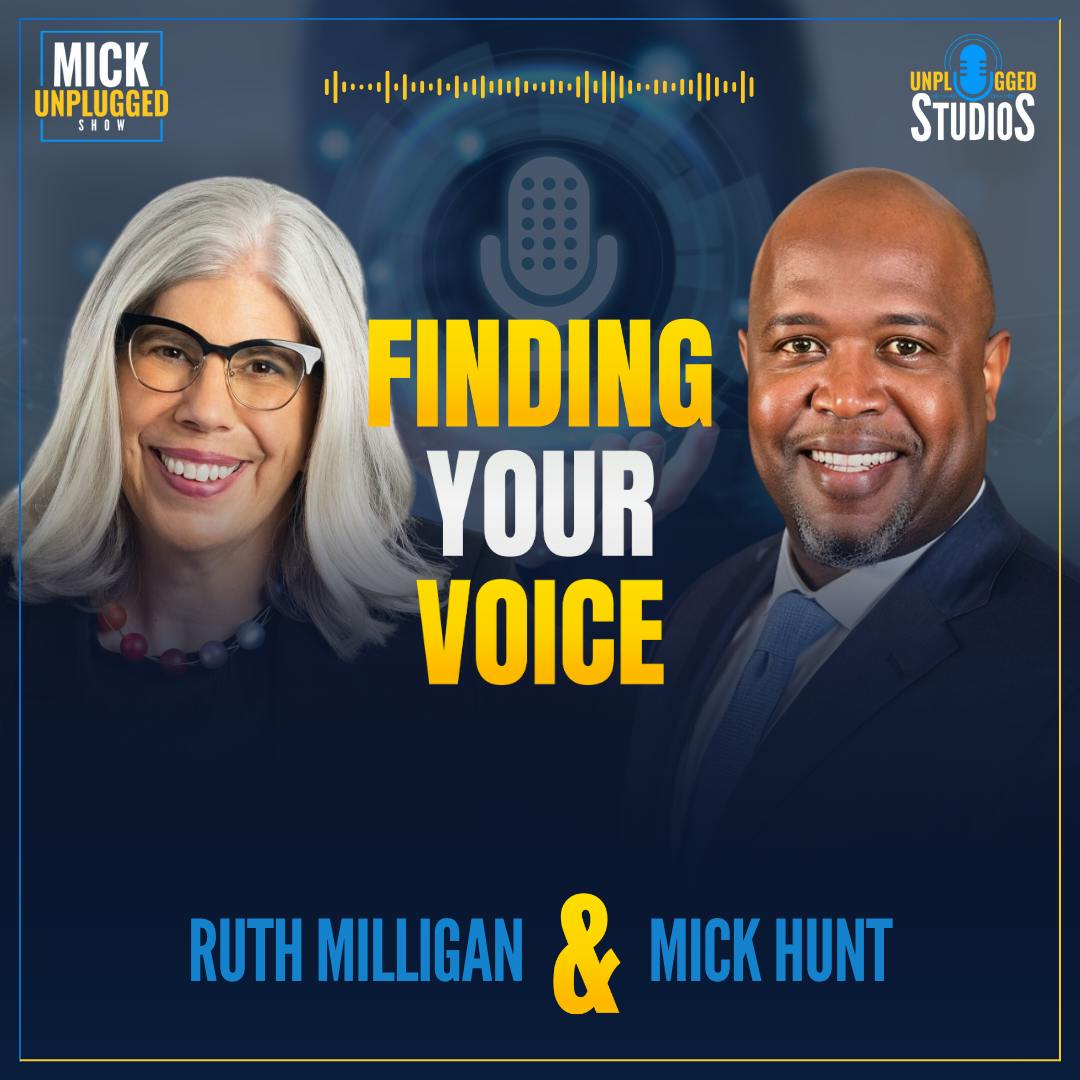
Loading summary
Transcript112 lines
- [00:00]
Ruth Milligan
There's no natural speaker, no one's born a speaker. Everyone is habitual. And if you are not a good speaker, you can become one. If you have a bad habit, you can work out of it.
- [00:14]
Mick
Welcome to Mick Unplugged, the number one podcast for self improvement, leadership and relentless growth. No fluff, no filters, just hard hitting truths, unstoppable strategies, and the mindset shifts that separate the best from the rest. Ready to break limits? Let's go.
- [00:40]
Ladies and gentlemen, welcome to another exciting episode of MC Unplugged. And today I have a brilliant storyteller to introduce you to. She's a TEDx veteran, a master storyteller and a coach shaping the voice of leaders around the world, from ideas to impact to from stages to boardrooms. She's a visionary, she's empowering, she's magnetic. She's a good friend of mine, Ms. Ruth Mulligan. Ruth, how are you doing today, dear?
- [01:07]
Ruth Milligan
Hi, Mick. I'm so good and really honored and delighted to be here. I can't wait to have our conversation.
- [01:14]
Mick
Well, I'm the honored one. You know, you are the master storyteller. And I think every story, as a fellow keynote speaker starts with what I call a the cause. That thing that's deeper than your. Why that thing that is really your true passion, your true purpose. And so I'd love to hear for the first time, Ruth Milligan, what's your. Because what keeps you doing what you do?
- [01:39]
Ruth Milligan
Because I really, truly believe that everyone has a voice and everyone has a story. That might sound trite, but it is true, very true. And everyone needs to practice for it to be heard.
- [02:00]
Mick
Totally agree.
- [02:01]
Ruth Milligan
And that doesn't go well alone. And we love to be the guide and the helper, the body double, the coach, the whatever you want to call us to support those who are trying to find their place in the world, in their lives, in their business. And it's a delight we dedicated the book that just came out to the speakers that we work with because that takes a lot of trust for them to let us into their worlds. And that all is my.
- [02:33]
Mick
Because I love that, Ruth, and I love how you broke that down. You know, as a speaker, as a coach, you see a lot, right? And you help transform a lot. And the reason I call you a master is because I know it's tough. You know, one of my mentors, you know, he calls me his son, I call him, my father is Les Brown. So like you, Les, you know, started his career in Ohio as well. Great storyteller. And Les the first lesson I ever got from Les is this. And I know you embody this. He said, mick, the key to speaking is this. Never tell a story without a point and never make a point without a story.
- [03:16]
Ruth Milligan
Love that.
- [03:17]
Mick
And if you can master that, oh, you'll speak forever and you'll be hired forever. Because so many people, when they go on stage, it's words. So, Ruth, for you, how do you help speakers transform what I'm going to call stories and points. Points and stories. Because that is something that you do brilliantly and you're one of the few people that I can actually listen to.
- [03:39]
Ruth Milligan
You're very kind and generous, but by the way, you really.
- [03:43]
Mick
I've seen a ton of your videos, I've seen a ton of your teachings and that's how I know that you.
- [03:48]
Ruth Milligan
Do that you do good research. So I always start with the points. The points are far outweigh the stories and they're very difficult to organize. Bring hierarchy, find the highest level meaning. And if I can get somebody, I did this yesterday on a call. There's a high, you know, I'm working generally in high stakes presentations, things with lots of consequence that could the consequences, how you define it. But it can go from a job interview, your first an interview for a scholarship in College, to a $5 billion contract. It's your definition of high stakes.
- [04:28]
Mick
Yeah.
- [04:29]
Ruth Milligan
And somebody had written out a script and I said, what are the three points? What's the one thing that you want to get across that's most important? And the sort of puzzled look comes and I said, how can we support that? And it becomes the shifting and organizing and debating. And I give people this visual which hopefully will help your listeners. I say, think of it like a family tree and there's a grandparent and that grandparent had three kids and those three kids might have had three kids on their own. And that's all. Those are the most number of points you're going to get.
- [05:04]
Mick
Yeah.
- [05:05]
Ruth Milligan
And that's the hardest part. Once we get through that mess, the rest of it starts to fill in the stories, then support those points. If I started with the story, I don't know where it's going to lead, then that doesn't work. So points first, then stories. I love that. And then some stories might be a metaphor, it might be a one line, it might be something longer. Stories can take on so many different shapes and sizes, so then there's not like a uniform, like every grandchild is the same size. And I want to make that point, but I don't have a story to go with it. So I might say this is. Mick and I are both published by the same publisher and their advice to me was, until publishing day, it's a sprint. And after publishing day, it's a marathon. And my publishing day was last week and I feel like I just started a marathon. That is a story of an author's journey. It doesn't have to be long. I don't agree when people say I don't have time to tell stories. That's just you don't have time to give yourself the freedom to think about them, to be vulnerable, to trust that your audience wants to hear them. So great. I love points and stories. That's terrific.
- [06:21]
Mick
I love it. And I want to go straight to the book. The Motivated Speaker. Yeah, right. The motivated Speaker.
- [06:29]
Ruth Milligan
That is you, Mick.
- [06:31]
Mick
Yes.
- [06:32]
Ruth Milligan
You are the ultimate. You are. It is not about motivational speaking.
- [06:36]
Mick
No.
- [06:37]
Ruth Milligan
This is about wanting to learn. That's what this book is about.
- [06:40]
Mick
Totally agree. And because I truly feel.
- [06:46]
Shopify Ad
It can be overwhelming to manage a business, especially when you're first starting out, your to do list just keeps growing every day with new tasks. And that list can easily begin to overrun your life. Finding the right tool not only helps you out, but can simplify problems you haven't even encountered yet. And for millions of businesses, that tool is Shopify. Shopify is the commerce platform behind millions of businesses around the world and 10% of all e commerce in the US from household names like Mattel and Gymshark to brands just getting started. With hundreds of ready to use templates, Shopify can help you easily build a beautiful online store to match your brand style. And best yet, Shopify is your commerce expert with world class expertise in everything from managing inventory to international shipping to processing returns and beyond. If you're ready to sell, you're ready for Shopify. Turn your big business idea into With Shopify on your side, sign up for your $1 per month trial and start selling today at shopify.com realm. Go to shopify.com realm shopify.com realm.
- [08:04]
Mick
Everyone may not be a keynote speaker.
- [08:06]
Ruth Milligan
No.
- [08:06]
Mick
Right. But everyone needs the skills of speaking. Whether you're doing presentations, sales calls, training your employees. Right. Everyone needs the skill of speaking. And I think that that's what this book truly delivers. Right. Like I would almost call it a blueprint in modern day form.
- [08:28]
Ruth Milligan
And may I quote you A blueprint. And I love that.
- [08:32]
Mick
A blueprint in modern day form. Absolutely, absolutely.
- [08:36]
Ruth Milligan
We, we sought that, so I think we did it. And what I love Most about our writing process is what is that? We didn't set out to write a book. We specifically set out to answer a question, how can we be better coaches to our speakers period? And we sought out a writing scholar who I knew from my alma mater, Miami University, who taught us the notion of threshold concepts, which are those troublesome recursive nudgy things that you have to push through in order to get to the learning. Remember like trying to learn calculus. And if you didn't get that one, really, I can't tell you what it is because I don't remember calculus. But those are the, the liminal spaces. They feel uncomfortable when you get there. You're like, oh, I don't want to be here. But when you get to the other side, you're forever changed.
- [09:30]
Mick
Yeah.
- [09:30]
Ruth Milligan
And we went and asked, had anyone written those or named them for speaking, for learning to speak. And that's what the book ended up being because we, we spent a year writing, blogging, thinking about what were the calls that we'd get from people that didn't do well and were they, what were they missing along the way?
- [09:51]
Mick
Yeah.
- [09:51]
Ruth Milligan
And so those are the six principles. And then we put a modern day blueprint in the back of every skill that you need to learn to speak. So if you were a fifth grader and you were 10 years old and I had a fifth grader start to read the book last week with a highlighter. Somebody who got the book at the event and sent me a picture the next morning of her daughter who was there. And I got on stage and I said this book is meant to be read with a highlighter and post it notes. And she said, mom, look, I'm on page 25 and I've already highlighted the things I want to remember. This book is for her. It's also for the 65 year old who's starting a consulting practice in their semi retirement. I have a client like that who's learning about what she needs to know about speaking that she never learned. So it, it is at its heart a self help book that reads like a novel. As someone else said, I love that. So stories and points. We have three different voices of stories in there from our three coaches and then we have a collective voice of perspective and tips and advice that we have spent the better part of 15 years assembling. So we come to this place honestly, I love it.
- [11:07]
Mick
So I want to go into some of the principles in the book and oh, by the way, Ruth doesn't know this and those that my, my Avid followers and listeners know. I always do this when I have a great book that I specifically endorse. If you message me, and it's gotta be the first 10 people message me, motivated speaker, I don't care what platform, LinkedIn, Instagram, whatever. And I am gonna go send you a copy of the book. So, ruth, I'm buying 10 copies or I'm gonna buy 20 copies. I'm giving 10 away to the listeners and viewers, and I'm gonna give 10 to some of my family that.
- [11:38]
Ruth Milligan
And I'm gonna send you 10 of those myself.
- [11:42]
Mick
Well, I'm purchasing. I'm purchasing 20, so if 30 show up, 30 show up, but I'm purchasing 20.
- [11:49]
Ruth Milligan
You are. You're a hero. That sounds great. We, we want as many people to be able to get it as possible. For sure.
- [11:55]
Mick
Perfect. So let's talk about some of the principles. What do people that are. I'm going to say, truly speaking, just because you've been on a stage also doesn't mean that you're a speaker. So I'm going to debunk some myths right now and hurt some feelings. Just get you on the stage doesn't mean that you.
- [12:11]
Ruth Milligan
Some feelings need to be heard.
- [12:13]
Mick
Right?
- [12:14]
Ruth Milligan
Right.
- [12:15]
Mick
What are a couple of key things that people that want to speak, that want to improve their speaking, or that just want to get started. What are a couple of things from Ruth the expert that they need to incorporate now?
- [12:31]
Ruth Milligan
So I think it would be who of us, And I'm happy to run through them. And I'm going to hit all six, but very quickly, and I will tell you the top two of the six.
- [12:41]
Mick
Okay?
- [12:42]
Ruth Milligan
And the top two are the first one and the last one. So you have to listen all the way through. The first one is there's no natural speaker. No one's born a speaker. Everyone is habitual. And if you are not a good speaker, you can become one. If you have a bad habit, you can work out of it. So that's number one. Number two, speaking is embodied, by the way. This is not embodied. Imagine how much energy I was expending being who I thought I had. That's reading someone's written word, right? Comes through eye contact, body, hand gestures, our soma, our bones, our energy, our space. You know, how we, how we move in space. Speaking is embodied. Number three, speaking comes in many genres. This is a genre. I know that you and I are set up to have a conversation. This is not meant for me to come on here and monologue to you. A panel should be a Dialogue, not a monologue, often isn't. A keynote has a genre. An interview has a genre. And if you're not ruthlessly interrogating them, I say that. Pun intended.
- [13:59]
Mick
No pun. You're right.
- [14:02]
Ruth Milligan
Then you're going to miss something. You're going to not read the room. You're not going to know how long to go. You're not going to know what kind of seat you're in. Right. So speaking comes in many genres. Speaking is social. And we have. We can edit that out. Speaking is social. Our audiences make meaning of our words. You start talking jargon to an audience that doesn't get the jargon, they're not going to listen to you. It is fleeting. Actually, one of my childhood friends posted on. On LinkedIn this morning one sentence from the book that struck her most. She was the former CIO of Ohio State. She's big brain speaking. They will forget the words. And this is sort of the Maya Angelou quote. Right. But it's because. Because speaking is fleeting. We don't actually remember what you said.
- [14:58]
Mick
Right.
- [14:59]
Ruth Milligan
So we have to really think about the impact we want to make. Speaking is, of course, there's always one that I'm. That I always sort of gloss over. It's funny. But the last one. I'll come back. The last one, the most important one is speaking requires feedback.
- [15:19]
Mick
Yes.
- [15:20]
Ruth Milligan
And your own.
- [15:21]
Mick
Yes.
- [15:23]
Ruth Milligan
Or the bookmark that we had made said, you think speaking public. Speaking is hard. Imagine trying to watch yourself on a recording. That's harder.
- [15:34]
Mick
Yeah.
- [15:35]
Ruth Milligan
We are really reluctant to listen to ourselves speak. Now, as a podcast host, you do all the time. So you catch things in your edits and review that have made you a better speaker. Naturally. Even though I said speaking isn't natural, but the process of listening to yourself. I had a speaker not want to listen to themselves and refused then in that moment to not learn and not get better. It's so painful. But one minute of listening to yourself puts yourself in the audience, and all of a sudden you're like, wait, do I want to be listening to myself? Yeah, I don't think so.
- [16:15]
Mick
Right.
- [16:15]
Ruth Milligan
So the first one and the last one are definitely the most important. Speaking is habitual. Speaking requires feedback. And, oh, speaking is messy. That's the last one. There's always something we forget. Speaking is messy. And this goes back to the points. There's a messy middle in every talk we give. We think we know what we're going to say, and we think we're. And then all of a sudden we have to switch it's like a train track. We have to switch over to a different lane. And we have to be willing to be uncomfortable and wrong and we have to be willing not to be perfect the first time we try. And when you are willing to do that, then it'll flow and you run it by people, the right people with the right feedback. Speaking is messy and sometimes we forget things. Anyway, those are the six. It's as fast as I can do them. We are unpacked, each one of those with sub points and lots of stories. But we tuck those stories in once the six were finished. So back to your point.
- [17:12]
Mick
No, I love that, Ruth, because I tell people the same thing. I don't call it messy. And so I'm not gonna take that because it's yours. I always tell people that speaking is complex, but to your point, you've got to practice and you got to rehearse. And I know it's boring, right?
- [17:29]
Ruth Milligan
Yes.
- [17:30]
Mick
But this is why you have to do it, because you've got to feel the audience. Right. If there's one thing that I learned from. There's many things I learned from Les Brown. But if there's an important piece, it's listen to the listening.
- [17:43]
Ruth Milligan
Yes.
- [17:43]
Mick
And he says that's where speakers go wrong. Because you've got this point that you want to make, right. And maybe in your mind, what if.
- [17:50]
Ruth Milligan
You'Re making that point and we can see each other?
- [17:54]
Mick
Yeah, yeah, exactly.
- [17:57]
Ruth Milligan
By the way, we can't. Or the listeners can't see that unless they're watching the video. But my daughter is two years older than my son and my son will start talking about something very nerdy and she won't say anything. She'll just put her head. She'll just put her head back.
- [18:12]
Mick
Right.
- [18:14]
Ruth Milligan
It's hilarious. She won't even say anything to him, like, I'm not listening. She just tells him through her nonverbals, I'm not listening. And if he, if he misses it, it's even funnier, right? We have to speak. We have to listen to the listening, or speak to the listening, as we like to say. We have to address it. I need to say, Mick, is that point making it for you? Because it sounds like it might be bored or you're distracted or are you texting for dinner?
- [18:39]
Mick
No, exactly. And what I got from Les is this, right, you've got maybe four points that you want to make in a 30 minute keynote, right?
- [18:50]
Ruth Milligan
Yeah, maybe.
- [18:51]
Mick
But if the listening says that point one is the point, then you've got to know all right, I'm only going to get to three points. And the point that I'm making here is this. You've got to know how to tell your point or get to your point in a 60 second version.
- [19:08]
Ruth Milligan
Yes.
- [19:09]
Mick
A three minute version, a seven minute version. Because when you're listening to the listening, you never know where that's going to go. And I, you know, I have a lot of friends that are comedians and they do the same thing, right? Like this joke might not be hitting and I need to know how to wrap it up in 60 seconds or the audience is loving this joke. How can I keep hammering this joke over and over again? And now it's a five minute bit. But from a speaker's perspective, that should be the best feeling. When what you thought was gonna be a three minute point, you can feel the audience. And now you can go places and make that point. Five, seven, ten minutes. And now you're engaged, they're engaged. And you just had an impactful keynote, but you rehearsed it, you practiced it going back to your point. It's complex. It's never the same. I can take the same keynote, Ruth, and do that keynote 15 different ways because of the audience listening or the audience reaction.
- [20:08]
Ruth Milligan
And it's also, who came before you and did you have coffee or not? Is it after lunch? Like, there's so many environmental things that you have to take into consideration. Hey, Mick, can I run my one sentence keynote promise by you?
- [20:21]
Mick
Let's do it.
- [20:23]
Ruth Milligan
Somebody taught me early in my career that you don't have a keynote unless you have a promise. What do I promise? To leave you. So we've been working on, what is that thing that we would say or, you know, it's because nobody wants to, like, be lectured about the threshold concepts. They are important to read and digest. So here it goes. Let's see if I can get it down. In every situation when you're speaking, there's something you do that's a little annoying. Could be a filler word, might talk on too long, talk too fast, not read the room. I call that a shaded habit. Not a habit in the shadows, but something that's everyone can see, it's just a little muted. And everyone goes, yeah, that's just Mick. But the minute you move to something illuminated, an executive presentation, a board presentation, a keynote stage, a very big business pitch, there's no more shade. And that carries with you and now becomes a risk of them not hearing you, of them getting in your own way of your message. And it's My presumption that everyone's got at least one shaded habit. And so in the next, in our keynotes, we invite people and we tell a few stories to get them thinking and then we invite them to whiteboard. And I did it last night and I had a hundred habits on a whiteboard behind me within like a minute and a half. And we see kind of by a vote which one is the most pervasive in the room. And then we go there and we work on it.
- [22:05]
Mick
Wow.
- [22:05]
Ruth Milligan
What do you think?
- [22:07]
Mick
That's amazing. That's why you're brilliant, Ruth.
- [22:09]
Ruth Milligan
Oh, I'm not brilliant, but we've been working. That took a lot of mess to get to. As a demonstration for your listeners, we started in many different places. How do you actually take 240 pages of content and distill it down that makes it relevant in a live setting? Just hard. It's really hard. But we're excited about that and hopefully that struck a chord with you.
- [22:34]
Mick
It did, it did, Ruth. And I know we're short on time, but goodness, I could talk to you forever. Really quick.
- [22:41]
Ruth Milligan
We can do part two if you want.
- [22:43]
Mick
We're definitely going to do part two because we haven't even talked about TedX Columbus and all the amazing cool things you're doing with TEDx and all of that.
- [22:50]
Ruth Milligan
Not that I used to. I did, I did officially retire. I don't know how many others have retired, but we had to give it up in Covid. I did it for 2009 to 2021.
- [23:00]
Mick
Yeah, yeah.
- [23:01]
Ruth Milligan
And I would be delighted to come back and it's still going strong, but it was the seminal moment for me in shifting my business to doing this work.
- [23:11]
Mick
Cool. Well, that's going to segue into my top five with Ruth.
- [23:14]
Ruth Milligan
Okay, here we go.
- [23:15]
Mick
This is my quick five 1. What is your favorite TEDx talk of all time?
- [23:22]
Ruth Milligan
Oh, you gotta, you gotta cut this out. I'm just, I. There's three and I want to give the one. It's. Oh my gosh. The lawyer. The African American lawyer. Help me out, Brian Stevenson. My favorite talk of all time is Bryan Stevenson.
- [23:45]
Mick
Bryan Stevenson. Got it. Love it. We're going to follow up on that one on part two.
- [23:49]
Ruth Milligan
Yes.
- [23:50]
Mick
What is your go to ritual before stepping on stage?
- [23:54]
Ruth Milligan
It starts several weeks before and the exact moments before is I put my notes down and I tell myself I got this.
- [24:03]
Mick
Love it. Love it. What's the most surprising lesson you've learned as a coach?
- [24:10]
Ruth Milligan
That I have to go to where people are, but keep in Mind where I want them to be.
- [24:16]
Mick
I like that.
- [24:17]
Ruth Milligan
That was an early hard lesson. I have this expectation. I want them to be here. It may take us seven steps when I thought it would only take two.
- [24:26]
Mick
I love that.
- [24:27]
Ruth Milligan
And my clients now tell me, trust Ruth and trust the process. Like, they'll say, you know, go work with Ruth. I'll get invited to another team. And they'll say, just trust the process. Because I have come to believe that everyone will get there, but maybe at different speeds and different paces. So that was. That was. That's been everything for me. Mick is realizing that everyone's got a different pathway, But I can keep in mind what I need them to do at the end.
- [24:55]
Mick
Describe Ruth. Describe Ruth in one word, full. Ooh, I like that.
- [25:05]
Ruth Milligan
I have had a full life. I have. I'm full of ideas. I have full expectations for people. I feel very full in my privilege and my opportunities, and I'm full of family. I just feel right now, at least in this moment in my life, I'm an author now. My children are both in college. Paid off my house. I feel full.
- [25:28]
Mick
I love that. I love that. And then the last one. Where do you want people to go buy this book?
- [25:35]
Ruth Milligan
It's kind of a tricky question today. For purposes of reviews, I would like you to buy it on Amazon and I would like you to buy. I would like you to review it.
- [25:46]
Mick
All right.
- [25:47]
Ruth Milligan
I'm a big independent bookstore person, though, so go find. Go ask your independent bookstore and support them through bookshop. I'm, you know, I'm a little torn because the book industry creates a little bit of tension, but it's on all the channels and TheMotivatedSpeaker.com will take you there.
- [26:05]
Mick
TheMotivatedSpeaker.com I'm going to have that in the show. Notes in the description. Ladies and gentlemen, this is my good friend Ruth Milligan. Ruth, thank you so much for your time today. You mean the world to me, so thank you, Mick.
- [26:17]
Ruth Milligan
Thank you. What a delight. Thank you so much for having me on.
- [26:21]
Mick
You got it. To all the viewers and listeners, remember your because is your superpower. Go unleash it.
- [26:30]
Thanks for tuning in to this episode of Mick Unplugged. If today hits you hard, then imagine what's next. Be sure to subscribe, rate and share this with someone who needs it. And most of all, make a plan and take action, because the next level is already waiting for you. Have a question or insight to share, send us an email to hello, ickunplugged.com until next time, ask yourself how you can step up.