← Mick Unplugged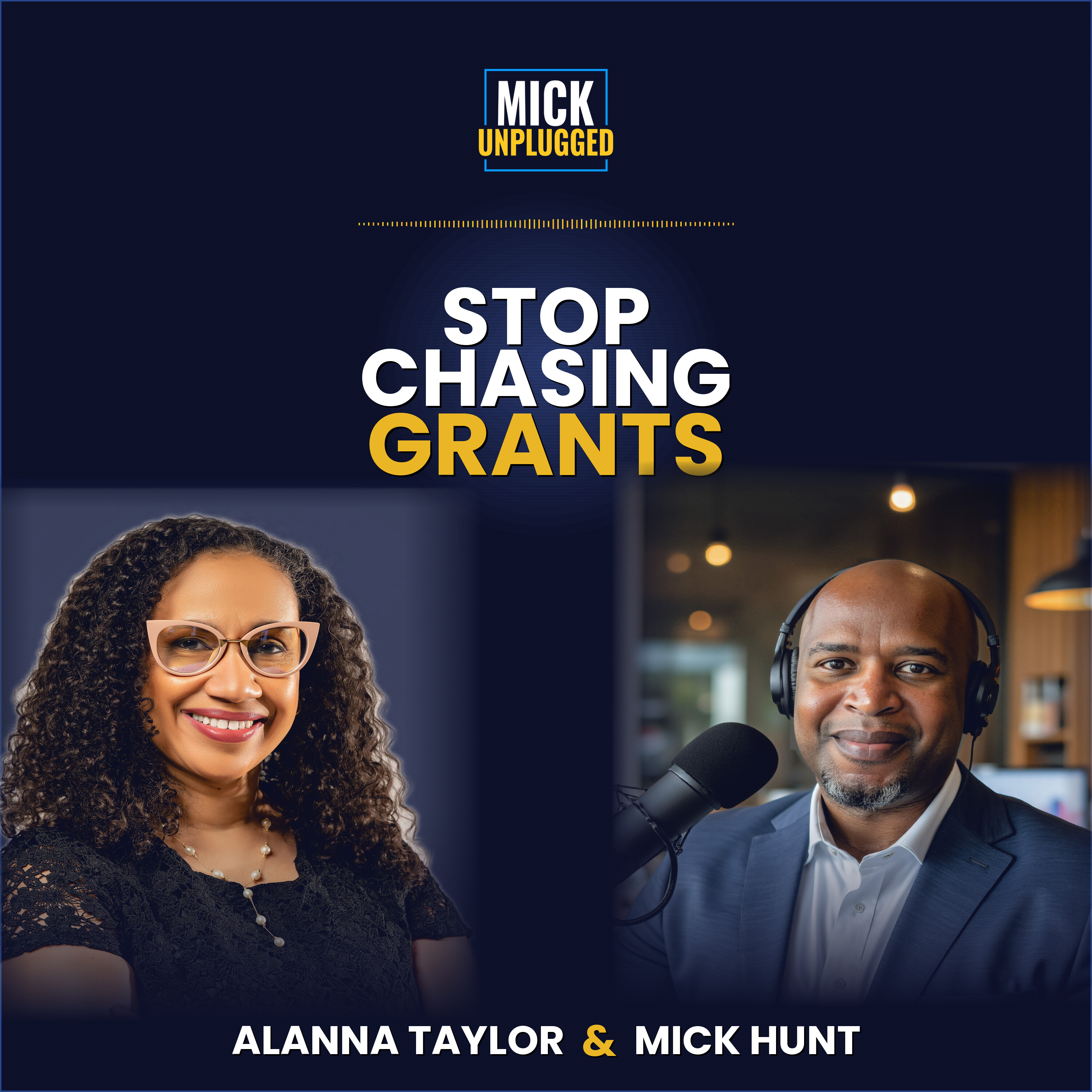
Loading summary
Transcript48 lines
- [00:01]
VRBO Announcer
You know what they say. Early bird gets the ultimate vacation home. Book early and save over $120 with VRBO because early gets you closer to the action, whether it's waves lapping at the shore or snoozing in a hammock that overlooks. Well, whatever you want it to. So you can all enjoy the payoff come summer with Vrbo's early booking deals. Rise and shine. Average savings, $141. Select homes only.
- [00:31]
Rudy Rush
You're listening to Mick Unplugged, hosted by the one and only Mick Hunt. This is where purpose meets power. And stories spark transformation. Mick takes you beyond the motivation and into meaning, helping you discover your because and becoming unstoppable. I'm Rudy Rush, and trust me, you're in the right place. Let's get unplugged.
- [00:55]
MC Unplugged Host
Ladies and gentlemen, welcome back to another
- [00:56]
Mick Hunt
exciting episode of MC Unplugged. And today we are joined by a visionary leader and a strategic architect who
- [01:03]
MC Unplugged Host
has spent three decades transforming bold ideas into fundable realities. With a staggering 60% plus grant win rate and over a million dollars raised
- [01:15]
Mick Hunt
annually for her clients, she is a nationally respected expert in program design, funding and sustainable growth for mission driven organizations. It is my distinct honor and pleasure
- [01:26]
MC Unplugged Host
to welcome the transformative, the strategic, the
- [01:29]
Mick Hunt
unparalleled, Ms. Alana Taylor. Ms. Taylor, how are you doing today, dear?
- [01:33]
Alana Taylor
I'm doing great. How are you?
- [01:34]
Mick Hunt
I am doing amazing now that I am here with you. You know, we met like a year ago, right, with Dr. Danielle, amazing leader herself. Puts on amazing events for a lot of people and. And you and I like, instantly connected, right? Like we were talking about, you know, our backgrounds and talking about life in general and our faith that kind of brought us together. So I'm honored that we can sit here and have a few moments together.
- [02:01]
Alana Taylor
Thank you for having me.
- [02:02]
Mick Hunt
Absolutely, absolutely. So, you know, I ask all my guests this question about your. Because that thing that's deeper than your why, like your true mission and all the things that you're doing with granted success. If I were to ask you today what's your because why do you keep doing what you do?
- [02:20]
Alana Taylor
I believe in the missions of the organizations I work with. Just about all of them are black centered, black run nonprofit organizations. My recent client list is really black women executive directors. I actually do screenshots of the Zoom meetings where it's just all black women on the screen. And I would say that's my. Because it's is really meeting the needs of black women who are in the nonprofit space very Few are executive directors. And when they are executive directors, many of them are founders of the nonprofit. For whatever reason, they position themselves as the executive director. That's a whole nother podcast. And then a disproportionate number of them get terminated by their board. So, yeah, so I'm really. My. Because black women that are in the nonprofit space, I love it.
- [03:12]
Mick Hunt
I love it. And I know you said this is for a different podcast, but I'd love to go there and have that conversation because you just said something that I want everybody that's watching to pay attention to. So you found this nonprofit, meaning you started this nonprofit. You then put yourself as the executive director.
- [03:30]
MC Unplugged Host
Things don't go so well, and the
- [03:31]
Mick Hunt
board's like, you're out. You're out of the business that you started. Right, right. Talk to us about that. I, I want to get to the brevity of that, of that topic.
- [03:41]
Alana Taylor
So what I'm finding is that because there's a need for a paycheck, many founders of nonprofits will position themselves as the executive director, and a disproportionate number of them will be black women. So a lot of times with founders of other races, they'll position themselves as a founder and then get on the board, and then they hire the executive director. They, they work to hire the staff. We, for whatever reason, we position ourselves to be the executive director and we create our boss. That's the board. So what I found is that many of the black centered, black run nonprofit school that are run by a black professional, a black executive director, they, hi. They put friends and family on the board. See that, that's getting around like, okay, it's know I'm not going to get fired. But then you stack the board with people who, they're there in name only. They're not going to raise money, they're not going to help with structuring the vision and the mission of the nonprofit. So then your nonprofit, you know, it ekes along not having a substantial budget.
- [04:48]
MC Unplugged Host
We talk a lot about trends on this show, and AI is the one that just won't quit. But here's the thing. Talking about AI doesn't make you more productive.
- [04:57]
Mick Hunt
Actually putting it to work does.
- [04:59]
MC Unplugged Host
And that's what Zapier did for me. Zapier is an AI orchestration platform that connects top AI models like ChatGPT and Claude to the apps your team already uses. No coding, no IT bottleneck, no complexity. You just plug AI into your workflow wherever you need it, whether that's enriching leads, coaching sales reps, or automating tasks that used to eat your whole day. 3.4 million companies are already on it and they're running over 300 million AI tasks. This isn't hype, it's results. My team uses Zapier to connect the platforms we Already use forms, CRMs, content, workflows, follow ups and more. It just runs in the background while we focus on leading. Join the 3.4 million companies already automating with Zapier and transform how you work with Zapier and AI. Get started for free by visiting zapier.com Mick that's Z-A P I E R.com Mik
- [06:05]
Alana Taylor
so you have this catch 22 here where it's like, yeah, you're not going to get fired, but then you don't have a strong board. And then if you do build up your board many times, you're going to end up putting people on your board who don't look like you. And before you know it, you could get pushed out of your position as executive director.
- [06:24]
Mick Hunt
And you're seeing that happen more often than not. So how, what's your first conversation when you come into an organization and they're hiring you for consultancy or advisory, what's that conversation like that you're having with them?
- [06:38]
Alana Taylor
That initial conversation I really talk about, I talk about bringing in, I'm, I don't do board development. I know I have other consultants, other colleagues that do that. But the main, the first thing I talk about is board development. And it's okay to ask board members to leave. In many cases, they're relieved you're asking them to leave. They really are. You'll be surprised and start getting your board together. But more importantly, you have to be comfortable with the fact that you could be let go as executive director. So the idea is maybe move yourself from being the executive director to getting on the board. And so then let's look at maybe you becoming a consultant yourself and having your own business, becoming a board member of the nonprofit you founded so that you're not beholden to the board as your boss. So I, that's what I say to a lot of many nonprofit executive directors. If you, if you're a founder, get yourself out of that position as the executive director. Unless you're willing to get let go eventually and position yourself as a board member and look at starting a business, a consulting business. Cause if you could, if you could create a nonprofit, you can create a business.
- [07:56]
Mick Hunt
Absolutely. Because you're doing the hard part. You're doing the hard part, right? Absolutely.
- [08:01]
Alana Taylor
And what I. And then I've had younger people come to me saying, I'm interested in starting a nonprofit. And I say, stop, don't do it. You could do social good and have a business. You could have an S corporation, an llc, and still do social good. And then they're like, well, how do I get grants? You look for a nonprofit with a similar mission and they become your fiscal sponsor.
- [08:23]
Mick Hunt
There you go. There you go. So, you know, let's talk about the grant writing and the funding because there's not three people on the planet that I can name that are better than you. Right? I mean that's, that's your kudos. Those are your flowers. When and how did that start for you? When did you know that that was a superpower?
- [08:44]
Alana Taylor
You had knew it was a superpower in 2015, but I wasn't willing to step fully into that lane. So my journey goes back to when virtual administrative assistant became an occupation. I think it started around the mid-90s. It was listed as an occupation. And then I think the four hour work week that book popularized having, you know, people entrepreneurs getting a virtual assistant. This was around 2006, 2007. I already started working remotely for small business owners, real estate agents, entrepreneurs, like doing graphic design, administrative work, calendar management. And one of my friends like said, you're a virtual administrative assistant. So I built a business around that. So since 2008, I have been, I was doing virtual admin work then. Then I started getting hired by nonprofits and I noticed that I was doing event planning, social media content creation and management, and grant writing. Then 2015, I said, forget event planning. I'm just going to do social media and grant writing. And I saw on the horizon that social media content creation people were really getting into digital communications doing that. There was a many people getting in that field of doing digital communications and social media. I was like, eh, grant writing, that's it. So by 2018, I just leap of faith, I said, it's going to be grant writing. Because I was, I was having an 80% win rate then. And I was like, yeah. So that's, that's when I did it. But I started off as a virtual administrative assistant.
- [10:22]
Mick Hunt
Wow. Wow. So you started Granite Granted Success. Right? Talk to us about that business. I know you do so many different things within that business. Right. It's not just the grant writing piece, but talk to us about Granite success and what you're doing there.
- [10:38]
Alana Taylor
Okay. So in Granted Success, we do grant writing. And even there there's different tiers. Sometimes people come to us with an idea already in how they want to approach the proposal. They want to get funding for an existing program, to expand it. So I, I then work with them in pulling information from previous proposals, but more importantly, I look at their outcomes. This is a running program. Well, what are your outcomes so far? Because that funders are now looking at outcomes. They're not looking at a whole bunch of narrative and fancy marketing information and proposals. They now have strict character limits and word limits on applications now, so you can't be wordy. But they want the quantitative data, they want outcomes. So I work with a client on that. In some cases, they come to me to create a whole new program. So not only am I writing the grant proposal, they're asking me to create a new program and ask a funder, hey, this is new. We haven't implemented this, but this is what we want to do with your money. And so in that situation, I have to show the need for that program and have projected outcomes for that. So that's what I have to do for that. In can, some clients will ask me to serve as what I call a fractional executive director. I come in as a part time executive director, not with the goal to become one. So I don't have any skin in the game to, you know, to take over the position and to get hired full time. So I am, I'm able to be objective and tell the organization what is needed moving forward when they do bring on a full time executive assistant, I mean, executive director, and what areas, what challenges they need to address to move the organization further along. So there's that. And then my favorite service is what I call the Grant Ready Elevation Audit. And that is where a nonprofit comes to us. They said, well, you know, we haven't won any grants or we haven't applied or, you know, we're just nervous about it. And my partner and I look at four pillars in their organization to determine their winability for a grant award. And so we look at their internal controls and operations. The second area is we look at their messaging. Then the third area is their digital footprint. And finally the fourth area we evaluate is their current grant ready, excuse me, grant writing strategy, as well as their fundraising strategies. So those are the four areas and we, and we give a score. So we look at their strengths and weaknesses in each one of those areas and then we give them recommendations based on those strengths and weaknesses. And then with the recommendations, we create a timeline to tackle those recommendations. So it's Like a mini strategic plan without paying 10,000, $20,000 for it and it collecting dust.
- [13:37]
MC Unplugged Host
Real talk, I'm always on the move, always jumping on some airport, WI fi or hotel network without thinking twice. Then it hit me how exposed my passwords and banking information really were. And that is when I started using NordVPN. It locks down my data wherever I am. Even on public WI fi. It's the fastest VPN out there. No buffering when I'm streaming. And one account covers up to 10 devices. And it's the price of a cup of coffee a month. Premium cybersecurity total. No brainer. To get the best discount off your NORDVPN plan, go to nordvpn.com MCUnplugged Our link will also give you four extra months on the two year plan. There's no risk with Nord's 30 day money back guarantee. The link is in the podcast episode description box. Go check out NordVPN.com MC there you go.
- [14:33]
Mick Hunt
You know, earlier I talked about giving you your flowers and I believe in statistics and numbers and so you know you've got a 60% win rate, more than 60% win rate on your grant writing, you know, securing over a million dollars annually for your clients. What's one pivotal strategy that you consistently implore that kind of allows you to, to make that happen? Because that's a phenomenal number. I know people that haven't won 10% of the grants that they apply for. And you, you've got 60 plus percent.
- [15:08]
Alana Taylor
Well, you know, because I've had control, I can say no to a client. Client can present an RFP and I review it carefully. I review the eligibility requirements, but more importantly, I review the end of the rfp. The end of the RFP has what's called term and conditions stating what you are required to do if you're awarded. And I say to client, are you going to have this insurance in place? Are you going to have this in place? Like you got to meet these. And if they say no, I say you have no business applying. Correct, correct that. And that's actually really my, my win rate was low. Like one time it was 80%. It got lower to 60% because I was running the clients insisting that I still apply. Another area of weakness for RFPs, when you apply, the funder will have what's called their focus areas, their priority areas. And if what you're proposing is not really in line with their focus areas or priority areas, and I've had clients like, well, make it work, you Know you're a great writer. Make it work. Look, I'm a great writer, but I am not Jesus. I cannot make this work. But, hey, if you want to waste your money and pay me, I'll take it. Yeah, but then it lowers my win rate.
- [16:22]
MC Unplugged Host
Yeah, I love the truth.
- [16:26]
Mick Hunt
I love the truth. You know, beyond securing that initial funding, you also emphasize that building organizations need to sustain it as well, too. Right. Which I think is really important because once you have funding, what are you going to do to keep the business moving, to keep the business tied to the mission that it was started for? So what are some key elements for you that truly define sustainability for the nonprofits that you work with, or I guess to say it better? What do you look for in those businesses before you agree to say, yes, I'll work with you?
- [17:06]
Alana Taylor
Yeah, I'm. I'm finding now, and this is thanks to Dr. Darn Yale, really evaluating my clients better. And it's a red flag for me if they don't have multiple streams of income revenue coming in. And I've had executive directors look like deer staring at headlights when I talk about, are you. Are you doing fee for service work? Are you do. Is the nonprofit positioning themselves to provide technical assistance? And I said you, you're allowed to make money as a nonprofit. You are allowed to generate revenue. You are allowed to create a service and charge for it, and that's unrestricted funding. You could spend it on whatever you want, whereas with a grant award, you can only use that money for. For what the funder stated in the RFP that you could use it for. Most cases is programmatic expenses. They allow a certain percentage to be used for salaries, but not much. Like, what, 20% maybe. But with, if you create fee for service or you do a technical assistance initiative, you could use that money for whatever your board says you could use it for. Another thing is maybe the nonprofit publishing a book and selling that, you could create merchandise, you know, swag that you could sell on your website. It's so many. More importantly, having private donors. Your board should be donating your friends and family. You're the executive director. Get your friends and family to donate.
- [18:40]
Mick Hunt
That's right.
- [18:41]
Alana Taylor
That's right.
- [18:42]
Mick Hunt
That's right. So for the person that's watching for that, and I'm going to go to who you said, like, your core, because is to the black female entrepreneur who now is like, I want to start a foundation. I want to start a nonprofit. Give me two or three things that you want them to consider. I know you talked about saying, wait, is that something you really want to do? Like, let's talk to. To her specifically, what do you want her to consider right now before she says yes? That's what I want to do.
- [19:14]
Alana Taylor
I want her to consider how she's going to position herself in that nonprofit. I would want her to position herself as the board chair, not the executive director. I would want her to consider. I really want her to do market competitive research. Who are your competitors? If you create a nonprofit to serve youth, do you know how many nonprofits are out here serving youth? What's going to make your nonprofit any different from any other youth organization out here? Here, you have to do market research as if it was a business. Third, what income streams are you going to create outside of grant writing? Donors?
- [19:53]
Mick Hunt
That's amazing. Those are some. Some beautiful tips. Some amazing tips. So now I want to turn the floor over to you for a moment. Talk to us about what you have going on where people can find and follow you. Like, this is the moment for Ms. Taylor to give herself her flowers.
- [20:08]
MC Unplugged Host
Now.
- [20:09]
Alana Taylor
Well, I am act. I have a business page on LinkedIn granted success, Inc. On. On LinkedIn. My profile's there. Alana Taylor. I must have been one of the first Alana Taylors to join LinkedIn because it's Alana Taylor or the URL. Yes, I must have been the first one giving away my age here. And my website is Granted Success. And then the Grant Ready Elevation audit, we created a separate website for that. That's GrantReadyNow.com and then my email address is a TaylorRantedSuccess.org Ladies and gentlemen.
- [20:49]
Mick Hunt
One, I'm going to have descriptions and links to all of that in the show, notes in the descriptions on YouTube as well. Do me a huge favor. Go to the sites that we have listed here that Alana just talked about. Shoot her email. Like, if a guest on my show gives you their email and you don't take advantage of it, that is shame on you. I can promise you reach out to her. Pick her brain. Go see the services that she offers on her website. She has a lot of affordable services. Um, I would definitely take a moment and, and schedule a consultation because it's worth it. If you have a nonprofit, if you have a mission, if you have a foundation, I would start here because there is no one better on planet Earth than Alana Taylor. And that's coming from me directly. So, Alana, I appreciate you more than you know. It's been an honor to spend time with you. I can't Wait to see you again. We have to be in person again soon. Just. Just honored for all the things that you do.
- [21:46]
Alana Taylor
And real quick, you know, a teacher is also a student based on all that, you know, around leadership. What advice do you give to someone who. Who is serving as a consultant in the nonprofit space?
- [21:59]
Mick Hunt
Yeah, so a few things. The first thing I'm going to tell you, which you kind of already know, is everyone isn't for you, right? No is a complete sentence. You heard me say that in person before. So you can have a heart. But that also doesn't mean that they should be a client. A lot of times with consultants and coaches, our heart gets in the way and we want to do and give and give and give, but then we forget that we are for profit on the other side of that. So always understand that. But then from a coaching standpoint, I'm going to tell you, the best thing you can do is being present, making sure that you show up for your clients. I would say one of the biggest things that I get from my clients is they just love the fact that me and my team are available. Right. Being available, you don't have to know all the answers. Right. But being available, being transparent about that, that would be my advice for sure.
- [22:52]
Alana Taylor
Thank you. I appreciate that.
- [22:54]
Mick Hunt
You got it. To all the viewers and listeners, remember your because is your superpower. Go unleash it.
- [23:01]
Rudy Rush
That's another powerful conversation on Mick Unplugged. If this episode moved you, and I'm sure it did, follow the show wherever you listen, share it with someone who needs that spark, and leave a review so more people can find there because I'm Rudy Rush. And until next time, stay driven, stay focused, and stay unplugged.