Loading summary
Transcript74 lines
- [00:00]
Commercial Announcer
When you manage procurement for multiple facilities, every order matters. But when it's for a hospital system, they matter even more. Grainger gets it and knows there's no time for managing multiple suppliers and no room for shipping delays. That's why Grainger offers millions of products in fast, dependable delivery so you can keep your facility stocked, safe, and running smoothly. Call 1-800-GRAINGER Click grainger.com or just stop by Granger for the ones who get it done.
- [00:30]
Rudy Rush
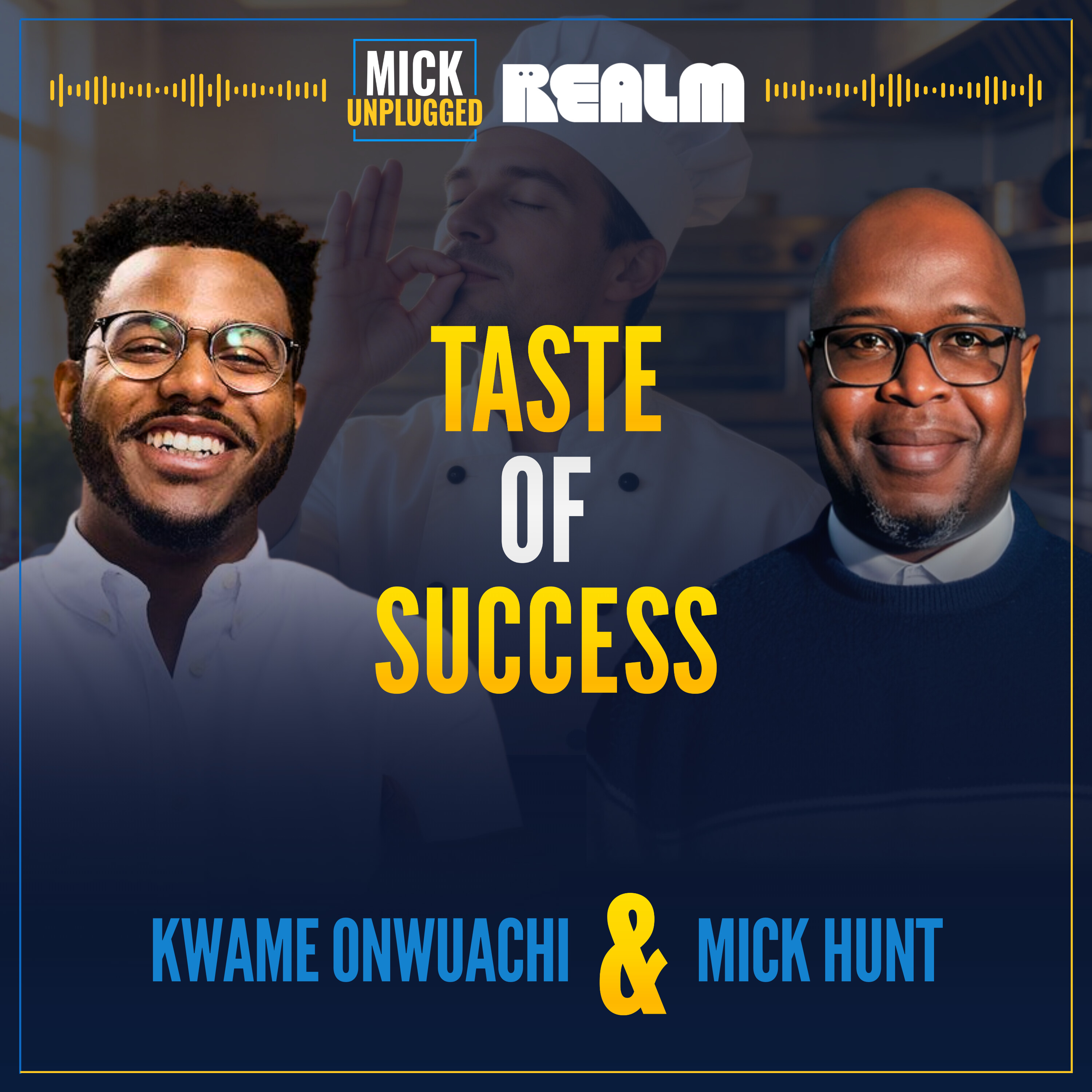
Ladies and gentlemen, welcome to another exciting episode of MC Unplugged. And today I'm sitting down with someone who I've been a fan of since, like, 2015 when I saw him grace my TV watching Top Chef. He is a revolutionary culinary artist, an award winning author, and a visionary restaurateur who is boldly redefining the landscape of modern American cuisine. He's a James Beard Award winner and a cultural force who continuously pushes boundaries so that people like me can enjoy and learn about food. Please join me in welcoming the amazing the chef Kwame. You're listening to Mick Unplugged, hosted by
- [01:14]
Mick Hunt
the one and only Mick Hunt.
- [01:16]
Rudy Rush
This is where purpose meets power, and stories spark transformation.
- [01:20]
Mick Hunt
Mick takes you beyond the motivation and
- [01:22]
Rudy Rush
into meaning, helping you discover your because and becoming unstoppable. I'm Rudy Rush, and trust me, you're in the right place. Let's get Unplugged. Comment? How are you doing today, brother?
- [01:37]
Chef Kwame
What's up? What's up? What's up? I'm good, man. Can't complain. Can't complain.
- [01:40]
Rudy Rush
I'm honored to have you on. Like I said, I was a huge fan of you. The first time I ever saw you, you pushed my palate too, man. Like, it was one of those things where, you know, growing up in the south, you eat what you eat and you get used to it. And I saw you, and for the first time, man, I was throwing in new dishes in the kitchen, new cuisine in the kitchen.
- [02:01]
Chef Kwame
I love that. I love that. I love that. I love how food can do that for people.
- [02:05]
Rudy Rush
Absolutely. So, Kwame, the first question I usually ask my guests is, what's your because? And I define your because as that thing that's deeper than your why. It's like your true purpose, and it probably changes from time to time. So if I were to ask you today in 2026, what's your because, brother? What's your purpose today?
- [02:25]
Chef Kwame
Oh, man. I mean, my because would honestly be the gift of life. You know, we're given this gift that we get to get up every Day. We get to experience joy. We get to experience sadness, fear, excitement, love, the gift of life. You know, I'm fortunate enough to be presented with a lot of opportunities, and that's not really missed on. So, you know, the fact that I'm able to do that, the fact that I'm able to get so many things done is my because. And, you know, then, you know, start to think of, like, okay, that's the root of it. Then, you know, what are you doing with that? What is your why? And I think my why is to leave this place better than I found it, you know, to kind of continue to put my culture at the forefront of everything that I do, to use my soapbox to amplify and give a voice to the inaudible.
- [03:26]
Rudy Rush
And you do an amazing job, man. And I want to. I want to hit on something that you said. You talked about always getting things done. And if I were to define Kwame now, again, being a huge fan of yours, following you forever and all of your journey, bro, you get things done, right? Like, for those that don't know, like, Kwame is restaurant here, book there, TV segment, TV shows here, the things you're doing in communities that. That I know you don't talk about because how humble you are, but the things that you do to give back, bro. Like, I always wonder, how much time does Kwame have in a day? Because I have 24 hours. It seems like you might have much more than that. All the things that you have going on. Talk to us about those things, bro.
- [04:08]
Chef Kwame
Yeah, I mean, I. Yeah, I. I have a lot going on, but I do have. I do have that me time, and I carve out time for it. It's really, really important for me, for my. My, like, recharging and resetting, that I have that time to myself. You know, I play a lot of golf. I work out. I watch tv, you know, but that. The. The. The times that I am working, they're very concentrated, and it's more like, you know, I have a team, and I would say I'm. Sometimes I'm the quarterback, and sometimes I'm the coach, and sometimes I'm the waterboy. Sometimes I have to fall back and let my team play the game or let my team run this play. So I think when you. When you can rely on your team, the days and the hours feel multiplied a little bit.
- [05:05]
Rudy Rush
I love it, man. Did you always see this vision for yourself, right? Like, you know, going back to elementary, middle school, high school?
- [05:15]
Chef Kwame
Right.
- [05:16]
Rudy Rush
Did you see this version of yourself?
- [05:19]
Chef Kwame
I Did. I always felt that I was going to be doing something. I didn't, I didn't know what it was going to be. You know, my mom is a chef. I grew up in the kitchen. I didn't know that that was going to be my career path, but I always wanted to do something. I remember by my dream was to own a McDonald's. You know, when I was younger and I went and I worked at McDonald's, and that was my first job. So, like, I always, I knew that I would be doing something that would be multifaceted, that I would be in, you know, have the responsibility of many people. I just didn't know what it was going to be.
- [05:56]
Rudy Rush
Amazing, man. Amazing. You know, I got to, to see a lot of that journey that you had in your memoir, right. Notes From a Young Black Chef. And one of the things that I truly was inspired by that book was that you talk about a lot of things, and I see your entrepreneur spirit all throughout that book, too. Right. You're talking about the journey. You're obviously aspiring chefs, right? But I also think there's a big punch part that's just like all entrepreneurs, no matter what you're doing, you need to hear this story, or you need to understand how you don't give up on visions and dreams and how obstacles are going to happen, but your mark is really going to be how you respond to those obstacles and what you decide to choose to do. Talk to us a little bit about what motivated you to, to share your story and inspire others with it.
- [06:52]
Chef Kwame
Well, you know, I was, I was giving, I was doing a couple of these keynote speeches where I would tell my story, and at one of them, there was a literary agent in the crowd, and she was like, you know, you need to have a book. And I was like, okay, how much is this going to cost? You know, me, me being from New York, thinking everything's a hustle. And she was just like, you don't get paid until I get paid. And at that moment, we started working on it. You know, it wasn't really like a dream of mine to write a memoir, especially at such a young age. That'd be a crazy dream. But I, I, I thought it was important to, to tell that story and be vulnerable. I think vulnerability is, is very human, and not just talk about the good times, but talk about the bad times and the obstacles. And, you know, that's, that's the also what displays, like, true defining moments for people. Like, it's not what happens to them. It's, it's how they get back up. It's how they respond to it because that's what you're really in control of. You know, you could be up one year and down one year. You know, how are you gonna really, how are you gonna respond to that?
- [08:01]
Rudy Rush
Yeah. And that's what I love taking away from the book, man. Because to your point, and you referenced it in the book to everybody that we know, that's great. Or that's good. Something happened. Multiple things probably happened that they had to overcome to get there. Right. But the common thread is they didn't give up. And so again, I think everyone, regardless of who you are, what you do for a living, like that book, needs to be a staple in your life because there's so much that you give in your journey that transpires and inspires to others.
- [08:36]
Chef Kwame
Yeah. I mean, that's a common thread among successful people. It's not how successful they are, it's that they didn't give up. That's it. And a successful person's most exciting project is the next project. A true entrepreneur. So, yeah, I'm glad you said that because I think that that book, the Name Chef, can be swapped out for any career path. And the narrative will reign true of the obstacles and the tribulations and the mental dexterity it takes to push through to get to that next level.
- [09:14]
Rudy Rush
Real talk, I'm always on the move, always jumping on some airport WI Fi or hotel network without thinking twice. Then it hit me how exposed my passwords and banking information really were. And that is when I started using NordVPN. It locks down my data wherever I am. Even on public WI fi. It's the fastest VPN out there. No buffering when I'm streaming. And one account covers up to 10 devices and it's the price of a cup of coffee a month. Premium cybersecurity total. No brainer. To get the best discount off your NORDVPN plan, go to nordvpn.com MCump Our link will also give you four extra months on the two year plan. There's no risk with Nord's 30 day money back guarantee. The link is in the podcast episode description box. Go check out nordvpn.com MC unplugged. Yes, sir. Yes, sir. So, I mean, I know the story of, of how this began, but I'd love to hear it from you personally. Now I can be selfish. This is a question for me, and me only. Talk to us about how your career began. The culinary side from the catering company. Like all the things that, that got you to where you are today, man.
- [10:32]
Chef Kwame
Yeah. I mean, it started, like I said, with my mom. You know, she had a catering company that she operated from the house, and we had no choice but to help out to keep the lights on. And that was more of a chore, but that chore turned into a passion, and that turned into, you know, a career and a profession. But I started working with my mom and catering and helping out, you know, set up events or, you know, helping prep dishes or pack up. You know, I learned how to drive on a, on a catering van. I, I pretty much did every job in, in the catering business. And then my first job outside of my mom's kitchen was in. At McDonald's. And I worked fry, I worked the grill, I worked the screen, I worked the drive through, I worked the register. I pretty much at every position there. And I went to school after that for business administration. And I ended up dropping out and moving to Louisiana where my mom had moved to Baton Rouge. And then I started working in kitchens as a dishwasher and as a cook, as a server. And then I went to the Deepwater Horizon oil spill that happened in the Gulf of Mexico as a chef for the cleanup crew, the oil, the first responders down there. And, you know, that really taught me that I, that I really, it showed me that I really enjoyed what I did, and I enjoyed the joy on people's faces when they ate a meal because I was cooking for a crew of 60 people, breakfast, lunch, and dinner. I didn't have any Internet. You know, this is before wifi or anything like that. So it was just focusing on cooking and, and honing my craft and making these people happy that were doing pretty tough, grueling jobs. Then after that, I went back to New York City. I started working as a cater waiter and a waiter at some affluent restaurants and found that I wasn't happy. And I needed to chase that happiness, that happiness that I felt when I was on the boat cooking for people. So I started my own catering company. And I needed access to capital. I didn't have it. So I got on the subway and started selling candy in order to raise money for my catering business. And I started it. It went. Did extremely well. And I was able to go to the Culinary Institute of America from the profits from that company. And from there I got introduced to some of the best restaurants in the world and went on to work at them and, and then left to then open my own restaurants.
- [13:17]
Rudy Rush
And the rest, as they say, is history.
- [13:19]
Chef Kwame
Right or history in the making, at least. History.
- [13:22]
Rudy Rush
There we go. History in the making. So when your mom started out, like, how does your cuisine differ from your mom's? Like, what. What are the. The different staples?
- [13:34]
Chef Kwame
Um, I mean, I would say, you know, mine differs in the sense of my training and, like, the restaurants that I've worked in, the. The core flavors are still there. Most of my restaurants run on, like, four. Four pillars of Trinidadian, Jamaican, Nigerian, and Creole from Louisiana. So I've taken those flavors and, you know, implemented them in different ways based off of, like, my culinary education. But I would say, you know, the root of it. My mom taught me how to season food, you know, so, like, the root of it all is definitely her. And then matched with, like, my education and my own. My own work history, I think that. And then my own creativity. Right. We're all individuals, so that. That all plays a role. But it's very different. You know, her cooking is. Her cooking is more traditional. She definitely gets creative when she's. She was a personal chef for a while, so she was able to get real creative. But. But for the most part, it's. You know, her stuff is very traditional, just done the right way. And, you know, I think with my cooking rooted in that, that's where I'm able to have some liberty and, you know, create things that are kind of new because I have that foundation in tradition.
- [14:57]
Rudy Rush
Absolutely. You know, one of the things that I learned from you, and this is something I'm sure everybody's gonna resonate with, you taught me the spice doesn't have to be spicy in the sense that, like, we normally think of, like, heat. And so, again, learning that from you, like, I cook differently now, man. Like, I. Not that I didn't understand spice before, but if you were to say, hey, go at spice, I would assume you meant heat. And now I. Because. And I don't like heat, but I now understand just I'm not very technical, but I am more technical now than I was. Like, how could you? For the everyday, you know, home chef. Not even home chef. The dad, the mom. Talk to us about spice versus spicy. We talk a lot about trends on this show, and AI is the one that just won't quit. But here's the thing. Talking about AI doesn't make you more productive. Actually putting it to work makes does. And that's what Zapier did for me. Zapier is an AI orchestration platform that connects top AI models like ChatGPT and Claude to the apps your team already uses. No coding no IT bottleneck, no complexity. You just plug AI into your workflow wherever you need it. Whether that's enriching leads, coaching sales reps, or automating tasks that used to eat your whole day. 3.4 million companies are already on it and they're running over 300 million AI tasks. This isn't hype, it's results. My team uses Zapier to connect the platforms we Already use forms, CRMs, content, workflows, follow ups and more. It just runs in the background while we focus on leading. Join the 3.4 million companies already automating with Zapier and transform how you work with Zapier in AI. Get started for free by visiting zapier.com that's Z-A P I-E-R.comm I C K
- [17:01]
Mick Hunt
youv're listening to this podcast, so I know you've got a curious mind. Here's a helpful fact you might not know yet. Drivers who switch and save with Progressive save over $900 on average. Pop over to progressive.com, answer some questions and you'll get a quick quote with discounts that are easy to come by. In fact, 99% of their auto customers earn at least one discount. And visit progressive.com and see if you can enjoy a little cash back. Progressive Casualty Insurance Company and affiliates national average 12 month savings of $946 by new customers surveyed who saved with Progressive between June 2024 and May 2025. Potential savings will vary.
- [17:40]
Chef Kwame
Spices are flavor additives to your food, whether even heat, you know, heat has different, heat has flavor. So you could be using, you know, Scotch Bonnet or a Thai chili or a Serrano chili. They, they all have different levels of heat, like Scoville units, but they all have different flavor profiles. And then when you're talking about spices, which are, you know, your dried berries and, and seeds and pods, you know, that radiate, you know, flavor, those are things that you use as like balancing acts with, with heat so the heat doesn't have to be the driving force. It's like a symphony almost. You know, every instrument has a role in creating this beautiful sound. You know, if it was just the drums, it would, it would, you know, it would sound totally different than when it's like six or seven instruments all together. So it's, it's that balancing act that, you know, I have to have spice in my food. That doesn't mean it chilies, but it has to be something more than just salt and pepper.
- [18:49]
Rudy Rush
Yeah. Yeah. So I, I personally thank you for that, man. Because I. I always just. If somebody wanted something with spices, I went to heat and, like, I was like, I'm. I'm not eating this dish because I can't do spicy, but I can definitely now do spices because, yeah, Chef Kwame.
- [19:07]
Chef Kwame
Yeah, man. Yeah. Spices are. They're very, very important in cooking. Very important in cooking.
- [19:14]
Rudy Rush
Yes, sir. Yes, sir. You know, you judge food as well. What's one thing that. That we can do at home to just bring a little bit of extra. That little bit of something to a dish?
- [19:30]
Chef Kwame
You know, you got to start with the basics. I always say, you know, salt is really, really important. I think people under salt their food a lot of. And then they're like, why doesn't this taste good? It's like, well, you didn't really season it to begin with. And then cooking things properly, you know, searing things properly, making sure that your, like, meats are patted dry. Make sure you're, you know, padded dry with paper towels so they're, you know, so that there's not this, like, layer of moisture on the outside. You know, your. Your pan is really hot. You're cooking on high heat, so you get a nice, you know, crust on the steak or the chicken or the fish or whatever you're making, you know, playing with the cooking temperatures so you're not cooking everything to, you know, 165 internal temperature. You know, other things, they. They lend themselves depending on what kind of fish it is or what cut of meat it is. Like, really, really doing research on when you're cooking. And then, you know, balancing acidity. Acidity brings out a lot of flavor to, you know, that final squeeze of lemon or lime. You know, that's what, like, makes restaurant quality food, you know, differ from home food, is that we're really honing in on the basics, letting the food speak for itself. But at the end of the day, we're seasoning things pretty well.
- [20:47]
Rudy Rush
Yep. I love it, brother. I love it. You know, I hinted earlier that you do a lot in the community. You do a lot for the culture. Talk to us about some of those. I don't even want to call them initiatives, because they're not initiatives. To me, it's just your way of being Kwame. Right. Talk to us about some of the things that you're doing to help elevate the culture and to help elevate community.
- [21:11]
Chef Kwame
Yeah. You know, it's important to. For me, for everything that I do to have a philanthropic arm. It's. I think it's easy to Give back when you're getting so much. And you know, like one thing that we do, we have an event called the family reunion that we do in Middleburg, Virginia at the Salamander Resort. And you know, we send someone to the CIA on a full ride scholarship that's, that's in need. And you know, we pay for their housing on externship. They have like mentorship by me throughout the entire time. So that's one way, you know, at, at the restaurant Tatiana in New York City, we have Tatiana gives back where a percentage of each check goes to the, the public housing behind Lincoln center to, you know, supply like turkey drives, give demonstrations on, you know, better ways to utilize your groceries. You know, we've done a lot of beautification and murals, you know, in the public housing and upkeep. So, you know, those are a couple of, couple of examples. But you know, it's important to always think about that. It doesn't have to be as grand as what I'm saying. You know, anything that you can do to give back is, is important to those that are in need, because a lot of us are in need. And you know, I saw that firsthand when I was growing up in the Bronx for one. You know, being the, one of the biggest food deserts and the biggest financial financially free capital of the world, you know, that, that, that's just because not enough people are thinking about them. And you know, I want to make sure that like I said earlier, I'm leaving the place better than I found it, you know, in any little way that I can and hopefully to inspire others to do the same thing.
- [23:05]
Rudy Rush
Amazing, brother. Amazing. And I'd be remiss, you know, because I know how busy you are and I don't want to keep you forever. I could ask you a thousand questions. But I do want to talk about these restaurants that you have and break some news on one that's opening up right around the corner. Right, like couple of days, we got one opening up.
- [23:24]
Chef Kwame
Yep, yep, yep. Maroon in Las Vegas. Here in Las Vegas. I'm here now. I'm officially a resident of Las Vegas, which is cool. It's a Caribbean steakhouse. You know, I thought about what does Vegas like need? And they need that. You know, there's, there's, there's not anything like that on the Strip. And you know, if I'm going to be involved in something, I'm definitely going to put my culture forward and there's going to be like Caribbean Steakhouse was going to be Steakhouse classics with a, with A Caribbean twist. And. Yeah, I mean, it's just going to be a really, really fun dining room. We have a giant jerk pit in the middle of the room. The design is meant to feel a little exclusive, you know, depending on where your seats are. And. Yeah, I mean, I want to just give Vegas something they haven't seen before because there's so much richness in the culinary landscape of Vegas. But I think the locals kind of get. Get lost in that. You know, they're always bringing restaurants that are, like transplants from other places. So I wanted a restaurant that's for Vegas.
- [24:31]
Rudy Rush
And where is it near? On the Strip.
- [24:34]
Chef Kwame
So it's in the Sahara. Yeah, got it. In the Sahara. Yeah, got it.
- [24:40]
Rudy Rush
So here's what I'm gonna do. Because I have several of my friends that host and run events that are in Vegas. I'm gonna make sure that we are promoting the heck out of your spot in Vegas. I'm gonna be out there this summer. The worst time to go to Vegas, but I'm gonna be out there this summer. I'm gonna make sure I come see you personally, bro. Like, I'm excited about this one because you're right, it's something. No offense to Vegas and the food scene there, but, like, you kind of see everything, right? It's like you've seen it before. This is something that Vegas can truly say they haven't seen before, and that's why I'm really excited.
- [25:16]
Chef Kwame
Exactly, exactly. And quite frankly, the country hasn't seen anything like this before either, so that's pretty exciting too.
- [25:24]
Rudy Rush
Yes, sir. All right, chef. Man, I'm going to get you out of here on my rapid fire top five.
- [25:29]
Chef Kwame
All right, let's do it.
- [25:30]
Rudy Rush
Ready?
- [25:31]
Chef Kwame
Yeah.
- [25:31]
Rudy Rush
All right. If you were not a chef, what career would you have pursued?
- [25:36]
Chef Kwame
Golf.
- [25:38]
Rudy Rush
Okay.
- [25:38]
Chef Kwame
Yeah.
- [25:39]
Rudy Rush
All right. I'm not even gonna mess with you in golf. Like, I can hit the ball, and that's about all I can do. I can't tell it where it's going. Your favorite dish from your childhood in either Nigeria, the Bronx, or Louisiana, it would be gumbo.
- [25:56]
Chef Kwame
My mom's seafood gumbo. Yeah, it's like crab, shrimp, andouille, chicken. So good, so good.
- [26:07]
Rudy Rush
What's one ingredient you can't live without in your kitchens?
- [26:13]
Chef Kwame
One ingredient. Like to cook?
- [26:16]
Rudy Rush
Yeah.
- [26:17]
Chef Kwame
Oh, man. Steak. Yeah, it's ribeye, for sure.
- [26:24]
Rudy Rush
Love it.
- [26:25]
Chef Kwame
Other than that, it would be salt. I couldn't live without salt. Yeah.
- [26:32]
Rudy Rush
So you can't say gumbo because that was your favorite. I was going to ask you what Is your go to comfort food after a long day.
- [26:39]
Chef Kwame
Go to comfort food after a long day is chicken wings, pork fried rice, and spare ribs from the Chinese takeout spot.
- [26:49]
Rudy Rush
Love it. Love it. As the story of Chef Kwame continues to evolve and history is being written, what's one word you want to make sure is used to define your legacy?
- [27:02]
Chef Kwame
Intentional. Yeah.
- [27:05]
Rudy Rush
I love it. I love it. Ladies and gentlemen, this has been Chef Kwame, bro. With everything in my soul. You are the man.
- [27:14]
Chef Kwame
Thank you.
- [27:15]
Rudy Rush
Honored to be here with you. I'm gonna have links to all your socials. I'm gonna have links to the book as well, too, because I think everyone needs it. And, Chef, because I love the book so much, the first 20 people that message me, chef, I'm gonna send you a copy of the book.
- [27:31]
Chef Kwame
Oh, wow. That's amazing, man. That's amazing, dude.
- [27:36]
Rudy Rush
The book is that book. Because to your point, swap out the word chef. It doesn't matter. It doesn't matter. Like the stories that are in there, the. The mission behind the book, the intent behind the book parallels anyone that's an entrepreneur, anyone that's looking to. For ways to overcome the book should be your blueprint. And I mean that, brother. I really do.
- [27:58]
Chef Kwame
Well, thank you. Thank you for your time. I appreciate it. And I can't wait to have you
- [28:02]
Rudy Rush
at the rest more than you know and to all the viewers and listeners, remember you're because is your superpower. Go unleash it.
- [28:10]
Mick Hunt
That's another powerful conversation on Mick Unplugged.
- [28:13]
Rudy Rush
If this episode moved you, and I'm sure it did, follow the show wherever you listen. Share it with someone who needs that spark and leave a review so more people can find there because I'm Rudy Rush, and until next time, stay driven, stay focused, and stay unplugged.
- [28:32]
Commercial Announcer
Foreign.
- [28:38]
Mick Hunt
This episode is brought to you by Progressive Insurance. Do you ever think about switching insurance companies to see if you could save some cash? Progressive makes it easy to see if you could save when you bundle your home and auto policies. Try it@progressive.com Progressive Casualty Insurance Company and affiliates. Potential savings will vary. Not available in all states.
- [28:58]
Commercial Announcer
When you manage procurement for multiple facilities, every order matters. But when it's for a hospital system, they matter even more. Grainger gets it and knows there's no time for managing multiple suppliers and no room for shipping delays. That's why Grainger offers millions of products in fast, dependable delivery, so you can keep your facility stocked, safe, and running smoothly. Call 1-800-GRAINGER Click grainger.com or just stop by Grainger for the ones who get it done.