← Mike Birbiglia's Working It Out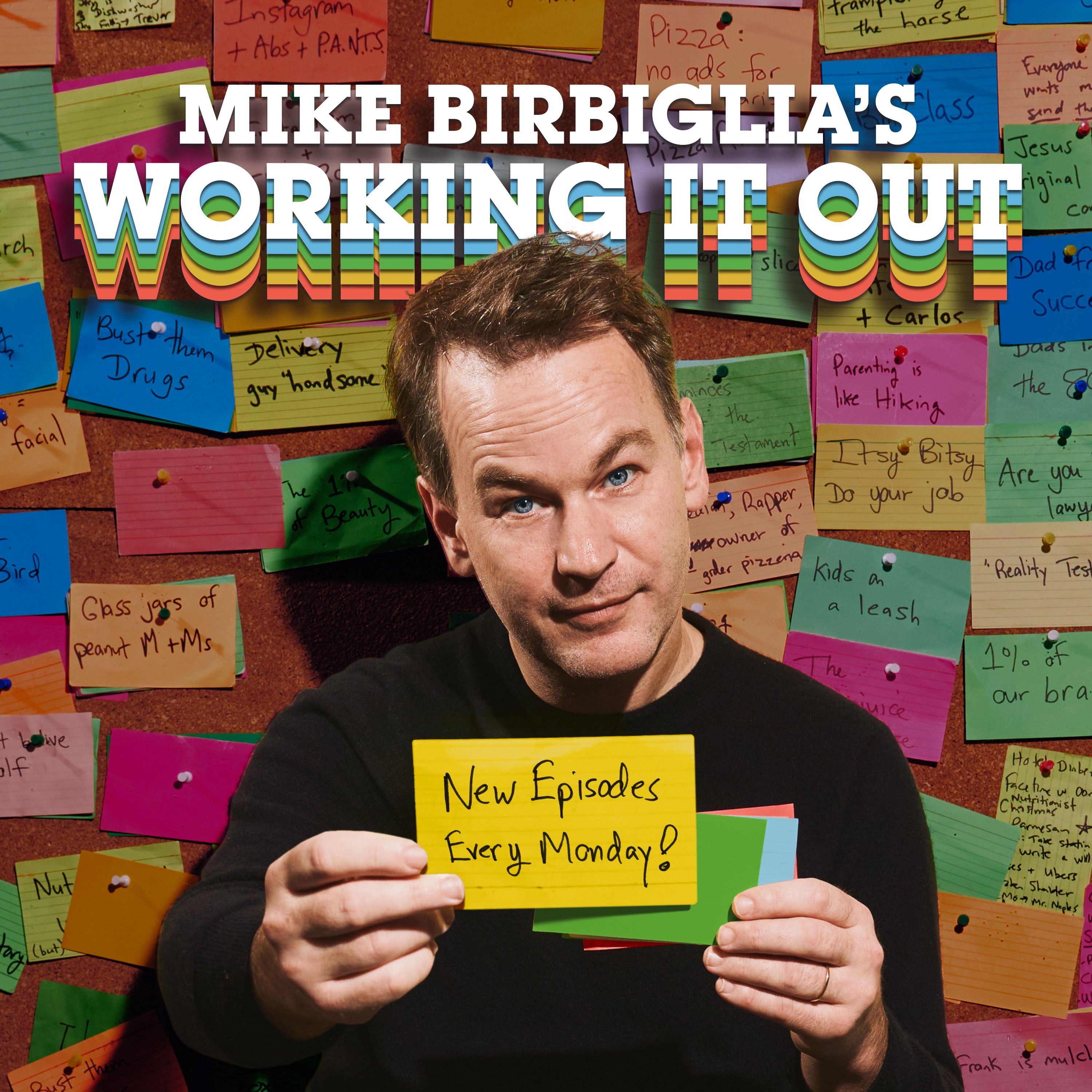
Mike Birbiglia's Working It Out
152. Gary Gulman Returns: Mommy, Look!
00:53:41
Working It Out Hall of Famer Gary Gulman returns to discuss his upcoming Off-Broadway show Grandiloquent. Mike and Gary break down, first of all, what “grandiloquent” means, and how the new show that looks back on Gary’s early life and looks ahead at the prospect of Gary becoming a father. Mike and Gary also check in on their friendship progress, moving from work friends to friend friends. Plus, jokes about soccer game injuries and the pitfalls of lecturing your spouse on pop culture.
Loading summary
Transcript332 lines
- [00:01]
Gary Gulman
My mother did say something really great. She said, if you have one good friend, you're doing great. And that was really helpful. And also, you're never alone if you have a book.
- [00:09]
Mike Birbiglia
Oh, that's beautiful. Yeah, both of those are great.
- [00:12]
Gary Gulman
Yeah. But she also said when I wanted to be a comedian, she said, you don't make us laugh.
- [00:24]
Unnamed Host/Co-host
That is the voice of the great Gary Gulman.
- [00:26]
Gary Gulman
Yay.
- [00:27]
Unnamed Host/Co-host
Gary Gulman's back. One of our all time favorite guests, he has now returned for a three peat. The previous two episodes that Gary was in are beloved by our listeners. So you can go back and listen to those. There's no paywall. I love talking to Gary. He has a new live show opening in January at the Lucille Lortel Theater in New York. It is produced by Mike Lavoy and Carly Briglia, who I've worked with on many, many things. And the show is called, wait for it, grandiloquent. Grandiloquent. What does that mean? That's not a word I use every day. You'll have to listen to the episode to find out. We go into detail about what the show is about and how he named it. I am so excited to see his show. I love the Lou Silvertale Theater. It is a gorgeous theater. I've done shows there as well. And I want to thank everyone who's been coming out to my shows. Last weekend in Michigan, Ohio and Pennsylvania, I'm heading to Florida. Those shows are sold out. But in December, I will be in Louisville at the Brown Theater, which I adore. I'll be at the Ryman Auditorium in Nashville, Tennessee, which I adore. They call it the Church. It is just the coolest theater. I'll be in Knoxville, Tennessee, at a place called the Tennessee Theater, which I found online as sort of one of the famous, historic, beautiful theaters of America. I'll be in Asheville, North Carolina, which, by the way, if you were wondering, is happening. We talked about it. We talked to local folks. Do I, do they want me to do it? We're going to do it. If you can't make it, you can get a refund. But that's December 12th at the Thomas Wolf Auditorium. I'm so excited for that. And then I'm rounding out my year in Charleston, South Carolina, at the Gayard center, which I've played it before and it's also awesome. Then I'm going to be in Iowa City at the Englert for two nights. In January, I'll be at the Pickering Casino Resort in Ontario. I'll be in Baltimore for Two nights at the Center Stage. I'll be in Northampton for two nights. I'll be in Burlington, Vermont. And then the final shows at the Beacon Theater. Four nights. March 19, 2021, 22. I was just over there with our designers the other day and my director, and we were scouting out how we're going to design the space. And I'm just super, super excited. All the stuff I'm talking about on tour right now is all in preparation for making those final shows at the Beacon as great as they can be for you. Get your tickets now. All of this is@forbigs.com I love this episode with Gary Gullman today. In the three episodes that we've done with Gary Gullman, in some ways, it's a sort of story about our friendship. In the last episode, we asked ourselves, are we work friends or. Or real friends? We dig into that a little deeper. Today we talk about Gary's new show. We talk about a comedian's relationship to their audience and how complicated that can be. I actually just saw Gary perform live at the Comedy Studio in Cambridge, which just reopened after a bunch of years off in a new, new location. And it was so great, and he was so good. So enjoy my chat with the great Gary Gulf.
- [04:11]
Mike Birbiglia
So you're doing a show in January, Off Broadway, New York City Off Broadway.
- [04:16]
Gary Gulman
Lucille Lortel.
- [04:17]
Mike Birbiglia
Oh, that's a good one.
- [04:19]
Gary Gulman
It's a good one. Yeah. Oh, really beautiful. Great shows there.
- [04:21]
Mike Birbiglia
Yes.
- [04:22]
Gary Gulman
And. Yeah. And it's called grandiloquent.
- [04:26]
Mike Birbiglia
Oh, I love that.
- [04:27]
Gary Gulman
Thank you.
- [04:27]
Mike Birbiglia
The two words, grand and eloquent.
- [04:29]
Gary Gulman
No, this is the key. It's. Grandiloquent means using extravagant or showy language. And here's my favorite part. Single word, especially when intended to impress.
- [04:46]
Mike Birbiglia
Oh, wow.
- [04:47]
Gary Gulman
Gary.
- [04:48]
Mike Birbiglia
Oh, I love that.
- [04:50]
Gary Gulman
It actually has my name in the definition.
- [04:53]
Mike Birbiglia
Gary comma Gary.
- [04:57]
Gary Gulman
Yeah, period comma, Gary, period. Oh, my God.
- [04:59]
Mike Birbiglia
It's grandiloquent.
- [05:00]
Gary Gulman
Yeah.
- [05:01]
Mike Birbiglia
Can you. Without giving away the show, can you describe the show to the listeners?
- [05:07]
Gary Gulman
It's part memoir in that I talk a lot about my life from first grade or an event in first grade that I feel either. It definitely changed my personality at the time and informs who I am now, which is I repeated the first grade and a lot of what I became soon thereafter. And what I am now is based on that. That idea that the child is the father of the man. That really resonates with me and so gave rise to a lot of the subjects I cover in the show and about fathers and sons and also my wife and I have frozen some embryos. And I was watching the new one, and you really captured that whole thing of having to go into. Having to go into a fertility clinic and humiliate yourself.
- [06:06]
Mike Birbiglia
So humiliating.
- [06:08]
Gary Gulman
Humiliating. And everybody knows what you did. And Eugene Merman did a great joke that night when we were.
- [06:15]
Mike Birbiglia
When we were in Cambridge Studio. Cambridge. Yeah.
- [06:17]
Gary Gulman
And he said that somebody. When he went in to do the fertility thing, somebody said, we love Bob's burgers.
- [06:23]
Mike Birbiglia
Oh, my God, we love Bob's burgers.
- [06:26]
Gary Gulman
You're supposed to be anonymous. And they. And they just. That's a HIPAA violation right there.
- [06:31]
Mike Birbiglia
Yeah. Everything about it is embarrassing.
- [06:34]
Gary Gulman
Yeah. So a lot of it was considering for a long time, I didn't want to have kids like you, but the main reason I didn't want to have kids was that my childhood was such a nightmare that I didn't want to foist that on someone. And so. But once I got healthy, I thought, no, life is a pretty good run. It's a good ride.
- [06:56]
Mike Birbiglia
It's a good ride.
- [06:57]
Gary Gulman
Yeah. And to Den and a being. This might not be as responsible as you think.
- [07:06]
Mike Birbiglia
That's really interesting.
- [07:07]
Gary Gulman
And so if somebody could have a life similar to mine, or at least the amount of joy that I'm able to experience in my mid-40s through now. I'm 54. I think I'm very positive about the prospects for a Goldman child.
- [07:26]
Mike Birbiglia
Oh, I love that.
- [07:27]
Gary Gulman
Yeah.
- [07:27]
Mike Birbiglia
Last time that you were on the podcast, we talked about our friendship, and we're going to move towards having less of a work friendship to a real friendship. Are we getting there?
- [07:35]
Gary Gulman
Well, we need to do something together. We need to meet for dinner or lunch or a double date or something like that, and then we'll be in that place. But I don't know if I told you when I said this the last time, but I had this friend when I was in high school, and he said. He said a friend is someone you do stuff with. That was his definition.
- [08:01]
Mike Birbiglia
I love that.
- [08:02]
Gary Gulman
Yeah. A friend is someone you do stuff with. And then I had this other friend, Sean, who said, a friend. If you're my friend, he said, and you're stuck in Australia, I will make every effort to come save you.
- [08:14]
Mike Birbiglia
That's beautiful.
- [08:15]
Gary Gulman
Yeah. And that was really. And he was like 18 years old, but that was like a solid friend. But those were the types of friends you make when you. And I explained it in the show. I didn't have a friend until fifth grade, and so I had high ideals for friends, but also attracted loyal friends. Because it doesn't take much to hurt my feelings and make me withdraw and.
- [08:41]
Mike Birbiglia
Right.
- [08:41]
Gary Gulman
Yeah.
- [08:43]
Mike Birbiglia
That's fascinating.
- [08:45]
Gary Gulman
It's sad.
- [08:46]
Mike Birbiglia
No, it's okay.
- [08:47]
Gary Gulman
Really.
- [08:47]
Mike Birbiglia
I don't think it's sad, but I think it's certainly. I think the reason I'm pausing is that it's an obsession of mine. Like, adult friendship is an obsession of mine because it's like, it doesn't have the construct of school.
- [09:00]
Gary Gulman
No.
- [09:01]
Mike Birbiglia
School provides a little bit of a framework for.
- [09:05]
Gary Gulman
Totally.
- [09:06]
Mike Birbiglia
Maybe these should be your friends.
- [09:07]
Gary Gulman
Yes.
- [09:08]
Mike Birbiglia
Maybe find some people in this scrum.
- [09:10]
Gary Gulman
Yes.
- [09:11]
Mike Birbiglia
And then you get into the grownup world and it's like you figure it out.
- [09:15]
Gary Gulman
Yes. I mean, making friends after 40, it's really tough because we're so set and we have our own friends and are usually our partners, and so it's difficult to fit them in. But I've been pretty good about making some good friends after 40. And it's easier when you're a comedian, too, because you have more free time than most people. Most people do. And you're intersecting with newer people from time to time when you work on new projects and things. So it's pretty cool. And also the diversity of the types of people that we intersect with. It's like sports or music. We're really lucky.
- [09:57]
Mike Birbiglia
You're absolutely right. Yeah.
- [09:59]
Gary Gulman
Yeah.
- [09:59]
Mike Birbiglia
So. So your show is now on sale for January.
- [10:03]
Gary Gulman
Yes.
- [10:04]
Mike Birbiglia
Seeing you live, because I saw you live recently, is such an absolute treat. And as people make fun of me in the comments section, my highest recommendation is I couldn't recommend this more highly. Seeing you live is just such a joy.
- [10:19]
Gary Gulman
Oh, thanks.
- [10:20]
Mike Birbiglia
One of the things that you do that I've never seen anyone do is sometimes you'll. You'll say to the audience, I'm at the top of my game.
- [10:27]
Gary Gulman
Which I think is hilarious, but it's not a lie. I'm really doing good work. And I'm not comparing. This is the great thing that you learn as you get older. Don't compare yourself to the other comedians because they're all better than you, but compare yourself to. In your head. You can make them all better than you, but compare yourself to yourself a year or two ago or when you were working at your best creative level. And. And that's a fair thing to say that.
- [10:59]
Mike Birbiglia
And I think you're right. Here's my observation today. I was watching your older clips from one of your specials in 2002, and recent clips. Well, here's my observation.
- [11:11]
Gary Gulman
It's a different comedian.
- [11:12]
Mike Birbiglia
Yeah. It's a different Comedian, I think your early work, you are presenting as cool.
- [11:20]
Gary Gulman
Totally.
- [11:21]
Mike Birbiglia
Right. Like, you're a cool guy. And. And when I say that, I mean you're judgmental of people around you without really acknowledging the absurdity of yourself.
- [11:31]
Gary Gulman
Yeah.
- [11:32]
Mike Birbiglia
Oh, yeah.
- [11:32]
Gary Gulman
Yeah.
- [11:32]
Mike Birbiglia
And the challenges of your own.
- [11:34]
Gary Gulman
Yeah.
- [11:34]
Mike Birbiglia
And then as you've aged, I feel like you've leaned into uncool, but actually, by being uncool, you've reached the nirvana. The nirvana of cool.
- [11:43]
Gary Gulman
Exactly. I thought. I think I was not the capital.
- [11:45]
Mike Birbiglia
N, but the lowercase and nirvana.
- [11:47]
Gary Gulman
I think I was. Yeah. I think I was influenced a lot by the. By the. The speed of Boston comedy that you tell your dreams early on. Yeah. And the need for a male Boston comedian to be the coolest guy in the room.
- [12:01]
Mike Birbiglia
Sure.
- [12:03]
Gary Gulman
And that's helpful in some ways and not helpful in artistic ways a lot of the times.
- [12:08]
Mike Birbiglia
Yeah. To give context to people who don't know Boston comedy, it's brash.
- [12:13]
Gary Gulman
Yeah.
- [12:13]
Mike Birbiglia
It's loud.
- [12:14]
Gary Gulman
It's loud.
- [12:14]
Mike Birbiglia
It's very male. At least when you and I came up in the 90s and early 2000s and the 80s, certainly. I mean, in the 80s, there's this unbelievably good documentary called When Standup Stood out that documents the Boston comedy scene in the 1980s. It is nothing like I've ever seen anything. These people were so out of their minds. They're on cocaine. They were. They were making tons of money and.
- [12:41]
Gary Gulman
Blowing it on things.
- [12:43]
Mike Birbiglia
Yeah.
- [12:43]
Unnamed Host/Co-host
Tons of cash.
- [12:45]
Gary Gulman
And.
- [12:46]
Mike Birbiglia
And the.
- [12:46]
Gary Gulman
And.
- [12:47]
Mike Birbiglia
And the comedians. Some of them were great.
- [12:49]
Gary Gulman
Yeah.
- [12:49]
Mike Birbiglia
A lot of them weren't great, but they were just loud and, like, are doing it, and it was. It's fascinating. And Solomon.
- [12:57]
Gary Gulman
Steven Wright came out of that.
- [12:58]
Mike Birbiglia
Yeah. There's some great comics that came out of it. But then. Yeah. And I want to say it's. Salamita is the name of the documentarian.
- [13:06]
Gary Gulman
Fran Salamita. Yeah.
- [13:07]
Mike Birbiglia
Yeah. And. Yeah, I've mentioned it before on the show because.
- [13:11]
Gary Gulman
No. Riveting.
- [13:12]
Mike Birbiglia
Mulaney and I used to. On tour when that. When we saw. First saw that documentary, we used to quote it all the time because there's this great line in it where they're talking about when Steven Wright got the Tonight show, which basically meant he made it in the 1980s, and somebody said to him, it's not your turn. Wow. It was either him or Bobcat Goldthwaite. It was one of those two where someone really made it big and they were like, it's not your turn. Which is very Boston.
- [13:44]
Gary Gulman
Totally Boston.
- [13:44]
Mike Birbiglia
It's the accent of nine yard turn. And then it's also just kind of like this hierarchy that's sort of fictional.
- [13:52]
Gary Gulman
Yeah. And also this fake fairness.
- [13:55]
Mike Birbiglia
As though anything's fair.
- [13:56]
Gary Gulman
Yeah. As anything's fair. Maybe sports is a complete meritocracy. So you can't imagine somebody saying to LeBron James, at 18, you're not out of college. You gotta go to college first.
- [14:12]
Mike Birbiglia
You gotta go to college first. Yeah.
- [14:14]
Gary Gulman
At least go for one year.
- [14:15]
Mike Birbiglia
You gotta go to Boston College.
- [14:17]
Gary Gulman
Yes. It's nuts, but you get it. Because part of the thing, and this comes back to friendship, about having a friend make it, is you're happy for them. But then there's also a sadness because I always think, like Brian Koppelman, we used to spend every Sunday together and then billions took off and we hardly saw each other for the, for years when he was making that joke because he was so busy. And so there's this kind of sadness. I miss my friend.
- [14:48]
Mike Birbiglia
Yeah.
- [14:48]
Gary Gulman
I miss my friend. It's like Shawshank Redemption when the guy gets out of prison. Like. Yeah. I also miss him, though.
- [14:55]
Mike Birbiglia
So how do you feel about sitting your show in New York? I mean, you and I were talking about how what's funny is, I think it was in your last special, you make fun of people who do one person shows and you're like, every one person show could be called Mommy Look. Mommy Look.
- [15:12]
Gary Gulman
Yes. Yeah, that was an alternative name to the, to the show. Yes. But I mean, I've always admired the form, been intimidated by it and, and loved the challenge of it. But have. Have tried, I think. I think born on third base, initially I wanted to make it a one person show. I would have loved to have had the, the energy and also the chops to make the Great Depression to a one man show. And so this time I wanted to do it. But yes, I said that just about every one person show could help Mommy Look. But I also feel that every stand up show that I've given over the past 30 years, the subtext is Mommy Look. It's an audition, an audience of one. In some ways.
- [16:02]
Mike Birbiglia
Certainly where I started is Mommy Look. That's how I started performing.
- [16:06]
Gary Gulman
Yeah.
- [16:07]
Mike Birbiglia
At very least.
- [16:08]
Gary Gulman
Yeah.
- [16:08]
Mike Birbiglia
Do you feel like it's. Do you feel like at this stage in your life you're. Is it like a modified Mommy look like you. Like, it's still Mommy look, but it's. But you're. You've aged with it.
- [16:18]
Gary Gulman
Maybe, but there's still, still a track in my head that is, that is commenting on the Show. Sometimes during the show, sometimes just after the show, when I consider it. And it's a combination of my. My mom and some other people in my life, brothers and people just, yeah, you're being indulgent, and this is not what they paid for. And also, I remember one night just not being very entertaining at the Cellar and getting a phone call about my lack of entertaining at the Cellar.
- [16:59]
Mike Birbiglia
From the higher powers.
- [17:00]
Gary Gulman
From the higher powers at the seller. And remember thinking, well, this is a moment. This is an interesting. This is an interesting inflection point.
- [17:09]
Mike Birbiglia
You're describing my greatest fear in my life. Basically the thing that haunts my dreams.
- [17:16]
Gary Gulman
Seriously?
- [17:16]
Mike Birbiglia
Oh, yeah, yeah. I think about it all the time. I feel like. Yeah, I feel like my fear is exactly what you're describing. Getting a phone call and saying, hey, we're concerned that this is not entertaining enough.
- [17:29]
Gary Gulman
Yeah, I mean, and I. And I was very careful about what parts of the Great Depression I shared at the Cellar because they. Some of it is a bummer and some of it is not all that funny, and some of it was not worked out entirely. And we've probably talked about this before, but David tell. I remember. And I heard this third or fourth hand, so who knows what he said originally. But he said, you need a place where you can kill and a place where you can bomb, and that's really important. And finding those places, and you don't have to bomb in the places.
- [18:02]
Mike Birbiglia
That's a beautiful line, by the way.
- [18:04]
Gary Gulman
You don't have to bomb in the places that you can bomb. You just have to go with that feeling. And for me, for a while, it was the comedy Studio in Cambridge. Yep, in Cambridge. The original comedy studio above the Hong Kong. And now I feel like it's QED and Union Hall. But I was dying to talk about this with you because you've experienced this where. How much different doing comedy for an audience that is there to see a comedy show versus an audience there to see a Mike Birbiglia show.
- [18:38]
Mike Birbiglia
Very different.
- [18:39]
Gary Gulman
It is not for me, it is so much the reason why I feel like I'm doing my best work is that I can trust an audience to be patient with me and have the context of what I do and what I'm about before I get on stage. And I'm a little bit spoiled. But also part of me says, well, why am I trying to. Why should I try to do jokes that everyone will love a little bit instead of trying to write jokes that the people who get it will think they were written especially for Them.
- [19:19]
Mike Birbiglia
But that's why I do both.
- [19:22]
Gary Gulman
Yeah.
- [19:22]
Mike Birbiglia
Because I think like we're discussing like that your joke that. That every one person show could be called Mommy Look. And it's like for me, my journey is. That's definitely how I got into stand up.
- [19:35]
Gary Gulman
Yeah.
- [19:36]
Mike Birbiglia
I think somewhere in my 20s or 30s, I started to have a connection with audiences where I'm like, oh my God, this is like a deep personal connection. And I've never experienced anything like this before. And so now I'm chasing that off.
- [19:51]
Gary Gulman
Stage or off stage.
- [19:52]
Mike Birbiglia
On stage. On stage.
- [19:55]
Gary Gulman
But I found that I didn't have that connection a lot off stage where I could be myself 100%. The way just in your life. Yeah. Or closer.
- [20:05]
Mike Birbiglia
Oh, yeah. I mean, you're stripping all of our lives, right?
- [20:08]
Gary Gulman
Or close. Yeah. Or closer to my real self on stage in some ways. But then I've also constructed a Persona. Oh, certainly. And prepared every single word I say.
- [20:19]
Mike Birbiglia
No, of course.
- [20:19]
Gary Gulman
Which you can't do in a conversation. They want you to ad lib.
- [20:25]
Mike Birbiglia
Bay humans.
- [20:27]
Gary Gulman
These people expect a conversation that you aren't building to something. And close on a callback.
- [20:35]
Mike Birbiglia
And that's why I feel like I'm constantly disappointing fans when I meet them in real life.
- [20:41]
Gary Gulman
Oh, my word.
- [20:41]
Mike Birbiglia
Because everything I say is not as good as what I constructed on stage.
- [20:48]
Gary Gulman
I get that.
- [20:49]
Mike Birbiglia
And it makes me actually understand why performers who I've enjoyed over the years try to avoid interaction sometimes with fans because of that. Because I can see the disappointment in fans when they talk to me in real time.
- [21:05]
Gary Gulman
I think you're projecting. I think all they want is for you to be earnest and sincere.
- [21:12]
Mike Birbiglia
I try.
- [21:12]
Gary Gulman
And you don't necessarily have to be funny, but. Yeah, we're never as funny after the show as. We're never as funny as our perfectly.
- [21:22]
Mike Birbiglia
Constructed 60 minute monologue we wrote over the course of four years.
- [21:27]
Gary Gulman
Exactly.
- [21:28]
Mike Birbiglia
Are you kidding me?
- [21:29]
Gary Gulman
Yeah, exactly.
- [21:30]
Mike Birbiglia
Well, it's like I always try to imply to the audience that these are things I've thought of afterwards and not things that I so wittily whipped off because I think early in my career I'm implied that I was so witty. Moment to moment.
- [21:46]
Gary Gulman
That's a very honest and vulnerable thing to say. I didn't say that right away because then. Because the original way most of us start off or I remember there was this guy, I think his name was Chuck Martin, and he said that he thought when he first started doing comedy that it was just snappy answers, stupid questions from Mad magazine. And there is a brand of that in. In comedy, these people who just make a list of all the funny things in Boston, it was always the witty things they said to police officers, arresting them for drunk driving.
- [22:20]
Mike Birbiglia
Oh, my gosh, it's so funny.
- [22:23]
Gary Gulman
It was so gross on so many levels. But would murder at the comedy shows in Boston in the early 90s when I started now, I think people are like, yeah, you shouldn't drink and drive. But back then it was like, ah, we all do it.
- [22:34]
Mike Birbiglia
Mulaney and Kroll used to goof around about the. That. That. They called that comic, the do what I do comic. Oh, my gosh. Oh, you ever in a situation like that, do what I do? And then it's something they definitely didn't do. And then as an audience, you're supposed to believe that that's what they did. And it's like, no, do what I do. You take a shit in the top of their couch and they're, yeah. And then you leave. It's like, no, I don't think that happened.
- [23:00]
Gary Gulman
I love that. On Todd Glass's first Comedy Central presents, he did this do what I do. But he just. I mean, they were so absurd. Like, at one point he was. He got into a kangaroo costume and took a dump on somebody's lawn and he said, do what I do. He was making fun of it. It was a satire of the do what I do. Comedians.
- [23:23]
Mike Birbiglia
Do what I do.
- [23:24]
Gary Gulman
Yes. It's just so crazy.
- [23:39]
Unnamed Advertiser/Producer
Support for working it out comes from Aura frames. Doesn't it sometimes feel like all your favorite photos I relate to this completely are stuck on your camera roll or on your laptop? Wouldn't it be great to have an easy way to share them and enjoy them with family and friends? That's where Aura comes in. We have one in the studio. I have one in my apartment. I put a whole bunch of photos in it, and it's almost like a playlist, like a musical playlist, except with photos and they just. They're on rotation. And it's a great gift. It's a perfect thing.
- [24:09]
Mike Birbiglia
I don't know about you, but I.
- [24:10]
Unnamed Advertiser/Producer
Have a lot of people in my life. I don't know what the heck to get them for anything ever. And it's the holiday season, and this is a perfect thing that maybe people wouldn't buy for themselves, but if you gave it to them, I think they would be thrilled. It's just one of those perfect gift items. Save on that perfect gift item by visiting auraframes.com to get 35 bucks off Aura's Best selling Carver Mat frames by using promo code WIO. That's for working it out. WIO at checkout that's a U R A frames.com promo code WIO. This deal is exclusive to listeners so get yours now in time for the holidays. Terms and conditions apply. Support for working it out comes from Helix. We love Helix. These are great mattresses. Whenever I'm in mine, it feels like a hug. It feels like the right temperature.
- [25:02]
Mike Birbiglia
It feels special.
- [25:05]
Unnamed Advertiser/Producer
Like it just feels different from when I'm out traveling and I'm in like a hotel bed or whatever. I'm traveling. It just feels like I'm in a primo mattress. By the way, they have so many sleep related items lately I've been using the weighted blanket quite a bit and it's so nice for the winter. It's just the beginning of winter, but I'm really enjoying it. We are announcing a very Special offer today. 27% off site wide plus 2 free dream pillows with any mattress purchase, free bedding bundle, two dream pillows, sheet set and mattress protector with any luxe or elite mattress order. Just go to helixsleep.com burbigs.
- [25:57]
Mike Birbiglia
I was watching your classic bit about state abbreviations. At the beginning of the bit you say, I watched a documentary about state abbreviations. Then you go into this hilarious bit that outrageous and extreme and hyperbolic. And then of course I look up the documentary. There is no documentary. I'm like, this is the Hasan Minhaj moment of Jared Dolman's career.
- [26:24]
Gary Gulman
Oh my gosh, that's hilarious.
- [26:25]
Mike Birbiglia
I captured you. I trapped you. You're lying about the documentary.
- [26:31]
Gary Gulman
That's hilarious. But I've told you this before. But that joke was in my notebook for 20 years. But until they started making documentaries about little things, there was really no way to tell it or I didn't know the way to tell it.
- [26:46]
Mike Birbiglia
Right. Like in other words, it was the conceit of. There was this documentary as opposed to. This is just this thing I'm thinking about.
- [26:52]
Gary Gulman
Yes, yes. The thing I've been thinking about since third grade when I got a book and they had all the state abbreviations in it. And I thought it's going to be impossible to memorize these because I was really into memorizing things for no reason other than that I had a lot of time and I remember thinking, it's going to be really hard to memorize these because most of these states start with the same first two letters.
- [27:13]
Mike Birbiglia
Yeah.
- [27:13]
Gary Gulman
And then when you start doing comedy, I don't know if you went through this, where you're spending days, all day long thinking, is this funny? Is this funny? Is this funny?
- [27:21]
Mike Birbiglia
Yeah.
- [27:21]
Gary Gulman
And what about the fact that most of the states start with the same two letters, but then soon thereafter, the premise isn't strong enough to hold the rest of the joke?
- [27:31]
Mike Birbiglia
There is this great interview with George Saunders, who I know you and I both love.
- [27:35]
Gary Gulman
I love him.
- [27:36]
Mike Birbiglia
Where she's talking about how so much of being a writer is reading your own writing and seeing if it still brings you joy or lights you up and then being honest with yourself about whether it does.
- [27:51]
Gary Gulman
Yeah.
- [27:52]
Mike Birbiglia
Because so often we're like, oh, yeah, this works, this works, this works. And it's like, well, does it?
- [27:56]
Gary Gulman
Yeah.
- [27:57]
Mike Birbiglia
Are you really holding yourself to the full standard?
- [27:59]
Gary Gulman
Yeah. I had a joke that I've had for months and months, and there are some biblical puns in it. And the main premise is that I feel that the Sermon on the Mount was not improvised, that Jesus workshopped it. And so I'm touring it for months and I had two pretty solid puns in there. That one of the clubs that he worked it out at was the Proverb Factory. And then John says, is that the one on Melrose? And Jesus says, no, that's the hymn prop. And this guy who's a fan, but a lot of fans can be very.
- [28:41]
Mike Birbiglia
Fun, by all means, right? Yeah, yeah.
- [28:43]
Gary Gulman
And so he says, what about saying that he went to all the open mounts.
- [28:47]
Mike Birbiglia
Oh, that's good.
- [28:48]
Gary Gulman
And I thought that was terrific. And I used it in the next show and it got a laugh. And I was like, oh, my gosh, my fans.
- [28:57]
Mike Birbiglia
One of my favorite jokes of yours is you go, Millennials get criticized by middle aged men who say, how are they going to learn how to lose? And then you go, oh, they'll get some practice. Oh, you familiar? Are you familiar at all with life? And I love that joke because it's so economical the way it's so few words. Oh, familiar with life. And I was curious, like, how'd you arrive at it? And did it take a series of drafts or did it just come to you?
- [29:26]
Gary Gulman
The first part? Here's what was difficult with Any time you say anything good about millennials at the average comedy club, I won't say they're bad comedy clubs, but the average comedy club is that they're so conditioned from comedians bashing millennials.
- [29:43]
Mike Birbiglia
And now that joke applies, of course, to Gen Z also. It's the same joke, basically.
- [29:48]
Gary Gulman
Yeah. They think you're being sarcastic. So it was always a fight against that. And I said, no, I mean this. They're kinder on the average and more empathetic than we are and much less tolerant of bullies and homophobia and things like that. And so that was a hurdle initially, but then, but also a lot of the. In the average comedy club, a lot of the people feel that these kids are getting participation trophies and they're not learning how to.
- [30:19]
Mike Birbiglia
So you probably got some shit or thinking you're being sarcastic, so you had.
- [30:24]
Gary Gulman
To fight through that. But then you'll get some practice. That was always there. And once you have, they'll get some practice. All you have to do is come up with what the practice will be. And then here's the thing. You can go truly specific and say, have you ever interviewed for a job? Right. Or anything like that? Not as funny as the broader, which is counterintuitive to what we do in comedy, which is specific. Specific. Specific or good comedy. But every once in a while you go really general. And Norm MacDonald was one of the best at that, at going really, really general or specific. I mean, he was, man, like a lot of the things he said were basically just the simple truth. And he wasn't really putting much on it.
- [31:25]
Mike Birbiglia
No, he would do. He was really great executor of understatement and overstatement.
- [31:35]
Gary Gulman
Yes.
- [31:36]
Mike Birbiglia
So he would say things like Hitler, we should be worried about that guy.
- [31:40]
Gary Gulman
Yes, yes.
- [31:43]
Mike Birbiglia
But the interesting understatement of all time.
- [31:45]
Gary Gulman
The interesting thing is that we could probably take most of our jokes and say, well, this is that formula.
- [31:53]
Unnamed Host/Co-host
Oh, no, certainly.
- [31:54]
Gary Gulman
Yeah, this is understatement. But it's what we're able to do with it at this point in our decades long careers to make it seem fresh or original. And I always think about how the simple truth is frequently the funniest. And just saying something using the right words is so much of it.
- [32:23]
Mike Birbiglia
Yeah. You familiar it all with life.
- [32:27]
Gary Gulman
Thanks, man.
- [32:28]
Mike Birbiglia
It's great. Are you familiar at all with life? Your therapist told you the audience is not your family because these people are rooting for you.
- [32:41]
Gary Gulman
Yeah.
- [32:42]
Mike Birbiglia
You have a person in your life who in hindsight you could have rooted for more.
- [32:46]
Gary Gulman
Oof. Man. Wow. This is a great. This is a great question and I want to give it. And I don't have an answer right off the top of my, the top of my head, but I think most of my, most of my friends growing up until I was, I don't think when I played basketball or I was in school or being around my friends, it wasn't that common that you would compliment a friend or tell them what you thought of them. And I wish I had told my friend other than laughing at everything he said. My friend, Jason Hurwitz. I wish I had told him in explicit words, my gosh, you are so smart and funny and talented and so insightful and you bring me so much joy and I feel like I can be myself around you. And I feel like you truly get me and love me and accept me. And I want you to know that I will be that, that person for you. But we're also insecure and in our heads and afraid of losing friends by being too nice or too especially men and especially New England men. We just, we didn't tell. I'm sure I expressed in the way that we were comfortable expressing and the way that he would get it, but I. There are boys who do that. They usually wind up. They're usually just so much more mature and have a better parental system and don't have a brother saying things about you, saying open things to them because it makes them uncomfortable giving you a hard time. I mean, even in Good Will Hunting, when they are affectionate with each other, there's always a kicker. Or if you watch the Sopranos, it's impossible for them to be open and kind with each other. So I wish I had been that guy earlier and I didn't have to. You don't have to be that with everybody, just the people you feel safe with. And my mother did say something really great. She said, if you have one good friend, you're doing great. And that was really helpful. And also, you're never alone if you have a book.
- [35:21]
Mike Birbiglia
Oh, that's beautiful.
- [35:23]
Gary Gulman
Yeah, both of those are great. Yeah. But she also said when I wanted to be a comedian, she said, you don't make us laugh. Why don't you start by making us laugh? She said. So yeah, she had her good and bad. Yeah.
- [35:48]
Unnamed Advertiser/Producer
Support for working it out comes from Mint Mobile. Mint Mobile offers wireless for $15 a month with the purchase of a three month plan. All plans come with high speed data and unlimited talk and text delivered on the nation's largest 5G network. You can use your own phone with any Mint Mobile plan. Bring your own phone number along with all of your existing contacts. Mint Mobile also offers plans for kids and seniors. Find out how easy it is to switch to Mint mobile and get three months of premium wireless service for 15 bucks a month. To get this new customer offer and your new three month premium wireless plan for just 15 bucks a month, go to mintmobile.com burbigs mintmobile.com Burbigs cut your wireless bill to 15 bucks a month. At mintmobile.com burbigs there is a $45 upfront payment required, equivalent to 15 bucks a month. This is for new customers only on the first three months. Plan speeds are slower above 40 gigabytes on the unlimited plan. Additional taxes, fees and restrictions apply. See mintmobile.com for details.
- [36:55]
Mike Birbiglia
So this is called the slow round. Who are you jealous of? And the second question is, who are you jealous of that you just thought of but didn't say?
- [37:05]
Gary Gulman
Oh, wow, who am I jealous of? There was a time when there would be a new comedian. When I first saw Dane Cook when I was 22 years old and going to my first open mic, and I saw an open mic and I was like, this guy is in an open mic. And I didn't know anything about him or his trajectory or anything like that. I just remember being like, he just made these people go crazy with how funny he was about Speak and spell in Jurassic park. And he's 18 or 19 years old. And I was like, oh, here's the thing that you have to avoid in early comedy is seeing somebody who makes you want to quit.
- [37:49]
Mike Birbiglia
Yeah.
- [37:50]
Gary Gulman
Like, I remember, I couldn't. I couldn't watch too much Brian Regan because there was always this thing where I was like, why do I even bother? It's. It's being done better, more physical. And it's a similar. When I watch Chris Fleming now, I'm like, man, is he bringing everything into every joke.
- [38:12]
Mike Birbiglia
Fearless.
- [38:13]
Gary Gulman
Yeah. And why is anybody else doing comedy? Because he's got it so, so locked down. And he's so original and fun and joyous and smart. He's incredible. And also the way he moves, I'm envious of.
- [38:30]
Mike Birbiglia
That's so funny. Oh, my gosh.
- [38:32]
Gary Gulman
He's a trained dancer.
- [38:34]
Mike Birbiglia
He's a good person to be jealous of.
- [38:36]
Gary Gulman
Totally.
- [38:37]
Mike Birbiglia
And he's a great dresser, too.
- [38:39]
Gary Gulman
Oh, I love how he dresses.
- [38:40]
Mike Birbiglia
Love the outfits.
- [38:41]
Gary Gulman
I love how he dresses. And I'm like, yeah, at 54, I can't wear a boa even if I wanted. Even if that was me, I couldn't. Could you imagine going to the Comedy Cellar and wearing a boa at any age?
- [39:00]
Mike Birbiglia
Can you think of a time that you were so scared you ran away?
- [39:04]
Gary Gulman
Wow. Literally ran away.
- [39:07]
Mike Birbiglia
Yeah.
- [39:08]
Gary Gulman
The literal one was there was this, and he was very. He was significantly smaller than me, but he had threatened to beat me up and also made an anti anti Semitic remark. And my Father had ingrained it in me that somebody makes an anti Semitic remark, you have to fight them. You cannot not fight them. Oh, my God. And so I'm walking home and this kid's taunting me, and he throws in the antisemitic remark. And we were right next to a drop off next to the sidewalk that kind of went into. It wasn't a ravine in that you could get hurt, but it was a sloping area that you would tumble if you were pushed over it. And he was walking beside me, following me home. And then we got to this ravine area and I hadn't planned it, and I just pushed. I just pushed him. And then I ran.
- [40:08]
Mike Birbiglia
Oh, my God.
- [40:08]
Gary Gulman
I ran for my life.
- [40:10]
Mike Birbiglia
Did he tumble?
- [40:11]
Gary Gulman
He tumbled.
- [40:11]
Mike Birbiglia
He tumbled down the ravine.
- [40:13]
Gary Gulman
And then. But it gave me an opportunity to get enough. To get enough distance that I could get to my house. And if the key was in the mailbox, I would be able to get in. And of course, the key was not in the mailbox. And he. And he caught up to me. And then we. And then we had it. And then we had a thing out front of my.
- [40:32]
Mike Birbiglia
This is straight out of Goonies.
- [40:33]
Gary Gulman
Out of my.
- [40:35]
Mike Birbiglia
This is Jewish Goonies. Yeah. Is that.
- [40:38]
Gary Gulman
Was that the name the Fratelli?
- [40:40]
Mike Birbiglia
Even the family. Yeah.
- [40:42]
Gary Gulman
That they were trying to avoid?
- [40:44]
Mike Birbiglia
Yeah.
- [40:44]
Gary Gulman
Oh, my gosh. Straight out of the goodness.
- [40:46]
Mike Birbiglia
It really is.
- [40:47]
Gary Gulman
Yeah. But I really ran from my. Ran from fear.
- [40:50]
Mike Birbiglia
Obviously, I wanted to get to material because I'm working on a story for my show right now that is about how I would play soccer when I was a kid. And the story is really about my dad. Because a lot of the show that I'm in, the show right now, I'm really trying to round out what was previously kind of a two dimensional version of my dad. He'd shout. He'd be like, God damn it, why's the watermelon? I'd be like, do we have water? Because it wasn't always so dramatic, but.
- [41:27]
Gary Gulman
Standup is always so two dimensional. And you can't put the three dimension, the third dimension, in which is the fact that we're humans and have contradictions and some good and some bad.
- [41:38]
Mike Birbiglia
Right?
- [41:39]
Gary Gulman
Because you don't have long enough. You don't have long enough. You don't have the right context, which the One man show is the context for. And so you can. And you can have. If you are comfortable with those quiet moments.
- [41:51]
Mike Birbiglia
Right. So I'm trying to work on dimensionalizing my dad and what I. Because I start with a joke about how When I was a kid, my dad was a doctor. And in his free time, he got his law degree. And I go, that's how much he didn't want to be a dad.
- [42:04]
Gary Gulman
Wow.
- [42:05]
Mike Birbiglia
And you know, and in fairness, we weren't great kids. You know, we always wanted a dad.
- [42:12]
Gary Gulman
Oh, my God.
- [42:13]
Mike Birbiglia
And he wanted another secondary degree. So that's like the joke part of it, right?
- [42:16]
Gary Gulman
So good.
- [42:17]
Mike Birbiglia
But then I. But so then the rounding out of it, dimensionalizing of it. I was trying to think like, what is the thing about my dad that was really sweet. And I go, like, he wasn't absent. He would show up for soccer games, which I felt like weren't my best showcase.
- [42:32]
Gary Gulman
Oh.
- [42:33]
Mike Birbiglia
You know?
- [42:33]
Gary Gulman
Yeah.
- [42:34]
Mike Birbiglia
Because it was like he didn't show up for the play. Right. Which is the thing that I was going pro with.
- [42:40]
Gary Gulman
Okay. Yeah, yeah, yeah. Oh, that's really good.
- [42:42]
Mike Birbiglia
But he'd show up for soccer games and then. And with youth soccer.
- [42:47]
Gary Gulman
And how did you feel when he was there? Did you get nervous? I used to get so nervous and anxious.
- [42:51]
Mike Birbiglia
Yeah. I always thought about it. And because I was okay at soccer, I will say, like youth soccer, at least in the 80s, it's very simple. A bunch of middle aged men chasing children around going, don't use your hands. That's the whole game. And then if you're terrible at it, you're the goalie. Here's this neon yellow shirt.
- [43:14]
Gary Gulman
It's very funny.
- [43:15]
Mike Birbiglia
And some gloves stand in that box. So I was the goalie and one time. And what I had going for me as the goalie was not my skillset, but my aggression. I was very tenacious, which I still am now in my comedy. And I remember one time, there's a ball rolling towards me in a game. I sprinted towards it and I made the mistake of diving headfirst towards the ball. Which you should not do.
- [43:38]
Gary Gulman
No.
- [43:38]
Mike Birbiglia
Because I got. I get the ball. I reach the ball. The guy sprinting towards it kicks my head like it is the ball.
- [43:45]
Gary Gulman
Oh, Jesus.
- [43:46]
Mike Birbiglia
And then I say to the audience, I go, I don't remember the rest of the story, but here's what was told to me by my teammates. Apparently I hopped right up and I go, I'm good. Yeah, everyone's worried. I'm good.
- [44:00]
Gary Gulman
Wow.
- [44:01]
Mike Birbiglia
And then the game continues. Again, I don't remember this part of the story. And then I. Fifteen minutes later, I wander off the field between the field and the concession stand, and everyone on my team are like, mike, are you okay? And I go, what are we even doing here? No. And they stopped the game, and I never played soccer goalie again. And then. So I go. The reason why I bring it up is that what I remember from that day is that my dad drove me home and he asked me all the questions a neurologist asks their patient. And I understood why people thought my dad was a great doctor. I never knew. Yeah, I never knew I saw this side of him.
- [44:45]
Gary Gulman
Wow.
- [44:45]
Mike Birbiglia
He was so. He said, great bedside manner, very patient and awful.
- [44:51]
Gary Gulman
And that's such a great anecdote. And also, he came to see you at your thing, and then you got to see him at his thing. Yeah, it's really. You became a patient and a son.
- [45:04]
Mike Birbiglia
Yeah. And I saw. And I saw very. You know, and then I bring up this anecdote from recently where I'm.
- [45:10]
Gary Gulman
Because of hipaa, you cannot do the bring your son to work day as a doctor and have your. Have your dad operate or do whatever he does with people with his son there.
- [45:23]
Mike Birbiglia
And people. People would come up to me when I was a kid and they would go like, you know, total strangers would go, oh, your dad, Dr. Burt Bigley, he'd go, he's great. He's a great doctor. And I go, okay. You know what I mean? Because I never saw that side of.
- [45:34]
Gary Gulman
It that's really strong. One thing that I was thinking is so meaningful and an aspect of being a good father, and it doesn't have to be being a great doctor, but one thing that would be great to be as a father is appreciated by the people that they work with. It's a really nice aspect of humanity. And I read Barry Sonnenfeld, right. He's the director of Men in Black, and it's a hilarious memoir. And he just bashes his mom and dad the entire way. And it's funny. And you can't believe the stories are so crazy, but you know they're true because they're so crazy. And at the end, he's talking about being at his mother's funeral and all the people that she worked in the school system, I think, as a teacher and also an administrator, and all the people who she had affected in their life. And it made me think that, all right, this woman was a horrific mother, but what a great feeling to have somebody speak so well of this mother that you had a different relationship with. I mean, that's one thing. I have a very complicated relationship with my mother. But people love her. If you've worked with her, if you've been exposed to her for two and a half hours at A time she's witty, she's kind, she's thoughtful, she's generous. But of course, if you live with her, you see every side of her and it's, and there's a lot of painful sides and there's a lot of sides. You both wish that somebody would take back their contribution to it. And I, yeah, I think that story, I mean, will you do it closer to the end of the show? Yeah, it's such a. I mean, that's what I love about your one person shows is that you get a to go bag at the end where you kind of sum up the show. And there's a part where it's almost, you don't do this intentionally. But if somebody were to say, well, what's the show about? And then it's a precis of what the show is about. And it's also very moving and there's a kicker and it's funny and it's just, it's, it's so important and, and you build to that and, and I mean, I'm aspiring to that in what I'm doing now.
- [48:17]
Mike Birbiglia
Is there material you're working on right now?
- [48:20]
Gary Gulman
Yes. I mean, one of the things I've been working on is this, this intellectual insecurity and how it's beneficial to my audience in that I want to write smart jokes. And so I work really hard on writing smart jokes. But this need to consider myself smart and feel smart. My wife has to experience that the other 22 hours of the day. So she'll say, and I think you might have seen this, she'll say, who sings this? And I hear it. Hey, could you give me a three hour lecture on the grunge movement and turn this car ride into a hostage crisis? And I'm being held hostage by Kurt Loder of MTV News.
- [49:14]
Mike Birbiglia
Oh my God.
- [49:16]
Gary Gulman
And So it's a 10 minute routine that I had to memorize and then test out. But the, the good thing is you get, you make it sound less memorized as it goes along. But then there's this push, pull. Where does this sound too written? And it's just, it's challenging because they have to believe that you're thinking of it just now.
- [49:43]
Mike Birbiglia
Right.
- [49:44]
Gary Gulman
But then there's also an ending where 10 minutes in Sade says, oh, good, we're here.
- [49:54]
Mike Birbiglia
That's so good.
- [49:56]
Gary Gulman
But is it.
- [49:57]
Mike Birbiglia
Oh, I like the ending.
- [49:58]
Gary Gulman
It felt so.
- [49:59]
Mike Birbiglia
Because I saw you do it live.
- [50:00]
Gary Gulman
Yeah, but doesn't it. Here's the problem with comedians who write really hard. We distrust if it's easy. Like, it didn't take a lot for me to think, yeah. Why don't you just say, oh, we're here? So I distrust it. Right. Do you get what I'm saying where something seems too easy to be good?
- [50:19]
Mike Birbiglia
No, no, no, no, no. Okay. If you want me to be super honest about that bit, because I saw you do it in front of an audience, I thought it was great. You basically do Sade. Your wife asks you. The construct of it is she asks you who sings a song. You go into a tangent on a tangent, on a tangent, on a tangent that reveals your own kind of like, intellectual insecurity and also knowledge of grunge rock and all these things. And then it. And then the way that it resolves is she goes, oh, we're here.
- [50:51]
Gary Gulman
Yeah.
- [50:52]
Mike Birbiglia
And I think it. I want to say it runs 10 minutes.
- [50:54]
Gary Gulman
Yeah.
- [50:55]
Mike Birbiglia
I think you cut it to the funniest five minutes so that the audience is distracted by the absurdity of what you're talking about, such that you can quickly circle back to Sade, and then they're like, oh, right, we were in the car the whole time. Yes.
- [51:12]
Gary Gulman
Oh, I like that.
- [51:12]
Mike Birbiglia
I think that'll be great. That's really helpful, because here's what I like about the Sade driving in the car bit. I get a sense of a lot of things. I get a sense of location. I get a sense of where you are. I get a sense of your relationship with her. I get a sense of your backstory, your backstory in the 90s, what you're interested in in music. So, like, here's this, like, five minute capsule, and, like, I'm getting a lot from you.
- [51:35]
Gary Gulman
Yeah.
- [51:35]
Mike Birbiglia
Which I think is so crucial in a show like this.
- [51:38]
Gary Gulman
But also you give me an idea that maybe to try and find some areas that do explain more about our relationship and who she is. Oh, absolutely. I think that's really interesting. But there was one thing that I.
- [51:58]
Mike Birbiglia
And also, it's worth pointing out, because not that many people do these types of solo shows. In my experience, the audience is willing.
- [52:08]
Gary Gulman
I'm sorry if I seem rude. I'm looking up this quote by Zadie Smith, so forgive me.
- [52:13]
Mike Birbiglia
In my experience, the audience will be patient with you if you step out of your story and without jokes, say, here's the dynamic between me and Sade, or here's a little quick detail about me and Sade's apartment, et cetera, whatever it is.
- [52:33]
Gary Gulman
Yeah.
- [52:34]
Mike Birbiglia
And. But that kind of thing could have major impact on that five minute driving in the car bit. Too.
- [52:40]
Gary Gulman
Yes. No, totally. Which is something you don't think about if you're just trying to get laughs.
- [52:46]
Mike Birbiglia
Absolutely. The final thing we do is working it out for our cause. Is there a nonprofit that you like to contribute to?
- [52:57]
Gary Gulman
Yes, and I think I did it the last time. That Helen Keller foundation. Yes. Through thegivewell.org I found them in a book by Peter Singer, the most good you can do. And they. The thing with the most good you can do and the effective altruism movement is they figured out that you can save a life with $5,000. So you want to find a charity that will take the most out of your $5,000. I'm not saying I give $5,000 every time, but the.
- [53:33]
Mike Birbiglia
I follow the logic of it.
- [53:34]
Gary Gulman
Yeah, yeah. That will do the Most with your $5,000. And they say that in one case, there's a charity that provides malaria nets and they feel like they can save the most lives by giving malaria nets with $5,000. You can save one life. And it's a similar thing with Helen Keller foundation where they provide vitamin A, which I don't even think about vitamin A, but. But there are kids and people who suffer from vitamin A deficiency and it causes blindness and it can cause death. So by providing vitamin A, it's a cheap, effective way to save lives. So that's. I would like to contribute to that. Contribute to that cause. Yeah.
- [54:15]
Mike Birbiglia
So givewell.org we search for the charities that save or improve lives the most per dollar.
- [54:21]
Gary Gulman
That's fantastic.
- [54:22]
Mike Birbiglia
We'll contribute to them. We'll link to the show notes and encourage the listeners to contribute as well. Gary Gilman, I'm thrilled to see your new show.
- [54:29]
Gary Gulman
Oh, man, I would love it if you could come to a night. Yeah, that would be awesome.
- [54:33]
Mike Birbiglia
I can't wait.
- [54:34]
Gary Gulman
Thank you. I really appreciate that. Working it out because it's not done. We're working it out because there's no.
- [54:44]
Unnamed Host/Co-host
That's going to do it. For another episode of Working it out, you can follow Gary Gulman on Instagram at Gary Gulman. He is on tour now in California, New Hampshire, Rhode Island, Pennsylvania, and in January at the Lucille Lortel Theater in New york. Tickets@garygoldman.com you can watch the full video of this episode on my YouTube channel @Mike Birbiglia. While you're at it, you can see some of the other episodes you got. The Lynn Miranda one is great on YouTube. The Elizabeth Gilbert one is great. Bridget Everett. Check that out and subscribe. Subscribe, subscribe, subscribe. Because we're posting more videos all the time. Check out brebigs.com to sign up for the mailing list and be the first to know about my upcoming shows. Our producers of Working it out are myself, along with Peter Salomon, Joseph Birbiglia and Mabel Lewis associate producer Gary Simons sound mix by Ben Cruz supervising engineer Kate Belinsky. Special thanks to Jack Antonov and Bleachers for their music. They have a new Christmas song that I love. Special thanks as always to my wife, the poet J. Hope Stein, and my daughter Una, who built the original radio fort made of pillows. Thanks most of all to you who are listening. If you enjoy our show, rate us and review us on apple podcast.
- [55:54]
Mike Birbiglia
Over 4,000 reviews. Come on.
- [55:57]
Unnamed Host/Co-host
Thank you so much for that. We really, really appreciate it. You can listen to all 150 plus episodes we've done. We've had Seth Meyers and Quinta Brunson and Jimmy Fallon. All these great people. We're really proud of the show. And if you're able to comment on Apple Podcasts, which is your favorite, people might know where to start. They're working it out. Journey. Thanks most of all to you. Tell your friends. Tell your enemies. Let's say you're lost in Boston. Easy, Easy city to get lost in old style roads. You encounter some tough Boston comedians and.
- [56:30]
Mike Birbiglia
You'Re a little intimidated.
- [56:32]
Unnamed Host/Co-host
So do what I do. Remember a podcast called Mike Bibiglia's Working It Out. It's where comics work out jokes and stories and creative process. Then take a shit on the top of that couch and leave. Don't do that. Just recommend the podcast. Thanks everybody.
- [56:47]
Unnamed Advertiser/Producer
We're Working it out.
- [56:48]
Unnamed Host/Co-host
We'll see you next time.