Loading summary
Transcript161 lines
- [00:00]
LeBron James
Let's do it. Let's go shoot. Let's go shoot. Past my bedtime. Steve knows. Look, I said come on now. I said my phone.
- [00:08]
Jason (podcast host)
My phone passed Past my bedtime.
- [00:09]
LeBron James
Past my bedtime, for sure.
- [00:11]
Jason (podcast host)
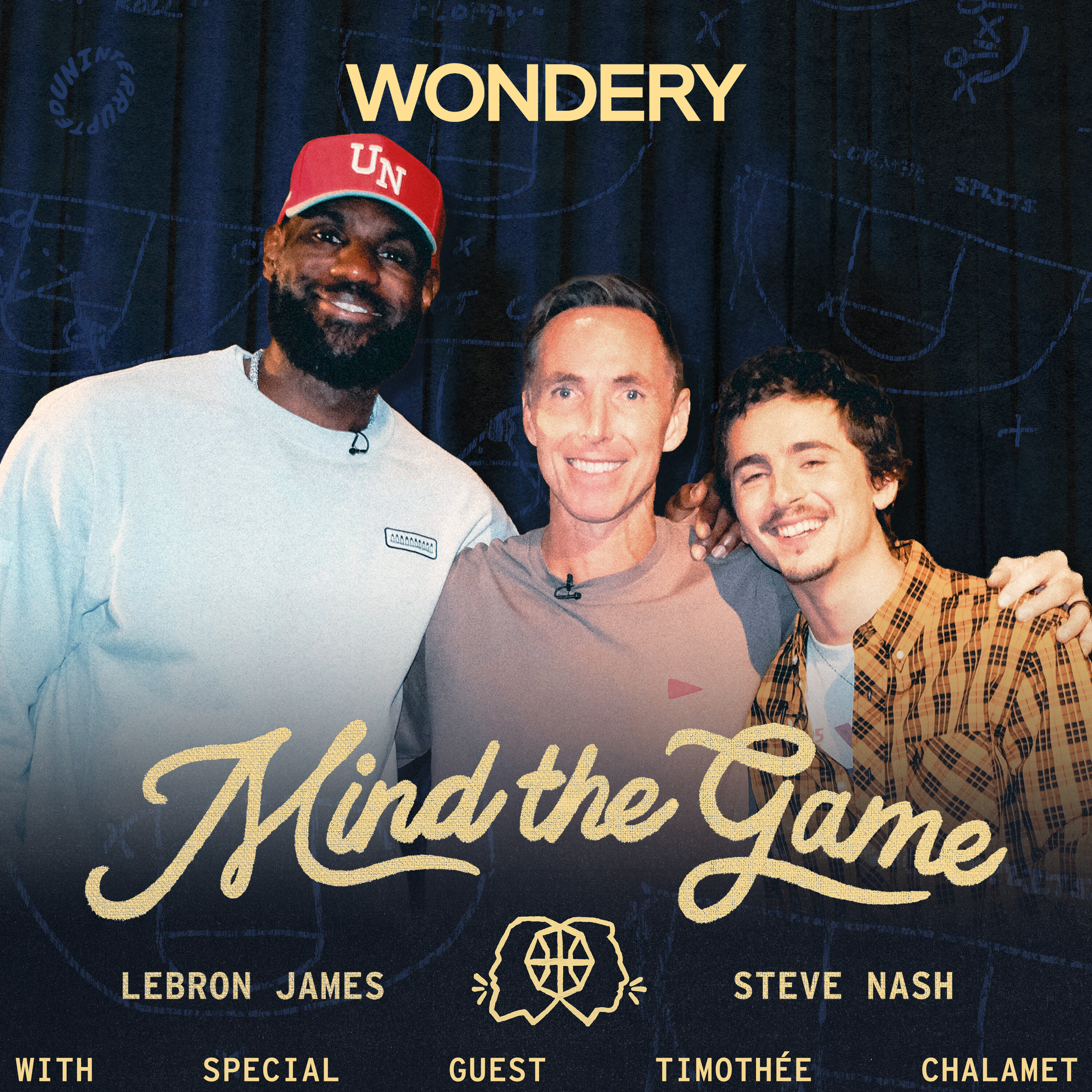
Hello, everybody. Thanks so much for coming. Yeah, my name is Jason. I'm the director of Mind the Game, and I just wanted to thank everybody for coming tonight. I want to thank a24 for helping make this possible. We're so excited about this conversation, and that's literally all I have to say. So without further ado, please welcome to the Stage Steve Nash, LeBron James, and Timothee Chalamet. First, behind the game, everybody.
- [00:40]
LeBron James
Hey, guys.
- [00:42]
Jason (podcast host)
Hello.
- [00:43]
LeBron James
Yeah,
- [00:46]
Jason (podcast host)
you're underwear.
- [00:47]
LeBron James
Whatever you want.
- [00:48]
Jason (podcast host)
You're in the middle. In the middle. All right. Yeah. Good evening. What's going on?
- [00:54]
Timothée Chalamet
What up? Yeah, what up?
- [00:56]
Jason (podcast host)
Yeah.
- [01:12]
Timothée Chalamet
Thank you, everyone, for taking the time to be here. What a trip. What's going on right now?
- [01:17]
Jason (podcast host)
Yeah, let's start here. Marty's an incredible character. How did you relate and find a way into the character being a New York City kid and growing up playing sports? And so I don't want to answer for you, but how did you find this role and the connection to it?
- [01:36]
Timothée Chalamet
That was exactly it. You know, majorly ambitious as a New York youth to find athletic greatness the way these two men next to me found it. I never found it in my own life, but I had that aspiration, that Jose Alvarado, whatever you want to call it, that kind of that dream big mentality in a huge part. I mean, I can't even look LeBron in the face right now, you know, like his whole career, but really more than a game. 2009 documentary about LeBron in high school and his classmates, his best friends. That was hugely impactful for me, man. That's the life I aspired to have. I didn't find it in athleticism, but I was able to find it in acting. And thanks to Josh, I found it in this role. I got to put it out there for the first time. You know,
- [02:21]
Jason (podcast host)
I just gotta ask, like, how nice are you at ping pong?
- [02:25]
Timothée Chalamet
Nicer than you.
- [02:26]
Jason (podcast host)
Okay, okay.
- [02:28]
Timothée Chalamet
Shit.
- [02:28]
Jason (podcast host)
You don't know anything about my ping pong game. But let's start back at the beginning because I think one thing that I'd love to do with our time here is, you know, we're Mind the Game is a basketball podcast. One of the things that we always try to do is share our experiences to help fans, but also younger generation. And so I think for us It'd be nice to frame this conversation in a way. Like, what could a young basketball player take from your journey? The, like, where you started, how you came to acting, and then what were the stages where you, like, got drawn into it, got obsessed with it? Your preparation, all the things that. The obsession of it, all those components of a career to get to the top. So could we start back in New York City? Your childhood? What was it like starting out? And let's get to, like, your sporting background. I mean, you wanted to be a soccer player as a kid.
- [03:17]
Timothée Chalamet
Yeah. Well, I feel like you grew up in New York, and you. Your personality is your armor. It's kind of like all you have. And I was definitely that crazy kid on the subway who had too much to express. You know, I wanted to be a soccer player. I wanted to be a basketball player. I didn't find my way into it. I went to LaGuardia High School, public Arts High School in New York. I definitely found my way there. You know, my mom went to PA as well, and I found a way to express myself. You know, I found a vacuum to put it through. I feel like in my career, I felt like Brandon Roy, you know, like, unheralded. And at times, I felt like LeBron, like, chosen one, you know, And I feel like in that dichotomy, I still can't look you in the face, man. And, like. And, you know, and it oscillates, you know, I felt like I had that raw talent going in. I felt like the first roles that I did a good job in, like, calling you by her name, were beautiful. Boy, that was all raw talent. There was no real process to it, you know, appreciate it. But that was just kind of messiness on screen, and I think it took a couple of years. And also the onslaught of fame and the attention and the intensity of it. Again, I could look at LeBron and his career, first couple years in Cleveland, and I didn't have a process. You don't have a way to deal with that. I feel like a complete unknown and Marty supreme. These are the first times I actually had a process and a way to. I don't want to say an artistic process. I don't want to discount my other work, but it's the first time I really locked in in a big way. Turning your phone off, you know, during an entire production. And, I mean, I'm doing eight years of history right now in, like, five seconds. That's. That's the short arc. Yep.
- [04:47]
LeBron James
I got a question. Like, we get a lot of like, fan questions, you know, a lot of our pods and, you know, a lot of kids that, you know, we all grew up in different environments, obviously. Growing up in Canada, me growing up in Ohio, you growing up in New York City. We all have, like, sports aspiration. We want to, we want to be on the big stage and play sports. But what would you say, what would be your, you know, conversation to those kids that's like, you know, can go and chase another, you know, genre like you did now, like, you're on big screen, you know, in movies. Your love for sports hasn't changed, but you're able to still, you know, love the game, be a part of the game, see the game, see you at the Knicks game all the time. But, you know, your path, you know, chose a different angle, but you're still doing the things that you want to do. So, like, a lot of kids, you know, they feel like if one thing don't work out for them, then they feel like they don't have another option. You know, what would you say to them?
- [05:40]
Timothée Chalamet
Man, I love that question, man. I feel like I'm sitting here with LeBron James and Steve Nash and like, you have, you could be 138 pounds and have infinite aura. That's like my answer and. No, no, no, but, but in all seriousness, like, I, I was supposed to hit him with the humbleness, and then I hit him with the craziness. But I feel like, you know, I found my, my, my way in, you know, and find your path, you know, and I feel like it's hard today because the world encourages kids to, to be cynical and it's a tough, man. We're living in a crazy environment. You have every reason to think we're living in a fucked up time and to not dream big. But that's why I love every Nike commercial you've ever done, you know, because I feel like that's a way of saying to inspire kids, you know, and to, and to always follow those dreams, you know, and like, like the way More Than a Game made me feel when I was 13, when I was watching that, man, it's just so important. And, and if you don't have that athletic gift like you guys have, you could find it in your own life. I'm like, you know.
- [06:33]
LeBron James
Yeah, that's awesome.
- [06:34]
Jason (podcast host)
Yeah. So we, we spoke recently a little bit, and you were talking about how early in your career, you touched on it already today, how it was kind of like vibes and aura and raw talent and you were messy, as you said. Earlier, your career. Talk about that. Like, when you got to LaGuardia, you started deciding that I'm getting this acting bug. What frame of mind were you in then? Because I'd love to get to where you are now.
- [06:58]
Timothée Chalamet
Well, I feel like coming out of the youth athletics I was doing, and I had these coaches that were dogmatic and intense, you know, and very orderly, and I felt like El Aguardia. I felt a lot of my acting peers have that sort of same mentality. There were rules to follow. I immediately found my strength in not following any rules. Like, I felt very raw. That just carried me through high school. Any suspicion of anyone trying to push you in any direction. But then at some point, not on a movie like Beautiful Borough Calling by her name, but on something like Dune or the King or these bigger Moo or Wonka, these bigger things, all of a sudden, you need to be able to flip it on all of a
- [07:30]
Jason (podcast host)
sudden, just so I make sure. So when you started LaGuardia getting into acting, it was almost like a benefit for you to be new to it, to be raw, to color outside the lines. Is that.
- [07:39]
Timothée Chalamet
Yeah, absolutely. Because I also felt like no one, at least at 13, 14 years old, I didn't see anybody else doing that. I felt like everyone was kind of coloring in the lines, and I feel like, oh, this is actually my superpowers, my fearlessness, my recklessness.
- [07:51]
Jason (podcast host)
And you felt a confidence to do that right away. Like an innate confidence, like on stage or in classes, to just go for it.
- [07:58]
Timothée Chalamet
Yeah, because I didn't have that athletic thing, like, that was with girls or anything, you know, that was my. Sorry. Sorry.
- [08:04]
Jason (podcast host)
All right.
- [08:05]
Timothée Chalamet
You know, that was just my thing was like, I. That was my personality. Yeah. It was like my only thing I really had going for me.
- [08:12]
LeBron James
Yeah, it was your superpower.
- [08:13]
Timothée Chalamet
That was my superpower. Exactly. And then. But to bring some organization to it, you know, was kind of what brought me over the edge, you know?
- [08:21]
Jason (podcast host)
Could you explain, like, so you had this success. You had some incredible early films and success and accolades and acclaim. And what was the inflection point where you're like, oh, I just can't come out here and act on vibes anymore?
- [08:36]
Timothée Chalamet
I think it was on. That's a great question, man. I mean, I feel like the King and Dune were really eye opening to me because I could see, you know, like, Rebecca Ferguson was this amazing actress I worked with, Josh Brolin, Oscar Isaac, they could flip it on a switch. I was selfish at that point where the roles were coming to me, like, Beautiful boy or calling me by name is supernaturalistic. And here all of a sudden I had to shapeshift, you know, and flip it on a dime. So I realized I need a process, you know, I need to find a way to bring these muscles to life when I need them to come to life.
- [09:05]
Jason (podcast host)
Think about the scale of something like Dune. The scale of Dune, like I'm assuming, sorry for the, the Neo fight here, but I'm seeing this is a lot of sound stages, massive productions. What's the difference from being on location in smaller films and then all of a sudden you've got this like $800 million apparatus around you. Like, is like for us, playing in a high school game and playing in a pro game or a regular season game in the playoffs. Do you feel the weight of that in those moments when you.
- [09:36]
Timothée Chalamet
Absolutely, because you feel the financial pressure, the commercial pressure of a $200 million movie, but also, you know, the eyes on set. I love what you just said. It's a studio environment like Call Me by Her Name was in the idyllic Italian countryside. And there, you know, you got all these eyes on you and the expectations and the pressure, especially on the first Dune, that, you know, in Hollywood you can, they can greenlight a movie. You have 200 million dollar movie around, but if it doesn't work, you're sort of cooked, or it'll take you a while to get that opportunity again, you know, so.
- [10:04]
LeBron James
And that was gonna be one of my questions too, because, like, for us in our profession, if we go out one night and we play like shit, well, we know we got one the next night or one that's less than 48 hours later. So, like, what's your mindset knowing that, like you just said, like, if I don't go out and I give shit a effort and have this process and go out and kill this fucking role, then boom, I may be cooked. And the roles that may be coming to me that I thought was gonna come to me maybe go to somebody else. So now, like, do you, do you benefit that to, like you said, do you benefit that now to like, the process? The fact that you had this new movie just come out, Marty supreme, the Dune 1 or Dune 2, those things, those bigger movies, is that when you got away from the messy to the process, that was you feeling the pressure of saying to yourself, oh shit, these are bigger roles. Or if I don't make these things happen, if I don't kill these roles, then somebody else may come forward?
- [11:01]
Timothée Chalamet
Yeah, both. And also the confidence that's come from the success of prior projects. But, man, the best way to answer that, I don't know. I get jealous of athletes. I was thinking about this on the way here because you have the camaraderie in the locker room. And also your coaches are your coaches, you know, and a director is not a coach. You know, they're not there to take care of you mentally. Not that your coaches are there to take care of you mentally, but they're there to put a project together. And I think it's a solitary process getting better. Like, I don't know, for you, like in the offseason, do you feel like you're doing your best work to get better alone or with, you know, a specific coach?
- [11:37]
LeBron James
Yeah, that's. That's a good question. I think I found. I found joy and a lot of, like, lock in mentality doing both. I understand that me personally, along my journey, that I. And my biggest critic. So even with all the conversation that goes on about me on the daily and everything that's going on in my career and everybody that's trying to decide what my career should look like or how I should play or whatever the case may be, I knew that nobody could put more pressure on me than myself and hold myself more accountable than myself. But it is good along the process to have people that you can go to and throw things off of and people just will just listen. Sometimes you don't even need a voice to come back to you. So I hope that you have this. I hope that you have that person that you can either throw things to them, they can throw things back to you, or you just got a soundboard, you could throw things to people and they don't even need to say anything. It's just allowing you to express what may be going on with you mentally, physically, emotionally, spiritually.
- [12:42]
Timothée Chalamet
So when did you shift? When was there a moment earlier in your career or maybe from the jump you were at Blinders On?
- [12:48]
LeBron James
No, when I went to Miami. When I went to Miami in 2010, that's when it shifted for me.
- [12:53]
Timothée Chalamet
So mad, man, I wanted you come to Knicks so badly. I was so mad, man, I got
- [12:58]
LeBron James
a story that I'll tell you backstage about this. About that New York situation. No, but like, if you think, you know, a lot of people kind of, you know, kind of follow my journey. Once I was on the COVID of Sports Illustrated at 16 and a half, 17. I was on a national stage on ESPN, you know, at 17. And then I got drafted to basically my hometown team. You know, I grew up In Akron, Ohio, 30 minutes south of Cleveland. Okay, I hear you back there. So my first 25 years of existence basically was at home. So even when I was a professional for the Cavs, I was still living in Akron. So I knew every street, I knew every road, I knew every restaurant. I knew everything that had to do that was comforting.
- [13:45]
Jason (podcast host)
Like, really helped a lot. Or were you like, enough's enough?
- [13:48]
LeBron James
No, I think it was comforting, but you never know because when you're. When you're. You're comfortable, you don't know if you uncomfortable or not, because it's just been my life. So it took me to get uncomfortable going to Miami and experiencing something new for me to tap into something I didn't even know I had or I knew I wanted. I knew I wanted to win championship, but it took me to go to Miami to kind of. Kind of learn myself.
- [14:13]
Jason (podcast host)
How old were you when you went to Miami?
- [14:14]
LeBron James
25.
- [14:15]
Jason (podcast host)
What was that like?
- [14:16]
LeBron James
I don't recommend anybody go to Miami at 25. If you don't have. Yeah, you gotta have a strong mindset. Yeah, I had it. I had a strong mindset. I don't recommend people to go to Miami at 25. Yeah, yeah.
- [14:34]
Timothée Chalamet
What about, like, turning your phone off in the playoffs and that kind of stuff?
- [14:37]
LeBron James
Yeah, I did that. And I just started reading a lot. Like, I wanted to start tapping into things that was just uncomfortable, something that I didn't even know I could do. But who's gonna hold me more accountable than myself, as I continue to mention? So just, you know, through a whole playoff run, you know, I would just turn my phone off completely. You know, if my loved ones wanted to get in contact with me. Randy was with me every day. Maverick would be around. You know, a lot of the times. They want to get in contact when they can call them, and if it was an emergency, they will come. If we was on the road, they'd come knock on my door. Then I knew it was an emergency. Other than that, nobody could get in contact with me for two and a half straight months, you know, And I was just doing a lot of reading, a lot of reflection, a lot of meditating just on what I wanted to accomplish in my career, what I wanted to accomplish. And it had nothing to do about, you know, the naysayers or what we call the haters or the down people that down shit on you and to make themselves feel better. It was never about that. It was, what can I get out of my career? And that's why I did it.
- [15:42]
Timothée Chalamet
And I got that straight from LeBron, the turn your phone off thing. And I started on complete unknown. But also, I'm already supreme just that time is sacred to shoot the movie, you know, and inspired hugely by LeBron. But also other people I've heard say that, you know, the phone's the easiest distraction now, and it's just such a gift. I love that you said, how can I make myself uncomfortable? I can relate to that so deeply. Like, what kind of austere setting can you. Severe mindset can you put yourself in and push yourself over the edge?
- [16:08]
Jason (podcast host)
You know, pushing those boundaries?
- [16:10]
Timothée Chalamet
You guys both. Or. Steve, you play with Kobe. I know you play with Kobe on the national team. I feel like he epitomized that. I never really got to know him on a personal level, but I feel like he epitomized that. I don't know if you guys can speak to that at all.
- [16:19]
LeBron James
Absolutely.
- [16:20]
Jason (podcast host)
Yeah, absolutely. Super driven as you guys are. And, you know, I think it's interesting. I always think of it as, like, so, for example, you're going into Dune. You know, there's a $200 million movie. There's. There's pressure not only to perform, there's also pressure for the career ramifications. So then you extrapolate that back to the beginning, and you say, okay, I gotta prepare for this role. I gotta show up ready to perform. That's same thing. LeBron goes to Miami, he teams up with D. Wade. He has to be ready to go in the playoffs. Right? So that informs your preparation. I always think of it as, like, there's a balance between tension and freedom. Like, you have to have that tension, those nerves, that anxiety that pushes you, and then the freedom to let go and perform.
- [17:01]
Timothée Chalamet
Oh, man, you nailed it. I mean, that's where an athletic and artistic approach matches up in the same way, too. Man, you just nailed it. Definitely. I'm already supreme. But also the last Dune I just shot this past summer. You over prepare, you're too prepared. And then on the day, I can let loose, like a freestyle, for lack of a better expression, because I know how prepared I am. You know, I don't know what the exact basketball metaphor would be, but maybe it's a play that's drawn up.
- [17:20]
LeBron James
And then, yeah, I will go back to my high school coach. He would always say, listen, yeah, we're going to practice hard as hell. We're going to make practice hard as hell every single day, because it's gonna make the games that much easier. And I think that's what's all About. I think that's what kicked into my head about just the process. Like, you know, if you go out and prepare yourself and you're process oriented and you also visualizing what it's going to look like, visualizing being in that moment, visualizing being at, you know, living in your own vessel. Like right then and there. I think once the director say action or once. Once the jump ball happens, boom. It's like I already know what I'm doing. I'm locked in. I'm already. Because I've been here already. I've already visioned this. This is. This is already written, you know, where everybody else is thinking and they're just watching it for the first time or seeing it for the first time. No, I've already been here. So you guys are going to see. They talk about in our sport, the Zone. How does it feel when you're in the zone? I never have the answer to it. I always say it's like. I always talk about the Bruce Leroy effect, you know, like, I have that effect, like that glow over me. It's like, yeah. You know what I'm saying? So it's like when you have that, it's hard to explain what the zone is. But for people that's been process oriented and people that tapped in on so many, I mean, this guy's amazing too, by the way. Unbelievable actor too, right there. Amazing. Like a legend right there, ain't he? He know what the process is about too. So, you know, it's just. It's a beautiful feeling.
- [18:50]
Timothée Chalamet
Let me ask you both then. Was there a period in life, and I think for athletes, it's harder than artists because the window's a little bit shorter where you feel. Feel like you didn't have that process as locked in. You joked about Miami at 25. When we had our zoom the other day, you said maybe there were times you weren't taking care of yourself after the game. When did you learn to take care of yourself? Because without saying any names, you could point at a laundry list of guys who never learned to take care of themselves and let their careers kind of fall by the wayside.
- [19:14]
Jason (podcast host)
I mean, for me, I was always had to outwork people. So always, always, always put in the work. I'd be there early, I'd stay late. But I also like to have fun. And so there was a time, I think, when I realized, okay, I'm not good enough to get where I want to go. Losing, getting beat by somebody, that that's what changed some of those behaviors, right, Hank? Going out with my friends too much, whatever it may be. I was always willing to go back and be the first one in the gym in the morning, but you can't do both. And so there was a time when I think I realized, like, if I want to take that next step and the next step and the next step, I had to cut some of this stuff out, be more focused, leave no stone unturned. When you think you just had a good workout, be paranoid that wasn't good enough. Like, I think I'm in shape, I'm not in shape. You know, that kind of mentality to push yourself further. So I could talk for two hours about ways that I either tricked myself, convinced myself had an inflection point in my life where, you know, because I was always obsessed with it, but I was also having fun or distractions. Other places where I needed to streamline this to, like, if I want to get everything I can out of myself. Like, some of this stuff doesn't fit in the picture. So I don't know. I'm sure. Similar situation for you as you mature.
- [20:33]
LeBron James
No, absolutely. I mean, me personally, I was getting early in my career, you know, my first seven years in Cleveland, I was getting out of my career. Some of the goals that I set out for myself. You know, all star appearances, rookie of the year, mvp, All Star game, mvp, whatever the case may be. But some of the. I've always been a team aspect guy, you know, I grew up being about the team. And the most ultimate team success is a championship. So if I'm not completely locked in and completely determined on that as well, then I felt like I was failing myself, too. So just kind of just seeing other ways that I could be better if it was something that, you know, I was getting. I got to the finals one time. I got to the Eastern Conference finals a couple times, lost a bunch of games, and it just never was. Losing has never been satisfying for me because I had won at every single level. Doesn't matter if it's little league to middle school through high school. I've won at every level, and I wanted to win at the highest level. I wanted to win at the highest level. So, you know, it was just about, like you said, just reshaping, like, you know, sacrificing something in order to get the bigger, you know, the bigger prize out of it. So, you know, that was. That was it for me.
- [21:52]
Jason (podcast host)
I think for us, we have to. In sports, at least in team sports, you have to balance the ego and the team and reconcile the two Right. You have to reconcile your own individual wants, needs, growth within the team landscape. I'm interested. From your perspective, how do you reconcile the competitive side of being career driven with the artistic side? You know, it's subjective, it's an art, and at the same time, it's an incredibly cutthroat career.
- [22:22]
Timothée Chalamet
Well, the competitive side is keeping me grounded, I feel like. And to that extent, I mean, how many roadmaps in front of me are really healthy to look at? I would say few. And I could see a lot of roadmaps, you know, heroes of mine that don't end in a particularly put together form.
- [22:40]
Jason (podcast host)
Can you name some names? I'm just kidding.
- [22:43]
Timothée Chalamet
No, but I feel like, again, that's why I'm envious in sports, because you have the camaraderie of the locker room, you know, the high pressure stakes of Hollywood, and you see people crack, you know, it's almost like people are anticipating that sometimes. And so I feel like a competitive edge keeps me grounded because it keeps me goal oriented. We talked about this on the Zoom. I see two traps. One is a life of indulgence. Partying isn't even the right expression, just indulgence. Let's say the other trap is, like, paranoia. Like, I'm gonna hold on to what I have for dear life because I don't wanna. But I'm in the middle path, which is like, I wanna keep shining and building and going forth, you know, and leaving it behind for the next guy. And that's why I love doing this for you guys. We don't have the same careers, but again, you know, so inspiring. LeBron's been to me my whole career, my whole life, you know, and something about even being in la. LA lets you live, like, not in Deluland, but a little. Like, it lets you think of the biggest version of yourself, you know, and being in New York. Sometimes it's hard to dream like that because the living situation's harder. But in la, you can kind of visualize the best version of yourself.
- [23:48]
Jason (podcast host)
You don't agree with that? Man, I agree.
- [23:50]
LeBron James
I just know how New Yorkers are. You guys are craz.
- [23:54]
Timothée Chalamet
Oh, yeah, we get. You're definitely crazy. Definitely. Why don't you come to The Knicks, man? 2010, man, come on. That would have been so good, man. Damn, man.
- [24:03]
LeBron James
I got a question for you, Steve. As long as we've been doing this, I never asked you this question. Like, have you ever. I mean, I know you have. I have as well. Do you ever, like, sit back and think, like, if you had played an individual sport, would you have gotten more or less out of your. Your ability, your career?
- [24:23]
Jason (podcast host)
Like, Great, great question. It's not that I couldn't see success in an individual and maybe growing and eclipsing in a way, that way, but there's something about being a part of a team that I just love so much, that meant so much to me, that gave me life, you know, to want to see your teammates succeed. You know, you and I both play in very different ways. A similar way. We both want to make our teammates better. We want to see them thrive. We want to make the whole thing. Thing fit and work and find harmony between our teammates. Like, that's a big part of the motivation and joy, I think, for both of us. And so that feels like a such a big hole in an individual sport. Having said that, there's ways, I think, like, I fell in love with tennis the last nine, 10 years. So if I were to imagine that, like, you can put a team around you, create an environment, you know, where you can make up for some of that in different ways. But I think having loved team sports my whole life, love the banter, the locker rooms, the pickup games, the practices, the road, the dinners, that just feels like something I can't imagine not having.
- [25:34]
LeBron James
Yeah, I agree.
- [25:36]
Jason (podcast host)
You feel the same.
- [25:37]
Timothée Chalamet
What about you in football? You ever think about.
- [25:39]
LeBron James
I do, I do. I definitely would not still be playing football right now at my age. I'd have been done probably about 10 or 12 years prior to this. But absolutely, you know, it's the first sport that I played, is where a lot of my aggression comes from. Over the last 11 years, my aggression has went quite down since my daughter entered the world. She's kind of taken away all my aggression over the last 11 years. But, yeah, I love the sport. I think it's one of the most detailed, you know, team sports because every single body has a very intricate individual role, and it's literally just one play, and you gotta do something different the next play and the next play and the next play. And it's very challenging. It's very challenging playing football, but it was fun. It was very fun. The biggest challenge is just playing football in Ohio during the wintertime. Falling on that grass is definitely not something I look forward to. So I'm happy. I fell in love with indoor sport, that's for sure.
- [26:47]
Jason (podcast host)
Let me flip back to you, Timmy. I think there's a role that fascinates me because I think there is a scoreboard, and that's a complete unknown. Like to play an iconic figure, Bob Dylan, like, there is a scoreboard because you. Everyone knows the role, and you have to then have people disappear into you as the character. How different is that from a role where you have more creative license in a. I mean, you still have creative license. You have to bring this Bob Dylan to life, and they have to buy him. But you know what I mean? Like, how do you measure yourself up against a real walking icon?
- [27:25]
Timothée Chalamet
Yeah, I love that you said a scoreboard. That's kind of how it felt. Because it feels like when you do a biopic of somebody who's beloved, they'll do a biopic about you, and they're definitely gonna do a biopic about you. So get ready. In fact, I'll ask you after who you guys want to play you. But I felt like I think there's
- [27:38]
Jason (podcast host)
only one person on the stage you could play. Personally, I don't know. I don't know.
- [27:45]
Timothée Chalamet
Let's work on the script, man.
- [27:46]
Jason (podcast host)
Okay.
- [27:48]
Timothée Chalamet
You don't think I could play LeBron, man?
- [27:49]
Jason (podcast host)
Come on, man.
- [27:51]
LeBron James
Well, if it started in, like, LeBron in second grade, you know, when my
- [27:55]
Timothée Chalamet
career, like, started, hey, man, I'll do it, man. There LeBron was 5'10 in second grade, and he was white. No, I'm kidding. That was the puncture.
- [28:06]
Jason (podcast host)
No.
- [28:07]
LeBron James
So the wintertime's really kicking his ass.
- [28:10]
Timothée Chalamet
There's no sun in Ohio. No sun. Wow, that's an amazing idea, actually. And the Oscar goes. No for this.
- [28:19]
LeBron James
No.
- [28:20]
Timothée Chalamet
We got good chemistry, man. We should do a bit. No, I feel like I got too sophisticated response to that. We're in too good a flow now. I would just say you gotta over. I over prepared the fuck out of everything in a complete unknown. I felt, like, more emotional about it than anybody on set. I felt like I had the authority about the character. I felt like everything. I was in the bones of it. So if somebody threw shade at the movie, in the long run, I would know that I had the most magical experience in my life, you know? And playing Bob Dylan, I don't know what the athletic metaphor would be. It'd be like, if you got to, you know, be Jordan, you know, you know, let's get in the goat conversation. No kidding. It'd be like, of everything the last three months, this is the best highlight, man. This is number one. I don't care about any awards show or anything. This is, like, by far the greatest thing ever. LeBron's first game on the Heat in New York. I was there. I was booing the out of LeBron, I said, why did you come to the Knicks?
- [29:19]
LeBron James
That's probably why I play so well.
- [29:21]
Timothée Chalamet
Yeah, he killed it. He crushed it. And by the end of the game, I was front row. I snuck down, I was next to Polo to Don, my Miami hip hop producer man. So if anybody could find that tape, I was front row by the end of the game.
- [29:32]
LeBron James
Oh, it'll be found probably by the next 20 minutes.
- [29:36]
Timothée Chalamet
Find it.
- [29:37]
Jason (podcast host)
But sorry, we're having.
- [29:39]
Timothée Chalamet
Sorry, Steve.
- [29:40]
Jason (podcast host)
I put it off. But like, what does that look like? Like, take me back to, like, you get the role and now, like, how do you become Bob Dylan? Like, so. And this is like, let me, let me frame this in two ways. In, in. I want to hear about Bob Dylan, but I also want to hear about acting. Like, I know what LeBron and I do, what an off season looks like, what pre practice routine looks like, what trying to add something to our game looks like for an actor. What does that look like between roles? Like, are you in the mirror practicing? Are you creating characters? How does an actor improve their skills? The way we are always trying to add something to our game or become more consistent so that we can perform?
- [30:18]
Timothée Chalamet
Great question, man. I would say it's less looking at movies and more looking at real life. Jack Fisk, the production designer of Marty supreme, he says he never pulls from another movie because you're already pulling down. You're pulling from water, down life. If you pull from another movie, you gotta go see real life. I feel like the off season for an actor is you don't destroy yourself. That's how low the stakes are, that's how low the requirement is and how high the stakes are. And I'm not trying to be preachy about mental health and acting and all that, or just in the artist community, people do not take care of themselves, you know. And I could put. That's been me at times, you know. And so the responsibility is, don't destroy yourself. If you don't destroy yourself, you've won 95% of the battle. And then now in the last three years, four years, moving to LA, the healthy lifestyle I have, you know, I'm locked in. I'm really. I got this rare gift, you know, to be working on projects at the highest level. So I want to seize it. You know, I could be one of a million people living a nice lifestyle, you know, that earned a nice living for themselves. I should have gotten into insurance banking if I wanted to live it like that. But if I'm going to be an actor, if I'M going to be in front of the world and live this weird lifestyle. I might as well try to make great things. You know, look at the way he's guarded his career and his. His, his. You know, all the championships. I go back to Kobe again, man. That Kobe stuff doesn't happen with him partying, you know, and that's why I took that approach on Marty supreme, too. You're never trying to be outwardly antagonistic on set, but if we're all taking pay cuts to be here, we might as well, like, really go extremely hard, you know, and be very intentional about what we're doing.
- [31:43]
LeBron James
Yeah, that's awesome. Yeah.
- [31:45]
Jason (podcast host)
Clap it up.
- [31:45]
LeBron James
Yeah, that's it. So, I mean, while you guys were having that conversation and you were talking, and I had a question pop up my mind for you. Like, do you think the motivation and, like, the determination and everything about that's happened in your life so far, like, when it comes to, like, the process and everything, whatever case may be, do you think your motivation and your drive has been more from starting ground level to get into the top or being at the top and stand there?
- [32:21]
Timothée Chalamet
The ladder. Absolutely, the ladder. What a great question, man. No, it's the Ladder because, you know, there's a great video of LeBron. You know, it's the lion video. I don't know if you've seen. It's Christopher Walken a monologue over. This is, like, insane framing. I'm gonna get killed for this. But it is what it is. There's a video of LeBron in the playoffs, and it's a Christopher Walken monologue. I forget from which movie, but they say the lion, and, you know, and the Jekylls are yapping at his side. You know, this is insane framing, but I'm just being honest, and I feel like once I achieved at a certain level, you know, you want to stay up top. And also, this is, like, the moment is thin. I know the moment is thin. You know, as an actor, you can have a long career, but this is, like, a unique thing I'm in. So I definitely feel like even coming here tonight, it's like, no, man, I don't want to just make this a humble podcast. I want to, like, leave an imprint. I did a thing with Matthew McConaughey in Texas. Same thing. I want to leave an imprint. Everything, every. If I go up there for an award show, like the SAG Awards last year was random. I wanted to say something, boom, that's going to leave an imprint, you know, and don't Take anything for granted. And that's. I love that you framed it that way. Because when I was starting out, I couldn't have had that thought to begin with because I was like, man, there's no chance I'm going to even. But once I'm here, you know, and also my motivations are in the right place. I feel like the ways yours are too. But I'm like, I just want to do great acting. I'm not here to take advantage of people. I'm not here to. To just make money. I really want to leave it for the next guy, you know? This is the only kind of conversation you can have with athletes, man. This. This would make. No, this would make sense with. I don't know, let me not say something to get me in trouble.
- [33:49]
LeBron James
But anyway, I think the. I think the best thing, just sitting up here and spending time with you for the first time. I think what I've gotten and what I feel is just your present. You're present in the moment. You're present with yourself. You're present with the moment. You're present. And that goes a long way because I think a lot of people are either thinking about the past way too much, which we can't change, is over with. And also worried about what's coming next when it's the unknown. And I think sometimes we get lost in what's actually happening now. Like, where are we now, personally? Where are the people around us that sometimes we take for granted, whatever the case may be along our journey? But it just seems like. And I'm. Had an unbelievable moment with your beautiful mother in the back, and she's awesome. Give it up. Give her. Give it up.
- [34:35]
Timothée Chalamet
Give it up, guys.
- [34:37]
LeBron James
Give it up for Mama.
- [34:37]
Jason (podcast host)
Yeah.
- [34:38]
LeBron James
There you go. Stand up, Mama. Yeah. You know, the presence of being here, like, I think that is big time. And you just. Bro, you dope, as hell, man. And it's going to be. I'm going to continue to watch it and see it unfold because it's nothing but greatness behind it, man.
- [35:00]
Timothée Chalamet
I appreciate. But let me flip it on you. Was it more motivating at the start to try to get to the top or once it was a couple championships in Miami or going back to Cleveland or Warriors.
- [35:10]
LeBron James
Wow. Was it more motivating to climb or staying there? I think, yeah, I would say the climb to the ladder. But also, I don't come from shit, you know, like, where I grew up, you know, single parent household, only child. My mother was 16 years. She was a high school sophomore when she had me. She didn't work. So we, like, we grind every. She grind. She grinded every day. And my. My only mindset as I was, like, growing up as a young man at 5, 6, 7 years old was not to put any more extra pressure on a black woman in the fucking ghetto. Like. Like, I couldn't do it, you know? So, like. Like, I think back as a. I think, like, I think back now as a parent of myself of three, you know, and it's so crazy. When I entered high school, my mom was only 30 years old, you know, like, you know, you don't know. You know, when I was 14, I'm like, my mom, like, you know, my mom's old, man. Like, she's old. Think about it now, like, she's 30 years old. Like, she was still. Like, my mom was still trying to live her life. She was still young. You know, she had to sacrifice, you know, being a parent at a young age. So, like, the client for me was so much more motivating because I had. I wanted to do everything I could in my power to get out of the situation that, you know, the hand that was dealt to me and my mom, you know, and then it turned from motivation once I got to the top to, like. Like, determination of not letting nobody knock me off that. Off that spot, you know, so. Yeah, but the climb, like you said, the ladder man. And it's a. It's a. It's a beautiful, you know, it's. It's a beautiful thorn in the ass. Yeah. Process, you know, going from here, getting to there. Like, you see so many different things, and it's a beautiful journey, you know, but, you know, this. It was. It was great, you know, I love it.
- [37:12]
Jason (podcast host)
That was beautiful, what you said about your mom. How old were you? And how did it manifest when you're like, I don't want to put anymore. I recognize what my mother's going through, and I don't want to put any more pressure on her.
- [37:24]
LeBron James
See, I. It's funny. I. I grew up. She gotta understand. When I grew up, I was. You know, I watched. I was watching the Cosby Show. Two parents, bunch of siblings. Fresh Prince of Bel Air. You know, I kind of looked at Will Smith on Fresh Press of Ballet. I was like, damn, I would love to go to Beverly Hills and live with a. Live with another family. And, you know, so, you know, Family Matters was another one. Two parents, bunch of, you know, bunch of siblings. Full house. Two parents, bunch of siblings. I grew up watching all these shows. Tgif Friday, for all the older people out here, y' all remember that? Like, it was literally two parents and a bunch of siblings. I was like, oh, that's. That's not. What is this? But. But I was like, that is very inspiring, too. You know, pick a fence, dog. You know, I tell me and my boys always talk about this a lot. I didn't know what a pantry was until my freshman year of high school. I went to my high school coach's house. His name was Coach Danbrot. And I went to his house, and I asked him, like, can I, like, get a snack or, like, some chips or whatever the case may be or whatever. He was like, yeah, just go in the pantry. I'm like, you have a map? I'm like, where I grew up, everything is on top of the refrigerator, bro. The bread, the chips, the cereal. Everything is on top of the refrigerator. I don't know what the hell a pantry is. So, like, that was my motivation right there. I'm like, I gotta give my mama a pantry.
- [39:02]
Jason (podcast host)
That's amazing.
- [39:05]
Timothée Chalamet
What's the moment where you felt like that clicked? I mean, where you solved that?
- [39:10]
LeBron James
I don't know. I think the moment it clicked was my sophomore year of high school. We played Oak Hill Academy, which is in Virginia. They was the number one high school team in high school, and they had a couple NBA guys on their team, a couple Division 1 players on their team. It was a big kid from Senegal named Sagana Jopp, who ended up being a lottery pick to the Cavs a year later, or maybe two years later. And I was out on that floor. And before the game, I was nervous as hell. I was super nervous to play against them. But then when I got on the
- [39:44]
Timothée Chalamet
court,
- [39:47]
LeBron James
something came over me. I was just. It was the man above. He had me, man. He had me. And he showed me like I was just out there just doing things that I didn't even know I was capable of doing. And I came out of that game, and the next day, it was a bunch of newspaper articles or whatever the case may be, was just talking about, hey, there was a lot of NBA scouts there at the game. They was there to see Sagana Jopp that was there to see, you know, a lot of these players from Oak Hill. But they left talking about LeBron James, and I was a high school sophomore, and when I heard NBA scouts in my name, I said, oh, boy. I said, listen, you don't fuck it up, Mr. James. As long as I stayed the course, have fun with my friends, but don't do nothing silly because you, I mean, where I grew up, you can. It could be good one day and the next day it could be not so good. So. But just don't mess it up. You know, once I heard my name associated with the NBA, I was like, okay, just, just lock in a stated course. Just two more years of high school. You don't even have to pass SAT or act. You don't have to worry about that. All right, let's just. NBA champ.
- [41:02]
Jason (podcast host)
Well, you, I mean, you've been quote unquote, the chosen one since freshman sophomore year. For you to get this far, to be the very, very best to ever do it and to literally navigate that whole thing like with unbelievable class, grace, family, man, it's. See can keep inspiring you.
- [41:27]
Timothée Chalamet
That's what you absolutely. You know, I got nothing to add to that.
- [41:31]
Jason (podcast host)
Right? Like that's. It's impressive because there's a lot of spotlight and I admire you a lot for that. If I must say to my, my pod co host here, and I got
- [41:40]
LeBron James
a new movie coming out next summer that I want. Y' all go check it. I'm just playing. Oh yeah, go check it out. Starring Timothy.
- [41:49]
Timothée Chalamet
Yeah, that's a young LeBron James. There you go.
- [41:55]
Jason (podcast host)
Should we go to the train wreck, train wreck clips now?
- [41:59]
LeBron James
But we do got a clip though. Don't we have a clip that we want to show?
- [42:04]
Timothée Chalamet
Yeah, we have a clip of a clip.
- [42:06]
LeBron James
Can you preface?
- [42:08]
Jason (podcast host)
We can. We have a clip from Dune 2 where you're addressing your people and you're kind of telling them that you want to be their leader. And it's a pivotal moment, I think, in this odyssey, so to speak, this, this epic series. I think it's interesting to just talk about, like, I'd like to know, like on the day, like, what were you and Denis trying to accomplish? What was it like in the day for you in your head versus the preparation, versus the choices that you make on set. So maybe tell us a little bit about that before we watch the clip and then.
- [42:46]
Timothée Chalamet
Yeah, definitely. And you know, I won't pause it or anything. It'll be weird when we're watching the clip. But this is a great scene I thought to break down because this is a scene that's memorized in a made up language called Chakopsa. So I went and I memorized it in English as well. So I knew the intention of every line in the scene. And we actually shot the scene in both versions. There's a version of Jacobsa that's in the movie. But there's also an English version that never made it into the movie. One of my favorite parts of the scene, too, is it's sort of shot out of order. So the first time you see Paul Atreides kind of turn on his shoulder and say, no one in this room can stand against me. That was actually shot in the middle of the day, which will be familiar to actors, but maybe not familiar to everyone at home, that you shoot tremendously out of order. Other than that, the only thing I really got to add to this scene is this is the biggest collaboration between Denis and I on the second movie. You know, this is. He's so tightly perfect as a director, Denis. He often doesn't even really need the. The ideas of Baki and stuff from an actor. And here, you know, this was something where I had figured out in the rehearsal in days in advance alone, you know, where I wanted to be, that I wanted to start squatting. I wanted to rise at a certain point. I wanted to approach one of the Fremen and chastise them in Jacobsen. I wanted to recross and, you know, end in the middle of the scene. And also, just as a point of reference, the set was really just like a mound surrounded by nothing. So it felt very. You use the word Odyssey, you know, it felt very like. Like a Greek tragedy or something. It was. It was. It was prime real estate to do something that felt very. Not theatrical, but very in the spirit of theater, you know, performing arts.
- [44:24]
Jason (podcast host)
But before we roll the clip now, I'm curious. You're. You're on a soundstage. You're on this mound. There's nobody around you. But in the scene, there's hundreds of. Whatever. It appears like there's thousands and thousands of people. How do you. For someone who's. Who's never been in that position, how do you bring it as though there are thousands and thousands?
- [44:49]
Timothée Chalamet
Well, you feel like there's an expectation to bring it. And for every moment that I haven't been dominant on a basketball court or on a soccer field, that's the chance I have or had. You know, that's my superpower, man. I got it cooking. I got it bubbling inside, sending a Marty supreme when I'm playing table tennis, that's all the athletic edge I've never gotten to have in real life, because I don't have the skill or the ability. The great thing is when you script it kind of like WWE or something, you can. You know, you do it. You can have it to your advantage, you know. So also, in those Movies, it felt like time to shine kind of thing, you know, Other days you can be more supporting and have seen all the sudden you feel like people are a little more quiet around you on set. Maybe it feels like that in the playoffs or something. People kind of giving you a little more space, and it's just great. You see your director calm. Maybe it's like that with head coaches. You see your head coach calm, you're like, all right, I know I'm locked in because everyone else is calm. You don't see people freaking out.
- [45:41]
Jason (podcast host)
So it's like a big adrenaline moment, like a big moment in a game as well.
- [45:45]
Timothée Chalamet
Not to make silly adrenaline rush on that scene, you know. And so I go to the Knicks games, you know, they'll play scenes from other movies. No, you guys play the Dune scene. When they play that at the Garden, then people get fired up, you know.
- [45:55]
Jason (podcast host)
That's amazing. Well, let's. Let's roll it and maybe we can talk about it after.
- [46:05]
Timothée Chalamet
Do you think you could have a ch. Do friendly?
- [46:51]
LeBron James
Do you sound okay?
- [47:38]
Timothée Chalamet
This is my father's ducal signet.
- [47:51]
LeBron James
I am paul muadib atreides, duke of arrakis.
- [48:26]
Jason (podcast host)
Yeah, it's incredible scene. Incredible scene.
- [48:30]
Timothée Chalamet
That was an insane angle to watch, that man.
- [48:32]
Jason (podcast host)
Holy.
- [48:33]
Timothée Chalamet
My neck.
- [48:36]
LeBron James
Wow.
- [48:37]
Jason (podcast host)
It was amazing, though. Powerful. I can see how the adrenaline must be a key component of that. But, like, maybe give us a second to tell us about the choice of kneeling and why, to someone who's not in acting, why these choices are so personal, so important, and yet you have to reconcile them with the director of the film, the set, the cast, the crew, everything.
- [48:58]
Timothée Chalamet
Yeah. Film is ultimately a director's medium, you know, you're only as good as your director is going to be. I feel like that scene is totally epitomizes that, you know, on a really granular level, starting, quote, unquote, smaller in that scene, even though it jumps in a huge way. But let's say halfway through that monologue, the volume comes down. You know, you're trying to find levels in a scene. You don't want to just keep hitting the same beat. And you never want people to feel like they're aware of you acting or seeing the choices you're trying to make. But sometimes you succeed at that. Sometimes you don't succeed at that. I love that scene, though, and I love what we did with this Dune Part three over the summer. That hasn't come out yet, though, because these movies are near and dear to my heart, you know, And I feel like I'VE grown up with them. And I finished. I'm 30 now, but I finished shooting the last one at 29, you know, so even seeing that scene now, it reminds me of where I was on the day, and I just can't wait. It feels like a culmination of a journey where this ends. You know, LeBron was fake plugging a movie before, and now I'm plugging into three, but it is coming.
- [49:56]
Jason (podcast host)
Incredible. So you're going to be at the playoffs this year?
- [49:58]
Timothée Chalamet
I'll be at the playoffs, man. Hey, Knicks, Lakers final would be glorious. That'd be good for the league. I'm like the. I'm like the coastal elite saying that, but, like.
- [50:06]
Jason (podcast host)
But it's true.
- [50:07]
Timothée Chalamet
It'd be great for the league, you know, And I know I'm not gonna put LeBron on the spot or anything, but the Lakers are looking great, too, man. It's unbelievable. LeBron's doing. Come on. And year. It's his 47th year in the league. 47 years.
- [50:19]
LeBron James
I've been in the league longer than my age
- [50:24]
Timothée Chalamet
and just crushing it, man. And, man, it's been unbelievable to see and. And, you know, just what a career, man. That's so exciting to be around. Stage view, man. What else, man, if I never talk to LeBron James.
- [50:35]
Jason (podcast host)
You better. You better get out now.
- [50:36]
LeBron James
No, we locked in. No, we locked in now.
- [50:39]
Timothée Chalamet
Okay. All right.
- [50:40]
LeBron James
I don't just sit by anybody, so, you know, we locked. We locked in. All right. Come on.
- [50:44]
Timothée Chalamet
No, we're not locked in. We don't have a handshake yet.
- [50:47]
LeBron James
Oh, yeah, yeah. You come back from China, I guess.
- [50:49]
Timothée Chalamet
Okay. You see me and LeBron hit those. Well, those guys are friends, man. Those guys are real friends. No. One day you'll tell me if 2010 you're actually considering, you know, because mom, mom, you know this. I did a Disney commercial. I made a couple thousand dollars off the Disney commercial. I said, mom, let me. Okay, thank you, Mom. And I said, it's true. All right. So I said, hey, let me get season tickets for the Knicks, the cheapest ones I can find. $3,000, because LeBron's gonna come to the Knicks and I'll double it. I'll flip him for. And then he didn't come. And then my investment was. We got Amari. We got. We got a Carmelo that year, too.
- [51:19]
Jason (podcast host)
You know, it's amazing. Well, Steve went.
- [51:21]
Timothée Chalamet
That's amazing. That's amazing.
- [51:26]
Jason (podcast host)
Well, this has been a pleasure and
- [51:28]
Timothée Chalamet
just a total honor. The highlight of the last couple months. Thank you, Steve.
- [51:31]
Jason (podcast host)
Thank you, LeBron, man. Thank you for doing this. Thank you, everybody. Thanks for watching Mind the Game. New episodes drop every other Tuesday. Remember to, like, subscribe or follow wherever you're watching.