Loading summary
Transcript35 lines
- [00:00]
A
Foreign.
- [00:10]
B
Who's early in their career or just getting established, you know, is it too soon to establish this market eminence, positioning and differentiation and so forth? When I hear that question, I hear it in different words. The words that I hear, Adam, are how much time should I waste trying to be everything to everyone? Trying to be universally like doing crap work for crap fees? David, how much time should I waste doing that before I establish who I really am and what I really want and what's really meaningful to me? And I say, well, how about zero? How about we waste zero, zero time doing that nonsense and you jump right into the deep end of the pool where the money and the happiness and the meaning and the impact really lie.
- [01:10]
A
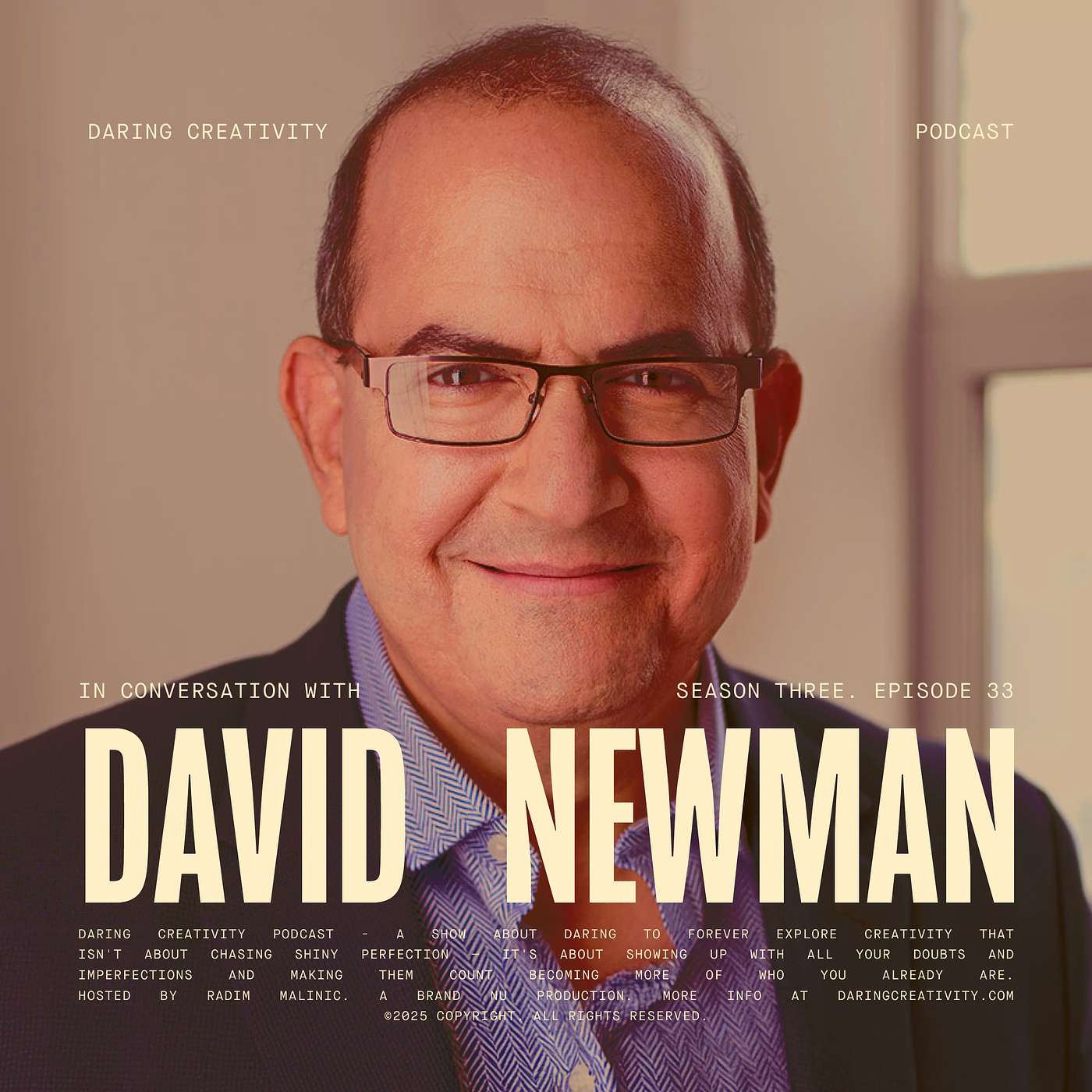
Welcome to the Daring Creativity Podcast, the show about daring to forever explore creativity that isn't about chasing shiny perfection. It's about showing up with all your doubts and imperfections and making them count. It's about becoming more of who you already are. My name is Radim Marinic. I'm a designer, author, and eternally curious human being. I am talking to a broad range of guests who share their stories of small actions that sparked lifetime discoveries, taking one step towards the thing that made them feel most alive. Let me begin this episode with a question. Are you ready to discover what happens when you dare to create? Today, I'm speaking with David Newman, author of Market Eminence, about how he helps experts become category of one. In our conversation, David discusses how his concept of market eminence makes you irreplaceable to the right people, why how to content is dead, and why we should teach people how to think instead, and how being contrarian means uncovering beliefs you already hold and finally speaking them publicly. He also opens up about how he learned to stop trying to be a better salesperson and become a better person, which told him that empathy, kindness, and curiosity matter more than deal closing techniques. It's my pleasure to share with you my conversation with David Newman. Hey, David. So great to see you today. How are you doing?
- [02:52]
B
Hey, Radam, it's great to be here. Thanks. I'm doing wonderfully well, now that I see your smiling face.
- [02:57]
A
Oh, likewise. We are here to celebrate the release of your new book called Market Eminence. And for the record, I've become aware of you. Years ago, I was writing my book of branding, and somehow it must have been one of your lead magnets. Whatever I did, I signed up to your newsletter and I remember seeing this email saying, you have to listen to this episode, that episode, and this episode, and Literally, that's what it said. This episode, that episode, this episode. And I'm clicking on your stuff. I'm listening to your podcast. I felt like it was a parallel to my creative world because you are in selling. And to people in my industry, or my sliver of the industry, or to my listeners or to people I talk talk to. Selling can be such a dirty word because, you know, people believe I'm an artist. Therefore, I believe I should have all the audience and all the sales done for me or thanks to my greatness. But you are very much in the business of selling. And this is why I like what you do and how you do it. But if the introduction wasn't enough, tell me, who's David Newman? What do you do and how you do it?
- [03:59]
B
Sure. So, very quick backstory. I started my business in 2002. I made every mistake in the book because I knew nothing about marketing or sales or any of the things that I'm teaching and preaching today. And for three years, it was kind of a bumpy road. And then I finally figured some things out. I figured out what to do. I figured out who to do it for, and then I just refused to stop. So it was that pigheaded stubbornness, I think, that I can attribute most of my success to. I have written three previous books. You mentioned Random, the other books. So Do It Marketing and Do It Speaking and Do It Selling. Those three. And then this latest book, Market Eminence, I consider sort of a greatest hits. So everything that I've always been teaching and preaching and speaking about and helping clients with, around positioning, differentiation, standing out, being contrarian, being a voice worth listening to, that is, I distilled all of that from my client work and from little slivers of it that showed up in the previous books. And I put it into this fabulous little, tiny flourless chocolate cake, very dense, very short, called Market Eminence.
- [05:17]
A
I mean, I can see the COVID behind you on the shelf. People who listen to this might not see it, but it stands out. And I love that you said it's the best hits. But before we get deep on this one, I want to get to 2002. Under three years of making mistakes. What business did you start and how did you feel for three years to be making mistakes and still persevering?
- [05:37]
B
Well, I will tell you my answer to that story. The real interesting answer is, what's my wife's answer to that story of fumbling and bumbling and hitting every brick wall and not making any money for three years? So before this, I had a corporate job. I had a legitimate corporate job. I was a productive member of society, and that job was in corporate consulting and training. So the thought process. And I think many entrepreneurs, many agency owners, many other experts have this idea. They say, hey, I know the work of my work. Why am I making money for somebody else? I'll just go out and do this on my own. And the answer, my friends and most of the entrepreneurs listening are already shaking their heads. That's not how it works when you're an entrepreneur. It's no longer about the work of the work. It's about selling the work. It's about getting the clients to say yes. It's about getting checks in the door. That's the part that I had no experience in, and that's why it was so challenging. But then I became a fierce student. I mean, I think like you, Radom, when you start to realize that, hey, there's something here that I don't know, there's some missing secret combination that other people have mastered, and I need to master it also, that turns on the hyperdrive, and then we start becoming students of the game. I read every marketing and sales book. I went to seminars. I went to conferences. I hired a couple of sales mentors. And one of my. I'll give you a quick, funny story that kind of leads into this. One of my early sales mentors, he saw me studying and applying and practicing and having some early level of success about two or three years in. And he says, david, we need to have a chat. He says, you're really focused on being a good salesperson. He says, that's not the key here. The key is to be a better person and more sales will happen. And you could hear the record needle going across the grooves going. And I was like, wait a minute. What does that mean? Be a better person? He says, well, you really have to care about your prospects. You have to have empathy. You have to truly listen. Don't just listen in a sales way. Listen in a human way. Listen with empathy, Listen with kindness. Listen with openness. Listen without an agenda and figure out what's the reason behind the reason. What's the problem behind the problem? What's the issue behind the issue? And figure out if you can truly help them and if you can offer to help them, and if you can't, then move on, because that prospect is not for you.
- [08:22]
A
I love your answers because you're right. And I remember coming across as a creative, As a part of a creative project for a company in central London, the hamlets of salespeople for the events arm. And I remember being in a room for the first time with a hardcore salesperson and I'm like, what planet are you on? Because I can tell you what, they didn't give a shit about anything. And anyone what was important to them was like, have we sold this space enough? Have you made enough margin? Have you made enough money? And I remember sitting there in my, what I would call the airy fairy creative phase, where I was very much about like, look, this needs to look good. You're going to pay attention to every single detail. You know, the splits of colors and all the details, the fonts and everything. This brand needs to be something. And then there was a person who could not care less. Like, he would literally happily put it in the bin and say, look, we've got front doors and the space to hire and we're going to do it through sales. So when you say I needed to learn to be a better person, to actually work with kindness, work with empathy, that obviously is the making of a better person, is actually you realize what other people might need because ultimately we are all the same, we are all human, we are equal in this life. But somehow that element seems to be missing, right?
- [09:35]
B
Yes, absolutely. And I think that, you know, it was almost like a divine intervention because usually most sales trainers, most sales programs, they don't include that line about, don't worry about being a better salesperson, be a better person and more sales will happen. I think that was really a sign from the universe that I needed to take my selling behavior, my selling philosophy, my. My perspective on what a good salesperson and a good entrepreneur is all about. And I think that was the beginnings of kind of developing my own philosophy around what sales is and isn't and what it could be and what it should be.
- [10:23]
A
We'll be back after a quick break. This episode is brought to you by Lux Coffee Company, the first creative specialty coffee company building a platform to shine the light on emerging global talent with a mission to make a positive impact on the creative industry and beyond. Lux Coffee Co offers exceptional coffee sourced from around the world through ethical and sustainable practices. And you can discover the current range of signature blends and single origins coffee hardware and accessories, along with exceptional apparel. At luxcofee.co.uk you can use the code podcast to get 15% off your first order. I like your accountability. When you talked about I was a fair student, I like that because there was a great quote on the show from a French animator called Danny Gossett. And she says her favorite quote is, the teacher will show up when the student is ready. Right? And I think the information like, we, we can be trudging the water, we can be sort of getting lost, taking the wrong turns, but when we actually want to find the answer, the teacher will show up. So in your case, when did a penny drop that to get to be where you want to be, you need to learn a little bit more.
- [11:49]
B
Oh, almost right away. I mean, I've always been a huge reader. I've always been. Because again, I came out of the training world, right? Training and consulting. But I had another logo on my business card, right? I had the company logo. It wasn't. I wasn't doing it under my own banner. So after 10 years of doing that, the consulting skill, the coaching skill, the training skill was there. And then here's another insight, and I actually put this in the market Eminence book. The insight I had was if you don't like sales and you don't like selling, like you just mentioned, many of our creative friends, they hate selling. They would rather do anything else. They just want to be the artist in the garret doing their brilliant work. They don't want to have to sell it, because selling is dirty and distracting. And who wants to do it? Imagine if you reframed the sales process as the first moment of delivery, meaning pretend you're already hired. There's no one in the universe that hasn't hired you. Some of them simply haven't written the check yet. So if you treat prospects like clients. So think about, you get hired, you have the first. You get a nice, big, beautiful check. You have the first meeting with the client. What's that meeting about? It's about questions, it's about the agenda. It's about what they want, what they don't want, where they're going, how fast they want to get there, what they need from you, what their dream outcome would be, how fantastic this is going to be, embarking on this relationship with you. My recommendation is take that first meeting after you're hired, pick it up out of the timeline, move it over here. So it's actually the meeting before you get hired and before you get the check. And watch what happens, because the more you treat prospects clients, the more clients you will get. And people can feel it. You know, it's so funny. I've taught this and preached this for such a long time. We think of prospects sometimes as the enemy. So. So we got to go and close the prospect. We got to close the deal we got to maximize our fees from this prospect. And this prospect is dodging us and avoiding us and ghosting us, and they're trying to talk us down on price, and they're just horrible, terrible people. And then you finally close the deal, and the same exact person from two minutes ago goes from being a prospect to being a client. And then we'll ask that creative professional, how do you feel about your clients? Oh, my clients are amazing. My clients are the best. My clients are fantastic. My clients are my favorite humans. So it's the same person from two minutes ago that now has suddenly been transformed to this most amazing person. Before, they were the enemy. They were dodging, they were ghosting, they were bargaining, they were negotiating, they were evading, escaping, and lying. But now they're the greatest person on earth. I said, how can that possibly be? And when I just sit and I say, how can that possibly be? Most of my clients go, oh, so I could give them the benefit of the doubt and I could treat them like clients before they become clients. Yes. How do you think that'll go over? And they usually know the answer.
- [15:14]
A
So what you're describing is. I think it's a very interesting reminder of, like, how to treat the client with kindness, empathy, and curiosity. Because I have seen in my sliver of the industry, as I would call it, throughout this conversation, where I see, like, the sort of the Western shootout, you know, when someone says, what you got job? Okay, how much you going to pay? Well, we can't tell you because you might tell us a smaller price. And you're like, okay, so is this this much? No, no, no. And it's just, come on, have your values, have your worth, and know what you sell in. Because mostly it's. There's no guardrails in most creative projects, or there are no most perceived guardrails on creative projects. And therefore, people just make shit up. Whereas if you know what you're selling, if you know what you're doing, yes, I can tell you the price straight away. I know exactly how to guide you. And firstly, I really don't want to. I really want to know who you are and how can we be friends first, so to speak, to actually have a human conversation about how we can collectively go to that sort of common interest and common goal and actually deliver something together. Because, yeah, as you said, that shootout and that sort of. That negotiation just feels even just horrible like you describe it.
- [16:24]
B
Yes, absolutely. Well, and then here's the other thing I would say when you have that first sales Conversation. It's almost too late. It's almost too late. And again, this is where the concept of market eminence comes in. What have they experienced before that first conversation? What are the ideas? What are the value that you've already delivered ahead of time, asynchronously? What value have you put in the marketplace? What image and what perspectives have you put out so that people understand your positioning, your differentiation, what you stand for, what you stand against? What's the movement that you're leading? Not just what products and services are you selling, but. But what do you really stand for and what do you stand against? And when they become a client, what movement are they joining? Because if you did that, then there's no more showdowns, there's no more shootouts necessary, right? So it almost turns the equation on its head, where we are the pursuers. We're the ones that are constantly chasing and convincing and persuading. Now we can sit back, clients come in already indoctrinated with who we are, what we do, why it's awesome, cooler, better, different, smarter, safer, less risky, more innovative, and we can literally flip the script. And now they are qualifying for us. And all of that playbook is what I call market eminence. And it's a combination of visibility and credibility and brand preference. Visibility, of course, meaning that it's important to get seen. Credibility. It's important what you say and what you write and how you show up in the marketplace so that people understand that you get them, you really get them on a deep, personal, emotional level. And also, it ties into what we're saying a moment ago, that they understand your perspective of kindness and generosity and curiosity, and they know that you're a little bit of a different animal. And then brand preference is a combination of positioning and differentiation and messaging, so that it becomes risky, dangerous, and dumb to hire anyone else. Let me repeat that. Risky, dangerous, and dumb to hire anyone other than you or your firm. Now imagine how much sales negotiating do you have to do if you're in that position? How much adversarial combat do you have to do if you're in that position? Almost all of it disappears. You become the magnet or the beacon, the lighthouse in your industry. That is making sense, that is somewhat polarizing. Meaning it turns the wrong people off and it turns the right people on so that the right people, all of a sudden, all the competition falls away, and they say, I need to work with Radham. I need to work with Radham's firm. Because he gets it. He's thought about this, he's written about this, he's published about this, he's podcasted about this. I know how he thinks, I know his personality, I like him, I trust him. And we have never met yet. Then you have the first sales conversation. And my question to you is, who's qualifying who, right? Who's in the driver's seat? Now, when you've done all of that work to establish sort of a beachhead and elevate yourself head and shoulders above everyone else.
- [19:58]
A
I love what you say and I think it's incredible, especially for this audience, for majority of this audience, to actually realize that you pre qualify in a way by showing the world who you are, what you do and how you think. Because of course, people in this industry, in a visual corner of the industry, our benefit is that our positioning, our differentiation is signature styles. We've got people doing things in a different way. But those are specialists though. I do sort of hyper niche people. But then you've got generalists who can do pretty much almost anything. You know, I think that ones who are trying to. What I see these people is trying to look around the corner and see like, what's the next thing when you can solve. And in that case, getting to work or being known for one thing is difficult, but you can be known for who you are as a person. Like, what can you bring to the table? Because in this day and age of AI and this sort of, what I call uninformed hysteria about like, what AI is going to mean for us and where it's heading, or is the bubble bursting? It's brought me back to the quote by Carnegie Institute of Technology when they say that 85% of your financial success is due to your personality, ability to communicate, negotiate and lead. Shockingly, only 15% is due to your technical knowledge. When you mix in AI into all of this, it's the 15% of what we do. It should be the 15% of we do, maybe even 5%. And I just came back to the score the other day and it kind of rang a massive bell in my head. That's a stupid thing to say, but it rang a bell in my head. I was like, wait a minute, I need to talk to you about it and talk to a few other friends about this. Because when you spell it out like this, what are we worried about? We've got new toys, we've got new tools, you know, but nothing's changing in the way of humanity, how we operate with one another. Because I'm going to choose to talk to you over an LLM model to say, well, tell me more about David Newman. I'd rather speak to you because again, that's what it's human after all.
- [21:49]
B
Yeah, absolutely right. I think a lot of people this AI conversation is so fascinating because you know, AI has taken over one and only one kind of human intelligence, that is computational intelligence, meaning pattern recognition. Assimilating and synthesizing all of this data, all of these words, all of these ideas that have been published and think about what humans are great at. So the world of how to. I will tell you what's. What's dead right now and where people should stop focusing their time and energy. How to content, purely information based how to content is dead. It's over. Stop doing it, stop publishing it, stop posting it. No one cares. AI can do that a million times better than you or I or anyone else. AI has taken over the world of how to content and. And good. I'm glad because you should not have been posting. Just boring. Same old Lamo. How to content in the first place. Where humans have the edge, or at least today they have the edge before the robots take over the world is three other kinds of content that is completely, completely in the realm of flesh and blood people like you and me. One is not how to, but how to think. How to think. In other words, strategic, high level, insight based advisory type of content. This is based on your personal experience, your battle scars, your war stories, what you've done, what you've seen, what you've learned, your recommendations, your biases, your perspective, your lens onto the world. Nobody can take that from you. That is organic human DNA that is sitting in your chair right now. And perhaps you haven't thought of talking about that or sharing that because oh my gosh, what if someone doesn't like it? What if someone doesn't agree with me? What if someone has a different perspective? My answer to that radom is good, good and good. So category one is how to think. Category number two is what to believe and more importantly, what not to believe. So how can you be the truth teller in your industry? Separate the wheat from the chaff, the signal from the noise. Tell people what outdated myths or half truths are holding them back, holding the industry back, holding your entire target market back. And then show them a new and better way. Again based on your personal experience, your expertise, your background, your backstory. Third category is how to get ready for what's coming next, Help people see around corners. This is trend spotting or future casting because high level people hate being surprised. They hate Being ambushed. They hate being blindsided by something that they could have seen coming but no one told them, no one warned them. So if you can be the early warning system in your industry saying, hey, here's what's coming Three months down the road, six months down the road, 12 months down the road, here's how to get ready, here's how to prepare, here's how to defend, or here's how to jump ahead. Here's how to leapfrog and take advantage of this new opportunity or this new opening in the marketplace that will also separate you. So just to recap the three kinds of content that you should be sharing, number one is how to think insight based, not information based. Number two, what to believe and what not to believe productive myth busting. And number three, how to get ready for what's coming next. So helping people prepare and be better equipped for the future trends and the things that you see coming down the road that might either hurt them if they don't take action or that could really benefit them if they take early action.
- [26:08]
A
I mean, these are nuggets of absolute wisdom. And that's so important because you're making people realize what is the work of a fair student, when you think about it, how would you prepare people for change and how do you help them to do it?
- [26:25]
B
So you put your finger on the biggest and earliest obstacle that I get with every client that brings me in for a strategic work session, every CEO group that I talk to. This all sounds good until about 45 minutes into our conversation when I start using words like change, polarization, being divisive, being contrarian, shifting beliefs. They're all like, yeah, yeah, yeah, that sounds good. And then we start talking about what that really means and what that really looks like, that things will need to change. And they go, hang on, hang on. I'm not, I'm not so sure this is for us. This sounds a little scary. This sounds like we might be losing something. I said, yeah, you will be losing something. You'll be losing being completely vanilla. You're going to be losing, trying to be everything to everyone. You're going to be losing this concept of hedging your bets. You're going to be losing this concept of let's cast a wide and that as possible because the more fish we catch, the better. I said, okay, let me go back to one of the tenets, one of the early tenants of market eminence, which is this concept of being divisive, not being for everyone, and being polarizing. The way that I explain this to CEOs and founders and agency owners is imagine that we installed a magic fence around your entire company, and this fence was made up of a very powerful electromagnetic force. And what it did was it pulled in all of the best fit prospects, talent, media partners, investors, maybe even acquirers, people that you want to have by your firm, eventually pulled in all of the best fits in all of those areas, all those stakeholders, and it repelled the bad fits. And they're like, well, and like, this is obvious to you and me, Radham. Right. But. So here's what I do to make them comfortable with this idea of change. I said, let's define what bad fits really are. Have you ever had a nightmare client from hell? Yes. Have you ever had a bad hire? Yes. Have you ever gotten, you know, a bad situation, a bad project, a bad partner? Yes. Great. Let's write on the whiteboard what were the characteristic traits and behaviors of those bad fits? So they will start to tell me, okay, they're unethical. They don't have the same values that we do. They didn't share our vision. They were out of alignment with our core, you know, best practices. As far as employees, they would come in late, they would leave early. They would do the minimum. They would just check the box. They didn't care about the work. They didn't care about the client. All right, let's talk about bad clients. Okay? They came in, they micromanaged everything. They nickel and dimed our fees. They were a nightmare to work with. They insulted our staff. And Radom, I'm writing all of these down on the whiteboard behind me, and it's about five, seven, eight, ten things. And then I turn to the group and I say, okay, these are the people that the electromagnetic fence is keeping out. These people. How do you feel about that? And when I say, how do you feel about that? I look around the room, everyone's shoulders start to soften. They make these dreamy, googly eyes at the whiteboard, and they say, that would be great. I say, I know, I know. It would, wouldn't it? Welcome to market eminence.
- [30:03]
A
In your way, obviously, when you talked about being different, you talk about being a contrarian quite a lot. And let's talk about it, because being contrarian again requires sometimes change, sometimes willingness, sometimes just wanting to be contrarian and actually put yourself in that position, because that will ultimately get you hurt.
- [30:24]
B
Yes. So let me be. This is another sticking point. You're just going right down the line here. This is fantastic. These are all the reasons people are scared or people don't want to fully commit or fully implement to their market eminence game plan. So I want to draw a distinction between being contrarian and I've got three tips for people who are listening to us right now to help them go down the path of baby steps of their first couple of contrarian ideas they can develop. But what people are afraid of is this is going to be a PR stunt, this is going to be some sort of marketing gimmick, this is going to be a flash in the pan one time campaign that's going to be an attention grab. And it's none of those things. In fact, it's the opposite of those things. So it is not a PR stunt, it is not a gimmick, it is not, you know, making waves for the sake of making waves. It's really to establish that electromagnet around your business that will pull in the best fits and repel the bad fits. So being contrarian is simply about uncovering beliefs that you already hold and perspectives that you already have. This is not, oh, let's see, what trend can we fight against? What external force can we make the villain here? So I want you to think about three questions that will help you help our listeners to really establish their first couple of little contrarian slant items. Number one, what conventional wisdom in your field do you secretly think is completely wrong, but you've never publicly talked about it, you've never publicly challenged it or faced it down. So I guarantee you there is some conventional wisdom or practice or principle in your field that you completely reject. But you've been like this, you've been like, let's not, look, we're not going to do that. We would never do that. That's a horrible thing. We don't believe in that. Let's not tell anyone, let's not tell anyone that we never do that or we don't believe in that or that is a harmful practice. Number two, what harsh truth about your industry? Our clients desperate for someone to finally acknowledge openly. I call this the elephant in the room question. So things that you prospects and clients that come to you, they say, oh my gosh, we worked with this other branding firm and it was so horrible because. And then you listen to what that because is. You know, we hired this other consulting company and oh my gosh, that project was a disaster because, right, this is probably a trend or a practice or some harsh truth that needs to be called out that people, the moment you utter it, people would be like, oh, finally Someone is speaking the truth. Finally, somebody gets it. Finally, someone's not willing to sugarcoat or lie or fake it anymore. And that's number two. Number three is what strong point of view do you already hold? Meaning you're not putting it on, you're not just grabbing it now out of thin air. What strong point of view do you already hold? This very moment that makes industry insiders and competitors uncomfortable, but resonates deeply with your ideal clients. So think about this, for example, Imagine if a consulting firm said, we don't believe in hourly rates because we are much more committed to getting you to your destination than in running the taximeter. And all the other consulting firms, all the other agencies, they love their hourly billing. The more hours, the better. And we bill this rate for the creatives, we bill this rate for the copywriters, we bill this other rate for the admin people. But this other firm just said that we don't do hourly billing because we're much more committed to getting you to your destination than in running the taxi meter. These other firms are now, oh, oh, someone just spilled the beans. Someone just told the truth and now they look like they're behind the eight ball because you just rejected that principle. You say project, and again, I'm just going down this example, right? Project based fees. No surprises, just results. If that was your positioning in the marketplace, imagine how people would be lining up at your front door saying, no surprises, just results.
- [35:11]
A
The person that comes to my mind that stands out in our industry, Simon Dixon. Simon Dixon is very vocal on LinkedIn. He tells it like it is, but he's very much about challenging exactly what you said. To have that grown up opinion and actually challenge, you know, be that contrarian and say, look, there's ways to do it, there's easy ways to do it, there's more ethical ways to do it, and there's right ways to do everything for the right ways to do it for everyone. Because ultimately when you're being contrarian, when you were talking, I was thinking, that sounds like a bit of an asshole. Like, why would you ruffle up feathers, you know, because it's almost like everyone's got fingers in their ears, why is that person speaking? But then when I got to the idea of who that person is and how they conduct themselves and what they mean to everyone, guess what? There are people lining up to work with Dixon Baxie. Because those people stand for something. And that's the beautiful way you just explained this.
- [36:05]
B
Yeah. Very, very powerful. And that's, you know, when you See these avatars, you know, you see these spirit animals of people that are being contrarian, that are shifting beliefs, that are establishing their sense of market eminence. It's always unique, it's always personal, and it's always authentic. That's the authenticity and the transparency is so key. This is why I said a moment ago, it's not a PR stunt. It's not something that you're just grabbing out of thin air. Well, let's see how people respond to this. It comes out of here. Not only is it coming out of your brain, it needs to come out of your soul. It needs to come out of your very being. Because you mentioned the word feel and feelings. People can feel the difference. They feel it when you're faking it, when it's a PR stunt, when it's a cheap attention grab. And equally, they feel it when you're finally busting out and speaking, you know, radical truths and being radically generous and radically helpful. They feel that too.
- [37:11]
A
When I was reading your book, it was that you talk about the fact that you want to stand against something. And I was thinking, because I've gone through all of the phases of the creative career, I'm thinking it's quite hard to stand for something, letting us stand in again, something, because. And again, I may be playing devil's advocates to more junior people or people who potentially might not have a steady business running a steady ship. You don't really want to stand against something because, yes, you want to have a bigger net to catch more fish and see what you can do with it. But being almost like a having done, almost personal strategy, or as you call it, marketing eminence game plan, when you know what you stand for and when you know what you don't want to do, that makes you ultimately so much stronger because it just takes you to places where you want to be rather than finding your way out of situations where you don't want to be.
- [38:01]
B
That's right. That's right. And this is such a great question that I sometimes get someone who's early in their career or just getting established, you know, is it too soon to establish this market eminence, positioning and differentiation and so forth? When I hear that question, I hear it in different words. The words that I hear, Adam, are how much time should I waste trying to be everything to everyone, trying to be universally liked, doing crap work for crap fees? David, how much time should I waste doing that before I establish who I really am and what I really want and what's really meaningful to Me. And I say, well, how about zero? How about we waste zero time doing that nonsense and you jump right into the deep end of the pool where the money and the happiness and the meaning and the impact really lie?
- [38:59]
A
I mean, what an answer. I mean, love it. I mean, how much time do you want to waste? If you concept of market eminence like the way you packaged it, obviously you didn't always talk about market eminence, so how did you put these two words together? Because you said this book is your best hits. Well, how did you settle on this concept, on this sort of refreshed game plan and strategy?
- [39:19]
B
That is a great question. And a lot of my friends, some of whom are authors, some of whom are not, when I first floated this idea over a year ago, they're like, yeah, I don't like that word eminence. That no one uses that word. No one understands what it means. You're going to paint yourself in a corner. You're going to regret that you hung your hat on this label of market eminence. Pick something else. Pick. Pick domination. Pick industry leadership. Now, I want you to listen to what that advice just said to me. No one understands what you're talking about. Use a term that everyone else uses. Use language that everyone else can easily understand in a minute. And I was like, that sort of goes against everything I believe in. So if I want to create this category, create this platform, create this movement, why in the world would I use a commonly used word? So the more they told me eminence is a strange word, no one knows what it means. It's going to be weird. You're going to have to educate a lot of people on what the heck you're talking about. I was like, oh, good. So to me, their red light became my green light. And but if you look at the word eminence, eminence is such a fantastic word. The dictionary definition is fame or recognized superiority. Not just superiority, but recognized superiority, especially within a particular sphere or profession. I'll read that whole thing to you over again. Fame or recognized superiority, especially within a particular sphere or profession. I'm like, that's it. That's what people are missing. That's what people need. So it's in the world of the market, it's in the world of marketing and sales and commerce. So market eminence to me made perfect sense. And honestly, if you Google market eminence, if you put market eminence in the chat, GPT or your favorite AI tool, if you ask who is the leading expert On Market Eminence, all the AI summaries, all of the AI tools, all of the platforms, they have the little links and the little references. So they're going to use my language from my book, my ideas, my presentation, and it's going to be, you know, my name is all over Market Eminence, and Market Eminence is all over me. So as far as live, here's what was really important to me. At the end of the day, the more that I commoditize this, the more I'm out of integrity. So, you know, all the SEO and the aieo, the artificial intelligence optimization experts are saying, well, no one's searching for that. No one's looking, David, until you told people, put it into Chat GPT. Trust me, no one's going into Chat GPT and typing Market Eminence. Not yet. Not yet. But the more that I move this movement forward, because that's my movement, right? It's not the David Newman movement. It's not the buy my book or hire me as your consultant movement. It's the Market Eminence movement. And I want people to implement this and have success with it and have results with it who I've never met, who are halfway around the world, who would never think of giving me money and don't need to give me money to benefit from these ideas. So that's the other part of Market Eminence is you want to have the ripple effects when you throw the stone into the pond. You want these ripples to be bigger and to go further than they could if you were doing a commoditized business with commoditized language and commoditized services. So I love Market Eminence because yes, it's weird and yes, it's different and yes, it's mine.
- [43:20]
A
As someone who's been writing books for a long time to find those two words, as if that's winning the jackpot. Like, those two words are harder to write than the rest of the book. Because I can tell you from personal experience, and it's amazing that we have a similar experience of telling your friends, your confidants, your group of trusted friends about like, hey, this is the idea I've got. And in my case, I gave them four different options and I said, hey, I've got four ideas. What do you think? No one speak. Daring, creativity, daring forever. But as soon as I told them, like, that's what I'm doing. As soon as I stood proud behind what I believe in. So that's what I'm doing. All of the people who didn't pick the title were like, oh, my God, that's the end. Of course, that makes perfect sense, because I needed to emanate what I believe in. Like, I need to stand behind it. Because what I've learned personally a while ago is what are the words that you own? Obviously, in your case, you've got your no, do it. Like, do selling, do it marketing, do speaking. But you also, you know, Debbie Newman, you've been doing it for a very long time, so you've got this presence, and you've been adding those rings to your trunk, so to speak. You know, it's adding up. Like it's a compounding effect. And I was like, okay, what do I want to own? What do I want to be? And again, in the same way, I did exactly the same thing. Who does Daring Creativity? Ask Claude. It's like, oh, man. There's a guy called Ryan Marinach, and he does this daring creativity podcast, and there's this upcoming book. Because, again, those words might feel weird, they might feel a bit aloof, you know, at first. But I can tell you, if it wasn't recommended to me, Atomic Habits. It doesn't make any sense to me. Like, atomic Habits. Why would I read Atomic Habits? Well, guess what? 15 million people thought that was a great book to buy because it's the new. It's like, how do we again shape into a change that's coming that takes us back to future for not future casting. But since we're talking about AI agents, and I think before we close up, I want to get your opinion on AI agents, because you talk about this amazing body of content, obviously thinking, being, having a brand, gravity, having, you know, all of these strategies that contribute to your market eminence. Because at some point somewhere, people will notice what you do, how you do it. Obviously, they'll buy into it, because they will buy into you. But in the world of sort of agentic AI, where people have found shortcuts, convenient, shall we say? I don't want to use the word lazy, but you might not always be able to make that impression through your own personal website. For your podcast, someone says, I need something, something, something. And the list of random people shows up and they go, okay, I'm going to call John and Mary here and that. And they. Some people. And it's been already, we've seen recently the first examples of this that people just look for branding, designer or for something. They don't even bother to look for the body of work. They don't validate it, they just take the to the prospective name and they get in touch with the people straight away. Therefore, you removed all the work and everything that you've done, of course, has warranted you space in a list produced by ChatGPT or Claude. But how do you then see this in the future? That all the work that we're doing might not be seen by certain people? The more I've been saying this question, it made me sound like those prospects are not the right prospects for your company. Right?
- [46:29]
B
That, my friend, is the exact answer that was floating through my head the moment that you posed the problem. I'm like, so do you really want as a client someone who just typed something into ChatGPT spit out your name? They did no research. They look, did not look at your portfolio, they did not look at your social media presence, they did not watch any of your training and they just call up and go, hi, how much? I mean, that's the definition of a commodity buyer, right? They're lazy, you know, they're price shoppers, they're tire kickers. They're not just going to call that first name in the chat GPT result. They're going to call all the names and they're going to say, well, who's the cheapest? Right? This is the definition of a terrible, terrible prospect.
- [47:16]
A
Let's go back to your book for a few more times. Your subtitle of the book is for mavericks, visionaries and change makers who want to play bigger, grow faster and become a category of one. People need to believe they are mavericks, visionaries and change makers. In your work, how do you lift people up to believe that they could be something like this?
- [47:36]
B
Well, so that's a great question. I don't think it's a matter of becoming, I think it's a matter of uncovering so the people that identify. So let's just. I'm break down those three labels real quick. A maverick is someone who's going against the grain, right? Someone who's different, someone who is kind of bucking the trend and knows that they're different. A visionary is someone who is looking ahead. They're mission driven. They're very excited about a certain goal or outcome or, or movement, right? So visionaries lead movements and then change maker. You mentioned that, you know, change is the currency of the realm. People that want to make things better, people that see where things are today and they want to be an agent of change. They want to be a catalyst that makes a difference, has an impact and has ripples well into the future. So those are three very aspirational labels. I get that, that those are three very aspirational labels. But there's a whole bunch of people, not everyone, far from everyone, but there's a whole bunch of people that go, you know, I am a maverick and I haven't been acting like one. I am a visionary, but I haven't been talking or communicating like one. I am a change maker. But, boy, this change is coming much more slowly than I would like. I would like this to be faster, more catalytic, more explosive, make a bigger splash on the pond. So for those people that identify that maybe they are that label, but they haven't been externalizing it, they haven't been communicating it, they haven't been positioning and differentiating themselves like a visionary, like a maverick, like a change maker, this is the playbook. To go from idea to implementation. This is what you know. This is the literal, step by step, what to say and how to say it, what to do and how to do it so that you can fulfill that role of maverick or visionary or change maker.
- [49:49]
A
You've definitely given people away to get to where they could be if they wanted to be there. Your book is full of prompts and mindspark questions and exercises. Do you find your people willing to do the exercises? How much do you have to lead a horse to water and make them drink?
- [50:08]
B
So not everyone is going to do all the exercises, and luckily not everyone needs to do all the exercises. When someone says, well, David, how do I start using your book? Like, where should I start? Should I start in exercise one and then go to exercise two? And I said, no, no, no, no, you don't need to do that. I said, read part one. Part one is sort of like kind of the setting, the foundation. It's about 30 pages, a very fast read. Then part two is the playbook. I want you to flip through the table of contents and pick two or three ideas that jump out at you and look at those two or three ideas as your starter kit. Once you've answered the questions, and if you or your team wants to sit down, answer the questions, there's all kinds of downloads and worksheets and shareable tools and resources. If you have a team, if you go to marketeminence.com work through the first two or three, implement those, and then look at the results, look at what you're starting to get as far as attention, as far as leads, as far as emails from fans. You're also looking for emails from haters. I can't Believe you put that in your last newsletter. I can't believe you just posted that on LinkedIn. That's outrageous. I'm furious. I'm upset. That means you're hitting it right. That means you're doing good. And then once you've gotten comfortable with those first two or three practices, pick another two. Introduce those into your marketing, introduce those into the water system. And I don't think everyone's going to need all 22. But start with baby steps and then watch the response. Watch the response. Watch how people show up when they book a sales conversation with you. Watch the comments that you get, both incredibly positive and, and a few incredibly negative. And be okay with that polarization. Be okay by going against the grain, be okay with upsetting some people because they're the wrong people and it's a hundred percent okay. So that's what I recommend, is that, you know, take yourself through it just in baby steps. And of course, if you want more help, just like you, Radom, just like all of our friends that are running agencies and so forth, we can put all the great ideas out into the world and we should. If people want help with implementation and guidance and accountability, they'll call you. Or in this case, they'll call me. And I hope that they do, but that doesn't mean that they can't walk themselves through all of it and have a lot of success if they're committed.
- [52:51]
A
I'm so happy that this book is out there and doing the work it needs to do because it's been my pleasure to be part of your beta reading group. I got to see how you put the book together. It's been nice to see Andrew. No, how someone else puts this together. Because when I've seen, when I've, when I got the final article, I was like, oh, he's had something really good. This is bite sized, this is clever. This is leading people somewhere. This doesn't try to solve anyone's problem. It's inspiring them to do stuff right. You've hit that perfect sort of structure, the perfect number of words that there's nothing extra. It's lean and it's got, I think, every making of the modern classic that it should become. So I'm so happy we had time to spend time to talk about it. Thank you so much for putting the work out there because ultimately you live and breathe what you do and that's what ultimately shows people that they can become what you are.
- [53:41]
B
Yes, yes, yes, yes. Well, Radam, thank you so much. It's such an honor and a privilege to have smart friends like you.
- [53:47]
A
Thank you. Good to see you. Foreign. Thank you for listening to this episode of Daring Creativity Podcast. I'd love to know your thoughts, questions and suggestions, so please get in touch via the email in the show notes or social channels. This episode was produced and presented by me, Radim Malinage. The audio production was done by Neil Mackay from 7 Million Banks podcast. Thank you and I hope to see you on the next episode. If you enjoyed this episode and would like more accessible resources to help you discover your daring creativity, you can pick up one of my books on themes of mindful creativity, creative business, branding and graphic design. Every physical book purchase comes with a free digital bundle including an ebook and audiobook to make the content accessible wherever you are and whatever you do. To get 10% off your order, visit novemberuniverse.co.uk and use the code Podcast. Have a look around and start living daringly. It.