Loading summary
Transcript68 lines
- [00:11]
A
Social media is creating anxiety, not just in individuals, but now in brands. And they think that they have to get this quick hit to have any success, but it's just, it's not going to land with all of your customers. You've probably got a really wide range of customers of different ages, and not everyone is chronically online. They might not know what this trend is that you're buying into jumping on. So whatever you're communicating is not going to mean anything to them. So that's damaging in the long run. But going more into your world on the visual side of things and talking about how brands react. When brands change their logos to support a cause, I think most people would be of the mind that show me that you support a cause. Don't tell me for a start, because it's all about actions, not words. Don't tell anyone I said that. No, I'm joking. A copywriter saying it's not about words, but every Black History Month or pride. If you keep changing your logo to show all the causes that you support, what is your logo?
- [01:13]
B
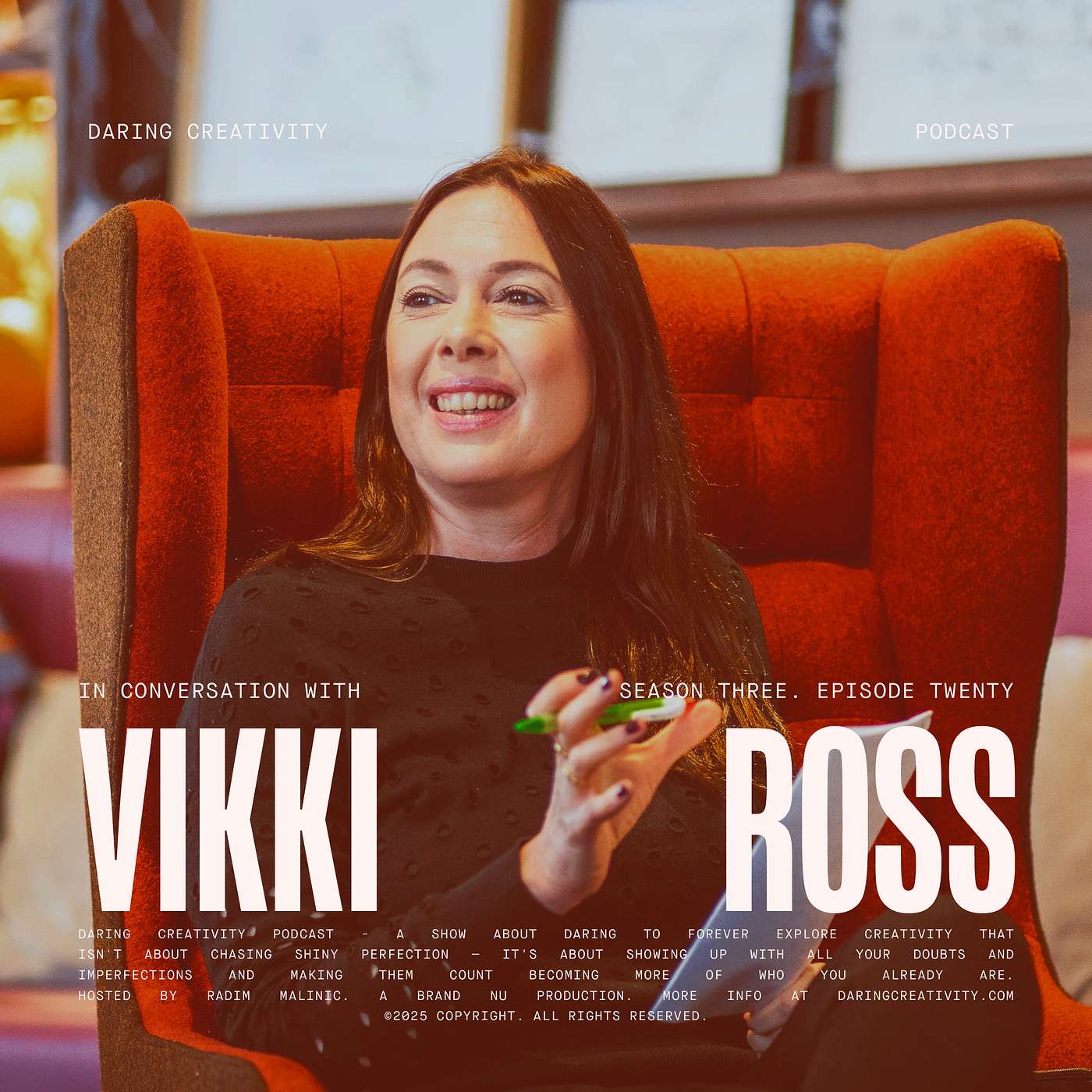
Welcome to the Daring Creative D podcast, a show about daring to forever explore creativity that isn't about chasing shiny perfection. It's about showing up with all your doubts and imperfections and making them count. It's about becoming more of who you already are. My name is Radim Malinj. I'm a designer, author and eternally curious human being. I am talking to a broad range of guests who share their stories of small actions that sparked lifetime discoveries, taking one step towards the thing that made them feel most alive. Let me begin this episode with a Are you ready to discover what happens when you dare to create? Today, I welcome back Vicky Ross, a copywriter and a global tone of voice specialist, to discuss the intersection of authentic creativity and AI anxiety in the modern marketing landscape. In our conversation, we talked about her approach to finding distinctive voices for major brands, emphasizing the importance of simplicity, curiosity and human connection in copywriting. Vicky openly talks about the need to focus on what makes human communication special. It's the real understanding, emotional connection and personal experience. We also talk about how brands find their way in a world that feels more divided, why it's risky to chase viral trends instead of staying true to your brand, and why real support for causes means more than just changing your logo. It's my real pleasure to share with you my conversation with Vicky Ross.
- [02:50]
A
Foreign.
- [02:55]
B
It'S so great to have you back. How are you doing today?
- [02:58]
A
I'm good, thank you. Thanks for having me back. How are you?
- [03:02]
B
Yeah, I'M grown. It's great to see you. You were my guest number two, and I thought, you need to come back. Because what I'm seeing, what you put out in the world, how you perceive the world of creativity, the world of copywriting, the world of advertising, there's always valuable insights for me. So I was like, okay, you need to come back, you need to talk to me, and let's see what we can do in the world of AI, emergencies of AI and the sort of uncertainty for creatives. What can we potentially instill and maybe probably slightly less panicky that's made me.
- [03:34]
A
Sound like I'm a bit of an AI pro, and I'm absolutely not.
- [03:38]
B
We'll find out. You're a pro in the world of copy.
- [03:40]
A
Yeah. And I have opinions on AI, so. Yes.
- [03:44]
B
And that's exactly the reason why you're back. For those who might not listen to the episode number two or don't follow your LinkedIn and other places, how would you introduce yourself?
- [03:53]
A
I always say I'm Vicky and I'm a copywriter. And everyone always says to me, that is nowhere near close enough to describing who you are and what you do. But I only ever wanted to be a copywriter, so that's always what I say. I guess if I was to elaborate, I am more than a copywriter. I'm a brand and tone of voice consultant. So I find a voice for a brand and help them express themselves. So I'm not very good at talking about myself and what I do. Can I write it down? I'm much better at that.
- [04:25]
B
You can write it down and I'll put it in the show note. But I think I always say, if you have a problem to explain yourself, you're doing something right. Because sometimes people are very sad. I see. I'm good at this. When people say when they're quite clear about what they are and what they want to do, I always feel like, is there deviation? Is there leeway? Because if you've got problems to explain yourself, I think that's a good problem to have.
- [04:49]
A
I just like to keep things simple. And I think if you know what a copywriter is, then I don't need to tell you much more. I think sometimes if we get ourselves wrapped up in describing who we are and what we do, we may be lacking confidence in what we do. I don't know. Now I sound like I'm lacking confidence in what I'm saying. Anyway, let's move on.
- [05:09]
B
Actually, no, I won't let you move on. Just for A second. Because you said, if someone knows what copywriter is, they know what I do. But when you meet mortals in a social setting and you say a copywriter, and you meet Gary D. A plumbing engineer or whoever, how would you explain the meaning and power of words to someone like him?
- [05:28]
A
When I meet normal people and they ask what I do, I say, I find a voice for brands. I don't even say copywriter, and they glaze over, because that doesn't really mean much to them either. Because I don't think normal people think that brands are talking to them in a certain way, which is why it's so important that we have a voice that stands out as a brand and means something to someone. Because, yeah, people aren't thinking, I wonder what Sainsbury's is going to say to me today. And I wonder how they're going to say it. And wasn't their choice of words really interesting? So, yeah, then it opens up an interesting conversation because as I say, people don't realize that's what goes on behind the scenes. And then they might say, oh, yeah, actually, because I did notice on an email that I got from them, it was really friendly or something like that. So, yeah, then it turns into a conversation about how they feel a brand fits within their lives. And I'm really nosy, and I love it when the conversation goes that way. And I also like talking about other people more than I do myself, which doesn't set us up for a good conversation on a podcast, does it?
- [06:29]
B
No, no, I think it does. I think I like when you say I'm nosy. I think that's. That's the first.
- [06:33]
A
I'm so nosy.
- [06:35]
B
That's one of the reasons for this podcast, full stop. Because nosy, that's a slightly bolder name for curiosity, intrigue. It's just that I think if you always try to know what's next, what's around the corner, I think that sort of sets you up for a super interesting career. Because ultimately it can also make you feel like what you're creating, it's not always enough. You feel like you can go further, you can potentially improve. You can find that different voice for a brand. You can find a different way how to speak to people. Because, yeah, the curiosity is irreplaceable. How would you describe your curiosity?
- [07:10]
A
So my nosiness ends with the job. I'm not nosy in real life. Like, whatever's going on in other people's lives is none of my business. But when it comes to work, I want to know everything about a brand and where they've been and how they got to where they are and where they're going and who works there and who does what. I need to feel like I'm part of the furniture because as a consultant and I'm sure you will feel the same when you're working for a brand that you haven't been. I don't like saying journey, but on the journey with for years, you're not part of the team and you don't know all the insider info. You have to get on board as quickly as possible to think and act like you do. Otherwise, whatever you create on behalf of that brand is going to be really light touch and it'll show that you don't know much about it. So, yeah, I suppose my nosiness is. I want to feel like I work there when I start working with a new client.
- [08:07]
B
How do you get under the skin of the brand? Like, how do you do this? Because you said, I want to be part of the brand. I want to understand as much as possible what are the methods for you that would help you to do that? Like, do you have certain checklists, certain processes, certain ways of doing this? We'll be back after a quick break. This episode is brought to you by Lux Coffee Co. The first creative specialty coffee company building a platform to shine the light on emerging global talent with a mission to make a positive impact on a creative industry and beyond. Lux Coffee Co offers exceptional coffee sourced from around the world through ethical and sustainable practices. And you can discover the current range of signature blends and single origins coffee hardware and accessories, along with exceptional apparel. @luxcoffee.co.uk you can use the code podcast to get 15% off your first order.
- [09:15]
A
I don't have a process or a checklist that sounds like I should have. That's an organized way to start a project. But no, I will ask the client to send me everything they feel comfortable sharing. Strategy documents, any reports that they've been working on, any meeting notes, any presentations that have led them to the point where they will contact me and then I do my own research. So obviously we can always look online and social and find all sorts of things about the people that we're working with. I say people brand, but I'll also experience their product or service if I can. So, for example, I'm in the middle of working with Formula E at the moment and when I first started working with them, it was really good timing because they were just about to host their E pre, their grand final in London. So I went and I. There's just no way I would have been able to write what I've written for them had I not been to that day. And the same goes for any brand that I've worked with. You just experience it on a different level to what you're being presented with. I guess it's like the creative technique show, don't tell, so the client can tell me anything they want. But it's not until they show me or I find a way for it to be shown to me that I can fully understand what's going on. And also at the E Pre, for example, experiencing it as a consumer, as a fan. So again, not the client telling me what the experience should be like, but me seeing how the experience is affecting the people that are there, the real people that are there.
- [10:47]
B
When you were talking about the fact that you asking client to send you everything, were they comfortable sending you? How much of a social listening do you do with brands? Because I found myself recently at a talk about fandom where there's a sort of hidden fandom for brands and how do you show up on Reddit and Discord and elsewhere that was like, oh, wait a minute, that's a very good idea. Do you do any of this sort of research on brands?
- [11:13]
A
Yeah, I do. Maybe not as deep a dive as a fandom professional would, but I do have a good look around. Because as much as it's important for me to know what a brand is up to, it's equally as important to know how a consumer or a fan is thinking and feeling about the brand or the product. Because if I'm trying to find a voice for the brand to talk to them in, it's got to be in one that's going to mean something to them. So yeah, I do a lot of that. And then when I do talks and workshops, I do always say to whoever I'm talking to, you have a free focus group at your fingertips 24 7. You can see what your audience is, as I say, thinking and feeling at any point. So to ignore them when they're expressing themselves without you asking them to is foolish.
- [12:00]
B
This is interesting. Yeah. Three focus group 24 seven. Have you found brands that were unwilling to listen to this? Like unwilling to take on feedback and actually stick into a particular voice that was not always open to dialogue?
- [12:14]
A
No, I don't find clients unwilling. I do find that a lot of them need a reminder of everything that's available to them in getting to a successful and effective result. For example, the social media thing that we just talked about, but also just knowing what your competitors are up to. I've been working with a lot of streaming platforms and they all want to say, and some of them do say, all your entertainment, all in one place, all your football games, all in one place. Everything's all in one place. And it's amazing how many don't look to the side at their competitors and see that they're all saying all in one place as well. Why would you want to say the same thing as another brand? And I get that in this weirdo world that we're in of massive anxiety that there's comfort in sounding the same as somebody else, but I just don't think there's a place for that in, for a brand. And in a world where you need to stand out and make money, if you are in a category that looks like wallpaper and people can't tell the difference from one brand to another, you're not going to succeed in the long term. And you could argue that the product does a lot of the heavy lifting and it does, but so does having a communication and a connection with your audience. So I'll quite simply, like I said at the start, I like to make things simple. I'll quite simply just put on a page. I'm very much a Word document person, by the way. It's about the extent of my technology skills, which sets us up for how we're going to talk about AI soon. But I'll just put on a in a Word document, brand name, slogan or positioning statement and I'll do it for however many I can think of or find and I'll present it back to the client. And very often they're like, oh my God, we just haven't seen this or looked at it. It takes five minutes to see what your competitors are up to. So yeah, there's a bit of a reminding job going on sometimes when I work with client.
- [14:11]
B
One of the reasons why I wanted to talk to you again is that you got this collection of posts with the theme of the lines that AI wouldn't write. And it's an incredible collection because sometimes we think that it needs to be pure excellence, like AI wouldn't write something excellent. But most of the things that you post are very much just about that soul about, like, how does it speak to another person? So I know that in the past you've been running Easter bingo and Christmas bingo and kind of stuff and now we talk more about AI because how much of a shift have you seen in Your part of the industry and copywriting and obviously generative AI, especially with tools like ChatGPT and Claude and all the others, obviously that has shaken up the foundation a little bit. What's the general situation and how have you seen over the last few years changed the part of your industry?
- [15:04]
A
I think the biggest change is how much AI is talked about. I think the noise is louder than the reality of what's going on. I think social media has a lot to answer for in all sorts of ways, in everything. But with AI in particular, I think the vibe is the economy is shit. Companies don't have any money, they're not paying for creatives because they can use AI. And so that makes the creatives think, oh shit, I'm going to be out of a job, or because they don't have a job, they can blame that on AI. And it makes clients think, oh, everyone's using AI, so I should use AI. But hardly anyone knows what to do with it. So I'm really enjoying the posts on social media that I see and that I've been seeing for the last six months talking about copywriting, specifically where a marketer has said, I tried using AI for a campaign and it just didn't deliver. So I've hired a copywriter or copywriter saying, I lost a client to AI, but they didn't like what happened, so they got me back. And that noise is not as loud as the noise that is screaming, AI is taking our jobs and the industry publications are not helping. I find it irresponsible and insane that the industry publications run headlines like, AI is going to wipe out creativity, because who is that help? It's not helping anybody and it's unfounded. And the reason I think it's unfounded and I might sound really naive and optimistic, but I'd rather be optimistic than scaremongering. I find it's unfounded because in 2019 I did a talk at a really big conference and for some reason, because it wasn't in my wheelhouse at all at the time, I decided to call the talk the Robots Aren't Coming in which I presented the case that AI cannot create adverts and write copy like real people do. That was six years ago. That's six years in AI years is like 5,000 lifetime. We're not there yet. I just can't see that it's going to completely take over. It's just not good enough. And you know what? The clients that do think it's good enough, they were writing their own copy or didn't value copy or didn't know what good copy looked like before the whole AI noise came about. So we didn't want to work for them or we weren't working for them anyway. So I don't feel like we've lost much other than the effect on people's mental health has got worse.
- [17:59]
B
There is an element, as you said, of irresponsibility from people who write the articles. You can give them the benefit of the doubt because most of the time they're just working out what the hell is going on. And they haven't got that 5,000 lifetimes of experience and reflection and looking at this because you said, maybe I'm naive when I look at some of these articles. They're showing up right now because it has showed up that you need to potentially change, adapt, or you might be out of a job. Because it's not ultimately things to AI, it's because of change. The change happens all the time regardless. And I've been having wonderful conversation with loads of people on this podcast about, like, how this change manifests itself in a different way. How did it manifest itself before? And actually how we potentially got so much better outcome because of it. Because it would have been lovely to do the one thing that you love over and over every day, but how freaking quickly would you get bored? Because I'm from the group of people that I can't sit still if the one thing I've done yesterday looks exactly the same today. I need to change. I need to look somewhere else. I need to find my. I would call it my nosiness, my curiosity. Okay, what is that? What is what? Dopamine. Can I get out of this? Because ultimately that's what moves us forward. And I believe the people who are finding it hard to adapt to the change right now or understand what's going on, hopefully they want the change to actually happen because it will ultimately give us progress, it give us ideas of, like, how we can grow and develop. Because the work that you do now as a tone of voice specialist is part of years of change, years of development, years of evolution.
- [19:45]
A
I think brands have always found a way to talk and that might have changed more often, maybe per campaign. I think that there are more specialists in it rather than whole agency. This is the client agency relationship changing as well. But there might have been an agency that was responsible for how a brand showed up, and that's visually and verbally. But yeah, there are a lot more jobs I see looking for a head of voice or a voice specialist.
- [20:15]
B
Yeah, how I would perceive the history of brand voice would be more of sort of individual headlines that would create these spikes. It's like this is how we are trying to get your attention so you can notice our product, but would necessarily not think that was a unified document of this is what we say, this is how we look. Because social even didn't exist back then either.
- [20:36]
A
Yeah, you're right. And also just filtering the voice through everything. So calling the terms and conditions something that's more in line with the tone of voice and having copy on packaging saying open me or something. Yeah, that was all non existent or quite rare. So yes, you're right.
- [20:50]
B
It's interesting because yeah, with the social, with what I would call like the fragmented marketing application, when you've got so many different micro channels making sure that brand speaks to almost everyone and anyone properly all the time. Because ultimately brand exists because they want to manufacture, design, manufacture, sell. But the marketing is such a heavy department now because if you haven't got it, ultimately you're really being left behind and people can make their own mind up about what you are rather than you telling them.
- [21:23]
A
Yeah. And also I think as a professional working in these departments and brands, you'll have the business map of what's happening and where you're going. But when you come to express yourself and tell anyone what you're up to, you need something that has defined you, that gives you something to hang onto and that gives the audience something to go on that helps you express yourself. I didn't really express myself very well or clearly then, but I just think you can't every time you want to say something wonderful, how am I going to say it today? And then obviously there's the whole brand history. So you need to fall back on something that exists and run with the consistency because that's what's making somebody recognize you as well. So yeah, I think that branding is there is here to stay. Which seems like such a immature, ill informed thing to say. Like it's obvious. But the concern is that going back to AI, if copywriters are out of jobs, I don't believe that they are all out of jobs because of AI. There are millions and zillions of brands in the world that all need to say something at some point and they'll need a copywriter to help them say it in the right way.
- [22:33]
B
You mentioned one word quite a few times already. It's an adjective and it's an outcome which is always so hard to find. The word is simple to find simplicity. We dream about Simplicity. And sometimes we think that simplicity is just because you don't put enough in, then therefore you make it minimal and simple. But would you agree that simplicity is very much an outcome of reduction and just prodding, trying, testing, working out actually what it is? Because if every road I've ever seen that sort of ended up with simple.
- [23:03]
A
Was a long one, it's actually, it's been a key thought for me in a way that I've been working more recently. I found that big companies are coming to me to help them find their voice and they have lots of people all writing something every day and they're not always able to hire a copywriter because it might just be a quick note about some work going on in the office, but it's coming from internal comms, so they want to put it together quickly. You're not going to necessarily, unless you've got a copywriter on the team, commission a freelancer to write a paragraph. And so I found that these thousands and thousands of people, they're all writing all different sorts of communications in their own voice. The brand comes. The brand team comes to me and says, we want a voice for everyone to write to. And it's become obvious that in a situation like that, they're not looking for, as much as I'd love to do it, some sexy, gorgeous, glossy, indulgent brand book with guidelines on how to execute a voice with loads of examples. They haven't got time to go through that. They need something that's really simple and quick and easy to digest. So really they're looking for. My last client said, I just need a list of instructions. And so that was how I wrote the last guidelines that I wrote for them. And it doesn't mean that it's not something I'm proud of and it's not creatively put together. It just means that it's going to be adopted really easily and everyone's going to get on board really quickly. Because presenting tone of voice guidelines to people, I always think that copywriters rarely need guidelines. If you tell them what voice you want to write in, they know what that means. So you're really writing guidelines for non copywriters and they need to understand them quickly. So the instructions are more effective than paragraphs of descriptions, the how rather than the what.
- [25:09]
B
This is interesting. So you mentioned a few things that I wrote down and you said there's hundreds of people writing something and then there's this overarching sort of big voices that big companies come to me to find their voice and Then you said, for those non copywriters, the right instructions. So it's almost like you write in a prompt for the human to execute in a way like it's still giving a direction. And when you think about it, the people who are in those marketing departments writing, hopefully according to your instructions, they will ultimately always be a person or designer or creative or writer that want to inject that little sort of unique voice within the, I don't want to call it machine, but within the organization or within the brand, they want to say, hey, I'm thinking this way. I would like to add my addition, I would like to add my two pens to this. I would like to be heard and seen, even though it's counterproductive. So how do you see those hundreds of little voices working towards one unified brand voice? And how do you find potentially some freedom of expression?
- [26:19]
A
I tried to make the guidelines as practical and achievable as possible so that everyone feels like, oh, yeah, I can write in this way. And I generally find people are really excited by it. And I think it's maybe a part of the process that gets everybody on board. Earlier this year, I created a voice for jlr. So Jaguar Land Rover have rebranded as jlr and they've got thousands of people in the company and they're all writing and they want one voice. And I spoke to, I don't know, maybe 100 people as part of the process. So people in all different parts of the company doing all different things in all different parts of the world. When I asked them to describe what they wanted the voice to be, they, every single person on every single call said the same one word. And so then I was in no doubt as to what the word to describe their voice would be. I added to it and gave it some more because they needed something else to go on. But it meant that they were all already on board with who and what their brand could and should be. There was nobody I needed to win over because they'd all said the same thing. When I presented it back to them, they all felt like they had their say and they'd been part of this process. So they were excited to then start writing in that voice because we'd come up with it. I was going to say we come up with it together. They did it, really. I just wrote it down.
- [27:39]
B
What was the word?
- [27:41]
A
I can't tell you.
- [27:43]
B
I'm so sorry to ask you see, I'm nosy. That's why I'm here.
- [27:46]
A
Well, no, this is the problem with my job, right I can't show anyone what I do. It's amazing that I get any work because I cannot show all of my guidelines are under NDA. I envy the people in our industry that are able to share guidelines that they've worked on because there are quite a few companies that do let them go out. Monzo even put them on their consumer facing website. But yeah, I haven't worked with anyone where I've been able to publish them. So unfortunately, yeah, they all. I have to just keep them close to my heart.
- [28:17]
B
Yeah, okay, we can all imagine the word. But I think there's one thing you just said and I remember that was a conversation we had last time you said that after you left sky you had lots of working relationships with people who have taken you with them wherever you go. And in a highly visual 247 LinkedIn bragging sort of society culture, whatever you want to call it, I think a lot of people still believe that you have to show your work to get work and there's a paroxy in it because you are busy as you ever been and you don't. You can't even show any work. And you realize it's not really what that is about. It's nice to see it out there and see it's working because ultimately that's our job. And you see sometimes people are saying, they complain about the fact that I can't shoot any work because it's under NDA and therefore I'm not getting any new work. And I'm like, you don't have an NDA problem, you've got new business strategy problems. This is where do things go like. It's just we find a model that just works with the existing relationships. Because was ultimately Drayton Bird in one of your copycabana talks. I love the man. I love that talk.
- [29:22]
A
Do you know he's 89? I saw him post on LinkedIn the other day.
- [29:26]
B
He said in his talk, everyone's obsessed about new business. There is a lot more business in the connections you already have with the clients you already have. It's just like how do you guide them to that next evolution? Like finding that way because it's messy and long and tricky to get new business. But where when you double down and you become that trusted consultant or that trusted voice and trusted guide in taking a brand on a journey where they can grow and evolve, you have find yourself a client for life. And that's. I think that's the best part of it.
- [29:57]
A
Yeah. Although there's a few things that you Said that probably interesting for me to pick up on what. Or I said this bit, the bit about not being able to show my work. I don't think I'd show it even if I could, to be honest. It's just not like me to show off, like, anytime. I haven't done a podcast recording like this for a couple of years now because I just got all. I thought, everyone's heard enough from me, I don't need to. To do this anymore. And I've only just started doing interviews again. And then you get people saying, do you mind resharing the interview you did with us on LinkedIn? And I find it really embarrassing. I love talking about and supporting other people, but to be all like, look what I did. I just. I'm not. This is nothing on anyone else, by the way. I'm glad that people do share their work because then I get to see it because I'm nosy, but I just feel it's very British. I think of me to be so embarrassed to share my work. And then the other thing is the contacts that you said about Sky. Yes, I did say that when we last spoke, and that is how I've worked with so many more TV or entertainment brands, because most people who've worked at sky go on to another entertainment brand and they've taken me with them. But Jaguar, Land Rover and Formula E, they. They are not jobs that I got through. People that I knew in the TV world or any world, they, Jaguar, Land Rover, they came to me because they'd seen me talking about how car brands, I think car brands could do better at advertising, and I'd said that quite a lot on social media and I didn't think any car brand would take any notice of what I've got to say. But JLR did, and we've been working together on and off for a couple of years now. And I created the Voice last year for or a new voice for Range Rover, Defender, Discovery and Jaguar. So all their cars, all car brands. Sorry. And you know what it was, it was just a category I never thought I would work in or thought I would like working in, and I loved it. And I think it told me that maybe as comfortable as I was in the entertainment category and as excited as I am about TV and film, having a challenge is good for you. And I've probably did some of my best work with them.
- [32:04]
B
This is the interesting equation you just mentioned, because you said I don't really show my work and even if I could, I wouldn't show it. But what you do is your generosity, because you always talk about other people's work. You always point out, like, how things could be better. And this is ultimately how you show up in the world, because it's from a place of care, from a place of soul, and from a place of interest of, like, how can we push this all together a little bit further? Because you're very active. You post and you share and you add your voice. And I think that's how ultimately you show other people how you think and what you can bring to the table. Because, let's be honest, lots of people can design, lots of people can write, lots of people can do lots of things. But who are you gonna sit next to at a dinner table? Is the person that you want to learn something from? So you're gonna go, hey, I'm here for you because I can learn something from you. So I think your strategy, if it's that strategy, or if your. Your nosiness, your intrigue and your generosity, and it's ultimately what you put out there, because I told you before our conversation, because you were my second guest on my podcast, and you backtracking nearly to two years ago, we recorded this first episode. And thank you for being back. If you have taken the sabbatical from these conversations.
- [33:19]
A
Well, I like you. That's different. I'm. I was happy to come back and talk to you.
- [33:23]
B
Oh, thank you. That's a nice compliment. And I totally forgot my question.
- [33:26]
A
Sorry, I interrupted strategy. I'm going to interrupt you. I'm going to carry on interrupting you. So, yeah, you say about my strategy every week is to not be on social media as much as I am. And every week I fail because I think my nosiness keeps me on LinkedIn because I want to see what everyone's up to. And then just in this. In the AI noise, I think I've gone even harder on supporting others and sharing their work, because I just think, why not? It takes nothing to help somebody else. I do it because I genuinely care about the craft, and I want copywriters to stay valued and employed. And so if I can do anything to help in that regard, and that means being on social media all the time, then I absolutely will. So, yeah, it's not a strategy. It's just. I want to. I think I said this when we last spoke. I just like to see what's going on, and I like to share stuff. I work on my own. Social media is my place to talk to people. But, yeah, I do. I am concerned every day that I Post too much.
- [34:23]
B
What you post like a list of value. Luckily you're not questionable character trying to justify your existence on LinkedIn or following a template or trying to gain followers so you can tell other followers how to gain followers. But again, it's out there. There's a shape, there's a template and people can do whatever they want with it. But ultimately what is the outcome would you want to bring to it? Because when everything's all said and done, when you switch it off, it's what you've created elsewhere. When you own the traffic, when you own your content, when you own your thinking, your creativity, that that's what matters. So I regained my thought because what you were talking about earlier, it's like it was giving people space to be seen through your, let's say, for your channel just to get people to see what it was. Because is that generosity is what makes you be seen, visible and appreciated by others.
- [35:14]
A
I think it's just showing that you're interested. I think people will want to work with you if you're interested in what you do. If you don't show an interest, then maybe you're not interesting. I suppose you're not going to want to work with somebody who always talks about what they had for lunch unless you're in a restaurant. So that's as if I've had any strategy on social media. It's not to talk about my personal life. I just don't think make fun of my husband or I used to on Twitter when Twitter was fun. But I don't talk about yeah, what I had for lunch or how much sleep I got, which isn't very much at the moment if anyone's interested. There you go, a sneak peek into my life. But the other thing is I worked with Twitter a couple of years ago when it was still wonderful Twitter and not what it is now. And I remember them very clearly saying social media is meant to be social and I've just always kept that. However, social media has changed into what it is now, which isn't always a nice place. I still keep in mind that it's a place to be social. So if I post anything in anyone comments I will always reply or as much as I can, I'll reply again. Because I work by myself and I haven't got anyone to talk to unless I do it online. I think it's just really nice to have all these relationships with people. Some people I might never meet. Yeah, that I keep saying I don't have a strategy, but I suppose there are A few strategies in there that I've mentioned.
- [36:37]
B
I think that was the last sort of topic of our conversation. You said, and I've got successful career with no strategy. And I think despite a popular belief or experiences by other people, you don't have to have every single step outlined, like knowing where you're going. But you mentioned Twitter, which is now something completely different in the name and existence. I'm trying to think like the role of brands in a highly polarizing world, that the algorithms are blitzing and any kind of big bit of humanity, because conversations would have benefited from a wider lens, from actually open conversations. Because ultimately, even though most of those two, three, four sides, whatever you want to see, subsets of movements, most of the time we want mostly the same things from life, which is sometimes we are just directed by the voice there, potentially just a bit louder because there's other benefit behind it. So without making it too heavy, how do brands slot into this and potentially adjust their voice or work in that? Such a sort of fragmented world that we've got now. Because a minute ago I talked about fragmented marketing. There's a lot of places to put a voice, but now we put it on a fragmented society, or fractured society, shall I say? And it becomes something potentially even bigger and more complicated.
- [38:00]
A
I think that given the climate, there is a huge opportunity for brands to lighten up and entertain the world. And I don't just mean entertainment brands. I think speaking from an advertising point of view, this is just. This is advertising. It used to be fun. Let's have fun. Not every category can do that or should do that. But in the main, if we're talking about people, holidays or shopping or whatever, like, let's keep it light. When I work with a client and they say to me, what do you think of our social channels? And I have a look around and they're on Twitter, sorry, X. Now, I think really in this, you're still on X. Like, is that where you want to be? But you said, let's not get too heavy or serious. So I'll just say this and then we won't go into it. But if you look into the background of what most brands are up to, you could find something wrong somewhere. So I think just focusing on how they talk on social is probably the least of their worries. But yes, on. On the surface level, and for my job, I think there's. Every brand should have a personality that doesn't mean fun or funny, but they have to have a personality to know how to express themselves. And they should Say something. And this is the rule in any type of communication, they should say something that's really interesting and if it's right for the brand, entertaining and exciting too.
- [39:23]
B
Would you say with those sort of micro trends, when you get viral moments with whoever shows up in Ibiza, you know, Lego head, everyone goes around how much, how much do you agree and disagree with this? Because. Okay, I don't need to, I don't need to finish my question.
- [39:40]
A
Yeah, I posted about this just yesterday actually because I listened to a really interesting episode on the Day One FM podcast about brands connecting with culture and how that phrase is mistaken on far to a regular basis. I think a lot of brands thinking that connecting with culture should mean they connect with whatever is hot right now. So the Lego head guy in Ibiza or whatever it is and it's just not right for every brand to jump on every trend. Also more often than not they're late to do it anyway, which just is embarrassing. So just leave it. But if it's already embedded into your personality that you are the sort of brand that A does play on viral trends and B, has something to say about Taylor Swift getting engaged, I don't know, if you're a jewelry brand, maybe then go for it. But it has for me, in my opinion, it has to be what's right for the brand, not what's right for the social media trend in that moment. That is not a strategy. It's not, it's not going to bring you long term success results. So just concentrate on who you are and what you do and how you say it rather than what's going on online and whether you can jump on that bandwagon or not.
- [40:55]
B
When you don't have a strategy of who you are, what you say, what you're going to do and what you're not going to do. If you remember, once upon a time we had every brand was celebrating the World Day for single people, for World Day for kittens and coffee cups or whatever. I can't, I can't remember any of this, but it was like if you haven't got a plan, you're going to be talking about all of these things because those are the only sort of things you can hang on and sort of use it as a sort of prom to create a content because when you know what you want to do and what you want to say, then you stick with it. Would you say that we chasing that sort of almost like the hits of dopamine in favor of damaging long term.
- [41:33]
A
Strategy or long term value yeah, absolutely. I think social media is creating anxiety, not just in individuals, but now in brands. And they think that they have to get this quick hit to have any success, but it's just, it's not going to land with all of your customers. You've probably got a really wide range of customers of different ages and not everyone is chronically online. They might not know what this trend is that you're buying into or jumping on. So whatever you're communicating is not going to mean anything to them. So that's damaging in the long run. But going more into your world on the visual side of things and talking about how brands react when brands change their logos to support a cause, I think most people would be of the mind that show me that you support a cause. Don't tell me for a start, because it's all about actions, not words. Don't tell anyone I said that. Now I jokingly the copywriter saying it's not about words. But yeah, every Black History Month or Pride, you, if you keep changing your logo to show all the causes that you support, what is your logo?
- [42:34]
B
Very good question. It's a very good question, Al. So you want everyone to support every cause, but then do you really support every cause? Because ultimately, when you think, let's say charity has been supported by a number of retailers, a number of companies, they have a relationship that there's a sort of feedback between the two and obviously they're working together on partnerships. There's activations, there's experiences, there's things to actually make sure that that course seems genuine. Because putting a ribbon, just amending your logo of changing the colors, sometimes it looks nice with the rainbow, but as you said, this is just a surface level signaling rather than really going down and actually supporting the cause. Because it's a tricky world because that marketing department has to get it right whilst the manufacturing of whatever sales and logistics working on their bit. Because there's a lot of responsibility and to change behaviors, actions, beliefs, it goes way beyond that. And I'm like, how would you do that? Because that feels heavy.
- [43:37]
A
Absolutely. And then I think it's a bigger discussion as to how much a brand should be involved in things that are going on in the world. And probably we're running out of time. But the short answer is there's an opportunity, but I mean that in the positive sense of the word, not in the, oh, there's an opportunity for us to jump in on something. And also the minute you stop showing your support for something, does that mean that you don't support it anymore. So what do they do next? Because if they don't do anything, then where's the value in what they did in the first place? Or with logos that have rainbows in them. So when Pride month ends, you then change your logo back. So it's like, right, we don't support Pride anymore. It's. This is a different podcast.
- [44:14]
B
I think, in my opinion, we got fragmented world and it's going to get even more fragmented because the way things going. Yeah. How do you try to do this from a point of brand, which, again, it's a bit like creating or creating a visual work. 50% of people will not like your brand or don't use your brand or don't buy your brand, but you want to speak to those people potentially, because they can become a customer. So we started this conversation with a little bit of a hint of talking about headlines that AI couldn't write if you were to inspire. That's a big word to say. But if you were to to instate hope in human copywriting and you use the word simplicity as one of the things, how would you encourage people to look further than they're looking now and in a way to just be more human? In time of AI, I think we've.
- [45:07]
A
Just got to remember that we will always be human and AI will never be human. And so it would never be able to talk to another human in a way that will be truly meaningful to someone. Yes, it can. It can tell them something interesting, although that's debatable because you have to fact check what it comes out with. But if we want to make a difference in people's lives, then we have to respect what goes on in people's lives and talk to the truth of that. And I can only do that at a surface level. So, yeah, I think everyone needs to calm down on. On whether AI is good or not. It is good. It's fine, it's good enough. But who wants good enough?
- [45:48]
B
Actually, when you look at the fact, when they say, currently it's got the mind of a college student or whatever their level, they say it's as intelligent as that. Obviously, I'm not. I'm not cheapening the genius or I'm not doubting the genius of certain teenagers to write amazing copy, but you're creating, you know, visual campaigns or, you know. Right. You create art because it's a response to your experiences, response to your society is response to how you feel about certain things. And that informs your decisions, influences, informs and inspires. And I think with AI, it's just like a powerful calculator. It regurgitates what you put in it. But if it's got the knowledge of the student with all sorts of conflicting informations, what you're going to get out is just the conflicting student ideas. There's so many good uses of AI because there's a practicality. My reason why I can do so many different things right now as a creative is because of the help of AI and automation, because it helped me save time so I can do things that actually excite me. But I would never think that you should use it for creative work because ultimately you would put yourself out of your own job because you would think that's what you do.
- [47:01]
A
Yeah, I think that there might be a risk of people who listen to creatives saying, we create because we love what we do and what we do comes from within and it's something that we feel and it comes from our heart. And that might seem like creativity is some sort of vanity job for us, but actually in the consumer world, if you're trying to appeal to a consumer to buy something or do something, you need to appeal to their heart as well. And AI doesn't have a heart, so it can't do that.
- [47:37]
B
Vicky, I don't think we can do any better than that right now. Thank you so much for coming back and speaking to me again. I treasure our conversations. I love what you do, inspiring people. Be generous the way you are because you're making a better place.
- [47:51]
A
Oh, I feel the same about you. Thank you so much for having me back. I love what you do too. I really enjoyed seeing you again. Let's not leave it two years.
- [48:00]
B
Thank you. Thank you for listening to this episode of Daring Creativity Podcast. I'd love to know your thoughts, questions and suggestions, so please get in touch via the email in the show notes or social channels. This episode was produced and presented by me, Radim Malinj. The audio production was done by Neil Mackay from 7 Million Bikes Podcast. Thank you and I hope to see you on the next episode.
- [48:51]
A
Foreign.
- [48:54]
B
If you enjoyed this episode and would like more accessible resources to help you discover your daring creativity, you can pick up one of my books on themes of mindful creativity, creative business, branding and graphic design. Every physical book purchase comes with a free digital bundle, including an ebook and audiobook to make the content accessible wherever you are and whatever you do. To get 10% off your order, visit novemberuniverse.co.uk and use the code Podcast. Have a look around and start living daringly.