← Daring Creativity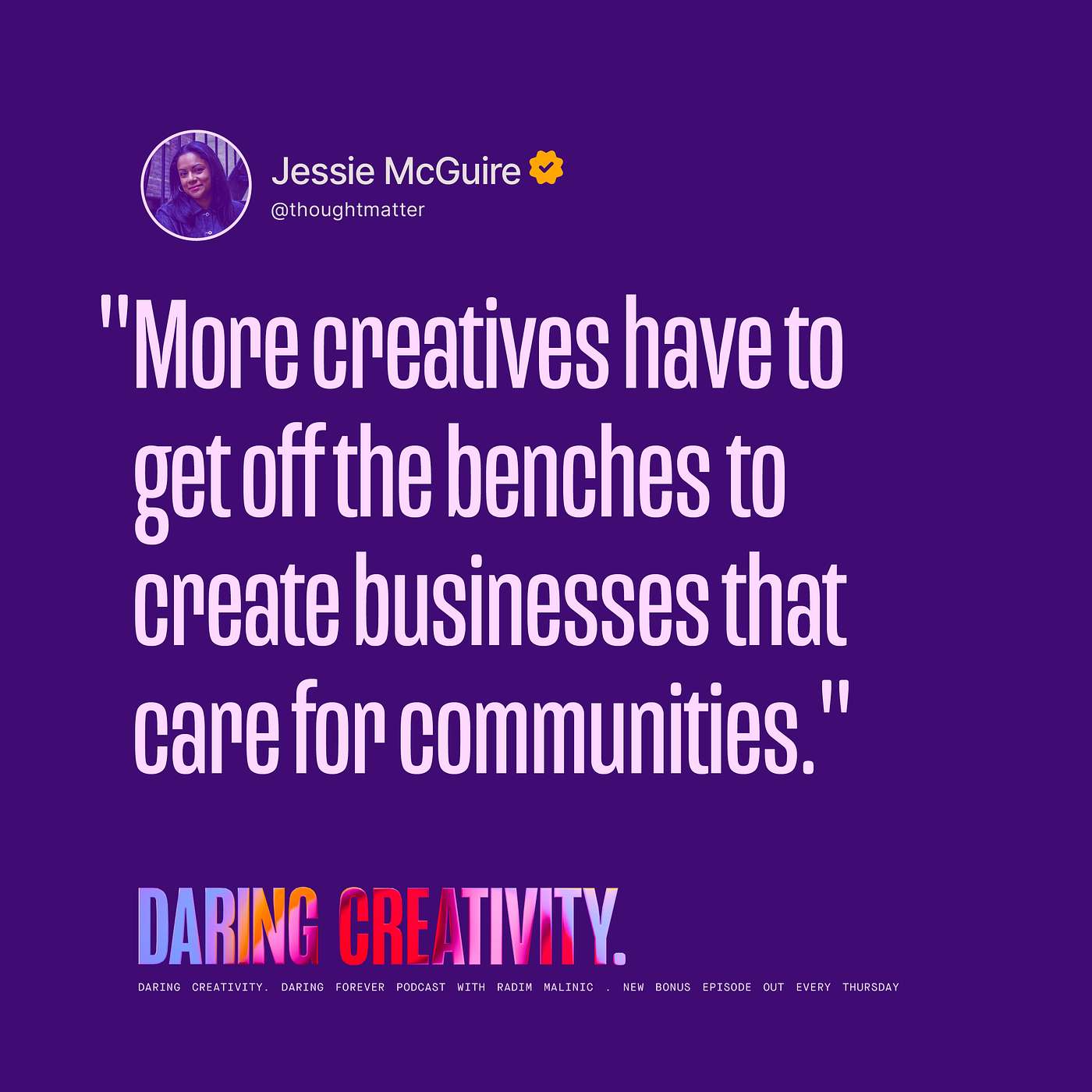
Daring Creativity
"More creatives have to get off the benches" (Jessie McGuire bonus episode)
00:13:43
Loading summary
Transcript11 lines
- [00:00]
A
Hey, it's time to celebrate the first milestone. This is bonus episode number 100. So in total, I've published 200 episodes with 100 interview and 100 bonus episodes in the last two years. Thanks for being here. I really appreciate you taking time to listen to this, sending messages, sending feedback, suggestions. It's been a fantastic ride, and I can tell you that I'm not stopping anytime soon. In the main episode published earlier in the week, which was titled Dare to Use youe Voice Where It Counts, I did say that one of the best ways to celebrate milestones was to share with you conversation with Jesse McGuire, who's a designer, educator, and managing partner at Thought Matter, a design agency in New York. And she's also one of the most powerful voices in the 21st century creative industry. The reason why I said that, because the episode was packed full of passion, views, opinions, and observation of how we should conduct ourselves or how we could conduct ourselves in the 21st century creative industry. So if you haven't checked out a full episode yet, let me start with these four moments that stood out from our conversation.
- [01:07]
B
Absolutely. I mean, I think something I've really sat with over the years is I think, and I think you were asking the question about where does design fit into this? I've always seen design as our opportunity to ask really great questions. You know, it's like something needs problem solving. Design can really help do that. And so I'd always like, over the years, I'd be like, let's ask great questions. Let's be uncomfortable. Let's be comfortable with the uncomfortable. Like, ask the question. But I think as I'm now where I am, sit. Now as a managing partner running a studio, seeing a lot of different facets of design, I actually have realized that we have to ask great questions, but we have to sit and actually wait to hear the answers.
- [01:46]
A
If you're a bit of a regular listener, you may have heard me many times to speak to my guests about the fact that in our younger years and sometimes even middle of our careers, we are still very eager to prove our worth in the room. So somebody would ask a question, would not necessarily listen even to the question, and try to answer it as quickly as possible, only to realize that actually to get to the bottom of whatever we need to do, we just need to listen, take time, and enjoy the time when we can actually process what's being said. Because the power is in that pause, that timing, when you can really understand what's being said. Because waiting to hear the answers, you're not doing anything wrong. You're admitting you don't already know everything. And that's liberating because those people who pretend to know everything are usually the ones who know absolutely nothing. They just speak for the sake of speaking. But in that space, in that pause, waiting for others and waiting to understand the question. I understand the answers, too. You make in space for someone else's experience, perspective, or even truth to reshape your understanding. And this is especially crucial for someone like Jesse, who's navigating identity, belonging, and civic imagination. Topics where assumptions cause real harm. And she's navigating civic imaginations. For creatives, this really translates to stop filling every silence with your next brilliant idea. Because that brilliant idea isn't brilliant, let's be honest. The breakthrough might come from what someone else says. If you just take time and listen is being patient and uncomfortable. So, yeah, we believe that the superpower comes from asking really good questions. But even bigger superpower is actually to take time and listen to the answers and make space for both.
- [03:38]
B
I'm not saying that they wouldn't have found somebody else who has a similar maybe background to me, but they wouldn't have found somebody who's had the same opportunities as me. Right. If I had sat it out, if I had said exactly what you said earlier, if I was. If fear had taken over my opportunity to say yes, or if I said, oh, this just seems like it's too uncomfortable for me, then the narrative doesn't change. So I actually think that more. Yeah, more creatives who have not seen themselves in the mainstream narrative have to get off the benches. We have to get off the. Not off the bench. But I guess we do. We. We have to be ready to play the game and push back on exactly what you're saying, which is how to be less fearful, more confident, but find it intrinsically in ourselves.
- [04:25]
A
I like that moment. I picked it as the opening hook of the episode because I like two words that Jesse mentioned throughout the episodes was civic imagination. And it's such a strong yet gentle, you know, motivation sort of piece. Because when she talks about designers getting off the benches, it's kind of the reminder that we can be entrepreneurs. We have the power to do things. And let's be honest, how many people are hoping to go viral on LinkedIn and. Or anywhere else and try to sort of build their businesses that way, hoping to attract, you know, some form of interest from passing traffic, hopefully getting some work, you know, showcasing their thought leadership or their processes that no one really asked for. And that's kind of like the only way for most people to operate. But in Jessie's case, I just love when she was talking, like, get off the benches and play the game to actually make something, because it even resonates, you know, beyond design. It's about representation, because when you think about it, it's a part of active participation in changing systems. You know, is it you? Is it me? Are we, you know, sat on the benches? Because I think it comes in everyone's life when they realize, like, you know what? Now it's my time to come and get on a pitch, so to speak. And if you had listened to my conversation with Carl Wilkinson, which started this year, so two episodes ago, Karl, talk about. I'd rather be on the pitch than have opinions from the stands. And I think that's the important part. I'm purposely choosing my guests who are the doers, makers, builders, the instigators, the contrarians, because they are making something in the name of daring, creativity, and I absolutely adore it. And, yeah, this is just the right sort of, I would say, ammunition to hear that, you know, if someone reminds you, get off the bench and actually build something. Be ready to play the game. And I would believe this is something we need to hear from people like Jesse.
- [06:36]
B
We should all be really excited to figure out how to make all of that better for our children. We should be thinking about how do we actually create the infrastructure that comes from imagination. And so that's what I'm like, how do we do more of that? How do we help people like, yeah, I don't know, redefine design to design the world we want to live in. I don't know. It just. That, to me, is what I'm really eager for. And I keep trying to talk to our designers in the studio, the young people at prad. It's like, you know, honestly, we don't need more businesses that have to scale. We just need businesses that are really caring for each other, caring for the community. And if you're a creative soul or a creative individual and you want to create a practice, like, figure out how you can do that work, get paid, support your family, like, you don't need to be next Amazon. I'm sorry. Like, I just feel like we are. We've been sold this a little bit faulty bill of goods, that it should be the Amazons, the Googles, the.
- [07:33]
A
The next unicorn.
- [07:34]
B
Yeah, yeah. Like, no, I didn't want a unicorn.
- [07:37]
A
So in Jesse's case, again, it's a kind of part of the Previous standout moment where she's talking about the fact that what we create, not only did we need to get off the benches and create stuff, but also it's a reminder that, you know, you can be famous for not getting more people to vote. You can have more power in creating companies that actually caring for the community, that actually created more for the people on the ground and not necessarily aim just for the next unicorn, for the next Amazons or the Googles. And okay, those companies have been incredibly successful in making money and making lots of people really rich. But where is the value to majority of the society? Yes, we got more accessible tools and you can get, you know, a toothpaste delivered within 24 hours, but it's just convenience. That's just something that someone else is making money in the background really quietly. But in Jesse's case and what she does with thought matter, their studio in New York is to bring greater value to the society, to the community, to nurture conversations and actually nurture education, to be more in the business of care. Because working with local communities can be powerful. Care can also be profitable and we can actually reframe how we can change an entire generation and how we approach building creative practices because it doesn't mean that you're doing something for the good of, you know, society that you need to be poor or non profitable. The question is, is how do you spend your time and energy in creating things that will help people to become something more Effy?
- [09:31]
B
You know, I think about it all the time because yeah, I go on LinkedIn, I always get, I get rage baited just being on LinkedIn and I mean I'm on it, right? And I know it's important and there's, it gives you access and, and whatnot but, but even Instagram or anything that has a way in which for us to comment. I always say to myself, because I do read the, read the comments against new logo comes out or a new brand. You know, someone's got my hot take and it's like great, let's all have a good interesting debate and dialogue. But I can't help think when somebody has a hot take on a logo brand that they never saw the brief, they didn't understand the clients, they didn't know the context that I just wish they would go take their common walk down to their public library and help that library like get more people to come in.
- [10:15]
A
Our conversation with Jesse has taken a sharp right turn towards the LinkedIn community mainly to just highlight some of the sort of the percentage of the rage baiting posts because I'm sure even from these previous three moments you can tell that Jesse's here with her work that is more about a human. It's about how we do stuff together, how we do stuff for one another and spend that energy wisely. We were very much on the same page when Jesse was talking about the fact that Even being on LinkedIn she feels rage baited. And I did a post, which technically I guess it was a rage baiting post a while ago about the fact how people tag along unrelated slightly polarizing topic, rubbing their hands and rubbing their thighs, hoping that they'll get the right engagement and then just go in be sort of dropped back into obscurity because they haven't really gone into the full cycle of winding people up with their polarizing opinion. Opinions are good. Like being able to disagree is good. But I think there's a time and place for it. When someone does that all the time and does their only input towards general state of creativity society, it gets a bit tiresome. Because of course we are nosy people. We are nosy humans who get triggered. And of course when you rub people the wrong way or when you trigger people with your opinion, they will listen. Some of them will chip in. If that's the absolute, maybe that's the worst case scenario. But it's often that you stop people in their tracks. They might not reply to you, but you've already interrupted their day. You may have made them think about something different. But I don't think there is that much value in all of this. Because Jesse's moment really challenges the entire creative class in redirecting the energy from performance criticism to generative to generative creation. Design is something that gets more people to vote. In her case, she says be famous for getting more people to vote. Do something that makes your neighborhood safer. Design something that helps your local small business survive. Because those projects won't go viral, but they actually matter a lot more. Let's be honest, the LinkedIn and all of those social media platforms are very much a mirror held up to our industry that's gotten drunk on its own discourse while forgetting its actual purpose. We are here to make the world work better for people. Thank you for joining me on this episode. I hope you check out a full interview with Jesse McGuire and I'll see you next week with episode 101. Thank you. If you enjoyed this episode and would like more accessible resources to help you discover your daring creativity, you can pick up one of my books on themes of mindful creativity creative business, branding and graphic design. Every physical book purchase comes with a free digital bundle, including an ebook and audiobook to make the content accessible wherever you are and whatever you do. To get 10% off your order, visit novemberuniverse.co.uk and use the Code podcast. Have a look around and start living daringly.