← Daring Forever (Find your Extraordinary)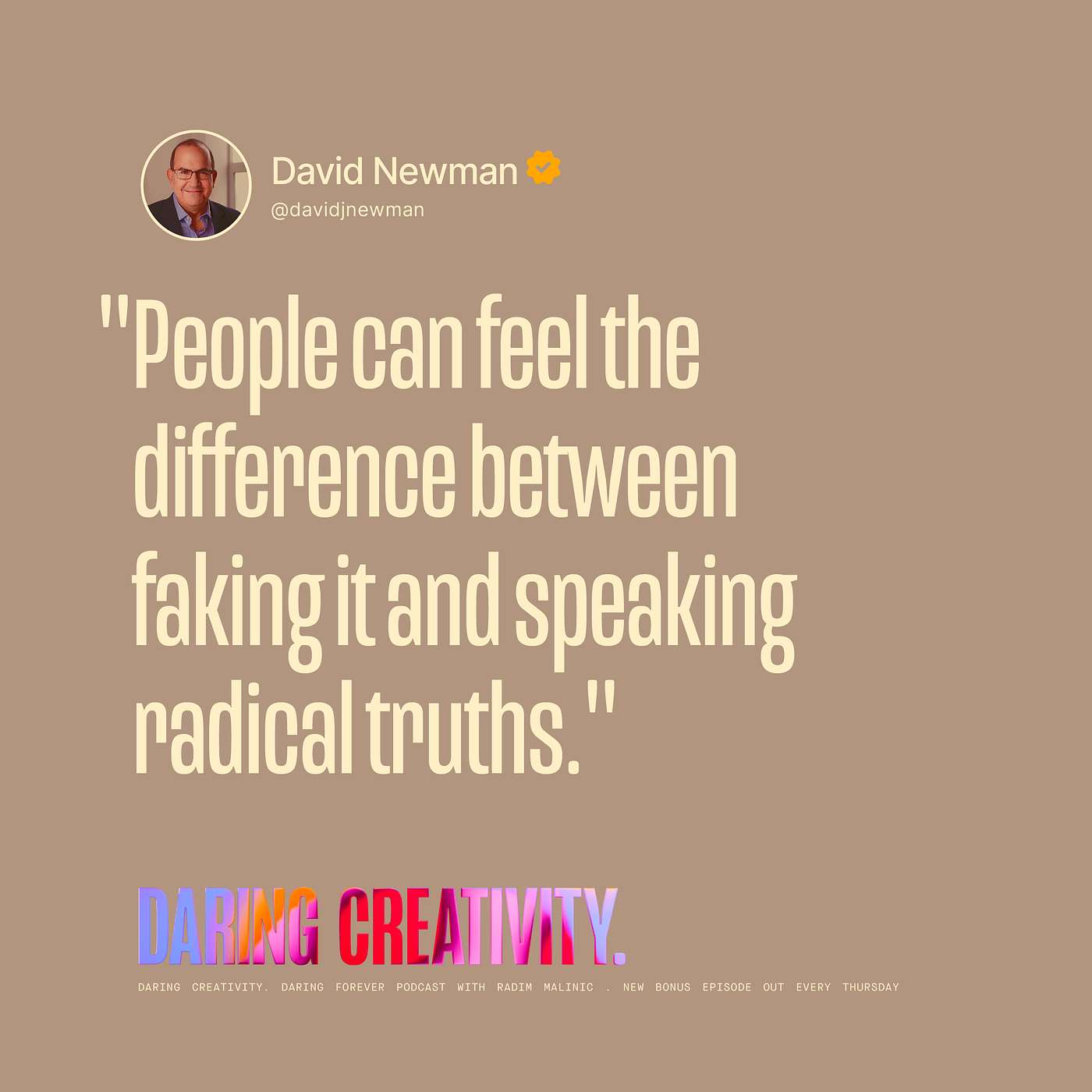
Daring Forever (Find your Extraordinary)
"People can feel the difference between faking it and speaking radical truths." (David Newman bonus episode)
00:14:15
Loading summary
Transcript9 lines
- [00:02]
A
Hey, welcome to this bonus episode of the Daring Creativity Podcast. I'm back to unpack some of the gems from this week's conversation, pulling out those moments that deserve a second look, and dig deeper into what makes them special. This week I spoke to David Newman, author of Market Eminence, about how he helps experts become in category of one. And guess what? The episode was titled Dare to become category of one. Because his message is so powerful and I've got to know David's work over the last six, seven years, if no longer. And I'm a fan. I find him bold, and he is very much a category of one. And I absolutely love and adore what he says, how he says it, what he means, and what he does, because his results are proven, and he is indeed a category of one. If you haven't checked out a full episode yet, let me start with these four moments and maybe convince you that you need to check out the full episode.
- [00:57]
B
One of my early sales mentors, he saw me studying and applying and practicing and having some early level of success about two or three years in, and he says, david, we need to have a chat. He says, you're really focused on being a good salesperson. He says, that's not the key here. The key is to be a better person and more sales will happen. And you could hear the record needle going across the grooves going. And I was like, wait a minute, what does that mean, be a better person? He says, well, you really have to care about your prospects. You have to have empathy. You have to truly listen. Don't just listen in a sales way. Listen in a human way. Listen with empathy, listen with kindness. Listen with openness. Listen. Listen without an agenda and figure out what's the reason behind the reason, what's the problem behind the problem, what's the issue behind the issue? And figure out if you can truly help them and if you can offer to help them, and if you can't, then move on, because that prospect is not for you.
- [02:08]
A
What Dave is hitting on in this, in this moment in the conversation is the fact that the sales anxiety sometimes can really push us into a different mode of empathy or actually suppresses the empathy per se. Because I mentioned in our conversation that I have come across, or shall I say, the first time I come across a real salesperson, I was really taken aback because their attitude, behavior, approach was so alien to my way of seeing things. The example I was actually talking about, which I didn't mention, was I used to work for London Film Museum, and this is where I've come across people who were just relentless sellers. And I didn't like it because I've kind of believed that there should be two sides of all of this. And yeah, to them, creative work, Pantone colors, whatever, didn't matter at all. They were very much in the business of being the best possible salesperson, but not the best possible human. And you know, we have been need people in different categories and different skill set. But in David's situation, he was talking about the fact that, yeah, he spent, you know, many years trying to work out what he should be doing with his business. That wasn't going kind of anywhere at that point because he was still learning about how to run a business. And when you think about it, it really opens up so much when you say, look, just be a better person. Because I believe that more business deals that I've ever closed was more about how to be human, how to actually align with your character, personality of sort of skills and negotiation. I just, I guess when I say negotiation, negotiation is just basically a conversation that talks about business in a way that's understandable because being a better person, I don't think it's ever so ever backfired on anyone. So when David says listen with kindness, listen with openness, listen without agenda, and figure out what's the reason behind the reason. Sometimes to have all of these sort of, you know, receptors switched on might be hard because we might be in situations where we really need work, where we need to put up no bank balance, where we need to have extra work to, you know, even pay people, if you're employing people. So it might be sometimes that this is impossible even to do because actually it reminds me of a conversation with Jessica hish many, many episodes ago. And she says, when you're desperate, no one wants to work with you. And how many times do you find yourself either sending desperate email or seeing a desperate email in your inbox, or find yourself being spammed on LinkedIn or everywhere else with people who are desperate and you can smell it from the right off.
- [05:04]
B
That's right. And this is such a great question that I sometimes get someone who's early in their career or just getting established, you know, is it too soon to establish this market eminence, positioning and differentiation and so forth? When I hear that question, I hear it in different words. The words that I hear, Adam, are how much time should I waste trying to be everything to everyone, Trying to be universally like doing crap work for crap fees. David, how much time should I waste doing that before I establish who I really am and what I really want and what's really meaningful to me. And I say, well, how about zero? How about we waste zero time doing that nonsense? And you jump right into the deep end of the pool where the money and the happiness and the meaning and the impact really lie.
- [06:01]
A
David's concept of market eminence is about becoming a category of one. And in his instance, he talks about the fact that the eminence is about kind of. We can. We can rebrand it, or we can talk about the fact that it's a. It's a. In this instant, eminence is about creating a public profile that talks for you, that. That summarizes who you are, what you do, how you think, you know, how do you have an opinion? And in this part of the conversation, I was David, like, okay, so what would you recommend to people who are starting up? Like, what is the time, you know, when they engage in this? Like, what is the concept of market eminence? And as you just heard, he said, like, well, how much time do you want to waste? Because we find our way into situations, professions, you know, status by emulating others. How many people, how many people would have put their hand up saying, hey, who did you copy and for how long? Until you find your own voice? And it's hard to be you in the world when everyone is everyone and they seem to be established by being that. So I love when David said, look, start now. Start already. Like, find your own voice and look for it. Because it's easy to say that from someone who's in their early 60s. He's had a lifetime of working stuff out. But this is why it's important to listen to people like David and not to pay attention to his concept of market evidence, because it does make sense. And guess what? It works.
- [07:39]
B
You see these spirit animals of people that are being contrarian, that are shifting beliefs, that are establishing their sense of market eminence. It's always unique, it's always personal, and it's always authentic. That's the authenticity and the transparency is so key. This is why I said a moment ago, it's not a PR stunt. It's not something that you're just grabbing out of thin air. Well, let's see how people respond to this. It comes out of here. Not only is it coming out of your brain, it needs to come out of your soul. It needs to come out of your very being. Because you mentioned the word feel and feelings. People can feel the difference. They feel it when you're Faking it when it's a PR stunt, when it's a cheap attention grab, and equally they feel it when you're finally busting out and speaking, you know, radical truths and being radically generous and radically helpful.
- [08:37]
A
When David talked about people being contrarian, I was like, they sound like a complicated people, contrarians or not something that you would set out to be. But in our conversation when David was telling me this, I was like, wait a minute, I can think of someone like this. Oh yeah, it's actually Simon Dixon and I love Simon dearly. He has opinion, he's got lived in experience and he talks about it. Of course, this can contradict what I just said in the previous standout moment, that you start early and try to establish yourself. What that means is that you don't want to waste time by just absorbing conversations. You want to spend time observing conversations and finding the parts that make sense and the parts that potentially need more time to digest and ferment in our minds in a way of making sense of them. So to David, when he was talking about the fact that, you know, being contrarian isn't a PR stunt, it isn't a gimmick, you're not grabbing something out of thin air. It actually is important because it's valuable to have something of importance to say about the current state of our industry or certain aspect of it. Because I know in the past, in previous conversations I do talk about a lot about LinkedIn baiting, you know, people who rage, bait certain opinions and that's not contrarian, that's just an idiot. And you know, having something proper to say is more about value and what we can see and we can learn from one another.
- [10:17]
B
AI has taken over the world of how to content and, and good, I'm glad because you should not have been posting just boring same old lamo how to content in the first place. Where humans have the edge, or at least today they have the edge before the robots take over the world, is three other kinds of content that is completely, completely in the realm of flesh and blood people like you and me. One is not how to, but how to think. How to think. In other words, strategic, high level, insight based advisory type of content. This is based on your personal experience, your battle scars, your war stories, what you've done, what you've seen, what you've learned, your recommendations, your biases, your perspective, your lens onto the world, nobody can take that from you. That is organic human DNA that is sitting in your chair right now. And perhaps you haven't thought of talking about that or sharing that because oh my gosh, what if someone doesn't like it? What if someone doesn't agree with me? What if someone has a different perspective?
- [11:36]
A
This is the exciting part, the how to content. Like how to do this and how to do that. You know those 15 years of blog articles, they've all been hoovered up by AI engines and you can say how do I do this? And there you go. You can pretty much create your own coaching program. But it'd be fair to say that the basic content has been digested by the LLMs and they can tell us what XYZ can mean and what we can do and how we can follow the step by step processes. But in David's instance he talks about let's talk to people how to think. And you might think that's a bit bold, don't tell me how to think. But it is more about a strategic insights, the high level insights advisory type of content that's based on personal experience, battle scars, the war stories, what we've done and what we've seen and what we've learned and what we can recommend, our biases. That's what we can tell people, how we can learn from one another and what to think of certain situation that we see and come across to because it can seem bold. But again, are we in a situation where artist doesn't want to sell, artist doesn't want to do this, artist doesn't want to tell something to somebody else. But how often and how much on daily basis are you being told by everybody else what to do and how to think and what's not? What's your how to content? And this is the question of what David is establishing here with the category of 1. Be who you are. Exactly. Be who you are. Have something to say, have an open mind, you know, see observations of our industry and shape your own opinion because you don't have to say them straight away, but they will mean something over time. Thank you for joining me on this bonus episode. I hope you check out a full interview with David Newman and I look forward to seeing you on the next one. Thank you. If you enjoyed this episode and would like more accessible resources to help you discover your daring creativity, you can pick up one of my books on themes of mindful creativity, creative business, branding and graphic design. Every physical book purchase comes with a free digital bundle, including an ebook and audiobook to make the content accessible wherever you are and whatever you do. To get 10% of your order, visit novemberuniverse.co.uk and use the code podcast, have a look around and start living daringly.