
Podcast
Modern Capital: The Private Markets Podcast
Hosted by Marc Andrew · EN
Conversations with leaders building the infrastructure of private markets.
22episodes
Episodes
Newest firstAll episodes
Harald Collet: Who Wrote That Spreadsheet Formula?
3w ago00:53:13Tap to summarizePrivate credit grew faster than the infrastructure built to monitor it.LPs are still reconciling loan agency notices, compliance certificates and financial statements by hand, out of spreadsheets held together by Excel formulas nobody currently employed can explain. The operational risk is real, and for some of the world's most important institutional investors, it's now front and center.Harald Collet's answer isn't a standard. He's betting that private markets data will never standardize the way public markets did. So he built Alkymi to absorb the mess, rather than wait for the industry to clean it up. The clients putting that bet to work are sovereign wealth funds, insurance companies and pension funds - with collectively over $20 trillion in AUM - for whom getting data 45 to 60 days ahead of the CIO is the difference between monitoring risk and discovering it.In this episode of the Modern Capital Podcast, Harald and Marc cover:Why private credit requires hundreds of data points per loan and why that number will never standardizeWhat it actually takes to move a monitoring workflow off spreadsheets and into productionWhy every effort at common data formats in private markets hits the same wallThe Forward Deployed Engineer model for getting firms through the change management they can't staff themselvesWhy Excel isn't going away and why it was never supposed to be the reporting platform"These were young hopeful professionals that were sold on the dream of joining a glamorous firm, and they were essentially processing PDFs in the shared email inboxes for the first 18 months of their time at the firm... And we thought, this is a terrible way to work."Private credit needs real data infrastructure. The asset class is only growing and the mess is only getting bigger. The firms still waiting for a standard are running out of time.
Transcribe →
Joan Kehoe: We've Been Here Before... But Not This Fast
Jul 1001:06:22Tap to summarizeFund administration was born in a world where a GP's entire LP base could fit in a small conference room. That world is gone. Now it's being asked to handle 500,000 investors. The subscription docs, data workflows and staffing models were never built for this. Neither was the technology underneath them.Joan Kehoe watched this transition happen once before. In 2006, hedge funds were running on infrastructure built for a different era, with quarterly cadences, manual processes and legacy platforms too embedded to move. She built the company that fixed it. Data transparency. Daily reporting. The work the large administrators wouldn't touch.She sold that business, then spent five years rebuilding hedge fund servicing from inside JP Morgan, the hardest five years of her career. Legacy technology plus legacy process plus an organization that size is a different problem than building from scratch.Then she watched the same pattern begin again in private markets and founded Alchelyst to fix it. The difference this time is pace. The industry has to move faster than it did in 2006 - and for once, the tools exist to do it.In this episode of the Modern Capital Podcast, Joan and Marc cover:Why hedge funds in 2006 are the exact template for private markets now The evergreen problem: why funds built for 50 institutions cannot simply scale to 500,000 investorsWhat AI agents actually do to the fund administration staffing equation and what they cannot replaceHow the merger with Lyra Client Solutions (Apollo's spun-out LP servicing team) creates a full-stack from pre-trade through post-tradeWhether fund administration consolidates to three or four dominant platforms - or stays distributed"The reason we set up Quintillion was recognizing there was room to do it quicker, smarter, better. And that all resonates with today. But what's really different now is the pace. The pace at which you can effect and have to effect change now is completely different than it was 20 years ago."Joan built this infrastructure once. The question is how fast it happens this time.
Transcribe →
Amit Gairola & Griff Norville: Customer Obsession Comes to Private Markets
Jul 300:42:26Tap to summarizePrivate markets grew for decades without obsessing over the investor experience. A few hundred GP names mattered, and they competed on one number: returns. There was no pressure to care about reporting quality, data timeliness, or what it felt like to be on the receiving end of a quarterly PDF.That era is over.Amit Gairola spent a decade at Amazon, where every decision came back to one question: what does this do for the customer? He brought that question to private markets and built Daphne, a permissioned data layer that makes straight-through data processing possible between GPs and the allocators, platforms and fund of funds that invest with them.Griff Norville is Co-Head of Innovation at Hamilton Lane, one of the largest allocators in private markets with roughly $1 trillion in assets under management and supervision - and both a backer and live user of Daphne. He's watched the industry evolve from one where delivering returns was enough, to one where a new class of investors brings expectations formed by public markets, consumer technology and the Amazon-era assumption that a good experience is simply the baseline.The problem they're solving is not subtle."The uncomfortable truth in this industry — for all the growth we've had and the improvements that we've made — is that we still operate with PDFs and emails and cumbersome data rooms."In this episode of the Modern Capital Podcast, Amit, Griff, and Marc cover:Why private markets built its infrastructure around documents instead of data and why that logic no longer holdsThe difference between data extraction and straight-through processing, and what closing that gap actually requiresWhy standardization keeps failing - and why AI-powered translation may make it irrelevantHow evergreen funds moving from quarterly to daily valuations are making the current system untenableWhat 401(k) access and secondary market growth require from data infrastructure before either can scalePrivate markets has to start treating its investors like customers. Delivering a great LP experience is becoming the new standard, and the infrastructure to make it possible is only now being built.
Transcribe →
Michael Gruener: Asset Management's Third Wave (and What Will Break It)
Jun 2600:54:51Tap to summarizeThe mutual fund put investing in the hands of ordinary savers. The ETF made it cheaper, faster and borderless. Both transformed asset management. Both also required infrastructure that didn't exist when the product arrived. Private markets are wave three. And the infrastructure problem is bigger this time.Michael Gruener lived through both of the first two: mutual funds at Goldman in the early 2000s and ETFs at BlackRock through the iShares expansion across Eastern Europe and the Middle East. He knows what a category-defining shift looks like from the inside. And he knows what breaks when the rails are not ready.Now, as co-CEO of Titanbay, he's building the infrastructure for wave three before it breaks.In this episode of the Modern Capital Podcast, Michael and Marc cover:Why the semi-liquid evergreen fund is the ETF of private markets - and why the infrastructure underneath it is not readyThe "know your client, know your trade" problem - and why today's trade rails were built to do the oppositeWhat an 8% NIGO rate looks like when a model portfolio rebalance triggers 100,000 trades in a single dayWhy the fix is faster than the industry expects - and why it comes down to 24 namesHow Titanbay connects to distributors in whatever format they have, applies private market logic, and hands back a trade in good orderWhere the boundaries between public and private markets are heading - and the one condition that has to be met first"That trade infrastructure was not built for this product... It was built for the industry as it existed in 1996, when I started at Goldman. Nobody went back and rebuilt it."Wave three is already in motion. This is a conversation about what it breaks on the way through.
Transcribe →
Jake Walker: Money in Motion, at Scale
Jun 1901:08:49Tap to summarizePrivate markets have solved origination. The products are built. The constraint now is a wealth management tech stack built for mutual funds and ETFs that cannot run semi-liquid products at scale.Jake Walker is Partner and COO of Client & Product Solutions at Apollo, where the wealth distribution build he has spent five years running has gone from zero to more than $17 billion in annual channel raises. Private markets are joining the $147 trillion world of traditional asset management. The infrastructure needed to carry them hasn't kept pace.His read: the fix costs $400 to $800 million spread across 50 to 70 endpoints. "Pennies for everybody," he says. But the problem isn't money. It's coordination. Every industry that hit this moment solved it the same way. The wealth management ecosystem never has. In this episode of the Modern Capital Podcast, Jake and Marc cover:Why the wealth management stack breaks when semi-liquid products arrive at scaleHow omnibus accounts could unlock distribution and what needs to be true for subscription documents to disappearApollo's push for estimated daily value across its entire credit bookThe Netflix parallel: what Reed Hastings had to build before anyone could stream (and what private markets needs to build before it can distribute)Whether asset managers become hardware providers or build the coalition that makes it unnecessary"I want the rail to be ubiquitous... we need it ubiquitous because I think if the market grows, our firms will grow. I will compete on brand, and content, and client service, and investment performance. I will not need to compete on how the infrastructure works."The money is in motion. The rails aren't ready. And the only path forward is a level of collaboration that this industry has never been forced to attempt before.
Transcribe →
Ben Haber: The Omnibus Unlock
Jun 1200:58:34Tap to summarizeThe wealth channel buildout everyone in private markets is betting on has a plumbing problem.Evergreen funds are growing fast. Roughly 300 products, ~$550 billion in AUM and demand from wealth platforms that is real and accelerating. These vehicles are designed to bring private markets within the reach of everyday portfolios, but the infrastructure underneath them was built for institutions writing $50M+ checks, not hundreds of thousands of investors at lower minimums.The NIGO rate (orders failing on documentation, compliance, or funding before they ever clear) sits at 8%. Every subscription flows bilaterally between advisor, custodian and transfer agent. At the scale this market needs to reach, that system breaks.Ben Haber is co-founder and CEO of Monark Markets. He started building it as a sophomore at NYU. On graduation day, he skipped the ceremony to close on the assets of a bankrupt fintech instead. That deal crystallized the thesis: private markets don’t need a better interface. They need better rails.His answer is omnibus: one account per fund per custodian, netting all orders rather than processing each one individually. The structure Schwab built for mutual funds with OneSource, applied to private markets.In this episode of the Modern Capital Podcast, Ben and Marc cover:Why the "Robinhood for alts" D2C wave failed and why competing with Fidelity and Schwab for the same customer was never going to workWhy evergreen funds cannot sit inside model portfolios without omnibus underneath themHow the pending paperwork crisis in private markets can be solved by simply removing the paperwork"One omnibus account per fund, per custodian... dramatically less than the hundreds of thousands or millions of individual accounts the transfer agent would need to record. A real ability to actually scale the evergreen fund market in a way that is simply not possible today."The wealth channel opportunity is well understood. This conversation is about what has to get built before it gets there.
Transcribe →
Jason Wenk & Michael Miller: How to Serve More (and Serve Better) in Private Markets
Jun 501:00:08Tap to summarizeThere are fewer than 4,000 public companies in the United States. In the late 1990s, there were 8,000.The companies that left public markets didn't stop creating wealth. They simply stopped being accessible to ordinary investors. The world’s most sophisticated institutional investors know this. The Ontario Teachers’ Pension Plan, widely regarded as one of the global leaders in institutional investing, is 60% allocated to alternatives. The average high-net-worth individual is under 2%. That gap isn't a knowledge problem.It's an infrastructure problem.Jason Wenk built Altruist to close it. Not with a new fund structure or a regulatory exemption, but by rebuilding the plumbing from scratch. He spent over a decade building middleware on top of legacy custodial infrastructure before concluding the ceiling was structural. In 2018, he stepped down and built a self-clearing custodian: one of the rarest things in financial services.Michael Miller came from Robinhood, where he worked on product strategy for brokerage and IPO access. At Altruist, he's building the private markets layer on top of that same infrastructure, working toward the thing the industry hasn't cracked: alternatives that move as fast as a public equity trade.In this episode of the Modern Capital Podcast, Jason, Michael and Marc cover:Why building a self-clearing custodian is harder than launching a rocket, and why the incumbents' inertia made it worth doing anywayThe subscription workflow that takes under 90 seconds and less than 10 clicks, and why that alone still shocks advisors who've spent 20 years in the industryWhat happens to a model portfolio when public markets sell off 15% and the private side has a 30-to-60-day settlement windowHazel, Altruist's AI tax agent, and how a product that does in two minutes what used to take a family office 10 people wiped out $120 billion in market cap in under 24 hoursWhy "self-driving money" was never achievable with software alone (and why it might be achievable now)"You kind of go, hey, I want the people that I grew up with and the families I knew, I want them to be able to have a fighting chance. And you can't do that if the minimums are 20 times higher than how much capital they have."The infrastructure layer private markets has been missing is being built. The question is whether the industry can move fast enough to meet the demand that's already here.
Transcribe →
Luke Flemmer: The Private Markets Inflection Point
Jun 100:51:36Tap to summarizeMarkets don't just happen. They're built.Public markets weren't a completely organic development. They were engineered over centuries, through boom and design and crisis. Every layer of trust investors now take for granted: the information rights, the settlement rails and the benchmarks, all came from people who did the work and built them.Luke Flemmer is one of those people. He runs private assets at MSCI. His central point: private markets are at the very start of that work.Private used to be the spice. Now it's the main dish. Institutional portfolios hold between 20 and 50 percent in private assets. The allocations scaled fast, but the infrastructure underneath them did not.Most people picture private equity as a guy in a vest in Midtown. Most of it is actually pension money. It is individual savers and capital managed on behalf of regular people. Private capital is public capital.Bad information flow is intrinsically value destructive. It slows the market and shrinks returns for the people these institutions serve.In this episode of the Modern Capital Podcast, Luke and Marc cover:Asset-level benchmarks: why investors need to see exposure across funds, not just inside themDaily nowcasting indexes for PE and private credit - closing the gap between quarterly marks and real valueThe classification problem: the industry still can't agree on what to call things (and what that costs)Why information asymmetry in private markets is mostly underdevelopment, not design, and why closing that gap doesn't harm returnsHow AI lets firms leapfrog data infrastructure gaps and what separates the institutions that will author that shift from those that absorb it"You need some degree of transparency to drive more robust price formation. Once you start to drive price formation, you start to drive liquidity. Once you start to drive liquidity, you kick off this data flywheel."Markets get built by people who decide to build them.
Transcribe →
Chris Sparenberg: The Raw Materials of Private Markets
May 2200:35:09Tap to summarizeS&P Global built the information layer for public markets. Private markets is next.In 1860, Henry Varnum Poor published a manual on American railroads to inform investors. That business became Standard and Poor’s.The mission then was the same as it is now: build the information infrastructure for a market that is scaling faster than anyone can track.Private markets is the current assignment.The problem: a market that cannot measure itself. Performance data arrives in PDFs. Every manager reports differently. There is no agreed taxonomy, no standard for comparison. More data is flowing through private markets than ever before... and almost none of it is comparable.Chris Sparenberg started his career at Cambridge Associates building private markets benchmarks from the ground up. He’s now Head of Private Markets Strategy and GTM at S&P Global Market Intelligence - and he’s spent his entire career in private markets data, technology and analytics.In this episode of the Modern Capital Podcast, Chris and Marc cover:The work S&P Global has done with Cambridge Associates and Mercer to create a new taxonomy and performance analytics for private marketsWhy more data is creating more complexity, not lessThe GP/LP disclosure challenge and how it's quietly resolvingThe role played by iLEVEL as a data clearinghouse, which allows GPs to report to their LPs on a one-to-many basisWhy we're in the second inning (and what separates the firms already building from the ones just arriving)"We want to be in the raw materials business. We want to collect data at the atomic level, enrich it, make it useful to our clients, but also really give them the tools to use it as they need to."
Transcribe →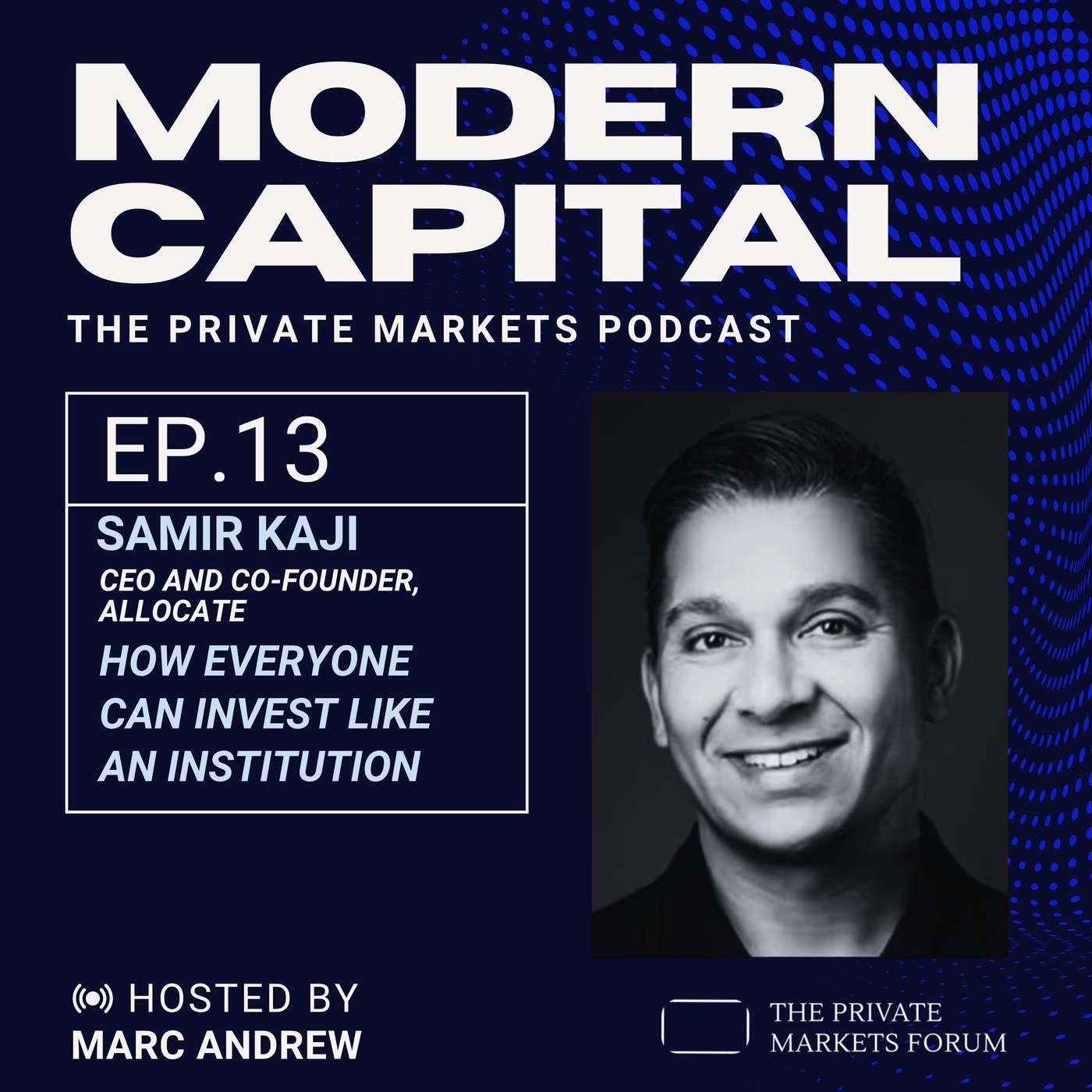
Samir Kaji: How Everyone Can Invest Like an Institution
May 1500:48:32Tap to summarizeThe next decade belongs to people who can think like institutions.Individual investors sit at 1-2% alternatives allocations. Institutions are at 20%. That gap is closing fast because the infrastructure to bridge it is finally being built.Samir Kaji spent 22 years watching that infrastructure not exist. Thirteen years at Silicon Valley Bank. Nine at First Republic. Both now gone. What he saw inside them is what convinced him the problem was never access. It was everything underneath access: the portfolio construction tools, the liquidity mechanisms, and the frameworks institutions take for granted and individuals don't have.That's what Allocate is built to fix. Four and a half years in, over $4 billion has moved through its pipes, connecting wealth advisors to private funds across venture, private equity and private credit. 360 advisor firms. 4,000 individual investors. In this episode of the Modern Capital Podcast, Samir and Marc cover:Why "semi-liquid" isn't the same as liquid, and what actually happens when individuals need outThe barbell: why large funds and emerging managers are playing completely different games, and how to build across bothWhat institutional portfolio construction actually looks like, and why accredited doesn't mean readyWhere private markets are heading and what has to be true for individuals to actually benefit"It's a way to generate alpha, but only if you get it right. So, let's build the system for that."Private markets are heading past $30 trillion. The wealth channel infrastructure to deliver them responsibly is being built right now. This is the conversation behind it.
Transcribe →