← Modern CTO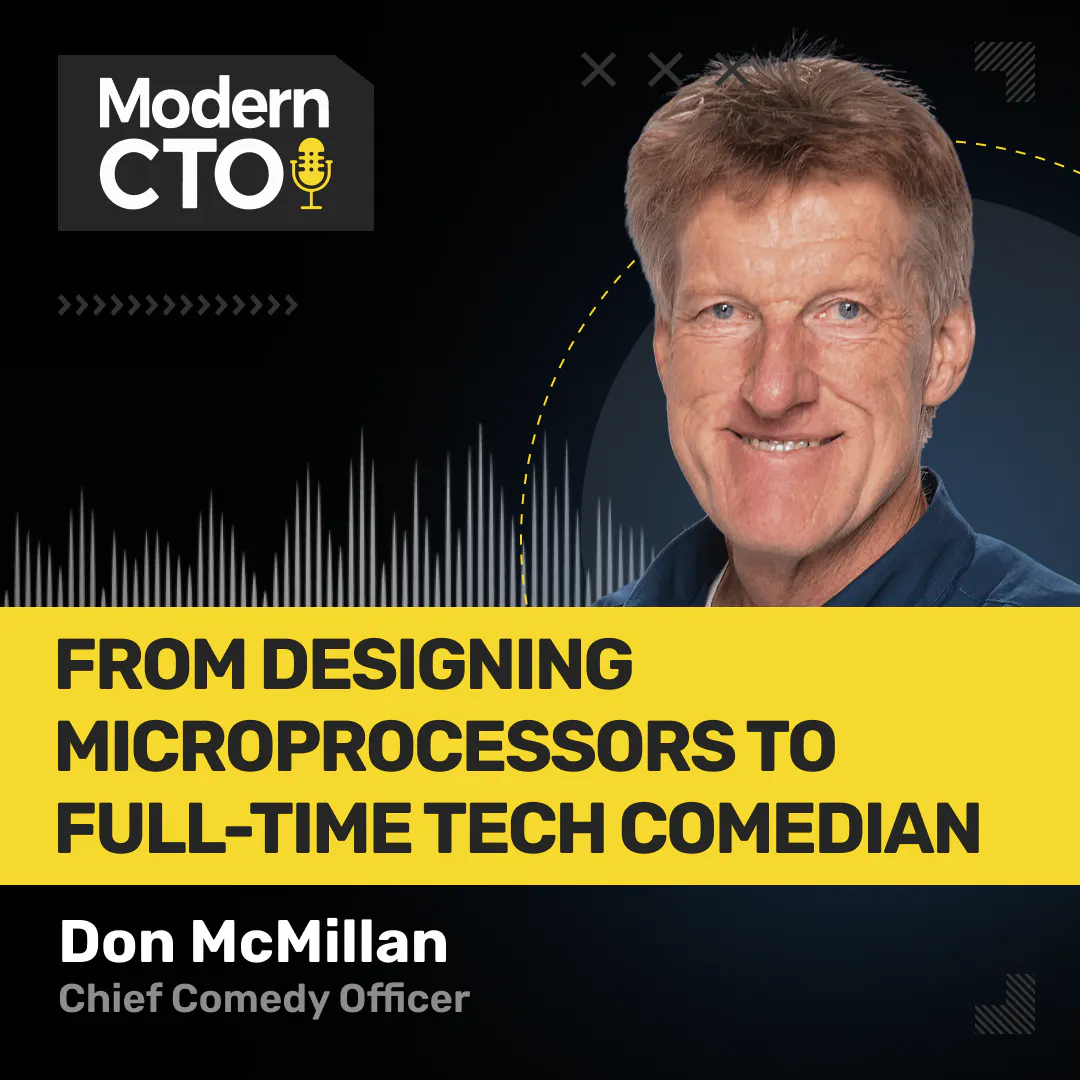
Loading summary
Transcript136 lines
- [00:00]
A
Today we're talking to comedian Don McMillan about how he went from an engineering career with multiple patents under his belt to doing stand up full time. You're listening to Joel Beasley, modern cto.
- [00:18]
B
We do education episodes on being a great tech leader, and we do entertainment episodes. You're kind of blending in the middle here because you were into technology, right? You're an engineer building cool stuff. Tell me about it.
- [00:33]
A
You know, this was never a plan for my career. Let me just start by saying that I, I was in high school. I was good at math, I was good at science. I said, go be an engineer. So I, I, I was good at engineering, I was good at taking tests. I became a chip designer. You know, there's nothing further from comedy than designing a computer chip. There really is not. But I worked in Silicon Valley at first. I worked for Bell Laboratories, which, for the nerds out there will know. It's like you're at the time. It was an ultimate research facility. Big Bang Theory was the guy who worked. Arno Penzias worked down this hall from me, shot D, invented the transistor. UNIX was developed there. Dennis Ritchie and an engineer comedian worked there. That's how much research went on there, everything. And I was really good at it, but I wasn't fulfilled. And when I went to Silicon Valley, I watched startups happening and I joined a startup and worked my ass off and get burned down. I went, well, comedy's kind of fun. Let's try that. And that's. It's been 30 years since I quit my day job.
- [01:34]
B
So was your. I want to talk about that moment where you were. So you, you were getting a little disheartened, and then so you quit your job and you went to a startup thinking that that would be the solution
- [01:45]
A
is that I did. I thought it would be really exciting. And it was exciting. It was stressful, but yeah. And I also saw Silicon Valley at the time was amazing. I remember when I landed for my job interview, they took me to lunch. First time in a restaurant in Silicon Valley. And it was like a Bennigan's or a TGI Fridays. And we walk in, and at the first table to the left of the the hostess stand is a guy sitting there with five TTL data books designing a circuit. And I said, I am not in any anywhere that I've ever been before. This is nirvana. It was the most amazing incubator of technology in the 80s, which is when I moved there. And, and I thought, this is exciting. I'm gonna be amongst nerds. We're gonna be changing the world. And we were changing the world, but it took 80 hours. You had no life. It was very stressful. It wasn't, it wasn't fulfilling because I wasn't in it for the money, I was in it for the challenge. And it was just so stressful and I was like, I gotta, I got do something else.
- [02:53]
B
Were you married at the time?
- [02:55]
A
No, no. If I had married, if I was married, there's no way I would have quit my day job. If I had kids. No, I, I, I had the typical engineering social life, which is if I met somebody at work, I might date them. But I, I, I didn't have a social life. My wife, and she's not around. I don't think she's here right now. I think she's, she found me. I did not find my wife. She found me. I, I, I, I, I was really bad at dating. I can, I can network you on the Internet, but I can't network with humans that, sorry. That's just how I'm, how I'm built.
- [03:28]
B
When did you meet her?
- [03:30]
A
She, I met her at work. I, when I, when I moved to la, I got a manager and she was my manager's assistant, which, if you know anything about la, they're the people that do all the work. And so I talked to her every day for many, many, many months, probably a couple years. And then when she quit and was leaving the business, she decided to go into social work. She thought that would be better than dealing with entertainers. She said, hey, how'd you like to go to lunch? And that was it, it was, you know, we started dating after that and, and it was, you know, we were already friends, so it was, it was great. That's how you have to ladies, that's how you have to approach an engineer. You have to be friends with them first.
- [04:10]
B
There's very few ladies listening to
- [04:14]
A
kid. Yeah. And the ones that are listening probably already know this, so I'm not helping anybody.
- [04:20]
B
Okay, so she met you after you met her when you were already like full on comedian.
- [04:25]
A
Yeah, she never knew me as an engineer. She, she only knew this. And when she meets my engineer friend, she goes, that, that's what you were like. I go, no, I was not like that. But I, those are my friends and I could be like that. That's one of my modes, you know, that's one. But I have other modes. I'm, I'm multimodal. For you techs out there, I'm a multimodal. Person, so.
- [04:48]
B
Oh, my goodness. So that's so cool. So up until that point of. Of deciding comedy, all of the introspection was just on your end. It was just you figuring out that you're unfulfilled, asking yourself these questions, and then making changes accordingly.
- [05:07]
A
Exactly right. Okay, very well put.
- [05:09]
B
For me, it was different. For me, it was my wife seeing me, like, mentally, I built some businesses and she saw me kind of like, check out. And she's like, you need to go take the path you didn't take. Cause I had this split in my path when I was doing a little bit of comedy. And then we got pregnant with our first child, and my tech company was doing pretty good. And I said, you know what? Forget the comedy. I've got a kid on the way. I gotta do the responsible thing. And then, you know, fast forward 10 years and I was like, not. Not happy with life. And she's like, you need to.
- [05:39]
A
I totally get that. Oh, yeah, no, you know, that's interesting. And you say that because I kind of had. I don't. It wasn't one moment, but I remember thinking I was a pretty good engineer. I wasn't a great engineer. I was a pretty good engineer. I'm a smart guy, so I could figure out how to do something and be good at it. But I didn't have the passion that some of my co workers had. Like, they would think, breathe and eat engineering, right? They would go home and think about what they did during the day. And I wasn't like that. I was. I'd go into engineering and I'd take the problem, but I didn't. It wasn't my passion. And I realized I wasn't gonna. It wasn't fulfilling something in. Deep inside of me. I didn't feel it, but I went, this. I don't have the passion. Wouldn't it be better if I had a job that I had passion for? Wouldn't I be better at it and think about it and be a happier person? And. And that's when I kind of just tried a lot of different things. I didn't know what I was going to do. But comedy was something that I immediately knew I had a passion for. And so when I had the chance to make that my career, I said, well, that sounds like a pretty good idea. Which is not. You moved away from it and realized, no, no, no, I need to go back to it. I actually chose that way because I thought, well, it makes more sense to have passion for what you do. And that's the best People in the world are ones that have that sleep, eat, and breathe what they do for a job, because it's not their job. It's the way they think or the way they be or the way it's true to their. Their person. And that sounds like what you did. You just had to go back to it.
- [07:08]
B
Yeah. You said the moment you realized comedy, you. You had an immediate passion for it. Tell me about that moment.
- [07:16]
A
It wasn't. It was. It was. It happened over many years. But I'll tell you one moment that sticks in my mind. I used to do this show in San Francisco called the Alex Bennett Show. It was kind of like Howard Stern. The difference was that he would have comics on two or three. Two comics, usually. And there would be a live studio audience of 10 to 15 people, but you'd play to the crowd that was there. So it was like live comedy improv, almost like a green room improv feeling right. And I love doing it. I would do it once a month, and I'm driving to work one day. I did this show when I was still an engineer, and somebody called in and said, hey, when's that Don McMillan coming back on your show again? And right then I went, oh, my God. I actually. Reaching people. I'm connecting with people. And it. Like, there's something in my soul went, I was meant to do this. That somebody took the time out of their day to call in when I wasn't on the show and go have that Don McMillan guy back. He. It was really. It was a very tough. Whoever that person was, I have no idea. Changed my life in that moment, because I kind of went, oh, no. I'm not just talking to myself. I'm. I have a relationship that I'm building with the audience. And I went, this is what I didn't have in engineering. I didn't have a relationship with the end. My end product. And now I did, which was really cool.
- [08:34]
B
So that's one of the big moments. What was like the first time you stepped foot into a comedy club
- [08:40]
A
as a comic or as a. As a. As a civilian?
- [08:43]
B
As a civilian, yeah.
- [08:45]
A
Oh, God. I used to go, actually, man, it's a really good question, Joel. I actually snuck in to see Steve Martin when I was 16 at the Latin Casino in Cherry Hill, New Jersey, which is how I grew up. And Latin Casino used to have Frank Sinatra. And they, you know, all the big stars of the day would come to this little. It's this. It was two miles from my house, and it was. It wasn't Actually a casino, but it was, it was like a Vegas showroom in the middle of Southern New Jersey. It was a weird thing. And he was on his King Tut tour and I couldn't get in, but somehow we talked to somebody and I got in and I saw Steve Martin, who was one of my favorite comics when I was young. And I just went, this is a. Wow. You know, I just loved comedy. And to see him live to first live comedy show and it was so much different. If you haven't seen a live comedy show, people have to go see. It's nothing. It's the difference between movies and live theater. It's nothing the same. It's a completely different experience. So goes. And that. That was the first time I hadn't thought of that in a long time. But yeah.
- [09:46]
B
And how, how much was the space between that first time of you seeing Steve Martin and you stepping on stage for an open mic?
- [09:56]
A
Eight years.
- [09:57]
B
Eight years. Were you doing any comp. Was that show happening with Alex Bennett in between those eight years or was it just eight years of silence?
- [10:04]
A
It was. Well, one other thing happened when I was 17 and my friend Ed Hubbard, shout out to my buddy Ed Hubbard, my high school buddy, Deci, and by the way, might be one of the funniest men I ever knew, who became a finance analyst and now teaches at. What did he, what did he end up doing? He's at a really good school, teaching at New York University or something. I'm sorry, Ed, I forget what school you're at. But he's a professor now. He made a. Made a lot of money investment banking. He. But he was really funny guy. And he goes, I want to try doing standup. I signed up for an open mic. You want to come with me? So 17 years old, this 17 year old gets up and it wasn't a comedy open mic, it was an open mic. Most of them were singers and guitar players. He got up and did comedy and he did pretty well. And I put this idea in my head that, wow, almost anybody can do comedy. There's no, there's no. You don't have to go to school. You just get up and do it. So that's incubated in my head for like eight years. And then I started, I moved to Silicon Valley. Actually it was more like 10 years, late 20s. And I remember thinking, I gotta find something to balance this Silicon Valley life. And I go, I always wanted to try comedy. I've been going to comedy clubs. I've been a comedy fan since I was a Kid I once saw at this place, Rooster T. Feathers, which I just played last weekend, by the way. I went to at Rooster T. Feathers when I was like 21. I saw Dana Carvey was the headliner, Ellen DeGeneres was the middle act. And I forget, oh, Warren Thomas, who's not with us anymore. It was a great comic and just an amazing show around the corner from me. And so comedy always felt it was there. And then when I was looking for something to do, I'm like, I'm gonna try comedy. So like, typical engineer, I took an improv comedy class. I'm like, I don't know how to be funny, but if I can be funny with nothing, maybe I can figure out my act. So that's how I started, took classes in improv comedy. And then the improv teacher said, didn't you get into this to do comedy? And I said, yeah. He goes, well, I signed you up for the open mic next Wednesday. So he pushed me into finally doing my first set. And I loved my first set. And I had some bad sets, but it didn't feel bad. I was like, okay, I can do better. I took the engineering approach. I'll take the jokes that worked, keep them, throw out the jokes that don't work and progress. A B testing. I did a B testing for you engineers out there.
- [12:31]
B
Yeah, reduce, refine, repeat, you know, exactly. Yeah, the three R's. So that was 16, 17. Age, seeing Steve Martin. Fast forward eight years, 23 to 25, you're doing your first open mic. And then where did it progress from there? You just did you say, I'm going to just keep doing open mics. And you just kept grinding it out for a year or two. How did it progress for you?
- [12:55]
A
Well, I, for the comics out there right now, let me just say I, I, I respect the fact that it's so much harder to start. Cause when I started in the 80s, there were open mics every night of the week in the Bay Area. Every night I could go somewhere and do a set. And I did one year, I, because I'm a nerd, 323 nights I performed. 323 nights I drove after work, did a set somewhere. And that went on for about five years. And then when I was 32, 32, I believe it was, I made the San Francisco comedy competition for the first time. I auditioned and I was chosen to be in it. And the same week, it's a long story, I booked a national commercial. I happened to go on my first audition ever booked it, it was a national commercial for United Airlines. So I'm in the San Francisco comedy competition. I booked a national commercial that's going to make me some money. And that's when I decided I was going to quit my engineering job. I went, if there's no better time to quit now, I'm getting, you know, this notoriety. And I booked a national commercial and I went into my boss and said, I'm going to go try this comedy thing. And he, he stood up and shook my hand and went, that's terrific. And I go, I think I should be insulted right now.
- [14:16]
B
Finally we can get a better engineer in here.
- [14:18]
A
Are you happy that I'm le.
- [14:21]
B
Well, you know, good managers, they, they will be, you know, if they really are. If they, if they see you and they know you and they, they can see that there's something else that lights you up. Like if I had an employee that was very effective, but I could tell that something else lit them up, it would suck because it would be hard to replace them, but I would encourage them to, to go do the thing that lights them up. So maybe he saw that.
- [14:43]
A
Yeah, no, he did. He. And, and he became one of my longest time fans. He used to come to see my shows all the time. He was, he was a good guy. And actually a lot of. I can't get away from my old job. They come out all the time and then they heckle me. They go, how about that design that you still ever finished the test program for? I can't get away with my old job. I can't get away from it.
- [15:03]
B
Did that commercial ever air?
- [15:05]
A
Oh, yeah. It ran for almost two years actually. And you're, you're too young to remember it, but it was a really cool commercial about United Airlines. It was like the old United and the new United. And there was a football team in the 1920s that was on a train. It was a metaphor for how travel used to be and how it is now. And I was the old guy, I guess I have an old looking face and they put me in a leather helmet. I was. And then they cut to a modern professional football team on the flight, sitting back and having drinks. And it was a really cool, artistic commercial and this grand music and, and United loved it and ran it during. You know, it was a football commercial. So it ran during, on ESPN and NFL and everything for years. Made me, made me more money than any commercial ever because they just. United loved that commercial. So it was very lucky. It was. I, I really do. I'm, I won't Say, I'm. I'm a religious person, but I'm. I'm a spiritual person. And I really felt like the universe was sending me a message by giving me that commercial that it was time to make a big switch and. And allowed me to do it. I try to read those things, and I go, when you see a door open, walk through it. That's what I'm telling you.
- [16:17]
B
Yeah, I had one of those the other day, actually.
- [16:19]
A
Yeah, yeah, yeah.
- [16:20]
B
I don't know if this will make the show, but I. So I got recognized for comedy in public for the first time yesterday.
- [16:28]
A
That's cool.
- [16:28]
B
Very first times I walked in, they're like, oh, you're Joel Beasley. And I was like, yep. What wasn't cool was I was pretty much naked in a gown getting prepared for a colonoscopy, and I was like, the nurse assigned to me is, like, a fan.
- [16:44]
A
Oh, that's hysterical. That is hysterical.
- [16:46]
B
She told me my favorite. So I have a. My youngest child has down syndrome. I have a funny down syndrome jokes that I do on stage. She had seen it, like, three weeks before at Zany's. I did a show with Jeff Allen, and I was his opener.
- [16:57]
A
Oh, wow, that's great. Yeah.
- [16:58]
B
And then she, like, was trying to tell me the joke back. It was this whole thing, and I was like, okay, I hear you, universe. Like, my life is funny. Like, what's the odds that the first time I get recognized I had a colonoscopy appointment. I was like, I don't know if I'll ever turn that into a bit or anything, but it was. It was hilarious.
- [17:18]
A
She didn't ask you to sign your gown or anything?
- [17:21]
B
No. She had that moment of, like, self recognition that she probably, like, should let the other nurse get the IV started and, like, stop talking to me.
- [17:31]
A
That's hysterical that.
- [17:32]
B
It was so sweet, though.
- [17:33]
A
You can't choose your fans.
- [17:35]
B
I'll never forget it either.
- [17:37]
A
No, that's a great moment. Yeah.
- [17:39]
B
So you're 32. San Francisco comedy competition, got this national commercial with the airlines. Does it how long from then until it actually paid your bills? Like, when could you say that you were, like, a comic? You were full time.
- [17:54]
A
You're really getting into my. You'll see my personality come out. I didn't lose money the first year, which is a victory, but it's because I'm an engineer, and I went into, you know, cheap mode. I just. I just didn't spend money. I said, oh, I had a good paying job. I had a great paying Job. I don't have a good paying job anymore. I can't spend. So I would. I, you know, I had every travel hack in the business. I still. My wife's gonna hate that I say this. I still, sometimes I don't want to pay $30 a day for parking. I find a parking spot and I'll walk a mile to the airport. That's how cheap I am. So I may. I didn't lose money my first year, which is a huge victory. As a young comic. I worked a lot because I was. Used to have a 9 to 5 job. So I booked like every week I could. I went on the road. In those days, there were comedy clubs everywhere. You could work, you know, 50 weeks a year if you wanted to, 52 weeks a year if you wanted to. And my act was portable enough. I was just a likable guy. I wasn't political, I wasn't super nerdy. When I first started doing comedy, I was a little nerdy because I'm a nerd. But I didn't nothing like I am now. And I had worked for the improvs. So that was like 12 weeks of work right there. And the punchlines at the time, there were like seven or eight of those. And the Catcher Rising stars, there were six or seven of those. So right there, you know, I have half a year's work of the work, and then I filled it in. So I was working right away. I was very lucky. The timing wise really was.
- [19:25]
B
That was awesome. So then at 32, you're like a full time comic.
- [19:29]
A
Yep. Yeah. And on the road a lot. I became a road dog. I barely was. I lived in San Francisco, but I was barely home. I spent a lot of time on the road.
- [19:37]
B
And how old are you?
- [19:38]
A
Because that's how you get better. I am 42. Hexadecimal.
- [19:44]
B
Okay.
- [19:44]
A
That time, that's 66 decimal for you people out there. But 42 sounds so much better, doesn't it? It does. I think everybody should give their age in hexadecimal.
- [19:53]
B
I think we should start doing that. My wife would agree. She's 29 plus 10, though, so that's
- [20:00]
A
another way to do it. But that's. That's an. That's an expression rather than an age. But if she wants to go with an expression, that's fine.
- [20:06]
B
Yeah, just a regular one.
- [20:08]
A
I got. I got expression heckled the other day. I had a. I wrote. I read a Valentine's poem when I. And it ended with, right, what roses are red, violet, blue. My favorite Formula is me plus you. I thought that was kind of romantic.
- [20:20]
B
Yeah.
- [20:21]
A
This woman goes, that's not a formula, that's an expression. Those are the heckles I get, Joel. I get mathematical heckles. I didn't have an equation. I didn't have an equal sign. So it's not a formula, it's an expression. So I had to fix the joke. Fix the joke.
- [20:36]
B
Okay, so when you were doing this and you were doing these, you know, work in your first year or two, you were making money, was the PowerPoint thing part of your act or were you just straight stand up at that point?
- [20:49]
A
No, the PowerPoint thing didn't start until the Mentor Graphics national sales meeting in 1999. Okay. I had done Mentor Graphics is. It was a software, still is a software company that does design software for semiconductors and integrated circuit chips, which is what I used to do. So the ct, the chief technology officer worked with me at VLSI and said, hey, will you MC our, our, our national sales meeting? I said, sure. You know, I know the industry really well and it's three days long. So I did a lot of emceeing in the day. So I'm em. I'm emceeing and this guy gets up, his name is Hans. I forget his last name. They're one of their technical does the most incredibly boring. And I'm sorry, Hans, but just the worst PowerPoint presentation ever. Busy slides, talks real slow, turns his back to. Does everything wrong in PowerPoint you should do. And I turned to Don, my friend Don, the cto, and said, go. Can, can I have Hans slides? And he goes, yeah, why, what are you gonna do? I go, I'm gonna show what not to do in PowerPoint and I'm gonna make it funny. And I did it the next day and it absolutely did great. You know, the crowd loved it and, and this bulb went on in my head. I go, why am I not using PowerPoint? Everybody at a corporate doesn't use PowerPoint. So the next day was a three day event. I wrote a couple of bits in PowerPoint. Every one of them did great. And I went, well, I gotta do PowerPoint, my act now. And from then on, whenever I could, always in corporate. But sometimes in comedy clubs, I could do PowerPoint because they had an AV system, but mostly just corporate. I developed a couple hours material of PowerPoint and then my corporate career. That's what I did really for 20 years. I did a lot, a lot of corporates. Let me really define what, what my act would look like. With PowerPoint and jokes, which is all it is. It's. It's nothing. It's like I was. If you're wondering what it looks like, it's kind of like when Letterman or Leno would do a desk bit. And they're. They're sitting at the desk and then there's a little screen up in the corner that shows the count, you know, Dave's top ten list or whatever. So it just adds a visual to the joke. But it's. For me, it just this freedom, maybe from engineering and from using PowerPoint, I can think and talk and be visual all at the same time. It just comes naturally. And I did it through corporate. Many, many corporate shows. I developed it. Yeah.
- [23:17]
B
And Don. Super popular online. So we're going to put a link in the show notes below to a couple of his top bits so that people can go check it out.
- [23:25]
A
Yeah. Do you want to see what one looks like?
- [23:26]
B
Let's do one.
- [23:27]
A
Let's do 41. By the way, what I just did, I entered for people who don't know. In PowerPoint, you can go to any slide you want. You just enter the slide number and enter. So I hit 41 enter. That's slide 41. It's an undocumented feature in PowerPoint. So you're. You're learning. By the way, you get college credit if you come to my show. I don't know if people know that. So I. I talk about Venn diagrams a lot, so I'll do this really quick. I. Apparently, I'm the world's number one Venn diagram comedian. I did not know that. But people love Venn diagrams. I do. I did a couple. And then people. More Venn diagrams, more Venn. So one of the first things I do is I explain what a Venn diagram is. So here. Here's a Venn diagram, and you got to have circles, solid colors, and they're overlapping, and that's a Venn diagram. Okay. People at home just, oh, this is really not good for people. But if you're watching, I'll be quick. What isn't a Venn diagram? You have circles and overlapping, and they're. And they're not solid colors. Those are Olympic rings. Oh. Or it's an Eowi symbol. Okay. If they're solid colors and overlapping, but they're not circles, that's stained glass. And if they're circles and solid colors, but they're not overlapping, those are M and M. So that's a Venn diagram. I. This is my. One of my Favorite new bits. Because people know venn diagrams. The MasterCard logo is a Venn diagram, right? It's a classic Venn diagram. They just didn't label it. So I labeled it. On the left there, that's this month's charges. And on the right, that's past interest. And in the middle, that's your monthly salary. See, that's a Venn diagram. So there you go. I like it, dude.
- [24:45]
B
It's hilarious. Like, I. When I first saw your stuff, I was like, this guy is unbelievable. So well written, so well spoken. The way I had never seen a comedian. My first experience to you was a PowerPoint type one of, one of your sets. And so when I saw it as the, the way you set up the punchlines with the visuals and connect them, I mean, it's a. It's hilarious, dude.
- [25:12]
A
It's.
- [25:12]
B
It's so good.
- [25:12]
A
Oh, thank you. Yeah, yeah, it's. It's. In comics, we all talk about timing. You know how timing is so important in comedy. And what has happened is my clicker hand has mechanically learned comedy timing because I need to push the button exactly when the punchline is going to come up, right? And believe me, I've had bad clickers, like a bad battery. And if it doesn't come at the right time, the joke will not work. It will not work if you hit the button at the wrong time. This hand is a comedy genius.
- [25:49]
B
Yeah, that's what I noticed when I was observing you as a comedian. I was like, his punchlines are non verbal. They're non verbal punchlines. He's showing you this image or changing something on the slide. Not all the time, but a lot of the time.
- [26:03]
A
Yeah, yeah, no, that's some of that for sure. And I do that on purpose. I think that's if you want to get into the. I like talking about the science of jokes, uh, and why things work. But one of the things, and you know this as a comic, it's. You don't want to get into the same pattern of a joke, right? Because they, they lose their, they lose the element of surprise. The brain numb gets used to the, okay, here comes the punchline. And then it's not as funny. You need that surprise to add to the laugh. So if sometimes they're visual jokes, sometimes they're, they're, they're verbal jokes, sometimes they're longer jokes. I try to vary it as much as I can because you want to keep the audience not knowing what's coming next. It's a pretty basic thing, but it's not funny. Nobody likes talking about the science of comedy, but it's really true.
- [26:52]
B
Yeah. And there are a couple good podcasts out there that do talk a lot about that. Like, Hot Breath is one of them.
- [26:58]
A
Oh, I've never listened to it.
- [26:59]
B
Yeah, there's a couple out there that will get into it. Jerry Corley is big. He's out in Las Vegas or California. He breaks it down from a very, like, nerdy standpoint. But. Okay, so I. I'm curious. I want to talk more about this projector thing. So you did your first one in 99, and at that point, was 80% of your work corporate gigs? Because in 99, I would say 1% of the clubs in America had a projector. So is that correct? Well, mostly corporate.
- [27:29]
A
That. That is correct. And. And then what I did was I bought a projector, a short throw projector, and a screen, and I would bring him down to clubs that would let me. And it was a pain in the butt, and it was hard to light. It was really bad. But, yeah, it was. It was not until well into the 2000s, you know, 2005, 2006, that I really started doing the PowerPoints heavy in the clubs. But I have a. People is what happens if your PowerPoint goes down? I go. I was a regular standup for 15 years. I can. I can just get up and talk and tell jokes, but, you know, I'm known for the PowerPoint. People would be upset. Yeah, yeah, it's. And even now, there's clubs that can't. Can't give me the AV stuff I want, and I can't play them, so. Yeah. Are you.
- [28:23]
B
Are you still writing a lot? Do you write, like, every day?
- [28:27]
A
Yeah, yeah. This tour especially, it's called Don McMillan now, powered by AI Don McMillan 2.0. And really what it is, it's me examining AI comedically and engineering wise. And what I do. The. The funnest part for me is I will have every day like, I'm in. I'm in this at the Stress Factory in Newark next Tuesday. So what I will do probably Monday or Tuesday is I'll have AI wrote. Write a bunch of jokes about New Jersey, Newark. I'll pick a couple of topics, and I will share AI's jokes, and then I will go and write my jokes, and I'll have the audience decide who wins. And then I also have a way of evaluating. I use Venn diagrams to evaluate how funny a joke is, and I kind of evaluate. And my model works really well, by the way. I can Pretty much predict the out how, how what kind of reaction a joke will get. And I make that part of the game too. But it's making me write a lot. Like I write a lot more than I ever have before so that I can take on AI head to head. Yeah.
- [29:33]
B
When I was researching you, I saw that you do a lot of custom corporate stuff. Like you'll do a corporate gig but you'll customize it to them. Is that correct?
- [29:43]
A
Yeah, like I just got off the phone. I'm doing a big insurance cooperative insurance company next week and one of the bits I wrote for them that I'm doing is I'm going to offer them three, three plans. A platinum gold and a bronze comedy plan. And they get to pick which one they want. I have a whole chart. I go, you know, the platinum plan comes with total comedy support it. Support all, all the drugs necessary to support my comedy or be paid for the bronze plan. Of course it'll be a co payment with every joke I do that I, it's, it's to me that's fun. It's fun and they really appreciate it. They're like, yeah, you get our world. You know, it's part of the, that relationship that's important in comedy with you and the, in the audience. So yeah, I, I do it. I, I do it, I do it in, in my live shows too. So.
- [30:29]
B
So you'll just customize like the first five minutes to like them specifically or you do the whole thing?
- [30:33]
A
Oh, I'm more than that. I'll do about 50%.
- [30:36]
B
Really?
- [30:37]
A
Yeah.
- [30:38]
B
Wow.
- [30:39]
A
One of the things I can do well, like another bit I have, I have, I have again very engineering. I have a library of jokes types like, I'll take their verbiage, all their. I'll pick out like hipaa. Okay. It's a, that's the one that comes to mind. HIPAA is a big insurance. Everybody knows HIPAA now insurance companies know HIPAA well that actually. And I'll take a word they all know or an acronym they all know and I'll attach a joke to it. And my theory is that next time they hear that word at, at work, they'll think of my joke and go, it's Don's joke. So I get a little time release comedy a little laugh down the road. So HIPAA is health insurance Pain in the ass act. That's what it stands for. So I do stuff like that and I have to learn their verbiage. So I'll go and do a little research and, and get Their terms. And I also do phone calls. I'll do at least an hour phone call with them beforehand and kind of get the feeling of the crowd in the room. And then, I don't know, it's. I think some comics don't realize that especially corporate comedy is a service. Right. I need, I'm providing a laugh service to relieve the stress and the humdrum of especially technology companies jobs. So if I can reach them where they are, that's going to be a lot better. The more specific a comment, a joke is, the better it's going to be. That's. I really believe that most comics know that. So if I can learn about their world, they're going to love it. They're going to take it back. They're going to, their friends are going to say, oh, yeah, he gets us. It just, it's such a better comedy show that to me, it's worth the work. So I put it in. But it is work. It's a job. And some comics don't like to work that hard. But I think coming from my background, it's just, well, that's what I got to do. It's part of my job. It's the way I look at it.
- [32:21]
B
Well, my brain's gonna run either way. So it's like, what am I instructing? It's like I'm gonna wake up and it's gonna start going and so I have to instruct it to do something and it's like, might as well do the thing that's in line with my goals. Yeah, that's funny. Comedy as a service. I didn't think about like that. That's.
- [32:39]
A
Yeah, yeah.
- [32:41]
B
Cheaper.
- [32:42]
A
It's. Yeah. Cheaper than therapy? Is that what you're gonna say?
- [32:45]
B
No. Cheaper than your AWS bill.
- [32:47]
A
Oh, that's true too. Yeah. But it's one of the, one of the many taglines I've tried through the years is that Don McKellen's custom comedy. He sees the stuff that's funny that you're too busy working to notice. You know, it's kind of what it is. It's kind of what it is. They don't realize, like, I'm. I'm this guy introducing me. He's the head of their sales guy and his name is Rich Byer. B Y E E. Rich. I go, what a name for a sales guy. It's every sales guy's dream. A rich buyer. Yeah, that never occurred to them. I go, that's so obvious to me. But I can take a step back and look at their world and see things that they're. They're too focused on their job. So that's my job as the service is to come in and find that funny stuff that's right in front of them. They may not notice. And that's my task. So. As an engineer and a comic comedian.
- [33:35]
B
And so you said something, I think. I don't know if you said it or I read it in your research, but you have a couple kids. One kid. Two kids. How many?
- [33:43]
A
One kid? Yeah. My son. Yeah.
- [33:45]
B
You have a son. And how was it growing up or raising him while being on the. Did you take him with you? How did that work out?
- [33:54]
A
No, I didn't take it with me. But think about corporate, which is why nobody in. I would get quite. I would live. I lived in LA for 30 years, okay? I moved down from San Francisco when I was doing pretty well, and I, and, And decided if I wasn't. If I was going to, you know, maybe do some TV or something like that, I couldn't be in San Francisco. So I moved to LA. I'm there 30 years. After 20 years, I'd still have people in the comedy clubs go, so when are you moving down to LA? I go, I've lived here for 20 years. What are you talking about? And the reason they didn't know is because corporates, I'd go out, do a show and come home. So I was home a lot, but I would go out for a day or two and make, you know, I would do 50 corporate shows a year. That's maybe two days for each. I'm still home 200 days a year. So I got to go. And I would time it. I got to go to all my son's events. If I'd gone on the road and done comedy clubs for three and four days, I wouldn't have been home very much. But doing corporates allowed me to, to earn money, do comedy and be there for my son. So I really felt like it was a great, a great way to still be in my son's life and have a comedy career. But nobody in a comedy club is. I didn't, I didn't sell tickets because nobody in the general public really knew me until I did America's Got Talent. And now I'm selling tickets. My son's in college. I can go on the road. I'm not, you know, my wife is like, I'm sick of you. No, she didn't really say that. She goes, no, go ahead. I. You don't need to stay home anymore. Go Go be on the road and do your comedy stuff. So it's a. It's like a rebirth to my comedy. Like an empty nest opening to be able to go out and do the thing that I did before my son was born. So it's worked out well.
- [35:32]
B
Nice. So the corporate stuff allowed you to be present and be there.
- [35:36]
A
Yeah, definitely. Nice. And he. I don't know what the effect on him personally was having a comic as a dad. It certainly wasn't my. What. I often go, my dad was an engineer. And, you know, my dad was too. And he had very little effect on. On my. On my daily life. You know, he basically went, how you doing today? Okay. You got any problem? No. Okay, good. That was my dad, you know, he's very. He wasn't a huggy guy. He wasn't emoji. I never had any deep talks with my dad. Good guy. You know, I like my dad. I know he loved me, but. But me with my son, you know, I would take. I would joke with my son, and he's turned out pretty well so far, but it was nothing like my upbringing. So oftentimes I look at him and go, I don't know what it was like growing up with a comic for a dad, but I hope you're doing okay.
- [36:23]
B
You're alive. I did my job.
- [36:24]
A
Yeah. Yeah. Well, that. That's true. And my dad would have looked at it that way, too. I fed you. I got what I'm supposed to.
- [36:31]
B
I told. Every time. My wife and I, we have three little ones under the age of 10. And every time we get stressed out, I just say, remember, we're lowering the bar to Keeping them alive is successful. Yay. We're successful. They're alive today. We're successful. Like, let's. Now. Now we take the pressure because there's so much pressure to be a great parent, all this stuff. So you gotta.
- [36:50]
A
And I feel bad. My son, he might listen to this. I won't tell him about this, but he. It also, like, okay, he's what he's gonna do with his life now. And he sees his dad was a comedian. What is that? What? What? There's no. There's no. Like, follow your passion is all I could tell him. Try to. Try to make some money at what you like to do. But he's not. He doesn't want to be a comedian. So he's like, I don't know what I'm supposed to do now. I'm not a comedian. Yeah, I feel bad. I've set the. I've set the comedy bar too high for him, I think. I. And I said, don't try to be me, just go be you. But that's. It's different with sons and dads, I think so, yeah.
- [37:26]
B
What is he, does he have any areas of interest? Currently, he.
- [37:32]
A
Here's a surprise. He's a nerd. Um, he's also really into gaming, but he's also artistic. He's also very bright. I, I tell him this all the time. He's very like. He, when he was 10, he was into Minecraft, right? And so he comes to me at 10 and he goes, dad, I hope you don't mind. I reconfigured the server to make a private server so that my friends and I could play Minecraft without other people coming in. And I went, how'd you do that? He goes, I saw a video and it did it on set up the server. I went, I love you, son. You're a, you're a brilliant kid. So he knows how to figure out what he wants to do when, when he wants to do something. So now he's just got to figure out what he wants to do. And I can't answer that for him. Like, you know, he's got to find. He's very personable. He, he, he, he likes working. Right now he's working in a, a home with autistic folks helping him out every day with their, like taking him to work, taking groceries, shopping, helping him on the Internet. And he really gets fulfilled by that. What he does with that and his skills, I don't know, but he's got to figure that out. I didn't know what I was going to do with my skills, but I sense that it fulfills him. But where it leads him, God bless him, I don't know where he's going to go, but as long as he likes the ride, that's what I tell him.
- [38:50]
B
Yeah, he'll figure it out. He's 19.
- [38:52]
A
Yeah, well, he's 20. 22 now. 22.
- [38:55]
B
I mean, I'm, I'm 38 and I'm still trying to figure it out.
- [38:59]
A
Yeah, it's, it's never ending. I'm trying to figure out what to do with this part of my life. It's another part. So it never stopped.
- [39:07]
B
Buy an rv, get the wife in there.
- [39:10]
A
No.
- [39:10]
B
Go to where the.
- [39:10]
A
No. My wife would love that. No, I'm not doing that. Why not? My wife would. The guy. No. I know I've been on the road too much now.
- [39:19]
B
Have you seen the. All Right. You've got some money built up. Yeah. Come on.
- [39:23]
A
Have you talked to my wife, Joel? Sound exactly like my wife.
- [39:26]
B
So.
- [39:26]
A
Yeah, no, she called you cuz. This is exactly. Have you seen the new ones? You can have your rocker recliner on there. Computer room. You can have your peloton on there. Oh, yeah. I'll give you a little. It may not be the same for you, but one of the biggest when you get to the teenage years, you know, everybody knows it's interesting with teenagers, you know, necessary process, you know, they gotta break away sometimes. It gives. But the one thing I bonded with with my son and, and I still, I'm close with my son. I am closer than I certainly was with my dad. He used to love to come with me to the Comedy Magic Club and hang out in the green room with the other comedians. I used to bring him down when he was 15 or 16 and he just loved that. Cause the comics would treat him like he was one of the comics and, and they would joke with him and give him crap. And you know, the idea of hanging out with my dad and his friends, so foreign to me. I'm like, you really want to come down? And he loved it and he always wanted to be a comic, but he just really enjoyed hanging with the, with the comics. So maybe you get to do that someday. Comics are really cool with kids for the most part. Yeah.
- [40:39]
B
So especially at like the 7:00pm shows, you know.
- [40:43]
A
Yeah, right. Well, but my son was an Internet kid. He, believe me, he, his, his words, he, he knew more bad words than I did. So by the time I brought in the Comedy Imagine Club, I wasn't worried. And you know Alan Havey. Do you know Alan Hay?
- [40:57]
B
No, I don't.
- [40:58]
A
Comic Alan Havey is a very acerbic, very funny. But for. Alan's one of my favorite comics, makes me laugh all the time. But he's very acerbic and very edgy. And Alan would give my son grief and my son would give him right back to him and he so enjoyed it. And Alan liked it. And I'm like, alan, you're good with kids? He goes, of course I am. Kids love me. I go, no, I would have never guessed you were good with kids. So it's a fun thing. Maybe you could do that. Yeah, Comedy is something you can share with your kids, so don't be afraid to do that either.
- [41:27]
B
So as we start to wrap up here, let's do some work for you people if they want to come see your comedy in person. Where can they find Your tour schedule at.
- [41:37]
A
@donmcmillin.com or technically funny. That's my company name, technicallyfunny.com I used. My tagline. Used to be. I'm not. If I'm not actually funny, I'm technically funny. My math is mathematically. And, and, but, yeah, that's it. And, And I am. It's. We have a bunch of. I'm not, I'm not the workhorse that Jeff Allen is. He works way more than I do, but I am. I'll be all over the country for the next, you know, several months for sure. And then take a little break in the summer and then back in the fall. And I'm, I'm all over the place. I'm all four corners. So hopefully I'm somewhere near you guys come out and see me. It's been really fun finding nerds in every corner of America, like Lowell, Arkansas. They're going to hate that I'm saying this. Lowell, Arkansas, is a most amazing, nerdy place. The Walmart headquarters are there. J.B. hunt's headquarters are there, and all the companies around that support those companies are there. I could not get dirty enough. I never thought that a town in northwest Arkansas would be where I could tell jokes about Fibonacci numbers and people would get them. I just would never have guessed. By the way, I went to an Italian restaurant called Fibonacci's, where every pasta is the sum of the two pastas that came before it. And Joe did great there. I could never tell that joke in most cities that. So I'm finding these little Huntsville, Alabama, people know it's space capital, but there's, there's nerds everywhere, and they're finally coming out to see me. So please come out if you see that I'm in the area.
- [43:09]
B
You know, I was in Laos last week.
- [43:11]
A
I love that. I, I, I love the grove. I, I degraded the grove.
- [43:15]
B
Yeah. Yeah. There was the new part, like 10 minutes north. Bentonville, where the headquarters. It is so beautiful. We stayed there, isn't it?
- [43:23]
A
And that hate that we're saying. I know they hate that we're saying this. They don't want people from California moving there. Don't.
- [43:29]
B
Okay.
- [43:30]
A
We won't tell people. Yeah, no. She's quiet, but it is. Yeah, it's very nice. It's, it's new. It's upbeat. It's just. There's life there. It's vibrant.
- [43:39]
B
I feel like I was very surprised because when I heard I'm going to northwest Arkansas, I thought cow fields. It's going to. And then I get there, and I said that we're in the future. This is beautiful.
- [43:51]
A
Yeah. Yeah. So I. I'm finding those areas. They're out there for sure. So it's. It's. If you see me in the area, come on out.
- [44:00]
B
All right, so thank you so much for listening, and if you found this episode useful, please share it with a friend or colleague who you think would get value from it. And if you have topics that you'd like to hear discussed on the podcast, either add me on LinkedIn or send me an email. Joel. Every time I get an email or LinkedIn message, it absolutely makes my day and inspires me to keep going.