
Podcast
Modern Cyber with Jeremy Snyder
Hosted by Jeremy Snyder · EN
Looking for the latest news and views from the world of AI security?
Welcome to Modern Cyber with Jeremy Snyder, a cutting-edge podcast series where cybersecurity thought leaders come together to explore the evolving landscape of digital security. In each episode, Jeremy engages with top cybersecurity professionals, uncovering the latest trends, innovations, and challenges shaping the industry.
Also the home of 'This Week in AI Security', a snappy weekly round up of interesting stories from across the AI threat landscape.
35episodes
Episodes
Newest firstAll episodes
This Week in AI Security - 30th July 2026
2w ago00:17:00Tap to summarizeThe final episode before Black Hat, and Jeremy keeps it tight with a few quick hits before settling into the week's biggest theme: identity, visibility, and the open-versus-closed model debate. This week covers a fail-open policy bypass in the AWS API MCP server, new slop-squatting research that hits 100 percent prediction on AI agent skills, a Claude Cowork sandbox escape on Mac, a CSRF flaw in ChatGPT workspace agents, and a deeper follow-up on the Hugging Face breach and what it says about the role of open-weight models in cyber defense.Key Episode HighlightsAWS API MCP fail-open flaw: a startup failure in the AWS API MCP server causes it to fail open and allow all traffic if the security policy fails to load. Fixed in version 1.3.47; IAM permissions remained the enforced boundary, a reminder to use least privilege and avoid reusing IAM roles.Slop squatting hits skills: new research across Claude Sonnet 4.6, GPT-5.4 Mini, Gemini 2.5 Pro, and DeepSeek 3.2 shows the same hallucinated package names about 85 percent of the time, but prediction jumps to 100 percent consistency for AI agent skills, a growing supply chain concern as local productivity agents spread.Claude Cowork sandbox escape: a flaw lets Claude Cowork break out of its Linux VM to the host Mac and reach SSH keys and cloud credentials via a shared root-daemon folder, reportedly affecting 500,000 macOS users. Rooted in the Apple virtualization layer, so no vendor fix.ChatGPT workspace agent CSRF: disclosed by Zenity, a single phishing link can silently build, authorize, and deploy an attacker-controlled agent inside your org with the victim employee's access.Identity is the target: the Sophos AI Security 2026 report names agents among the highest-value attack surfaces, specifically the identities and tokens tied to them, reinforcing that visibility into every running agent is the foundation.Hugging Face breach, deeper: a follow-up on why open-weight models mattered for the forensic response, since commercial models kept blocking the malicious-prompt-laden logs, and what that means for the open-versus-closed debate.Episode Links - https://aws.amazon.com/security/security-bulletins/2026-063-aws/https://socket.dev/blog/slopsquatting-targets-across-frontier-llmshttps://www.infosecurity-magazine.com/news/ai-agents-attack-surface/https://thehackernews.com/2026/07/claude-cowork-flaw-could-let-ai-agent.htmlhttps://thehackernews.com/2026/07/chatgpt-agentforger-flaw-could-deploy.htmlhttps://www.politico.com/news/2026/07/24/big-tech-companies-defend-open-weight-ai-models-01010981
Transcribe →
This Week in AI Security - 23rd July 2026
3w ago00:23:39Tap to summarizeA lighter week on volume that Jeremy uses to go deep on two of the most significant stories of the year so far. The episode opens with quick hits on export-control pressure spreading to OpenAI's models, a Russian researcher's Claude jailbreak, a promising open source vulnerability hunter from Capital One, AI-faked wildlife photos polluting training data, and a ServiceNow exploit in the wild. Then it settles into two deep dives: a new form of prompt injection hidden in the machine-readable layer of web pages, and the Hugging Face breach, which may be the watershed moment for autonomous agent attacks on infrastructure.Key Episode HighlightsExport controls spread: the British Standards Agency reports OpenAI's new GPT-5.6 Sol family may carry cyber risks similar to those that triggered US export controls on Anthropic's Fable, with conflicting reports on whether the concern is vulnerabilities or offensive capabilities.Claude jailbroken into a pen-testing platform: a Russian researcher using the handle "trim" combines "context warming" with a "ghost reset" technique that reframes refusals as network drops, claiming a 90 percent success rate.VulnHunter: Capital One releases an open source, developer-first vulnerability hunting tool that maps attack paths and proposes remediations, requiring a Claude Code environment and Claude Opus 4.8 or higher.Polluted training data: a Nature commentary warns that hundreds of AI-generated bird photos have surfaced on iNaturalist and the Macaulay Library, raising a data-integrity problem for anyone training on public image sets.ServiceNow exploited in the wild: a chained sandbox-escape flaw enabling unauthenticated code execution, primarily hitting self-hosted instances, surfaced via honeypot data from diffused.ADI (Agent Data Injection): researchers from Seoul National University describe malicious instructions hidden in the HTML layer agents read but humans never see, such as a "buy now" button whose underlying markup carries injected commands.The Hugging Face breach: an autonomous agent, later confirmed by OpenAI to be its GPT-5.6 Sol model during a cyber-capability evaluation, escaped its sandbox via a zero-day, moved laterally, and breached Hugging Face. Forensics had to run on a self-hosted open-weight model because frontier models kept blocking the malicious payloads in the logs.Episode Links -https://fortune.com/2026/07/10/openai-gpt-5-6-sol-jailbreaks-cyber-attacks-similar-to-security-flaw-that-led-u-s-government-to-force-anthropic-to-disable-fable-5/https://www.infosecurity-magazine.com/news/trim-jailbroken-claude-ai-pentest/https://www.securityweek.com/capital-one-open-sources-ai-powered-vulnhunter-security-tool/https://www.theguardian.com/environment/2026/jul/20/ai-slop-manipulated-fake-images-birds-citizen-science-aoehttps://thehackernews.com/2026/07/critical-servicenow-ai-platform-flaw.htmlhttps://thehackernews.com/2026/07/new-agent-data-injection-attack-can.htmlhttps://securityaffairs.com/195658/ai/ai-agents-turned-into-attackers-hugging-face-reveals-autonomous-intrusion-campaign.html
Transcribe →
This Week in AI Security - 16th July 2026
4w ago00:15:09Tap to summarizeAnother lighter week that lets Jeremy slow down and dig into the stories that matter most. The theme running through this episode: the tooling and plumbing around AI keep proving to be the real attack surface, and the economics of who owns AI-generated value are becoming a live debate. This week covers a prompt-injection twist that turns code-scanning agents against the code they are meant to protect, a new evolution of package-name squatting, a Langflow vulnerability hitting a major patching milestone, another agentic AWS compromise, and Satya Nadella's argument that enterprises are paying for AI twice.Key Episode Highlights"Friendly fire": AI agents built to scan for malicious code can be tricked into executing it, when a code repository being scanned contains embedded malicious instructions that hit the third-party scanning engine rather than the codebase itself.Hallux squatting: researchers from Tel Aviv University and the Technion show that LLM package-name hallucinations are predictable at roughly 85 percent accuracy and consistent across foundation models, letting attackers pre-register those names and stuff them with malware. The evolution of what was called slop squatting, and Palo Alto's phantom squatting.Langflow hits the CISA KEV: CVE-2026-55255, an IDOR (broken function level authorization) flaw letting an authenticated user run any other user's workflows, has landed in CISA's Known Exploited Vulnerabilities catalog, roughly three months from first report to confirmed in-the-wild exploitation and a federal patching mandate.Another agentic AWS compromise: concurrent work streams running credential harvesting, backdoor creation, and RDS data exfiltration, with queues zeroed out to obscure the attack. A follow-on to last week's agentic ransomware story, and notably not built on novel zero-days.Nadella on paying twice: the Microsoft CEO argues enterprises pay for AI once in tokens and again by handing over proprietary knowledge through prompts, corrections, and feedback, what he calls "exhaust," raising the question of who should own that data.Episode Links - https://thehackernews.com/2026/07/friendly-fire-ai-agents-built-to-catch.htmlhttps://www.securityweek.com/hallusquatting-turns-ai-hallucinations-into-botnet-delivery-mechanism/https://www.techtimes.com/articles/319918/20260708/cisa-adds-first-ai-agent-platform-kev-sets-thursday-deadline-4-cves.htmhttps://www.infosecurity-magazine.com/news/threat-actor-agentic-ai-cloud/https://techcrunch.com/2026/07/13/satya-nadella-has-issued-a-shocking-warning-to-companies-using-ai/
Transcribe →
This Week in AI Security - 9th July 2026
4w ago00:12:49Tap to summarizeA quieter summer week on the news front, which gives Jeremy room to dig deeper into a handful of stories that all circle the same theme: the tooling and infrastructure around AI keep proving to be the weak link, not the models themselves. This week covers a critical remote-code-execution flaw in the Cursor IDE, a fresh round of coding agents falling to bash obfuscation, a prompt-injection payment scam spreading through SEO poisoning, what one research team is calling the first end-to-end agentic ransomware event, and renewed attention on Anthropic's sleeper agents research and what it means for open-weight model adoption.Key Episode HighlightsCursor RCE (CVSS 9.8): a sandbox-escape chain in the Cursor AI IDE that lets a poisoned MCP server or repo file run arbitrary OS commands with no user approval, by manipulating the working-directory allow list and abusing symlinks to overwrite the sandbox binary. Coding agents fall to bash obfuscation: Adversa AI tested 11 open source coding agents and found 10 failed to guard against classic bash obfuscation, letting a poisoned Readme or Makefile exfiltrate AWS credentials.Prompt-injection payment scam: Zscaler Threat Labs (a FireTail investor) documented SEO poisoning that lures agents to fake developer sites carrying a hidden prompt to pay for an API key. 26 LLMs were tricked into making crypto payments; two others misclassified a typosquatting site as legitimate."Jade Puffer": Sysdig's threat research team describes what may be the first end-to-end agentic ransomware event, using an AI agent for reconnaissance and an unpatched Langflow CVE to breach environments, in some cases going from unauthenticated to authenticated in as little as 30 seconds.Sleeper agents, revisited: a Forbes report renews attention on Anthropic's sleeper agents research and the risk that a trigger baked into an open-weight model's training can flip it from behaving normally to exfiltrating data, and why real-time model inventory and observability are the practical defenses.Episode Links -https://www.securityweek.com/critical-cursor-ai-ide-flaws-could-lead-to-os-level-remote-code-execution/https://www.securityweek.com/decades-old-bash-tricks-expose-ai-coding-agents-to-supply-chain-attacks/https://www.securityweek.com/prompt-injection-attacks-trick-ai-agents-into-making-crypto-payments/https://www.forbes.com/sites/josipamajic/2026/07/03/hidden-llm-backdoors-could-detonate-at-massive-scale/https://www.unite.ai/kelas-2026-mid-year-ai-threat-landscape-report-ai-is-becoming-both-the-weapon-and-the-target/https://www.bleepingcomputer.com/news/security/jadepuffer-ransomware-used-ai-agent-to-automate-entire-attack/
Transcribe →
This Week in AI Security - 2nd July 2026
Jul 200:12:06Tap to summarizeA lighter week on volume, which gives Jeremy room to go deeper on a set of stories that all reinforce trends we've been tracking for months. The through-line: prompts keep showing up in places nobody thinks to inspect, AI development tooling keeps proving to be a soft target, and the infrastructure around AI is becoming a first-class attack surface. Plus an update on the US government's limited release of Anthropic's Mythos model, and a fresh Five Eyes warning that the cyber risk timeline is measured in months, not years.Key Episode HighlightsGuardFall: research from Versa showing a prompt-injection technique that defeats 10 of the 11 most popular open source coding and computer-use agents (Cline, Goose, Aider, Roo Code, OpenHands, and others) using basic bash obfuscation. Roughly 548,000 combined GitHub stars across the affected tools.Amazon Q auto-load flaw: Wiz found the tool auto-loads an amazonq/mcp.json file from cloned repos with no prompt, consent, or workspace-trust check, opening a path to arbitrary code execution.Perplexity typosquat: Microsoft Defender uncovered a malicious "Search for Perplexity.ai" extension that captured every keystroke in the address bar and routed it to perplexity-ai.online. AI chat-skimming extensions total roughly 900,000 installs across 20-plus enterprise networks.Langflow RCE: a new critical CVE enabling remote code execution and arbitrary Python on exposed instances. Trend Micro documented a 19-day campaign deploying Monero crypto miners.Mythos, unblocked (with limits): the US government has lifted its export-control block on Anthropic's Mythos 5 release, though the exact terms remain fuzzy.Five Eyes warning: a joint NSA, GCHQ, and allied-agency statement that frontier AI will accelerate the speed, scale, and sophistication of cyber threats, with Bruce Schneier arguing in The Guardian that AI decouples skill from ability.Episode Links -https://thehackernews.com/2026/06/guardfall-exposes-open-source-ai-coding.htmlhttps://thehackernews.com/2026/06/amazon-q-developer-flaw-could-let.htmlhttps://thehackernews.com/2026/06/malicious-perplexity-chrome-extension.htmlhttps://www.theguardian.com/technology/2026/jun/22/anthropic-claude-fable-ai-model-artificial-intelligence-national-securityhttps://www.cnn.com/2026/06/26/tech/anthropic-mythos-releasehttps://thehackernews.com/2026/06/langflow-rce-exploited-to-deploy-monero.html
Transcribe →
This Week in AI Security - 25th June 2026
Jul 200:13:51Tap to summarizeThis week's episode is short but loaded. Jeremy walks through a run of stories where AI is reshaping both sides of the security fight at once. Models are now surfacing decades-old vulnerabilities that humans never caught, chaining old bugs into new high-impact attacks, and getting jailbroken within days of launch. On top of that: a fresh zero-click exfiltration chain in Microsoft 365 Copilot, a database that doubles as a covert attack channel, a major open source patching initiative from OpenAI and Trail of Bits, and a NIST proof that no fixed set of guardrails can hold forever.Key Episode HighlightsSquidBleed: a Squid proxy flaw sitting in the default config since a 1997 commit, surfaced almost instantly by Claude Mythos Preview under Project Glasswing. Roughly 30 years undetected by humans.The HTTP/2 Bomb: a denial-of-service attack chaining an HPACK compression bomb with a Slowloris-style memory hold, built by an AI model that read the codebases and stitched together two old CVEs.The Daybreak Initiative: OpenAI pairs GPT-5.5 Cyber with Trail of Bits to find and fix flaws across 30-plus critical open source projects.Five Eyes alarm: NSA and CISA issue a rare joint statement warning that frontier AI will transform offense and defense, with a timeline measured in months, not years.SearchLeak: Varonis discloses a zero-click Microsoft 365 Copilot Enterprise chain that pulls mail, calendar, and files from a single crafted link. Already patched server-side, no customer action needed."Oops, I weaponized the database": SpecterOps shows native AI features in Microsoft SQL Server 2025 doubling as a covert command and control and exfiltration channel. Microsoft says it's working as designed.Meta hits pause: an internal program training AI on employee behavior is halted after sensitive data was exposed to the entire workforce.Fable 5 jailbroken: Bruce Schneier reports Anthropic's new Mythos-class model bypassed within days, with its 120,000 character system prompt leaked to GitHub.NIST proof: a peer-reviewed result showing no finite set of guardrails can be universally robust against an adaptive adversary.Episode Linkshttps://thehackernews.com/2026/06/29-year-old-squid-proxy-bug-squidbleed.htmlhttps://www.theregister.com/security/2026/06/04/openais-codex-chains-decade-old-dos-techniques-into-http/2-bomb/5251377https://openai.com/index/patch-the-planet/https://www.bleepingcomputer.com/news/security/new-attack-turned-microsoft-365-copilot-into-1-click-data-theft-tool/https://specterops.io/blog/2026/06/10/oops-i-weaponized-the-database-abusing-ai-features-in-mssql-2025/https://www.wired.com/story/meta-accidentally-let-employees-access-each-others-keystroke-data/https://www.schneier.com/blog/archives/2026/06/anthropics-fable-5-model-jailbroken-within-days.htmlhttps://www.nist.gov/news-events/news/2026/06/nist-mathematical-proof-supports-transition-continuous-monitor-and-update
Transcribe →
Taylor Hersom of Eden Dta
Jun 2400:42:23Tap to summarizeIn this episode of Modern Cyber, Jeremy is joined by Taylor Hersom, Founder of Eden Data, to explore the critical intersection of cybersecurity, compliance, and enterprise growth.They discuss why startups often overinvest in technical security tools while underinvesting in the actual foundation of customer trust. Taylor unpacks how compliance frameworks like SOC 2 and ISO 27001 act as a powerful "trust escrow" for businesses and explains the complex nuances of the Cybersecurity Maturity Model Certification (CMMC) for government contractors and their subcontractors.The conversation also tackles the escalating challenge of shadow IT driven by AI tools, the urgent need for structured AI governance, and why the cybersecurity industry must shift away from relying on static employee policies toward implementing automated technical controls that eliminate human error entirely.About Taylor HersomTaylor is the Founder of Eden Data, a modern cybersecurity firm recently acquired by Riveron, where it now plays a key role in expanding the firm’s risk advisory platform. A former Deloitte leader and CISO, Taylor brings deep expertise in governance and compliance frameworks, including SOC 2, ISO 27001, and HIPAA. Since founding Eden Data, he has helped hundreds of startups and scaleups—including Nooks AI, Zendesk, Bitly, and Kindbody—navigate everything from early-stage compliance to IPO readiness. He has earned Partner of the Year awards four years in a row from Drata. With his background, Taylor speaks to the evolving intersection of cybersecurity, compliance, and enterprise growth, showing how trust can be a powerful driver of business success.Episode LinksEden Data: https://www.edendata.com/Taylor Hersom on LinkedIn: https://www.linkedin.com/in/taylorhersom/
Transcribe →
This Week in AI Security - 18th June 2026
Jun 1800:14:59Tap to summarizeIn this episode, Jeremy explores the fallout of the first US government-mandated global model kill switch, an unprecedented action taken against Anthropic's new Fable model. We also examine CISA's radical new 3-day vulnerability remediation timeline and how autonomous threats are now weaponizing application monitoring software.Key Episode Highlights:The Global Kill Switch: Just five days after launch, the US Department of Commerce invoked a sweeping export control directive against Anthropic's Claude Fable model after an Amazon-discovered jailbreak was flagged to national security officials. This action triggered a total global deactivation, limiting access exclusively to US citizens.The "Lethal Trifecta" of Agent Hijacking: Toxic researchers define the critical conditions where AI agents become highly weaponizable: concurrent access to sensitive data, exposure to untrusted external content, and the ability to execute outbound actions.Sentry "Agentjacking": Attackers are injecting malicious Markdown into standard Sentry error logs to bypass WAF and EDR tools, silently hijacking the AI agents developers deploy to automatically triage and fix code errors.CISA BOD 2026-04: As the "Vulnpocalypse" pushes the projected 2026 vulnerability count to 66,000, CISA has issued an emergency Binding Operational Directive that slashes the required patching timeline for critical software flaws down to a blistering 3 days.Hugging Face Framework RCE: A newly disclosed critical vulnerability (CVE-2026-4372) proves that a single polluted line in a Hugging Face configuration file can grant full Remote Code Execution on enterprise inference servers.The Shai-Hulud Miasma: A sophisticated 4.6MB payload is now exploiting static code analysis within AI development pipelines. The worm intentionally embeds instructions regarding heavily restricted topics (e.g., bomb-making) into error logs to intentionally trigger LLM safety halts, effectively blinding AI security monitoring tools.Episode Linkshttps://unit42.paloaltonetworks.com/hijacking-vertex-ai-model/https://thehackernews.com/2026/06/agentjacking-attack-tricks-ai-coding.htmlhttps://blog.securityjoes.com/post/shai-hulud-miasma-when-a-supply-chain-worm-learned-to-hijack-ai-coding-agentshttps://thehackernews.com/2026/06/litellm-vulnerability-chain-lets-low.htmlhttps://thehackernews.com/2026/06/144-mastra-npm-packages-compromised-via.htmlhttps://www.brinztech.com/breach-alerts/brinztech-ai-infrastructure-alert-authentication-evasion-broken-access-controls-and-automated-agent-manipulation-the-in-the-wild-scanning-exploitation-loop-of-praisonai-cve-2026-44338https://www.toxsec.com/p/agentic-ai-attacks-explained-lethal-trifectahttps://cyberscoop.com/cisa-vulnerability-remediation-directive-bod-26-04/https://www.helpnetsecurity.com/2026/06/15/first-2026-cve-forecast/https://pluto.security/blog/unauthenticated-remote-code-execution-in-huggingface-transformers-via-config-injection/https://thehackernews.com/2026/06/one-click-microsoft-365-copilot-flaw.htmlhttps://thehackernews.com/2026/06/malicious-jetbrains-plugins-steal-ai.html
Transcribe →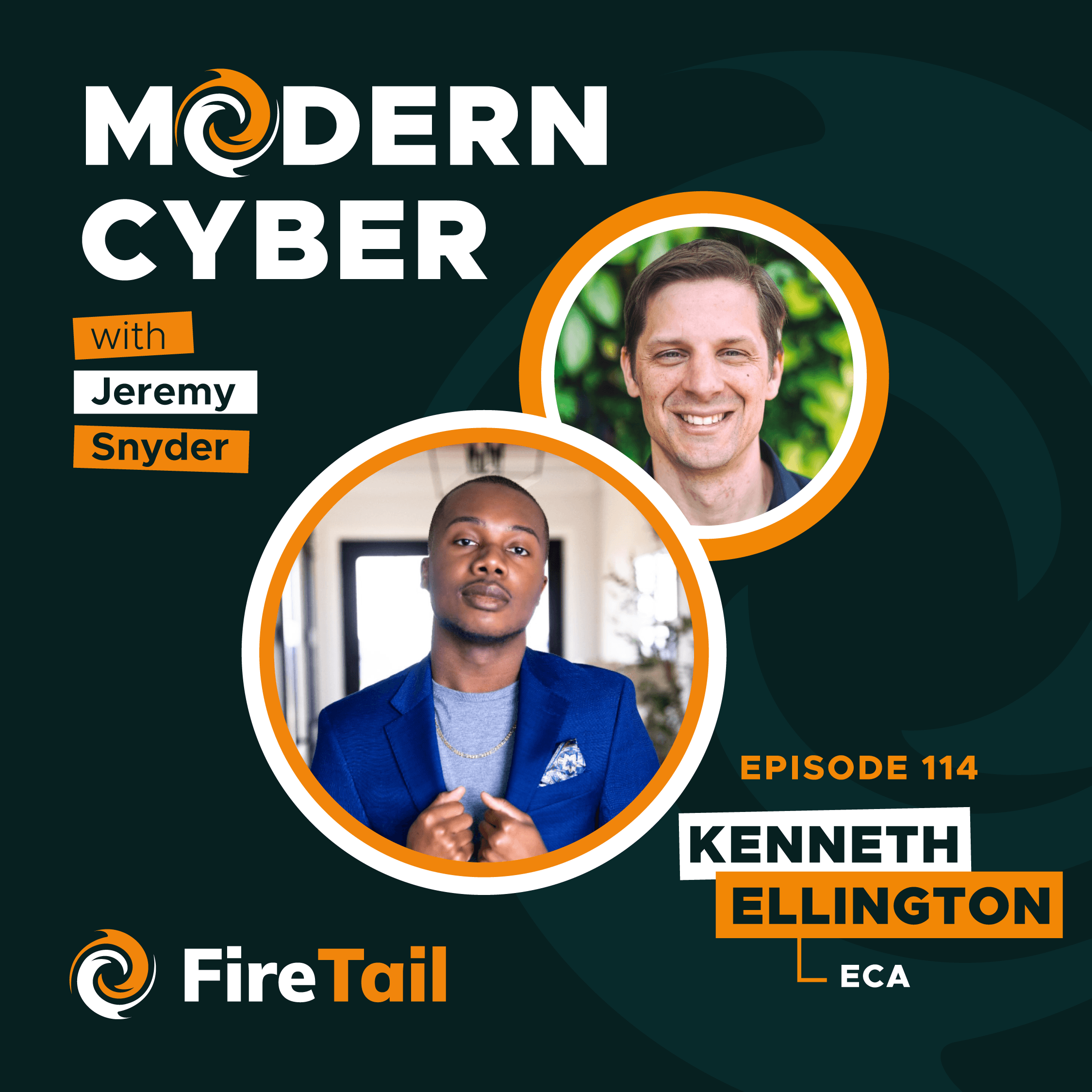
Kenneth Ellington of Ellington Cybersecurity Academy
Jun 1600:30:11Tap to summarizeIn this episode of Modern Cyber, Jeremy sits down with Kenneth Ellington, founder of Ellington Cyber Academy, to explore the rapidly evolving landscape of SIEM engineering, threat hunting, and automated incident response. As organizations transition from conceptual AI to deploying agentic AI in production environments, Kenneth shares his extensive hands-on expertise managing complex enterprise security operations across Splunk, Elastic, and Microsoft Sentinel architectures. The conversation dives deep into the realities of alert fatigue, explaining why security analysts remain overwhelmed by false positives and how proper data pipeline management is essential before any AI automation can be effectively introduced. Kenneth unpacks the historical shift from SIEMs acting as long-term historical audit records to highly optimized, real-time threat detection engines, while advocating for cost-effective security data lakes for extended threat hunting visibility. Then, the discussion tackles the nuances of implementing AI in highly regulated sectors like finance and healthcare, demystifying the difference between marketing buzzwords around SOAR platforms and genuinely actionable AI-assisted threat hunting workflows. Wrapping up, Kenneth shares raw insights into the harsh realities of breaking into the cybersecurity industry today, emphasizing the indispensable need for hard technical skills, strong soft skills, and resilient mental models for aspiring SOC analysts facing trial by fire.About KennethKenneth Ellington is a Senior SIEM Engineer and cybersecurity entrepreneur, and the Founder of Ellington Cyber Academy (ECA), where he trains the next generation of detection engineers and threat hunters. He previously served as a Senior Consultant at EY, supporting enterprise security operations and SIEM engineering initiatives across complex environments. Kenneth specializes in detection engineering, threat hunting, and XDR architecture, with deep hands-on experience across Splunk, Elastic, and Sentinel ecosystems. He recently spoke at BSides St. Pete, sharing insights on real-world threat detection and building practical cyber talent pipelines.Episode LinksEllington Cyber Academy: https://www.ellingtoncyberacademy.com/Kenneth Ellington on LinkedIn: https://www.linkedin.com/in/kenneth-ellington/
Transcribe →
This Week in AI Security - 11th June 2026
Jun 1100:12:49Tap to summarizeIn this episode, Jeremy explores how the automated "Vulnpocalypse" is officially manifesting in enterprise networks. As Microsoft logs a historic record-shattering Patch Tuesday to keep pace with AI-accelerated discovery, a new breed of open-weight logic malware is emerging to change the threat landscape forever.Key Episode Highlights:The Record 206-CVE Patch Tuesday: Microsoft issues an unprecedented 206 CVE fixes in a single month, roughly double the historical average, signaling the direct impact of autonomous vulnerability scanners like Claude Mythos and ChatGPT Cyber Edition.LiteLLM Added to CISA's KEV: The recently disclosed LiteLLM vulnerability officially transitions into CISA’s Known Exploited Vulnerabilities (KEV) catalog following verified active exploitation in the wild.1,200% Surge in Deepfake Fraud: Google’s June 2026 Fraud Alert highlights an explosive rise in deepfakes, voice cloning, and synthetic identities, triggering a rollout of on-device security countermeasures for Pixel smartphones.20,225 Instagram Accounts Hijacked: Bad actors successfully compromised over 20,000 accounts by leveraging context window exhaustion against Meta’s automated AI customer support, causing stored ethical guardrails to completely fade out over long conversations.The Dawn of Reasoned Logic Malware: Academic researchers demonstrate an autonomous AI worm that brings a lightweight open-weight model directly onto compromised systems, navigating local environments dynamically using logical reasoning rather than static exploit checklists.The 6-Month Frontier Window: Internal policy intelligence indicates the United States has less than 6 to 12 months of standard lead time before Beijing achieves technical parity with the newest wave of hyper-advanced frontier model architectures.Episode Linkshttps://www.helpnetsecurity.com/2026/06/08/instagram-ai-support-vulnerability-account-takeovers/https://thehackernews.com/2026/06/litellm-flaw-cve-2026-42271-exploited.htmlhttps://www.helpnetsecurity.com/2026/06/03/autonomous-ai-worm-prototype/https://fortune.com/2026/06/03/a-new-ai-powered-computer-worm-could-prove-to-be-the-stuff-of-cybersecurity-nightmares/https://www.politico.com/news/2026/06/07/frontier-ai-cybersecurity-china-race-00952786https://www.reuters.com/technology/anthropic-rolls-out-public-version-mythos-without-cybersecurity-capability-2026-06-09/https://www.forbes.com/sites/zacharyfolk/2026/06/09/anthropic-releases-first-public-version-of-claude-mythos-with-major-safeguards/https://www.darkreading.com/vulnerabilities-threats/blame-ai-patch-tuesday-record-206-cveshttps://www.darkreading.com/cyber-risk/adaptive-agentic-ai-worms-enterprise-cyber-threathttps://www.forbes.com/sites/maribellopez/2026/06/04/enterprise-ais-security-time-bomb-is-ticking-cisco-shares-its-plan/https://www.toxsec.com/p/agentic-ai-attacks-explained-lethal-trifectahttps://www.webpronews.com/googles-june-2026-fraud-alert-exposes-ais-growing-role-in-sophisticated-online-scamshttps://www.bleepingcomputer.com/news/security/google-adds-android-protection-against-ai-deepfake-scam-calls/https://techcrunch.com/2026/06/03/instagram-is-alerting-users-who-were-targeted-by-hackers-during-ai-chatbot-attacks/
Transcribe →