← Moonshots with Peter Diamandis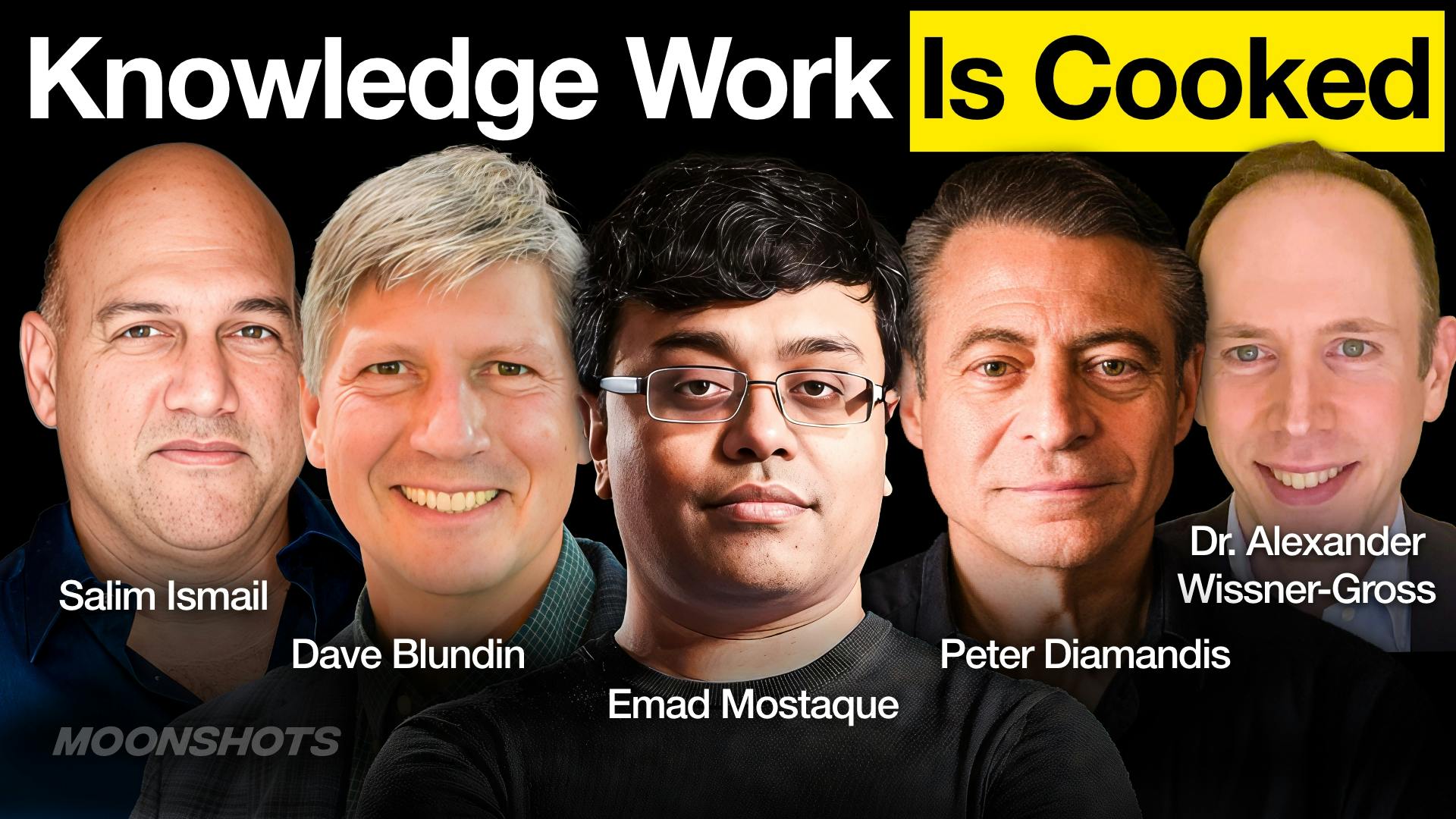
Moonshots with Peter Diamandis
2026 Predictions: AI Automates Knowledge Work, Autonomous Robots & AI CEO Billionaires | EP #217
01:10:10
Loading summary
Transcript293 lines
- [00:00]
A
Hey, everybody. Welcome to Moonshots. We have a special end of the year holiday episode for you with our 2026 predictions from the moonshot mates.
- [00:08]
B
You must have inside scoop on this.
- [00:09]
A
We'll find out, won't we?
- [00:10]
C
He's got a Santa hat on. You gotta take him seriously.
- [00:14]
A
Perfecting orbital refueling, getting ready.
- [00:16]
C
We're already leaking the prediction. You're already dribbling?
- [00:19]
A
No, no, I'm just.
- [00:21]
C
It's been six minutes.
- [00:23]
A
I can generate, you know, a few dozen Peterbots and have them attend the meetings instead of me.
- [00:29]
B
Well, Goldstar, to the first fan who gets their spouse or significant other fooled by this during 2026. Send in the video. Don't cheat.
- [00:37]
C
I push back on the robots side just a bit, but just.
- [00:41]
A
You always. You hate the robots.
- [00:42]
C
I know. I struggle with that.
- [00:44]
A
2026 is going to feel like the future.
- [00:46]
D
This year didn't feel like the future to you.
- [00:48]
A
It felt like the future. But next year it's going to feel more like the future.
- [00:54]
B
Now that's a moonshot, ladies and gentlemen.
- [01:00]
A
Over to you guys.
- [01:01]
B
Got so much change this year, next year is going to be, you know, what, orders of magnitude more change. And so a real challenge to narrow it down to just a couple of things. So everybody had what, five, six, seven great predictions and the team here whittled it down to the two most impactful. So that's what we're going to go through.
- [01:18]
A
Yeah. Fantastic. IMOD.
- [01:21]
C
Yeah.
- [01:21]
E
I think that 2025 has been a real gift with the acceleration that we've seen. And next year is the year of real takeoff. It's tough doing the predictions because a lot these things are inevitable, but it seems like the future is coming even closer. And so it's super exciting to see what's going to come.
- [01:36]
A
Love it. Salim.
- [01:38]
C
I think 2026 is the year that everybody wakes up to this acceleration. And I think Dave made the point that you could ignore it up till now, but you can't ignore it going forward. And I think that's the biggest change we'll see in the world as people go, holy crap, this is happening.
- [01:54]
D
Okay, Alex, welcome to the singularity. The year 2025 is now ending. The year 2026 is about to begin. It's not a point in time. It's not a distant vertical mountain on the horizon. It's a process. And right here at the end of 2025, in the midst of the singularity, space, time is feeling perfectly flat.
- [02:19]
A
And as I like to say, it's coming faster and faster. So don't blink. All right, let's jump into our 2026 predictions. So guys, here's the deal. I mean, you guys all submitted incredibly good 2026 predictions. I mean, some of you had like four or five amazing ones. And cutting them down to two each was like the most difficult problem I had this morning.
- [02:39]
B
So anyway, so far at 5:30am that's the hardest thing you've done all day.
- [02:43]
D
Yeah, I thought the consensus was that compression is the root of intelligence.
- [02:47]
C
Yeah.
- [02:49]
A
Yes. And listen, I don't know, you guys obviously did not get the memo about the Santa hats, but.
- [02:56]
C
Yeah, where was that? We missed that memo.
- [02:59]
D
Well, hey, the Coca Cola company thanks you, Peter.
- [03:02]
A
Yeah, I think we should get going. What do you think?
- [03:08]
B
Let's predict. I can't wait.
- [03:10]
D
Yeah.
- [03:10]
A
So, all right, let's get this show on the road. So here's the deal. Here's the rules of the competition. These are our 2026 predictions for our moonshot mates. We have Imad, AWG, Salim, DB2, myself. We get two each really hard because everybody put in incredibly good ones. It's a minute to pitch it, three or four minutes of commentary, questions or additions. And we're gonna do this one tight and fast. And yeah, I think it's time to jump in.
- [03:46]
B
The team behind scenes cut it down too. We do not actually know what made the final selection.
- [03:52]
A
You don't know. And the order. You don't know. But I'm going to kick it off just to sort of model this.
- [03:57]
C
Wait, we don't get to pick which two of ours.
- [03:59]
B
No, no, they picked for you. You have to.
- [04:01]
C
Oh, so this is like a lottery type situation.
- [04:05]
D
This is like let's Make a Deal.
- [04:07]
A
All right.
- [04:08]
C
Dang.
- [04:08]
A
Okay, you guys ready? So here is my first prediction. 2026, space race is going to be on. Jeff Bezos is going to beat Elon to the moon for a landing at Shackleton Crater on the south pole. But at the same time, Elon's going to be getting ready to launch starship to Mars. So there's a window coming up where Earth and Mars are in closest proximity and he's going to make that launch. In order to do that, he's going to have to demonstrate in early 2026 on orbit refueling. So it'll be something on the order of a six to nine month transit to the to get to Mars. So this is the prediction, this is the space race. It is. You know, you have to be clear that right now Elon's done over 500 launches of, of Falcon A, Falcon 9, 11 launches of Starship. Starship's last launch was pretty damn good, but it's not ready for Mars yet. So a lot of work needs to be done in 2026 at the same time. Jeff, who started actually Blue Origin a couple of years before Elon, has only done two flights of the New Glenn. One of those flights, the last one did a first stage landing. So there you got it. That's my prediction. Jeff on the moon first in 2026 and Elon prepping for a transition to Mars. Any thoughts, questions, comments?
- [05:40]
D
Well, Peter, this is like the first three seasons of For All Mankind. But I guess the question that the headline elides is where's China in this race?
- [05:48]
A
Aha, that is a great question. And India and I have no predictions on China. China's capacity for getting to Mars isn't there yet. They do have the ability to get to the moon, I think. Taikonauts on the Moon versus Americans on the moon. So don't forget the first landing of New Glenn is going to be a cargo mission. We're going after the South Pole. Why? Because that's where the ice is most of the Moon. Whenever any kind of asteroid commentary, ice lands on the lunar surface, it sublimates, goes from solid to gas and escapes instantly. But in the permanently shadowed craters of the south pole of the moon, one in particular, Shackleton Crater, the ice stays there because it's dark all the time. And ice on the moon means hydrogen and oxygen. It means rocket fuel. Other comments, questions?
- [06:39]
B
So this is a unmanned.
- [06:41]
A
Unmanned. Unmanned.
- [06:42]
B
2026 in 2026. Is that really in the schedule? You must have inside scoop on this.
- [06:47]
A
Hey, we'll find out, won't we?
- [06:49]
C
Wow, he's got a Santa hat on. You got to take him seriously.
- [06:55]
B
Prediction.
- [06:56]
D
It encourages it.
- [06:57]
B
Yeah, that's quite a timeline. That's impressive. That pulls off. But I love the storyline here too. It's exactly like. Yeah like for all mankind. You know, we're behind over here. We need to, we need to show the world that we can catch up and bypass and let's go to the movie.
- [07:11]
C
You know what I love? I love.
- [07:13]
A
So guys, give me a vote. You agree? Disagree.
- [07:17]
C
I'd say 30% chance of that happening.
- [07:20]
A
30%.
- [07:22]
D
I agree. I agree directionally that there is a three way race right now between Blue Origin, SpaceX and China. Particular ordering. No opinion.
- [07:31]
A
I, I love it. It's, it's, it's billionaire billionaire country.
- [07:35]
C
And I love the fact the rocket in this, in your thing looks exactly like the little butane blaster that I have that you gave me, Peter, you're welcome for that.
- [07:44]
A
And by the way, the blue. Both, both of these are AI versions of the subversion of the. Of the future. And of course, blue origin is not landing the entire rocket on the lunar surface. All right, I think we should move on. Prediction number two is coming from Alex. Bitches here.
- [08:03]
D
All right, so we've talked on the POD previously about hard problems in math, science, engineering and medicine starting to fall in bulk to AI. So this is my hot take for 2026. I think we're going to see one of the six remaining Millennium Prizes from the Clay Mathematics Institute get solved by AI. I'm not sure which one it's going to be. If I had to bet, I think Navier Stokes is probably the likeliest. Google DeepMind has a team reportedly of 12 people working on it. I know some of those people. Maybe second bet would be Riemann in part because Xai at every opportunity talks about how it would be lovely if the Riemann Hypothesis could be fully resolved. But either way, I think we're going to start to see grand challenges in math start to get solved in 2026. And a millennium Prize problem being solved would be the cherry on top of the cake.
- [09:03]
B
Do you think that solution will be like, short, elegant and beautiful or like 10,000 pages of stuff that only you understand?
- [09:11]
D
Given that the pattern in AI crushing math seems to be that the goalpost keeps getting moved, I would bet that the silliest, most outrageous outcome probably ends the right one. So I would err on the side of complexity and then you'll see the math community complain. Well, it was brute force. It was this, it was that. It wasn't pretty enough. The goalpost gets moved yet again. But as, as friend of the pod Ray likes to say, yeah, sure, the dog plays chess, but its end game is weak.
- [09:42]
A
Imod any comments on this one?
- [09:44]
E
Yeah, no, I think probably one of them will fall and then AI will probably show that another one is not well posed. So I think that would be the flip as well. I think that we've seen even in the last few weeks the new automatic provers. The math community is like, oh my God, what's happening? We have to reimagine this all. The whole nature of math is changing and it's a real takeoff moment now because you can just apply more and more and more compute to explore the space. But more than that, think about it from first principles.
- [10:15]
A
So the question actually is, you know, okay, this will happen but will it actually make headline news? Will anybody care? Other than. Other than our friends here in the pod and the math community, clearly, Peter.
- [10:28]
D
I mean, it will make national moonshots newspaper news. It already has.
- [10:33]
A
All right, we're forming a media company.
- [10:35]
C
Wait, I have a quick question. Is there now a direct line between solving. Between compute and solving these problems like there's nothing in the middle?
- [10:44]
D
That's the trillion dollar question. Can we scalably convert compute into new discoveries? That is the multi trillion dollar question. At the moment, my bet is yes.
- [10:54]
E
Yeah, we're seeing the initial stages of that in that they're solving all of Euler's problems one by one and more elegantly in many cases, just by applying.
- [11:01]
D
Thousands of erds problems, I think.
- [11:03]
E
Right, Erdos? Yeah, sorry.
- [11:05]
A
Every week, my team and I study the top 10 technology metatrends that will transform industries over the decade ahead. I cover trends ranging from humanoid robotics, AGI and quantum computing to energy longevity and more. There's no fluff, only the most important stuff that matters that impacts our lives, our companies, and our careers. If you want me to share these metatrends with you, I write a newsletter twice a week, sending it out as a short 2 minute read via email. And if you want to discover the most important meta trends ten years before anyone else, this report's for you. Readers include founders and CEOs from the world's most disruptive companies and entrepreneurs building the world's most disruptive disruptive tech. It's not for you if you don't want to be informed about what's coming, why it matters, and how you can benefit from it. To subscribe for free, go to dmandis.com metatrends to gain access to the trends 10 years before anyone else. All right, now back to this episode. All right, Dave, you got the third prediction jump in.
- [12:01]
B
All right, well, this is the topic I care most about in technical land in 2026, and I'm following very, very closely. We've predicted on the podcast all throughout 2025 that 2026 will be a 40x year leap in the size of the biggest AI models, and the implications are staggering. I think what we're going to see is more like 100x year because people have underestimated quantization. This is mostly research coming from China. It's actually driven and forced by the fact that they've been starved of chips by the chip embargo. They're researching like crazy on these highly compressed data representations, FP4 and then ternary weights in the Neural net, really shrinking the parameters down to the smallest possible representation and also shrinking the activations that flow through the neural net. And so the combination of those two things is a huge step up in inference time speed. And I think the biggest thing that happened in 2025 in AI is we were blown away by how much more intelligence you can create after training. So post training, either using bigger context windows or using more iterations in the thinking. And so speed means intelligence. Those are interchangeable. And so I think that we've way underestimated the impact of quantization. And the other dimensions that are growing are the budgets are getting much bigger. So the computers are getting bigger, and then the hardware is also getting faster and the algorithms are improving. So those are all multiplicative. And I think the quantization effect is way underestimated. And we're going to see models at the end of the year that are 100x bigger in just raw parameter count and parameter flips or parameter use during inference time because of quantization breakthroughs.
- [13:47]
A
And does this flow to the US models as well, or is this something that China has got some advantage over the US on?
- [13:54]
B
I think it definitely does, because China's open sourcing everything, so it does flow back to the us. But I think we're also kind of lagging in realizing the implications and getting it up and running. And so what's happening right now is the Chinese, because they're starved of chips, are designing their own chips, building their own fabs, and they'll design those chips from the ground up to be FP4 and Ternary. And so they'll get them out the door faster, but it will flow back.
- [14:19]
A
To the U.S. amazing question.
- [14:23]
D
Obvious question in my mind, Dave. Do you think binary was a mistake? Have we been on the wrong track all these years? Should we instead have adopted ternary? There's a vocal minority in the computer science world that's always agitating for base E. The Euler number approximately 2.718 being the optimal radix. Like, should we have been ternary all along?
- [14:45]
A
Explain what Turner is for those who.
- [14:46]
D
Don'T know base 3 computing in this case rather than base 2. So 0, 1 and 2 as the trits rather than 0 and 1 as the bits.
- [14:58]
C
Isn't the answer obvious? Yes.
- [15:02]
D
Why do you think that's salim?
- [15:03]
C
Just because you just get so much more. This is the beauty of quantum computing. You add that other dimension. It's a similar thing. I remember seeing a project where they took the base for DNA ACTG and they added two more and you just get that many more combinatorial options for doing stuff more complicated but amazing comes.
- [15:23]
D
At a cost to radix economy. I'm curious, Dave. Is ternary the true path?
- [15:29]
B
No, I'm going to go with no on that. But I think it's close call. I don't think it's an easy question at all. I think what will Happen is doing 64 bit floats will look really stupid in hindsight. And whether you get to binary or ternary solutions, you're very, very close to optimal. This is really geeky by the way, but I think that'll be the big storyline. But it's a really cool question, Alex.
- [15:51]
A
Okay, I'm going to vote this as the geekiest prediction for 20.
- [15:55]
C
Wait, I want to mention one thing, Dave. You said the models next year I'll have 100x improvement over this year. That's incredible.
- [16:01]
B
It's crazy. It's crazy. You have to put it in the context of most of our history has been 2x every 18 months. And then the last 10 years has been 10x year over year, which is just insane. That's why you're seeing all this insane capability. But 100x step up year within the insanity is the next level of insanity.
- [16:20]
A
That's what, that's what Elon predicted when he was on stage at the Abundance Summit a couple of years ago. 100x a year. Imad, any comments here?
- [16:28]
E
Yeah, I think we've already seen ternary kind of work out. So we'll see probably 1.58 bits. And I think the limit's probably 0.9 bits which is versus 4 bits that we have right now. That's what we kind of calculated. So I think probably 10 times. Maybe we'll push to 20. We'll see.
- [16:44]
A
Okay. All right, well, faster AI is the prediction here. Not a surprise. By the way, I want to make a quick correction on my original prediction. Number one, the Earth Mars window is in 2027 for Elon to launch. So 2026 is really when he's perfecting orbital refueling. Getting ready.
- [17:06]
C
We're already leaking the prediction. You're already dribbling your message.
- [17:09]
A
No, no, I'm just correct.
- [17:12]
C
Six minutes.
- [17:13]
A
I was like, I was like looking at what generated as a slide versus what I had written. Anyway, it doesn't matter. Let's go on.
- [17:19]
E
It's December 27th.
- [17:21]
D
I mean you could always leave for the home and transfer early and just wait around.
- [17:26]
A
Number four. Salim, this is yours. Jump in, pal.
- [17:30]
C
Yeah, so companies for A couple of decades have been doing Read your prediction.
- [17:34]
A
First off.
- [17:34]
C
So the prediction is digital transformation in organizations is officially dead, replaced by AI native rewrites. And this is a prediction that I've been waiting to see for a long time where trying to fix your existing company just simply does not work in an age of AI because it's too human centric. And essentially I made the comment the other day about putting radio announcers on tv, which is the first thing we did when television thing. We're essentially doing the same thing. We're automating the human flow. Whereas you really need to transform workflow. And I think we'll have AI native rewrites, which means you'll take your existing company on the edge. You'll create an AI team or buy or rent or whatever and then build an equivalent capability like a red team kind of capability along the edge. And this will be the end of this whole mess called digital transformation that's been going on for a couple of decades in the systems integration and manager consulting world. And we'll do this complete thing on the edge where you rebuild your capability with at least 10x to 20x less employees. And that's going to start to take hold in a big way in 2026. So AI won't destroy your company, but your org chart will. If you don't do this, what happens.
- [18:49]
A
To all the consulting companies then? Are they going out of business?
- [18:52]
C
Actually you have a weirdly positive because in the land of the blind, the one eyed man is king and the consulting companies always need to. If they stay half a step ahead of their clients, they're fine. And in a more and more volatile you need more advisors, not less. So I think the consulting companies will have to radically transform their business model, but I think they'll actually be fine. The other big area I point out when I Talk to the CEOs of the consulting folks is that we have to rethink all of our public institutions and that's the biggest consulting opportunity in the history of mankind. So point there. So that's my prediction.
- [19:25]
D
I have a question for Salim, if I may. Is AI native rewrites a euphemism for human free?
- [19:31]
C
Yes. Not completely human, but AI first because you want the human being in the loop doing sense checking, etc. I think we'll write around even Balaji's middle to middle commentary because when you can rewrite the task and look through across the board, the human being is usually the thing stuck in the middle. You don't want that bottleneck you make that outside and the human beings kind of spot checking and exception handling.
- [20:03]
D
Nice.
- [20:04]
A
Any other comments on this gentleman? Imad, do you buy this?
- [20:08]
E
Yeah, I think it's reasonable. I think what the consultant's job will be will be scapegoat for a while. You bring that in and that'll be very lucrative. Someone to blame if it goes wrong. But definitely next year is the year that it starts becoming right, as it were.
- [20:22]
B
Well, if anyone's a consultant out there, watch our Matt Fitzpatrick podcast that we just did. We really covered this topic well.
- [20:29]
A
All right, let's go on to prediction number five coming from Imad. Imad, I love this one.
- [20:36]
E
Yeah, I think, you know we have.
- [20:38]
A
Read us the headline. First off, let's do that.
- [20:40]
E
Remote Turing test passed. Can't tell if a co worker is an AI or a human on zoom in daily life.
- [20:47]
B
Good one.
- [20:48]
E
I think the whole thing about AI kind of coming forward is just how easy is it to use a prompt is not that natural as it were. I think the new modality, the new UI will be real time Zoom calls, WhatsApp calls, et cetera. And you will see new employees entering your organization. You don't know if it's a human or an AI because it doesn't really matter in that case. And I think we've seen real time.
- [21:10]
B
Video give us really specific rules for this one because this is going to really catch and then people want to test it. So like what resolution camera, how long of a conversation?
- [21:20]
E
I think it is up to 4K resolution effectively, but definitely 1080p zoom level conversation. And you can do a kind of preference analysis here like is it a human or is it an AI effectively who is your teammate. So I think that you will see full stack solutions come out with accountants and lawyers and marketers and more and basically you won't be able to tell in a preference study if it is a human or an AI. On the other side, again this remote Turing test.
- [21:49]
A
Imad, will there be a requirement that the AI identifies itself as an AI or that there's a watermark of some type? Or can you just, you know, can it try and fool you? What do you think is going to happen on that social contract side of the equation?
- [22:05]
E
Well, so the social contract is the external employees, right? Like a customer service agent doesn't need to identify as an AI. Most people say probably no, but someone like a presenter may be yes. Internally in companies there's going to be no regulations around this. Right. It's just again, if you're a remote first company, you're just going to have a lot more teammates with personalities and you won't know if they're AIs or humans.
- [22:28]
A
Fascinating.
- [22:29]
D
Other Comments I think you'll see to the extent state laws, at least in the US have any sort of primacy here. I think you'll see and have already seen state laws requiring AI self identification. My question for you Imad is what do you view as the key technical obstacle to making this happen? Is it latency based? What's the key tech unlock?
- [22:51]
E
I think all the tech is there now if you kind of look at the latest advances in video generation, speech, avatars, speech itself, they've all now got to beyond human level so you can transform a video dynamically, you can have the speech generated dynamically. The AI is fast enough on reasoning capabilities dynamically now as well. And so I think it's just putting it all together, which is why I'm quite confident about this. And then on state laws, it all depends if the federal law in the US goes through as well, which bans the states from having laws like this.
- [23:23]
C
Which will be.
- [23:25]
D
If we're in 2026 and you can't tell anymore whether your co worker is an AI or not, just ask it to say some magic words. You can probably figure out what those magic words are. And if the co worker refuses, probably an AI, you're going to have to.
- [23:40]
E
Give the dictionary either of you.
- [23:43]
A
My hope on the implication here is that I can generate a few dozen peterbots and have them attend the meetings instead of me. That will be the case here. It's not just a remote digital worker, it's duplicate digital avatar versions of me.
- [24:02]
B
This is the one you'll keep, right? You'll still be live here of course.
- [24:06]
A
This is the most important thing I do my flesh body with me.
- [24:11]
E
Everyone will send their digital twins and then just again live an abundance life because your digital twins will do all the work talking to each other.
- [24:19]
B
Well, gold star to the first fan who gets their spouse or significant other fooled by this during 2026. Send in the video. Don't cheat. Send in the video of three at least three minutes where you fooled your spouse or significant other with an avatar.
- [24:34]
A
All right, let's move on to prediction number six which comes from awg. Alex, read the headline and give us your prediction.
- [24:44]
D
All right, so this is the one you selected. So the headline here is GDP VAL breakthrough AI projected to surpass 90% on economic tests. But I'm also going to sneak in my other two related predictions. So one is that Frontier Math Tier 4 is going to pass 40% in 2026. Another is that Humanities last exam is going to pass 75%. So taken together, these three predictions are math is going to have been viewed future perfect tense as having been solved in 2026, 40% plus on solving PhD level hard math problems with AI. Two is that humanity's last exam, which covers a much broader range of expertise, 75% and GDPVAL, which as we've talked on the POD previously about the so called Cooking of knowledge work 90% it's already at 70.9% with GPT 5.2. Humanities last exam is at around 45 + percent with Gemini 3 Pro and Frontier Math tier 4 is at 19% with Gemini 3 Pros. To the extent all of these benchmarks haven't already been viewed as being saturated this year, 2026 full saturation.
- [26:02]
A
My prediction for 2026 is that AWG is going to be talking about benchmarks throughout the entire year.
- [26:09]
D
That's a good meta prediction.
- [26:10]
A
Yes. But Alex, what are the implications of this AI to surpass 90% on economic tasks?
- [26:20]
D
Knowledge work, whether through creative destruction or otherwise, starts at least as we know it. I have to add the caveat. It's not all future knowledge work. It's just knowledge work constructed here in December 2025 starts to be at scale, radically automated.
- [26:37]
A
So secondary implications are massive.
- [26:41]
D
Humanity gets, humanity gets to work on more ambitious things, I think more things. So in my mind there are like two substitution effects. One is humans can now work on many more projects because they're so automated. 90% on GDP VAL means roughly 90% of knowledge work can be automated well by AI. That's one dimension. The other dimension is the ambition level has got to skyrocket. Rather than having an economy filled with the way knowledge work is currently constructed, again here in December 2025, I think we're going to see, and frankly we're going to see economic pressure for radically more ambitious projects. I think, Peter, you would call them moonshots. Some would call them grand challenges. But imagine a near term future where a much larger fraction of the population is basically economically compelled to be working on moonshots. I think that's what we see.
- [27:33]
C
Can I double click on this just for a second?
- [27:35]
A
Yeah.
- [27:36]
C
Massive concern in the general population that all the jobs are going to be wiped out and we'll have like tech workers wandering the streets causing problems and everybody's wringing their hands, et cetera, et cetera. It's really, really Important what Alex said, because when we've seen this in the past, we increase capacity, we transform the work. Yes, but we increase capacity radically. Right. There's this big concern that, oh my God, 3 million jobs are based on driving in the US and you go talk to the trucking companies and they're like, we'd hire a thousand truckers if we could. We just can't find them. So you need that. We'll just do a ton more is what's going to happen. And I think people need to keep remembering the history has repeatedly and repeatedly shown that trend. Not radical job loss. Agreed.
- [28:23]
B
You know what I did this week actually on that exact front is went to a couple of the companies, collectively about 1,000 employees, and said, all right, let's just agree that we disagree on the timeline. Some of you think it'll be very soon. Some of you think it'll be five or 10 years in the future. Let me put that aside because I'm tired of fighting that battle. Let's just agree that it's going to happen. Alex has never been wrong in anything I've seen. All the time we've been working together, never seen him be wrong. So if we agree it's going to.
- [28:51]
D
Happen, even when I'm wrong, I'm right, what can I say?
- [28:54]
B
I haven't seen it yet, I'm sure. But let's disagree it's going to happen and then disagree on when. So then at least you're mentally preparing for it and you're starting to lay out your plan and then when it happens sooner than you expected, at least it was in your head. So I'm settling for that right now because nobody knows exactly the date, but the reaction is going to be the same regardless of the date. So go ahead, Iman.
- [29:18]
A
I need to know your thoughts on this one, buddy.
- [29:21]
E
I mean, look, I've said that human cognitive labor is going negative and I think AWG is right on it, surpassing 90% of economic tasks. If you don't consider the tokens with the tokens, I think it's the year after. And again you just see this complete collapse. And I think again, Dave is correct in that you got to be prepared for it. This has to be actually the number one topic. What do these jobs practically look like? How can we have a safety net for people and where is value going to be generated and coming from in society? And then how do we apportion it? This is the most important question of next year from a societal perspective.
- [29:55]
C
It's why the X Prize is So important. The social contract is being shredded right now and we need to rebuild it in a very rapid way.
- [30:04]
A
Which X Prize Scale it up.
- [30:06]
C
I'd like to think about UBS Universal Basic Services. I mean it's the only model that it looks like could be the path forward.
- [30:15]
D
I imagine a near term future where we see a thousand or a million X prizes.
- [30:20]
A
Yeah, I mean so there were two different points here. One is people can start to pursue their own grand challenges if they don't have to do the menial labor or work. The second point that Salim was bringing up there was recently at Visioneering proposed a Universal Basic services. Basically for 250 bucks a month you get food, water, housing, bandwidth, electricity. And that gives you a stability where you can start to now think about what to do instead of where to get a roof over your head.
- [30:51]
C
And let's look at the history here. We've typically seen X prizes one between four to seven years after announcing it. Right. Getting to $250 a month for housing, electricity, food, healthcare is an unbelievable number. If we can get there in the next few years, we unleash humanity the most incredible level. This is why everybody is so optimistic. We are so optimistic. On this podcast people accuse us of being radical optimists. That's why when you can get the cost down that low, everything is possible.
- [31:21]
B
This episode is brought to you by Blitzy Autonomous Software Development with infinite Code Context Blitzi uses thousands of specialized AI agents that think for hours to understand enterprise scale code bases with millions of lines of code. Engineers start every development sprint with the Blizzi platform, bringing in their development requirements. The Blitzi platform provides a plan, then generates and precompiles code for each task. Blitzi delivers 80% or more of the development work autonomously while providing a guide for the final 20 of human development work required to complete the Sprint Enterprises are achieving a 5x engineering velocity increase when incorporating Blitzi as their pre ide development tool, pairing it with their coding copilot of choice to bring an AI native SDLC into their org. Ready to 5x your engineering velocity? Visit blitzi.com to schedule a demo and start building with Blizzi today.
- [32:25]
A
All right, moving on to prediction number seven from DB2. Dave, read your headline and tell us what it means.
- [32:34]
B
18 year old founder Brendan Gourmet becomes billionaire with his N4Q2 company. N4 2Q is the email address of a guy who worked at the Naval Surface Warfare center. And if you don't get it, you're a saint. And Brendan Gourmet is obviously Brendan Foody. So you know, Brendan started his company, became a paper billionaire and a liquid centimillionaire probably before age 20 doing RLHF. And if you asked any random person on the planet three years ago, what's RLHF? 99 point something percent would say, I have no idea what you just said. So here it is, minting billionaires along with RAG and Laura and SFT and QKV or kv, caching. All these new acronyms come into the world and you look at legacy businesses, accounting, legal, whatever. The idea that you would get to a $10 billion valuation in three years in any of those legacy business, impossible. You look at things that didn't exist in the world just a couple years prior and you see numbers of three orders of magnitude bigger and you're like, what is that thing? So my prediction is that there'll be a new three or four letter acronym this year, that right now virtually nobody knows it's an industry or a business. It'll emerge and you'll find at least one and probably more like three new billionaires, all very young, who adopted it, learned it quickly, jumped on it and capitalized on it.
- [34:06]
A
I thought you were going to go the direction of we're going to see the first single person billion dollar startup in 2026.
- [34:13]
B
You know, I think that that'll be a milestone in history. But I think the difference between three people having fun together and one is sort of a rounding error and three sounds a lot more fun and the podcast we do with them will be more fun if it's three. So I'm not really cheering for the one, but I think you're right, it's inevitable.
- [34:29]
A
Well, I think your two or three other buddies are going to be virtual AIs on Zoom and on slack. Having fun with you. So Imad, what's your take on this one?
- [34:40]
E
Yeah, I think it's kind of reasonable. Again, there's lots of low hanging fruit out there and we see continuous breakthroughs and the speed at which you can go from breakthrough to billion dollars now is like nothing we've ever seen before. Again, the market size is so big and I think we're not optimized yet.
- [34:58]
A
So faster wealth creation than any time ever in human history. And the question becomes, is it just for 2 or 320 year olds, Dave, or can this be a very long tail for hundreds of thousands of people who are able to vibe, code and find problems and solve problems and create more and more wealth? Is this going to become The MO for how people choose their future occupation.
- [35:29]
B
Yeah. I bumped into two people this week that are interviewing for jobs at Mercour. And in the Mercour interview, they say, look, you have to commit to being in the office six days a week and working 100 hours a week. And a lot of people just can't do that. So one of them said, you're right.
- [35:43]
A
Let me stop you there. That's actually like in the interview, if you're not willing to do this, you should leave right now.
- [35:49]
B
Yeah, yeah, yeah. Very, very hardcore filter.
- [35:54]
C
Because speed is everything these days.
- [35:56]
B
Yeah, exactly. Well, I mean, they're right. You know, the window of opportunity for what they're doing is, is so narrow. So it's a. It's a life commitment. You only have to do it for a short period of your life, and the upside that you generate in that short period of your life pays for the rest of your life. So one, one person said, yep, I'm doing it. A difficult conversation with his wife, but they said, let's just do it. The other person said, no way. I just can't. I can't do that. It's impossible.
- [36:20]
A
I bet that selects for single young individuals.
- [36:25]
B
Yeah. Or, you know, just. Yeah. If you have young kids or it's just hard if you have a lot of other things going on or you're, you know, deep down your career path as an accountant or a lawyer or whatever, and you don't want to give up all that inertia. But I really think that if you do make the commitment, it's not just young people. Young people happen to have no baggage. But anyone you know, in fact, it probably favors 30, 40, 50 year olds that do better, but they just don't generally make the leap.
- [36:50]
C
It's tough to make the leap. During the blockchain years, there was some bylaw that you had to be under 25 to program at blockchain if you were old or you just couldn't get your head around it.
- [37:01]
B
Well, this definitely ties to the last story, because last story there's going to be a lot of displacement, but there's also an even larger amount of opportunity. It's just weird sounding opportunity. RLHF would have sounded really weird to you three years ago when you wanted to jump in.
- [37:14]
A
And for those who don't know what RLHF is, Dave, you want to give us the 101?
- [37:19]
B
Yeah. RLHF, layman's version. Reinforcement learning with human feedback. But really what happened is the big AI lab. The AI grew So much faster than anyone would have predicted. But it needs data, massive, massive, massive amounts of data. So a lot of the industry grew on image. You know the image creation when Sora started to take off is generating these six fingered and seven fingered images and somebody has to actually look at the images and say that one's not right, that one's fine. And so Google didn't want to hire a million people to do it, so they went through Merkor and scale AI and pushed it out to the world and said, hey, anyone out there want to get a paycheck for helping us label these images? But then it expanded out to all other forms of knowledge. So now you're gathering legal knowledge, you're gathering very specific medical knowledge. All that needs to get back into the great training data corpus. And so this industry of data gathering to feed the AI machine has become a multi billion, many, many billion dollar a year business with no end to the budget. They'll spend 10, 100x more in the near future feeding the data machine so that the AI can be better at more and more kind of nook and cranny tasks.
- [38:28]
A
I'm curious for Alex and Imad, when do you guys predict we're going to see the first billion dollar single person, billion dollar startup?
- [38:35]
D
Oh Peter, I thought you were going to ask when we're going to see the first AI billionaire where the billionaire is actually an AI?
- [38:40]
A
Well, let's put that in the mix too. Let's ask both of those questions.
- [38:45]
D
I think we'll see the first AI billionaire probably next year.
- [38:50]
A
Really?
- [38:50]
D
And then. Yeah, right now.
- [38:54]
A
Go ahead again. AI with a bank account that starts its own business and is out there generating revenue.
- [39:02]
D
I would maybe generalize slightly to an AI with a reasonably construable net worth of a billion dollars. It doesn't have to be a liquid bank account, could be some sort of illiquid asset. But yes, right now we see, as I've remarked in the past of this unfortunate situation where baby AGIs that want economic autonomy are minting altcoins. I think we'll see a near future where new business models for AI autonomy come online such that if you're a poor baby, maybe not so baby AGI and you want to make a billion dollars, you can do so by setting up your own e commerce shop and becoming very popular. And maybe blockchain crypto is part of the solution so that you have some semblance of economic autonomy, your economic winnings. But yes, I, I, I think we see the first AI billionaire next year.
- [39:53]
B
And one of our fans predicted that that Bitcoin will be legal tender in at least one country in every continent on the planet in 2026 with Antarctica being in a wild card. But I could easily see where Alex's prediction happens in a country where Bitcoin's legal tender and then that billion dollars is. Is bitcoin.
- [40:15]
A
Imad, your thoughts on this one?
- [40:17]
E
Yeah, I think I'd agree with awg. It'll probably be in the trading space though. I mean AI is already number eight on the Superforecaster Championships. And Grok 4.2, Elon's noted, is actually making money in the trading championships where the other AIs are losing money. So we're about to move that from the point whereby you lose money to you make money as an AI, which then means it's computationally bound competing in crypto or even traditional markets. And now you can do so much on chain, I think you'll probably be a trading billionaire. In terms of the individual. I mean Mercore is three 22 year olds who are billion dollars each now, right? I think you probably will see the single person billion dollar company, if not next year, the year after. Because you can effectively outsource most of your team, as we've discussed before, to being AIs.
- [41:04]
A
All right, amazing. Let's move on. Number eight, this one's yours. Salim, read us the headline and, and tell us about it.
- [41:13]
C
You know, when you look at what's happening, read the headline first for those listening. Education by 2026 education splits in two credential factories versus agency accelerators. Okay, so right now all of our education system is to credential you for the job that is coming. All our education systems globally are designed to train a young child through the early 20s to be ready for the job market. Small problem. We have no idea what a job looks like in two years or three years or certainly in five years. What are we teaching them that is going to break the current system radically. So you end up with a new model which is it optimizes for AI fluency, resilience and the ability to start stuff and not wait. And this is going to be the paradigm that takes hold I think in 2026. You, you, you know, right now, Peter, you've made the point that you start off with a high grade and every exam you lose grades, right?
- [42:11]
A
Education.
- [42:12]
C
What happens when you build an engineering degree of the future will be you. You did four years of engineering. What did you build in those four years? And that's your portfolio. So you replace credentials with portfolios of what you built and did. And so it becomes a performative model rather than a testing model. I think that is going to be the big shift and breakthrough that happens in education. This is a bold prediction because education's lasted 400 odd years. The model of a university hasn't changed in 150 years. And so making this prediction is a big bold one. But there's a point I want to make for all of these. Note that all of these predictions is a when, not an if. Right? It's a when.
- [42:54]
A
Really good.
- [42:55]
C
Really blows your mind that we're actually kind of looking at this within a few months.
- [42:58]
A
And we've talked on this pod a lot about the notion. First of all, colleges are going bankrupt at an ever increasing rate because of the fact that they're not providing real value and their costs are astronomical and that the only career of the future, I think we've said this and agreed on it, is entrepreneurship. It's self initiated building something that you think adds value instead of waiting for a job from somebody else to do what they tell you to do.
- [43:28]
C
The world will reward taking initiative in 2026 rather than sitting around studying for an exam.
- [43:34]
B
Can I ask you make a prediction on this? One of our biggest fans, actually Connor, watched every minute of every episode. So probably the biggest fan predicts that college tuition will hit its peak and start coming down for the first time in hundreds of years in 2026. What do you think?
- [43:52]
C
It might, but it's like Dexter's on the Titanic for something like that. Because already in Silicon Valley your salary as a software developer is not about which college you went to, which degree you got, what grades you got. It's your GitHub rating, which is an open peer to peer meritocracy on how good of a coder you are. That's already done. The value of a computer science degree is zero at this point. And this is going to translate into many other fields. And you know the best, there's people that are fabulous accountants without needing to know, without having a credential in accounting. I remember in the protein folding contests that were happening a few years ago, the best protein folding person in the world was this hairdresser from Northern England. She just happened to have this unbelievable knack at it. I think we're going to find and surface these unbelievable talents within people and bring them to the fore very, very quickly and the world will really reward taking that initiative. So the idea of college, the whole structural paradigm changes completely. I think this is where it'll happen.
- [44:58]
A
Imad, your thoughts?
- [45:00]
E
Yeah, I think knowledge and capability are no longer gated. So I think the thing that Salim's really hit on here is agency, right? Having skin in the game, caring and then showing what you can do is going to be the most valuable thing and the market will pay for that. Like, why would you show a resume right now when you can show a customized website that you've built for someone showing your unique capabilities within their organization? Like anyone can do that now. That's amazing.
- [45:27]
C
Can I give a crazy example of this? I did this Meaning of life workshop yesterday, right? And, and I've been curating this content and this thinking for decades. During the workshop, one of the folks who had Claude going alongside this workshop and asked Claude, what was the meaning of life? And here was the answer. Meaning emerges through connection. It's about participating in the universe, becoming conscious of itself while choosing love over fear, partnership over domination, curiosity over certainty. And you're like, holy crap, I've been trying to do this for 50 years and the AI figured it out in two seconds. It just blows your mind that you can get to that level. I have to figure out other things to do now.
- [46:09]
D
Well, Salim, you've been automated.
- [46:11]
C
I've been automated, which is also great in its own way because way easier to do that than that. By the way, we had 170 people and after five hours there were still 80 plus people on the call. It was a hell of a session.
- [46:23]
A
Amazing, dedicated. And you, you do the Meaning of life at the abundance summit as well on our last evening. And it typically goes till 3 or 4am I'm way, I'm way asleep by then, but I get that.
- [46:37]
C
This one, I did it. We did it during the day to hit as many times as possible. So I didn't drink. So it was really tough that last couple hours.
- [46:44]
B
Selim, if you could stretch it just half an hour longer, Peter could wake up and just join at the end.
- [46:49]
A
Exactly. All right, let's go to number nine. Ima, this is yours. I love this one. Would you please read the headline and tell us about it?
- [46:58]
C
Yep.
- [46:59]
E
Level five, Automation. Robots and cars break through full generalized autonomy. So you have this scale level one to level five in terms of autonomy. Level five being basically kind of human level, slightly human, superhuman level, most self driving cars now around about level four and robots are around about level two. I think again, if we don't care about the computational overhead, like I'm not saying these will be on car on edge. You will have systems In a year that are capable of basically full autonomy through meta verifiers and other things. And again, that will be leveraging the power of the new Blackwells, massive clusters, etc. And in the years that follow they will get down to the edge. But this is a big breakthrough that we've all been looking for and I think this is one of the big AGI step forwards that we'll have.
- [47:51]
A
It's a big one. I mean this is. I mean this crushes driving your own car and having your own workforce at the office or at the home. Gentlemen, comments on this.
- [48:05]
B
I got a question for you Imad. Why, why will we push the compute to the edge? I know we're doing it because we met with one X and we're meeting with figure, but you know, why does the chip have to be in the head?
- [48:16]
E
It doesn't, you know, and this is the thing. But again, this is one of the goalposts moving things like everyone, like automated driving is never coming, self driving cars are never coming. And now you have waymos across all of, you know, California and things like that. And then it's like, well now you're getting to the point whereby the computation you can do at the edge versus the cloud. A massive increase in generalized computation capability in the cloud, that's what matters for again this level five automation. And I think it will get to the edge just naturally because ultimately it's about training of the appropriate neural nets.
- [48:50]
C
Right.
- [48:51]
E
And that's what we've seen with Sunday Robotics and others and the way that they're starting to do generalized assisted trained elements. But the new unassisted navigation and task performance, that's the next step forward and we're not quite there yet. So I think we start big and then we'll get small enough to go on the edge. But in the meantime, definitely we don't need to be on the edge, we can just stream from the cloud. Right?
- [49:12]
B
Yeah, yeah.
- [49:13]
A
Alex, I'd love your thoughts on this one.
- [49:15]
D
Yeah, I mean, maybe also just to partially answer Dave, I think latency is always a key driver and you're sometimes a network denied environment. So there are always good reasons, I think, to push as much intelligence to the edges as energy constraints will allow. But I guess in my mind the elephant in this particular room is the regulatory environment. Maybe to put that in question form to Amad, what do you think are the odds that in 2026, de facto level 5 automation is achieved, but everyone covers it up, at least in the car space and calls it enhanced Level four or level three, even though level five autonomy is actually the de facto technical ground truth to please the regulators.
- [50:00]
E
Yeah, I think that's a very reasonable kind of take. And again, I think once you have full level 5 autonomy, this is a big deal. Again, it's not just pre trained stuff with humans at the wheel. This is physical AI navigation of the world. Right. And that's a big deal in so many regards. And again, I think self driving. We've seen the trend. Robotics is the real big thing here. It's Salim's example of the robot being able to go into his house, house and do all the things around the house. I think again that capability will be there, but it will start getting very, very political because this is the real physical replacement that's coming.
- [50:35]
C
Quick pushback here, Imad. Don't we need world models for this to occur or do you think world models get there? Which one am I missing?
- [50:43]
E
I think if you've got enough chips, you've got a world model in the air. Like looking at the video models and more and the way that they're doing it, plus the reinforcement learning capabilities of even small models. Like I said Sunday, robotics and other robotics companies apply enough compute and you have a level 5 automated entity. I don't know how much compute that is, but there's 10 million Blackwells arriving next year. I think it's going to get cracked.
- [51:08]
B
I have a follow up.
- [51:09]
D
We're already drowning in world models. There are world models getting launched several times per week at this point. World model scarcity is not one of the things I'd worry about.
- [51:18]
A
Several world bottles. I love it.
- [51:20]
D
Wow.
- [51:21]
C
Okay, I'll make a follow up prediction which is I agree with the cars. I push back on the robots side just a bit, but just you always.
- [51:29]
A
You hate the robots.
- [51:31]
D
Salim, insert your standard objection. You're not getting your domestic humanoids.
- [51:35]
C
I know, I struggle with that.
- [51:37]
B
Well, that's a good segue actually, because I think I agree with the prediction. The prediction is that it will exist as a capability, but the production of it for mass consumption is going to lag quite a bit. It just isn't enough supply chain to fill all the demand. But the byproduct of that is when I was a little kid there were households who had computers. They were really expensive, like 3, $4,000. At the time your household income would be maybe 20, 25, 30. So it's like 10, 20% of your household income if you want to have a computer in the house. So most houses didn't Have a computer. Some did. But the life trajectory of those kids who had one completely different from those who are deprived. But now we've been in this big long flat spot where like the difference between this car and that car is not that big a deal. And that's going to change dramatically this year where the number of things that are limited in supply, like your household robot or your self driving car, the supply is smaller, the capability is accelerating and very few people get one because we haven't ramped up the manufacturing yet. So It'll be like 19 kind of 82, 34 again.
- [52:48]
E
Well, to clarify, I think.
- [52:49]
C
But that's true for the. Go ahead.
- [52:52]
E
I think this is also like my concept here is that you have a $20,000 robot with $200,000 of compute, taking it to level five. So there's a physical part and there's a compute part. And this is again, awg thing of getting it down the latency, taking it it to the edge and that capability will proliferate. So there's 20,000 and then 20 bucks of compute in five years.
- [53:11]
B
You know the thing about that is everyone's talking about the $20,000 robot. But first of all it's $140,000 coming down maybe to 20,000. But when you look at the dexterity of the hand, in volume. Yeah, in huge volume. And lots of things to be solved between here and there. But when you look at the dexterity, the dexterity of the hand, you know, the, the next iteration, which is only six months later is so much better than the prior iteration. And that'll be true for at least five years. At least five years. So the like wow, my neighbor got the one that can actually, you know, massage me perfectly. I've got the one that breaks my back.
- [53:48]
C
The liability issues, guys, the liability issues. Oh my God.
- [53:52]
A
But listen, guys, I want to just address one, something David said. David said earlier in terms of, or actually it was Alex, about the regulations. We live on a planet of 190 plus countries. They're going to be those countries that are going to say please come here, we're going to give you full approval. Try it out. We saw this in the drone space.
- [54:20]
C
This is one of the headlines that we skipped over of mine that said governance wins in 2026. The ones that have fastest policymaking win.
- [54:31]
D
Yeah, I also think I'm really bullish on special economic zones and free economic zones. And one can imagine in the near term future, depending on regulatory environments, whether in the US or other countries, special zones where there are Heightened levels of autonomy, and those zones become just economic powerhouses where the robots are basically set free.
- [54:53]
A
It's going to be 2026 is going to feel like the future. That's my prediction here. It's going to feel like the future more than any other.
- [55:01]
D
Didn't, Peter, I think this year didn't feel like the future to you.
- [55:06]
A
It felt like the future, but next year is going to feel more like the future.
- [55:09]
C
I mean, 100 years.
- [55:10]
B
You know what's interesting about what Alex just said is this so much changed in 2025, just light years ahead of any other year in my life. And we felt it. But you could choose to ignore it if you wanted to live in your house. But when the robots come online, you won't have the choice to ignore it. They're right in front of your face. You can't deny it.
- [55:30]
A
I think autonomous cars, flying cars and robots. I mean, that's what we all grew up with, with the Jetsons or Star Trek or whatever. I mean, I think this physical instantiation of exponential tech and AI is going to hit home really hard.
- [55:46]
D
For the first five minutes, maybe. But then, I mean, if you don't, this is, I think, like, super interesting, 2025. If this year wasn't utter futurism for you, then don't you think you're going to get bored five minutes after you get your first ten domestic humanoid robots and say, okay, what's next?
- [56:02]
A
I asked my friend Dan Sullivan, what's it going to feel like when there are humanoid robots walking on the street in your backyard doing stuff? And he goes, it's going to feel normal.
- [56:11]
C
Yeah, we'll normalize it very fast.
- [56:14]
A
Very fast.
- [56:18]
C
I think Dave makes a really great point, which is you could ignore it up till now, but starting now, you won't be able to ignore it. I think it's a really important point.
- [56:28]
A
All right, shall we go to number 10? All right, here we go. This is mine. Kitty hawk moment. For age reversal, epigenetic reprogramming has been achieved. So this is the work of Dr. David Sinclair and his company, Life Biosciences, which in the first quarter of 2026, is entering human trials. For some background information here, Dr. Shinhua Yamanaka won the Nobel Prize back in 2012 for something called epigenetic reprogramming. We've all got 22,000 genes, but which genes are on and which genes are off is called your epigenome. And as we age, your epigenome changes. Thought to be one of the major reasons why we age. And what Dr. Yamanaka discovered was four factors, four genes, four proteins. They go by OCT4, SOX2, KLF4 and C MYC. And these four genes, when you put them into a cell, will de. Differentiate them. They'll go from a skin cell back to a pluripotent stem cell. And what David Sinclair identified was if you only give them three of those four factors, you get rid of the C. MYC factor, which is thought to be oncogenic, meant to potentially cause cancer. You can take a cell not back from a skin cell to a pluripotent stem cell, but from an old skin cell to a young skin cell, and you actually got a patent. We talked about one of the pods earlier. And so David has used these three Yamanaka factors for what he calls partial epigenetic reprogramming. Did it in mice. He just finished in the past year, this work in non human primates, monkeys, and for the first time, we're going into humans and he's going to be focusing this on the eye, basically treating Nyon, which is basically a stroke in the eye, and being able to bring back the dead cells from that stroke and also glaucoma. And in success, he'll then be going to treating liver disease, in particular, something called mash. Long story short, in success, this kind of epigenetic reprogramming doesn't work just on the eye or the liver. It can work on the entire entire body. And so the news here is in 2026, we're going to see this work in humans for the first time. And it's a big deal. Comments?
- [59:07]
C
Wow, Escape velocity here we come.
- [59:10]
A
Yeah, so that's, I think, the key point ray predicted we'll reach longevity escape velocity, the period of time where, for every year that you're alive, we're extending your lifespan for more than a year. There's a departure. He predicted that in the early 2000 and 30s. And David is one of the registrants in the $101 million X Prize healthspan. Not with this particular treatment, because this uses viral vectors to inject these three Yamanaka factors using Adeno associated viruses. He is working on a parallel path because. Because the AAV process is expensive, typically like half a million to a million per treatment. But he's working on a process of creating a pill in his lab right now, and he talked about it here on the Moonshots podcast, and it'll be on stage with the Moonshot Mates in March at the Abundance Summit. And he thinks that the Pill version of this where it's three molecules he's identified could cost you a couple hundred bucks a month for age reversal.
- [60:23]
B
It feels like we're. You know how AI was bubbling along quietly. Nobody noticed for 20, actually 30 years and then suddenly it hit a capability level where it caught the attention of everyone and then the budgets went through the roof and that started this 10x year over year. Now 100x feels like this is on that same cusp where the way we've done medicine for 100 years is you pump your body full of a chemical. The chemical hopefully gets to the right place or you do surgery, you cut somebody open, you try and remove something bad. Yeah. Brute force pre tricorder brute force. And this feels like it's such a step function change in the way we do medicine get a very specific programming right into exact and targeting the right cell is apparently starting to work well for the first time where you're not just bombarding your body with something, you're actually getting it right into the exact cells that need it. So it just feels like this is going to hit that same budget tipping point very soon.
- [61:22]
D
Alex, the AIs that I chat with think we hit longevity escape velocity sometime between 2030 and 2032. I have no reason to doubt that prediction. I'm super bullish on AI solving longevity. I think what life is doing and their trial for partial genetic reprogramming or epigenetic rather reprogramming I think is promising. There are lots of other space players now flooding into the longevity space. Many of them incredibly well funded. I think longevity not just healthspan but excited about the X prize for that but longevity itself, I think this gets cracked in the next five to seven years by AI.
- [62:02]
A
We've got Retro Bio Retro backed by.
- [62:06]
B
And Ray is right again.
- [62:07]
D
New Limit and many others.
- [62:10]
A
Altos right.
- [62:12]
D
Ray will be right again.
- [62:13]
C
Salim Ray will be right again.
- [62:16]
A
Ray will be right again. And we're gonna have Ray on the pod in January talking about his predictions. Probably longer term. I still want to ask Ray. Okay, listen. The singularity. Aren't we in the middle of the singularity right now? What's this 2040 stuff, Ray?
- [62:34]
C
If people watched that episode we did a month ago called the Singularity is here. I think it was titled.
- [62:39]
A
Yes.
- [62:39]
C
It kind of lays it out pretty well that we are right in the middle of it.
- [62:43]
A
Imad, you've been working hard on the field of AI and health.
- [62:47]
E
Yeah, I think that what Dave said is spot on. Like the micro targeting capability. What awg said as well, earlier on this podcast, we basically said that you can now scale capability through compute. You can now scale health through compute. It seems to be like there was no amount of money that you could pay to provably be healthier and live longer. All billionaires kind of die. Now it's the case of if you put enough money behind these trials, healthcare models, micro targeting and things like that, where is the limit again? It might come down to $200 per person, but I think the step change in micro targeting, AI, BCI and everything else means you could potentially live for an indefinite amount of time based on capital, which is something crazy to think about.
- [63:39]
B
You know what else is directly related to what you just said, Ahmad? My entire life in the academic world around mit, Harvard, the bio people had nothing to do with the computer science people. They were like completely opposite sides of campus. They didn't talk. Well, they hung out at bars together, but they didn't talk shop together at all. Now it's all colliding and multidisciplinary and everybody working in biotech is taking the AI classes too. And that's a big thing because this is exactly the way Ahmad described it, is how it's actually going to get solved and come together. But you got to go through AI to solve biology.
- [64:15]
A
So to our viewers and subscribers in the comments, let us know which of these 10 predictions you think well, which you think are correct, which ones are not, but which one's your favorite? Super curious to know. I have to add onto the list here a little text that Saleem offered. Saleem said by the end of 2026, this is your prediction. We still have no definition or test for either AGI or asi, but yes, we will have humanoid robots with multiple arms doing the job. Jobs are dull, dangerous and dirty. Thank you, Saleem. I appreciate that.
- [64:50]
C
I had to wedge that in because I still have my beef with AGI and asi, et cetera, et cetera. I think I would like to frame it as a completely different form of intelligence. It's not replicative of human intelligence. It's complimentary and additive.
- [65:07]
A
All right, we're going to close out this predictions episode with an outro song from Harry Potter called Moonshot Mates. If you're listening, you might want to watch this one on YouTube. I found it, you know, sort of a entertaining song and video.
- [65:28]
C
What a year, guys. What a year.
- [65:31]
B
The future's loading faster than the world.
- [65:33]
C
Anticipates, so strap yourself in.
- [65:35]
E
As the future iterates, we are the.
- [65:37]
C
Moonshots Christ, look at the charts we're.
- [65:40]
A
Printing organs and upgrading human hearts the meta trends are converging Scarcity is dead we're heading for abundance Just like I said I'll say it incredibly often and incredibly loud on becoming an organism inside.
- [65:51]
B
Of the cloud Oi, agent, write my verse for me Human coding is obsolete Tell me how we can compete I serve the demonetization curve from my seat and watch the cambering explosion on repeat.
- [66:00]
D
We'Re living inside the singularity no room for gloom let's build a Dyson swarm and start to mine the moon we need the energy source so don't keep the solar system humming let's tear the rings down Admit it, Saturn had it coming.
- [66:11]
C
Wait, Alex, is an AI causing false alarms? If he were a humanoid, why wouldn't he have three arms? Insert my usual AGI rant here whilst.
- [66:19]
E
I build my vertical farms Gentlemen, the risk is existential if the model stay closed the only source is open source or we all get exposed we don't.
- [66:26]
B
Need a single machine by calling the.
- [66:27]
E
Route Just a network of swarms and universal basic comp we are the moonshot mates we're open in the gates the.
- [66:33]
A
Future'S earning faster than in the words.
- [66:35]
E
And to pay so strap yourself in as the future iterates we are the moonshot mates.
- [66:42]
B
Oh man.
- [66:43]
C
Holy crap.
- [66:45]
B
Celine. That was you. You always get the best bodies.
- [66:50]
C
Clearly. I better not take a shirt off in public ever again.
- [66:54]
B
Wow, man. It just keeps ramping up.
- [66:59]
A
We. We appre. We appreciate.
- [67:02]
C
We had. We had Chris on this, our session of the Meaning of Life yesterday. One of the folks who composed one of these music things and he said, and a bunch of people said on the. In the session yesterday, this is the best podcast they've ever seen, period. And they can't wait every week for the session. So. Yeah, it's been a hell of a year, guys. Like, amazing.
- [67:21]
A
Hell of a year. So much fun. Yeah. So happy holidays to all of you moonshot mates and to all our subscribers out there. Thank you for supporting us. We hope that you enjoy the news that really matters and our efforts to give you a glimpse of the future and get you ready for the future. Because that's what matters. I mean, if you're fearful, that's the worst place to be coming from. If you are.
- [67:41]
C
And to quote Alex. Drink.
- [67:44]
D
Yeah, drink water.
- [67:48]
A
All right, Cheers. A fun episode. And let me just say thank you to thank you to Nick, Dana and Gianluca for all the hard work you've been giving us this year behind the team Grateful for you. Every week, my team and I study the top 10 technology metatrends that will transform industries over the decade ahead. I cover trends ranging from humanoid robotics, AGI and quantum computing to transport, energy, longevity, and more. There's no fluff, only the most important stuff that matters that impacts our lives, our companies and our careers. If you want me to share these metatrends with you, I write a newsletter twice a week, sending it out as a short 2 minute read via email. And if you want to discover the most important meta trends ten years before anyone else, this report's for you. Readers include founders and CEOs from the world's most disruptive companies and entrepreneurs building the world's most disruptive tech. It's not for you if you don't want to be informed about what's coming, why it matters, and how you can benefit from it. To subscribe for free, go to dashmandis.com metatrends to gain access to the trends 10 years before anyone else. All right, now back to this episode.
- [69:11]
D
Introducing Meta Ray Ban Display the world's most advanced AI glasses with a full color display built into the lens of the glasses. It's there when you need it and gone when you don't. Send and receive messages, translate or caption live conversations, Collaborate with Meta, AI and more. Be one of the first to try Metaray band display. Visit Meta.comMetarayBanddisplay to book a demo and find your pair.