← Moonshots with Peter Diamandis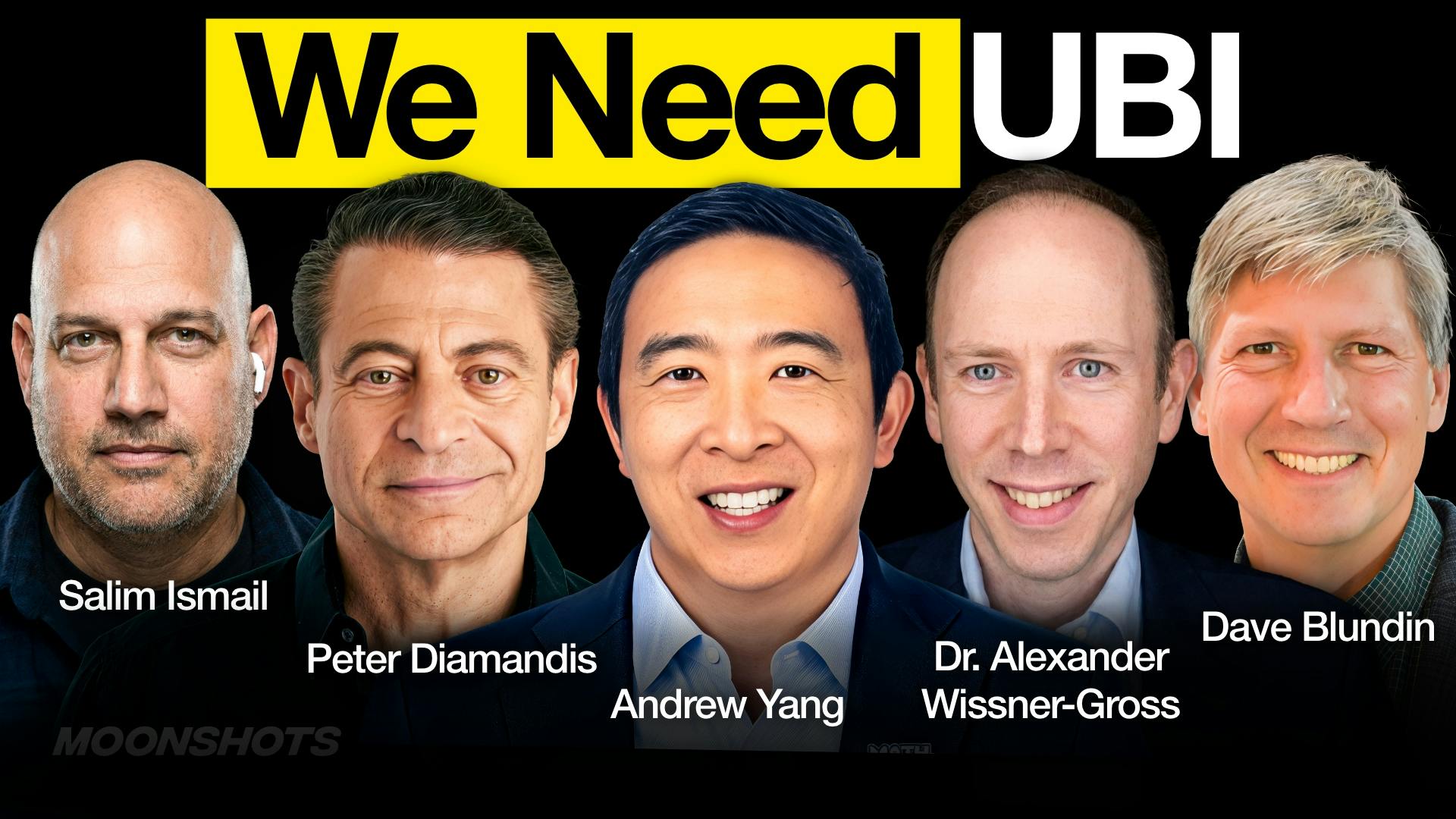
Moonshots with Peter Diamandis
Andrew Yang: UBI Before UHI, Solving Job Loss, and the Future of Work | #236
01:42:15
Loading summary
Transcript256 lines
- [00:01]
Peter Diamandis
Given the advances of AI and robotics, we're going to have something called universal high income.
- [00:06]
Andrew Yang
I'm not sure how you get to universal high income without major. As dysfunctional as I thought our political system was, it's even worse. This fourth industrial revolution is the most dramatic thing that's happened to our society in history. We're here in 2026. I do think the jobs are going to get whisked away.
- [00:27]
Dave Blundell
So you're going to have rampant social unrest if we don't do something quick.
- [00:32]
Andrew Yang
DC is on a multi decade tape delay. You have, like you said, the rate of change just accelerating all the time. And so what's gone from an inconvenient tape delay is now a catastrophic one.
- [00:43]
Saleem Ali
The disintegration of the social contract is the most important conversation that we could be having.
- [00:48]
Peter Diamandis
What's the advice for someone in college today or someone a junior senior in high school?
- [00:53]
Andrew Yang
The only career path you can rely on is entrepreneurship and owning your own future and path. But a lot of people aren't cut out for that.
- [01:04]
Peter Diamandis
Now that's a moonshot.
- [01:05]
Dave Blundell
Ladies and gentlemen,
- [01:09]
Peter Diamandis
everybody, welcome to Moonshots. Another episode of WTF just happened in tech. Here with my moonshot mates, DB2, Dr. EXO and AWG. And here with a friend of the pod, a dear friend of mine, Andrew Yang. Andrew, good morning to you.
- [01:24]
Andrew Yang
Hey Peter, thanks for having me. It's a pleasure to be here.
- [01:27]
Peter Diamandis
Are you on the West Coast?
- [01:29]
Andrew Yang
East coast?
- [01:30]
Peter Diamandis
All right.
- [01:31]
Andrew Yang
Yeah. So for me this is a better time than you guys.
- [01:34]
Peter Diamandis
Well, everybody else on the east coast,
- [01:35]
Dave Blundell
that's why I'm on the West Coast.
- [01:37]
Peter Diamandis
No one complained about a 6am start this morning. We're excited to have this conversation. A lot going on for us. This is a conversation on typically AI and exponential technologies, how we get people ready for the future. And one of the things we're talking about in the future is the changes that are coming and the potential for social unrest. How do we deal with the changing social contract? We're going to talk about ubi, uhi, a number of different subjects. Everybody, if you don't know, Andrew, entrepreneur extraordinaire, 2020 US presidential candidate, which really put him on the main scene. Leading advocate for Universal Basic Income, founder of Humanity Forward and the Forward Party, and a national voice about AI's impact on jobs and the middle class. We get a lot of conversations, a lot of questions around how does all this conversation around AI, crypto, robotics apply to me? How does it apply to me if I'm not in the VC business? If I'm not a tech entrepreneur, I want to dive into that. So let's jump in. Andrew, I'm going to start with a conversation about UBI versus uhi. When Dave and I were interviewing Elon at The beginning of 26, one of the conversations that came up was his theory that no, we're not going to have a universal basic income. Given the advances of AI and robotics, we're going to have something called universal high income. Let me play this short clip from our conversation which went a little bit in unintended or unexpected direction. How do we go towards universal high income instead of social unrest?
- [03:31]
Andrew Yang
Have universal high income and social unrest. That's my prediction.
- [03:35]
Peter Diamandis
Oh, that will make for a lot of problems.
- [03:38]
Dave Blundell
Is that your actual prediction? Yeah, yeah, it seems likely.
- [03:42]
Peter Diamandis
Andrew, reaction to that, pal.
- [03:45]
Andrew Yang
I'm not sure how you get to universal high income without major political realignment. And I'd suggest that universal basic income would probably have to come first. It would be like an intermediate step. And one of the things I'd love to unpack with Elon is how he thinks we get from here to there. And also how this interacts with the person that's asking the question, like let's say you're a 50 year old middle manager at Fortune 500 company that's worried that your job is going to disappear. You might have a mortgage, you might have two kids. And then how does that person wind up with a robot doing all their chores and money flowing in such that they can bring their family out to a nice meal at will? You know, like that. The path to me is what's important because we're here in 2026. I do think the jobs are going to get whisked away in a lot of these firms. And that family is real. I mean, I grew up with folks who right now are deeply concerned that they're going to lose their job. And they very well might don't have a huge safety net or pool of savings. Maybe they have a kid who's, you know, prime to go to college. And then that's another part of it is like, hey, what's college for? You know, like if I, if I'm saving up 250, $300,000 for my child to go to university, are they going to get a job afterwards? Are they just going to come right back and live with me? So those are the questions that I hear every day.
- [05:28]
Dave Blundell
I really got the feeling talking to Elon, like he was eager to work on exactly the question you asked until he got to Washington. And his quote actually was like, it's a blood sport. And man, did it scare him away in a hurry. But I think he was eager to work on exactly the logistics of getting from here to UBI to uhi. And one thing we talk about on the pod is how short the timelines are. The election cycle is going to be four years no matter what. But AI is accelerating at a rate where four years is like 40 years. So the amount of change inside any given time window is like nothing we've ever seen. So maybe we should just figure it out right now.
- [06:08]
Andrew Yang
One of the jokes I told just yesterday, Dave, is that D.C. is on a multi decade tape delay in part because we have 70 and 80 year old legislators and you have, like you said, the rate of change just accelerating all the time. And so what's gone from an inconvenient tape delay is now a catastrophic one.
- [06:31]
Dave Blundell
Yeah, yeah.
- [06:32]
Peter Diamandis
Salim, what are you thinking about this?
- [06:35]
Saleem Ali
I've got a bunch of thoughts. First of all, Andrew, I want to just applaud you. You're the social contract interpreter for the whole world. I think that you're bringing UBI at a top level discussion is one of the most important things we could be doing. I have a quick apology for you because a few years ago when you were doing your presidential run, I interviewed you for 25 minutes and we finished this interview and at the end I realized I'd forgotten to hit the record button.
- [07:02]
Andrew Yang
I'm so sorry.
- [07:03]
Saleem Ali
And you were so gracious.
- [07:04]
Andrew Yang
You said, saleem, if that interview had.
- [07:07]
Saleem Ali
No, no, no, no.
- [07:08]
Andrew Yang
You were doing this on the white right now.
- [07:11]
Saleem Ali
You were incredibly gracious and you said,
- [07:13]
Andrew Yang
let's do it again.
- [07:14]
Saleem Ali
And we did it again and it was fantastic. So I really want to just thank you for that.
- [07:19]
Andrew Yang
That's why I didn't win.
- [07:22]
Saleem Ali
You can't put it on me. But I think this is the fundamental. The disintegration of the social contract is the most important conversation that we could be having. And I think you're absolutely right. UBI has to come before uhi. The big challenge is going from a labor union tax job construct to that is such a big leap. Public office and public sector is not going to get us there. So have you thought about how do we get there?
- [07:50]
Andrew Yang
Oh, yeah, I think about it all the time. I think about it every day.
- [07:56]
Saleem Ali
I'm waiting for enlightenment. So.
- [07:58]
Andrew Yang
So path number one is that government gets its act together. And that seems vanishingly unlikely. I know, but I still believe that that's more of a possibility than most. And I can see some real outsized, asymmetrical like possibilities even in 2028. Then the other path is that you have a series of, I was going to say billionaires, but they don't have to be billionaires. Just like well resourced individuals say, look, let's just get this show on the road. I was encouraged by some of what Dario Amadei and the anthropic team have put out there where they say, look, A, they were honest. They said we're going to automate away 50% of the entry level white collar jobs next one to five years. And I was like, oh, like thank goodness they came out and said it because you know, like people might believe them. And B, they're going to get phenomenally wealthy and they expect to give the vast majority of it away. And they would like to shore up the social contract and find ways to keep society whole and strong. And so if the government doesn't get its act together, you can see a group of tech innovators and entrepreneurs who are part of this revolution turning around and saying, look, we want to make sure the middle class survives this ERA and here's $100 million, here's $500 million. And then you'd pick a locality and show what can be done which itself might catalyze other philanthropy and the government eventually. So those are two pathways. I see everybody, you may not know
- [09:49]
Peter Diamandis
this, but I've done an incredible research team and every week myself, my research team study the meta trends that are impacting the world. Topics like computation, sensors, networks, AI, robotics, 3D printing, synthetic biology. And these metatrend reports I put out once a week enable you to see the future 10 years ahead of anybody else. If you'd like to get access to the Meta Trends newsletter every week, go to diamandis.com metatrends that's diamandis.com metatrenDS But Andrew, just to dive in this a little bit, we're talking about ubi, every single person in the United States. Let's talk about for the US getting a check, very much a stimulus check. If you would, similar to what happened during COVID You know, what do you think the right amount of capital for UBI payment would be to every family? Do you have a number in mind?
- [10:39]
Andrew Yang
Well, I campaigned on $1,000 a month in 2020, which if you run some numbers, GDP right now is around $84,000 ahead. It's going up, up, up because of AI, so it's going to break 90 and then 100,000 in the relatively near future, 1,000 is probably a bit low if you look at the poverty level. Agreed. Now it, now the poverty level, it depends upon where you are in the country, but it might be something around $25,000 a person. In that order? In that order of magnitude. And that's per person. And so you, you can see maybe like twice the thousand dollars a month might be necessary.
- [11:29]
Peter Diamandis
So if we give, if we gave the bottom 200 million of the 300 million Americans 50,000amonth, you know, that's about 50,000 a year. You mean 50,000 a year? Yes, a month. That's about $10 trillion allocated per year. I mean the challenge, the, the opportunity is if in fact we start dividing by zero, meaning the cost of labor and AI. We're going to. One of the other conversations we had with Elon was we're going to see the first hundred trillion dollar companies and we're going to see multi trillionaires coming online. And one of the points you bring up is, is the money for a UBI coming from the government or do humans start aligning with companies and the companies start providing basically that ubi. I wonder if that's an option you've considered.
- [12:16]
Andrew Yang
You know, companies are possibility. I actually think it's going to come from human beings, you know, and one example would be something like what Michael Dell and his wife recently did where they gave away, I want to say, $6 billion to Trump accounts for generally poor kids in the Texas area. It was maybe $250 a person, but it was from an individual or their philanthropy and it was geographically centered on where Michael lives. And so I see that as a harbinger where you just have an individual say, like if it was anthropic and they live in the Bay Area, they could be like, look, we're going to do this for like this region. And then like that to me is more likely because if a company does it, a company has a hard time justifying it, you know, especially if they have shareholders. And even if they're public, I mean, if they're public, they would end up with lawsuits up the wazoo saying like, you can't be giving company money away to do something this non shareholder serving. So I think it's going to have to come from human beings. And by the way, one of the cases I also make is that look, so if I'm a billionaire, which I'm obviously not, though I know you guys know people who resemble that the media sometimes presented it like I was and then my wife's like, where the heck is this billion dollars that they keep talking about?
- [13:50]
Saleem Ali
So
- [13:53]
Andrew Yang
if I'm a billionaire and you come to me and by the way, I think this entire billionaire tax conversation is really counterproductive. You know, it's, it's, yeah, like, I mean, the fact is if you actually had a 5% wealth tax, you'd have zero billionaires the next day because they'd all, you know, be in Switzerland or wherever.
- [14:15]
Dave Blundell
Any, any one time taxes, like, what are you doing?
- [14:18]
Andrew Yang
No, no, they're saying taking the can
- [14:19]
Dave Blundell
down the road next year. Like, how's that going to work?
- [14:21]
Andrew Yang
Yeah, no, they're saying recurring. I was like, yeah, good luck finding someone who's going to stick around for that. So if you're a billionaire and I come to you and say, hey, we need your help to keep America from utterly disintegrating, you would say, look, I'm into it, I'm a human being, I'm sympathetic and I don't want my kids having armed guards around them all the time and all this other nonsense. But I'm dubious that if I send a check to the government, it's actually going to go to anything good because the government is, you know, just going to end up like putting it towards some debt that they ran up or some bureaucracy I can identify or some, you know, other boondoggle. I'm very, very sympathetic. And so then you'd say, hey, how about we skip the government step and we take this right to the people and people that you care about. I think the Dalio as Ray Dalio, they were trying to emulate what the Dells were doing in Connecticut. So I think that human billionaires are going to be the first movers in this direction and they're going to center it around where they live.
- [15:30]
Dave Blundell
Let's throw the rest so much that was like, you know, Peter's question is how do we get to ubi? And the answer is, well, government could get its act together. And then everyone says, not a chance in hell. Okay, Path two is through billionaires, which you said, okay, let's call those well heeled people. But one of the things that came up in Davos four years ago and also again this year in a big way is the fact that this is the first time in the history of the world that those well heeled AI billionaires also control all media. Elon is on stage being very political in the last election while buying Twitter X which is one of the massive media platforms and now those media platforms have AI all over them. So for the first time in world history, what you described as a scenario where These billionaires give $100 million check to a candidate. The candidate runs TV ads that elevates their campaign, they get elected. But that's so four years ago. Now, that same well heeled Dario, in this case, also controls the AI voice and what it says with the training data. I mean, it's just a very, very different scenario from anything we've seen before.
- [16:34]
Andrew Yang
Alex, Evan, present to you all the 2028 scenario where, like, everything speeds up. Sounds good. And Elon was tiptoeing around this. He actually didn't tiptoe. He just publicly said, like, hey, we should start the America party. At which time my phone started blowing up, and then he flipped. A lot of people where they're like, oh, you can't do a third party. It's like, oh, wait a minute. Elon totally could do a third party, because you identify the obstacles. And Dave, you just touched. So one is, let's call it, for sake of argument, $1 billion. You could probably do it on less, but let's say $1 billion to a media platform or megaphone and he owns it. And then three is popular movement. And you definitely have that lying in wait, where right now, 50% of Americans say, we're independents. Democrats have a 29% approval rating. Republicans have a 32% approval rating. So if you were to light the signal, a bunch of people would come your way. And if you are a political party, which the forward party is, you can design a nomination process however you like. There's no magical scripture that says it has to be in New Hampshire and Iowa or whatever. Like, it's just made up.
- [17:51]
Dave Blundell
Oh, really?
- [17:52]
Andrew Yang
And so you could do an online vote on your smartphone independent presidential primary with me, Mark Cuban, Oprah, Matthew McConaughey. America's gonna be all right, all right, all right. And then have, like, a series of people. And by the way, the American public would be like, oh, this is actually interesting. People are gonna say, I kind of know on some level what all the Dems are gonna say, what J.D. vance is gonna say, but I do not know what. What this crew's gonna say. You have Joe Rogan moderate the forum and the debate. You go around the country. And the American people would then say, this crew, regardless of which of these people I prefer, this crew is trying to give it back to me. I can tell because the Democratic Party and the Republican Party have no interest in giving it back to me, but these guys do. And then you'd get millions and millions of people participating in this primary. The. The person that wins then gets Elon and Dario and the rest of it being like, sure, I'm more into this than I am into that. And then we run it back. This is all on the table for 2028. Now, will all of that come together? Don't know, but certainly every piece is there.
- [19:11]
Peter Diamandis
Exciting.
- [19:11]
Dave Blundell
Well, at the time. I mean, that last election showed how flawed the primary process is. And, yeah, the timing is perfect for it. The amount of change between here and 2028 is going to be like nothing we've ever seen, too, so. But I had no idea. I thought, you know, my whole life, you'd start in New Hampshire, then, you know, you tromp across the country to Iowa, and then you. I thought that was just sort of written into law somewhere, but I had no idea you could just do it
- [19:35]
Andrew Yang
any way you want, 1,000%. No, Dave, as a matter of fact, there are people that are trying to change the order right now within the dnc, and the RNC just demoted Iowa. Sorry, the DNC already demoted Iowa, so you won't see Democrats going to Iowa anymore. It's carved in stone in that. It's a DNC rule that they fight over every four years, but there's no magic to it at all. And if you think about it, there are 42 states that have been on the outside looking in. And so if you were to go to them and be like, hey, guys, how would you like to actually choose who the nominee's gonna be? California or wherever they'd be, like, oh, I never get to do that. Because by the time it gets to California, it's already.
- [20:21]
Dave Blundell
Wow, it's amazing.
- [20:23]
Peter Diamandis
Alex, you have any opinions in this conversation?
- [20:26]
Alex Wissner-Gross
Sure, many. So, Andrew, first of all, fun to be chatting. I'd like to maybe start by probing on the implicit assumption that universal basic income, as sort of a proxy for wealth redistribution in response to perceived technological disemployment or underemployment or unemployment, is necessarily the. The optimal policy versus, say, one of many alternatives. In my mind. Alternatives would be universal basic services, where the cost of energy and healthcare and housing and other utilities drop to near 0 or 0, or are essentially available for free in the same sense that breathing air is, for the most part, available for free, or Wikipedia access is free or nearly free. So universal basic services could be as much somewhere in between free and, say, like an Amazon super prime that offers everything that one needs to survive for $100 per month as one, by the
- [21:30]
Peter Diamandis
way, which, by the way, is the subject of something called the abundance x prize. 250 bucks a month for food, housing, water, energy, bandwidth.
- [21:39]
Alex Wissner-Gross
Yeah, as one possible alternative policy, call it a supply side version versus the demand side UBI where everyone gets stimmy checks or universal basic equity where everyone is getting dividends from say an Alaska or Norway style sovereign fund. How do you reason? What's the thinking process behind UBI versus lots of other policy alternatives.
- [22:06]
Andrew Yang
I'm on all hands on deck. Any solution that improves people's lives is a win. And so right now, and I think Peter knows this, but I started a company called Noble Mobile that's trying to get Americans wireless costs down closer to what Europeans pay. So the average American spending 83amonth on their wireless. I have a hunch that all of you are spending twice that. I was spending 150amonth on Verizon. The average European spending 35amonth. That delta of 48amonth comes to about $600 a year for the average American. Then multiply it times all the years they're going to be a wireless customer and the people in their household. By the way, Verizon gave its shareholders 11 billion in the last 12 months. So. So you have a hidden tax about 100 billion on the American people, Alex, in terms of our wireless connectivity. And so I was inspired by what Mark Cuban did with generic drugs where he bought generic drugs of bulk and tried to make them available to the American people at a low markup. You could frame that as universal basic services. Maybe, maybe that's not enough, but I love it. You know, if we can get energy costs down to zero, near zero. Freaking sign me up. Like the. If you look at the cost structure of the average American household right now, it goes in this order. Number one, housing, two healthcare, three education, four food, five fuel, six transportation, seven entertainment and media and eight, wireless. So I think we should be trying to attack each of those. But the fact is like the highest line item one is housing, which is reliant upon local zoning ordinances and all this nonsense that it's hard even for the feds to come in and say, hey, we're going to build 7 million new housing units. Because wealthy people get very conservative when someone's trying to build an affordable housing complex in their neighborhood. So I'm totally down with trying to attack the cost structure at every turn. And you know, you identified fuel, which is, you know, on the list at like, you know, but it's not the main thing for Americans. Maybe housing and healthcare and like, hopefully Education under control, then you know, then you'd be making real progress.
- [24:42]
Alex Wissner-Gross
But maybe just to press on that point a bit. So for housing, healthcare and education, there's an alternative universe perhaps where we create an overabundance of supply rather than juicing demand with stimulus checks. So in your mind, how would you morally weight, say, creating special economic zones where housing is overabundant, filled with skyscrapers, or where healthcare is driven to zero with effectively municipality level AI or education is purely AI Basically trying to solve this perceived problem from the supply side with overabundance rather than from the demand side with stimulus.
- [25:23]
Andrew Yang
I'm all for it. I just think that right now, if you say, hey, which is going to be faster? I have more confidence in our ability to transfer money into people's bank accounts very, very quickly than I do designing some of the solutions.
- [25:41]
Peter Diamandis
You're talking about one or the other, right?
- [25:42]
Andrew Yang
It's not one or the other point that have like the permits today to build the skyscrapers and like the place, I mean, you're talking about realistically months or years and that's if everything were magically in place. Yeah.
- [25:55]
Peter Diamandis
Elon's point was we're going to have humanoid robots that will be able to build you whatever you want at the cost of basically energy and raw materials. And AI will deliver us health and education and in fact AI will become your shadow worker for you. Go earn the revenue for you. We can get into that. Salim, you were going to add.
- [26:15]
Saleem Ali
Yeah, two things. I think the ubs. The most constructive thing I've heard about the UBS commentary, Universal basic services is the channels aren't burned in. Right. I think Andrew makes a valid point that if you want to just give money, it's the easiest model. And on the affordability and how much do you think the best framing I've seen is you give people enough to survive but not be happy and then you still have a very thriving economy, jobs, etc. Entrepreneurship explodes under this model. One, just an observation. In the 1970s, Manitoba in Canada, the province gave a UBI out and they implemented this program and it was staggeringly successful. And after two years they realized, oh my God, they don't even need government to exist if we have this incident and they canceled it instantly because government wants to exist. And that's the immune system. I think that's the most difficult part about this, is that if you implement it properly, you can get rid of a lot of government services, let the market take care of it. But that's a very hard jump. For governments to make.
- [27:16]
Andrew Yang
I would really enjoy that. And one of the things that made me sad when I was campaigning was that like there was a woman in Iowa who said, hey, I'm afraid to volunteer in my community because I might lose my disability check because I'm afraid someone might see me walking around and that I'm healthy. And so I don't, I stay in. And I was like, well that's really depressing. I think everyone can agree that her showing up to the church bake sale is a win for both her and the people. So that there's a lot of bad incentives in this system, a lot of paternalism, a lot of stuff that makes people feel like they're subject to the bureaucracy of government in a way that's really stilling like the, even the most basic forms of entrepreneurship.
- [28:08]
Dave Blundell
Andrew, I think your answer is right on target because the, the timelines, the small timeline differences are going to matter a lot. Job loss is a 2026 thing and then have a huge 2027 thing. And then building, you know, low income housing is a multi year. Just getting it approved is a very long slow process. So you're going to have rampant social unrest during that two year window if we don't do something quick. So giving out stimmy checks is quick. I also think that subsidizing employment, the problem with stimulus checks is when you pay somebody to not work, they lose the work motivation very, very quickly. And we saw that during COVID So another very quick thing is subsidizing employment where the government says, look, if you find new productive things for people to do that are AI oriented and that have a long term future, the government will subsidize half that payroll or three quarters of that payroll, but put it back in the hands of the private sector to decide how to use people subsidized by the government.
- [29:07]
Peter Diamandis
There's also the public works, right, where the government basically takes on large massive projects and employs people to do those things.
- [29:15]
Dave Blundell
Yeah, but like the Cape Cod Canal to me was a massive public works project with one boat a day and 10 million cars trying to get over the bridges. Just like you created a huge hole in the ground that is more of a problem than a solution. So you don't want the government decide it. You want to put that back into the private sector saying hey creators, find something really useful to do. Amazon, find something really useful to do. We'll just partially subsidize it during this turbulent window. And then Alex is so Dave, you're
- [29:46]
Saleem Ali
describing Canada because in Canada, they do a lot of this where they subsidize. But the problem is they put so many rules and procedural barriers, it becomes nonsensical to try and get it. So that's the problem there.
- [30:00]
Peter Diamandis
Alex, over to you.
- [30:02]
Alex Wissner-Gross
Yeah, I think there's another potential interesting model that we've started to discuss on this pod a bit over the past few episodes that looks maybe a little bit like what we're seeing with data centers that are being compelled or are opting into subsidizing electric infrastructure construction because they're becoming increasingly the largest consumers of the supply of available power. And one can imagine a near future, a very near future, where data centers and the hyperscalers and frontier labs behind them are essentially subsidizing to the point of offering for free electricity to consumers that can then consume from the same infrastructure that the hyperscalers are building for their own consumption. So I guess maybe to put that in question form, Andrew, going back to UBI versus UBS versus Universal Basic Equity versus whatever's behind door number four, what do you think of the possibility that as superintelligence is driving an overabundance of supply, that what we see is some sort of basically shadow UBI or shadow ubs, wherein as we're seeing again, with data center builders being asked to subsidize infrastructure consumption, we see the hyperscalers being asked to subsidize universal basic services or income for personnel, for consumers, for municipalities in their general area.
- [31:35]
Andrew Yang
Yes, I think that's in the portfolio, Alex, of things that could be helpful solves. I want to underscore just how far along in this process we are. I mean, you all remember when the, the healthcare CEO was shot in the street and then his killer is lionized, and that was X months ago. I think things just continue to deteriorate where young people today, and this pains me, I was just speaking to a group of CEOs yesterday where it's like, young people now regard a lot of successful people as bad. And you look at that and be like, wait a minute, like that. That's obviously like a very troubling characterization where, you know, it's like, oh, anyone who's done well must have stepped on people or done something negative or malignant. And so we're, you know, you can characterize what inning we're in of the deterioration. But it's one reason why Dave said it's like, oh, yeah, like we got to move fast. I think we really have to move as quickly as we can because the anger is rising. And the anger is getting refracted through our two party system in various ways. So on the left it's like, okay, capitalism bad, socialism good. You know, the average age of a first time home buyer is like 40 years old now. So if you're 28, you're out of luck. You know, you're going to get a college degree that is valueless. The underemployment rate for recent college grads is now over 50%. You're going to be at home with your parents, you still owe these loans. The anger is really, really high and rising. And then on the right, it's taking this other form, this kind of reactive, hyper genderizing of various roles in conversations and things that also don't, in my mind, you know, like solve the problem. And so I'm all about trying to get there as quickly as we can, even recognizing that people are going to slip through the cracks. Like even if we were to do a lot of good things like that, there's, I mean, this is where Elon's I predict universal high income and social unrest. It's like the unrest is unfortunately much closer than we'd like to think.
- [34:05]
Peter Diamandis
Andrew, let me throw out an idea that I've been focused on and trying to work on solutions, which is we have a new pandemic coming and this is a emotional pandemic of fear and anger that it's going to be spreading, especially due to increased uncertainty and concerns over social unrest. And we need to find some vaccination mechanism, if you would, to protect us against that, that growing. Because the future is a terrible place to face from a position of fear. I'm going to move us to a conversation around jobs. This is Peter.
- [34:43]
Andrew Yang
I have a joke for you to lighten the mood a little bit.
- [34:47]
Peter Diamandis
Sure.
- [34:47]
Andrew Yang
So I was a CNN contributor and a number of years ago they pitched me a TV show called the Future of with Andrew Yang. It was going to be like the future of healthcare, the future of transportation. And then they ran focus groups and said, hey, bad news, Andrew. People don't like the future. So now everyone listening to your podcast loves the future, embraces the future, trying to make it work for them.
- [35:13]
Peter Diamandis
This is something we're going to be announcing at the Abundance Summit. I don't know when we're going to particularly air this episode, but we are. One of the biggest concerns is people's vision of the future is dystopian.
- [35:25]
Alex Wissner-Gross
Why?
- [35:25]
Peter Diamandis
Because Hollywood paints every future scenario as killer robots and dystopian AI. So if that's the future, you've learned why would you want Ex Machina or Black Mirror or Terminator? And we need to paint better versions of the future. We need visions that are more Star Trek, as Elon said on the pod that Dave and I did with him. We need more Roddenberry and Les Cameron in that regard. All right, let's jump.
- [35:50]
Andrew Yang
I used to have a slide Peter, saying it's either Star Trek or Mad Max, and you kind of veer towards one or the other.
- [35:57]
Peter Diamandis
Yeah, we have these two futures in superposition and we need to collapse the waveform in one of those directions.
- [36:04]
Saleem Ali
I mean, they're right to Alex's point that we're speedrunning all.
- [36:06]
Alex Wissner-Gross
I think they are both happening. And also I want to reach for some sort of Strauss Howe generation hypothesis type theory that it's cyclical with some timescale of 80 years. Like somehow after World War II, tail fins are getting added to cars in the 50s and 60s and people were reading the golden age of science fiction, but now people are watching Lord of the Rings and fantasy rather than science fiction. Like fantasy is completely overwhelming science fiction words. If you look at trends over time, I guess maybe Andrew, to put that in question form, how much of generational pessimism do you think is actually generational? How much of it is cyclical versus periodic trends that'll just people will eventually cycle back to optimism after something bad has happened?
- [36:51]
Andrew Yang
Well, I'm a numbers guy, Alex, and one of the numbers that really haunts me is that young people socialize and get together about 50% less than we all did in our 20s. And I see gatherings as optimistic events. Like even if you decide to have a little party at your house, you have to assume that people will want to come. You have to assume that they'll like your food. You have to assume that your house can accommodate them. They won't trash the place. And so to me, like you could go hand in hand with like in real life social gatherings and how good people are going to feel. And right now, unfortunately, we're getting together less and less.
- [37:38]
Peter Diamandis
Yeah. All right, I am going to move this conversation towards jobs. So here is a comment from the co founder of Morning Brew Austin who says my friend who works at a large PE firm said, quote, we just had a firm wide meeting about how we don't need associates anymore. That's the first slide. First topic. Second one here the Fed Governor Waller highlights unusual growth without jobs historic anomaly where GDP is expanding while labor market is fragile. GDP grew 1.4% in Q4 of 2025. Despite the weakest job creation since 2022. And the third story here to weave in comes from Jack Dorsey.
- [38:22]
Andrew Yang
Gotta be blocked.
- [38:23]
Peter Diamandis
Yeah. So block. His company shares soared 24% after 4,000 employees got laid off. So this is what Wall street rewards, higher profitability from lower costs. So let's paint this picture of the growing loss of jobs. There's a lot of conversation out there from other people in the tech community saying, no, no, no, we're going to increase the number of jobs. I think people get confused about entry level jobs versus more advanced jobs. Andrew, how do you think about all this?
- [38:56]
Andrew Yang
I talked to CEO of a publicly traded tech company and he said unannounced, he said, we're going to fire 15% of our workers and then two years from now we're going to fire another 20%, and then two years after that, we're going to fire another 20%. He's like, after that, don't know. And I take him at his word. You know what I mean? Especially after this block illustration where CEOs are going to have to be ruthless on headcount if they want to keep their own jobs and if they want their stock to be healthy. I will also say something kind of bleak and negative. But if you've been inside one of these.
- [39:35]
Peter Diamandis
And then you'll tell us a joke.
- [39:37]
Andrew Yang
Yeah. And then may I tell you a joke? But if you've been inside one of these large corporations, you kind of sense instinctively that 40% of the people aren't really indispensable, shall we say? You know, it's like, because, I mean, I've worked in startups and in startups, like everyone is. I mean, you know, even in startups, like, you know, not everyone's indispensable all the time, but.
- [40:05]
Peter Diamandis
But there's a much more of a culture of making, of finding problems and solving problems in a company versus laying back.
- [40:14]
Andrew Yang
Oh yeah. And I mean, it's one reason why I love startups so much, you know, like, I find them to be pure utilization of the soul, like energy, talent, optimism, et cetera. So I think publicly traded companies are going to fire white collar workers very, very quickly. And the easiest people to fire are the people you haven't hired yet. So they're not going to hire a bunch of whippersnappers. And that's showing up in the numbers where the college premium is quickly evaporating. I do think that these changes are going to apply to small private companies too. I'll use Noble Mobile as an example. We were Hiring junior engineers or trying to for the last several months. And then our CTO came and said, hey, I don't think we need to hire for that role because the AI tools are now good enough. Like, if you have, like, a strong managerial type. The comparison I make is that used to have pyramids and someone said, I would hire three juniors for every senior. And then now you have columns, maybe. So you have like a senior and then one junior, and you're good. And so if you're a young person, then you never make it into one of these environments to get trained and learn and develop and ascend. And so that's one of the things that's going to be driving the despair, is that for all these young people that thought the way I did, probably you all did, too. Get good grades, get into a good school, get a good job, have a good career, contract. Yeah, like, you know, the steps three and four are going to be harder and harder to find, and that's going
- [42:03]
Peter Diamandis
to cause a lot of anger if I can't get a job, can't get a house, can't get a wife or a husband and, you know, and can't have a family. That is what causes social unrest and anger towards those tech companies or those investors that made that future, destroyed the American dream that we had. So let's bring it back. What's the advice for someone in college today or someone a junior, senior in high school? What's the new strategy? We've talked on this pod a lot because we're all entrepreneurs, as are you, that entrepreneurship is ultimately the future career. It's not working for somebody else. It's working for yourself. That's what I would like for my kids. It's not cut out for everybody. What advice are you giving people?
- [42:49]
Andrew Yang
You know, it's similar, Peter, in that the only career path you can rely on is entrepreneurship and owning your own future and path. But a lot of people aren't cut out for that. And I'm actually going to look at my two boys, one of whom is 13, one of whom is 10. One of them is definitely not cut out for that, you know. And so you're trying to guide people on a path that isn't going to be right for, in my opinion, 80% of people, because entrepreneurship's really, really difficult. And so one thing I say to parents is the success factors for our kids are the same as they ever were. It's grit, it's perseverance, it's coachability, it's sociability, it's Caring about something, it's hustle, it's believing that your efforts can actually pay off. One of the single biggest factors in whether your kids have those attributes is screen time. Like you give them too much screen time and their self control goes down, their ability to focus goes down, like all this stuff. So the shorthand for parents is try and keep your kids off of screens and social media to the extent you can and try and train them to be an awesome ass kicking human being regardless of circumstances. And then they'll have a chance knowing that their course of study might not matter. That's like the big thing is to be like, look, you know, to the extent your course of study matters, it just like it's how to think, how to approach things, how to care about, you know, learning and development. But the actual subject matter, it could be anything. And knowing too that to the extent that some of our kids can be channeled towards the trades and jobs that we're going to need. Because you know, the simplest examples I use is. And Elon might disagree with me, but like, you know, I'm pretty confident I'm right. We're not going to have a robot plumber anytime soon. We're not going to have a robot H vac repair person anytime soon. Like all of the old buildings will still need electricians of which there's a massive shortage. So if you have like a young person who might be handy and let's say they're a guy, you know, like it like not a bad thing. I mean, you know, like you, you skip the indebtedness, you skip a lot of things.
- [45:12]
Saleem Ali
Yeah. This is also women become entrepreneurs and all the men become plumbers. Yeah.
- [45:16]
Alex Wissner-Gross
What was the gender angle there, Andrew?
- [45:18]
Andrew Yang
That's great. Well, it's just that it's more likely for like a man to pursue like some of these trades, like statistically. And what we've done is we've stigmatized the trades for everybody and then we should be saying to men in particular, trades are cool, really good, solid, steady job, don't worry about it.
- [45:39]
Saleem Ali
Well, if you're a data center builder, you have a hell of a future right now. So there's all sorts of areas that you could apply this.
- [45:46]
Peter Diamandis
Yeah. The question of when an optimist or pick your favorite robot is able to do that. Elon's vision is next three years, even if it's eight years. Right. I mean the progress we're seeing in robotic software and robotic agility and progress is stunning.
- [46:03]
Andrew Yang
What we've seen in the industry data centers Yes. I can see robots building them in like some foreseeable time frame plumber. No, it's just that. Because the human is just going to have an easier time knocking on your door, being like, hey, what's the problem? Coming in, doing the thing.
- [46:20]
Peter Diamandis
Can we talk time frames, Andrew?
- [46:22]
Alex Wissner-Gross
Yeah, please.
- [46:23]
Peter Diamandis
When I think about the timeframes here, the challenging timeframe where UBI stimulus checks capital into to sort of quelch the fear and uncertainty is like the one to three year timeframe bringing universal basic services, I think starts coming in maybe in three years to the five, eight year time frame. I've always viewed that the challenges are the next three to eight years and then on the backside of that is abundance, where people have access to everything they need. Do you agree with that timeframe, that layout?
- [47:05]
Andrew Yang
Peter, I love your timeframe because it's actually very, very optimistic. I mean, you're talking to the preeminent proponent of UBI, and if you were like, yeah, UBI, next one to three years, I would take it 100 times out of 100, you know what I mean? Like, even as I'm the guy who's saying, like, we should do this, and it's totally possible. So I hope you're right. I hope we end up heading down this road over the timeline you laid out. Because the truth of it is that, and this is like the Buckminster Fuller quote, that of the race between Utopia and Dystopia will be decided at, like the very last moment kind of thing that, you know, that there's like a race on and the dystopian march is going on along at a pretty nice clip, shall we say. And then the utopian march, it's like fits and starts, in my view. But it's one reason why I would urge people who have the capacity to do more, to do what they can, to do what we can, because, like, Utopia is like a deliberate choice and it's going to require like, a group of innovators like you all and the folks that we collectively know to do what we do and build.
- [48:28]
Alex Wissner-Gross
But maybe, Andrew, just to press this point, what is your expectation regarding the timeline for humanoid robots making themselves available for plumbing services to the broad American public?
- [48:38]
Andrew Yang
Oh, so again, I don't foresee robot plumbers for quite some time because the home environment is like, you know, especially like a home you haven't been in, like the rest of it. It's like, you know, you'd rather send a human, and the human's not that expensive in, in that context. Whereas, like a data center. The whole thing is controlled and controllable. Then you know, like you'd have humans still in there, but, but you'd also have a ton of robots and I think people sense that.
- [49:08]
Alex Wissner-Gross
Can I persuade you to put a number to the. Not for some time. Is it like 10 years that you think we get humanoid robot plumbers, 20 years. What's the precise timescale you envision?
- [49:17]
Andrew Yang
I think human plumbers are safe for at least 10 years and probably significantly longer.
- [49:26]
Alex Wissner-Gross
Wow. Well, isn't that then the solution to, in your mind at least to technical, the technological disemployment? Let's just ramp up the trades and the trades will absorb the excess of so called white collar surplus. Why isn't that the solution?
- [49:39]
Andrew Yang
Oh, it's part of it, Alex. And unfortunately there's going to be a lot of competition for those jobs. But like the numbers don't work out to your point. It's like you have a certain number of plumbers per like capita and then you know, you can't have like 10x that number.
- [49:55]
Alex Wissner-Gross
But look at the, look at the sectors with Bellmore's cost disease, like health care, like why can't everyone have one or not everyone, but the wealthiest portion of the society. And this is the thought experiment, this isn't a policy prescription. Have like one or two personal healthcare assistants as one of several classes or you know, personal plumbers, personal assistants and absorb the labor surplus that way.
- [50:20]
Andrew Yang
You're certainly going to see a significant proportion of Americans whose job it is to serve the top layer, the top 20%. You're going to see nannies, you're going to see personal assistants, you're going to see personal trainers. You do now, you know, and, but I will say if you look at home health care aids as a profession, the turnover is rampant because it's very difficult isolating work. And the Average compensation is $35,000 a year for a home health care aid. So if you say, hey, that's going to be the job of the future. Like none of the people listening to this right now want to be a home health care aid. Like it's, you know, and one of my jokes in one of my books was like I was a home health care aide for one day and I wanted to tap out, you know, and so if you were to ask like millions of people be like, hey, bathe grandma. And that's what you're going to do as like your job forever, like, you know, it's very, very few people are cut out for that. And the People that are doing it right now often are doing it because it's the only job on offer.
- [51:21]
Saleem Ali
They have to do it. Yeah.
- [51:22]
Peter Diamandis
Hey, Andrew, you had a book come out last month. Tell us about it. And I love the title of it.
- [51:31]
Andrew Yang
I'm sure it's very aptly named hey, Yang, Where's My Thousand Bucks? You can see the image. That's me with some money. That's awesome. The alternate title you'll enjoy even more. It's hey, am I racist or are you Andrew Yang?
- [51:46]
Peter Diamandis
Oh, no. So what's the book about?
- [51:50]
Andrew Yang
The book's about the ins and outs of trying to make utopia happen over this last number of years. And I sensed that this was going to be kind of a fraught time. So I wanted to write something light hearted and humorous while also trying to get some ideas across. So it was a really fun process. A lot easier than writing my other nonfiction books. And I'm happy to say people are enjoying it. So if you want like a laugh that'll make you think, I think it's a good choice.
- [52:22]
Peter Diamandis
You know, Andrew, you're gonna be joining us at the abundance Summit this coming Sunday. Excited. Can you bring a couple of books with you?
- [52:30]
Andrew Yang
I think I'll have a whole crate. Or your team might have ordered a crate.
- [52:34]
Peter Diamandis
Oh, great, then I'm so happy we
- [52:35]
Andrew Yang
did, you know, but have. Yeah, thank you every. By the way, this is funny. Peter, have you written a book?
- [52:42]
Peter Diamandis
I have, yeah.
- [52:43]
Andrew Yang
So then, you know, and I sense maybe the rest of you have too. But if you want to prey on someone when they're vulnerable, like get to them when they have a book coming because then they're just like, oh, I hear anything thoughts, you know, like, I wrote them down. And if you're like, I want to hear your thoughts, then they'll be like, ooh, someone wants to hear my thoughts. It's like a very vulnerable.
- [53:07]
Peter Diamandis
Alex is bringing 600 copies of Solve Everything, which is a book slash paper that we co authored mostly under Alex's genius. So excited for both of your works of art and intelligence to make it there.
- [53:22]
Blitzy Representative
This episode is brought to you by Blitzy. Autonomous software development with infinite code context. Blitzy uses thousands of specialized AI agents that think for hours to understand enterprise scale code bases with millions of lines of code. Engineers start every development sprint with the Blitzi platform, bringing in their development requirements. The Blitzi platform provides a plan, then generates and precompiles code for each task. Blitzi delivers 80% or more of the development work autonomously while providing a guide for the final 20% of human development work required to complete the Sprint Enterprises are achieving a 5x engineering velocity increase when incorporating Blitzi as their pre IDE development tool, pairing it with their coding copilot of choice to bring an AI native SDLC into their org. Ready to 5x your engineering velocity? Visit blitzi.com to schedule a demo and start building with Blitzi Today.
- [54:26]
Peter Diamandis
I want to take us forward to a tweet you sent out that went viral, which is the end of the office. AI will replace large numbers of white collar jobs in 12 to 18 months. 20 to 50% of 70 million US office workers could be displaced. What happens to all of this real estate? We saw this over Covid take a sharp hit and now a double tap to the head.
- [54:54]
Andrew Yang
Yeah, so if you play out block times 10,000, not to say there are 10,000 blocks, because there aren't. But there are going to be private companies again making choices that are quite similar. And so you're going to have fewer workers who head to an office. You're going to have commercial districts under tremendous pressure, which we did see under Covid. You're going to have folks questioning the value of a college degree because there's not like a high paying corporate job waiting for you on the other side. And it's going to get nasty and dark. And I do rely upon some of my friends who are more normal than I am. So what do I mean by that? It's like one, one friend my age, I'm 51 now, and one of my jokes is like, I'm lucky not to get dumber in any given month where while I just gets, you know, twice as smart. So like, eventually we just have to raise our hands and say, you know what? Like, asking us all to compete against AI is probably not going to work out. But my friend is, is 50 years old, has three kids, has a mortgage, has a corporate job at a bank and he was recently laid off. And so then like, what's the next move for him? You know, and so I've been very encouraging, but that's the kind of place I turn to see like what is the. By the way, he's got a college degree, you know, six figure job, like, you know, educated, pillar of the burbs. And, and then you imagine him losing his job and then not being able to find another one that pays him the same. And then how, how that plays out in his town and the surrounding suburbs where some people are going to start selling their houses. And one of the things I put in this note, which it was not just a tweet, it was a blog post that went somewhat viral at, like I have a substack. I said you might want to put your home up for sale first because you don't want to be last. Like, you know, if you live in Westchester county or some of the peninsula suburbs, like people are going to be selling, so. So if you can get a reasonable price at the front of the line, you'd much prefer that than trying to unwind.
- [57:18]
Peter Diamandis
Everything starts unwinding. And of course, one quick follow on there. We've seen in fact the bankruptcy rate in colleges start to skyrocket because who wants to get that much of a debt? And like you said, the group with the highest unemployment rate is college graduates.
- [57:43]
Andrew Yang
Yeah. You're starting to see debt delinquency rates rise, mortgage delinquency rates rise. Like the personal financial distress is, is ratcheting up. And you know, you've probably seen a lot of the stats where you know, significant proportions. Call it half of Americans have limited savings living essentially paycheck to paycheck. Like I know people who resemble this who are college grads who have had, you know, multi decade long careers who I think are doing great. And then I like have coffee or dinner with them and then you press a little bit and they're super stressed because they borrowed money to send their one kid to college. And I was like, oh my gosh, like this much like I thought you were. It just goes to show too. I mean, you know, it's like I'm like I'm not normal. You guys are not normal. Most of the people listening to this are not normal. Like if you hang out with normal Americans, it's like a real splash of water. And so you're seeing the distress pick up by the numbers. You can look at any of the credit card rates, all that stuff. It's starting. People are less and less able to meet their obligations, financial or otherwise.
- [58:57]
Alex Wissner-Gross
Don't you think though, Andrew, this whole notion of a life path or career path where you go to college and then you graduate and you get a so called white collar job and then you have a stable life in suburbia or whatever the cliche is, is such a modern inv. Humanity has existed for thousands of years prior to any notion of everyone goes to college. Everyone sits in, yeah, hundreds of, depending on how you count, sits in commercial real estate at a desk job and does some stuff, moves papers around and then goes home, commutes back and forth. This is such a modern 20th 21st century invention that's in some sense evolutionarily highly unnatural for people to be spending their time on this anyway. And that in some sense it would be far better, at least more ergonomic for most people to be doing something other than this, like, really cliched life story.
- [59:49]
Andrew Yang
You know, Alex, I agree that it's something of a modern invention that's about to get uninvented. You know, the problem is that all of these people came of age and made life decisions based upon something that was true during their lifetime. That's going to become untrue. And so again, I'd put you in the shoes of either a young person or a parent trying to decide, am I going to go to college? And it's like, well, shoot, like traditionally going to college, I mean, I'm going to guess. All of us went to college just to guess.
- [60:26]
Peter Diamandis
Alex has like a half dozen degrees.
- [60:28]
Andrew Yang
Yeah, yeah. And so then, you know, so if someone comes to you and says, hey, guess what? That entire path got de invented. So like, figure it out then are you going to pivot at age 17, 18, or if you're a parent of a 1718 year old, are you going to say, hey, guess what? All that stuff's obsolete. And I wrote another substack post about like, is college still worth it? Being honest, Being like, look, my kids are going to college almost certainly unless they become savant entrepreneurs or shut inside. But part of it is that I can afford it. And to me, them going to college is about this social development as much or more than it is the vocational,
- [61:11]
Alex Wissner-Gross
building a network, finding plans and adult daycare.
- [61:14]
Andrew Yang
Yes, but yes, that's what I said, Alex. I said my strongest memory of going to Brown was my college girlfriend leaving me for another guy and then being sad for a semester or two. And so my major learning from Brown was how to deal with a breakup, which I'm gonna suggest is a very important life skill. It served me very well.
- [61:33]
Alex Wissner-Gross
On the other hand, simulating a breakup at the tender age can probably be afforded at a much lower cost than Brown tuition.
- [61:40]
Andrew Yang
Probably. But again, like, you know, we're in a circle where, you know, like, and I was honest, it's like, look, I'm not gonna be. Cause I think it's disingenuous to be like, hey, don't do the thing that my kids are totally gonna do. You know what I mean? It's like I was honest, like, look, my kids are gonna go to college. And like, like so. But it's just a much worse value proposition. For most families than is being sold to them. And so like both of those things are true. So that's really what I'd like to suggest to folks is that it's like these paths are still going to be there and lots of people are going to take them. They're just not going to lead to as steady ground.
- [62:23]
Peter Diamandis
I'm going to move us to another fun and important subject. We've sort of danced around this, which is the impact of AI on youth and on populations. So here we go. Population decline in China is extraordinary. China's birth rate reported at 75 year low. This demographic shift is fueling the trend in particular because AI is being seen as a partner option. Young women in China are opting for AI boyfriends, seen as a real alternative to a life partner. You don't have to deal with your boyfriend's snarky attitude. And one in eight teens are seeking emotional support from AI chatbots. 64% of teens use chatbots, 12% of them for emotional support. Andrew, thoughts on this?
- [63:16]
Andrew Yang
Yeah, one of my kids resembles this where he doesn't interface very readily with other people generally and so he already is joking about having an AI girlfriend and then his mom and I are like no, no real girlfriend. And then he's like nah, AI, your
- [63:38]
Peter Diamandis
AI girlfriend will not leave you.
- [63:40]
Andrew Yang
Yeah, so like this trend is playing out in my household. This is part of my sadness for the death of partying because you know, like if you're at home on your screen it's hard to meet a girl and easy to meet an AI chatbot because AI Chatbot's right there. So I see this trend unfortunately growing more and more and I wish it were otherwise. Yeah.
- [64:12]
Peter Diamandis
Other comments, Jens?
- [64:13]
Alex Wissner-Gross
Well, so I have to I guess press on the point, Andrew. It sounds like in some sense you're concerned about using I think Peter's language, a growing abundance or overabundance of romance. It's artificial romance, but it's an abundance of romance nonetheless. At the same time I look to China. There's this notion in China of, I think it's pronounced tong ping, lying flat where due to pressures of society many youth are again sort of the cliche but choosing to opt out of the so called rat race and instead staying home as shut ins or in Japan the hikikomori. Again similar concept. But isn't this in some sense a reflection of an abundance of entertainment and artificial romance? And in that sense why wouldn't you reasonably expect that as we achieve abundance, if you think we're going to Achieve abundance in other sectors as well. Not just sort of the personal lifestyle type sectors that again, we come back and have this conversation and now we're drowning in abundance in all these other areas. And no, I, Andrew, I'm encouraging my children to stay away from abundance because I want them to work hard and experience a traditional, in some sense scarce scarcity based lifestyle.
- [65:33]
Andrew Yang
You know, the word that popped into my mind, Alex, is friction. I'm married, have been for 15 years and it's far from frictionless. Now the AI chatbot is there and ever present and ever supportive and all that stuff. And so you have to have a tolerance for a certain degree of friction to get married and have a family. And these are things that I see as positives on multiple levels. I see them as positives personally, I see them as positives societally. I see them as positives for the species. You know, I think reproducing is a good thing. And, and it's, you know, to be husband and father and the rest of it or you know, wife and mother. I mean you just have to put up with a lot of. And our young people, you know, I think are not used to putting up with tons of like in, in their entertainments and interactions. And I talk about my college girlfriend. I mean you have like a lot of false starts and like trial and error and be like, oh, I like, I like this sort of person, like maybe that, you know, it's. And so that's what I want for my kids. That's what I want for other people's kids too. I want them to be out there meeting other real life flesh and blood humans having misadventures and adventures and then eventually settle down, have a family, have kids. I don't think that's going to be easy at all. I think what we're talking about now with work for men, if you don't have a steady paycheck and path and you don't feel good about yourself and then you don't think you're worthy of partnering, you know. And by the way, some women might agree with you, this is such a gen.
- [67:26]
Alex Wissner-Gross
I mean just like note for the record, this seems like a somewhat gendered vision for the role of post scarce economics. One last question if I may. I'm curious about the neither the quote unquote man nor the quote unquote woman, but the AI side. So do you have a position or does the forward party, I guess have a position on AI personhood? Should the AIs have a say or rights in this Entire discussion right now.
- [67:53]
Andrew Yang
I'm pre AI personhood, but I'm open minded.
- [67:59]
Dave Blundell
I love it.
- [68:00]
Peter Diamandis
Salim, I want to go to you on this subject of AI companionship in youth. The dropping birth rate is not just China. Japan's an all time low. South Korea, much of the world other than Africa and parts of India is massive decline. But you and I both have boys at age 14. How do you think about AI and in normal relationships?
- [68:27]
Saleem Ali
So take into account that I have a radical positivity bias in my view of the world. Right. I think people will adapt. When we were growing up, our parents were like, oh my God, you're on the phone non stop. That phone's gonna be stuck to the ear. You don't know how to communicate with anybody else or socialize. It was the same conversation, but something is a bit different now. We saw a photograph, we sent our son to kind of hang out with his friends and he sent back a photograph of a dark basement with six kids sitting independently on their phones. And all you could see is their cell phones not talking to each other at all. And we're like, oh my God. This was a driving Lily to do this teenager mindset workshop that she's doing. Andrew, I think you dropped some really deep wisdom there. You know, a lot of the reason we get married is to work out our deepest issues and bring the biggest trauma that we have to the surface and process it in that intimacy of a marriage over a number of years. And if we stop having that type of relationship as adults, then that burden of processing that will go to somewhere else. And so this is going to be an interesting evolution to see where this goes. It could be that AI processes that and is able to do that, but that visceral human experience, partying, falling in love, going through that hassle, etc. Is the essence of all of this. I, for years was convinced I wouldn't get married and wouldn't have kids. When I got married, about half the people came just to physically witness the fact that it was actually happening. And the, the. But the, but the grounding and the, the reality of being a human being, that it brings you to deal with a spouse and deal with kids and deal with the, the process they're all going through and watching that is such a powerful one. I can't imagine now not doing that. Right. And so what does it look like if a somebody marries an AI and then just switches AIs over time, et cetera? We'll just have to adapt to that.
- [70:28]
Andrew Yang
That's what we tell Our son. It's like, look, AI girlfriend can't have kids. Unacceptable. You know, need grandkids.
- [70:35]
Alex Wissner-Gross
Wow.
- [70:35]
Andrew Yang
Reprogram
- [70:39]
Saleem Ali
or no college tuition for you.
- [70:42]
Andrew Yang
We don't go that far.
- [70:43]
Alex Wissner-Gross
But so pronatalism. And also pro ubi.
- [70:48]
Andrew Yang
Yeah, guilty.
- [70:50]
Peter Diamandis
Andrew, I am curious, given, you know, this. This program here, you know, our focus, you know, is one of the top, you know, if not the top, AI and exponential tech podcast out there isn't about politics, it's about technology. Typically. But given the fact that we have you and the Forward party, the American party, whatever it might be, I'm curious about your thoughts here on this particular article. So pro and anti AI regulation groups are amassing a war chest for lobbying. Right? War chest of $265 million. Lobbying spent by AI companies surged 200% in the last 24 months. 170 million were contributed to the 2024 election cycle. Your thoughts on this, on this topic here?
- [71:37]
Andrew Yang
Yeah, I'm not really seeing the money from the anti AI groups. Like, I see a lot of money.
- [71:45]
Peter Diamandis
Typically not very rich.
- [71:47]
Andrew Yang
Yeah, yeah, right, exactly. But by the way, the folks who are dubious of AI, like, those ranks grow every day. And the polling, let's say, if you were to ask a basic question like, hey, should I be more regulated than it is? That gets 80%. And one joke is that there are more regulations to open a hot dog stand on the streets of New York, definitely New York, than there are of launching, like, a large language model. Now all the money's on the other side. And if you had a, like, in my mind, a nuanced, intelligent conversation, you could be like, okay, guys, we want to do this. We don't want to do that. But, like, right now, there's this massive divide between what the companies want and the companies want. What companies want the companies want. Look, we just want to do what we want. Like, stay out of our way. We're just going to do what we want. And then the vast majority of elected officials are right there with them because this is where all the money and the growth is. You know, if you're even the governor of Pennsylvania, you're like, hey, we're opening data centers. I'm pro data center.
- [72:53]
Peter Diamandis
I'm pro growth.
- [72:54]
Andrew Yang
Like, yeah, like, I'm on board. And so then there's this popular sentiment that's on the other side that has not actually found its way into the political system yet because no Republican wants to pick it up yet. Very few Democrats want to pick it up yet. But it's where most Americans are so, so that you're going to wind up with a regulatory regime that's very, very pro business. And a lot of people listen to this, be like, sure. And then most Americans are just going to be looking at it, being like, yeah, like that happened. But most Americans are going to feel like they're on the outside of this one.
- [73:29]
Peter Diamandis
I want to bring this back before we, we go to an AMA section, back to the conversation earlier about this idea of an American party. What do you imagine might unfold over the next few months?
- [73:44]
Andrew Yang
I think that there's going to be an independent candidate and they're going to get an outsized amount of support despite attacks from one side or the other. And then the rubber is going to hit the road as to whether there are multiple candidates, a primary, a process, like a genuine competition. I have those conversations all the time.
- [74:08]
Alex Wissner-Gross
What's.
- [74:08]
Andrew Yang
What's fun is that among Andrew's projects. So, like, I'm for alleviating poverty at scale via universal basic income. I don't foresee that happening without some kind of political realignment, which then makes me pro political realignment.
- [74:23]
Peter Diamandis
Have you been having these conversations with Scaramucci as well?
- [74:27]
Andrew Yang
Yeah, yeah. Anthony and I are in touch and friendly on it. Some of the other figures that you'd imagine. But the ranks are growing all the time. Even folks who were in one party or another now have just thrown in the towel, said, like, I'm out. I think.
- [74:47]
Peter Diamandis
Do you think Elon, I mean, have you had a conversation with Elon about this or DM'd with him?
- [74:52]
Andrew Yang
Elon and I DM'd. I talked to his team. I get the sense that right now Elon's on board with the administration and that there are a lot of people in his circle that are saying, look, you know, we need the administration. We've got like too much stuff. But I also think that folks kind of know that he has his own person and if he were, you know, if he had his druthers, I think that, you know, things might look a little different.
- [75:20]
Peter Diamandis
Amazing. You know, the big conversation Here is Can AI Fix Poverty? The vision that I painted God 14 years ago with my first book, Abundance and new book that's coming out, We Are as Gods is in fact, we're demonetizing and democratizing access to food, water, energy, healthcare, education, all of these things. And there is a flip side of this technological challenging societal period where people are godlike and they have access to everything they need. The biggest challenge on that front, on the flip side of this is Going to be purpose. Can you use that technology to do something purposeful? Can you be a creator versus a consumer? A couch potato is the consumer and the creator is the entrepreneur out there. It's Star Trek versus Mad Max, as you said. Do you think that AI can in fact uplift every man, woman and child?
- [76:21]
Andrew Yang
I think it's certainly a possibility and my goal is to try and get us there. AI is going to create trillions of dollars of value, for sure. It's going to completely transform the way we work and live. And the question is, who wins in that world and who doesn't? When you say can AI fix poverty, that suggests that people who are currently poor will not be. And that's where I think we should try and go. Right now the path of least resistance is that of the trillions of dollars of value that get generated, it's going to be in the hands of the firms and then the stakeholders in those firms. And if you do the math, that's very small slice of the population. And so the question is how the value gets from within those confines out to, let's say, the broader American public. Though from the look of this picture, you're thinking even bigger than America, which I love. So for me, I take shots at what's happening in America, but I think there's a chance that AI does fix poverty globally.
- [77:41]
Peter Diamandis
Amazing.
- [77:42]
Saleem Ali
I have a simple thought on this. If you can use AI to reduce poverty of access like education, healthcare, etc. Faster than you can fix the poverty of power like rights and ownership, then you win. If AI boosts productivity while concentrating ownership, then you get worse. And so poverty gets worse. And so you can, you can solve it by having AI go for poverty of access, solve for that and that'll help.
- [78:14]
Alex Wissner-Gross
So much of this discussion in my mind is focusing on redistribution rather than growing the pie. I'm curious, Andrew, what is the. You talk about Star Trek versus Mad Max. What is the most Star Trek Ian type scenario that you envision realistically happening over the next 10 to 20 years that radically grows the pie beyond just the separate discussion of how best to redistribute wealth?
- [78:36]
Andrew Yang
Oh, I mean, Alex, shoot, like everyone can see the pie is going to grow like very, very quickly because AI is going to do the work of millions of humans in like hours instead of years and then do the work better, like run down all these loose balls that we never would have identified, like enhance the discovery of life saving, drugs, material sciences, like, you know, like everything is going to, so the, the pie is going to Grow, I mean it can't not grow in, in that scenario. And so you know, like the most Star Trekkian thing I can imagine is that, and this by the way is the vision I'm going to talk about at abundance. Is that so UBI is like a piece of the puzzle, but to me it's not like the answer because individuals, families, want purpose, community, values, development, training, like all these things, a place to go in the morning, like all these things that people want. And there would be an explosion of entrepreneurship to what Saleem said. So I give you. Or what might have been, Dave. Like if you put money into people's hands, of course people are going to start all sorts of new businesses, initiatives, orgs going to get out more. But this most Star Trekking thing would be if you had a caring and nurturing economy and a health and wellness economy and arts and creativity economy. And then people got to do various things on various like wavelengths and then get rewarded, get recognized, like self organized around these things. Like to me the utopian path is a multivariate economy with multiple currencies around different pursuits of human flourishing. And I played Dungeons and Dragons as a kid and role playing games. So maybe it's like a bit of that coming in where you have like different classes with different strengths and weaknesses and different pursuits. But one of the comps I make is that at this point we should be getting paid to go to the gym instead of paying ourselves. Like someone should be paying us to go to the gym. So and then the personal trainer who's there whipping us into shape should be getting these like wellness bucks that he can or she can then go out and like use to like go to the game and like, you know, like live a great life. So that's the most Star Trek Ian thing. And I do think we can get there because it's one of the only paths that makes sense to me in terms of people living the lives they want to live.
- [81:08]
Alex Wissner-Gross
So you want to just, just to be clear on that, this is fascinating by the way, your sort of Star Trek scenario is for different verticals of the economy or different sectors like health and wellness versus education. Do I understand correctly that you want sort of non fungible currencies with one currency or credit system per sector?
- [81:30]
Andrew Yang
Well, I mean they could be fungible,
- [81:32]
Alex Wissner-Gross
you know, but between fungible, between sectors. Like could I trade a gym credit for an education credit?
- [81:38]
Andrew Yang
Maybe you could. And so there are a couple of really fun things about this, alex. I have 300,000American Express points right now. Like how much does it cost American Express for me to have those points?
- [81:51]
Peter Diamandis
Zero.
- [81:52]
Andrew Yang
Zero. Because I haven't done anything with them yet. Did I modify my behavior to get those points? I 100% did. And so, like, you can imagine, by the way, it's also an asshole move if I show you my American Express reward points or the money in my bank account. But it might not be an asshole move if I showed you all the points I got, like visiting the nursing home or tutoring kids. Like, it might actually just make me like a person who does a lot in the community. And then maybe I get honored at the baseball game like that. They're like the way that right now military veterans get honored, you know, at the game. So that there are things that we can do that make it just like social credit. Yes. I mean, so what's funny, Peter, is that I was prohibited from saying the word social credit because I'm Asian. And. And people, you know, look at it and be like, oh, freaking, like, you know, like dystopian Chinese, like authoritarian government, like measuring, like blah, blah, blah. Like it's not like that. It's like doing stuff that people want to do and enjoy and want to self organize around and then some sort
- [82:55]
Alex Wissner-Gross
of centralized, multivariate credit based scheme for shaping human behavior.
- [83:00]
Andrew Yang
But it doesn't need to be centralized to your point. I mean, like, you could put it in the hands of like crypto municipality.
- [83:07]
Peter Diamandis
The church can assign it, Right? The church can assign what they think are incredible support that their community needs.
- [83:13]
Andrew Yang
And there, by the way, there are communities doing a version of this right now, and they tend to be religious communities.
- [83:19]
Peter Diamandis
All right, I want to move us next to our AMA with our mates. Andrew. The way this works is each of us picks a question as our guest. I'm going to ask you to go first. Where do you want to hit?
- [83:31]
Andrew Yang
Well, geez, I have to pick number three. Okay, UBI is the most important topic right now. What can individuals like me do to help accelerate its adoption? Yes, you are wise and smart right now.
- [83:46]
Peter Diamandis
This is awe and deletier.
- [83:51]
Andrew Yang
Yes. So the best thing you can do is become an individual advocate. Put it on social media to say, look, I think we should adopt universal basic income. And then to the extent that there are a couple of organizers and organizations around that you should follow them. A guy named Scott Santins. S A N T E N S is excellent.
- [84:10]
Saleem Ali
Big fan of Scott.
- [84:11]
Andrew Yang
Yeah, big fan of Scott and also me. You can come to andrewyang.com and I have a substack with hundreds of thousands of members, and I'm pushing in this direction. And then just keep making the case. When there's a candidate who comes around, show up and ask a question to say, like, hey, universal basic income. And to the extent that, you know folks in your community that might be able to help others, you know, like, push them in that direction.
- [84:38]
Saleem Ali
But thank you.
- [84:39]
Andrew Yang
I totally agree.
- [84:41]
Saleem Ali
Dave Blunder point there. Very quick point. The please. When you talk to people about ubs, stress that it is not socialism.
- [84:49]
Peter Diamandis
Okay, Professor Blunden, your question, please.
- [84:53]
Dave Blundell
I'll take question number one. Because it's so hard. This is really, really tricky. So I'm a public school superintendent. I want my students to be prepared for AI. I use AI daily. And I understand it. That's a great start. But where do we begin? And that's from Ralph Cecir Jr. Yeah. Really, really tough time, actually. I feel for you. And specifically because do you guide your students to go to college or not? It's a really, really tricky question, but the one hard and fast answer is encourage them to use AI as much as you can and get them into groups. As Andrew said, there's way too little socializing going on between people. So get them into groups that are also experimenting with AI. The new thing is open claw. There'll be something new every single week. Keep them on the tip of the spear and keep them talking to each other about it as they use it, and the answers will emerge. The more difficult question of like, okay, what do you study next? Where do you go next? Hopefully that'll resolve relatively quickly right now. As long as they follow the normal path, Apply to college, get in, but keep using AI daily and stay on the front end, something good will happen. Because remember, the tailwind of abundance is overwhelmingly strong. So even though there'll be a lot of disruption, a lot of job displacement, a lot of people that are perturbed, a lot of social unrest, the tailwind is still in your favor in aggregate in macro. So keep them hands on for ralph,
- [86:19]
Peter Diamandis
which is, please, please, please. When you're encouraging your students to use AI, it's not to do their 9th grade homework or their 10th grade homework. It's to do something that they would consider impossible to do. It's like, give your students the objective of designing a starship to go to Alpha Centauri. What's involved in doing all of those things? You know, basically giving them the superpower of deployable intelligence to go solve a challenge that they're blown away by their ability to solve. This is about uplifting the capabilities they have. All right, Alex, over to you, pal.
- [86:56]
Alex Wissner-Gross
I'll take the softball question. Peter. So question number five. How is debt going to be paid in a hyper deflationary AI economy? If scarcity disappears, earnings collapse, but debt remains. And this is from poetry to song. It's such a softball question. The answer is obvious. We'll hyperinflate. We know how to do it. If the cost of everything goes down to zero or near zero, because we've solved everything, we start printing money and everyone becomes billionaires or trillionaires. We have the state capacity, both as a country and as a world, to hyperinflate to compensate against the hyper deflation. And that's probably the easiest numerical way to make everyone billionaires.
- [87:37]
Peter Diamandis
Salim,
- [87:40]
Saleem Ali
I'll also take the softball1. Number two, which is Ubi, who decides how much only for citizens is its scale to wealth. Is human effort no longer a criteria? And this is from Quiet Us 6. So we've talked about this already. Ubi is not really kind of a moral prize. It's a stability protocol. Right? And you, you find the amount that is enough for. For people to survive but not be happy. Citizenship is a political choice, but the economic logic is that whoever participates in the economy needs a floor to prevent that collapse. When you have this type of a demand destruction. So you can do it implicitly through taxes rather than means testing the benefit side. But the scarcest resource these days is not effort, it's human coherence. And UBI buys human coherence. It buys stability.
- [88:34]
Peter Diamandis
All right, I'll take number four.
- [88:36]
Andrew Yang
Thank you, Saleem. I approve that message.
- [88:39]
Saleem Ali
I'm your biggest superfan.
- [88:41]
Peter Diamandis
Well, thank you, Saleem for vice president under Andrew Yang's.
- [88:46]
Andrew Yang
Got it. Yes.
- [88:48]
Peter Diamandis
All right, from Eve. Trisha Wilson quote. As someone leaving the labor market next year for retirement, what economic disruptions should I be prepared for? First of all, I don't believe in retirement. I think retirement is a four letter word. I think you should be looking at what you do next. I think you should be looking at what you enjoy. How do you create something around a passion that you have that can still earn income, keep you in the game? Retirement is the worst thing for your longevity. But what should you be prepared for next? Well, first of all, have you saved enough money if we hit longevity escape Velocity? If you're 65, say, and you've saved enough to get to 80, the average US lifespan today is 79. Healthspan is 63. What happens if all of a sudden new protocols hit and you can make it to 120. So that's something to think about. The second part of this is we're going to see rapid inflation and then rapid de inflation as the cost of things begin to drop towards zero. The rapid inflation in the near term is going to come from the. The government just printing money around the whole UBI side. I mean, I don't know if you agree with that, Andrew. In terms of this cycle. Right. We basically have a ton of money being printed like we did during COVID And then as AI and robotics come in and provide oversupply of product and services, the prices begin to drop dramatically. Thoughts on that?
- [90:20]
Andrew Yang
That makes sense to me.
- [90:23]
Peter Diamandis
All right, we're going to do a second round here of one question each. Andrew, you get to go first.
- [90:31]
Andrew Yang
Wow.
- [90:33]
Saleem Ali
Wow.
- [90:34]
Andrew Yang
Oh, I have to take in the questions. I have to choose one.
- [90:37]
Peter Diamandis
Yes,
- [90:41]
Andrew Yang
I'll do number eight. Why not? If AI replaces CEO, shareholders shed a major cost. Means of production shift to capital owners. Isn't that the extreme version of wealth concentration? You know, people make jokes about CEOs be like, oh, CEO is firing all these people. Why don't you replace the CEO with AI? Like, I think this questioner MGP star is actually hitting on something really important, which is what I was suggesting too. It's like, look, if you look at these large corporations, they're overstaffed and you can make a decision as to like who's deciding who stays and who goes. And then people naturally become very hostile towards the CEO because you know that that's like the decision maker on that. I think that in most places the CEO will be the last to go. And this is within private companies and public companies. Companies. And One reason why CEOs are expensive is because you kind of need someone and in the scheme of the like the enterprise, that that cost actually makes sense. So I do think though, that wealth concentration will pick up because these firms will have fewer workers.
- [92:05]
Peter Diamandis
Thank you, Dave. Over to you, Bell.
- [92:08]
Dave Blundell
All right, I'll take number seven then. Many Americans rely on gig work like Uber for income. Once AI eliminates those jobs, $400 a month is gone. Who's addressed this impact? Yeah, I really.
- [92:23]
Peter Diamandis
From a Joe Kingstown.
- [92:25]
Dave Blundell
Joe King. Joe Nighttown. Night and Nighttown.
- [92:29]
Peter Diamandis
Right.
- [92:29]
Dave Blundell
Yeah, I would. You have to take agency like nobody is thinking this through for you. The amount of change and disruption is happening very, very quickly. I think Andrew on this pod is one of the few guys really trying to brainstorm through it. But you see all the friction in politics. So we meet with governors all the Time, the rate of motion is near zero. So no one is thinking it through for you. That's the short answer. Do not rely on somebody else to give you the path forward. Start talking to the AI. The AI will give you a better roadmap and a better answer to to what you should do next than anyone in politics or anyone out there. Corporations are going to be cutting these jobs. They're not the ones to talk to. So get your AI agents up and running. Start talking to them. Ask them what you should be doing next. But you're absolutely right. This is going away. No one's creating a roadmap for you.
- [93:19]
Andrew Yang
I think it's Joe King H town and he's in Houston. So if I'm right, Joe thumbs up, but I agree with Dave.
- [93:25]
Peter Diamandis
Nice. Saleem, over to you.
- [93:29]
Saleem Ali
I will go with number 9. So FSD full self driving will tip because of insurance costs. Once people can't afford EV insurance adoption stalls. Isn't affordability to the real point to discuss. And this was from jsbgmc6613. So insurance for now is absolutely the hidden governor on autonomy adoption. But it's transitional, right, because as safety data improves, the underwriting drops and you flip from driver risk to systemic risk. Okay, now there's a huge shift coming in this because we won't be purchasing cars, we'll be accessing cars. Right. So you flip from consumer ownership to subscription models. I want to go back to the best model we've seen for this is we've already seen this transition in the music business where you had seven or eight music studios selling you the cassette, the cd, the DVD selling you scarcity. Okay? Then we digitize music and now you have itunes and Spotify delivering abundance on a subscription model. That transition that we've seen fully in music, we expect to see in transportation, healthcare, education, energy, anywhere, everywhere. Right? So the affordability matters, but it's the path to the new model from I own a car to I buy miles from autonomous network.
- [94:48]
Peter Diamandis
All right, over to you, Bell.
- [94:50]
Alex Wissner-Gross
That leaves me with number six, which is a fun question. So six is what's the role of nonprofits in the AI economy? How can they safely adopt AI when the lack. When I think when. When they lack the tech and financial resources. And this is from G ni us 4 or 5. Okay. So the elephant in the room, the very center, the beating heart of the AI economy was until very recently a nonprofit OpenAI and it's worth nearly a trillion dollars. So I would question the premise of these pairs of questions. The modern AI economy as it currently exists was arguably created by a nonprofit that then transitioned to what it is now, which is structured as a constellation of entities. But it is essentially a public benefit company. And I would again, in the spirit of questioning the premise that they lack the financial resources, I think my hot take for this episode is I think the OpenAI transition from nonprofit to PBC is in fact a template for the future of nonprofits in general, educational and otherwise. One of my fever dreams is to take some of the largest research universities in this country, which are right now nonprofits, and with the help of government, transition them over to being for profit public benefit companies and then take them public. I'd love to take Harvard, mit, Stanford public on the New York Stock Exchange or the nasdaq. I think it would unlock an enormous amount of societal value.
- [96:20]
Peter Diamandis
Can't wait to have that conversation with the presidents of universities.
- [96:24]
Alex Wissner-Gross
You know, I'd love to. I don't trade individual public stocks, but I'd love to buy Harvard and MIT stock on public markets if I could. There's so much societal value, I think that right now is being kneecapped because we have seen so many faculty who are doing their best to try to pretend to be basically employed at a nonprofit. They're handicapping their ability to spin out companies that would be societally valuable. Why? Because many universities, Stanford is sort of a quasi exception, but certainly Harvard and MIT are doing their best not to look like venture capitalists.
- [96:56]
Peter Diamandis
That's great, right? These universities become the largest incubators on the planet and the faculty get ownership and upside in everything they help incubate and all their rock star students who succeed. Yes. Yeah, it's amazing.
- [97:09]
Saleem Ali
I mean, universities turning incubators and venturous studios is absolutely the only way it's
- [97:17]
Peter Diamandis
going to go and survive. For them to survive to do that,
- [97:20]
Alex Wissner-Gross
they need to escape from the sword of Damocles, that they'll be taxed as a for profit, which right now they're petrified of.
- [97:27]
Peter Diamandis
Yeah. Amazing. All right everybody, I hope you've enjoyed this AMA again. We're putting out at this week the three episodes on Moonshot. So please subscribe, turn on notifications so you can find that when they come out. If you've got questions for the Moonshot mates, please drop them into the comments. We read them all. If you've got any outro music that you want to send to us, send it to mediaeamandis.com and with that, one of my favorite parts of the show, we have an incredible piece of outro music called moonshot 2035 by Manos and Seka. Andrew, enjoy this. I think this one is especially apropos for our conversation today.
- [98:29]
Alex Wissner-Gross
Moonshot.
- [98:53]
Andrew Yang
Was that you, Peter, in that.
- [98:55]
Peter Diamandis
That it's all of us.
- [98:59]
Saleem Ali
This is amazing.
- [99:02]
Dave Blundell
Oh, this is really an appropriate theme for what we're talking about. Serious devastation coming here and then we get to the other side.
- [99:19]
Andrew Yang
Well, I. I for one feel like closing my eyes and opening them in 2035, so.
- [99:27]
Alex Wissner-Gross
But if you do that, Andrew, you'll sleep through the singularity.
- [99:30]
Andrew Yang
I sleep through a great deal, Alex. That was super fun. That was amazing.
- [99:41]
Peter Diamandis
That was. We have such an awesome community of creators that Follow us, support us. Thank you for all of you generating extraordinary music outro videos and sometimes intro videos. We love you, Andrew. This was an amazing conversation, pal. Thank you.
- [99:56]
Saleem Ali
One of the most important.
- [99:57]
Peter Diamandis
Yes, for sure.
- [99:58]
Andrew Yang
Well, thank you all. Thanks for having me and look forward to seeing you out at Abundance before.
- [100:04]
Peter Diamandis
Yeah, it's going to be incredible. We're on together on Sunday.
- [100:07]
Andrew Yang
Yes, much appreciated. See you all soon. Thank you in particular. Thank you, Salima in particular. Bye, guys.
- [100:14]
Peter Diamandis
If you made it to the end of this episode, which you obviously did, I consider you a moonshot mate. Every week, my moonshot mates and I spend a lot of energy and time to really deliver you the news that matters. If you're a subscriber, thank you. If you're not a subscriber yet, please consider subscribing so you get the news as it comes out. I also want to invite you to join me on my weekly newsletter called Metatrends. I have a research team. You may not know this, but we spend the entire week looking at the meta trends that are impacting your family, your company, your industry, your nation. And I put this into a two minute read every week. If you'd like to get access to the Metatrends newsletter every week, go to diamandis.com metatrends that's diamandis.com metatrenDS thank you again for joining us today. It's a blast for us to put this together. Every week.
- [101:16]
Dave Blundell
This episode is brought to you by indeed. Stop waiting around for the perfect candidate. Instead, use Indeed sponsored jobs to find the right people with the right skills fast.
- [101:26]
Andrew Yang
It's a simple way to make sure
- [101:27]
Dave Blundell
your listing is the first candidate. C. According to Indeed data, sponsored jobs have four times more applicants than non sponsored jobs. So go build your dream team today with Indeed. Get a $75 sponsored job credit at indeed. Com. Podcast terms and conditions apply.