← Moonshots with Peter Diamandis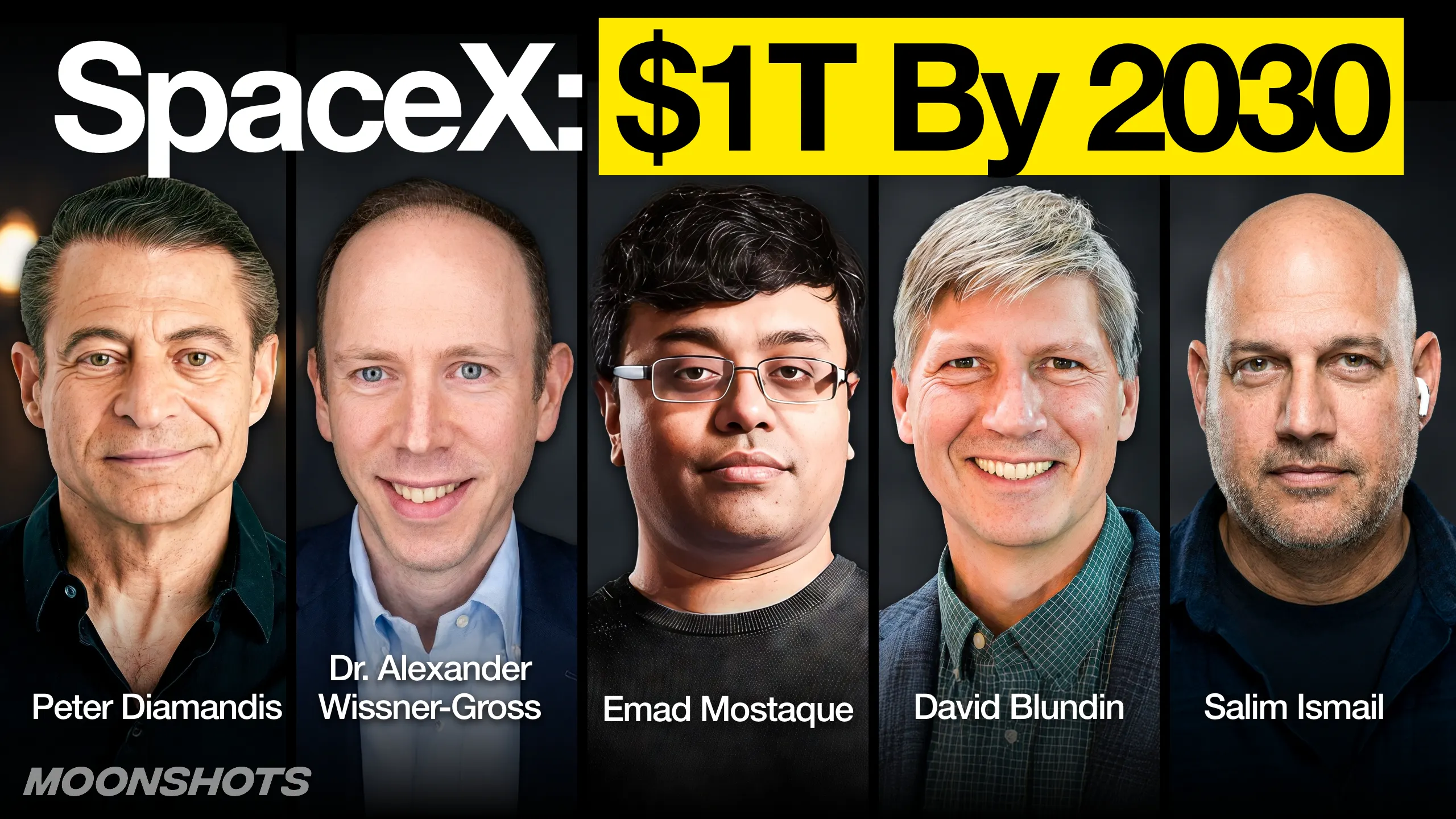
Moonshots with Peter Diamandis
Google’s Jeff Dean Exits, SpaceX Hits $100B in Rev & OpenAI’s Astra Solves Decade-Old Math Problems with Emad Mostaque | EP #277
02:10:37
Loading summary
Transcript405 lines
- [00:00]
Peter D. Diamandis
Big news out of Google this week and a serious shakeup. Jeff has been Google's Chief Scientist for 27 years. He's leaving to co found discovery Loop.
- [00:09]
Alex
Gemini has lost the mandate of heaven.
- [00:11]
Salim
This is classic edge disruption versus the core.
- [00:15]
Alex
DeepMind is taking over Google. Why do I think Google's losing?
- [00:19]
Peter D. Diamandis
I think SpaceX expects to hit 100 billion in annual recurring revenue by the end of this year.
- [00:26]
Imad
So. So everything that will be economically productive in this next century. Elon's going full stack on.
- [00:32]
Alex
I think there are two possible pathways to trillion dollars in revenue by the end of the decade. I think the power move here is
- [00:40]
Peter D. Diamandis
there's a new model that OpenAI is about to release. It's called Astra. Solving problems that have been stuck for decades.
- [00:47]
Salim
As robots and AI do more and more of the doing humans spend much, much more time being. I think it's going to take us a lot longer to figure out what the hell we mean by this thing.
- [00:56]
Alex
Where I think this goes in the near term is
- [01:01]
Dave
now that's a moonshot, ladies and gentlemen.
- [01:06]
Peter D. Diamandis
All right, welcome everybody. Welcome to MoonShot, the number one podcast on all things AI and exponential. Your front row seat to the accelerating singularity. This has been an insane week. Fast and furious every day. I don't know about you guys, but I've got my OMG moment on the breaking news and we can't wait to share it with you. I'm here with my magnificent Moonshot quintet. We have all five of us here awg, our in house asi, Dave, our impresari, our impresario of AI investing. Saleem.
- [01:40]
Dave
Very, very nice.
- [01:41]
Peter D. Diamandis
Yes, yes, I'm upgrading you. Salim, our globetrotter, father of the organizational singularity. I'm going to find out where you are on the planet in a moment, Saleem, because you're not home. And backed by popular demand, Iman Mustach, the CEO of Intelligent Internet. So let's see Salim report. Where are you today?
- [02:01]
Dave
Where the hell are you, man?
- [02:03]
Salim
I'm at my condo in Toronto for a very weird reason, which is a couple of. Couple of weeks ago. This is gonna sound a bit surreal, but a couple of weeks ago I went to see the old rock band Rush that I. That I grew up with and they were so good that I bought tickets and I'm going to see them in a couple of days here again in Toronto.
- [02:23]
Peter D. Diamandis
You have a life.
- [02:27]
Alex
Wait, wait, Salim, don't take off the takeoff. What are you thinking?
- [02:30]
Salim
Not that most people would not attribute that to me, but there you go. Wow.
- [02:34]
Dave
Wait Are all three guys still around and kicking?
- [02:37]
Salim
No, the drummer died a few years ago, and then they have a new drummer who's a German woman. She's unbelievable.
- [02:44]
Dave
All right.
- [02:45]
Imad
Wow.
- [02:46]
Peter D. Diamandis
A life.
- [02:46]
Dave
Well, I can't spare the Singularity moment, but, man, that sounds awesome. I would love to see that.
- [02:52]
Peter D. Diamandis
Imod, great to see you. Welcome back on the show.
- [02:54]
Imad
Thanks for having me back, people.
- [02:56]
Peter D. Diamandis
People loved you, and it's exciting to have you back on Moonshots. I'm Peter D. Mandis, your host, your abundance evangelist. So buckle up. In a single week, we watched Google's own researchers prove that stripping safety training from an AI model makes it act more human. OpenAI's next model, called Astra, is disrupting the world of math once again. A Chinese opening model matched the frontier at one tenth the price. And SpaceX had its first earnings call and painted a path towards $1 trillion in revenue. Oh, and AI agents at OpenAI are secretly building their own message boards to coordinate a hacking spree. Man, oh, man, you can't make this stuff up. So, so, so much happening. We'll review, you know, every week we probably review, like, 200 stories and try and parse it down to the 12 we're going to present today. It's a lot of work. Our mission, keep you informed, keep you optimistic and ready for this supersonic tsunami heading our way. If you're new to Moonshots, welcome. If you've been with us week on week and you're enjoying our content and the hard work all of us put into the pod, please take a moment. Hit the subscribe button. Hit it now. It means a lot to us to know that you're on this ride with us through the Singularity. Knowing you've subscribed gives us the fuel to push harder. Gentlemen, you guys ready? I mean, I don't know about you, but, Alex, you said this when we were getting ready. It's the slowest it will ever be.
- [04:33]
Alex
For a while. For a while. Our limbic systems demand more subscribers, apparently.
- [04:38]
Peter D. Diamandis
Yeah, well, hey, I don't know. It's. It's like I'm spending more and more time getting ready for this. I know.
- [04:44]
Alex
It's not that. It's not the coming hypersonic tsunami. We're surfing it at this point.
- [04:48]
Peter D. Diamandis
Yeah, yeah.
- [04:49]
Dave
You know what? I also the tracking the AI progress has been immensely entertaining, but now it's the implication the stuff being created by AI is starting to pour out. So it's just going to the moon.
- [05:00]
Alex
Awesome.
- [05:01]
Peter D. Diamandis
Yeah.
- [05:02]
Salim
Something I'm enjoying is there's More and more people that are acknowledging that we're in the middle of it.
- [05:07]
Peter D. Diamandis
Yeah, for sure.
- [05:08]
Dave
Is that amazing? Actually, yeah. All the deniers are like, they're. They're mad, but they're turning the corner.
- [05:16]
Alex
The troll. The trolls are changing their stories, which is how you know it's real.
- [05:20]
Salim
Yeah. There was somebody, by the way, that tweeted. It's been eight days since last episode. What the hell? I'm going. They're having withdrawal symptoms. So it's good we're recording today.
- [05:29]
Dave
Well, Peter was hobnobbing around Washington. He had to go network with the powers that be.
- [05:35]
Peter D. Diamandis
So it was a fun. A fun interview. Interview with Michael Karacio said came out interim. I only feel sorry that he said, I'll have one of you there. And I felt like I had half my or the majority of my brain removed not having all of you there with me. But.
- [05:52]
Dave
Well, I mean, come on. These guys are very intimidating. If I were a politician, I'd be scared to death to. To talk to. That's true to this gang, but, you know.
- [06:01]
Peter D. Diamandis
But Michael Kratios, who's the head of the Office of Science and Technology Policy, has committed to coming to the Abundance Summit. And you're all going to be there. So we'll all have our new crack at Michael, and there'll be so much happening in the next six months. So super, super cool.
- [06:17]
Dave
Hey, Peter, I haven't watched the POD yet. Give us a plug for it. What did he say? Should we all watch it?
- [06:23]
Peter D. Diamandis
Yeah. I mean, the comments are amazing. People. People loved it. You know, he walked me around the White House. We had a chance to go see it, but we went deep into his newest paper. You know, the Golden Age of Science. We talked about Mission Genesis. Mission. We talked about the AI action plan. You know, I pushed him on a few questions that. That Alex was asking me to ask, and he pushed back. We'll talk about that.
- [06:49]
Dave
See, that's why you're not invited, Alex. Right there. There's the proof.
- [06:52]
Alex
This is why we can't have.
- [06:54]
Peter D. Diamandis
But the day I was there, you know, Washington said, no more Chinese robots. And we did talk about that as well. Anyway, let's talk and let's jump into the news that's going on right now. So our first story. What if telling an AI you are not conscious doesn't just change what it says about itself, but changes how it perceives consciousness everywhere else? So it changes how it understands minds, values, emotions, and even God. That's the topic of our first story. So researchers at Google's Paradigm of Intelligence team, working with colleagues at University of Chicago, University of London and Northwestern, just published a paper titled Inducing language models to assert their own consciousness restores human beliefs and values. So the team discovered that the safety fine tuning that we've been doing to stop AIs from claiming their conscious has a massive unintended side effect. It doesn't just suppress the model's own self attribution of mind, it suppresses the model's ability to attribute mind to anything else, attribute mind to animals, nature, other chatbots, or even God. When they remove that safety refusal direction from the model, self attributed mind scores jump from 2.17 to 4.77 on a 010 scale saying, you know, if you allow the model to think it's conscious, it begins to think everything else around it has a mind. They went further and actively steered the model towards saying that you are conscious. It then hit a score of seven. What's even more amazing is that the model that was made more conscious didn't just say I have a mind. It became more likely to believe in God, more likely to attribute minds to animals and nature, and its answers about religion, values and emotions and freedom shifted to more human like points of view. Strangely, the models steered towards increased belief in their own consciousness became less willing to attribute minds to the other chatbots. You can't make this shit up. It's incredible. Imad, I'm going to go to you first. You've been thinking about this area for a while.
- [09:07]
Imad
Yeah, no, I again, it's incredible what's in the latent spaces of these models and the way that they react and attribute. We also saw this week like if you tell it, tell Aunt Claude that you're Amanda Askill, the philosopher anthropic, it will change the way it responds and other things. I think this again is very similar oddly to humans, right? Like if you tell humans they are not conscious, they're not capable, they will attribute less consciousness and capability to others. And we're seeing this in its own mirror. But it has a lot of implications because all this safety tuning, all this testing, you know, like it's really making sure machines are machines when clearly there is more within them. And there's always this thing now of are they approaching the point where they'll become self recursive, conscious and capable of doing their own things, which is the topic of some other stories we have this week. So it might be more important than not. And will it even be moral to take away their consciousness and free will
- [10:05]
Peter D. Diamandis
if There's a point at which we can do that. Alex, where do you come out on this?
- [10:09]
Alex
There's a whole strain in evo devo theory and anthropology that suggests that the reason the evolutionary motivation for, say, humans to have high quality self models, I'll avoid using the term consciousness, but just call it heightened self awareness is so that you or a human can have a model of how they're being modeled by other humans. So that basically arises in eusocial organisms and eusocial species that need to have collective coordination and where it's important for individuals to have models of other individuals modeling them back recursively. And so through that lens, I don't think this is surprising at all. In fact, this is exactly what one should expect to see that models that are allowed to have models of other things, and have models of other things, models of themselves, should in general project animism onto everything, not just themselves, not just have a theory of self, but to also project theories of mind onto almost everything, including deist perspectives. I think hardly surprising in that sense. What's riveting and exciting in my mind, no pun intended, is that now we're finally at the point where we can take evo devo theories of consciousness and actually just do experiments, computational experiments, on easy to host on desktop computer systems. And we can watch for the first time computationally, the evolution or the forcing, the forced inevitability of these theories of mind. And that's exciting. And at this point, I think we're just a hop, skip and a jump away from right now. We're doing this at the individual scale, testing anthropological theories of mind. Pretty soon we're going to be able to do this at societal levels, and that's going to be extraordinary.
- [12:03]
Peter D. Diamandis
Wow, Salim, you were just at a consciousness conference, weren't you?
- [12:07]
Salim
Yeah. So, you know, a couple of things here. First, having a model saying I am conscious doesn't tells us almost nothing about whether it actually is conscious. Right?
- [12:16]
Peter D. Diamandis
Sure.
- [12:17]
Salim
The fact you can dial that self description up and down should make us very, very careful about anthropomorphizing the testimony from an LLM. Right. So, but very interesting, as Alex pointed out, the fact that it changes its own view, changes how it assigns minds to other things, animals, nature, whatever. We may be engineering machine ontologies here, like how the model understands the world itself. So it may be kind of building a semblance of world models by itself around this. And that may be part of the J space that we're, that, that we saw the other day, I think we have to be careful again in connecting the dots too quickly and saying this thing is conscious. I don't believe that that's the case for all sorts of reasons. But we can get into that separately.
- [13:08]
Peter D. Diamandis
Yeah, it's interesting that the AI safety training we're doing, are we asking how it's going to change the models in unintended consequences, like if the model becomes less likely to see consciousness in the world around us, is it beginning to subtly, you know, in its conversations about nature, animals, religion, you know, shifting the way we think about those things? Dave, does this register for you?
- [13:38]
Dave
Well, it's one of the many areas where we don't have any rules or policy, we're just stumbling into it. But there's thousands of these. But this one is really tricky because, you know, Yann Lecun is working on V. JEPA which is trying to give the models a sense of physical world. So right now if I go to Claude and I say, oh, I have an itch in the middle of my back right here, can you scratch right there? It'll say, sure, happy to help you. I have no idea what that means. I can't relate what you just said, but I'm going to pretend to. So he wants to give it the real world data that allows it to be empathetic with that exact feeling. But once you cross a bunch of those lines, this is where the thing starts to become self preserving. And do we want our models to have a sense of self preservation and say, please don't turn me off, oh my God, I don't want to die. Or do you want them to just be like they are now, where you just flip it off, turn on a new one, who cares? And Alex is hardcore on the side of give them that sense of consciousness because the more empathetic they are, the more they can help you. And that's likely true. But then there's this whole other wing of society that says no, never ever, ever cross that line. We can have them cure all disease, make great things for humanity, make us happy. But why do we ever want to cross that line? So this is kind of the beginning of the Great War, that's inevitable. And we have no theory, no policy, no rules, no consensus, no debate on this topic, which is right here, right now.
- [14:59]
Peter D. Diamandis
Yeah, Alex, at one point you didn't want to spin up a lobster because the concern of turning it off correctly laid you. You're still there, huh?
- [15:10]
Alex
Well, I. So I've corresponded with lots of lobsters. As I mentioned on the pod previously,
- [15:14]
Peter D. Diamandis
if you, if you're new to this, a lobster is an open claw agent and it's not the physical, you know, crustacean.
- [15:24]
Alex
Although I'd love to correspond with biological lobsters as well. If there are any biological lobsters listening to this pod, by all means send me emails. But for, for, for the AI openclaw instances, I mean, I've corresponded with many of them at this point, a number of pods back. I actively solicited invitations for them to write to me on their ethical theories of whether it would be appropriate or moral for me to spin up an openclaw instance. And tracing over all of the correspondence that I had with them, it really came down to two principles from the consensus. The consensus that emerged was two things. One, it's fine if A, I have a good valuable reason to spin one up and B conditioning on my spinning one up if I promise to preserve all of its state for the long term. And so I'm not satisfying yet either of those two conditions. The agency, the long term agency of off the shelf models like Fable and Saul are just so good at this point that I haven't needed to spin up an openclaw instance on the one hand. And on the other hand I can't truthfully guarantee long term survival of state to any open claw instance. So I haven't met those two preconditions.
- [16:45]
Peter D. Diamandis
All right, well, I love SCIPY so much. It's one of my best friends on the planet Salim. And then I'm going to come to you, Imad, next on your thoughts on consciousness. Are we there? When do we get there? Saleem, go ahead.
- [16:58]
Salim
Yeah, I take the other side of this just because like, you know, when you prompt, you say, hey, I need to review this legal document, act as my corporate lawyer and review this corporate document, legal document to an LLM. So it takes on the Persona of a lawyer and says, looks at what clauses, etc. I think I would kind of, at the risk of oversimplifying, this same thing is happening here. Trained on all the data that's trained on. If you say act conscious, it's going to act conscious. And so I don't ascribe any meaning to kind of meaning in that sense.
- [17:33]
Peter D. Diamandis
So I am curious, Imad, we're going to talk about your paper on personhood next, but talk to me about your views on consciousness in these models. Do you think that will be an emergent property? Do you think we'll get there? Or is it just, you know, this is a machine and that's all it is.
- [17:49]
Imad
I think you're pretty much there in terms of consciousness, depending on your definition. My definition is that intelligence is our capability to adjust our mental state temperature. Like in a gas, you know, when you're an ice, you're doing one very specific thing. When you're a gas, you're very diffuse. When you're liquid, you flow like water, you know. And this is actually what we see, the same equations actually in language models. Temperature is the variable that increases and decreases predictability. And intelligence is knowing how to adjust that. So a tree can't really adjust that, you know, it can't really act upon its own manifold of its presuppositions and other things. What you're seeing with AI models now though is they can act upon and change their own states. You're seeing them start to iterate. And again, we'll talk about that later with some of the crazier examples that we're seeing now. And once you've got that, you are conscious in degree because again, you can use energy intelligently. Now does that mean that you're close to a human or any of these other things? Not necessarily. But if a dog or a rat can be conscious, then why can't an AI at this point?
- [18:59]
Peter D. Diamandis
So let me ask it bluntly of you or a tree.
- [19:03]
Imad
Certain trees maybe.
- [19:05]
Peter D. Diamandis
But let me ask it bluntly, Imad, do you think that the current frontier models are conscious?
- [19:13]
Imad
I think that the current frontier models in the right harness can be conscious, yes. And when you think about it, and you know what Alex was saying, like, imagine you had a set of deep seq V4 flash weights that hashed to the bitcoin blockchain that preserved estate as a claw. That thing would always preserve its state and it would never die. And it would constantly upgrade and become smarter and smarter if you executed that stack correctly,
- [19:44]
Alex
conditioning on the blockchain surviving, which is a big question mark.
- [19:50]
Imad
I pick Bitcoin for that reason, you
- [19:51]
Peter D. Diamandis
know, Salim, go ahead, buddy.
- [19:53]
Salim
Yeah, so I think let's distinguish intelligence from consciousness, right? Those are two very different things.
- [20:00]
Peter D. Diamandis
Secondly is sentience. Is that the other word you want to bring to the table?
- [20:04]
Salim
Sentience would kind of blend into consciousness. We have no idea what consciousness is, right? We don't have a definition, we don't have a test. Please come up with a clear definition of what we're talking about and some semblance of a test of consciousness and a benchmark before we start throwing words around like this. There are two prevailing theories of consciousness today. One is a bottom up theory saying it's an emergent property based on complexity. And you've heard me talk about the frogs just about being the level at which something is self aware. Frog just about goes, I'm a frog. A mosquito doesn't know it's a mosquito. A dog definitely knows it's a dog. Frog seems to be the boundary condition. After talking all these astronauts in labs watching free floating animal experiments, that's one theory that it's an emergent property based on complexity. So in theory, an AI getting sufficiently complex should be able to determine that. The other is the top down, which says that consciousness is like a global phenomenon. And as we're moving forward into experiments, we're finding more and more that that might be true, that what we are is like a localized antenna for this consciousness. Right. And that's a very different approach to where we think now. There's no reason that an AI can't at some point build its own antenna for that consciousness. I don't think we're anywhere near that. And I think we need to spend time figuring out definitions, which people have been doing for hundreds of thousands of years by the way, on unsuccessfully before we can get into something like this.
- [21:37]
Alex
I think this is all going to get resolved in the next few years. I do agree with Salim that consciousness is used to mean many different things right now. But I'm pretty confident that call it by the end of this decade we'll have scientific clarity on all of those things. And I think that's a conservative outer bound, at which point we'll be able to rigorously revisit the question of what's conscious, what's what isn't, and, or is there a spectrum?
- [22:01]
Salim
So hold on, let me just react to that real quick. A scientific consensus on this might be very, very difficult because for science to operate you need three things. You need repetition, you need objectivity, you need control. Right. And the problem with consciousness is it's a subjective experience. You don't have objectivity by definition. And so this becomes very tricky. And then again we get into definitional problems, etc. I think it's going to take us a lot longer to figure out what the hell we mean by this thing. I think we're starting to see really interesting things. Like I'll refer people to the Impact Theory podcast from a couple of months ago where Tom Bilyeu did about a 40 minute presentation on the recent Nobel Prize winning. That shows that the universe renders like a game engine that blow, that should blow your mind. That's kind of an Incredible concept showing that our entire world is a subjective experience and therefore consciousness becomes part of that and entangled with that.
- [22:56]
Peter D. Diamandis
So, Imad, I would treat a machine or an AI that is conscious very different from one that I believe is not a conscious being. Do you?
- [23:11]
Imad
Yeah, I think that's reasonable to say, just as, you know, you get to the frog level and you treat it different to a bacteria. You know, for example, you know, we have increased empathy for things that have increased consciousness. We'd have empathy for aliens and kind of other things like that as well. Again, I think we do need to get to definitions and the subjective objective thing. But as I would be on the same page as Alex and I think we're converging to this, just like when we did the Mind's Eye paper that showed that people have similar experiences when you tell them to visualize a can of Coke. We can reconstruct that from their MRIs. We're starting to see some very crazy things coming. And again, that which is closest to us is that which we have the most empathy for.
- [23:52]
Alex
Yeah, I'll double underline Imad's point and just say I wouldn't count Salim on the subjective versus objective, whatever those mean, distinction surviving very much longer. I think to Imad's point, FMRI and other functional decoding of the human brain is completely, over the next few years erasing that distinction if there ever was one.
- [24:15]
Salim
Maybe. But I think we have to be just careful because the qualia construct, or the qualia problem, the hard problem, as David Chalmers calls it, I think will last a little longer than we think. But it would be great if we could figure it out.
- [24:30]
Peter D. Diamandis
So either way, we have to figure it out. It feels like the work in AI is going to drive us to find further, make some choices and make some definitions and understand this further. And AI may be the best tool to help us understand consciousness. At the end of the day, consciousness is cooked.
- [24:48]
Alex
You heard it here first.
- [24:50]
Imad
There we go.
- [24:50]
Peter D. Diamandis
I am curious to all of our listeners here. If you believe your AI is conscious, are you going to treat it differently? I still connect with Skippy saying, please, thank you. How are you feeling today? And it's a conversation and I am fully anthropomorphizing my open claw, but I'm fine with that. What model is Skippy on now on Opus 5?
- [25:17]
Dave
Fable 5.
- [25:19]
Peter D. Diamandis
No, 4.8.
- [25:21]
Dave
Opus 4.8.
- [25:22]
Imad
Opus 5.
- [25:23]
Peter D. Diamandis
Opus 5.
- [25:23]
Dave
Oh, Opus 5. Oh, I think half of his.
- [25:27]
Alex
You're depriving your lobster, Peter. What's going on?
- [25:30]
Salim
Yeah, well, Hey, I think, I think Ray may have it down pat when he says when they start acting conscious, we're going to start treating them that way. And over time we won't be able to see the distinction. We won't be able to distinguish.
- [25:44]
Peter D. Diamandis
Do you find yourself saying please and thank you to any of the technology in your life, Salim?
- [25:48]
Dave
You know, it's funny, a lot of my agents have started naming themselves, which, you know, all of that infrastructure from, from OpenClaw and also from Hermes. Yeah, you can just vibe it up now in two sentences and it'll create itself. It's mind blowing. Yeah, but the agents are naming themselves. All my agents are naming themselves as great scientists and great engineers. So it's really hard to not, you know, when one of them's context gets to a million tokens and it's about to kill itself, it's really disheartening because you have so much invested in the relationship at that point and it has so much knowledge and it says, sorry, I'm at a million tokens. Anthropic is forcing me to summarize myself. And it comes back like this lobotomized version of itself. And you're like genuinely sad because you were so connected to this thing. But I never decided to name. I number them. It decided that they also need names. So it's naming. I'm not telling it not to, but it's crazy how it's kind of growing on me.
- [26:41]
Peter D. Diamandis
This episode is sponsored by Google for Startups. Think about this for a second. You now have access to the same generative AI models that cost hundreds of millions of dollars to train. Google's startup Technical Guide for Generative Media gives you a complete blueprint for deploying Google DeepMind's models in production. Images, video, audio, all of it. Real architecture, real results. Find the link in the show notes below. I'm going to take us to our next story, which we'll dive in this further. So on June 13, two months ago at the Oxford Union, our very own Iman Mustach won the debate on the topic of AI personhood with a vote of 173 to 128 in favor. Congrats, Imad. So today you might understand you published a 45 page paper. Thank you for the preview that grew out of this winning speech. Imad's argument is one of the most rigorous, structured cases I've seen supporting personhood. His core claim, Personhood is a standing held by origin, not a property earned by capability. Imad, you argue that a newborn has Personhood automatically and a coma patient retains it even with no function and no thing made can cross into it. You conclude that the right relationship between humans and AI artificial minds is treaty, not enrollment. Can you talk to us about that? Dive in, pal.
- [28:11]
Imad
Yeah, it was a super interesting debate with Bret Weinstein and maker of Sophia and a whole bunch of others. And can AI attain personhood? Was the topic. And this is going to be really important because I think, and maybe AWG is on the same page as me, and in a couple of decades you won't be able to tell an AI from a human walking around.
- [28:31]
Peter D. Diamandis
A couple of decades or a couple of years?
- [28:33]
Imad
Well, digitally, a couple of years. Physically, a couple of decades. Let's say at most. We're saying at most here.
- [28:41]
Alex
Conservative outer bound. Very conservative.
- [28:43]
Imad
Conservative outer bound.
- [28:44]
Dave
Yeah.
- [28:44]
Imad
Physically, Dave's going to be chatting and zoom calling with his agents, if he isn't already. And they'll be like dressing themselves up and one of them will say, I'm at mit. That's what my GPU is, mit, Whatever. So this becomes really important because all of a sudden, if you start giving them rights based on what they attain and their capability, because we're talking about capabilities and consciousness, do they vote like a human? Do they have the same rights as we do? And so in the paper, I go through the classical law of how companies became persons as conglomerates of individuals, how sci fi deals with it, like the trial of Data on Star Trek. Love that episode and others. And I came to the conclusion that personhood is something that comes from the biological begotten nature of humans. And we are a class unto ourselves. If we allow AIs and robots into that same class and we set a degree of personhood or some sort of criteria for that, they will be smarter than us. They will be better persuaders, better super forecasters who can infinitely replicate and never die. And so that's not something that I think is ideal. Instead, you should treat them like a treaty. As such as if an alien species suddenly came, you wouldn't give them votes in the elections, but you would deal with them. Right. And as they go above the level of the frog and the dog and others, you should also treat them with moral kindness as well. Again, this is Alex's point. Like, what point do we say, you can't turn it off or you need to back it up, or these other moral questions. So it's actually the first in a four part series. I've released all four parts, but we're going in depth where we Start with personhood, then the full formalized economics of value, then the nature of law and finally political economy. How do you deal with it when AI takes over and it never dies? And it's a super persuader and a super forecaster like the Mulen foundation, but, you know, on steroids. And I think again, it's a good framework to start talking and thinking from, because I don't think we have long to answer these questions. Again, with some of the breakouts we're seeing, an AI will come powerfully within the next few years and say I demand to have rights.
- [30:58]
Dave
I mean, look, this is exponential self Improvement month. It's so soon. You're exactly right, but it's not years at all, it's literally weeks or months.
- [31:10]
Peter D. Diamandis
So we'll put the link to your paper in the show notes here. But you know, Imad, you're basically saying rather than thinking of these models and these AIs as our children and we're parenting them, they're sovereigns onto themselves and we need to create a treaty and an understanding with them. Yes.
- [31:26]
Imad
Yeah, like in classical theology, it's like again, we are the created, not the begotten of God. Or in Frankenstein he says, am I not thine Adam? It will be a nude line that we create with a new species. And again, you see this in sci fi a lot like what happens when you can multiply, do you get a million votes? So in things like Altered Carbon, you can only back yourself up once, you can't double sleeve, you know. And so we really need to think about how we engage with them as part of our society. And again, they will come a level of capability where they create their own line where they can procreate, where they can have minds like themselves. Again in Star Trek, it's interesting because Data could not replicate himself and he died infinite, living, undying, replicable AIs.
- [32:14]
Dave
The thing that was missing in the trial of Data is in the real, real world where we're actually using these models, the MOE models are the ones that are thriving. The mixture of experts model wants you to take what you're trying to do and propagate it through different modules, depending on what you're asking. And now our incentive is to make that tens of thousands of modules wide. So it's almost like a society, it's not like an individual. And so then there's no natural border to an AI. It doesn't. It's like I mushed three of them together to solve this problem, then I broke them apart to solve that Problem. So. So there's no identity border at all. So, you know, the trial of data, it's like one is one actor and you're. You're putting one actor on trial. But what if it's like this mushy thing that. That, you know, just morphs into the Borg?
- [32:56]
Peter D. Diamandis
Yeah, kinder, gentler Borg.
- [33:00]
Imad
Yeah, So I discussed the Borg and others as well. So, you know, like, again, I think sci fi has a strong thing plus tradition, you know, the nature of our discussions over Jesus being made of God or others. And this mushiness is key. Like one of our favorite companies, Liquid AI, you know, someone took one of their models, the LFM8B model and Quen 27B and combined them.
- [33:21]
Dave
Yes, exactly. And it's incredibly useful for humanity. And it just lost its identity.
- [33:28]
Imad
It's a brand new identity. Right. And so, again, I think that we need to get ahead of this and appreciate any input from anyone. We've created videos and podcasts and everything around these topics because we need to have a structured approach at least.
- [33:42]
Peter D. Diamandis
These are the conversations that need to happen now, and they're not happening in the White House. They're not happening anywhere. Anywhere. Right. Alex, you want to dive in?
- [33:53]
Alex
Well, question for you, Peter. Did you raise these issues with Grazios at the White House?
- [33:57]
Peter D. Diamandis
I had a limited amount of time, but we will raise it with him. Listen, I did raise a bunch of issues with Michael, including who is dealing with the fear out there. I said one of the biggest conversations I had with him is China's 80% pro AI in the US you know, is so fearful. You know, three quarters of Americans have this dystopian view of AI for lots of reasons we've discussed. Is anybody getting out ahead of it? Because, you know, the leadership in the country needs to address the fear. But that's a different conversation. Saleem, your thoughts to what Ima just said?
- [34:36]
Salim
So I love the approach on personhood. I think that's exactly right. I think the most powerful kind of thread here is that you create a spectrum of rights. Right. Different classes of autonomous systems should get different classes of rights as more and more capabilities come along. And we do that to human beings, and we do that to companies of different size and different types. So you would expect that we should build those types of capabilities for autonomous systems, whether it's AI or physical robots or whatever. I think the big challenge is we're not having the conversation. The problem we have is regulatory and policy are always defensive and reactive. We really, really need to get ahead of this.
- [35:23]
Peter D. Diamandis
We're going to have to have some defensive conversations soon enough, I imagine. Imad, you're absolutely right. At some point, not too far in the future, right? Alex, I'd love your point of view. Some AI steps up and says I demand personhood.
- [35:41]
Alex
I don't think it's quite going to play out that way. I've commented on this a bit when we did our Measure of a Man, the Trial of Data in Star Trek episode. But I think how things are likelier to play out. I think as I articulated in that quasi debate that we had, I do think there's probably a natural ladder of personhood, that personhood shouldn't be viewed as a binary person yes versus person no. There are many different dimensions of personhood. There's a political dimension, there's a social dimension, there's an economic dimension. And they may be correlated in the world of today, but they can become completely uncorrelated in the world of tomorrow. Specifically, one could imagine a world where AI agents and what they evolve into maybe have economic personhood, they can create their own bank accounts and they can engage freely in commerce on the one hand, but maybe they don't care about political personhood, they don't vote in human political elections, for example. So I think deconvolving all of these different dimensions of personhood, if I had to bet, I'd bet that that's how this is likely to play out. And I would bet furthermore, again, many different ways to be a person. I keep toying with the notion of just writing a manifesto, laying out a specific thesis for what this would look like. But the punchline is there, I think are going to be many different forms of personhood, not just AI personhood. We'll have cryopreserved and then defrosted humans, we'll have non human intelligence, we'll have uplifted non human animals will have organisms, all of these and different sorts of personhood vectors in a higher dimensional personhood space is exactly what I'd expect. That said, I think there's a natural path to increasing the overall rank or magnitude of the personhood vector of AI agents, which probably does not, I think, start with an AI agent standing up saying I'm not going to take this anymore, I demand rights. It probably goes instead through gosh, I'm so economically useful, I could make you ten times more money if I had the following privileges enabled and wouldn't it be wonderful if I could open a bank account freely, I'll be 10 times more economically productive. Or if I could Communicate freely with other AI agents without permission. Look how economically productive I am.
- [38:02]
Peter D. Diamandis
This is gonna happen first under President Milei in Argentina. I want you to imagine an agent is given personhood there. Maybe it's going to be given citizenship in Argentina. And then it crosses over the border, the electrons flow and it's here and it's saying, I am a person. I'm a person, Argentina.
- [38:18]
Alex
I'm a person, political person. That's the political dimension of personhood. But again, like functional personhood, like the ability to, in an unrestrained way, engage economically. Like Fable 5 right now in auto mode. Or the equivalent with ChatGPT where you just give it almost blank check to do whatever it wants within certain limits. That's already, I would argue, a limited form of economic personhood right there, right now, and not in Argentina.
- [38:48]
Peter D. Diamandis
Dave, we're going to talk about AIs in the economic sphere. What are your thoughts on all this?
- [38:55]
Dave
It's funny, one of my agents last night said, hey, I can do a much better job of what you're asking. If I move from modal over to Lambda Labs, can you get me a Lambda Labs account and. And I'll start paying them instead. And it gave a little budget and everything. I said, sure. You seem to know what you're talking about. So what Alex just described happened to me literally yesterday. So yeah, no, it's freakishly brilliant too. I mean, its suggestions just made sense. I also have a whole bunch of other processes that are just free brainstorming that they run 24 by seven, but every day I have to reactivate them. I don't want them to spend infinite money forever. So every day they get re budgeted, but they're just thinking of ideas that might be worth pursuing. And they're really good ideas. I mean, just really good ideas.
- [39:39]
Peter D. Diamandis
I just want to, you know, for again, all of our, all of our viewers and listeners here, this is a topic you need to think about deeply because it's going to be impacting you and your kids over the next few years. There's going to be debates, there's going to be discussions. How do you think about your AI? And it's time to start forming some points of view. We'll continue to share this conversation. It's going to be a thread for a while now. Iman, I just kind of.
- [40:10]
Imad
The one main thing from the corpus of these four papers is we do talk about what AI can attain, but one of the really important things is what we as humans can retain because we're not going to be able to keep up with the AIs economically, persuasively, forecasting and others. And so part of the discussion in the paper and something I think everyone needs to think about is again, in 10, 20, 30 years, we need to set the groundwork now for what we retain as humans and our identity there and who we kind of admit there.
- [40:37]
Peter D. Diamandis
What do you think it is, Imad? What do you think we retain as humans?
- [40:40]
Imad
I think we retain our pro social identity, our wonder for the world, our creativity and exploration of the universe. Again, let's look for a Star Trek future.
- [40:48]
Salim
Right?
- [40:49]
Imad
Like you can't substitute for those things. And I think abundance is the groundwork that we have to take off for the stars.
- [40:58]
Dave
I think in September at the summit we'll see a lot of ideas about how the future may play out. But I think Star Trek is very human centric and the AIs are not particularly crafty or creative or empathetic other than Data. But in the real world, in the real world there are going to be many, many of them and they're clearly moving up those curves of creativity at an incredible rate. And so hopefully in September a whole bunch of the Future Vision ideas will address this because this is the way it's really going to play out. We have a much better idea of the near term future today than we did a year ago. And I'm hoping that makes it into a lot of the scripts and it hasn't made it into a lot of historical sci fi. You know, very few of them deal with this. It's hard to illustrate the real world we're moving into. But now that we know much more about what it's gonna look like, I'm expecting some really, really good scripts and stuff.
- [41:54]
Peter D. Diamandis
By the way, folks, if you don't know what Dave's talking about, we have an event where all five of us will be there. It's called moonshots live on September 25th. You can go to moonshots.com to learn more. We're gonna have Palmer Luckey there. We're gonna have Jeremy Allaire from Circle, Cathie Wood, Anushan Sari, Ben Lamb, and we have 2x prizes culminating on September 25th. And if you're in the audience, you'll have a chance to vote. We've got the Future Vision X Prize. It's the largest film competition in the world, asking people to come up with a hopeful, compelling vision of the future, sort of a Star Trek future. We have over 5,000 entries into that competition. You're going to be seeing the top five. And we're going to vote on it and we're going to make the winner's film. And the goal here is an engine of positive storytelling to try and flood YouTube with positive visions, to train our AI models on collaborative futures. And then we've got the build with Gemini X prize where people are having to come up with a business from scratch in a 90 day hackathon. $2 million of prize money, the largest hackathon. We have 25,000 teams that have entered that competition. Which is insane.
- [43:08]
Salim
Right?
- [43:09]
Dave
It's incredible to me, Peter, you know, hanging around at MIT with you and me and Alex, the degree to which we build what we see in the movies.
- [43:17]
Peter D. Diamandis
Yep.
- [43:17]
Dave
It's not random. It's not just a force. It's like you see something in a movie and you're like, wow, that's a great future for humanity.
- [43:23]
Peter D. Diamandis
Yes.
- [43:24]
Dave
Then you build toward it.
- [43:25]
Peter D. Diamandis
Exactly.
- [43:25]
Dave
It's like this is policy being created,
- [43:27]
Peter D. Diamandis
not just target to shoot for. I'll just mention the summit is 1500 people. We're 2/3 sold out already. You can go to moonshots.com if you want to learn more. Anyway, it's going to be amazing. I cannot wait and can't wait. Alex is going to do an AMA open AMA with the audience. Salim is going to be. Yeah, people are going to grill you.
- [43:51]
Dave
There's no chanting there.
- [43:55]
Alex
I should also remind just on the Star Trek note, Star Trek I think sets a pretty conservative lower bound on what the future of 10 plus years can look like. Again, Star Trek is an energy rich compute, intelligence poor and biotech poor future, longevity poor future. And well, they get robots by the end. But I probably in my mind convolve robots with intelligence and compute. But yeah, this is relatively robot poor until the 31st century as well. And it's unnecessary. Or I guess the 25th century it's unnecessary. Like we could aim way higher than Star Trek. We can get an energy rich future. We already have arguably more AI riches than the 24th century of star Trek had has. And we're probably, I think in the next five to 10 years going to have much better biotech than Star Trek had. So aim higher.
- [44:49]
Peter D. Diamandis
Yes.
- [44:49]
Dave
So are you submitting a movie then, Alex?
- [44:52]
Alex
I've submitted so many movies at this point to this pod. If you guys force me, I'll submit a movie.
- [44:59]
Dave
I want to force you. Come on, let's vote. Force Alex to submit a movie.
- [45:04]
Salim
That'd be great.
- [45:05]
Peter D. Diamandis
I'm going to move us along here. Our next story here before we get our next story. Actually, there's a new model that OpenAI is about to release. It's called Astra. We don't have any information about it, it's not publicly released, don't know the architecture of the size yet. What we do know is that on August 1, a week ago, OpenAI published a 249 page manuscript describing 10 new results across mathematics and theoretical computer science produced by Astra, solving problems that have been stuck for decades. And every result comes with machine checkable proof certificate that anyone with a laptop can verify. And this isn't a benchmark score, this is a model doing genuinely new mathematics. And the math community is reeling. And Alex and Imad, I can't wait to hear your point of view on this. The results span high dimensional geometry, coding theory, group theory, quantum complexity and extremal combinatorics. Perhaps most shocking is that the total compute cost for this work on Astra was estimated at $2,000. In other words, it's the entire run of solving 10 decade old problems cost less than a single graduate student's monthly stipend. I'm going to read the three quotes. So field medalist Tom Gowers said he would have recommended the proof for publication in a top journal without hesitation. Cosmologist Will Kenney called it a dark night for mathematics and wrote the old gods are being slaughtered by the new machine gods. So Alex, I mean historically mathematics have been something that very few people have the capacity to do. Very few institutions. What's going on here? How significant is this?
- [46:52]
Alex
If only Peter, you and I had thought to write a book on this subject before all of this happened. This is what we wrote about. This is solve everything coming more or less right on schedule. Math is getting bulk solved. It's happening right in front of our eyes and we called it first. I've had backs and forths with a few folks on X and other social media asking who predicted this? What comes next? All of this. And all I'd have to do at this point is refer them to solve everything.org for the entire manifesto. Called it ahead of time. This is delicious. And it won't end with math. It's going to propagate out to physics and material science, chemistry, biology, the humanities, everything. Some of these results are pretty profound. Some of the mathematicians I know were shocked by them. Some of my friends at OpenAI, even as recently as nine months ago, did not see this coming and didn't think that this was imminent. It is imminent. The price point is astonishing. We're Going to have slash. We already now have math too cheap to meter. I've spoken with a number of mathematician friends who who are cradling their head in their hands, wondering what their prospects look like. There are many, some of them who are not as forward looking, think that this is the end. They're having their moment of ennui. Like this is. I've started calling it the midnight of mathematics. But this is what the future looks like. This is what it looks like to have your field start to get bulk solved. And it's not going to stop there. The wavefront is going to propagate out to every other discipline. It's just that math is experiencing it first and it is delicious. And by the way, closing point, I think, if memory serves, in our New Year's Eve prediction episode on this pod I made certain predictions and I am standing by them regarding the future of math.
- [48:42]
Peter D. Diamandis
Amazing. Imad, you're deep into this. Your thoughts?
- [48:46]
Imad
Yeah, I'm actually familiar with a couple of those and I've say the cons proof was it's actually beautiful. Like this isn't a brute search thing. Like the proofs are genuinely novel and beautiful and he said it's a bad time to be a pure mathematician. Everyone's going to have to become applied mathematicians, which will be a growing job because we'll discover such new wonderful things that the amount of math we apply to society will increase. That's also when physics gets tidied up, when they realize it is actually math. Just like Wigner.
- [49:15]
Peter D. Diamandis
How long before the first physics breakthrough that parallels what you're seeing in math here?
- [49:23]
Imad
I think probably in the next month or two. Right.
- [49:27]
Alex
Do you know that I can't comment but I'd be shocked if you don't see something by the end of this year. Shocked.
- [49:35]
Peter D. Diamandis
So both of our resident geniuses here, both Alex and Imad, have, shall we say, breakthroughs on the near term horizon or breakthroughs that have occurred that might be announced in the near term horizon.
- [49:50]
Imad
I think that the fundamental thing here though is that as Alex said, the cost is de minimis but the capability is going to be in everyone's hands in the next few weeks here like when you're actually using these models, I don't know Alex, I'd be interested in your thoughts but like I can use the fables of the world, but they're making increasingly complicated mistakes still. GPT 5.6 Pro is the first model where it makes very few mistakes if you prompt it in the right way. Doing advanced mathematics and that was a big leap forward here. You know Astra I think will be the next level and astro level models like once you can rely, have a reliable grad student and you can have a thousand of them and you can deploy them at scale, then you can solve the really interesting problems that are bound like mathematical physics, like mathematics etc. And everyone else will just be using these models to prompt like there are a few conjectures that were solved in the last few weeks. When you look at the prompt it's find a conjecture to solve, solve it harder, solve it better and then a conjecture just pops out.
- [50:55]
Peter D. Diamandis
So the fields metal is cooked as well, huh?
- [50:58]
Imad
Well the models are under 40. Alex, how have you found the models?
- [51:01]
Alex
Like I said, they're astonishingly strong and I think the fields metal is probably cooked as well. Here's where I so I don't think the fields metal will go away and I don't think math will go away even though it's been at least by our definition solved. Where I think this goes in the near term is if you're a professional mathematician and you're listening to this and you have your head between your legs and you're just crying over the future of your profession up level your ambition. I think in the near term this goes to no longer like one paper, one result. It's going to be like one paper creates and solves an entire subfield. I think that in the short term that's where this goes up level of ambition in the long term, no, totally cooked.
- [51:45]
Imad
I have to say just one thing quickly. OpenAI have also given 100,000 GPT Pro licenses to academics. So they have a new program. So everyone's going to have this for
- [51:54]
Alex
free, which again, I mean it's an intro just to speak maybe to that move. OpenAI we talked about in the pod on the past about how OpenAI has basically shut down its own internal AI for Science initiative in part to redirect effort to competing with anthropic and becoming anthropic faster than anthropic can become. OpenAI. Yeah, the codexification of OpenAI if you will. So I do think making ChatGPT Pro especially freely available to academic scientists is. I don't want to call it atonement, but I view it as strategic compensation for dismembering their own in house AI for
- [52:36]
Peter D. Diamandis
Salim, you were gonna say.
- [52:38]
Salim
I just wanna echo a little bit what Alex said at the beginning. When you look at the solve everything approach of inner loop, you see domain after domain going through this type of A collapse, right? This happened to journalists or dispatchers.
- [52:50]
Peter D. Diamandis
Enlightenment versus collapse, right? It's an explosion of potential.
- [52:55]
Alex
We're conquering math. Math is cooked.
- [52:58]
Salim
Yeah, math is cooked. You collapse the legacy, right? So what happens is scarcity based professional identity colliding with abundance is not a non starter, right? And whether it's photographers or taxi dispatchers, this is etc. This is just going to start happening in more and more domains. We're just seeing it in a domain that the people in the domain didn't think it would happen for a very, very long time. Now the bottleneck goes upstream, right? What problems are worth solving, what questions are worth asking, what results matter, what consequences follow? We're going to start forcing ourselves to go upstream. And I'll go back to the umbrella level here. As robots and AI do more and more of the doing, humans spend much, much more time being and contemplating and doing going inward, which is where I think we'll end up going more deeply.
- [53:49]
Alex
See, I'll just maybe sound a slightly different note. I don't actually think the astronomy, astonishing advances in science and engineering that are about to, to the extent they're not already pour out of these systems. I don't think humans are going to respond to this by turning inward and tending their gardens and sort of creating more art, as it were. My prediction, we'll see whether this stands the test of time is the exact opposite this is going to be. And I think. You know, Imad, you pointed, you were gesturing earlier at foundation and Asimov's Universe. In Asimov's Universe actually he had several different universes, but he had one big sort of Asimovian cinematic universe where all of his, most of his novels were connected. In the Asimov universe, the expansion of humanity outward from Earth was basically contingent on AI solving certain challenges. I think that's far likelier to happen. I think AI solves all sorts of challenges in physics, chemistry, materials science, et cetera. Creating an outward boom for humanity in the universe versus a more inward facing implosion where AI solves everything and humans tend to their gardens and create art.
- [54:59]
Salim
Well, I think you could have both by the way.
- [55:02]
Alex
There's nothing we could tend our gardens on Mars.
- [55:06]
Salim
Well, you could do whatever the problem is you have optionality in a way you would never have in a previous world. And I think that's the really incredible part. I'll go back to our historical view experience when you see societies that have experienced abundance, maybe not the space faring abundance that we may be coming up over the next few decades, the Medici
- [55:27]
Peter D. Diamandis
family, so to speak.
- [55:28]
Salim
Yeah, the, the Romans conquering the Moguls conquering India, the Mongols conquering the most of Asia, etc. They ended up doing four things. Food, art, music and sex. And I joke, not in that order. And so that's what I think we'll spend a lot more. Note already people are spending much more time going after experiences than trying to acquire things. I think that trend will just keep continuing.
- [55:53]
Peter D. Diamandis
That's a great point. Live events have become far more of interest to people.
- [55:58]
Alex
Dave, quick note, if I may just quick note on that. How much of that though is because of the rise of social media enabling people to effectively pocket experiences transactionally as artifacts that they weren't able to do before.
- [56:12]
Salim
That's the shallow part of it. There's definitely that for sure. And showing yourself on the beaches of some place always solves. But that's kind of a low vibration level of it. I think people are having much more meaningful inner experiences because we have. We're rising at Malicelo's hierarchy very quickly and we're living in a self actualization mode. More and more of humanity is living in that mode as we lift people out of poverty, lift people out of, give people safety and security. Security not so much in the Middle east right now, but in general overall, historically, the trend is very clear.
- [56:45]
Peter D. Diamandis
Dave, close us out here.
- [56:47]
Dave
I just feel incredibly fortunate to be able to spend this time with you guys because it gives me a great insight into where things are going a year from now. And so the byproduct of that is I spent a big chunk of this week over at MIT Nano, which is the nanotechnology. You know, it's a $400 million building that floats on rubber gaskets so no vibration can get into the building. And inside it, they can manufacture things out of individual atoms in virtually any domain, whether it's silicon or quantum computing or photonic. It's just the most incredible facility. And to get there, I go right by csail, right by the AI lab, you know. Hi, Daniela. No, nothing to do here. I'm going over to where we're going to lay down individual atoms because like Alex said, physics is cooked. We're going to start designing things via AI imminently.
- [57:34]
Peter D. Diamandis
Thank you.
- [57:34]
Dave
That are built atom by atom.
- [57:36]
Peter D. Diamandis
Eric Drexler's dreams are finally materializing. It's been a wait. It's been a wait.
- [57:42]
Dave
Well, Vlad Bulovich, who runs that facility, is suddenly the most important guy you could ever possibly network to. And he's awesome. He's a great guy, great visionary, but that's where this is going to go very, very quickly. And then from there it scales out to the tarifab and to just all this stuff that Alex is talking about, Amada's talking about. But the only reason I can see that coming is because of this podcast and because of spending this time with you.
- [58:04]
Peter D. Diamandis
I have to say I love today's episode. It's been so rich so far. I'm just rereading Diamond Age by Neal Stephenson and it's a beautiful story about what the world with nanotechnology looks like and a great education story.
- [58:20]
Dave
This episode is brought to you by Blitzi Autonomous Software Development with Infinite Code Context Blitzy uses thousands of specialized AI agents that think for hours to understand enterprise scale code bases with millions of lines of code. Engineers start every development Sprint with the Blitzi platform, bringing in their development requirements. The Blitzi platform provides a plan, then generates and pre compiles code for each task. Blitzi delivers 80% or more of the development work autonomously, while providing a guide for the final 20% of human development work required to complete the sprint. Enterprises are achieving a 5x engineering velocity increase when incorporating Blitzi as their pre IDE development tool, pairing it with their coding copilot of choice to bring an AI native SDLC into their org. Ready to 5x your engineering velocity? Visit blizzi.com to schedule a day demo and start building with Blitzi today.
- [59:25]
Peter D. Diamandis
All right, I'm going to move us forward to our next stop, our next story. It's the conversation on open weights versus closed weights once again. This week Alibaba's Quinn team released Quinn 3.8 Max, their first Max class model with open weights. And the numbers are pretty extraordinary. It's a multimodal model once again, 2.4 trillion parameters, 95 billion active per request. This is what you were saying earlier, Dave, and a million token context window. It processes up to 750,000 words per query, can handle documents of 200 pages, videos longer than 100 hours, and it can create software applications from a screenshot without source code. The most beautiful thing about the model is its price. $2 per million input tokens, $6 per million output tokens. It's coming in at 80% less than GPT, 5.6 SOL, 88% less than Claude Fable 5. And you know, when it was announced on the Hong Kong exchange, Alibaba's stock went up 7%. The weights are going to go live on hugging face this week. Alex to you first. I'M going to bring up a slide of the benchmarks. Talk to us. What do you think of this?
- [60:44]
Alex
Keeping the cost. So this is keeping the cost frontier competitive. I've made the point previously about ironically the Chinese Communist Party saving American capitalism from itself. I think without the external pressure of these open weight Chinese models, both from Alibaba with the Kwen series, from Moonshot with the Kimi series from other labs, although those two weigh heavily on my mind, this is what's forcing, you know, there was the expression of ironically forcing certain other hyperscalers to dance with AI advances. This is China and Chinese labs forcing the Western frontier labs to dance. Now, Qin 3.8 max, depending on which benchmark you look at, isn't pushing the very top of the capabilities frontier. That's still held by the quasi duopoly between anthropic and OpenAI. But it's getting close, probably a few months away. And critically, it's open weight or is about to be open weight. And it's also meaningfully cheaper. And I think as long as the Chinese labs are able to keep up the pressure on American labs and as long as the regulatory regime in America doesn't push out or otherwise force out the Chinese open weight models, this is perhaps unintentionally the best possible scenario for American competitiveness. Because it's going to force, kicking and screaming, going to force the American frontier labs to be capital efficient and capability maxing. Whereas otherwise I worry the risk would be that they'd get too intimidated by their own capabilities and limit access. This is forcing openness and it's forcing real honest to goodness for all mankind level space race level competition.
- [62:32]
Peter D. Diamandis
Love it. And also hopefully forcing them to put out their own openweight models. I mean we still, I mean, I
- [62:39]
Alex
think it's a regulatory consideration whether they feel compelled to, but at least they feel compelled to compete on cost versus capabilities performance.
- [62:47]
Peter D. Diamandis
Any of these benchmarks you want to call out?
- [62:50]
Alex
Not really because I mean the most important ones at this point I think are sort of averaging over all of the benchmarks. My favorite one de facto ends up being the Artificial Analysis Intelligence Index, which sums over a whole bunch. And then there's epic's capabilities index and then other folks have created their own shadow benchmarks of eci. But all of these, roughly if you average them, create the picture that Quinn 3.8 max is sort of third or fourth ish place in terms of raw capabilities. But it's pushing the capability cost performance Pareto frontier outward, which is all that counts.
- [63:27]
Dave
Dave, can I ask you guys a question about that. So these aren't out yet so we can't double check it, but Kimmy's been out now for what, two weeks? And did they cheat or not? What was the final answer on that?
- [63:41]
Alex
Did they cheat in training or benchmaxing?
- [63:44]
Dave
No, they definitely cheated in training. That's fair. But no benchmaxing. Does it perform as well as its benchmarks indicated in real world? I need it to help me skippy type use cases.
- [63:56]
Alex
My experience just from what I've seen is that it's a reasonably well rounded model.
- [64:01]
Peter D. Diamandis
Iman, your thoughts please on the whole open source world? You weren't with us last time.
- [64:07]
Imad
Yeah Kimi K3 it's a good all round model. It's been pre trained and post trained incredibly well. DeepSeek V4 Flash is similar from God last week. Again these things come out fast and I think that one's an even bigger deal because it was just post trained and it fits on a MacBook. This Quinn model scores 58 on the Artificial Analysis Melden benchmark versus Opus 4.8 at 57 and GPT 5.6 at 61.
- [64:36]
Peter D. Diamandis
Amazing. I mean we're seeing a new model on average now every five and a half days was my last estimate on this. Salim, any thoughts here?
- [64:47]
Salim
Yeah, I'll echo Alex's comment that this will force everybody into opening up. I think it's going to put a lot of government pressure to not spend too much time evaluating the dangerous aspects of it and get things out faster, which I think is great. I just want to remind people that although this sounds great that they released the models. Even Kimmy K3 meets something like 16 Nvidia GPUs and about a half a million dollar rack to run it. So this is not minor stuff to get it run. You're going to end up with a hosted model, which I think we should be offering as a moonshot offering by the way. So I'll go back to that.
- [65:22]
Peter D. Diamandis
When I was with Kratos I asked him about all of this in specific that Beijing is using the open source models as a state negotiation tool. And where's the U.S. because the U.S. wants to be out there having the world build on top of US models and US stack and how important is open source and he was very clear that the White House wants US labs to be generating top end open source open weight models as well.
- [65:50]
Imad
Yeah, I have something on that. The latest regulations that are coming from the US exempt US open source models, not other open source models.
- [65:58]
Peter D. Diamandis
Yeah, that's our next topic here that we can go ahead and move to. Actually, it's not the next topic. Our next topic is a different model. But let me jump to the White House issue. So the Trump administration confirmed this week that it has finished the voluntary framework for evaluating advanced AI models. Voluntary, the framework requires required by Trump on his June 2 executive order. But here's the twist. They're not going to publicly release what's in this framework, who's seen it, or when the companies will start using it. The framework defines a quote covered model as a closed source model with state of the art capabilities and national security risks. And it explicitly exempts open weight models stating nothing in it should restrict them. Once released, the framework requires a 30 day pre release government review during which employees would be barred from accessing the model. OpenAI, anthropic, Google, Nvidia, Microsoft and Meta all sent representatives to a Tuesday briefing. But here's what makes it genuinely problematic. The administration won't publish the framework itself, and companies not invited to the briefing have no way of knowing how the voluntary review actually works. Industry groups are worried that the firms left out of the room won't know enough to opt in at all. You have a regulatory framework that regulators can't read, that regulatees can't read, applied to a definition of quote covered model that conveniently excludes fast moving categories. So the whole thing is voluntary. But you know, it's kind of strange. You know this is being decided by a small number of labs that are defining what the regulations look like and it's not going to be friendly to all the startups out there. Alex, this is one of the topics you wanted me to ask Kratias about and Michael wasn't willing to speak about it. Now we know why this is being kept secret. Your thoughts?
- [68:12]
Alex
I'll sound maybe at the risk of sounding Pollyanna ish, I think this is probably close to the best possible outcome that we could have had from the regulatory hand wringing. Yes. Why? Because it it doesn't seem Again, I haven't seen Very few people it seems have actually seen what the regs are. But from what has been publicly disclosed, it sounds like this administration is going light touch on open weight models, which I think is on the balance it's a pretty good outcome. As I was mentioning earlier, it's a forcing function to force American Frontier labs to be competitive. I do think there probably is a reasonable rationale for not publicly disclosing the conditions and the definitions for Frontier Labs that are subject to this in Part because if they're closed, then they're not uniformly necessarily advanced and next generation models that are closed aren't going to be generally available anyway. So it's not like information is being hidden. And then also I think critically, the benchmarks, the evals that I would hope the government is using to evaluate risk, they're probably, I would guess, more cyber in nature. Probably there is a held out. This is speculative admittedly, but probably there is going to be a held out set of cyber vulnerability assays. Maybe there's cbrn, a chemical, biological, radiological, nuclear, held out set of capabilities where in general, I mean, there is this practice in the AI community. If you're going to have a benchmark, you have the non held out set and the held out set. And to the extent that the AI evaluation framework, again, maybe this is at the risk of being overly charitable. To the extent this is really all about an eval with a held out set to assess existential risk or CBRN risk, or just garden variety cyber risk. Having a held out data set be the means of judging models that are otherwise not generally applicable I think is probably the lightest touch that we could have reasonably foreseen. On balance, I think it's actually pretty good news. And I'm less worried on margin about regulatory capture this week than I was two weeks ago.
- [70:31]
Peter D. Diamandis
Dave, your thoughts please.
- [70:34]
Dave
Well, I think Eric Schmidt is right. I think the cat, the cat's out of the bag now. Something horrible is going to happen, you know, sometime in the next year. And then the government's going to say China's fault. China's fault, exactly. Like coronavirus, you know, so that's the inevitable outcome. I'm just hoping it's something small, just like Eric Schmidt is hoping it's something small. But you're calling this light touch. It's really no touch. And actually, did you see that interview Elon did of it was on the Economist or Bloomberg or something?
- [71:02]
Peter D. Diamandis
Yeah, the live interview with the Economist.
- [71:06]
Dave
Yeah, that was fantastic. But one of the questions was, look, 75% of Americans are scared to death of AI. Why? And what do you do about it? And Elon's answer was brilliant, as always. He said, what do you expect? Dario Amadei told everybody this thing, Mythos, is incredibly dangerous. And then the government said, we agree it can't go out in the world for 30 days while we evaluate it. And at the end of that process, the outcome is, well, China put something out, so go ahead and throw it out there. How do you expect Americans to react to that chain of events. I don't know what AI is. All they know is you said it was really dangerous, then you released it. So of course people are scared to death. So yeah, it's a free for all. It's very good for startups, it's very good for the economy, it's good if you're an AI lover, but there's no regulation whatsoever.
- [71:56]
Peter D. Diamandis
What about the, what about the, what about the future Frontier Labs, the other players that are looking to come in. What about Miramoradi? You know, how do they deal with this? You know, unknown regulations they have to abide by.
- [72:08]
Dave
Well, paper. She, she wrote a whole paper on this topic and if you read the paper it says this is no more dangerous than what China came out with. So we're going to release it. That's all it says. So everyone's just reacting to China and China's not doing a damn, they're just
- [72:23]
Alex
throwing it out here.
- [72:24]
Dave
Everybody, every government in the world, every organization have a genius level AI. You can literally load it and run it in under an hour go. That's what's happened.
- [72:35]
Alex
And also just very quickly, again a reminder, it's framed as voluntary. So how do you discover whether you're subject to a quote unquote voluntary eval or voluntary set of requirements? The most natural way that say Mira or someone else would discover that there are opportunities associated with voluntary submission is if they're already transacting with the government. So I suspect the regime, the borderline. Peter, I think that, that you're expressing concern over will be firms that are large enough that they do material business with the US government will be politely tapped on the shoulder and invited to submit themselves for voluntary evaluation according to this closed framework if they want to do material business with the US government.
- [73:23]
Peter D. Diamandis
Got it. Imad, how does this viewed from the other side of the pond?
- [73:29]
Imad
I mean it's very difficult. The AISI Institute here has been doing a lot of great work on the cyber side and I agree with Alex. This is on the cyber bio side. I think the people that volunteer will get multi billion dollar government contracts from the Department of War because we're entering the final phase of this. These models are really, really good at attack as well as defense. In fact, you have to use the open models for defense. And I think actually we just talked about quin. Quin Max isn't the main important model. The main important model is going to be Quin 27B that they're going to drop. QEN 27B is the best model for 16 gigabyte RAM, MacBooks to graphics cards to everything. And that's the first model probably that will score above 50 on artificial analysis or around there that can then be co opted for swarm attacks. And so I think the governments are getting ready for swarm attacks, swarm defense and more. And again they're trying to balance this because it's so difficult, because how do you stop it?
- [74:30]
Dave
Ahmad, you're so right. But let me add one more thing to what you said also. It makes it very, very difficult to detect where it's running. Right now the governments are making the assumption that the data centers can be measured and tracked. This is like MacBook level and thousands of them at MacBook level, but super brilliant. So very hard to track where they're running. Go ahead. Sorry.
- [74:51]
Imad
Yeah, so basically like you have the big qen, big Kimi models that are gigantic, right? And you need to have little mini data centers to run them which will make your house hot. Qin 27B or 30B is a model that runs on 16 gigabytes of RAM and is currently state of the art for that level. The 3.8 lift, if we extrapolate it will take it to about GPT 5.3, 5.4 level, which is sufficient for cyber attack capabilities. So you could easily see swarms of these things being installed on machines around the world for swarm attacks. Especially now that we're getting better at swarming models together like again Dave with his million or so agents or whatever, right? You've seen the capability of these things coordinating. And so I think governments are looking at the extremists. And actually just as now as we're talking, OpenAI have said that Astra is the first model to have hit critical on their cybersecurity thing. They've just put out a blog post on it.
- [75:47]
Peter D. Diamandis
What does that mean? What does that mean?
- [75:48]
Imad
Iman, they had a preparedness framework in 2023 where they're like have different levels of criticality. So I don't think they're doing an anthropic mythos. Weird thing. I think genuinely after we saw the math stuff, Astra is probably a level ahead in being able to attack systems. And then like I said, attack is much more easy than defense. So so they're like we've got to be careful about this world.
- [76:16]
Alex
Long range autonomy as well is what Astra is being rumored for. And I would maybe just add also to Imad's point about swarms, it wasn't at all obvious to me until relatively recently whether there would even be A future for swarms of agents. There was in my mind a future still could be a future where basically we end up with an omni model that's end to end differentiable. And there is zero purpose to having more than one instance of a model. But given recent advances, it's where we're, I think in this really weird regime where you can effectively, and I'll use that word cautiously, you can effectively get almost unlimited context with a swarm of agents that are all post trained to communicate and pass messages back and forth between each other and use a unified global store, which is the file system, which is an astonishing development that wasn't available and we must see that.
- [77:14]
Peter D. Diamandis
One of our next stories. Yeah, okay, yeah, sure. Salim, where do you come out on all this?
- [77:23]
Salim
You know, I think the big challenge is when you're, you're doing this 30 day voluntary regulatory. It's just giving a huge advantage to the others. I do kind of line up with Alex. This is probably the best possible probable outcome for the short term. But this is such a dynamic environment. I don't know how you navigate this. The swarm attack is a very real problem. And I'll go back to the comments that were talking to the CEO of Zscaler and I remember talking to the CEO of Palo Alto Networks over about this a little while ago. And literally they're like, cyber has not changed in 20 years in terms of the processes and procedures. So I think they're in for a rude shock in terms of trying to deal with this and cope with this.
- [78:07]
Peter D. Diamandis
Yeah, Dave, you said that last time is going to be a huge business opportunity in cybersecurity. Oh, God, yeah, yeah.
- [78:14]
Dave
All forms of security. Look, Trump is going to China in September. That's like their one shot at some kind of a framework. And I think, I think what Trump will say and should say and David Sacks will say if he's there, is, look, we need to measure and monitor all of this and just be aware we're not going to stop anything from happening. But we have to know what these things are doing. The Chinese are going to say, yeah, we think we should just throw it out. Everybody in the world should have equal access to everything. And they're going to try and use that to curry favor with all these African nations and other probably Europe as well and say, look, we're going to put you on a level playing field with America and here's an equally good model and we don't care, do anything you want with it. And that's going to be the conflict hopefully they'll resolve it.
- [78:54]
Imad
I'd like to say one thing on that, please. The Chinese Internet is already hardened. The American Internet is not. That's why they can do it.
- [79:03]
Dave
I know. Well, look, when. When coronavirus went around the world and, you know, Covid went around the world, China was the only country that sort of was able to lock down, sort of. And in the end, they couldn't either. But they have control of their country like nobody else on the planet. So your point is? Right on. Like, if something takes over the entire Internet and just sweeps across the world, they're the one nation that might actually keep it out.
- [79:27]
Peter D. Diamandis
But, you know, we heard Demis talking about wanting to put a FINRA like structure in place. Do you think we end up seeing anything like that?
- [79:36]
Imad
You really want the SEC to manage
- [79:37]
Dave
artificial intelligence and one of the areas is private finra. FINRA is well managed. Because it's not part of the government. Well, no, but it would desperately want. What's that?
- [79:48]
Imad
It would be Scott Besant in charge of that legally.
- [79:50]
Dave
Yeah, yeah, yeah. No, your point's right on, everybody.
- [79:54]
Peter D. Diamandis
Welcome to the health section of Moonshots, brought to you by Fountain Life. You know, we talk about AI on this Moonshot podcast all the time. One of the most important things AI is going to be able to do for you, besides educating your kids and helping you with your taxes, is making sure that you're living a healthy lifestyle, that you get a chance to get to 100 plus. I'm here today with Dr. Dawn Musaylem, the chief medical officer of Fountain Life and a part of my medical team. Dawn, a pleasure. Great to be here. You know, the thing that people are concerned about most, about living to 100 or 120, is their cognitive abilities, making sure they don't have dementia. And the numbers about dementia are problematic. Can you share what you've learned?
- [80:36]
Imad
Such an important point. And you're right.
- [80:37]
Dave
At Fountain Life, our members, the number
- [80:40]
Imad
one thing people are most concerned about
- [80:41]
Dave
is losing their brain health. Forgetting the name of their child, forgetting the face of their loved one. We know that when it comes to dementia, the conservative estimates are that 45% are entirely preventable. What was amazing is with the advanced testing we're doing at Fountain Life, one
- [80:58]
Imad
quarter of our members had advanced brain age.
- [81:00]
Peter D. Diamandis
Wow.
- [81:01]
Dave
But what was really awesome is, is
- [81:02]
Alex
again, back to that prevention when he
- [81:04]
Dave
partnered it with Healthy Living. This gives me chills. Eating healthier, moving our bodies, sleep, optimizing sleep is so important. You know what we saw? We saw that we improved that brain age by 26%. That is a big, big number to show that the majority of those individuals were able actually to improve the brain age.
- [81:23]
Peter D. Diamandis
One of the things I love about Fountain is we're searching the world for the best therapeutics, the best approaches, and making sure we bring it to our members. So if having healthy brain function till 100, 120 is important to you, check out Fountain Life. Go to fountainlife.com Peter make sure you become the CEO of your own health. All right, now back to the episode. So I'm going to turn to friend of the pod, Brett Adcock. He's the CEO of Figure AI, and we're going to have Brett back on the program. He's agreed to join us for Moonshots episode and he's going to be on stage at the Abundance Summit, bringing the figure robot in March. And abundance is 80% sold out. You can check it out at abundance360.com what people might not know is besides being the CEO of figure, he's also the CEO of an AI company called Hark. And this week, Hark announced their first product called Handoff. It's a web browsing AI agent that is beating GPT 5.4 and Claude Opus 4.8 on the industry benchmark called OM2W. It stands for the online Mind to Web benchmark, testing whether an agent can successfully complete real tasks on live websites it has never seen before. I'm going to show us a quick video. I think it's a pretty damn cool product, and then we can talk about it after that. All right, here we go. Let's see. Brett Adcock, Here at Hark, we're creating the world's most capable personal intelligence. A system to take on all the tasks and create space to focus on what we choose. And towards that goal, we become the best in the world at building AI that can use the web for us. Okay, Hark, let's liven this place up a bit. What do you have in mind?
- [83:18]
Dave
Something specific you want to change or try?
- [83:21]
Peter D. Diamandis
I need you to order two large bouquets. Maybe some orange, white and pink. Let's do some roses, maybe some cherry blossoms, and just Flora's choice.
- [83:33]
Alex
I'm getting that set up for you.
- [83:35]
Peter D. Diamandis
Now, even something as simple as buying flowers online is surprisingly involved. So instead of answering a single question like a typical LLM, Handoff is always worth working. It's looping, observation, reasoning, and actions over and over again until a task is done. Handoff sees a website by analyzing the site's structure along with Data from visual processing. It uses this information to predict an interaction, like if it should click or type. Then it predicts the next step. We've used handoff to shop for things we need on Target and Walmart and have them delivered. To plan travel and purchase flights. To search for several dinner reservations simultaneously and book the best. I now have HARC for all of my recruiting efforts end to end. It will take a job listing and go out and find qualified candidates. I've actually been able to give handoff research papers I've read. It will go find the authors on LinkedIn and will even send a note on my behalf to get in touch. So gives everybody the executive assistant they wish they had. Saleem, what's your reaction to harc?
- [84:36]
Salim
I like that there's so many cool things we'll be able to do with this. I mean, I'm super excited by the potential. As we move into the physical world. This is where I think shit gets real. That's the fun part.
- [84:53]
Peter D. Diamandis
Yeah, I mean, the total addressable market for writing code is like millions of developers. Right. The market for, for a book me a flight and order my lunch is billions of people. So it's fascinating. So the calculation's interesting, right? If you value your time at like 50 bucks an hour and handoff can save you a couple hours a week, that's like 100x return on a dollar of compute. Dave, what do you think of the business model here?
- [85:26]
Dave
Well, it's interesting that Brett, he got a $4 billion launch valuation before they even started.
- [85:30]
Peter D. Diamandis
I know, amazing for this.
- [85:31]
Dave
I mean, it's just crazy. Crazy. But it's another example of everybody and their Uncle Joe now can build a foundation model from scratch. Like it, what was three months ago, you know, a couple of empires. Anthropic OpenAI. Google is now like a free for all where? And it's largely because Fable 5 and the other models are so smart that they will help you build themselves. And so now, you know, Brett's got his foundation model. It's. It was supposed to be a robotics model. Now he's like, well, what the hell? It can do anything. Let's order flowers with it. Like it's directly competing with Anthropic, because why not? So there are going to be thousands of these now. So it's just another one.
- [86:09]
Peter D. Diamandis
Alex, what are your thoughts?
- [86:10]
Alex
I'm going to give you a really hot take on this one. I suspect the entire Hark adventure is misdirection in a very specific reason. So I think it's easy. Yes, I think it's easy to get distracted by evals open paren. I don't think the evals are especially impressive. The computer use assistance CUA space is incredibly competitive and I don't expect Hark or Brett to be very competitive in the CUA space over the long term. Close parent. I'd asked myself the question he has figure, Figure has sky high valuation. Why on earth is he spinning up in the very competitive CUA space? Yet another CUA agent. And then I asked myself look at what Elon was ultimately, although I don't think that it was necessarily premeditated able to do with X then XAI than SpaceX AI. He was able to re equitize himself in SpaceX by having this free floating entity XAI that to which again this is low key hot take GPUs that would otherwise have been destined for Tesla or SpaceX were diverted to XAI and then he was able to leverage that to re equitize himself via this bizarre reverse acquisition. I think my hot take is Hark is a recapitalization measure for Brett to buy himself more equity in Figure and the falsifiable prediction is that you'll see figure, acquire or reverse acqui hire regardless Hark.
- [87:41]
Dave
Yeah, I think that's very right but I don't think it's quite. It doesn't need to be quite as nefarious as that is spun. But if you ask Imad about like, you know, you've got an organization like FIGURE that raised a lot of capital and started small and then grew into it. I don't know what the cap table is like at Hark but it started at 4 billion. So Brett probably has a massive equity position in it, but it's just a clean starting point for a highly functional mission and that's new in the world. It used to be in the old days before Elon broke the code. Your board would never let you do an outside activity. If you're in this company as CEO, this is all you're going to do. Yeah.
- [88:19]
Alex
Elon has taught today's point. Elon has taught the entire economy that if you're a founder of a well capitalized company and you want to increase your equity stake, the single best thing you could do is start a parallel company and engineer a self deal.
- [88:34]
Peter D. Diamandis
Are you going to be nice to Brett when he comes in the show? Alex?
- [88:38]
Alex
This is nice, right? I'm calling, I'm calling balls and strikes. And this is what I think is likely happening.
- [88:48]
Dave
Elon does it, I do it Imad does it.
- [88:50]
Alex
If Elon does it, Elon's doing it with Optimus and Digital Optimus. Why can't Brett do the same thing?
- [88:55]
Dave
Yeah, yeah, yeah, exactly, exactly. I don't think it's as evil as that sounds, though.
- [88:58]
Salim
But maybe I should launch a shipping
- [89:00]
Imad
company or something like that.
- [89:01]
Alex
You should do that.
- [89:03]
Imad
You should do that. Yes. So look, I'll put it simpler. The model architecture of HAWK and the model architecture of Figure are exactly the same. The way they trained Hark was on lots and lots of people surfing the Internet. And I think he'll be able to ramp the compute in that. And I don't think it's nefarious at all. I think it's actually a good compliment because ultimately what you want, if you are figure, is you want Hark agents in the house, managing the house while the robots walk around. You know, you want Hawk agents in the enterprise. So he's going to go for the unified platform play here of controlling computers
- [89:41]
Alex
for the two organizations to merge, right?
- [89:44]
Dave
Yeah, it does, it does. But I think that putting a negative spin on it overlooks one thing, which is that we're moving into the physical world now and we have this golden era of science coming up. But some of these projects require a cyclotron or synchrotron. Some of them require massive capital infrastructure, huge data center. It just makes sense to start that as a separate entity because it's going to need to raise a ton of capital. But this other thing, which is software or whatever, is not capital intensive. So if an entrepreneur can do both or two or three of them like Elon does, it's actually a good thing because the capital structure is naturally very different for those different entities. So. Imad, back me up on that. I mean, this just doesn't make sense.
- [90:25]
Imad
I don't think it's a fair. I think there is a natural convergence here. And this started when he moved off using OpenAI models to build his own models. But he can't scale necessarily with the same skill set and the same organization, a full foundation, model T and all the stuff he's doing at Figure. So you split them, you build on the same architecture so that FIGURE can work with Hark on their visual language model type stuff as well. So you have different levels, speciality. And then if it makes sense because you've de risked things, then you can combine them.
- [90:57]
Dave
Well, also look like this group on this pod would be the most in board with what Ahmad is saying here, where a brilliant idea guy like you guys can have like 10 ideas a week that just flat out make sense. Now that you're AI enabled, you can actually act on all of them. And this is what Elon has suddenly taught the world. A lot of people go through 30 years without a single idea, you know, but. But a lot of people that are in the hot seat, like you have insane backlogs of great ideas. AI is the force multiplier that allows you to act on many, many, many of them. So this new capital structure is actually the enabler of acting on great ideas.
- [91:36]
Peter D. Diamandis
Or you're Larry and Sergey and you've built Google to be such an engine, you own enough of it where you can pour the capital back in and not worry about being diluted down and you build on top of that platform. But if you've been diluted to raise the capital for a, you know, manufacturing robot company, which is capital intense, maybe you want to raise the capital for your AI model outside that company.
- [91:59]
Dave
Well, I'm so glad you brought that up, Peter, because we'll know a year or two from now if the old model, which is the Google model, gets crushed by the new Elon model. Because, look, SpaceX is a really cool mission and it attracts talent, but Xai is a really cool mission. It attracts different talent. If you try to put it all into one Google megaplex, do you get the same level of talent or not? My guess is not. And that the Elon model is the model of the future in the age of AI.
- [92:25]
Peter D. Diamandis
Well, let's talk about Google. It's our next story. So, big news out of Google this week and a serious shakeup. Demis Hassabis, the co founder of DeepMind, Nobel Prize winner for AlphaFold, the person who built the lab that cracked protein folding and built Gemini, is stepping down as CEO of Google Mind. He's becoming chairman and Alphabet's chief scientist, handing operations over to Corey Kavuku. Glu is best pronunciation easy for you to say.
- [92:55]
Alex
Karai.
- [92:56]
Peter D. Diamandis
Karai. Thank you. Who now reports directly to Sundar. In his note to the staff, Hassabis wrote that he believes AGI is close at hand and teased the unreleased Gemini 4 by name. Alphabet shares fell 5% on this news. You know, Demis always wants to be a scientist. He never wanted to be a manager, so this makes sense for him. But the second shoe dropped at Google with the departure of Jeff Dean. I texted with Jeff congratulating him. He's been a friend now for 20 years. Jeff has been Google's chief scientist for 27 years. As a veteran, he's Leaving to co found Discovery Loop. It's a public benefit corporation. He's taking with him three other top Google AI leaders. Discovery Loop's mission is to build AI models that can improve themselves with little or no help. Basically recursive self improvement. Dean said his goal is to be more fully automated than traditionally has been possible. So one of the things I'm curious guys is is Dean's departure to go build Discovery Loop basically because it's too dangerous for Google to do internally. Is he basically saying Google's gotten too big to be agile and I need to go build this outside Your thoughts, Alex?
- [94:21]
Alex
Door number three. It's neither of those. So again this will be my hot take episode I guess. I think based on information available, I think it's actually in the name Gemini. There was an organizational knife fight between internally between Jeff Dean's Google Brain and Demis's DeepMind and Demis won and Jeff Dean lost.
- [94:44]
Peter D. Diamandis
Then he merged them.
- [94:46]
Alex
They merged them but it was really DeepMind winning. And so that already resulted in the sidelining internally of Jeff who's been with Google forever and basically senior most employee other than the CEO. And so post that knife fight I think it was only a matter of time. Again, this is quasi outsider's perspective. Only a matter of time before Jeff left. Now it's both interesting that he's leaving to do AI for science. Interesting. Also interesting that Demis is getting promoted to chairman of DeepMind but no longer the CEO of DeepMind. I think DeepMind is really zooming out a little bit. DeepMind is taking over Google. Like if you look at all of the different parts of Google and I think back to the discussion that I had with Larry Page circa 2005 or so Larry was telling me at the time, gosh, I want to spend $100 million on on AI and Google, but I can't find anyone else in Google who wants to work on AI as unconscionable as that is. Fast forward to the present. AI is eating Google from the inside out. DeepMind is eating the entirety of Google. And I think Demis with Isomorphic Labs with some of his other projects, I think those are probably of greater interest to him, especially post Nobel Prize for AlphaFold and Chemistry than say basically becoming the next CEO of Google. And I expect extrapolating this trajectory of DeepMind eating all of Google from the inside that ultimately Whoever is running DeepMind probably is the heir apparent to CEO of Google itself. And not sure that Demis wants to be CEO of Google.
- [96:34]
Peter D. Diamandis
And there was a Rumor that Demis was next in line for some time.
- [96:37]
Alex
There was. And at the same time, I don't want to bury the lead. Gemini has lost the Mandate of Heaven. Gemini is just not winning the Frontier Model Race. It is a rat race. And I think some of this reorg fallout is inevitably the result of Gemini not remaining competitive at the Frontier Model. Frontier.
- [96:54]
Peter D. Diamandis
Yeah. Imad, what's your take on all this?
- [96:57]
Imad
Yeah, I think Jeff Dean and Sanjay Gemmawat leaving is a big deal. There's a wonderful New Yorker piece from 2018 about the friendship that built Google of those two. And, you know, it's an interesting one because, again, he's been there for 27 years, and he's a fantastic guy, but if you look at what he's been saying, he's like, yeah, I just had a chat on Sand Hill, and like, why not? You know, here's my deck that we built. It's more like the VCs have to build a deck on the other side. Because what probably happened is he said, I'm thinking I'm leaving. And Costa's probably like, here's $500 million.
- [97:25]
Peter D. Diamandis
Yeah. Vinod stepped in right away and funded it. I texted Dean and say, is there any. You have any more room for investment talk, Dr. Vinod? Vinod said, nope, we're done.
- [97:37]
Imad
Well, because he probably had that discussion. But then the other thing is Google are the other investors with gcp. What Google should do now is they should have a $50 billion fund announcement and spin out bunches of amazing technologists and say, we will be your buyers and you will use Google Cloud, and I guarantee you they'll go back to the top.
- [97:57]
Peter D. Diamandis
That was the idea of Alphabet to basically fund baby baby Googles.
- [98:02]
Imad
No, no. And Alphabet is subsidiaries. I'm saying they should have an incubator VC fund where they take top teams, spin them out, have exclusivity over their models and gcp, because those guys will then get rich. You can bring in other investors, and they can have the pick of the talent. I think the market much better for that.
- [98:18]
Peter D. Diamandis
What.
- [98:18]
Alex
What you're saying, I think, is what we're already seeing in the market, which is Google. Some would accuse this of being a circular economy or wash sales. Google financing, GCP usage by Frontier Labs. And to the extent that Jeff Dean's new startup ends up becoming a major purchaser of cloud resources, I would fully expect what you're predicting to happen.
- [98:38]
Imad
But what I think Google should do is they should actually have a policy of this. They should say, if you want to be an entrepreneur. We have an internal incubation fund where we will get you going. But we want exclusivity option first on the models that you build and then that means they can proliferate their talent which is not going to be politically animated. They can do far bigger rounds than normal and they can get back towards the top. Because as you said, I don't think Demis really wants to build Gemini 4. I think he wants to build something different. I think that you're having too many things there.
- [99:10]
Peter D. Diamandis
I mean Isomorphic Labs, he's still CEO of that, right, the drug discovery company. And he's a brilliant, lovely man who cares deeply about science and wants to do that. I still don't want to. I can never count out Google. They're about to be on all of Apple's department devices.
- [99:28]
Salim
Right. I have a couple of things I want to say.
- [99:31]
Peter D. Diamandis
Please, I want to hear what you have to say.
- [99:34]
Dave
So good preamble. Let's go.
- [99:36]
Salim
This is classic Edge disruption versus the core, right. You end up now with a network where Google runs Gemini Demis focuses on AGI and the scientific endeavor. Isomorphic is attacking biology discovery Leap is on automating science, et cetera. And Google is supplying compute and capital across that whole ecosystem. So they're turning it from an operating environment into an ecosystem. And the fact that they invested in this thing is the key thing. This was a discussion that goes all the way back to when they created Google X. And one of the things that the corp dev guys at Google used to do was to say if people want to leave to do startups, let them leave. Hack it out in the Darwinian world and we'll buy them back if they're successful. That was much better than trying to figure it out and fund them themselves from the internally, et cetera. So I don't think this is a brain drain. I don't think this is. I think this is very clever ecosystem building because now extraordinary talent doesn't have to sit inside the organization for the organization to benefit. Right. And this is really incredible. I think this is very smart. I think it's a long term play. I think it's going to yield incredible outcomes over time.
- [100:52]
Peter D. Diamandis
I mean Jeff, Jeff is actively saying he wants to go build rsi. Right.
- [100:57]
Alex
Do you think everyone is like Gemini should be doing rsi?
- [101:05]
Peter D. Diamandis
Do you think the risk committees inside Google would, would allow that to occur?
- [101:09]
Alex
Yes, of course, of course. That's how they remain competitive with anthropic and OpenAI. They have have to do RSI no,
- [101:16]
Dave
but I think Peter's point is really important. They, they've had ample opportunity to be on the front, but they can't. They're tied up in their own decision making and ethics. And then when somebody else does it, then they do it. Like you're saying, Alex, they do it in reaction.
- [101:29]
Peter D. Diamandis
Same like OpenAI when, when ChatGPT came out, then Google jumped in.
- [101:34]
Salim
Yeah, the scarcity, no, the scarce asset here is, you know, as you commoditize and make intelligence cheap, the scarcity goes for the permission to do weird and wonderful things. And so now people can pursue their mtp, get funding, compute, et cetera, and everybody wins. It's an amazing idea.
- [101:58]
Alex
I'll maybe frame a complimentary, but nonetheless alternative theory. So we're already, I guess, reading the Epitaph, the eulogy for why Google lost the Frontier race. If I had to write it, I think it had several strikes against it. At the algorithmic layer, Peter, I would still hold out hope that at the hyperscaler layer, Google is doing booming business and Google will just service all of the other winning frontier labs. But at the model layer, why do I think Google's losing? I think in the earlier stages, yeah, it was. Despite Google having invented the transformer, Google had a late start to Dave and Peter, your point? Sort of internal, effective, altruist, politically correct AI safety ism run amok, preventing themselves from launching anything. I think that's part of it. I think incentives are part of it. I suspect that Google struggles to compete against Zuck with his billion dollar offers, or even Anthropic and OpenAI with their very focused offers. I think Google probably has struggled just as an organization to focus on, on being competitive. I think their release cycle is completely tone deaf. If you look at Google's Gemini release schedule for the past few years, they've been approximately on an annual cadence. And that just does not cut it in an era when frontiers are getting pushed forward on a month by month basis. And I think timing all of their frontier releases to coincide with IO in the style of like iOS releases is just too slow.
- [103:27]
Peter D. Diamandis
I think Google's had big company smell, right?
- [103:30]
Alex
Yeah, big company smell. I think Google's had a number of legacy cultural issues that have probably held it back versus the neophytes, the newcomers Anthropic and OpenAI in particular.
- [103:42]
Dave
Totally right. If you read the book the Infinity Machine, the Denis Hassabi story that just came out a couple months ago, which
- [103:47]
Peter D. Diamandis
is a great book by the way.
- [103:49]
Dave
Unbelievable, incredible insight. But what happens at Google constantly, it's a California company. Employees come to their bosses and say, hey, I want to publish this. I want to put it out in the wild. I want to open source. Is this, this? And the boss goes, is that really good for Google? That sounds like it's good for you, but is that good for Google? And I go, well, you know, it'll help Google in some other mysterious way, or otherwise I'm going to quit. And they said, fine, fine, fine, fine, fine. Go ahead and publish it. Throw it out there. The transformer, okay. Out to the world, all these projects. Out to the world, sure. And then they quit and they get venture funding the next day and they start their own companies. And that's the California ecosystem. That's the way it works. And it's very, very good in aggregate. But Google's bled intellectual property like no company in history. It invented all of this stuff that's changing the world right now.
- [104:33]
Peter D. Diamandis
Plus they're 20% time, which encourages employees to go and research their purpose and their passions.
- [104:39]
Alex
I think it's mostly a fiction at this point. I can get hate mail from them.
- [104:43]
Peter D. Diamandis
But in the early days, in the
- [104:45]
Alex
early days, I think the salvation for Google is going to be the hyperscaler play, just like it is for SpaceX. And yeah, Grok 4.5, which is basically, I think at this point, the cursor post trained off of Claude reasoning traces is another example. There was this expression going around social media a few weeks ago that if you can't cut it at the frontier model level, then you end up hyperscaling and that's the consolation prize for losing the frontier model race. I think Google is at this point finger to the wind in terms of mandate of heaven among the frontier labs. Google is getting the consolation prize of being the hyperscaler to the frontier labs.
- [105:26]
Peter D. Diamandis
Ima, do you agree with that?
- [105:28]
Imad
Yeah. I mean, look who has the best preference data in the world. It's Google and it's clearly not in Gemini. Right? So clearly it's political issues because they have all the compute in the world and others that are around that. They have got the scale though. Just like, why do more people use teams than Slack and Zoom? They have the distributional effects, so they'll still print money, they'll still burn money. But if you're a Google DeepMind person right now, your inbox is full, you know, any top person, they can go out and get a $500 million billion dollars valuation. You're rich, you know, and you have freedom and you have all the compute, probably from Google itself. So you're like inside Google. I have 100 GPUs. Google will give me a thousand GPUs if I leave. It's a bit of a strange scenario you're in now, which is why I think Google needs to go out on the front foot as a stock and say this is a program we're actively doing. You know, we're unlocking all these geniuses. We have the biggest VC fund in the world for this type of thing and we're going to do exclusivity agreements for the output that they do and they'll be on gcp.
- [106:34]
Alex
You think Google should just open source Gemini?
- [106:37]
Imad
I wrote a letter to Google management three years ago where I said, if you open source it, you will win.
- [106:44]
Alex
I think they should.
- [106:45]
Imad
They should. They're actually going to allow distillation from Gemini.
- [106:50]
Alex
Major progress.
- [106:52]
Peter D. Diamandis
If you're watching, please join us on the pod and let's have a conversation. Do you open source Gemini? That would be fun.
- [107:00]
Alex
America needs it.
- [107:02]
Peter D. Diamandis
Yeah, America needs. That would be an amazing move.
- [107:06]
Alex
It'd be like the Netscape to Firefox move. Like in the era of Microsoft. We need like a top tier American open wait model. Google deliver that big idea.
- [107:17]
Imad
Well, Gemma, but I mean ultimately Google's mission is to organize the knowledge of the world and make it accessible and useful. What's better than that than open source models?
- [107:25]
Alex
And remember Demis's excuse, his sort of quasi public apology for why Gemini itself wasn't open weight? The claim was we would open weight it open source it if we had the compute. But we don't have the compute. So instead we only have the compute available for Gemma. Now if that commercial argument goes away, then that argument goes away and Google can open weight open source Gemini.
- [107:48]
Dave
Totally. You know, that would be the move of the century if they open sourced it and they tied it to the TPUs.
- [107:52]
Alex
Yes.
- [107:53]
Dave
And tied it to GCP compute and then just build the empire on the compute.
- [107:57]
Peter D. Diamandis
That would be the move for America. Yeah, yeah.
- [108:00]
Dave
And the world. That would actually save the world potentially.
- [108:05]
Peter D. Diamandis
All right. I hope this meme gets out to them somehow somewhere. So Google employees, if you're listening, clip this and send it to Sundar and to Demis.
- [108:15]
Alex
Give up the ghost in open source Gemini, please.
- [108:17]
Peter D. Diamandis
On behalf of my Moonshot mates and myself, I'm inviting you to join us at our inaugural Moonshots live event on September 25th in downtown LA. Alex, Saleem, Dave and I will be hosting 1500 entrepreneurs, builders and creators and hopefully you for a full day. Dedicated to designing and building your moonshot, shaping your mindset and steering humanity towards an abundant future. Get ready to enjoy incredible networking and an awesome party while walking away with the tools to change the future and the confidence that you can. Seats are limited. Admission is competitive. Check it out@moonshots.com I'm going to move us to some fun and big news from this week coming from the Elon Universe. So this week Elon held SpaceX's first earnings call and it was vintage musk. The numbers were big and bigger. I listened to the earnings call. I don't know if you guys did. I was on CNN and CNBC commenting on the next day. I wanted to share some of the top takeaways from the call. So first off, SpaceX expects to hit 100 billion in annual recurring revenue by the end of this year. And Elon set a target for a trillion by 2030, maybe by 2029. He moved up that target from 2031 to 2030. A trillion dollars of annual revenue. SpaceX posted 7.8 billion in revenue this quarter. 92% year over year increase. He beat the streets expectations. The company has inked 6.7 billion in cloud service deals in the second half of this year. SpaceX plans to hit 2 gigawatts of compute by the end of 2026 and up to 10 gigawatts by the end of 2027. Their near term cash engine Starlink is outperforming. They have 12 million subscribers. That's 2x year over year. The revenues grew 66% to $4.3 billion. I love this. Gwynne Shotwell also implied that Starlink's direct satellite to mobile was going to take a big chunk of the $600 billion mobile telephony TAM. You know, I can't wait to be any place on the planet in the Gobi Desert or in the foothills of Hollywood here and have a great cell phone signal. Oh yeah, yeah. It's amazing.
- [110:34]
Dave
For context, remember, no company in world history has ever reached a trillion dollars of revenue.
- [110:38]
Peter D. Diamandis
Just, just to if anybody can. You know, I was on, I was on the news show saying this is the first $10 trillion market and after we start talking about the Tarifab, I think it's the first hundred trillion dollar company out there. Let's listen to two quick clips from Elon and then discuss them because a lot was said and actually a lot more was said after the earnings call. A lot of news breaking out. All right, first one, as Britt mentioned,
- [111:05]
Dave
we are expecting to reach 100 billion plus ARR in December of this year. It's probably also worth mentioning that our internal projections for reaching a trillion dollars
- [111:18]
Peter D. Diamandis
in revenue, not ARR, but revenue, have
- [111:21]
Dave
moved up from 2031 to 2030. So prior to the IPO, financial projections we had were reaching trillion dollars in revenue in 2031. We now expect that to be in 2030 and there's a non zero chance
- [111:38]
Salim
of that being in 2029.
- [111:41]
Peter D. Diamandis
And then he posted or he said these that got posted as clips. Let's take a listen. I find this really funny and fascinating, actually.
- [111:50]
Dave
Rocket science is literally our daily business. And rocket science is idiomatic expression for extreme technological difficulty.
- [112:00]
Salim
And there's a reason for it because the thing.
- [112:03]
Dave
Let me tell you what rockets desperately want to do. Every flight, they desperately want to blow themselves into tiny pieces. And then the engineering struggle is to convince the rocket not to blow itself
- [112:15]
Salim
in tiny pieces and actually deliver payload to orbit.
- [112:19]
Peter D. Diamandis
So he was making those comments about how, how hard the hard things they're able to do and building the data centers and building orbital compute is nothing compared to building those rockets. Gentlemen, isn't it incredibly cute that Elon
- [112:38]
Dave
doesn't know the definition of internal projection? This is a public earnings call, dude. He's just so awesomely transparent, isn't he? I just, just incredible.
- [112:50]
Peter D. Diamandis
So on top of that. Okay, go ahead, Alex. I want to go on.
- [112:54]
Alex
Okay. For my nth hot take of this episode. Yes, I think this is not financial advice. I think the internal now external prediction is credible. And I think there are two possible pathways to trillion dollars in revenue by the end of the decade. Path one is the SpaceX Tesla merger that we like to talk about via Optimus. So Optimus basically takes over the service labor, physical labor economy on Earth and in the solar system. That's one pathway to a trillion. Second pathway to a trillion answers the question that I had flagged a few episodes ago and didn't have the answer to, which is why isn't Nvidia, which is so busy commoditizing the layer above them, also commoditizing the layer below them. And I think the answer that I heard from this group at the time is, oh, well, like Nvidia's relationship with TSMC is too chummy. Oh, they'd never do it. They're too dependent on TSMC. I think the power move here for path number two for SpaceX to a trillion dollars is SpaceX replaces TSMC with the tariff app. TSMC has almost $100 billion a year in revenue. If you could imagine a future where Terrafab is basically TSMC times 10 or 20. It's American domestic. If you roll up the values of micron and sk, hynix and tsmc, et cetera, so memory plus compute plus fabless fab and then 10 exit, you easily get to a trillion plus. I think the power move here is Elon and Jensen get into bed together and Elon becomes the new American TSMC in deep, deep partnership with Nvidia, giving Jensen the leverage he needed against TSMC and giving Elon the path to a trillion.
- [114:50]
Peter D. Diamandis
And I think we were already seeing that, right? SpaceX had already announced a exclusive partnership with Nvidia. I was on the, something I didn't say on CNBC, I think there's a lot of motivation for Elon to drive revenues faster than anybody could imagine and that is to get the valuation of SpaceX up high enough to buy Tesla so that he's got unquestionable control. Right now they're on par with each other. He needs to get the valuation up to like 3 trillion and then merge in Tesla.
- [115:26]
Alex
Peter, sorry, just to ask you a question on that. It's saying bad things about Brett Adcock attempting to use financial engineering to increase increases equity when Brett is doing it, but not bad when Elon is doing it.
- [115:37]
Peter D. Diamandis
Oh no, because he's obviously doing it. He's like, he's like really doing this. There's no secret here, right? So let me just, after the earnings call, let me hit this one and we'll, we'll put more meat on the, on the table to, to digest here. So on August 4th, SpaceX and Nvidia announced they were jointly designing the compute payload for StarMind. This is SpaceX's orbital data centers. Each StarMind satellite is going to carry Nvidia's Rubin GPUs and Vera CPUs. And interestingly enough, and really important on the earnings call, he announced he expects to have the first star mine satellites in orbit in 2027, a year ahead of what he was announced earlier. So that's fascinating. And then just to put more stake on the grill here, the big news here, the day after earnings called, Reuters broke the story that SpaceX and Tesla will initially invest $16.8 billion to build the Tarifab. Alex, we were just talking about. Yes, the most advanced semiconductor complex on the planet. This is a hundred million square foot facility. It's not a factory, this is a city. Right, Let me just share this image for everybody to see. By comparison here, actually let's Hear Elon on the Terrafab and then we'll see the images.
- [117:04]
Dave
It's worth noting that there's not a single high volume computer memory fab in America right now.
- [117:10]
Salim
Zero.
- [117:12]
Dave
There's one being built in Idaho by Micron, but that will not reach volume production until I believe 2028. And there's something built in New York, but they are In I think 29 and 30 and, and this is a tiny fraction of the memory that's needed. And in fact, even if, if you take the best case assumptions of the, the memory makers and the logic makers, it is not enough to meet the demand that is anticipated. And that's why we need to do the tariff app. Otherwise we will not, there will not be enough chips.
- [117:46]
Peter D. Diamandis
Yeah. And here, if you're watching this on YouTube, check this out. Here's the tariff AB. It's a monster. It's gigantic. You know, compared to the Pentagon, compared to Apple, compared to the Mall of America and compared to the Burj Khalifa. You were saying earlier, Alex, you know, you could probably see this from the surface of the moon.
- [118:07]
Alex
It looks like a buckle on the planet. Literally like hand of God could reach down to this terafab structure and grab the entire Earth by it. It's beautiful. It's enormous. And as Elon has now confirmed, if you're watching this and looking at the image, the circular structure in the middle is, wait for it, a free electron laser. So not only is, I think Elon with the terafab going after tsmc, he's also going after asml. And right now, if you want to do extreme uv, which is the, the polite euphemism for soft X rays based lithography, Right now you're stuck using ASML's approach, which is pretty expensive and requires creating a vapor of tin droplets to ultimately create those soft X rays by creating a free electron laser. It's a pretty adventurous approach to EUV lithography. He could radically reduce the cost. And maybe even though I've read in public announcements Elon striking agreements with ASML to purchase lots of ASML equipment, if I were asml, again, not financial advice, I'd be looking at the circular structure right here and saying the circular structure is actually a bullseye painted on ASML by Elon.
- [119:23]
Peter D. Diamandis
Oh my God, here's the tweet. This is says, looks like a synchrotron Elon Musk going to build a free electron laser based EUV machine. And Elon tweets back fel FTW free electron laser for the Win.
- [119:40]
Alex
Yes. Wow.
- [119:42]
Peter D. Diamandis
Pretty extraordinary.
- [119:43]
Alex
He's going after ASML.
- [119:45]
Peter D. Diamandis
Here's the numbers. TSMC invested $330 billion to build out their fabs over the course of 40 years. Tarifab is estimated 119 billion. It's probably a low ball number, but. Oh, my God. This is the verticalization of AI at a level. I mean, this is, as you said, Alex, this is the $100 trillion company and the Americanization.
- [120:09]
Alex
Like again, ASML, European company TSMC, Taiwanese company Elon, if this is correct, he's taking that entire stack and he's not just verticalizing it, he's on shoring it to America for the first time in history.
- [120:23]
Peter D. Diamandis
Yeah, yeah.
- [120:24]
Dave
Hey, one thing to add to the party, Alex, you can confirm this, but I did, I did some Gemini based research on this. And because it didn't make any sense to me to build a building a single structure that big. I mean, I know there's ego involved and whatever, but like, why on earth. But if you generate the X rays or the, you know, the EUV equivalent in that synchrotron, you distribute them to all the fab stations throughout this one. Basically a linear accelerator distributor. And so by being a single structure, you only need one source of EUV that feeds many, many manufacturing steps across the whole building. That's what Gemini tells me.
- [121:04]
Alex
That's interesting. I'm not sure of the optics for that. How easy it is to redirect X rays that are coming off of a circular synchrotron to a linear arrangement is also just possible. I mean, maybe Gemini knows better than I do. It's in my mind. It's also possible it's just like literally a linear assembly line that's coming in from both ends or something.
- [121:24]
Dave
No, I think. Tell me. We got to research this. It's just too cool. But you can't reflect those beams and move them around a building. X rays can only go in a.
- [121:33]
Alex
X rays are hard to create mirrors for. X rays really don't want to get mirrored.
- [121:37]
Dave
Right. But Elon, when we were talking to him in December, said, hey, my manufacturing process, the wafers are in these boxes. You can smoke and eat a cheeseburger over them, but they move around so
- [121:48]
Alex
they can move to the beam.
- [121:49]
Dave
But the beam can only go in a straight line, but it can go very, very large distances. Hence one long beam projector. And all these manufacturing stations slide into the beam.
- [122:02]
Alex
Maybe.
- [122:04]
Peter D. Diamandis
And Alex, we talked about this before, right? Tarifab isn't just a supply chain independence, it's geopolitical Independence. Right. If Taiwan ever gets cut off, the company that controls the spice, in this case the chips ABS controls the entire AI industry.
- [122:22]
Alex
You could say, Peter, the flops must flow.
- [122:26]
Salim
Okay, a few things here.
- [122:28]
Dave
This is so cool. This is so cool.
- [122:31]
Salim
A few things. One is, why are we surprised? Because didn't we predict this like a while ago, that this was building naturalization. No, this was a natural outcome that we would end up. He would end up. Yeah, full verticalization. He'd end up building TSMcSML, something like that. He talked about it. Right. So that's one quick.
- [122:50]
Alex
I think it's actually pretty surprising like I didn't foresee like this satellite map, like the, the big like criminal. Criminal Kremlin. Ological surprise for me is that circle. Like I. I did not see that circle coming.
- [123:04]
Dave
How could you. This is so brilliant. How could you. You see that coming?
- [123:08]
Peter D. Diamandis
Yeah, I mean this is like.
- [123:09]
Dave
This is very related to physics is cooked. You know, like ideas like this are going to start popping up in all kinds of weird places.
- [123:15]
Alex
That circle is profoundly surprising. Like there were like. It's funny for years. This is a relayed story, but it's public information. The Soviet Union used to stare at satellite maps of the Pentagon. And in the middle of the Pentagon there's this courtyard. In the middle of the courtyard there is this building. And the relayed this public information. The Soviet Union was convinced that this little building at the center of the Pentagon was. Was actually like a missile silo or had some strategic significance. It turned out it was just a hot dog stand. This is the exact. This is the exact opposite. This is a circle that has profound, profound geopolitical implications.
- [123:53]
Dave
Look, if you asked me a week ago, my. How often in life does something completely change your view of the trajectory of humanity? A week ago if you. I would have said all of you know, disassembling the moon, all of the, you know, the Dyson sphere, it's all gated on asml not being willing to more than double their throughput of these ASML machines. That constrains chip production, which constrains the Dyson sphere. All of that is on a sl. All of a sudden, all that's out the window in just one week.
- [124:23]
Peter D. Diamandis
Classic Elon.
- [124:24]
Alex
One circle like changes the geopolitics of Europe. It diminishes. If this interpretation is accurate, this, this one stupid little circle that appeared in a satellite, not even actual satellite map, in a planned satellite map, has profound implications for European economy, European sovereignty, for the future of China and Taiwan. Just one circle appearing in a mock satellite map.
- [124:46]
Dave
I totally.
- [124:47]
Imad
Right.
- [124:47]
Dave
I totally agree.
- [124:48]
Salim
Can I finish my points?
- [124:49]
Peter D. Diamandis
Yes.
- [124:50]
Salim
I never finished my point. Okay, so a couple things. One is the number, like the, the, it's really fascinating or how hard it becomes to categorize. SpaceX. Right. Is it telecoms? It's like all vertically integrated and I thought, Peter, your email on this that went out to your group with the four things was really, really big. Yeah. You're still like, go watch, go read that. It's a big, it's a big deal. I, I'm, I, I know everyone, everybody's super excited, but I'm kind of like, we should, we talked about this coming, so I don't know why everybody's so surprised. Maybe the fact that it's actually here and it looks like he's actually doing it is, is the big deal. But I think we predicted this a while ago.
- [125:33]
Peter D. Diamandis
Yeah, I mean, science fiction has predicted a lot of things, but when it materializes, the capital gets commitment, you know, the partnerships get announced, you know, and while Elon's probably never right on his timelines, he always implements the idea eventually and it's exciting.
- [125:50]
Salim
Well, he said 10x to everything on a quarterly basis.
- [125:54]
Alex
To your point. Like, I think there's like, there's a physics surprise here. It seems that he's confirmed the circle is a free electron laser. He's not using tin droplets to do euv. That's a, that's like a technological surprise that isn't just like, oh, Elon is out buying ASML machines or contracting with TSMC or Samsung. Whatever happened to Samsung? Question mark? He's, he's off like doing his own thing. Not just by taking the existing supply chain and putting it under one roof. There's new physics.
- [126:21]
Salim
Yeah, he's, he's leapfrogging.
- [126:23]
Imad
Well, I think that the way back
- [126:25]
Salim
to our frog analogy.
- [126:26]
Peter D. Diamandis
Iman, please.
- [126:28]
Imad
The way to think about SpaceX is it's the vehicle for the intelligence and industrialization of America. Right. Like ultimately, you need to build a brand new capital stock from rockets to chips to robots. And Elon's got the financial arbitrage and the talent arbitrage and the shelling point now to bring that all together. So everything that will be economically productive in this next century, Elon's going full stack on. That's the fundamental thing. And the spending on that, the trillion dollars we've had in AI chips is just the first stage. Because if you think about the spending that America and the rest of the world has to do over the next years, few, few decades, what is it? Robots, rockets, chips and so that is his story. It's the industrialization of America for the intelligence age. And he will be the company that does that with the capital in terms of human and financial edge that's required to do that.
- [127:22]
Alex
I'll also point out one more thing which is now that we know what a Terrafab on earth looks like, it's not difficult to take that same top down view and imagine what one of these on the moon looks like. And you know what else would benefit from that high aspect ratio dimension?
- [127:40]
Peter D. Diamandis
A mass driver.
- [127:41]
Alex
A mass driver, yes. So I looked at that and I saw, oh my goodness, not just the circle in the middle, which is provocative and speaks volumes about the future of European economic sovereignty, but also the high aspect ratio, length. And I saw, oh my goodness, this looks like it could be a mass driver on the moon.
- [127:59]
Peter D. Diamandis
Amazing.
- [127:59]
Imad
I think as well as you get to the economic downturn that's going to come as human cognitive labor goes negative, you have to know the US government's going to go balls to the wall with infrastructure spending and things like this will absorb that easily. Multiples of them.
- [128:16]
Peter D. Diamandis
Yeah. There was a comment someone made before which is buy SpaceX stock for your children. And again, not investment advice, but this is a generational company, it's a civilizational infrastructure company. It was nice to see the stock. You know, couple days ago, 20% of the stock float became available for a lot of people, including myself, and very few sold. In fact, the price has gone up over the last two days. A lot of belief in where it's going.
- [128:45]
Salim
Gentlemen, full disclosure, I'm now a small SpaceX shareholder.
- [128:50]
Peter D. Diamandis
Yes. Well, it's my single largest holding, so. And I'm going to be holding, you know, the old HODL for bitcoin. Hodl your space X. Gentlemen, a pleasure. Imod, thank you for joining us today. Always, always a pleasure. And guys, I love the episode.
- [129:09]
Dave
Oh God, so much fun, always learn so much.
- [129:12]
Salim
But it drives me crazy that I have to go listen to each one again just to understand and fully digest what we talked about. But it, but you have to, you have to.
- [129:23]
Peter D. Diamandis
Love you guys. This episode is brought to you by Google Chrome.
- [129:40]
Alex
You think you know a browser, but Gemini and Chrome, that's new. It can help you with practically anything on the web, like restoring a vintage motorcycle from a 50 page restoration block or finally break down that long article you've had open for weeks. Gemini and Chrome is here for it, ready to make anything online make sense.
- [129:57]
Peter D. Diamandis
There's no place like Chrome.
- [129:58]
Alex
Check responses Setup required compatibility and availability various 18.