← Moonshots with Peter Diamandis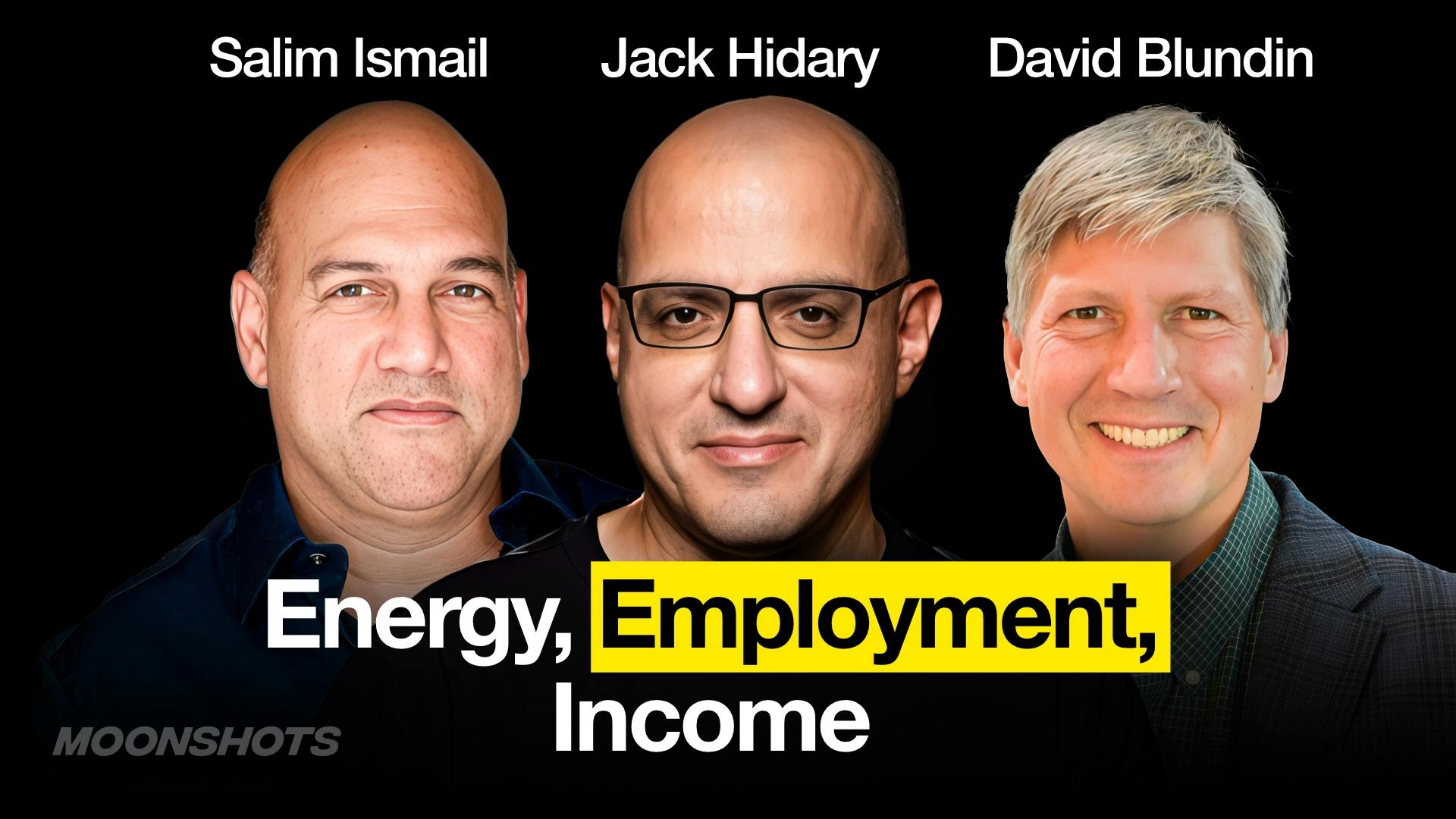
Moonshots with Peter Diamandis
Unlocking AGI: How Life Changes for Everyone w/ Jack Hidary, Salim Ismail & Dave Blundin | EP #213
00:32:05
Loading summary
Transcript149 lines
- [00:00]
A
What does Sandboxaq do, and what do you think about quantum computing?
- [00:03]
B
SandboxAQ A for AIQ, for quantum. This is ultimately the twin engines of the transformation of our society. What technology has done for us is model our world and then be able to change our world using the data from that modeling. The AI and quantum coming together gives us a new superpower, and it's upon us in the next four or five years. 20, 30 is my prediction where I, I think we'll have the kind of impact that is business impact, societal impact. It's not going to be winner takes.
- [00:32]
C
All, these non intuitive, non human domains. The AI with the training data is just as good or better there. It's not replacing humans, it's adding things that we otherwise couldn't do.
- [00:43]
D
Once the capability's there, we'll have an explosion of imagination.
- [00:46]
A
Is there going to be that moment where people go, oh, my God, I.
- [00:50]
B
Think it's going to be when?
- [00:53]
E
Now.
- [00:54]
A
That's a moonshot, ladies and gentlemen.
- [01:03]
All right, everybody, welcome to our Moonshots episode. We're going to be recording an episode here in Riyadh at FII nine of our Moonshots podcast. I'm very pleased to be joined by our moonshot mates, Salim Ismail, the head of Exo Saleem. Welcome. Let's give it up for Salim Ismail, everybody. All right, right here.
- [01:30]
Dave Blunden, my other moonshot mate. For Dave Blunden.
- [01:36]
C
Dave.
- [01:37]
A
All right, buddy. And as a special guest, we have here Jack Hickory, the CEO of Sandbox aq. Jack, bring it up.
- [01:49]
Jack, I am always. I can always count on you to.
- [01:52]
D
Bring the hat and the energy and the.
- [01:55]
A
Any energy for sure.
- [01:57]
B
Let's do it.
- [01:57]
A
A fusion power source.
- [01:59]
B
Let's do it.
- [02:01]
C
So.
- [02:03]
A
In our moonshot conversation today, gentlemen, I want to cover three subjects. I want you to bring all of.
- [02:09]
E
It to the table.
- [02:11]
A
Don't hold back. We're in the middle of this incredible location with 6,000 of our closest friends.
- [02:17]
D
Quick question. How many of you in the audience have listened to the podcast? Just show fans.
- [02:21]
E
All right.
- [02:21]
C
Whoa.
- [02:23]
B
Lot of fans.
- [02:24]
A
Amazing. So this is a conversation on three subjects today. The first is energy. The second is robotics. And we're going to wrap up because we've got Jack here on Quantum. So let's begin with energy.
- [02:40]
Question ultimately is, what do we do with abundant energy? And let me just look at my notes here. One moment.
- [02:49]
So today, China has added 429 gigawatts of new power in 2024, as opposed to the US at 51 gigawatts. Of power. There is an electron gap that's significant. We're seeing the emergence of small modular reactors, SMRs. We're seeing basically corporations going out and buying their own nuclear power sources, investing in Gen4 fission, investing in fusion. By my last count there's 37 fusion backed or 37 fusion VC backed companies that are in production. But we're still woefully inadequately short in the United States and most in the world for energy. What are your thoughts Jack? Want to kick us off?
- [03:36]
B
Sure, Peter. It's fascinating. In energy right now we're in a very odd limited period of scarcity and so we're not seeing the big picture, which is abundance is coming very soon. Somebody wrote a book about abundance. Who? Okay, right now if you look at, for example gas turbines, 40% of electricity in the United States, about 35% in Europe is supplied by gas. An increasing amount here in the Gulf is moving to gas as well. What is the wait time right now to get a gas turbine, something that looks like a propeller that allows you to make electricity? I'll take bids starting at six months. What's the wait time for getting a gas turbine? Two years, five years? It's four and a half years right now. So ge, Mitsubishi Heavy and Siemens are the producers. Four year wait. They're not willing to actually make more capacity because the last time they did they got burned. And so that's not happening. So we have this little odd period where there's lots of data centers, lots of AI demand, open air stargates, all kinds of stuff happening. But you can't, it's very hard to make it happen. What's going to happen starting though in seven, eight, nine years is we're going to flip the script to abundance. And what's going to happen is the smarts that you just mentioned, Peter, on the nuclear side are kicking in. Other nuclear is kicking in. Various governments right now are about to build factories to make more turbines. And so that's really going to be fixed as well. And then in terms of solar and batteries, we're going to see step function change. Right now we're at about 27% efficiency in terms of photons, light going to electricity in solar panels. That's going to move up because of material science breakthroughs, because of quantum.
- [05:18]
C
I'll give you another story exactly supporting what you said. I took a tour of the biggest quantum data center in America and Jeff Barkley had just built this thing and he tried to buy five gigawatt generators. They're sold out there are none. So he bought every 3 gigawatt generator that was left. So then he bought a million valves and said, what are you going to do with a million valves? He's like, well, look, it's all liquid cooled. I'm going to need the valves. But the last time I tried to build something, everything was sold out. I'm not taking that chance anymore. I'm going to buy a million valves and be ready. So any some valve manufacturing company just became a unicorn.
- [05:53]
A
Can I get a hand mic for Jack over here, please?
- [05:56]
B
Thank you.
- [05:57]
A
Saleem, what do we do with abundant energy? So let's go to Jack Kitty's thesis. You know, seven, eight, ten years from now, we've got more capacity of energy than we've ever been able to use.
- [06:07]
D
Yeah.
- [06:08]
A
What are we doing with it?
- [06:09]
D
Well, I think it's very hard to project, right? We've had 10,000 years of civilization on a scarcity of energy and suddenly we flip to abundance. We're going to have this amazing challenge of thinking through what do we do with it. If you have abundant energy, desalinization becomes largely much less expensive. Right. If you have fresh water, you take out half of all the infectious diseases in the world. The ripple effects start to propagate.
- [06:33]
A
Energy tips everything.
- [06:34]
D
Energy tips everything. Food becomes easy. And so the ripple effects are so profound, we have to rethink all of society. Think about the idea that the last hundred years almost all the wars have been fought over oil, right? So hopefully we should have less wars. We're human beings, so we'll find other things to fight about. But it will decrease the need for overt aggression in the way we.
- [06:57]
A
How many countries in the world do we have dependent on the petrodollar? Russia, Venezuela, you know, obviously here in.
- [07:06]
D
The Middle east, about 40.
- [07:07]
A
And so what happens to their economies when we've got abundance energy from everything else?
- [07:12]
D
Huge impact. I mean, take Canada, right? I'm Canadian. 40% of exports are oil. When do we have abundant solar or other technologies? The marginal cost of extraction there is like $50 a barrel. Here it's like $7 a barrel. So there's no way the expensive countries are going to be able to compete on oil in the future. So it'll be moving. The geopolitics is crazy. One thesis I have is that the reason Russia invaded Ukraine is in a few years there are 70% of exports of oil and gas are not going to be worth much. They have to.
- [07:45]
A
Dr. Hittery.
- [07:46]
B
Peter, just to add to Saleem's point, Saleem mentioned it in passing want to double click on the health care implications? 50% of all the hospital beds occupied in the continent of Africa are due to bad water due to infections and bacteria and viruses carried by water related to water. Mosquitoes also standing water. So once you have fresh water because of energy, then suddenly you free up huge amounts of the health care system and people become much healthier. And so just the implications for water and then the downsize effect, the down effect of health care is already multi trillion in nature, not multi billion in terms of its effect. And then when you think about what you can do in terms of transport, transport is expensive because of energy. And so if you can now transport stuff from place to place, you again change global economics. So I don't think we're ready. I don't think the.
- [08:43]
Global political leaders have really taken into account what's going to happen starting six, seven years from now when we flip from scarcity to abundance here.
- [08:51]
A
Closing thought Dave on energy.
- [08:53]
C
Yeah, well so you know we're right here in Saudi Arabia. Saudi is playing the cards absolutely perfectly because the way this will play out is that the data centers are moving to where the energy is. So this is a brand new thing in the world. The energy used to need to move to the population, hence all the tankers. You know, the oil has to go there. But that doesn't work with it. It doesn't have to work that way with a. The AI can come to the energy. So there's huge amounts of natural gas that gets wasted. There's huge amounts of oil that is expensive to export. Why not bring data centers here?
- [09:23]
A
What's the quote on solar energy here? Was it you say? No, it was Imad that was telling us about it earlier. Imad, what's the quote on solar energy? So I can repeat it 3. So the solar energy here in Saudi is 3 times cheaper than it is.
- [09:39]
E
In the United States.
- [09:40]
B
Yes, I was going to say Aqua Power, the largest deployer of solar and wind is a Saudi company. People think of Saudi as only oil. Not the case.
- [09:48]
C
Yeah, yeah.
- [09:48]
A
All right, I want to move to.
- [09:49]
C
Our second or so the energy. Once the data centers are built, you're locked and loaded. The data center is not going to move. These are massive capital inventive. Once that's on the ground, no matter what happens with fusion, you're good to go.
- [10:01]
A
Fascinating.
- [10:02]
D
And then you have Bill Gross building the energy storage system.
- [10:05]
B
Bill Gross.
- [10:06]
D
And then off you go there.
- [10:07]
A
We'll hear from him in a little bit.
- [10:08]
D
Energy vault.
- [10:09]
A
Let's move to Our second subject, which is the world of humanoid robotics, embodied intelligence. You know, last year I was on stage here, on the main stage here with Elon talking about robots. His prediction is 10 billion humanoid robots by 2040, and a price point of, you know, 20 to $30,000. We heard yesterday. Today I interviewed Dr. Robert Player, the CEO of Boston Dynamics. Tomorrow, I'm interviewing the team from 1X. Today 1X announced their pricing on their Neo Gamma robot. They're selling it at $20,000 and they're going to be leasing it at 499amonth. Now, this is before we've gone into production. Right. When we get to millions of robots, tens and hundreds of millions of robots, we're going to see the price come down at these price points. Think about $10 a day, 40 cents an hour for labor, labor running GPT 5, 6 or 7 or Grok 10 superintelligence. What do you guys think about robots coming?
- [11:17]
B
Jack, just to kick off, the first five factories where robots are building robots have begun construction. There's two in the us, there's three in China. And so they're not ready yet, they're not in production, but these factors will be ready in the next six, 12, 18 months. And that's where you begin to get some of the kind of scale that Elon's talking about. Not sure about the number he had, but the point is it's directionally correct.
- [11:46]
A
They're the iPhone production scales.
- [11:48]
B
That's right. And when robots can make robots, now we're in a whole different ballgame. And the second thing you add, of course, is that the LLMs, the software side, is getting better and that software gets implanted in the embodied robot. And therefore the kind of programming we thought we had to do. Back when a lot of us were thinking about robotics on this stage here a number of years ago, we thought, wow, the coding, the programming, no, that's out the window because we now have an intelligence that can see something and do something. And so this is a very different future where at fii, we can make a prediction right now, fai, two years from now, there'll be quite a few robots walking amongst us, maybe even some on stage presenting. And I think that's going to have a profound impact in terms of first, initially warehouse logistics, profound impact on that whole sector there. And then also in hospitals. We're seeing already penetration of about 20% of hospitals in America have some kind of robotic helper. Not for medicine, not for surgery, but, but for the mundane things in hospitals. Bringing up the towels the linens, the food, the medicine, things like that.
- [12:52]
A
Eventually we're heading towards surgery, right?
- [12:54]
B
We're getting there. But right now, already, adoption today, if you go to hospitals in America, you see a 20% adoption right now. Imagine when they're better in humanoid.
- [13:05]
D
I don't buy it. Okay, I have three points. One, I totally agree with the industrial use of robots. Massive opportunities, especially for the dull date during dirty, dangerous jobs. I think supply chain issues are much deeper than people think. So I don't see how we can end up with a billion robots.
- [13:24]
Down the line, at least in the foreseeable future. I think it's going to take a lot longer to get there. I am coming around to the software adaptation side. These things are going to learn very, very quickly. But as I said on our last podcast, can we please get the Roomba working at least before we start thinking about all sorts of other household tasks? I think industrial uses, where we start and have a profound penetration there before you bring it into the home. And your idea of a robot per room, I don't think that's going to happen.
- [13:54]
B
To your point, household is the last place.
- [13:58]
D
Thank you.
- [13:59]
B
I agree 100%. The amount of variables in a house, dogs walking and running around, kids. There are way more variables in a house than any factory on this planet.
- [14:07]
A
Which is. Which is, by the way, why, for example, 1x wants to go in the house. They want to have enough of variety where they can pick up and get data and learn. Right. We've sucked up every single data point.
- [14:20]
B
They injure some kids on the way, but they're going to learn.
- [14:22]
A
Yes, they're going to learn.
- [14:24]
D
One thought from our last podcast, you know we have that little video of the robot kickboxing.
- [14:28]
A
Yes.
- [14:29]
D
From a marketing perspective, it feels to me like kickboxing is not the first task you should show a robot doing.
- [14:35]
A
What do you want? Massage?
- [14:37]
D
Yeah, massage. Have it vacuuming the floors. Have it cleaning the dishes. I don't want a kickboxing robot standing next to me. That's going to be unnerving. You want to convey a sense of safety and comfort, not UFC in the house.
- [14:49]
A
Oh, my God.
- [14:50]
C
Dave, thoughts here, Celine, we talked about that. The only reason they're humanoid at all and don't have six arms like you want.
- [14:55]
D
I know.
- [14:56]
C
Is because it inspires people. And when they kickbox, it inspires people. And this is where China is running away with the robot Olympics.
- [15:02]
A
Yeah, Amazing.
- [15:02]
C
Like, it's inspirational. And watching soccer games through robots.
- [15:05]
A
It's the China of it all.
- [15:07]
B
Peter, you had some export. Export stats.
- [15:10]
A
Yeah, I do. So here's, here's what's going on. Right. There are two hotbeds of robot manufacturing. United States has got probably about 30 humanoid robot companies. We hear about the top five or six, but there's a long tail here. China is at least that. You know, I'm putting out my humanoid robot report in about a week's time and we're tracking on the order of 100 humanoid robots, a lot of them out of China. And it's interesting, right? As China goes out to the world and I understand why, and provides, you know, free open source AI models, we're having those models adopted by country after country in the Chinese robot space. What we're seeing is that it's the up and coming countries that are not technologically forward, like Poland, Mexico, Russia and Vietnam that are buying Chinese robots. So Poland is 1700% increase in robots coming in from China. Mexico is at 275%, Russia 135 and Vietnam 114. The countries which are technologically forward, South Korea, Germany, US are not importing the Russian, the Chinese robots.
- [16:29]
C
Yeah. I think, I think it's important to note though that China, you know, the Chinese economy grew at 10% plus for what, two decades, largely by bringing manufacturing into China and using this 1.4 billion person labor pool to win manufacturing wars all over the world.
- [16:43]
A
And that pool is going away.
- [16:44]
C
That is about to implode so badly if they don't race to robotics all that.
- [16:50]
D
Yeah, they have to because of the population bombs. That makes sense to me there. Totally makes sense.
- [16:54]
C
Yeah. Well, that's why they got ahead now. Now the US needs to bring manufacturing back. That's going to take some time. And then robotics goes hand in hand with that because the US just doesn't have that labor pool. So it's a very different dynamic in China versus the US and that's why it got into the state that it's in right now.
- [17:08]
A
Professor Hidary, I think we're going to.
- [17:10]
B
See really different variability in terms of the penetration of Chinese robots in different countries. Let's take Japan as an example. Japan had a head start in robotics. Everyone remember the Asimo robot from.
- [17:22]
A
I do. Amazing.
- [17:23]
B
Okay. Program closed.
- [17:26]
A
It greeted Professor President Obama.
- [17:28]
B
It's an example of being too early. It's bad to be too late, but also too early is very difficult too. Japan's birth rate is well below replacement rate. They're shrinking from 145 million people to 90 million people. And they've always thought it's robots that can help take care of the older people because there's no young people to take care of the older people. But they're going to be Chinese robots, not Japanese robots. That's the kicker. And when it comes to the States, I think there will be some adoption of robots from China, but there's going to be some sensitive areas, such as supply chain defense, so and so forth, where some more expensive robots, be it Tesla, be it, figure AI and others, will also have a play. So I think they're going to coexist. Here in Europe, we're seeing BYD on the car side, penetrate and demolish the European car companies. My prediction is the same on robotics.
- [18:17]
A
Amazing. All right, I want to take our last 10 minutes of this Moonshot podcast to talk about the quantum of it all. So we just saw the Google's chief scientist, Michel Deborah win the Nobel Prize. Google is just racking up Nobel Prizes. Congratulations to our, our family at Google. We just saw the Willow, Google willow reach what they call quantum advantage, which is a marketing term. We can talk about what that means, but announcing a thousand, a 13,000x increase over classical computing. And let's talk about what it means, Jack, to have a quantum advantage. Talk about what? Sandbox aq. Eric Schmidt is your chairman. You're the CEO. You have skyrocketed. You came out of Google X at like a half a billion dollar valuation and you've been on an exponential growth curve since then. What is, what does Sandbox AQ do? And what do you think about quantum computing?
- [19:17]
B
Well, thanks, Peter. Quantum is the kind of thing that both scares, shocks and exhilarates people at the same time. We should probably make a pill called the quantum pill. So people get excited just to take the pill.
- [19:29]
Quantum is upon us. We've gone from five years ago, people saying, will anyone ever really build a real quantum computer? Will it ever have any impact? I think it's clear now that we're headed to a yes. Now the question is when? My prediction to you on Stage here is 2030 will be a critical year where we'll have a usable quantum computer.
- [19:50]
A
What does that mean? What is usable quantum computer?
- [19:52]
B
So usable means that there's two aspects to quantum the positive and the negative. The positive side, we can be able to render this world, model this world down to the subatomic level. Why is that important? You want to make a drug for cancer, for brain cancer. You want to make a drug for Alzheimer's, you want to make a new material out of hydrocarbon outflow. And make a carbon composite to make cars lighter, more fuel efficient. You want a quantum computer because it is the best modeler, the best simulator of our physical world. And that's going to be great. And in 2030 we're going to do that, I think with some really good power, with a quantum computer. It won't be the ultimate quantum computer, but it'll be pretty good. On the negative side, we're going to cross a threshold around that same year, 2030, when a quantum computer will break, will break all the cybersecurity, the public cyber in your phone. When WhatsApp says end to end encrypted, that is using a protocol that quantum breaks. And so if you have blockchain, anyone here have cryptocurrency, any bitcoiners in the room, right, you want to worry about this because eventually this is going to be something that we have to switch the blockchain to a quantum Safe program. So 2030 is my prediction where I think we'll have the kind of impact that is business impact, societal impact. We're still going to have to wait till the super scale quantum computers to do even bigger things, but four or five years from now, I think we're going to make some really good headway. And I think several companies, it's not going to be winner takes all. This is not a winner takes all game. The government is no network effect.
- [21:28]
A
The US government's going to take all.
- [21:31]
B
They're definitely a player in the game. So that's on quantum computing. It's worth mentioning though, Peter, that quantum community is not the only game. Quantum sensing is here today. Sensors that can see how your heart's doing because the magnetic field in your heart, way better than any ECG or an MRI actually are here today. And so sensing is something that maybe another podcast we can talk about, but look it up online. Quantum sensing. And fundamentally, where is this all going? Where it's going is that we need AI to actually interpret a lot of the output of these quantum devices. There is no human on earth that could see a quantum sensor and read it natively. Our minds would literally blow up. And so AI has been fundamental in turning these from laboratory ideas to commercial products. Sandbox aq. Yes, we actually named our company A for aiq for Quantum. Many years ago we saw this merger coming because this is ultimately the twin engines of the transformation of our society. What technology has done for us and all of us on stage are part of this, is model our world and then be able to change our world using the data from that modeling. That's what we've done in the past 70 years. And that's where we have pushed forward technology in such a great degree. The AI and quantum coming together gives us a new superpower and it's upon us in the next four or five years.
- [22:52]
A
Philim thoughts?
- [22:54]
D
I think it's huge. I think one area that is going to be really interesting is almost all the computational applications or for classical computers. And we just don't have the imagination. Just what could we do with a quantum computer? So people dismiss it, but I think once the capability's there, we'll have an explosion of imagination as to the types of problems and you're probably dealing with them more than anybody else right now. So in a few years we'll all be wearing hats like yours, trying to imagine what are the quantum applications of the future.
- [23:21]
A
He's wearing that hat so his brain doesn't explode.
- [23:23]
D
That's right. He's holding it contained in one place. And I think that's where there'll be a massive opportunity is the application side of it.
- [23:31]
C
Yeah, Dave, I think one of the coolest things about what's happening in AI right now is when most people think about what you do with AI, they think in terms of, okay, here's a person doing call center work, here's a person doing white collar, here's a person, here's a robot walking around cleaning my house. Let's move that over to AI. But actually AI is even better in these domains. Like can you program this really complicated quantum computer? Computer. Can you contain a fusion reaction with a really complicated.
- [23:56]
A
Interesting. Right.
- [23:57]
C
These non intuitive, non human domains. The AI with the training data is just as good or better there. And that, that's so greenfield it's, it's additive to humanity. It's not replacing humans, it's adding things that we otherwise couldn't do. And Quantum is just one of those things.
- [24:12]
A
What's it going to look like when we hit our chat moment in Quantum? Is there going to be that. That moment where people go, oh my.
- [24:20]
B
God, we're going to have two chatgpt moments in Quantum. The first is going to be when secrets of our society, our companies will literally be exposed by hackers on the Internet. Quantum computers are not just going to be the hands of great governments and companies. Because it's cloud based and because those clouds are everywhere, including many countries, hackers will have access to quantum techniques. Once it's known how to build a quantum computer of scale and it will be rebuilt and replicated all around the world. And that means that one of the GPT moments is going to be suddenly really confidential. Stuff from the CIA, from governments is going to pop up submarine style on the Internet. And unless people protect themselves, that is going to happen. So there'll be a wake up call again roughly in that year 2029, 2030, when people have not protected themselves are suddenly be like how? How did this happen? I thought I was encrypted. You were encrypted just now. We can read it. So that's gonna be one chapter. The other chatgpt moment I think is gonna be when and this is moiba strip right back to the beginning of our conversation on energy. The number one thing that's holding back fusion power, which would give us abundance. One of the many things that would give us abundance is it's very hard to model the plasma that's in a fusion reactor. It's really hard to model when on the other ignition type of system facility you have millions of lasers going to a little dot. Quantum computing is the first computing platform that gives us the power to model what's happening in a fusion reactor that will accelerate us probably by 10 to 20 years. So we're fully back now circular into the energy abundance.
- [26:01]
A
So interestingly enough, right. I had breakfast this morning with Lupitan, who's the CEO of Intel. The US government takes a 10% position in intel and the stock has been flying ever since. Those of us holding intel options are celebrating. Yay. We just saw a whole number of quantum computing stocks literally go up 20%. Right. Because the U.S. government considering taking a position, then how do you think about the government taking positions? And in these technology companies, Dave, you want to kick us off?
- [26:34]
C
I think they're brilliant investments, mostly David Sacks driving the agenda. And they're incredibly valuable for the US right now. And I think they're a terrible precedent because if you think about what prior administrations might have invested in, you know, I mean, it ranges from the most insane to beyond the most insane.
- [26:52]
A
Dog food dot com.
- [26:53]
E
Right.
- [26:54]
C
So as a precedent for the way government works. It's terrible.
- [26:57]
D
Yeah.
- [26:57]
C
But the, these particular investments are fantastic.
- [27:00]
D
I mean also just the defense implications mean that they'll try and do this as a strateg starting point in nationalizing the whole thing, which would be bad.
- [27:08]
A
I mean if we have massive quantum computational capability in the hands of private companies, will that ultimately need to be a national asset?
- [27:20]
B
I think there could be a national reserve. Just like we have an oil strategic oil reserve. You can have a national compute reserve of Quantum without having to own these companies. I agree with Salim and Dave. It is of the history of picking winners by governments is a horrific history. It's bad because actually often they turn out to be bad government, but also because it's just not. It restricts innovation and the unleashing of an entrepreneurial spirit.
- [27:46]
C
Well, it's completely inconsistent too. You have no idea what's going to happen just a couple of years from now. Could completely invert course in a democracy. Completely invert course. So no one can predict the future as it's terrible to have that inside the government.
- [27:58]
D
Not that democracy is working that well right now for another podcast.
- [28:03]
A
This morning we just saw Nvidia hit a $5 trillion valuation. Welcome to the first $5 trillion company.
- [28:10]
C
Crazy.
- [28:12]
A
Close this out with your predictions on what other industries are going to hit a $5 trillion mark here, Jack.
- [28:22]
B
Well, the energy sector you're going to see right now aramco sitting at 1.8 trillion of market cap. If Aramco and other oil companies, energy companies take hold of COMPUTE the way they could in the next three to five years, it's going to take a little longer than Nvidia, but you could see a $5 trillion energy company if they're taking hold. Because when you think energy, think of all the things around energy. In the case of Aramco, they have their unit called Sabic, which is a chemicals producer. In the case of Exxon Mobil, they are an integrated chemicals producer as well. So Exxon could be that company, Aramco could be that company, could be three or five of them. It really depends on whether the energy companies go beyond thinking about themselves just as energy and go into the compute to think about the future of the products coming out of those energy products that will create $5 trillion in energy.
- [29:14]
A
Five trillion.
- [29:15]
C
Dr. Alex wasn't a gross. This company constantly saying on the podcast on moonshots, we're going to tile the Earth with compute. And that's inevitable. As fast as we can create chips and as fast as we can find energy, we're going to be building compute. And that'll be true for the whole future of humanity, starting with this.
- [29:31]
A
Until we. Until we break down all the planets and all the planets and create a Dyson swarm around our planet.
- [29:36]
C
Exactly.
- [29:36]
B
Any sphere, Dyson sphere.
- [29:38]
C
But anything Dyson sphere directly in that value chain is going to be a multitrillion dollar opportunity.
- [29:44]
D
Saleem, I call the question irrelevant because once you have abundant energy, the whole economy becomes meaningless. We're divided by 5 trillion meat.
- [29:51]
A
Yeah, 5 trillion.
- [29:52]
D
All BS on the whole question.
- [29:53]
A
All right, ladies and gentlemen, give it up for our moonshot mate here.
- [29:56]
D
Thank you. Thank you, Peter.
- [29:58]
E
Every week my team and I study the top 10 technology metatrends that will transform industries over the decade ahead. I cover trends ranging from humanoid robotics, AGI and quantum computing to transport energy, longevity, and more.
- [30:10]
A
There's no fluff, only the most important.
- [30:13]
E
Stuff that matters that impacts our lives, our companies and our careers. If you want me to share these metatrends with you, I write a newsletter twice a week, sending it out as a short 2 minute read via email. And if you want to discover the most important meta trends ten years before anyone else, this report's for you. Readers include founders and CEOs from the world's most disruptive companies and entrepreneurs building the world's most disruptive tech. It's not for you if you don't want to be informed about what's coming, why it matters, and how you can benefit from it. To subscribe for free, go to dashmandis.com metatrends to gain access to the trends 10 years before anyone else. Alright, now back to this episode.
- [31:07]
F
So you're about to make a trade based on a friend's text, but which you do you listen to is it we could buy a house in Tulum.
- [31:18]
Get optioning those options.
- [31:21]
We could lose everything.
- [31:24]
Or let's do a little research, get your head in the trade and make the investment decision that's right for you. Learn more@finra.org TradeSmart.