Loading summary
Transcript31 lines
- [00:00]
A
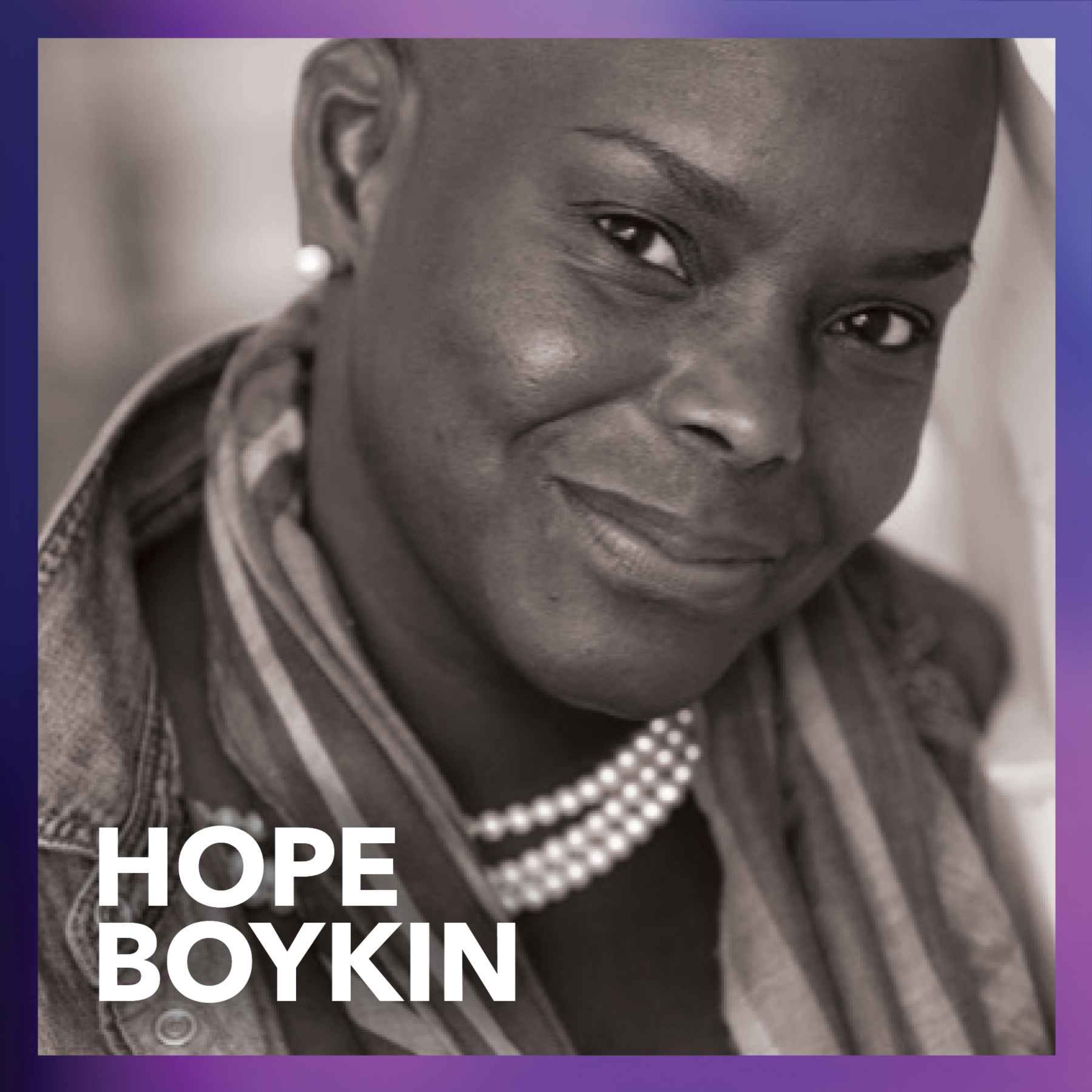
Hey listeners, thanks for tuning in. If you're enjoying Moving Moments, please consider supporting our work with a tax deductible donation. You can easily contribute on our website@artfulnarrativesmedia.com donate or just click the link in the show note of this episode. Every donation, no matter the size, helps us to keep bringing you inspiring conversations with remarkable artists. Thank you so much for your continued support. We really appreciate it. Two time Bessie Award winner Hope Boykin is a performer, choreographer, educator, and the director of a company that bears her name. An original member of Complexions, Hope spent many years as a dancer with Philadenko and then with the world renowned Alvin Ailey American Dance Theater, where we became friends. Hope's drive to be her best has helped her to overcome every struggle and she champions this success in her current work.
- [01:05]
B
Now I'm in the position to look at young artists and say, you are beautiful just as you are. Let's just make sure you maintain your strength, you maintain your goodness, because who you are is super important. And I want to be discerning enough like those other leaders to say, oh, I recognize something in that person. Let me help them the best way that I can.
- [01:32]
A
You're listening to Moving Moments, the podcast that explores the dance world's most accomplished and groundbreaking artists. I'm your host, Alicia Graf, Mack Dean and director of Dance at the Juilliard School. During each episode, you'll hear me talk with some of my closest friends and most trusted colleagues as we sit down to hear about their creative process and how they are changing the dance world on and off the stage. Hope, before I was your friend and colleague in the field, I was a major fan of your dancing. I remember coming to City Center. I think it was Chocolate Sessions by Dwight Roden. I saw you perform and you just lit up the stage and, and the audience. I remember the audience just hooping and hollering and like losing their mind, myself included for you. You have been such an inspiration to me and so many. Thank you for being on the show today.
- [02:35]
B
Thank you, friend. I just love you so much.
- [02:38]
A
I know in some ways how you've developed the type of artistry and creativity and strength that you have throughout your years. But I'm really excited to have you share your journey with our audience today. You've been in this industry basically your whole life. I feel like you were born a mover. How did you fall in love with movement in the first place?
- [03:02]
B
Thank you so much for that. I do think maybe you're right. I was born a Mover. I like the way that sounds. I might borrow that for future things, but my mother saw how active I was. I loved action movies, I loved musicals. And I would see the dancing, you know, growing up and watching PBS because those are really the only ways you could watch it or Saturday afternoon performances. And I remember trying to imitate these dancers. I would stand on coffee tables that I shouldn't have been standing on because they were glass, you know, And I would break the coffee table or I would just see a Bruce Lee movie. And I am not kidding about this. And then I would run and try to kick a hole in the wall. And my foot would be in the wall, like I just have scars and scratches. And she was like, enough of this. And she said, gymnastics, you go. And I was good at tumbling because I didn't have any fear. I remember even running into the vault and I've compulsory competition and I had my two front temporary teeth were still in and those teeth came out because I smashed it at the vault like I did not care. I wanted to try it all. And then my gymnastics teacher told her that she should also put me in dance. And then things took a turn. I did the typical, you know, hour and a half class where you have tap and then ballet and jazz and then the recital happens. One leotard, you add the skirt, you add the fringe for the tap, you add the tutu to it, you know, like all that one and that. Three in one outfit. And I loved it. And I remember doing that for a while and then I just stopped. Other things became more important, you know, boys, cheerleading, all the things. And then one day the Olympic Festival came to Durham and a woman who was choreographing it, her name is Nina Wheeler. I started to love on Nina how she talked and how I felt when I was with her. And from then we, you know, there was competition dance. I was probably in high school by the time I really started back and I was spending all of my time there. I didn't really get why it was so important for me to spend so much time there. And then the American Dance Festival is also in Durham. And so I was often seeing performances in the summer, but still not thinking dance was a thing to do for a job. The only person, and the only person who, you know, remotely looked like me who was doing dance as a profession was Debbie Allen. Because fame was on do you know? But that's also. It was so, you know, like fantasy. You just looked at it like you were watching all the other things on television that's not for you. And I grew up in a house of educators. I went to Howard University. And it's funny, because people don't believe me. I applied to one college because that was the only college I wanted to attend, because I grew up in private school. I know I grew up in private school. And so I wanted to be surrounded by people who looked like me, because I went for one visit and I was like, oh, this is it. And I loved that they called it the Mecca. You know, that it is the Mecca. Like, I've just felt it made sense. And then Debbie Helen went to Howard. So all of a sudden, I was in the right place. But at that point, Howard didn't have a dance major. There were so many great dancers who'd come through and around Howard, and so much good dance in D.C. because of Duke Ellington. And I know you're from this DMV area, so Duke Ellington School for the Arts. And I ended up just falling in with the right group of people who knew enough and knew enough of the right people to point me in the direction, you know, that I didn't really know if it was correct or not. But I left Howard the second semester of my junior year. Devastated all families. Because my mother was the first person to really go to college and succeed. She graduated from North Carolina Central when she was 18. So she was like, oh, no, there's education happening. So I devastated them thoroughly. And a friend of mine offered me his love seat. And I love telling my students, you know, I know I'm not as tall, but a love seat still only has two cushions. His name is Chris Freeman. And without Chris Freeman. And that time for me to find something that was mine. I kept telling myself, I just want to see how far I can get. And then I got a tap on the shoulder from this man that I knew was in the Ailey Company because I was at the Ailey School at that time. Oh, I had just done a performance of a solo that Matthew Rushin choreographed to a Dionne Warwick song. And after that performance, this man tapped me on the shoulder and said, I'm putting on a show with some friends of mine. I'd love for you to be in it, you know? And it was Dwight Roden. And he and Desmond asked if I would just joined this show. This. What, like 30 years, this complexion, Right. Coming up. So that's part of the history, you know. While I was at the American Dance Festival, I was asked, because I was from Durham, if I would drive Tally Beatty around. So I became Tally Beatty's. Assistant. While I was there at ADF, I worked with Pearl Primus. I met Donald McHale, Elio Pomari, like Pauline Connor Lucas Hoving. Like, I literally was at the end of this modern dance. The pioneers were still alive. And I think that that was a change for me in how accessible dance was. But I still didn't feel I personally had access until I got to the Ailey School. And then Dwight said, would you like to be in this concert? And then, you know, the day after the concert, I auditioned for Philadelphia. And Deborah Chase Hicks was good friends with Dwight and Desmond. And however I performed, I got a recommendation. I didn't realize because she had been performance the night before. And I joined Filidanco. I joined in a way where I. I wasn't really sure if that was correct either. Now, all of these things were right, but I wasn't sure if that was correct because I was told, oh, well, you know, I want you to get your body in a better shape, and I want you to do, you know, these things, but I'm going to take a chance on you. Joe Myers Brown said, I'm going to take a chance. And I was like, okay, you know, I don't know what that means, but for like, eight months, I didn't perform with the company. But during those eight months, I worked in the office, I answered phones, I learned how to Lee Marley, I learned how to steam costumes, I learned how to. To have conversations with people. I taught classes, I knew all the choreography. Look at all that thing that didn't feel right, that was prepping me for what all the things that are happening now. And then after six years with Solodenko, I auditioned and joined Ailey. And Ms. Jamison says something similarly. She was like, you know, I want to take a chance on you, but I want you to work on your body. I want you to work on this thing. Because I was in a space that appeared more muscular, I appeared heavier than others. And the weight. The issues. I'm saying that with quotes, right? The issues were all of the things that I just didn't really understand about how to really maintain an instrument that needed to sit within their personal aesthetic, you know, and I use that word carefully because each of those leaders of those organizations had a vision of how they wanted their artists to look. So I'm not upset with their vision, you know, but they were willing to invite me into these spaces that sort of went against what it was that they said they agreed to on. And so, once again, something that felt uncomfortable at Times something that felt maybe I should leave or quit or stop or give up or whatever. That was never as important as trying to give my best in those spaces. I don't know if I'm talking too much, but now I'm in the position to look at young artists and say, you are beautiful just as you are. Let's just make sure you maintain your strength, you maintain your goodness, because who you are is super important. And I want to be discerning enough like those other leaders to say, oh, I recognize something in that person. Let me help them the best way that I can, you know? So now, because of all of my experiences, I can point people in directions because of the things that seemed like they were trials or seemed like difficult circumstances. Well, they're not. They just provided me, you know, a resource, a closet full of information so that then I can come and be a part of these different spaces. And you are also a huge. Thank you. I still get an email or two from some of the work that I've been able to do at Juilliard because you know how much I love working with these young folk and how much I want to help them, no matter who they are, how they look, how tall, or how small. I feel like all the things I wasn't sure were right. I found her exactly right because they put me in a position to be. I was about to be corny and say, the hope of the future, but, you know, they put me in a position to lead in a way that maybe the way that I felt things before can be rounded out and curved and shaped, directed toward them. So I don't have to just be the one exception that we can create a room of exceptions, which means there's a room of exception open.
- [12:48]
A
Amen, sister. Well, you covered a lot of ground there, and I think I'd like to focus on your time as a performer. What did it feel like to be achieving your dream of becoming a professional performer in a major company like Viladenko, like Alvin Ailey, American Dance Theater, and going out there every night to do the thing that you set out to do.
- [13:15]
B
I heard once that someone said that the stage is a sacred place, and I agree with that. But I think everything we do is sacred. The days are long, but when we put them all in the year and we reflect, those days were just hours, you know, like they were moments in your. Moving moments in time. Right. And so I think that I understood that I was at home when I was performing. I understood that there was a purpose for me. I had Joy, you know, it's more than happiness because I was hurt sometimes. There were aches and pains. We had traveled and then had to perform, so we were tired. But none of that matters on the scope of the joy that I found ultimately. And I remember watching someone else perform and saying, oh, that's how I want to feel, because how they felt, what they were feeling, leapt off the stage. So I need to really make sure that I'm focusing on my feelings, like being a little bit selfish about wanting to be and feel good about the work I'm doing. I told my students this the other day. I'm only in competition with myself, so therefore, I always win. You know, it's not about taking from someone else. It's just about constantly living this encouragement of myself, you know?
- [14:38]
A
And do you have a favorite work, something that you remember dancing, that made you feel like, this is it. This is the why of what I do?
- [14:50]
B
Yeah. I'm sure any Ailey person who've been through there would say Revelations. And that's true. The curtain goes up. And to be at the point of that wedge, because I remember very clearly the first time I did it, that was a transformative moment for me, knowing that I was leading history. So in a way, that filled me because of the power, because of the lineage of that work. And then there's a work that Ulysses Dove choreographed called Urban Folk Dance. That was the in all, be all, call them all the things, because as a creator, as a choreographer, I was like, this is brilliant. But as a dancer, it just made sense. One person speaks, another person responds. One person's a little sharp. Wait a minute. Are you talking to me like that? Like, you know, like, all of this humanness was in this work. And so I was like, oh, this is how I want people to see it. And I had some great partners in that. The partner that I danced with and then the partners that were across the stage. And it just felt like you were, like I said, at home in those spaces. I mean, I've danced some. Some things that I'm super proud of, but those two in particular have changed, changed me.
- [16:14]
A
I remember watching you in Urban Folk Dance and definitely dancing alongside of you in Revelations. It does change you. And it reminds you every time you step onto the stage into that work that you have a purpose as a dancer. It's not really about being an entertainer, but being a mover, someone who moves and then is called to inspire others. You talked a little bit about yourself as a choreographer. I'm interested to know when you Started to create. And when did you start to actually define yourself as a choreographer?
- [16:51]
B
I was in high school, and I was assisting at my dance school. And so they would say, hope, do you have something that could go there? And I would immediately come up with something. There were parts of our jazz class we'd have to improv. And so you did the thing you did best. But at one point, I was like, well, how many times am I going to kick this right leg? You know, like, there has to be something else. And then in adf, there were different types of connective classes, and I was like, oh, I like this. But the first time I knew I really wanted to choreograph was when I was in a work that I was like, what are they doing? Like, it would have been much better if the people that come from here, well, if they had brought me and, like, I was dissecting this work to try to make it better. I was just like, oh, I would have done, and I would have done, and I would have done. So then I did. And I got a lot of choreography experience in Philadelphia because I was adjunct at University of the Arts at the time. And then Joe Myers Brown would allow the dancers in the company to put on Danko and Danko. And so out of those seven or eight performances in pieces in that evening, I did six of them. Like, I was just. I was busy, you know, But. But I consider myself an educator, a creator, a mover, and a motivator. So I am always trying to create. I know how to move people around in space.
- [18:17]
A
I know that you have created works for Avon Ailey, American Dance Theater. I know that you've set works on various universities and major companies, and you have your own company, Hope Boykin Dance. And I've noticed as you've developed, you've started also to include your own spoken word and poetry. Where did that come from?
- [18:40]
B
I had my heart broken and ended up doing a lot of writing around it. And I didn't really say much to anyone. I would just write, you know, And I think I've always written, you know, taking creative writing classes and even taking online memoir writing classes. You know, the things that challenge you to tell a story, because I thought those would be super helpful for me as a creator, as a choreographer. How to tell the story, how to understand and what's it led me to share. I let a good friend of mine, Al Crawford, listen to something I'd written, and he's like, oh, you should put that to music. And I was like, for what? He's like, so you could dance to it. I was like, there's no way I'm dancing to my own words. Because at that point, I was really dancing. And then I held on to this piece for about 10 years, just not even tweaking it, just sharing it in different ways. And I was invited to present my writing at a writer's meeting. And I said, well, there's no way I'm going to just stand there with my notebook and read my work and not show dance. So two friends of mine got together with me, and someone at the end of that event said, oh, where's your book? And I was like, oh, we filmed that, you know, And I was like, what? And so, you know, maybe a month later, I filmed it, and then a few months later, I did the book, because I didn't even know those options were open to me. And then, you know, most recently, I presented States of Hope at the Joyce, which is fully scripted.
- [20:16]
A
It was amazing.
- [20:18]
B
Thank you for all.
- [20:19]
A
It was amazing. Before you go on and talk about that work, I just want to illuminate for the audience what it was like to be sitting in the Joyce that day especially. I was there on the premiere to see all the people from your various walks of life there supporting you, and then all your fans. It was a moment, and I'm so proud of you because it revealed so many of your inner thoughts. And I wonder how you became so brave to be able to put your life out there like that. And all those thoughts that, you know, most people would never dare to share.
- [21:01]
B
It was more like a why not instead of a why. You know, I've been walking some difficult roads, and I've been walking them solo. And some good friends of mine came and they said, we can't believe you told everyone your business. But it didn't feel like I was just telling. It felt like I was really opening up. And so that's what I feel like gave me a little license and permission for states of hope to grow in.
- [21:30]
A
That way you mentioned. Ms. Jamison. I'm always curious to know how various people in your life have influenced the way that you walk through your life. And what have you taken from Joan Myers Brown? What have you taken from Judith Jamison and Tali Beatty and all these people that you've had the chance to brush up against and learn from?
- [21:55]
B
Such a great question. And the truth of life is what I've gotten from all of them. Tell the truth. Tell the truth. You know, I've called JB and Judy and my mom. Truth Tellers in my life. You know, Tally would tell you when it was, that was not good, girl. That wasn't good. Do it again. You know, and so now I tell my students, you know, that wasn't good. Let's do that again. I mean, my tone is different, my sound is different because I'm different. But let's tell these young folk the truth. Part of this education platform I really want to stand on is to really help build the skills and communities so that they can live and work in a place comfortably and safely. But without giving you a trophy for. Just show it up. You have work to do. You have to put your foot down. When someone is, you know, not on time, you have to tell them, that's not going to work for me. I need you to try something different. We're not going to leave them with the nose or make them feel like they're not accomplished or their work isn't valued. But there's a standard that has to be maintained, and the standard is excellence. And excellence changes every day. The more we gain in technology, the greater our span of excellence is, the more someone comes up with something new and invents something. Now we have a larger idea of what that can be, and that needs to happen within the minds of the artists to acknowledge where they are, acknowledge it was good today, and then make better the best the next day. Just keep growing. So we have to tell them the truth. We have to tell them when they're great, and we tell them when they could be better at what they're doing. And those people did that for me.
- [23:52]
A
I see that, Hope. So thank you so much for that.
- [23:57]
B
And I know this is your. I was going to say, I know this is your show, but, you know, I hope people know how strong and impactful and how much we all admire you as. As a leader. You know, it's important to be around people and surround yourself with people who are doing things the way that feel, feel natural and feel right. So I'm just saying I love you. It's good what you're doing.
- [24:27]
A
Love you, too. Do it together. We do it together with all the things that you're doing. Hope, you are leading the charge at the Kennedy center with their dance education initiatives. You're leading your own company, Hope, Wake and Dance. You're creating and choreographing all over the place with schools and companies and off Broadway and with plays and musicals. How do you do it? Like, how do you fuel your day? What is your day to day? Like, what's your week to week, like.
- [25:00]
B
To get super personal. I've always wondered why I was sort of walking by myself, you know, like I, I come from an upbringing where you're supposed to have the two car garage with the extra car on the outside and the 3.5 kids, whatever it is. Right. Because those things aren't with me. I. I felt that I needed to fill the gaps. And then after the pandemic, you know, I planned to retire from Ailey before the world went on pause. And then after the pandemic, I was like, oh, I have to fill all the gaps because I need to stay relevant and I need to stay in the forefront. At first it felt strategic, but I got tired and I got tired to the point that my health suffered. And I say this with confidence but not with too much pride that I know that I have a place. And understanding my place has made me take the things that fit and leave the things that don't. But it's still quite full. I am carving out space for things where I know I'm supposed to be. My latest little project is this Encourage Yourself journal. You know, with all the things that I've been sharing with the students, I decided to put it in a book and I handed off my first edition full of flaws still. But I'm really pretty happy about whatever is next. It involves these young people and I can tell you that along with Hope Boy can Dance. I am founder of a new not for profit 501c3 called HB Arts Collective and it's the home for creative work, music, film, theater and dance. But its dual mission is to be a community and skill building platform for young new and emerging artists who are transitioning out of educational spaces and needing guidance toward their future careers. How to read a contract, how to go into an interview, networking, choreography skills, how to stay in costumes. All the things that I learned on the go. Two cohorts a year is what we're aiming toward to guide them out of this place into their next. It was called the Next. That's part of the platform. So I'm happy to share with you. I love that people don't know, but it's new. Yes.
- [27:27]
A
I mean, one of the things that has been revealed through this podcast is that there is no one way to get there. Right. Everybody has had such a unique path, but everyone has had someone in their life leading them to the next place. You know, kind of being that person that sits on their shoulder and says, hey, you should try this, or hey, when you do your interview, you should think about this. So it's amazing to have this sort of collective for young people that they can look towards for help. See how you do it. Amazing.
- [28:04]
B
I'm very excited.
- [28:06]
A
My last question for you is, when you have moments of free time, when you have time for yourself, what do you enjoy doing?
- [28:14]
B
I like to go on long walks. It sounds so dating app, doesn't it? But I do. I like to go on long walks. I like to take trips that don't involve a lot of drama. So I'll get on the train or I'll drive and I'll like retreat myself out someplace. Literally, I'm revising and I'm treating at the same time. Right. I'm renewing and I'm treating myself. And I found that going to these places alone, even though I say I walk a lot of these paths alone, really is energizing to me. I like the resort type. Somebody can bring you breakfast every once in a while, but sitting, sitting in rooms with different kind of mind focus and restorative work is really how I get back to myself.
- [29:04]
A
Well, I'm glad that you take the time for yourself because we need you, your artistry, your creativity and your energy in our lives. Thank you so much for taking the time to sit with me today. And I love you, dear.
- [29:19]
B
I love you too. You're in there. We're in there. Thank you, friend.
- [29:25]
A
I hope you enjoyed this episode of Moving Moments. If you like what you heard, please tell your friends about it. Spread the word. Be sure to follow the show, rate us, and leave a review wherever you get your podcasts. To keep up with future episodes, follow us on Instagram at movingmomenspodcast and Visit us at artfulnarrativesmedia.com Tune in next month as we hear another inspiring artist's moving moments.