
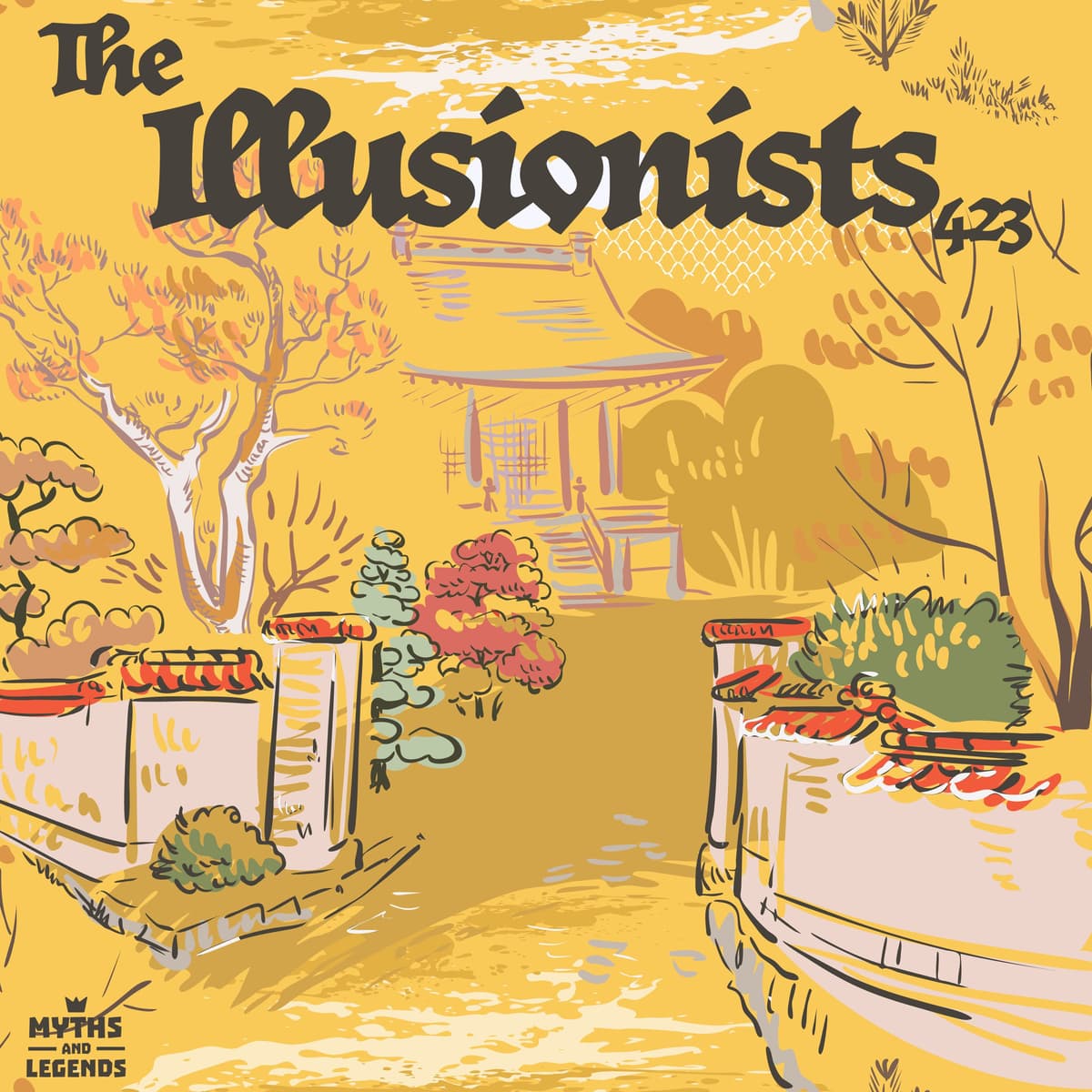

Myths and Legends – Episode 423: Japanese Folklore: The Illusionists
Hosted by Jason Weiser and Carissa Weiser
Release Date: December 3, 2025
Episode Overview
This episode of Myths and Legends explores a Japanese folktale set against the backdrop of the Meiji Restoration—a time of massive social upheaval in Japan. The story centers on an abandoned, eerie forest temple rumored to be haunted by a cunning, magical entity. Through intertwined tales recounting encounters with illusions, foxes, and monsters in the woods, host Jason Weiser unpacks not just supernatural dangers but also the fading of old ways and the uncertainty that comes with social change. The episode is rich in character, atmospheric storytelling, and historical insight, retelling the legend for modern ears with characteristic wit and warmth.
Key Discussion Points and Story Breakdown
I. Historical Backdrop – The Changing Tide (00:00–04:45)
- Context Setting: Jason explains the turbulent transition from the Edo period to the Meiji era, a time when Japan's social classes (notably the samurai) were in upheaval. Civil war, shifting loyalties, and change threatened the old order, affecting not just people but even the spirits said to haunt Japan's wild places.
- Quote (Jason, 02:15):
“The old ways are changing, and not even the monsters in the woods are safe.”
II. The Doctor at the Temple – The Setup (04:45–12:20)
- An elderly doctor, wise to the ways of both men and monsters, arrives at a decrepit temple with food in hopes of encountering the rumored spirit or creature.
- He muses on the nature of such beings: their tricks, deceptions, and that the “wise accept the impossible—that they will be deceived.”
- A fraught yet calm first encounter with the resident priest, leading to stories over tea.
- Memorable Moment (Jason, as Doctor, 10:05):
“Well, he felt more relaxed in the den of a monster. So, that was something.”
III. Tale of the Samurai’s Encounter – Seduction and Terror (12:20–23:50)
- The doctor retells the first of two linked village legends:
- A young samurai, lured by a beautiful woman to the ill-famed temple, expects romance but instead meets terror.
- The temple is at first serene and inviting, but as night falls, the atmosphere shifts.
- The “woman” vanishes; a monstrous, towering priest appears and chases the samurai, who flees in terror, leaving behind his catch of fish.
- Quote (Jason, as Samurai, 19:30):
"Was this happening? This. This was happening alright..." - Laughter from multiple unseen sources hints at the presence of supernatural tricksters.
IV. Tavern Debate and the Challenge (23:50–33:00)
- The next day, the humiliated samurai is challenged in a tavern, accused of drunken cowardice.
- An older, sword-carrying “fencer” (not a true samurai, but a survivor of the wars) steps in, defending the tale, and decides to visit the temple himself to confront whatever haunts it.
- Discussion of changes in status: who can wield swords, what honor means in new times.
- Quote (Fencer, 32:20):
“He would obey the new law when they both could... But so far, no one had the desire or skill to take his sword, so he would keep it.”
V. The Fencer’s Night at the Temple – Illusions Deepen (33:00–45:30)
- The fencer climbs to the temple, greeted by three beautiful women who try to ensnare him—with food, with drink, then with a hypnotic fan-dance.
- The fencer, skeptical, resists, but is momentarily entranced—until a severed, living head lands in his lap and the women turn monstrous, tearing off their own heads and mocking him with laughter.
- His attempts to fight them are fruitless; the creatures only multiply and mock his lack of “imagination.”
- The fencer escapes, missing his basket of fish (another “offering”).
- Quote (Monstrous Woman, 44:40):
"You serious types, you’re even easier than the others. You lack imagination, creativity. You can’t see our traps until they’re closing around you."
VI. The Doctor Steps In – Resolve and Revelation (45:30–59:50)
- The fencer, humiliated but safe, reports back; the doctor decides to confront the temple’s monster himself, asking for three days to prepare.
- He brings a meal as bait (steamed beef and peppers, sake), and heads up the hill alone, watched by the villagers.
- The final encounter with the “priest” reveals layers of truth and illusion:
- The priest confesses his life story: orphaned, trained for the temple, exiled and changed by war, returning to care for the abandoned building.
- As they talk, it becomes clear both are testing each other’s honesty.
- The conversation shifts—was there ever a monster, or have the villagers’ stories and fears reshaped reality?
- Quote (Priest, 56:15):
“Everyone’s honest until they’re not... People tell you who they are. All you have to do is listen.”
VII. The Tanuki Revealed – Truth Under the Mask (59:50–1:05:50)
- The next day, the fencer and doctor return to the priest’s quarters to find the “priest,” now revealed as a massive, dead tanuki (raccoon-dog yokai), who has been tricking generations of villagers with illusions and stories.
- The doctor had poisoned the creature, revealing it clung to a fragment of truth about its origins that betrayed it.
- The tanuki’s legendary cunning, its role in the ebbing spiritual landscape, and a meditation on the cost of change as magical beings fade.
- Quote (Jason, reflecting as Narrator, 1:04:20):
“Even if it was a lie, that tanuki was part of the world that was fading like a morning fog and would soon be gone completely. It was ultimately good, but something had also been lost.”
Notable Quotes and Moments (with Timestamps)
- “The old ways are changing, and not even the monsters in the woods are safe.”
— Jason (02:15) - “Well, he felt more relaxed in the den of a monster. So, that was something.”
— Jason, as Doctor (10:05) - “Was this happening? This. This was happening alright...”
— Jason, as Samurai (19:30) - “He would obey the new law when they both could... But so far, no one had the desire or skill to take his sword, so he would keep it.”
— Fencer (32:20) - “You serious types, you’re even easier than the others. You lack imagination, creativity. You can’t see our traps until they’re closing around you.”
— Monstrous Woman (44:40) - “Everyone’s honest until they’re not... People tell you who they are. All you have to do is listen.”
— Priest (56:15) - “Even if it was a lie, that tanuki was part of the world that was fading like a morning fog and would soon be gone completely. It was ultimately good, but something had also been lost.”
— Narrator/Jason (1:04:20)
Segment Breakdown with Timestamps
| Timestamp | Segment | |-------------|--------------------------------------------------------------| | 00:00–04:45 | Historical context: Meiji Restoration and its discontents | | 04:45–12:20 | The doctor's approach to the temple | | 12:20–23:50 | The samurai’s ill-fated visit, seduction, and terror | | 23:50–33:00 | Tavern scene: challenge, debate on honor and sword laws | | 33:00–45:30 | The fencer's test: illusions, ghostly dance, and horror | | 45:30–59:50 | The doctor’s preparation, the real "priest", philosophical talk| | 59:50–1:05:50| The true face of the monster, the tanuki unmasked |
Insights and Thematic Threads
- Transitions and Uncertainty: Echoed in both the supernatural and human worlds, Japan’s changing times are a crucible for both monsters and men.
- Illusion vs. Reality: Throughout, characters must distinguish truth from trickery; ultimately, even the “priest” hides his real nature.
- Loss and Renewal: As old ways and monsters fade, so too does a sense of magic and certainty; rebuilding—physically and spiritually—becomes a quiet, communal act.
- Empathy for the Monster: The tanuki is painted not as a simple villain, but as a cipher for the parts of the past that are both obstructive and poignant.
Conclusion
The Illusionists is more than a ghost or yokai story—it's a meditation on transition, the costs of progress, and how myths shape (and are shaped by) the societies that tell them. Jason Weiser’s retelling weaves humor, spookiness, and warmth into a narrative that’s both ancient and timely.
Next episode tease: A return to 1001 Nights and a sultan’s troubles—with a mischievous folkloric twist.