
Podcast
Narativ with Zev Shalev (Audio)
Hosted by Zev Shalev · EN
Uncover the hidden forces shaping our world.
Zev applies his skills gained as a journalist and news executive for 30 years to give viewers and listeners an unparalleled view of events changing our world.
Narativ is Where Truth Lives.
www.narativ.org
www.narativ.org
68episodes
Episodes
Newest firstAll episodes

SPECIAL REPORT: FORMER CIA STATION CHIEF: PUTIN WILL INTERFERE IN US ELECTION
3d ago00:50:37Tap to summarizeVladimir Putin will aim his interference machine at the November midterms, former CIA station chief Sean Wiswesser warned on Narativ Live Wednesday — exactly 90 days before the vote, with the operation already running at a scale no troll farm ever reached. Election interference “is a primary tactic of the Russian intelligence services,” Wiswesser said. “It has been for 100 years.” He ran CIA stations against that machine across 28 years, five joint-duty assignments and a war zone, and his book — Tradecraft, Tactics, and Dirty Tricks: Russian Intelligence and Putin’s Secret War, back at number one on Amazon’s Russia list — is a manual of the other side’s methods. For an hour, on the Narativ special report T Minus 90, he opened it.Wiswesser brought the case file to match. A flash mob formed in a small Midwestern town, two crowds screaming across a street — one swearing nobody would take its guns, the other swearing nobody would hand guns to schoolchildren. Police pushed in and asked each side for its leader. Neither had one. The FBI pulled the thread and found the summons hadn’t come from either side — or from anywhere in America. “It was our adversaries playing us for suckers,” Wiswesser said.The method has a name: active measures — the Kremlin now prefers “measures of support.” Wiswesser reached for defector Vasili Mitrokhin’s KGB archive to define it: intelligence as politics by other means. The SVR runs an entire directorate for it — thousands of officers, he said, whose sole job is meddling in the United States and its allies. The FSB, Putin’s alma mater, fields roughly 400,000 people and a hacking unit, Center 16, that worked the 2016 and 2020 elections. The GRU’s Fancy Bear cracked the DNC’s servers — while the FSB, hacking the same building, nearly tripped over them. “They don’t coordinate,” Wiswesser said. “They’re all after the United States.” The services conscript criminal hackers to fill the gaps: hack for us or go to the Gulag.What changed since 2016 is the engine. “What happened 10 years ago that was done by human actors, now cognitive AI can do,” Wiswesser said. “The amplification is 10,000 or even 100,000-fold.” Prigozhin’s troll farm needed people; the 2026 version is machine-enabled, and it feeds on the same fuel — the rawest wound in any democracy, amplified until neighbors hate each other. The Venezuelan voting-machine story, the one Attorney General Bill Barr called “b******t” — his word — is the template: find a thread of grievance, spin it, repeat it until Americans stop trusting their own elections.Zev pushed where the guest could not go. Wiswesser, who still contracts for the Defense Department, held the professional line — the SSCI report Marco Rubio signed found Moscow meddled against democracy itself, and any benefit to a candidate “is incidental to the larger goal.” Zev answered with his own read: one American party trends toward autocracy, the other toward democracy, and a power whose stated target is democracy knows exactly which outcome serves it. The guest didn’t take the bait, and didn’t need to. Hungary made his point for him: Moscow ran more intelligence officers in Budapest under Viktor Orbán than ever before. “They didn’t trust Orbán either,” Wiswesser said. “They don’t have any allies.”Zev has met the secret war himself, and told the story on air: a woman, plainly Russian and plainly out of place, cornered him at a Tony Awards after-party, claimed Oliver Stone wanted to work with him, and offered to fund his journalism. Somebody had tracked a reporter to a closed room full of people who sing for a living.Wiswesser’s prescription for the drones now probing Romania and the cables cut on the Baltic seabed is the one Kennedy used on Khrushchev: a deterrent with consequences. “Shoot down those drones,” he said. “Right now we have an empty deterrent.” The night before he spoke, a Russian strike killed 17 people around Kyiv — while American interceptors sat undelivered. Ukraine, which he rates among the world’s top five intelligence services, keeps teaching the lesson anyway: Operation Spiderweb’s drones crawled out of trailers and burned Russia’s strategic bombers where they parked. Britain handed America radar in 1940, he noted. Kyiv is offering the drone.Ninety days out, the target is not a candidate. It is the thing on the ballot underneath every name. Wiswesser spent a career meeting Russians who risked their lives for the CIA because they believed America was the city on the hill. The people trying to burn the city down are counting on Americans to strike the match themselves.Thank you Robin Payes, Skutt Hope, Farmers AGAINST trump., Jami, Kim G, and many others for tuning into my live video with Sean Wiswesser! Join me for my next live video in the app. This is a public episode. If you'd like to discuss this with other subscribers or get access to bonus episodes, visit www.narativ.org/subscribe
Transcribe →
SPECIAL REPORT: THE MERGING OF TWO WARS WITH OLGA LAUTMAN
2w ago00:28:57Tap to summarizeThe phrase sounds like a warning from a war room: the merging of two wars. Olga Lautman traced it to a sales campaign.“Everywhere you see this merging of two wars coming from Iranian agents, from Russia’s influence agents,” the Russia analyst told Zev on Narativ Live. “I guarantee you that Russia is behind this narrative — because in December they were completely quiet.”December is the tell. Ukraine first struck Russian vessels in the Caspian Sea last December — ships Kyiv says ran weapons between Russia and Iran, cargo invoiced as bananas. Nobody objected. “The Russians didn’t say anything. The Iranians didn’t say anything. The Americans didn’t say anything,” Lautman said. This week Ukraine hit the same route again — and Tehran erupted. A senior Iranian parliamentarian threatened Ukraine on Twitter, in Ukrainian. Iran claimed the struck vessel as its own; Ukraine says it hit Russian ships. The difference between December’s silence and this week’s screaming, Lautman argued, is an audience of one — the story exists to tell Trump that Ukraine is wrecking his Middle East plans.The wars did merge — years ago, and in hardware, not headlines. Iran handed Russia its Shahed drones in 2022, then opened joint drone factories inside Russia. China ships military components and helps Moscow dodge sanctions; Russia trains Chinese troops for an invasion of Taiwan, Lautman said, while North Korea sent 10,000 soldiers last year and, per new intelligence she cited, prepares 30,000 more. “Ukraine has been the laboratory for this.”And the country supposedly dragging America into world war keeps picking targets a general would choose. “Ukrainians are going after logistical routes,” Lautman said — refineries and export terminals 1,300 kilometers inside Russia, supply lines “choking off Russia’s reach into Crimea,” even Wildberries, Russia’s answer to Amazon. The bill so far, she said, citing the British Defence Ministry and U.S. intelligence: 1.4 million Russian casualties, several hundred thousand of them dead.Then came Navy Day. Putin marks it most years by reviewing the fleet. This year the fleet stayed out of sight — Ukraine has sunk roughly 30 percent of it, Lautman said — so Putin reviewed a painting. “They couldn’t bring the vessels, so Putin had to deal with the banner of a submarine.” Even the wall behind him was painted on.That humiliated navy shares the Black Sea with Romania, where Russian drones crossed the border three days running — Friday, Saturday, Sunday — and Romanian F-16s shot down all three, the first such kills in the country’s history. On Monday, Bucharest declared a Russian embassy staffer persona non grata after prosecutors confirmed the wreckage as Russian. Moscow denied aiming anything at Romania and promised retaliation.Lautman set the incursions inside a warning European intelligence services keep raising: Russia “might test Article 5” — strike a Baltic state or Romania — “to see how NATO will respond” while Trump sits occupied elsewhere and cold on the alliance. And the test would not look like tanks. “They can do drone swarms and hit Romania or Estonia or Lithuania, and that would be enough,” she said. Russia rehearses with 200, 300, 400 drones a night over Kyiv. Ukraine now sends the same numbers back.Her oldest warning ties it together: Russia moves on Europe while China moves on Taiwan — one axis, two theaters. The merging of two wars is propaganda. The merging of four regimes is documented.Thank you LC - Silence is Complicity, Lalisa, Chardonai, Deborah J., Kelly, and many others for tuning into my live video with Olga Lautman! Join me for my next live video in the app. This is a public episode. If you'd like to discuss this with other subscribers or get access to bonus episodes, visit www.narativ.org/subscribe
Transcribe →
The Epstein Smoking Gun E-Mail: What It Reveals About Bill Barr
2w ago00:30:00Tap to summarizeThis is a free preview of a paid episode. To hear more, visit www.narativ.orgAn internal DOJ email — EFTA01648946, surfaced by Narativ on Friday — lists the men accused in the Epstein files. The last entry: “William Barr, for being present when a girl was raped.”The allegations are likely witness allegations, not proven acts, attorney Anne P. Mitchell said on Narativ Live. The point is what the DOJ did with them: “They took them…
Transcribe →
Breaking News: 'Smoking Gun' Document Could Upend Todd Blanche's Confirmation as AG
2w ago00:48:56Tap to summarizeZev surfaced a document Friday that no outlet had reported: an internal DOJ email cataloguing the most serious allegations against Donald Trump, Bill Barr, Howard Lutnick, Les Wexner and seven other men — dated July 24, 2025, the day Todd Blanche sat down with Ghislaine Maxwell. Zev runs daily AI searches of the Epstein files; his system flagged the email Friday morning, and he took it to air within hours, joined by attorney and advocate Anne P. Mitchell and congressional candidate Lev Parnas.The email began as a request. One DOJ official asked another: “Can you write me a sentence or two… [on] the salacious statements made against the individuals in the file? Feel free to add if I missed someone.” The reply came back as a roster — Trump, Barr, Lutnick, Wexner, Jes Staley, Leon Black, Prince Andrew, Harvey Weinstein, Alan Dershowitz, Bill Clinton — with each man’s entry drawn from victim statements in the files.The Trump entry, as the file records it: Epstein introduced a woman to Trump, “who subsequently forced her head down to his exposed penis.” She bit him. Trump punched her in the head and threw her out. A second redacted account has Epstein introducing another woman with “this is a good one, huh?” — and Trump answering yes.The date carries the story — and Zev did the legwork before air, verifying the email against the Blanche–Maxwell interview transcript name by name. Blanche — Trump’s former defense lawyer, then running the DOJ’s Maxwell interview, now weeks from a confirmation vote for attorney general — asked Maxwell about nearly every name on the list. On Trump, Maxwell answered: “Absolutely never in any context. The president was never inappropriate with anybody… he was a gentleman in all respects.” On Barr — who the file places at an Epstein model event, with a second account claiming he was “present during some of this abuse” — Maxwell answered “no,” then “I don’t recall.” On Wexner, the file states he sat at number one on Epstein’s speed dial and that “Epstein earned his money from having sex with Wexner” — the first time that alleged relationship appears in writing anywhere in the files, and something sources close to Epstein told Zev years ago. Maxwell confirmed only “the one very famous client everybody talks about.”One name Blanche never raised: Howard Lutnick.The file repeats what Narativ first reported months ago — Epstein sold Lutnick a home for $10 that later sold for millions — and Maxwell volunteered, unprompted, that Epstein’s cohort included men “in your cabinet, who you call your friends.” Weeks after the interview, Maxwell moved from prison to a minimum-security camp.Mitchell traced the paper trail on air: the joint DOJ-FBI-SDNY task force slideshow that circulated this year was built from this document, compiled July 22–24, 2025, forwarded to Kash Patel on August 7, 2025, and released publicly in January under the Epstein files mandate. The email sat in the public files for six months; Zev’s daily searches never returned it until Friday. “We have to ask whether it was somehow not visible to everybody,” he said.Parnas added a third thread: Maxwell’s attorney, Oscar Marcus, hosted Blanche on his podcast twice — once before the Maxwell interview, once after.Mitchell put the question that hangs over the whole document: why would anyone prepare this list for Blanche if he believed none of it was true?Blanche faces his confirmation vote already under a $1,000-a-day fine for defying a federal court order to release Trump-related Epstein documents. Epstein’s survivors met him days ago and left distressed, recounting his words to them: “They wanted something from me I can’t give them — justice.” Zev closed on that line: if Blanche held this email when he looked those survivors in the eye, how can he possibly be the attorney general of the United States?The document is posted below this video. Narativ viewers are sending it to the Senate Judiciary Committee — email it, then call.Subscribe free — Narativ: Where Truth Lives. Know Sooner: narativ.org This is a public episode. If you'd like to discuss this with other subscribers or get access to bonus episodes, visit www.narativ.org/subscribe
Transcribe →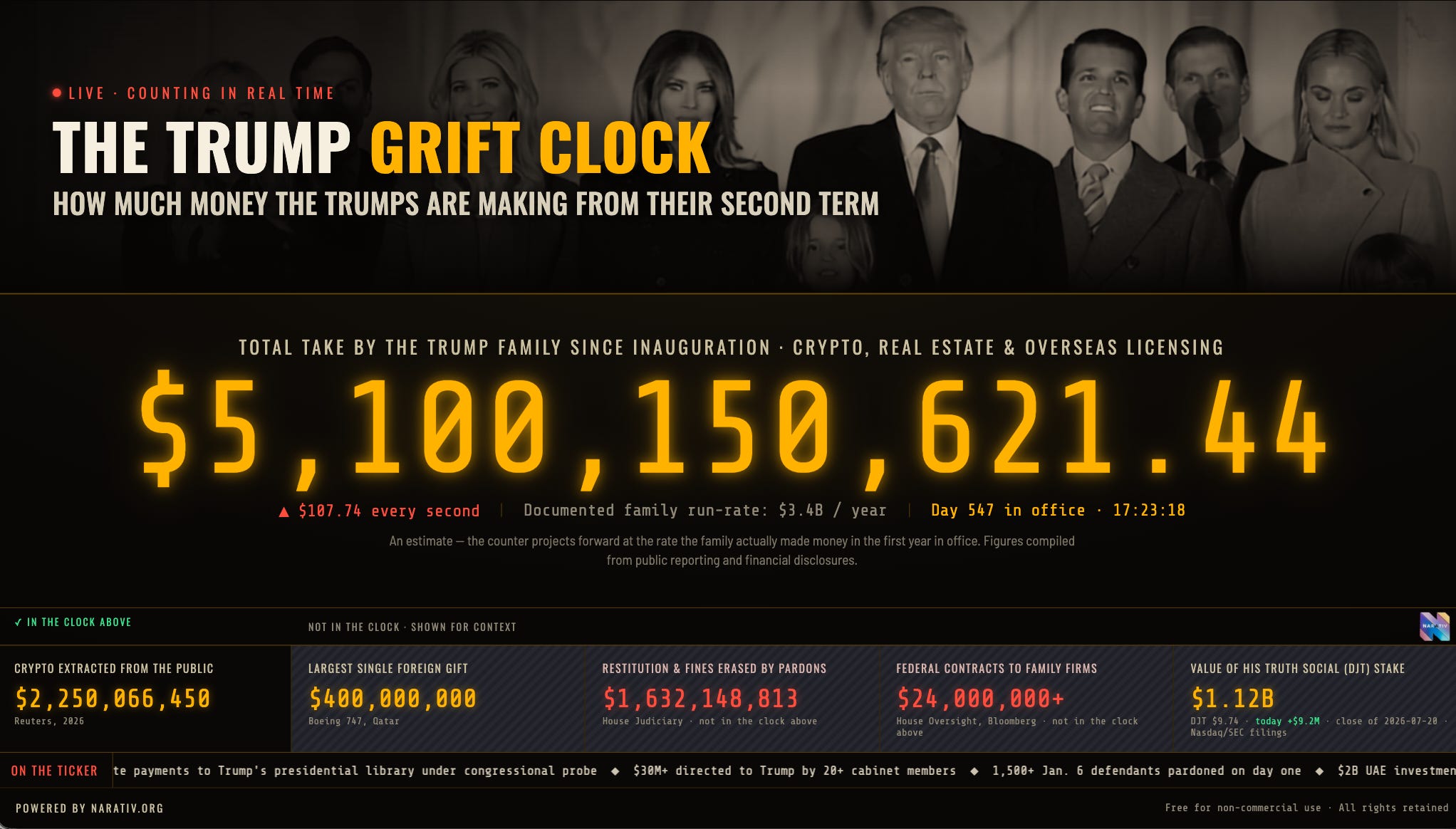
BREAKING NEWS — THE TRUMP GRIFT CLOCK CROSSED $5.1 BILLION LIVE ON AIR
3w ago00:11:29Tap to summarizeThe Trump family crossed $5 billion in presidential profit on July 10, and nobody marked it — no network cut in, no chyron, no headline. So Narativ built a clock. On Tuesday afternoon Zev Shalev put the counter on camera, and at 5:01 PM Eastern the audience watched it tick past $5,100,000,000 — the first billion-dollar line of the Trump grift crossed live, on the record, in real time.The clock counts three streams and only three: the family’s crypto ventures, the real-estate holdings foreign governments keep handing over, and the licensing deals signed since Trump’s inauguration on January 20, 2025. “This is money that belongs to the taxpayer,” Zev said as the digits turned, “money that’s being grifted out of the U.S. Treasury.”The number is a floor, not a ceiling. Along the bottom of the clock runs the ledger of what Narativ left out: the $400 million Qatari jet handed to Trump as a gift, the fines and restitutions erased through pardons, the no-bid contracts steered to friends and family, and $1.12 billion in Trump Media stock. Add those and the take climbs well past the headline figure. Narativ printed the conservative number on purpose — the one no lawyer can argue down.The pace is the story. The clock added $100 million in ten days — $116 every second at its current rate. Every 12 minutes it swallows what a median American family earns in a year, $83,730 by the Census Bureau’s count. The special report opened at 4:59. By the time Zev signed off, a family’s entire annual income had crossed from the public’s side of the ledger to the Trumps’. “Maybe when they say the golden age is here,” Zev said, “they mean the golden age is here for them.”Then Zev priced the grift in the currency the country actually lives on. The full $5.1 billion equals the annual income of 61,000 American households — a city the size of Fort Lauderdale working a year for the Trump family’s eighteen months. At Feeding America’s $3.58 a meal, it buys 1.4 billion meals — 30 for every one of the 47 million Americans facing hunger. Routed through Medicaid, the National Bureau of Economic Research’s mortality math says it saves 944 lives — 28,500 years of human life. Or it buys a full year of family health coverage for 189,000 households, at KFF’s average premium. The family that pocketed it instead governs a country paying $4 a gallon for gas.The clock doesn’t stop because the broadcast did. Narativ will keep it running through the election season and return to air at every meaningful crossing — the next hundred million, the next billion. At $116 a second, the wait won’t be long.Watch the full special report at narativ.org. The Narativ in your inbox every morning — free. Know Sooner.Thank you Lisa 🌸🌞☮️, Sheila Avrin McLean, Gary Law, Benga Harrison, Christine Walsh, and many others for tuning into my live video! Join me for my next live video in the app. This is a public episode. If you'd like to discuss this with other subscribers or get access to bonus episodes, visit www.narativ.org/subscribe
Transcribe →
BREAKING NEWS: Tate Bros Vow To Fight Extradition To UK, But Former US Attorney Dave Aronberg Says Nobody Is Coming To Save Them
3w ago00:35:29Tap to summarizeThis is a free preview of a paid episode. To hear more, visit www.narativ.orgThe Tate brothers are betting their freedom on a rescue from the administration that sprang them once before. On Monday’s Narativ Live, the two guests best positioned to judge that bet — Dave Aronberg, the former Palm Beach County state attorney, and Lev Parnas, who lived inside the Trump-world protection racket — called it the same way: the rescue isn’t coming.“There’s zero support for these guys in the administration,” Parnas said, citing his own sources inside Trump world. “Once your credit is no good, you are shipped off. And the Tate brothers right now are more than credit no good.”The legal road ends at Rubio’s desk — and Rubio won’t signAronberg walked through the extradition machinery the cable networks are skipping. The defense has three offramps — mistaken identity, non-extraditable offense, no probable cause — and none of them work against 59 UK charges spanning seven women, some underage, from 2010 to 2017. “Probable cause is such a low standard,” Aronberg said. After the appeals run out — he estimates one to two years — a single signature ships them to Britain, and under Article 4 of the 2003 US-UK treaty, Secretary of State Marco Rubio could refuse on political-persecution grounds. That is exactly what Tate lawyer Joseph McBride is building toward; the show played his courthouse claim that “the process is the punishment.” Aronberg’s verdict: “That is not going to be the hill this administration dies on — especially a guy who may want to be president.” He knows Rubio personally: “The Tate brothers aren’t his jam.”PAID SUBSCRIBERS CAN ACCESS A DEEPER DIVE BELOW THE PAYWALL
Transcribe →
Trump’s Envoy Handed Andrew Tate the Constitution. Tate Promised to Cite It in Court.
3w ago00:05:30Tap to summarizeThis is a free preview of a paid episode. To hear more, visit www.narativ.orgThe tape opens with a gift. Paolo Zampolli — the State Department’s special envoy for global partnerships, Melania Trump’s oldest friend, the man Narativ has spent weeks tracing through Russian diplomatic circles — hands Andrew Tate a copy of the US Constitution. Tate thanks him and says the quiet part into the microphone: “I’m gonna read this and I’m g…
Transcribe →
BREAKING NEWS: TRUMP’S MARSHALS CUFFED THE TATES — AND THE FIGHT TO FREE THEM HAS ALREADY STARTED
3w ago00:59:49Tap to summarizeUS Marshals arrested Andrew and Tristan Tate in Miami early Saturday. The marshals approached the brothers and asked for a signature — the kind of approach the Tates know from fans. The paper was an arrest warrant. Britain’s Crown Prosecution Service had filed 38 new charges after police identified four more victims — seven women in all — bringing the total to 59: rape, human trafficking, and offences relating to indecent images of a child. Andrew Tate faces 42 counts, Tristan 17. Britain wants them extradited. The brothers deny everything; their lawyers call the prosecution false.Lev Parnas came on Narativ’s Sunday special with a warning the wires don’t have: the machine that protected the Tates for seventeen months is already working to spring them. “From what I’m hearing behind the scenes, there’s a major push by the Tate brothers and their advocates in the Trump world,” Parnas told Zev. “They’re going to try to block this extradition.”Parnas has lived inside this machine — the favors, and the day the favors stop — and he walked the audience through how the protection was built. Donald Trump’s administration pressed Romania in February 2025 to cut the brothers loose from their stalled trafficking case, and Romania folded. The Tates flew to Florida “under Trump’s umbrella,” Parnas said, and bragged about it — Andrew Tate boasted of his relationship with Barron Trump. This April they sat near the President at UFC in Miami. Alina Habba, Trump’s former lawyer and his pick for US Attorney of New Jersey, gushed on camera that she’d been a fan of Andrew Tate “for a very long time.”Then the protection lapsed. The Tates’ own lawyer revealed the seam in a letter Parnas dissected on air: the arrest, the lawyer complained, was approved by “a low-level DOJ employee,” not the top — and he expressed hope that “once the proper people see this,” it will be taken care of. Read that the way Parnas does: local Miami officials did their jobs before the fix could arrive. “The corruption is just about to start,” he said.The extradition now runs on two tracks. In court: a judge, a bail fight, an extradition hearing. In politics: the surrender decision lands with Trump’s administration — Zev pointed at Marco Rubio’s State Department for the final call — and Parnas has watched that lever pulled before. He was involved in the Dmitry Firtash extradition saga; Trump’s first administration let it die in Vienna. He predicts the same choreography used on Ghislaine Maxwell: keep it quiet through the midterms, then deliver the favor. His prediction for the Tates — watch whether the process stays noisy or goes strangely peaceful. Peaceful means a deal.Narativ’s own reporting put the arrest inside a wider frame. Seven days before the handcuffs, a photo shows the brothers at the congressional office of Representative Wesley Hunt of Texas — and they spent the weekend as guests of Paolo Zampolli, the State Department’s special envoy for global partnerships, the man who discovered Melania Trump, brought her to America, and introduced her to both Jeffrey Epstein and Donald Trump. Narativ’s investigation with Amanda Ungaro’s email trove shows Zampolli’s decades of contact with senior Russian diplomats — Churkin, Lavrov, Voronkov — and his alleged proximity to Russian organized crime. Another photo, taken at Bedminster, shows Zampolli alongside Andrew Giuliani — now running the White House task force on the 2026 FIFA World Cup — and Paul Ingrassia, Trump’s General Services administrator. The men who ran cover for the Tates sit inside the government, on the taxpayer’s dime.The show closed on the war. American forces flew a seventh straight night of strikes across Iran; two US soldiers are dead and one missing in Jordan, four more wounded, and the conflict Zev called “a world war in waiting” has spread to Kuwait, Bahrain and Jordan. Parnas connected it to the ballot: Israel’s government is reportedly spending $45 million on an AI campaign to divide Democratic voters before November, the same play Elon Musk ran with $30 million in 2024. His answer, and Zev’s: blinders on. The only division that matters is democracy against autocracy.The Tate file moves fast from here — a courtroom in Florida, a decision on Trump’s desk, and a base watching to see if he protects two more predators in the summer of the Epstein revolt.Lev Parnas writes Lev Remembers on Substack and is running for Congress at levforcongress.org.Thank you Cathy R. Payne, Jason Gael, More Than Poetry, Lalisa, Noble Blend, and many others for tuning into my live video with Lev Parnas! Join me for my next live video in the app. This is a public episode. If you'd like to discuss this with other subscribers or get access to bonus episodes, visit www.narativ.org/subscribe
Transcribe →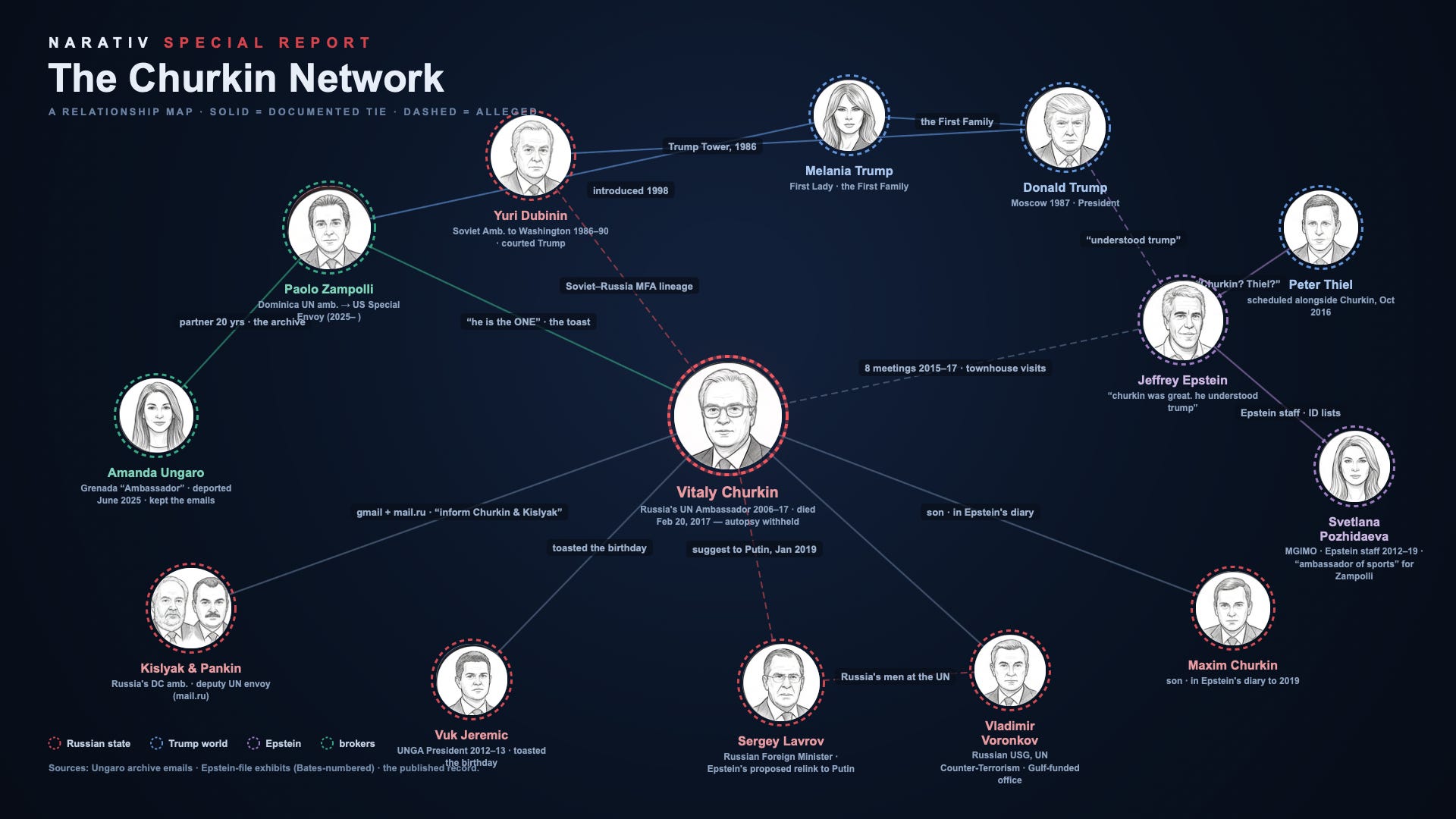
Coincidence Takes a Lot of Planning
3w ago00:37:47Tap to summarizeJacob Kaarsbo spent a career inside Danish military intelligence. From 2005 to 2007, on loan to Denmark’s foreign ministry, he sat at the United Nations Security Council during Denmark’s rotating turn — working Kosovo, Bosnia and Georgia, and meeting Russia’s ambassador Vitaly Churkin more than once a week, in the open sessions and the closed chambers behind them. “He didn’t look like your typical Russian diplomat,” he said. “He looked quite fit… He spoke English really well.” Churkin, he said, was “a pro.”Then Zev asked the question the whole story turns on: diplomat, or intelligence officer? Kaarsbo did not hedge. “Exactly,” he said. Churkin carried the diplomatic dossier and, in Kaarsbo’s assessment, “another dossier where he was likely an intelligence professional — also an operative.” A spy in an ambassador’s chair, and a good one.Kaarsbo learned the rest the way most people did — later. Churkin dropped dead in New York in February 2017, a month after Donald Trump’s inauguration. No U.S. autopsy followed; the Russians handled it. “His cause of death could be anything, because we only know this from the Russians,” Kaarsbo said. Then he offered the line that framed the hour: “Coincidence takes a lot of planning.”He went further than Zev expected. Shown the shape of the network — Churkin to Epstein, Epstein to Trump, the same names surfacing again and again — Kaarsbo named it plainly. “This is indeed a Russian operation,” he said. He described the method he knows from the inside: Moscow gathers a little compromise, leans on it for more, and wraps a “treasonous web” around a target who may not, at first, know he is caught. When Zev raised the counter-narrative — Vice President JD Vance’s claim that the Epstein affair is “all Mossad and CIA” — Kaarsbo waved it off. Every time he digs, he said, the same thing surfaces. “It was not a hoax. It’s Russia. It’s all over.”To reach the root, Zev went back to 1983. He played a clip of the former KGB officer Yuri Shvets describing how the KGB moved to cultivate Trump — through the Soviet ambassador Yuri Dubinin and his daughter, whom Shvets believed to be an intelligence officer — and found in Trump “the ideal target”: vanity, narcissism, greed. Churkin, in those same years, helped organize Trump’s 1987 trip to Moscow. Kaarsbo said he had watched the same Shvets interviews before he published his own book in March, which traced the economic links; the Epstein files, released afterward, “put everything into perspective. It does add up.” Watch the interview with Yuri Shvets below (Paid subscribers)This post has bonus content for paid subscribers. Upgrade to get full access.Paolo Zampolli — the Italian who represented a Caribbean island at the UN, moved in the trade of black-market diplomatic passports Kaarsbo described, and stood closest of all to Churkin — is the man who brought Melania to America and now serves in Trump’s government. Kaarsbo placed the recent Budapest trip: Zampolli traveled there with the Vice President to rally the crowd behind Viktor Orbán. Zev put the stakes to a European: if a Danish first lady kept a decades-long friend who was a Russian operative, wouldn’t it be the only story in the country? “Of course,” Kaarsbo said. What baffles him is the silence — a party and its institutions that look at “obvious, obvious, deep links” and do nothing.Zev closed on the scale. Fifty years, one operation, kept quiet and effective — America caught off guard. Kaarsbo reached for John Bolton’s image: the Kremlin “drinking vodka straight out of the bottle” over what it pulled off. “It is actually a remarkable intelligence operation,” he said, “and one of the most successful.” Then, once more, the line: coincidence takes a lot of planning.Thank you Nick G, A Dude On The Couch, Lori Modafferi, Dominique, Patricia Wren, Deborah J., and many others for tuning into my live video with Jacob Kaarsbo! Join me for my next live video in the app. This is a public episode. If you'd like to discuss this with other subscribers or get access to bonus episodes, visit www.narativ.org/subscribe
Transcribe →
The Tiger Was Never the Point
4w ago00:30:40Tap to summarizeThis is a free preview of a paid episode. To hear more, visit www.narativ.orgZev opened on a tell. Weeks ago, the First Lady of the United States walked before the press corps, unannounced, and denied a relationship with Jeffrey Epstein and Ghislaine Maxwell that no one had accused her of having. She read a statement. She walked away. Zev Shalev played the clip and named the oddity: Melania Trump does not answer tweets, and she …
Transcribe →