
Podcast
Neural Search Talks — Zeta Alpha
Hosted by Zeta Alpha · EN
A monthly podcast where we discuss recent research and developments in the world of Neural Search, LLMs, RAG and Natural Language Processing with our co-hosts Jakub Zavrel (AI veteran and founder at Zeta Alpha) and Dinos Papakostas (AI Researcher at Zeta Alpha).
11episodes
Episodes
Newest firstAll episodes

AGI vs ASI: The future of AI-supported decision making with Louis Rosenberg
Dec 16, 202400:54:42Tap to summarizeIn this episode of Neural Search Talks, we have invited Louis Rosenberg, CEO of Unanimous.AI, to discuss the future of AI in decision-making, contrasting the development of artificial superintelligence (ASI) with collective human intelligence systems, such as swarm intelligence. In particular, Louis argues that the advancement of AI should focus on amplifying human intelligence rather than replacing it, drawing from the biological inspiration found in nature, where species evolve by connecting individuals into systems that function as a singular intelligent entity, exemplified by schools of fish and swarms of bees. Tune into our conversation to learn more about how AI can assist humans in disseminating knowledge and making better decisions! Check out the Zeta Alpha Neural Discovery platform: https://zeta-alpha.com Subscribe to the Zeta Alpha calendar to not miss out on any of our events: https://lu.ma/zeta-alpha Timestamps: 0:00 Intro by Jakub Zavrel 2:08 Using AI to amplify human intelligence 18:19 How AI and humans learn from each other 26:41 Scaling human collaboration with AI 40:13 Satisfying information needs with AI 45:57 How Unanimous AI connects experts to make better decisions 51:37 Predictions for AI progress in one year 53:21 Outro
Transcribe →
EXAONE 3.0: An Expert AI for Everyone (with Hyeongu Yun)
Nov 22, 202400:24:57Tap to summarizeIn this episode of Neural Search Talks, we welcome Hyeongu Yun from LG AI Research to discuss the newest addition to the EXAONE Universe: EXAONE 3.0. The model demonstrates strong capabilities in both English and Korean, excelling not only in real-world instruction-following scenarios but also achieving impressive results in math and coding benchmarks. Hyeongu shares the team's approach to the development of this model, revealing key training factors that contributed to its success while also highlighting the challenges they faced along the way. We close this episode off with a look at EXAONE's future, as well as Hyeongu's perspective on the evolving role of AI systems. Check out the Zeta Alpha Neural Discovery platform. Subscribe to the Zeta Alpha calendar to not miss out on any of our events! Sources: - https://lgresearch.ai/blog/view?seq=460 - https://huggingface.co/LGAI-EXAONE/EXAONE-3.0-7.8B-Instruct - https://arxiv.org/abs/2408.03541 Timestamps: 0:00 Intro by Jakub Zavrel 1:37 The journey of the EXAONE project 4:34 The main challenges in the development of EXAONE 3.0 6:37 The secret to achieving great bilingual performance in English & Korean 7:51 How EXAONE 3.0 stacks against other open-source models 9:20 The trade-off between instruction-following and reasoning skills 12:32 How will retrieval and generative models evolve in the future 16:36 Open sourcing and user feedback on EXAONE 19:20 The role of synthetic data in model training 20:57 The role of LLMs as evaluators 23:16 Outro
Transcribe →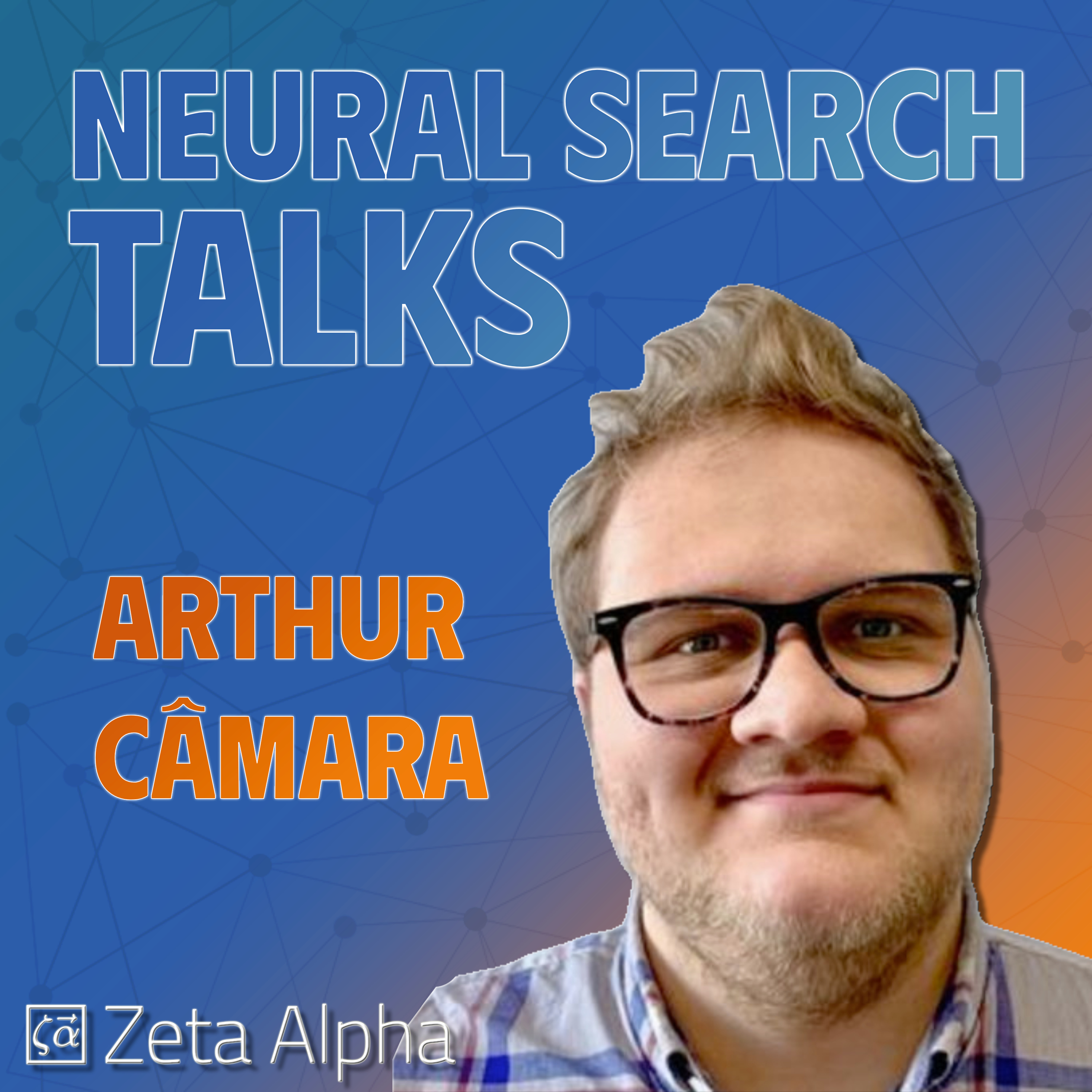
Zeta-Alpha-E5-Mistral: Finetuning LLMs for Retrieval (with Arthur Câmara)
Nov 14, 202400:19:35Tap to summarizeIn the 30th episode of Neural Search Talks, we have our very own Arthur Câmara, Senior Research Engineer at Zeta Alpha, presenting a 20-minute guide on how we fine-tune Large Language Models for effective text retrieval. Arthur discusses the common issues with embedding models in a general-purpose RAG pipeline, how to tackle the lack of retrieval-oriented data for fine-tuning with InPars, and how we adapted E5-Mistral to rank in the top 10 on the BEIR benchmark. ## Sources InPars https://github.com/zetaalphavector/InPars https://dl.acm.org/doi/10.1145/3477495.3531863 https://arxiv.org/abs/2301.01820 https://arxiv.org/abs/2307.04601 Zeta-Alpha-E5-Mistral https://zeta-alpha.com/post/fine-tuning-an-llm-for-state-of-the-art-retrieval-zeta-alpha-s-top-10-submission-to-the-the-mteb-be https://huggingface.co/zeta-alpha-ai/Zeta-Alpha-E5-Mistral NanoBEIR https://huggingface.co/collections/zeta-alpha-ai/nanobeir-66e1a0af21dfd93e620cd9f6
Transcribe →
ColPali: Document Retrieval with Vision-Language Models only (with Manuel Faysse)
Sep 27, 202400:34:48Tap to summarizeIn this episode of Neural Search Talks, we're chatting with Manuel Faysse, a 2nd year PhD student from CentraleSupélec & Illuin Technology, who is the first author of the paper "ColPali: Efficient Document Retrieval with Vision Language Models". ColPali is making waves in the IR community as a simple but effective new take on embedding documents using their image patches and the late-interaction paradigm popularized by ColBERT. Tune in to learn how Manu conceptualized ColPali, his methodology for tackling new research ideas, and why this new approach outperforms all classic multimodal embedding models. A must-watch episode! Timestamps: 0:00 Introduction with Jakub & Manu 4:09 The "Aha!" moment that led to ColPali 7:06 Challenges that had to be solved 9:16 The main idea behind ColPali 13:20 How ColPali simplifies the IR pipeline 15:54 The ViDoRe benchmark 18:23 Why ColPali is superior to CLIP-based retrievers 20:41 The training setup used for ColPali 24:00 Optimizations to make ColPali more efficient 29:00 How ColPali could work with text-only datasets 31:21 Outro: The next steps for this line of research
Transcribe →
Using LLMs in Information Retrieval (w/ Ronak Pradeep)
Aug 16, 202400:22:15Tap to summarizeIn this episode of Neural Search Talks, we're chatting with Ronak Pradeep, a PhD student from the University of Waterloo, about his experience using LLMs in Information Retrieval, both as a backbone of ranking systems and for their end-to-end evaluation. Ronak analyzes the impact of the advancements in language models on the way we think about IR systems and shares his insights on efficiently integrating them in production pipelines, with techniques such as knowledge distillation. Timestamps: 0:00 Introduction & the impact of the LLM day in SIGIR 2024 2:11 The perspective of the IR community on LLMs 6:10 Language models as backbones for Information Retrieval 13:49 The feasibility & tricks for using LLMs in production IR pipelines 20:11 Ronak's hidden gems from the SIGIR 2024 programme 21:36 Outro
Transcribe →
Designing Reliable AI Systems with DSPy (w/ Omar Khattab)
Aug 9, 202400:59:57Tap to summarizeIn this episode of Neural Search Talks, we're chatting with Omar Khattab, the author behind popular IR & LLM frameworks like ColBERT and DSPy. Omar describes the current state of using AI models in production systems, highlighting how thinking at the right level of abstraction with the right tools for optimization can deliver reliable solutions that extract the most out of the current generation of models. He also lays out his vision for a future of Artificial Programmable Intelligence (API), rather than jumping on the hype of Artificial General Intelligence (AGI), where the goal would be to build systems that effectively integrate AI, with self-improving mechanisms that allow the developers to focus on the design and the problem, rather than the optimization of the lower-level hyperparameters. Timestamps: 0:00 Introduction with Omar Khattab 1:14 How to reliably integrate LLMs in production-grade software 12:19 DSPy's philosophy differences from agentic approaches 14:55 Omar's background in IR that helped him pivot to DSPy 25:47 The strengths of DSPy's optimization framework 39:22 How DSPy has reimagined modularity in AI systems 45:45 The future of using AI models for self-improvement 49:41 How open-sourcing a project like DSPy influences its development 52:32 Omar's vision for the future of AI and his research agenda 59:12 Outro
Transcribe →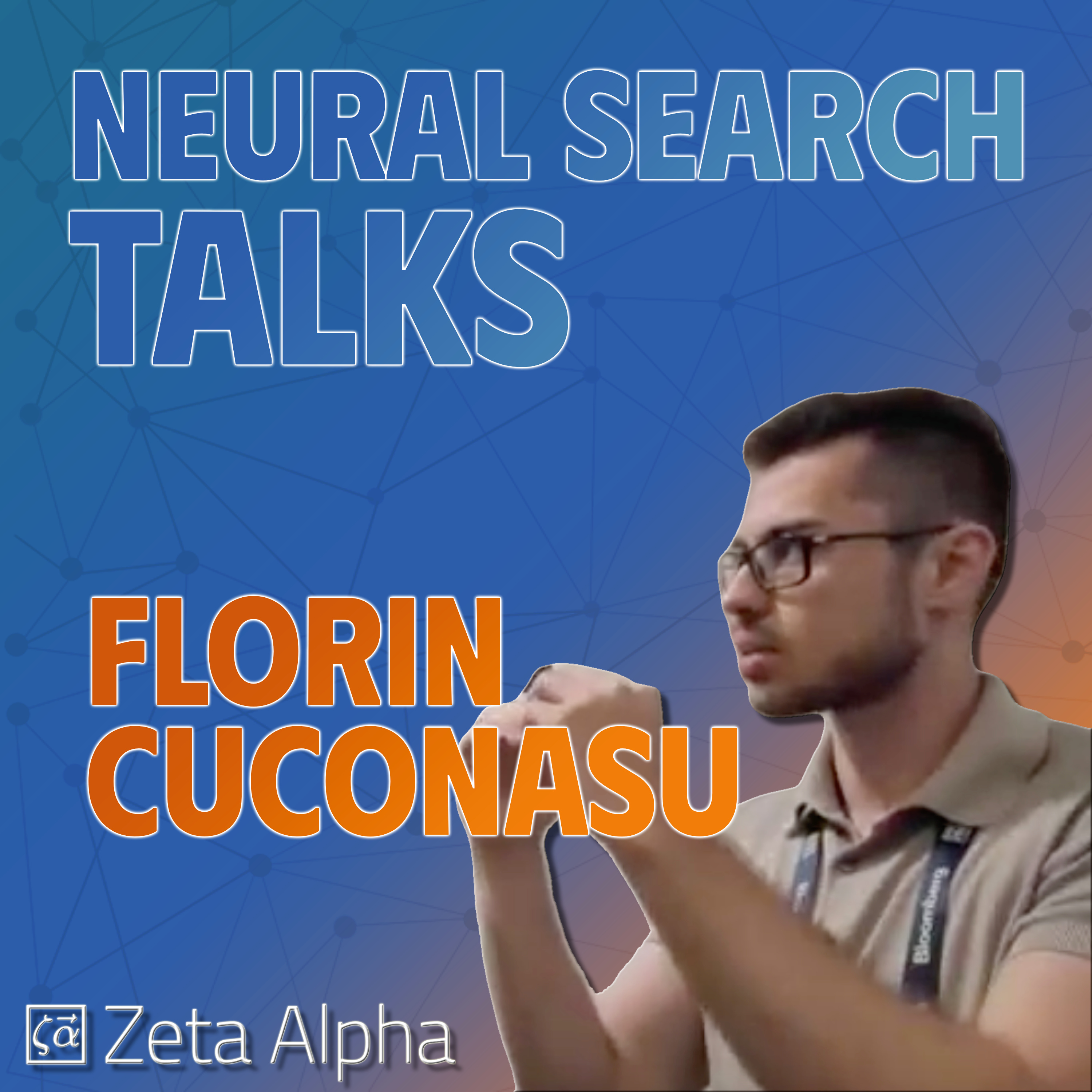
The Power of Noise (w/ Florin Cuconasu)
Aug 2, 202400:11:45Tap to summarizeIn this episode of Neural Search Talks, we're chatting with Florin Cuconasu, the first author of the paper "The Power of Noise", presented at SIGIR 2024. We discuss the current state of the field of Retrieval-Augmented Generation (RAG), and how LLMs interact with retrievers to power modern Generative AI applications, with Florin delivering practical advice for those developing RAG systems, and laying out his research agenda for the near future. Timestamps: 0:00 Introduction & how RAG has taken over the IR literature 1:40 How retrievers and LLMs interact in Retrieval-Augmented Generation 2:55 What practitioners should pay attention to when developing RAG systems 5:04 What is the power of noise in the context of RAG? 7:31 Florin's long-term research agenda on RAG interactions 9:25 How advances in LLMs can impact IR research 11:26 Outro
Transcribe →
Benchmarking IR Models (w/ Nandan Thakur)
Jul 26, 202400:21:55Tap to summarizeIn this episode of Neural Search Talks, we're chatting with Nandan Thakur about the state of model evaluations in Information Retrieval. Nandan is the first author of the paper that introduced the BEIR benchmark, and since its publication in 2021, we've seen models try to hill-climb on the leaderboard, but also fail to outperform the BM25 baseline in subsets like Touché 2020. Plus some insights into what the future of benchmarking IR systems might look like, such as the newly announced TREC RAG track this year. Timestamps: 0:00 Introduction & the vibe at SIGIR'24 1:19 Nandan's two papers at the conference 2:09 The backstory of the BEIR benchmark 5:55 The shortcomings of BEIR in 2024 8:04 What's up with the Touché 2020 subset of BEIR 11:24 The problem with overfitting on benchmarks 13:09 TREC-RAG: the future of IR benchmarking 17:34 MIRACL & the importance of multilinguality in IR 21:38 Outro
Transcribe →
Baking the Future of Information Retrieval Models
Apr 19, 202400:27:05Tap to summarizeIn this episode of Neural Search Talks, we're chatting with Aamir Shakir from Mixed Bread AI, who shares his insights on starting a company that aims to make search smarter with AI. He details their approach to overcoming challenges in embedding models, touching on the significance of data diversity, novel loss functions, and the future of multilingual and multimodal capabilities. We also get insights on their journey, the ups and downs, and what they're excited about for the future. Timestamps: 0:00 Introduction 0:25 How did mixedbread.ai start? 2:16 The story behind the company name and its "bakers" 4:25 What makes Berlin a great pool for AI talent 6:12 Building as a GPU-poor team 7:05 The recipe behind mxbai-embed-large-v1 9:56 The Angle objective for embedding models 15:00 Going beyond Matryoshka with mxbai-embed-2d-large-v1 17:45 Supporting binary embeddings & quantization 19:07 Collecting large-scale data is key for robust embedding models 21:50 The importance of multilingual and multimodal models for IR 24:07 Where will mixedbread.ai be in 12 months? 26:46 Outro
Transcribe →
Hacking JIT Assembly to Build Exascale AI Infrastructure
Apr 19, 202400:38:04Tap to summarizeAsh shares his journey from software development to pioneering in the AI infrastructure space with Unum. He discusses Unum's focus on unleashing the full potential of modern computers for AI, search, and database applications through efficient data processing and infrastructure. Highlighting Unum's technical achievements, including SIMD instructions and just-in-time compilation, Ash also touches on the future of computing and his vision for Unum to contribute to advances in personalized medicine and extending human productivity. Timestamps: 0:00 Introduction 0:44 How did Unum start and what is it about? 6:12 Differentiating from the competition in vector search 17:45 Supporting modern features like large dimensions & binary embeddings 27:49 Upcoming model releases from Unum 30:00 The future of hardware for AI 34:56 The impact of AI in society 37:35 Outro
Transcribe →