← Neuroscience Meets Social and Emotional Learning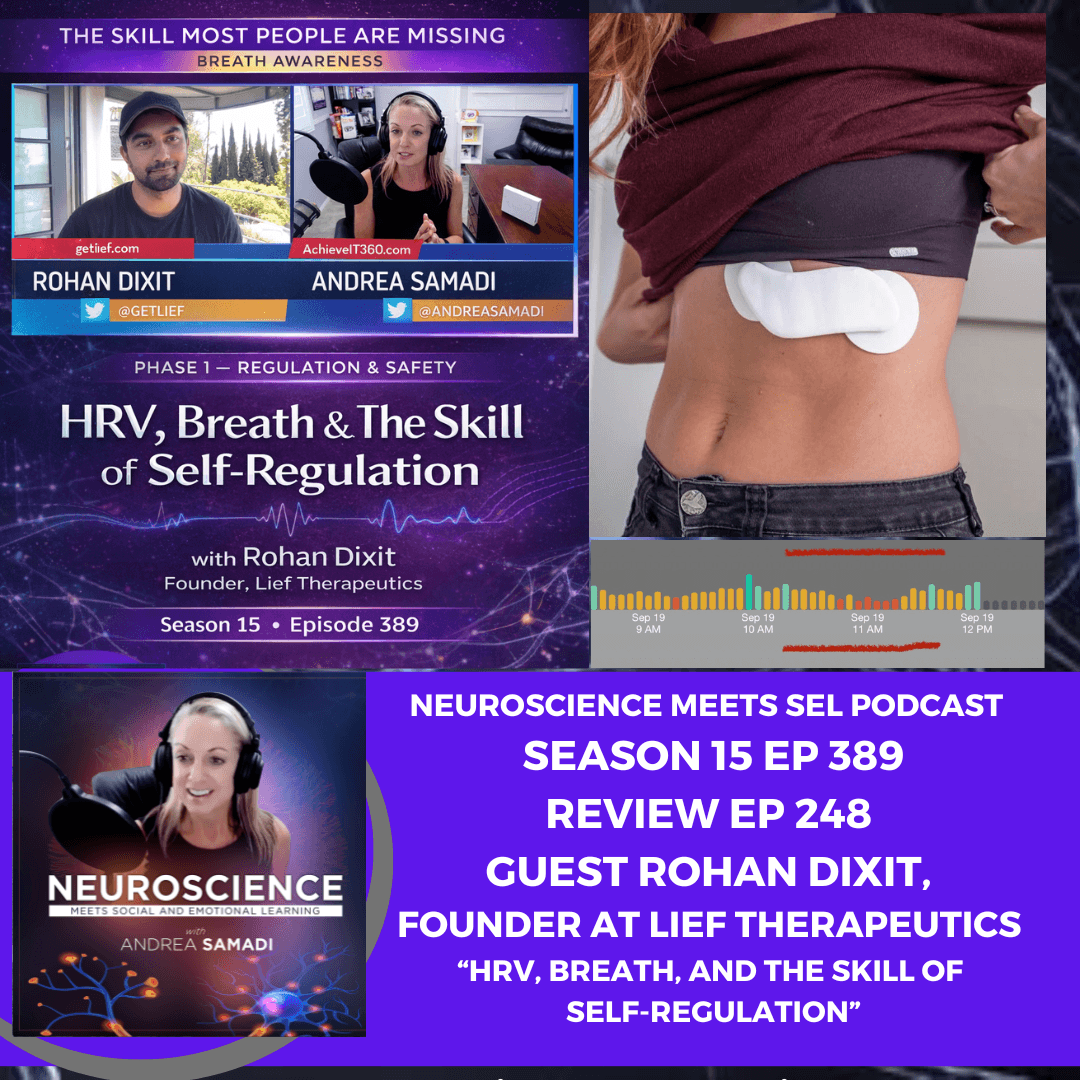
Neuroscience Meets Social and Emotional Learning
Breathe to Reset: How HRV Tech Reveals Hidden Stress (Rohan Dixit)
00:17:07
Loading summary
Transcript38 lines
- [00:03]
A
Welcome Back to season 15 of the Neuroscience Meets Social and Emotional Learning Podcast. I'm Andrea Samadhi, and it's here that we bridge the science behind social and emotional learning, emotional intelligence, and practical neuroscience so we can create measurable improvements in well being, achievement, productivity and results. Now, when we first launched this podcast seven years ago, it was driven by a question that I'd never been taught to ask. Not in school, not in business, and not in life. If results matter, and they matter now more than ever before, how exactly are we using our brain to make these results happen? And most of us were never taught what to do. Very few of us were taught how to think and under pressure, how to regulate our emotion, how to sustain our motivation, or even how to produce consistent results without burning out. And that question led me into a deep exploration of the mind, brain, results connection, and how neuroscience applies to everyday decisions, to our conversations and to our performance. And that's why this podcast exists.
- [01:27]
B
Each week, we bring you leading experts to break down complex science and translate it into practical strategies that we can all apply immediately. And in season 15, we've organized it as a review roadmap, where each episode explores one foundational brain system and each phase builds on the one before it.
- [01:52]
A
And in phase one, regulation and safety, we're asking one essential question. Is the nervous system safe enough to learn? And so far, we've revisited Dr. Bellangelal on curiosity, sleep, imagination and creativity. We looked at Dr. Bruce Perry on trauma, rhythm and relational safety. Dr. Sui Wong on autonomic balance, lifestyle medicine and brain resilience. And today we turn to one of my favorite episodes. It was episode 248 with Rohan Dixit, the founder of Leaf Therapeutics, where we explored how a deeper understanding of heart rate variability, or hrv, can help us to sharpen our awareness of stress recovery and resilience.
- [02:43]
B
And what stood out most to me about Rohan's work was that his wearable device was never meant to become something that we depend on forever. Instead, it was designed to help people to learn how to breathe and regulate themselves in real time, so that eventually they can recognize stress, anxiety and overwhelm on their own and know how to calm their body without needing the device. And at the heart of Rohan's mission is something much bigger than technology. It's about helping people to build the skills to manage stress in healthier ways without over relying on medication or quick
- [03:21]
A
fixes or habits that may bring short
- [03:24]
B
term relief, but create long term harm. So this episode reminds us that self regulation is a skill and when we learn to read the signals of the body, we can begin to build the safety and stability that the brain needs for learning, for healing and for growth. So in clip one, before we actually
- [03:45]
A
looked at the device that Rohan had created to improve our HRV in real time, I asked Rohan, what are we missing that could help us to handle life's pressures better? What do you think people are missing? And here's how he responded.
- [04:02]
B
What are most of us missing that could help us handle life's pressures better?
- [04:07]
A
Without even starting what your device does,
- [04:09]
B
what are we missing?
- [04:10]
C
Yeah, I mean, I would say for most people the number one thing is to become more aware of your breath and how you're maybe holding your breath or changing your breathing pattern throughout the day.
- [04:20]
B
That's huge, Rohan, because I never noticed I do this, but when I'm stressed, I hold my breath and I'm just
- [04:27]
A
like, I look at myself in some of my earlier interviews, like I'd say
- [04:31]
B
0 to 50, I'm holding my breath
- [04:33]
A
and I'm like, why wasn't I breathing?
- [04:36]
B
So weird.
- [04:36]
C
You're a pro now. But I feel like a lot of people don't. Yeah, we think about a lot. But has such a huge impact on your mental health and your state of mind. Just breathing.
- [04:48]
B
Some key takeaways now from clip 1. Takeaway 1. Most people are unaware of how they breathe. Many of us unintentionally hold our breath or change our breathing patterns when we're stressed or focused or overwhelmed. And I notice that I do this and the worst time to do this is right before sleep if my stress levels have been unusually high. And the first step to improving this is is to notice how you breathe. Takeaway 2. Breath is directly connected to our nervous system. When breathing becomes shallow or paused, it can signal the body that we're under stress and it activates the sympathetic fight or flight response. Have you ever noticed having a hard time catching your breath at a time when you know you should be resting?
- [05:39]
A
And I have and just noticing this
- [05:41]
B
and talking about it was the first step that I took to making a change to better man manage whatever it was that was stressing me out at that time. Takeaway 3 Breath awareness is the first step to self regulation. Simply noticing how you're breathing throughout the day can dramatically improve your ability to regulate stress. And I never had paid attention to how I was breathing until I wore the Leaf Therapeutic HRV monitor. Takeaway 4. Small breathing changes can influence our mental health. Intentional breathing can shift the body towards the parasympathetic rest and recover state, improving calm focus and emotional balance. And it really did make an impact to notice when my breathing was shallow or when I was holding my breath. Once I could see this pattern, I was able to practice the steps we'll talk about next to bring myself back to calm.
- [06:41]
A
So how do we put these key takeaways into action? Tip 1 Notice your breath throughout the day. You can either set a reminder on your phone three to five times a day and pause and ask am I holding my breath? Is my breathing shallow? Am I breathing through my chest or my diaphragm? From deep down, awareness is the first step towards change and it looks like since our last interview. The LEAF device now uses AI to help you to change your breathing when you're under stress. And I had never paid attention to my breath throughout the day before I actually hooked up this device and I noticed where my patterns were quickly and easily so I could make the changes.
- [07:26]
B
Tip 2 Practice the physiological sigh. This is a science backed breathing reset. You inhale through your nose and then you take a second short inhale. So two inhales and then slowly exhale through the mouth and repeat this three to five times to quickly reduce stress. American neuroscientist Dr. Andrew Huberman has covered the physiological sigh often on his podcast and he explains how these two quick inhales followed by one long exhale can in real time make a significant impact on your stress levels. Tip 3 Try five minutes of slow breathing. Research shows that five to six breaths per minute can increase our heart rate variability and calm the nervous system. So inhale for 4 to 5 seconds and exhale for 5 to 6 seconds. Tip 4 Watch for breath holding during stress. Common moments when people hold their breath when they're working intensely, when they're reading email, when they're speaking, driving in traffic, or for me, when I'm recording a podcast interview or right before sleep. Once you notice it, begin to exhale slowly to reset your breathing.
- [08:50]
A
Now just a summary.
- [08:51]
B
Most people don't realize when they're holding their breath when they're stressed. Rohan Dixit explains that simply becoming aware of our breathing patterns can dramatically improve stress regulation, mental clarity and emotional balance. Learning to breathe intentionally is one of the simplest ways to support the nervous system.
- [09:13]
A
Now moving to our second clip together, I shared with Rohan that I noticed something surprising about my breathing before going to sleep. Now, since this podcast was originally recorded in 2022, I've had time now to reflect on this moment that I talked to him about. Preparing for this episode. And I can say that even now I still occasionally notice this pattern before sleep. It's something I continue to work on because breath work isn't something you practice once and then forget it. It's an ongoing awareness and sleep skill. Now my aha moment came when I began noticing my stress levels right before bedtime. So listen in clip 2 what I mentioned to Rohan I've noticed recently before I go to sleep. Like all of life's pressures seem to hit me at night before I close my eyes and I was holding my breath and I started before I used your device. I'm like just take some deep breaths
- [10:09]
B
and let it out.
- [10:10]
A
But then I noticed it started going
- [10:12]
B
off randomly before I was trying to sleep. So that was it. Picking up. You're stressed. Breathe right.
- [10:18]
C
That's a great way to use the leaf, but also just in general to think about stress reduction. A lot of people sit there and lay in bed and are thinking about everything that happened that day and what's going to happen tomorrow. And especially if you're a busy person, there's a lot to have in your mind. So a little bit of breathing before you go to bed can help a lot with sleep quality, which research shows actually helps your anxiety the next day. So there's kind of like all these benefits you get from taking care of yourself at night breathing a little bit.
- [10:44]
B
Some key takeaways from clip 2 takeaway 1 stress often shows up right before sleep. Many people notice when the day slows down and distractions disappear, the mind starts replaying the day or worrying about tomorrow. This mental activity can trigger physical stress responses like holding your breath or shallow breathing. Takeaway two Breath patterns reveal hidden stress from my experience, the LEAF device detected moments of stress even before I consciously noticed them. This highlights how our body often recognizes stress before our minds do. Takeaway 3 breath Work is a practice, not a one time fix. Learning to regulate breathing is an ongoing skill. Even after becoming aware of this pattern, it's something that still requires conscious attention and practice. Takeaway 4 Calming the body improves sleep and the next day. As Rohan explains, taking time to slow your breathing before bed can improve sleep quality, which in turn helps to reduce anxiety and improve emotional regulation the following day. Some action Steps for Clip 2 Create a breathing transition before sleep before getting into bed, spend two to five minutes of slowing your breathing. Simple rhythm. Inhale through the nose for four seconds and exhale slowly for six. And this signals the nervous system that it's safe to relax. Tip 2 Notice nighttime stress signals Pay attention to physical cues like holding your breath, your chest is tightening, racing thoughts or shallow breathing. These signals mean your nervous system is still in daytime alert mode. Tip 3 Try a mind cleanse before bed if your mind is racing at night, write down your thoughts.
- [12:48]
A
What happened today?
- [12:49]
B
What needs attention tomorrow? Anything you're worried about? Getting your thoughts out of your head can reduce your mental load before sleep. Tip 4 Pair breathwork with a habit Attach breathing to something you already do every night turning off your lights, brushing your teeth, or getting into bed. This makes it easier to build a consistent regulation routine.
- [13:14]
A
Just a summary of today's episode. Many people experience their highest stress levels right before sleep, when the mind starts replaying the day and worrying about tomorrow.
- [13:25]
B
Rohan Dixit explains that slowing your breathing
- [13:28]
A
before bed can calm the nervous system, improve sleep quality, and even reduce anxiety the following day. Now, as we wrap up this week's episode, reviewing our 2022 conversation with Rohan Dixit, the founder of Leaf Therapeutics, we're reminded of something incredibly simple but often overlooked. When it comes to managing stress and building resilience, it's our breath that matters. Throughout this conversation, Rohan showed us that one of the most powerful ways to understand our nervous system is by paying attention to the signals our body gives us throughout the day.
- [14:11]
B
One of the clearest signals is our breathing patterns. Many of us unknowingly hold our breath or shift into shallow breathing when we're under pressure, when we're focused or overwhelmed. And I definitely do this. What I found fascinating about the Leaf device was that it helped to bring awareness to something most of us never notice. By tracking our heart rate variability, our HRV and our breathing patterns in real time, the device can gently alert you to when your body is moving into a stress state state, encouraging you to slow your breathing and regulate your nervous system. But the real takeaway from this conversation isn't about the technology itself. As Rohan explained, the goal of the device is not long term dependence, it's learning over time. The aim is for people to develop the awareness and skills needed to regulate their stress naturally without needing a device to tell them when to breathe. And this episode also highlights an important truth that we've explored through this Phase one of regulation and safety. The brain cannot perform, learn or grow if the nervous system is stuck in a chronic state of stress. When we improve our ability to regulate stress through breathing, sleep, recovery and awareness, we create the internal conditions that allow learning, creativity and performance to emerge.
- [15:44]
A
And sometimes the most powerful tools for doing that are the simplest ones that we already have our breath. So as we move forward in this season, remember this. Before we talk about motivation, productivity or peak performance, we must first ask the foundational question that we're exploring here in Phase one. Is the nervous system safe enough to learn? Learning to notice and regulate our breathing may be one of the simplest ways to start answering that question. And you can review our interview with Rohan Dixit from 2022. You can see the full interview in the resource section below and we'll see you next time as we go on to review our interview with Dr. Kristen Holmes, the VP of Performance Science from Woop. See you next time.
- [16:39]
D
If you're enjoying the Neuroscience meets Social and Emotional Learning podcast, please don't forget to subscribe so you'll stay up to date with our new episodes. While you're there, please feel free to give us a review or a five star rating as it helps others find us. For more information on our programs, books and tools for schools and the workplace, Visit us at www. AchieveIt360.Com.