← Neuroscience Meets Social and Emotional Learning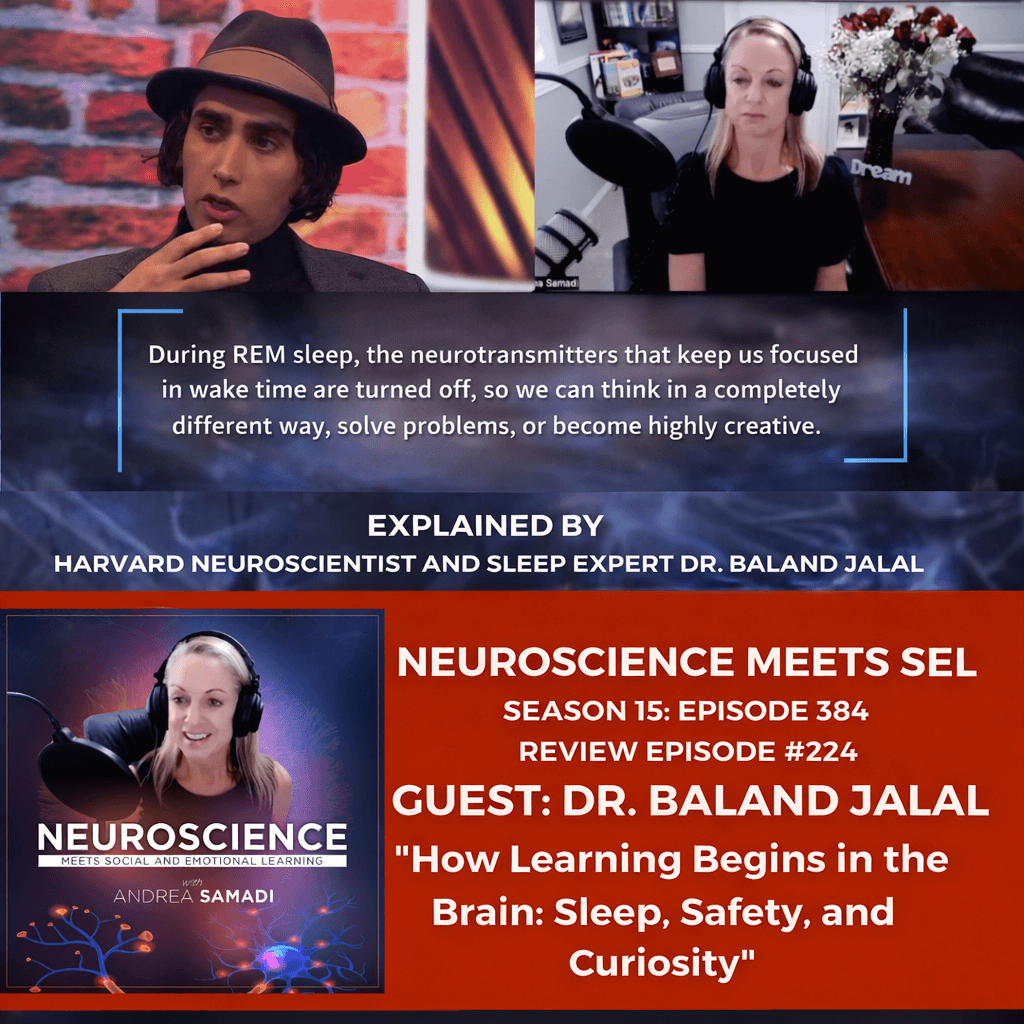
Neuroscience Meets Social and Emotional Learning
How Learning Begins in the Brain: Sleep, Safety and Curiosity (Revisiting Dr. Baland Jalal)
00:26:17
Loading summary
Transcript6 lines
- [00:02]
A
Welcome Back to season 15 of the Neuroscience Meets Social and Emotional Learning Podcast. I'm Andrea Samadhi, and it's here that we bridge the science behind social and emotional learning, emotional intelligence, and practical neuroscience, so we can create measurable improvements in well being, achievement, productivity and results. When we launched this podcast seven years ago, it was driven by a question I had never been taught to ask. Not in school, not in business, and not ever in life. If results matter, and they matter now more than ever before, how exactly are we using our brain to make these results happen? And most of us were never taught what to do. Very few of us were taught how to think under pressure, how to regulate our emotions, or how to sustain motivation, or even how to produce consistent results without burning out. And that question led me into a deep exploration of the mind, brain, results, connection, and how neuroscience applies to everyday decisions, our conversations, and most importantly, our performance. And that's why this podcast exists. Each week we bring you leading experts to break down complex science and translate this science into practical strategies that we can all use and apply immediately. And if you've been with us through season 14, you may have felt something shift. That season wasn't about just collecting ideas. It was about integrating these ideas into our daily life. Across conversations on neuroscience, social and emotional learning, sleep, stress, exercise, nutrition, and mindset frameworks, all from voices like Bob Proctor, Jose Silva, Dr. Church, Dr. John Medina and others, one thing became very clear. These aren't separate tools. They're all a part of one operating system. When the brain, body and our emotions are aligned, performance stops feeling forced and it starts to feel sustainable. Season 14 showed us what alignment looks like in real life. And now we move into season 15. That's all about understanding how that alignment is built so we can build it ourselves using predictable science backed principles. Because alignment doesn't happen all at once. It happens by using a sequence, by repeating the sequence over and over again until magically or predictably, we notice our results have changed. So this season, we're revisiting past conversations, not to repeat them, but to understand how they fit together so we can replicate them ourselves. Because the brain doesn't develop skills in isolation, learning doesn't happen in isolation. And neither does performance, resilience or well being. The brain operates as a set of interconnected systems. When one system is out of balance, everything else is affected. So season 15 we've organized as a review roadmap, where each episode explores one foundational brain system and each phase builds on the one before it. We're going to cover phase one, Regulation and safety. Phase two, we'll move into neurochemistry and motivation. Phase three, movement, learning and cognition. Phase four, perception, emotion, and social intelligence. And we'll end up with phase five, integration, insight, and meaning. But today, we begin with phase one, regulation and safety. Because before learning can happen, before curiosity can emerge, before motivation or growth is possible, the brain must feel safe. And that's where we are today. As we embark on this journey together, I encourage all of us to take notes and apply what each phase is encouraging us to do. This is not just for you, the listener. I'm going right back myself and revisiting each interview with a new lens. So for Today's episode number 384, we go back to episode 224, recorded in June of 2022, featuring Danish neuroscientist Dr. Balan Jalal. He's a researcher, author, and one of the world's leading experts on sleep paralysis. Just to give you a reminder of his background, Dr. Jalal is a neuroscientist affiliated with Harvard University's Department of Psychology, and he was previously a visiting researcher at Cambridge University's Medical school, where he earned his PhD and his work has been featured in many places. New York Times, Washington Post, BBC, NBC News, and many others. Since our original interview, I've watched Dr. Jalal's influence expand globally. Most recently, he appeared on Jordan B. Peterson's podcast discussing dreams, nightmares and neuroscience. And he was also on Lewis Howe's School of Greatness podcast, where he explored dreams, lucid dreaming, and the neuroscience of consciousness, an episode that truly stretched Lewis Howe's thinking. That's a good one to watch. Now, what stood out to me the most then and now was Dr. Jalal's transparency about learning. At the beginning of his interview with Lewis Howes, Dr. Jalal shared how a single experience, his desire to understand his own episodes of sleep paralysis more than 20 years ago sparked a lifelong curiosity for him. And it was that curiosity that led him to his local library in Copenhagen. And it ultimately transformed his entire career path in ways he never could have imagined. So as a young man spending time on the streets playing soccer, and that honestly, deeply resonated with me. Before there was Google, I remember sitting in a local library in Arizona around that same time, trying to understand the mysteries of the world all the way from the pyramids to Stonehenge, reading everything I could get my hands on. Like Dr. Jalal, I was curious about many things I didn't understand. But my path didn't start with neuroscience or learning science, which came later for me, we all begin somewhere. So let's go to our first clip from Dr. Bilan Jalal, where he shares how his love of learning truly began.
- [07:08]
B
I always hated books. I thought books were so boring. You know, I'd rather hang out in the streets and just play soccer and things like that. But I then started to sort of look into books, and I found, wow, you know, psychology and the brains kind of interesting, you know, learning about why we do certain behaviors, you know, why we think in certain way, and how the brain works. And then I realized I was just reading and reading more books, and I would just hang out in the, you know, the library instead of, you know, the streets, you know, and, yeah, so that. That was really cool. And I. I was kind of hiding it, you know, it's kind of like I was supposed to be the cool kid in school, you know, like the. You know, and then how do you kind of, like, walk with this wagon? Like, having books in your. You know, it kind of didn't fit, but, you know, I made it work. And then eventually, you know, I ended up realizing I'm spending money more times with books and science and why not pursue this further? And I realized when you actually like the material, you know, and what you're doing, and you can become really good at it.
- [08:00]
A
Now, some key takeaways from this first clip. First, curiosity precedes confidence. Expertise rarely begins with certainty. It begins with a question. Dr. Jalal didn't set out to become a neuroscientist. He. He set out to understand his own experiences with sleep paralysis. And this mirrors what many of our experts have shared on this podcast. Doug Fisher, for example, told me that he enrolled in medical school classes simply to better understand how the brain learns best. Curiosity comes first, as Dr. Jalal explains. The more you learn, the clearer your thinking becomes. And. And clarity builds confidence naturally. Takeaway 2. Identity shifts are often private at first. Real growth often begins quietly, long before others notice, before the transformation becomes visible. It happens internally, sometimes even in secrecy. Dr. Jalal hid the books he was reading, unsure how his growing interest would be received. And I remember doing the exact same thing. When I first began to study the brain and learning, I questioned myself constantly. Who was I to explain this topic that I hadn't formally studied in university? Years later, I've read more books on neuroscience than I did during my entire university career. Growth doesn't ask for permission. It asks for commitment. Takeaway 3. Intrinsic motivation changes the brain when learning is driven by genuine interest rather than obligation, engagement deepens, persistence increases, and mastery accelerates. Neuroscience consistently shows that motivation strengthens attention, memory and long term retention. And I was first handed John Medina's Brain Rules book in 2009, nearly a decade before I was to fully read and absorb it. My boss at the time thought I would enjoy it. She had no idea this one book, along with a few others, would eventually inspire me to study the brain deeply enough to launch this podcast. Takeaway 4. You don't need to start as an expert Dr. Jalal's journey reminds us that passion often develops after exposure, not before it. And I clearly remember the fear of making mistakes on our early podcast episodes. I didn't want to admit that I was still learning this topic, and what's refreshing and reassuring is realizing that we all begin in the same place with curiosity. And it's the willingness to keep learning that ultimately determines how far we will go. And Takeaway five. Environment shapes our trajectory. A library, a book. A single moment, small environmental shifts can redirect an entire life. And this idea continues to stand out to me. In 1999, during my first visit to New Orleans, Louisiana, I was riding a trolley from Jackson Square through the French Market when I noticed a young boy. He was maybe around 15 years old. He was on the trolley reading the book Think and Grow Rich by Napoleon Hill. And I'll never forget the determination on this young boy's face that was decades before I would cover this book on this podcast. But I'm certain that moment shaped the future in ways that we'll never truly see. Learning can take place anywhere when there's a will behind your desire. So how do we put these ideas into action? Tip 1 Follow the question that won't let you go. Notice the topics that you keep returning to. That recurring curiosity is often your brain pointing you towards growth. For me, it started with the mysteries of the world. Neuroscience and learning came later, but we all start somewhere. Pay attention to what it is that occupies your thoughts when you have some quiet time. Tip 2 Create a low pressure learning space. Give yourself permission to learn privately without posting online or performing or proving anything to anyone. Learning takes time to organize internally. Journaling or keeping a dedicated notebook will help you to move your ideas from your head onto paper, strengthening your understanding and your reflection. Tip 3 Replace I'm not good at this with I'm interested in this. Interest is a strong predictor of success, more so than talent. Motivation literally rewires attention and memory networks in the brain. I still remember opening how the brain learns by David Souza and then closing it just as quickly, thinking this is way over my head. Give yourself time. Learning settles in layers tip 4 change 1 environment variable spend time where learning naturally happens. Libraries, podcasts, books, long form conversations. The brain will adapt to what it's exposed to repeatedly, so keep your learning time consistent over time as notebooks fill and ideas connect. You'll be amazed at how much this simple daily habit Compounds and tip 5 let your identity catch up later. You don't need to call yourself a scientist, a leader, an expert today. Keep learning. The identity will follow I initially called myself a researcher in the beginning of this podcast, and it took years before I felt comfortable saying that I'm a neuroscience researcher. That big word felt intimidating to me in the beginning, but now it fits because the work came first. And I hope Dr. Jalal's first clip has inspired you to notice what's been quietly calling your attention and to take the first step towards becoming an expert in that area just simply by beginning now. In our second clip with Dr. Belangelal, he takes us into a stage of sleep that I've been fascinated by since my early 20s. It's hypnagogic sleep, and this is the transitional brain state that occurs just before we drift off to sleep, or in those brief moments when we've just woken up and we talk about this around the 30 minute mark of our interview. If you want to revisit that where I shared with Dr. Jalal that years ago I asked a sleep expert why I was seeing what I can only describe as flashes of insight on the screen of my mind right before falling asleep and then again upon waking. And that expert told me to study the term hypnagogic sleep. Dr. Jalal took this idea a step further by explaining that this is not a strange or fleeting state, but it's a highly creative brain state. He explains that during REM sleep, certain neurotransmitters such as noradrenaline, which keep us focused and goal directed during waking life, are significantly reduced. And while those focus chemicals turn down, the brain becomes far more open to connecting unrelated ideas, thinking expansively, and solving problems in novel ways. Dr. Jalal even references Thomas Edison, who famously used this state intentionally. Edison would sit in a chair holding a spoon with a metal plate underneath it, and as he drifted towards sleep, the moment he lost consciousness, the spoon would fall, wake him up, and allow him to capture ideas that surfaced in that brief window of awareness. This hypnagogic state those few seconds before waking and sleeping, is a sweet Spot for creativity, insight and innovation.
- [16:28]
B
During REM sleep, your brain shuts down this chemical. And so your brain is much more open to sort of combining things in a much more creative way because you're no longer as focused. You're more likely to sort of, you know, think in an unfocused manner and link seemingly unrelated things in the world. And that makes you much more creative. It makes you much more likely to just to be more expansive in your, in your way of thinking. I think it was Edison. I always mentioned this. Edison was used to, you know, when he was coming up with his ideas, he would sit on a chair and then he was sort of driven off to sleep with a spoon in his hand and the spoon and underneath his, you know, his chair was this, was this plate. And so as he was drifting off to sleep, he would just kind of think about his ideas and then, and then as he was falling asleep, the spoon would fall down and, and destroy the, the plate and he would wake up. But he had these few seconds of conscious awareness which would make him sort of completely up with new ideas for his work. So it is a very creative and interesting stage of our lives.
- [17:24]
A
Some key takeaways from this clip. Takeaway 1 Hypnagogic sleep is a gateway state. The moments before we fall asleep and just after waking up are neurologically unique. The brain is not fully awake or asleep, making it more flexible and imaginative. Takeaway 2 Reduced focus enables creativity. When neurotransmitters like noradrenaline decrease, the brain becomes less rigid and more associative, allowing ideas to connect in unexpected ways. Takeaway 3 Insight often comes when control loosens. Creativity doesn't come from intense focus. Sometimes it emerges when the brain is allowed to wander without pressure. Takeaway 4 this state can be accessed intentionally. Visionaries like Thomas Edison didn't wait for inspiration. They design conditions to access it deliberately. And takeaway five Many aha moments live here. Those flashes of insight you experience over sleep or upon waking or are not random. They're a byproduct of how the brain reorganizes information during this state. So how do we put these ideas into action? Tip 1. Capture ideas at the edge of sleep. Keep a notebook or a voice memo next to your bed. And if an idea surfaces just before sleep or immediately upon waking, capture it right away. Don't trust yourself to remember it later. Remember this quote by Earl Nightingale. Ideas are like slippery fish. If you don't gaff them on the end of a pen, they'll swim away quickly. Never to be seen again. Many ideas that arrive during this highly creative state won't make sense in the moment, so write them down anyway. What feels fragmented at the time today may reveal meaningful weeks or even months Later. Later. Tip 2 Set an intention before you go to sleep, before drifting off, gently focus on a question or a problem that you'd like insight on. Don't force an answer. Just invite your brain to explore it while you rest. And often clarity emerges when effort steps aside. Tip 3 Protect the wake up window Resist the urge to grab your phone the moment you wake up. Give yourself one or two minutes to notice lingering images, ideas or thoughts before your analytical mind takes over. This brief window can hold surprising insight. Tip 4 Allow unfocused thinking time Creativity thrives when the brain isn't under constant demand. Build in moments of mental looseness. Go for walks, quiet reflection, stillness, or even stepping away for lunch. I'll never forget putting this into practice when I worked in the seminar industry. During our busiest selling days, my colleague Mark would insist on us taking a lunch break and go out to eat, often to the same sushi restaurant down the street. And every time we returned, without fail, there would be a new sale waiting on the fax machine. This was back when we used fax machines. We became convinced that stepping away from the work was a part of what allowed the result to arrive. Trust the subconscious process Some of your best ideas won't come through effort, but through space. Learning to work with your brain's natural rhythms rather than against them can dramatically expand creative output. Whether it's on a walk in the shower, through journaling, or during moments of stillness. Give your subconscious room enough to surface what it already knows. So as we wrap up episode 384 revisiting our 2022 conversation with Dr. Bilan Jalal, what stands out the most to me is not what we learned about sleep or dreams or creativity, but how learning itself unfolds over time. In our first clip, we saw how Dr. Jalal's entire career began, not with certainty or with credentials, but with curiosity. He asked himself a single question, why is this happening to me? That led him from the streets of Copenhagen to the library, and eventually to becoming one of the world's leading experts on sleep paralysis. His story is a reminder that expertise is not something you decide in advance. It's something that emerges when curiosity is given space to grow. In our second clip, we explored the hypnagogic state, that brief window between waking and sleeping where the brain loosens its grip on focus and control in this state, insight becomes possible not because we try harder, but because we try less. Creativity, problem solving, and expansive thinking emerge when the brain is allowed to wander, to connect and reorganize information, all in new ways. And together, these clips tell a powerful story. Learning begins with curiosity. Growth often happens quietly and privately. Creativity emerges when we allow space, space instead of pressure. And some of our most meaningful ideas arrive when we stop forcing them. And this is why conversations like this continue to matter years later. Not because the science has changed, but because we have. And if there's one takeaway from today's episode, it's this. You don't need to know where your curiosity will lead. You only need to honor it long enough to begin. Whether your insights arrive in a library, during a walk or just before sleep, or in the quiet moments you usually rush past, pay attention, write them down, and give them time. Because learning doesn't always announce itself loudly. Sometimes it whispers right before we fall asleep or just as we wake up. And that's where the next chapter often begins. And as we close out today's episode, I want to leave you with one simple idea to carry this forward. Before the brain can learn, before curiosity can expand, before imagination or growth can take hold, the nervous system has to feel safe. What Dr. Belangelal helped us to see today is that sleep, rhythm and regulation aren't nice to have. They're the entry point. When the brain is rested and regulated, it can become curious. When it isn't, it stays in survival mode, no matter how motivated or capable we are. And this is where phase one of season 15 truly begins. Because regulation isn't about fixing what's broken. It's about creating the conditions where learning becomes possible. And next week, episode 385, we'll deepen this conversation with Dr. Bruce Perry, one of the world's leading experts on trauma, brain development, and relational safety. His work reminds us that when we ask, what's wrong with you? We miss the real question, what happened to you? We'll explore how rhythm, relationships, and safety shape the developing brain and why understanding this changes how we approach education, leadership, parenting, and performance. So as we move into the next coming week, notice this. Where does your nervous system feel supported? And where might it be asking for safety? Because everything we build in this season, motivation, learning, resilience, and insight all rests on this foundation. And I'll see you next week for episode 385.
- [25:50]
C
If you're enjoying the Neuroscience meets Social and Emotional Learning podcast, please don't forget to subscribe. So you'll stay up to date with our new episodes. While you're there, please feel free to give us a review or a five star rating as it helps others find us. For more information on our programs, books and tools for schools and the workplace, Visit us at www. AchieveIt360.com.