← Neuroscience Meets Social and Emotional Learning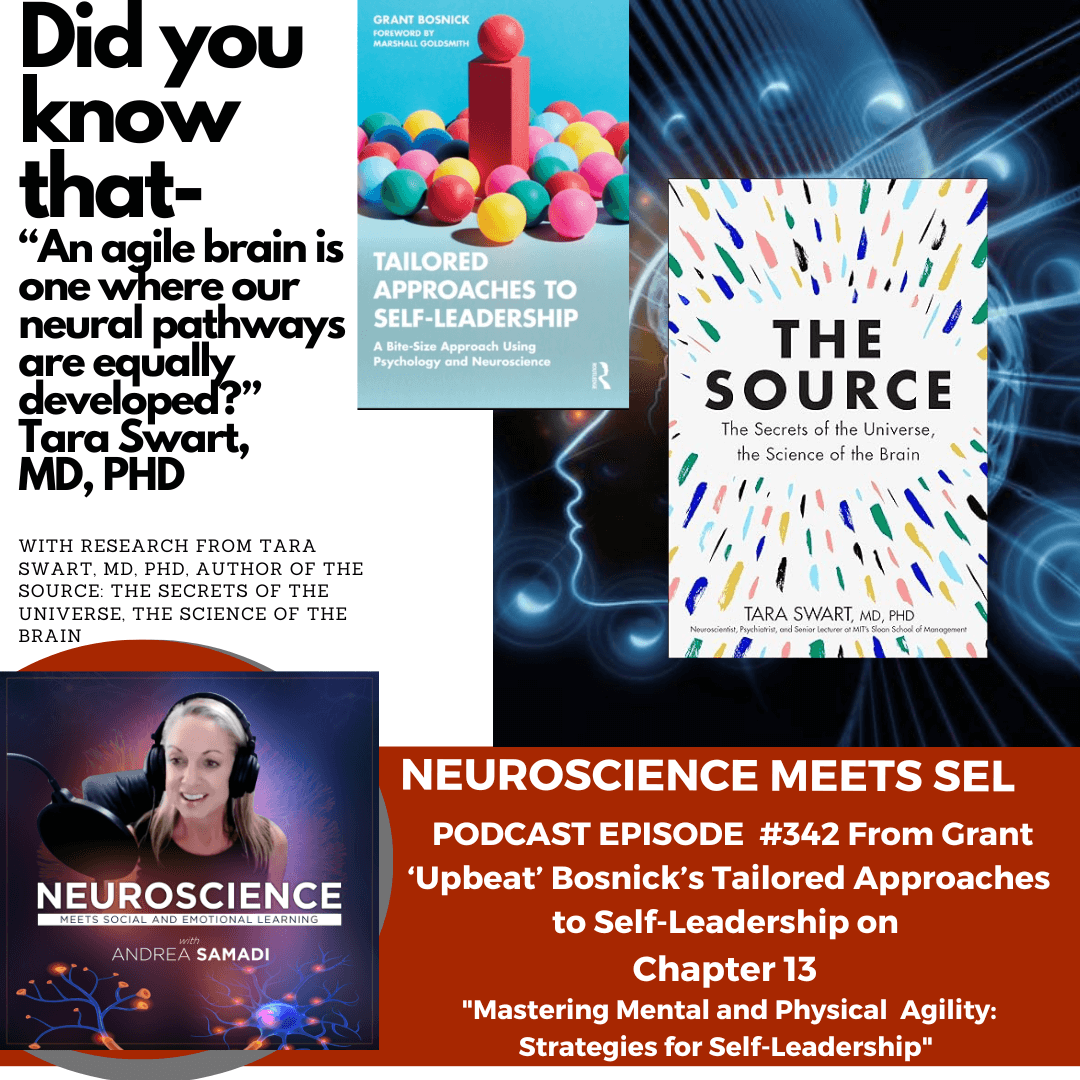
Neuroscience Meets Social and Emotional Learning
Mastering Mental and Physical Agility: Strategies for Self-Leadership Insights from Grant Upbeat Bosnick (Chapter 13)
00:23:44
Loading summary
Transcript2 lines
- [00:00]
A
Foreign welcome Back to season 12 of the Neuroscience Meets Social and Emotional Learning Podcast where we connect the science based evidence behind social and emotional learning and emotional intelligence training for improved well being, achievement, productivity and results using what I saw as the missing link since we weren't taught this when we were growing up in school. The applic of Practical Neuroscience I'm Andrea Samadhi, an author and an educator with a passion for learning and launched this podcast six years ago with the goal of bringing all the leading experts together in one place to help us to apply this research in our daily lives. On Today's episode number 342 we continue with our 18 week self leadership series based on Grant Bosnick's tailored approaches to self leadership that we first dove into with our interview on episode 321, the end of January. The goal was that each week we focused on learning something new from Grant's book tied to the most current neuroscience research that builds off the prior week to help us to take us to Greater Heights in 2024. So far it's taken us eight months to cover the first 13 chapters thoroughly and we still have six chapters to go after this week on agility, we have chapter 14 on resilience, 15 on relationships and authenticity, 16 on biases, 17 on trust, 18 on empathy, and the final chapter 19 and one of my target areas to focus on this year, the topic of presence. When we finish each of these chapters, we'll put them all together with a review of each one in one place. It really has surprised me that a thorough study of this book will take the entire year to complete. So for Today's episode number 342, we're moving on to chapter 13 covering the neuroscience of agility, which came out as a low priority for me with a 0% in pathway 5 along with change and resilience. If you've taken the Leadership Self assessment, look to see if agility in Pathway 5 along with change and resilience is of a low, medium or high priority for you to focus on. This year I was surprised to see this topic showing up with a low priority. Not because this topic is something I don't think about daily, but it was when I read the first few paragraphs of Grant Bosnik's chapter 13 on agility where I was reminded that we're talking about physical agility in addition to mental agility. And as I'm getting older I notice this area requires extra effort to stay on top of. While the self assessment says this is not an area of Focus. For me, it's one of my top priorities at the moment. Grant Bosnik opens up this chapter by talking about a basketball player who pivots by maintaining one foot having contact with the ground without changing its position on the floor and utilizes the other foot to rotate their body to improve position while in possession of the basketball. In life and business, when we're faced with a change or a challenge immediately in front of us, Bosnik says it's the same. He reminds us that in basketball, to be agile and pivot, a player needs to be physically fit and have strong ankles, otherwise they may injure themselves in the moment of stopping suddenly. Reading this paragraph took me back to my 20s when I was a teacher in Toronto. I loved basketball. So much so that I spent some of my weekends being trained as a basketball coach where I learned drills and directly from one of the Toronto Raptors coaches themselves. I remember taking these drills to a boys PE class and watched in amazement at the skill of these young men playing a sport where I honestly thought there were players in that PE class who should have gone pro. I watched them pivot and move in ways I knew I never could. One student worked with me after class trying to teach me to walk and pass the ball through my legs at the same time, and after an hour I just gave up. It took these young athletes many years of practice outside of their gym time to develop these skills. And thinking back now to those days a few decades later, I know that while I don't have the same physical agility as I did years ago, and I definitely can't walk and pass a basketball through my legs at the same time, but I still put exercise at the top of my list. And I know when I put in my time here this helps, not hurts my ability to pivot. Maybe not like those basketball players, but enough to be prepared physically to handle sudden change that inevitably will come my way in life. And while I know that we can all be at the same level physically, depends on the amount of time we can dedicate here. We all have the same advantage when it comes to the ability to strengthen our mental agility. And this is where Grant Bosnik takes us in his book reminding us that in business or life, when we're faced with a challenge or a change that makes us stop suddenly in our course of action at that moment, we need to have mental agility to be strong in that moment, reminding us that we all face stressors and challenges in life. We need to push through, adapt and thrive in the moment. So we can pivot, see the opportunities, and come out even stronger on the other side. Bosnik covers various stressors or triggers that may cause us to stop our course of action with ways to improve our mental agility and our ability to Pivot on Table 13.1. In his book, Bosnik lists common stressors in the workplace, in our personal lives, and I think he's got all the stressors covered. I looked at what's currently stressing me out in my work and personal life, and they're all on Bosnick's list in some form. I think it's easy to get overwhelmed with work and personal stressors that I even forgot about daily stressors like traffic or road closures or not having enough time for daily exercise or the things that are important to us. Or those days where I fall short of sleep and I know I'll pay for it somehow. Bosnik does tie chapter 9 on emotion regulation into this chapter with some strategies to overcome our daily stress. And when we look at the neuroscience of mental agility. Next, we'll connect emotion regulation with a strategy from Tara Swart. She's a neuroscientist and an author of the book the Source, and she helps us to learn how to improve and strengthen our neural pathways to to improve our brain agility or our mental ability. But before we can strengthen our mental agility, it helps to know what's stressing us out. I was actually talking about this during the week with one of my good friends from high school. We throw ideas back and forth, and I mentioned that as certain stressors were piling up in my daily life, I was getting to the end of my rope with them. She gave me a good analogy and shared that we can all pile up our stressors on a bookshelf until we reach our breaking point and the bookshelf breaks. And I think it's good to be aware of our breaking points and how much we can all handle at once. Bosnik suggests an activity where we identify all of our stressors. First, look at the stressors from Bosnik's list and see if you can identify what's stressing you out. I think these days we can all circle workload and lack of time in our workday. And I've also circled injury with my girls, who are both facing injuries from their competitive gymnastics at the moment. So look and see what your stressors are. And then second, Bosnick suggests to uncover the magnitude of these stressors by rating them on a scale of 1 to 5. And here's where our mental agility comes into play. Bosnik introduces three terms from the book Antifragile by N. Taleb where he says there are three types of systems, organizations or people. First, the fragile, which is like an egg and breaks under stress. No one wants to be labeled as fragile. Second, the robust, which is like a phoenix when destroyed, comes back exactly as it was before. This is a step in the right direction, but who wants to emerge from challenge the same as before? Finally, he talks about the antifragile that gets stronger from uncertainty, like the hydra from the Greek myth where you cut off one head and two grows back in its place. It gets stronger from the sudden change when we face challenges, changes and stressors, we need to become antifragile in the process, according to Grant Bosnik. He also mentions resilience and we'll cover this Next in Chapter 14. And we've covered this topic often on this podcast with episode 135 using recovery to become resilient to Physical, Mental and Emotional Stressors this episode came from some of the biggest aha moments from episode 134 with Kristen Holmes. She's the VP of Performance Science from Whoops, that wearable personal fitness and health coach that measures sleep, strain and recovery. Now Bosnik in Chapter 13 covers specifically how to grow from adversity sustaining our peak performance, and that what we want to take away from this chapter is how to train our brain to be antifragile in order to become more agile in the moment when we face challenges and stressors. So how do we improve our physical and mental agility? Bosnik does talk about the importance of maintaining a healthy lifestyle with proper amounts of sleep, food, water and physical fitness. This will increase your energy and mental alertness so that when something comes our way unexpectedly, we can be better prepared or more agile, which will help us to be prepared to withstand stand the shock. He also talks about the importance of taking time to rest and recover by going for a walk or practicing yoga or meditating. And we've gone deep into the top six health staples that are scientifically proven to boost our physical and mental health and this will provide us with the mental strength to withstand our stressors in the first place. Just like a basketball player needs to have that physical strength to withstand the sudden stop. Bosnick also suggests yet another way to improve our mental well being and strength is to find meaning in what we do and that by aligning personal meaning and doing what matters most, we'll create a focus and a source of energy that can help cut us through a lot of the chaos. We did cover this on chapter two on goals and chapter three, inspiration and motivation. Bosnick does cover more strategies in Chapter 13, including overshooting, mental self talk, and the importance of anticipating the future, with examples I know I've mentioned before on this podcast. And one comes to mind with neuroscientist Frederica Fabricius, who wrote about Wayne Gretzky's ability to think ahead of the hockey puck. Bosnick shares that Wayne Gretzky, the greatest ice hockey player in history, once said, I don't go where the puck is, I go where the puck will be. And this, Bosnick reminds us, is what we need to think in order to get through these stressors or obstacles and find opportunities on the other side. Anticipating and directing ourselves to where we want to be. Bosnik has us think of ways we can adapt and manage ourselves through change, urging us to overshoot to strengthen our mental muscles, which can endure more than we think, with strategies that include learning to become more optimistic. It was here that I wondered what else we could learn about the neuroscience of agility, specifically mental agility, where we all have the same ability since we all have a brain brain. And I wondered if there was a way that would allow for our brain to work for us rather than against us. And the answer came when I found Tara Swart. She's a neuroscientist and author of the book the Source. And the answer came to me with her definition of mental agility. So what is mental agility? Tara Swart opens up her book the Source with a paragraph written by Charles Hanel, and It was from 1919. And you can actually tell from the language that this book was written over a hundred years ago. But in her epigraph it reads, some men seem to attract success, power, wealth attainment with very little conscious effort, while others conquer with great difficulty. Still others fail altogether to reach their ambitions, desires and ideals. Why is this so? This cannot be physical, hence mind must be the creative force, must constitute the sole difference between men. It's mind which overcomes environment and every other obstacle. Tara Swartz says that mental agility is the ability to switch between tasks and between different ways of thinking, like logical, emotional, creative, intuitive, physical or motivational. She says that mental agility also enhances the way you respond to stress and your capacity to keep multiple options open, allowing you to make your thoughts and emotions work for you during challenging tactics or physical events. In many ways, mental agility boils down to being flexible and not so hard on yourself. Whether life gets in the way of your goals, like with any of the stressors from Bosnik's list, or when you encounter personal slip ups in your day to day life, we've all been there. But how we persevere through all of this is a sign of mental agility. Tara Swart wrote this book to offer an up to date, scientifically backed method for retraining the brain to direct our actions and emotions to lead us towards our deepest dreams and goals. And she shows us how to take control of our own brain. And this powerful understanding took her nine years of college, seven years of practicing psychiatry, and ten years of being an executive coach to get to this point. So in chapter five of her book the Source, Swart lists an activity to help us to improve our mental health, our brain agility. By learning to nimbly switch between different ways of thinking, Swart reminds us that we're all perfectly capable to assessing more of our brain power more of the time. And we don't because we don't realize how brilliant, flexible and agile our brain can be. Did you know that an agile brain is one where each of our neural pathways is adequately developed? An agile brain, Swartz says, can focus intensely and efficiently on one task at a time. It can think in many different ways about the same problem or situation. It can switch gradually between different ways of thinking. It can fuse ideas from different cognitive pathways to create integrated solutions. And it can think in a balanced way rather than thinking rigidly or logical, for example. So what is Swart's whole brain approach to brain agility? Swart lists six ways of thinking that correlate with a simplified version of that neural pathway in the brain. She suggests that we try this activity to see how agile or balanced our brain is or and where our strengths are, as well as our areas for improvement. And I put a list of what the six pathways are. And then she suggests step one. Draw a circle in a notebook and give yourself 100% to start off with in the center and call it your source. We've all got 100% to start with. Then step two, draw the arms for each of the six areas that correlate with brain agility. Emotions, physicality, intuition, motivation, logic and creativity. And in the diagram in the show notes, I list what each one means. Step three, call to mind one of your stressors, personal or a work stressor, and rate how much of your brain power went towards each area. And step four, look to see how effectively you draw from your brain's resources during times of stress? Did you allocate more energy to certain areas and less to others? Swart reminds us that we don't need to have balance in all areas, but it's important to feel strong enough in all the pathways as well as knowing what your key strengths are. And I put an example in the show notes with a sports injury with both my children. That's definitely one of my stressors. You can see intuition I listed at 50% of my brain power. While dealing with anything stressful, I notice I go straight to my intuition first. Before I was even told about each of my daughter's injuries, I could tell by looking at their facial expressions and their body language that the injuries were important for me to take seriously. Next I go to physicality and I labeled it 20% of my brain power once I have the intuitive feeling. Next I'll feel something in the pit of my stomach that tells me either go straight to the ER or whether we can wait the injury out with some time. Next, I listed my emotions at 10%. While I'm always working on mastering my emotions, it's impossible for me to hide what I'm feeling. When I'm serious, you'll see it on my face. Next, I listed creativity at 10%, thinking of creative ways to solve the problem or the injury and what we'll have to do next for a speedy recovery. And I put motivation next at 5%. This pathway does keep me focused on the end result, getting to the end or conclusion of the problem, and logic I put at 5%. I don't need to get X rays or wait for a doctor to tell me the results. And I know that my husband would lean this way stronger than I would. I rely on different pathways in the brain while under pressure. So see if you can take one of your stressors and work through this activity and you'll learn what pathways in your brain are your strengths. Most people, Swartz says, have two or three pathways that they favor, two that they draw on while they're under pressure, and two they don't use much, if at all. So to review and conclude this week's episode 342 on the neuroscience of agility, we looked at chapter 13 of Grant Bosnik's tailored approaches to Self Leadership, Uncovering our Top Work Personal and Everyday Life Stressors. Next, we rated our stressors on a scale of 1 to 5 to uncover the magnitude of what stresses us out on a daily basis. And we looked at three terms from the book Antifragile Bayan Taleb, where there were three types of stuff, systems, organizations or people. We looked at those who are fragile, the brakes under stress. No one wants to be labeled as fragile. Next we looked at the robust which is like a phoenix. When destroyed it comes back exactly as it was before. And while it's a step in the right direction, who wants to emerge from challenge the same as before? Finally we looked at the anti fragile that gets stronger from uncertainty. Like the hydra from the Greek myth where you cut off one head and two goes back in its place. It gets stronger from the sudden change. We learned that when we face challenges, changes and stressors, we want to become anti fragile in the process. So we grow from adversity and become stronger in the process. Finally we looked at mental agility with Tara Swartz's whole brain approach from her book the Source. By taking one of our stressors and rating how much of our brain power we use while problem solving. I highly encourage this activity to notice which pathways you favor during problem solving, which ones you go to while under pressure, and which ones you don't use at all. The goal with this episode was to show us that while physical agility is important, it's our mental agility that some, like Charles Hanno from 1919 believe overcomes environment and every other obstacle. While I always keep the top six health staples on the top of my mind to improve my physical agility, I'll end this episode with a quote from our all time, most listened to episode From November of 2022 on applying the Silva Method for Improved Creativity, Intuition and Focus that now has over 9,000 downloads. Once we learn to use our minds to train it, it will do some astounding things for us as you'll soon see. I hope you found some valuable insights in this episode and we'll see you next week with an interview from neuroscientist Dr. Sui Wang from the UK and then chapter 414 on resilience. See you next week.
- [23:17]
B
If you're enjoying the Neuroscience meets Social and Emotional Learning podcast, please don't forget to subscribe so you'll stay up to date with our new episodes. While you're there, please feel free to give us a review or a five star rating as it helps others find us. For more information on our programs, books and tools for schools and the workplace, Visit us at www.educationit 360 com.