← Neuroscience Meets Social and Emotional Learning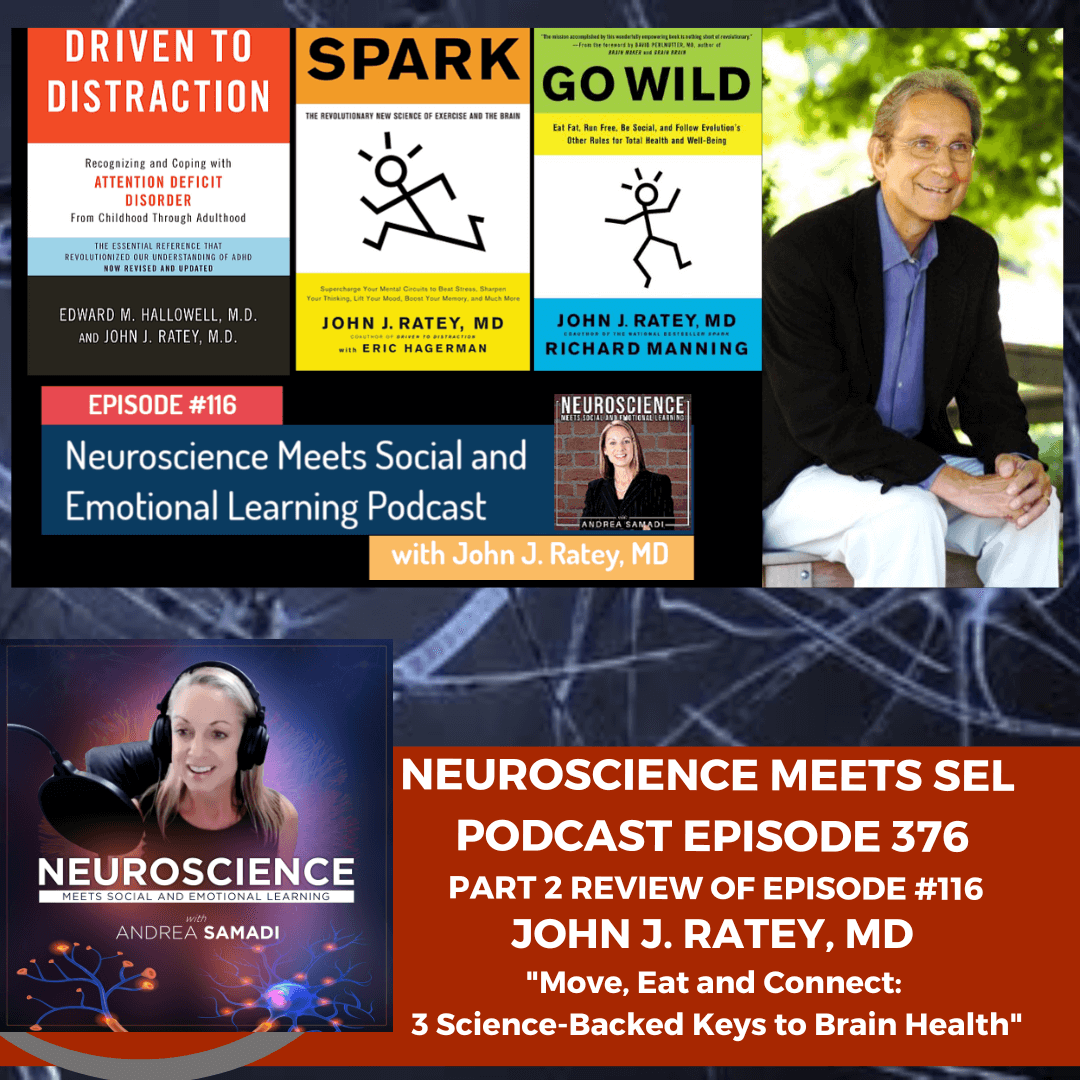
Neuroscience Meets Social and Emotional Learning
Move, Eat, Connect: 3 Science-Backed Keys to Brain Health PART 2 with Dr. John Ratey
00:24:52
Loading summary
Transcript8 lines
- [00:03]
A
Welcome Back to season 14 of the Neuroscience Meets Social and Emotional Learning Podcast where we connect the science based evidence behind social and emotional learning and emotional intelligence training for improved well being, achievement, productivity and results using what I saw as the missing link since we weren't taught this when we were growing up in school, the Application Practical Neuroscience I'm Andrea Samdi and seven years ago launched this podcast with a question that I've never truly asked myself before and that is if productivity and results matter to us, and they do now more than ever, how exactly are we using our brain to make them happen? And most of us were never taught how to apply neuroscience to improve productivity, our results or our well being. About a decade ago I became fascinated by the Mind Brain Results connection and how science can be applied to our everyday lives. And that's why I've made it my mission to bring you the world's top experts so together we can explore the intersection of science and social and emotional learning. We'll break down complex ideas and turn them into practical strategies we can use for predictable science backed results. And as we kick off season 14, I've been revisiting past episodes and reflecting on the incredible insights that our guests shared since we first launched in 2019. So as we dive into this review of our past conversations, know that this review isn't just for you, it's for me as well. I've learned that slowing down helps us to uncover even more wisdom and I'm excited for us to walk this path together for Today's episode number 376. We continue with part two of our review with Dr. John Ratey covering the first health staple that we know is scientifically proven to to boost our physical and mental health. That's exercise. We first met with Dr. Rady on episode 116 back in March of 2021 on his book the Revolutionary New Science of Exercise and the brain. Dr. Rady is also an Associate Clinical professor of Psychiatry at Harvard Medical School and an internationally recognized expert on neuropsychiatry. Dr. Rady has published over 60 peer review articles and 11 books in 17 languages. You'll notice that around the time of the pandemic in 2020, our interviews took a turn towards health and wellness. And to stay on track, I created a framework of the top five health staples and we covered that on episode 87, which eventually evolved into our top six health staples. And you can review that episode 87 and learn more about Dr. Rady with the links in the show notes. We also did a deep dive into Dr. Rady's books on episode 118. Now, before we go into Dr. Rady's first clip, I've got those thoughts of debating diet plans or supplements, which is really a broad and deep topic. Dr. Peter Attia, the author of the book the Science and Art of Longevity, suggests that we first get our exercise house in order order. Before we do this, he argues that until we can do the following, our time is better spent on foundational fitness. But for those of us who want to do a deep dive into this topic, he asks us to do the following, which has been coined as Atiya's rule. He says we must be able to do a dead hang for one minute wall sit for two minutes, deadlift your body weight for 10 reps and achieve a VO2 max at or above the 75th percentile. As Dr. Attia explains, conversations about nutrition are premature until these core physical metrics are met. And I keep these metrics in mind for myself as well as for those I'm seeking advice from who haven't written books or done experiments. Extensive research in these areas and I tested the criteria out myself back on episode 252. Using neuroscience to improve fitness, longevity and overall health. I did that three years ago. Looking at these numbers now, my VO2 max is the same. I can still deadlift my body weight and wall sit for two minutes, but dead hang for one minute? I'm not sure about that. I'm going to have to try this one out and see if I can still do this. Can you do these items suggested by Peter Attia? Do you fit the criteria for Attia's rule? Now moving into our topic of exercise. Dr. Peter Attia, who's exactly in line with Dr. John Ratey, calls exercise the single biggest elixir for brain health because of its wide ranging impact on numerous bodily systems like glucose disposal, insulin sensitivity and inflammation, he says. While sleep and nutrition are also crucial, Atiya argues that exercise's ability to positively affect so many systems makes it the most powerful single intervention. And he suggests that just three hours of exercise a week is beneficial, with seven hours offering even greater rewards. And it's surprising if you've had the ability to track your workouts and know this number. Since I'm a huge fan of of Dr. Attia's work and use exercise to stay on track with mental and physical health, I was surprised when I asked my WHOOP device to see exactly how many hours a week I was actually logging on this important health staple. I was able to see that I'm above what Dr. Attia suggests most weeks when I can fit it in. Do you know how many hours each week you spend exercising? Remember, it doesn't have to be intense exercise to get your heart rate moving. A 30 minute walk really does move the needle for our health and wellness. Now, there's certain wearable devices like WHOOP that can now measure your age based on your activity level and certain algorithms. And we'll cover our interview with whoop's Kristin Holmes on a future review. But for now, measuring these metrics can show you in real time whether your activity is helping you to turn back those hands of time or move them forward. Whoopage is a metric provided by the WHOOP Fitness Tracker. And it's calculated on an algorithm that takes into account various health and fitness data. And the data considered with this device is sleep duration and consistency. And we're going to go into sleep on our next episodes. It looks at heart rate data, including time spent in different heart rate zones. It looks at strength training activity, your steps, your resting heart rate, your VO2 max and lean body mass. If you're able to hook up a scale to the device, the algorithm uses these data points to estimate a physiological age that reflects the user's overall health and fitness level. And this number is based on research into healthy aging and mortality risk factors. And just by watching these numbers and making sure I'm getting enough sleep and exercise, I've been able to move the aging needle back 4.3 years younger than I actually am. Which takes us to our first clip with Dr. Rady, where he now adds in the idea of nutrition. He covers the topic of fatphobia related to our diet in the United States.
- [08:29]
B
He says, in the US we got what we call fat phobic. You know, that fats were bad cholesterol, high cholesterol was killing us, you know, that we should avoid fats and eat sugar or eat glucose and starch. And this has led us to where we're at now. When we have the obesity crisis and the diabetes type 2 crisis and the heart disease and Alzheimer's and yada yada, it makes us less healthy to pack on all the glucose that we eat. I mean, we love it. You know, we're addicted to it and we have to bring that under control. And in fact, like your friend with the keto diet, that's a radical departure from our current dietary preferences. I mean, think about it, all of the quick foods, the foods that are so inviting, the potato chips, you know, Doritos, all that stuff is carbs carbs, carbs.
- [09:29]
A
Now, in this first clip, Dr. Rady discusses how in the US we've developed a fear of fats while embracing sugar and processed carbs. He emphasizes that our addiction to sugar and preference for quick processed foods and snacks have contributed to today's major health crisis. Rady calls for a radical shift in dietary habits similar to what we heard Jason Whitrock discuss on our episode 94, with the focus of bringing our glucose intake under control. So some practical tips to apply Peter Attia's and Dr. Rady's insights. First, get your exercise house in order. And before debating which diet is best, make sure you're moving consistently. Test yourself on Dr. Attia's rule. Can you hang from a bar for a minute? Can you wall sit for two minutes? Can you deadlift your body weight for 10 reps? And how's your cardiovascular fitness? Your VO2 max? If you're not there yet, set small measurable goals for each one and track your Progress Weekly. Next step 2 Rethink your relationship with sugar. Dr. Rady reminded us that sugar is addictive and deeply embedded in modern diets. He suggests to start by replacing one processed snack a day with a whole foods option like nuts, fruit or yogurt and then using the half full roll. Fill only half your plate with carbs and balance the rest with proteins and healthy fats. And we covered this topic on episode 275 where we went into the damaging impacts of sugar on the brain and body which where we learned that sugar in the brain looks like Alzheimer's in the brain. And I even wore a glucose monitor at the time when I was writing that episode. Some other tips for evaluating your relationship with sugar and we covered this on the episode with the glucose monitor. You don't have to measure with a glucose monitor to know this. You just have to listen to your body and your body will guide you. Some tips here. Learn what foods are low glycemic and replace what you used to eat that spikes your blood sugar. You don't have to measure this. You can feel it. You know when your blood sugar is going up high and then replace it with something else that doesn't. And I found some great resources for low glycemic foods from Dr. Daniel Layman. Another one Discover the meal plan that makes you feel the best. Our body is our biggest guide. Learn to tap into how you feel after you eat certain foods. Then read labels. Reading labels and know how to identify sugar to make better choices. It's shocking how many foods have hidden sugars did you know the average American consumes 150 pounds of sugar a year? This makes sense when there's so many foods labeled as healthy with hidden sugars added and a tip 3 don't fear healthy fats. Instead of avoiding fats altogether, focus on the quality. Add omega 3s like salmon, walnuts and flaxseeds, use olive oil or avocado oil instead of processed vegetable oils and include whole fat versions of yogurt or dairy in moderation and they help to keep you full and control those sugar cravings. And this one was eye opening for me when I first started to follow Jason Wittrock in around 2016 and watched what he was eating on a daily basis. I started to model his breakfast lunches and dinners just a little bit less for me and I let go of my fear of eating foods that are high in fats like avocado or bacon or butter. Things that I thought would make me fat, but they definitely did not. Tip number four prioritize consistency over perfection. Neither Dr. Attia nor Dr. Rady promote an all or nothing mindset. Aim for steady habit. Getting that exercise in walking daily or getting 30 minutes of moderate activity eating those balanced meals most of the time and enjoy treats without the guilt and sleep, hydration and stress management that we'll go into next on our next episodes. These matter just as much as diet and exercise and finding the balance is the key. Some days that I can't fit exercise in, I can always find 30 minutes for a walk at the end of the day. And tip 5 track your feedback loop. Notice how your body and brain respond when you move more and eat less sugar. Do you sleep better? Is your focus or mood improved and are your energy levels steadier throughout the day? Your results, not diet trends should guide your next steps. And this is extremely noticeable for me. I just feel right when I've got this balanced and off when I don't. I know Our body is our greatest guide. And this takes us to our second video clip where Dr. Rady highlights the top three factors that most impact healthy aging and brain longevity.
- [14:50]
B
What to do as an anti aging push exercise at the top. Right beneath that is diet. Then right alongside of that is connection being connected to others. Those are the three. And then you got you got other things in with the I call the wellness levers of sleep and being outside being in nature. You know you're going up the mountain today is being out in nature already, you know and it's great when you can do that. So in the in the 90s, really, the whole science of wellness really took off around exercise and sort of diet came along with it. Michael Pollan and all the others who were starting to write about it way.
- [15:31]
A
Back now, just to review Dr. Rady's three keys to anti aging and lifelong wellness. Number one exercise at the top, he says, physical movement remains the strongest lever we have to slow aging, boost cognition and protect the brain, just like Dr. Peter Attia says. Then two diet nutrition directly affects inflammation, metabolism and mental sharpness, and three, he says, is connection with others. Social interaction and belonging help regulate stress hormones and keep the brain resilient. He also adds that other wellness levers, like sleep and time in nature play important supporting roles. And as Dr. Rady explains, the science of wellness really began expanding in the 1990s alongside the work of authors like Michael Pollan, who helped bridge the gap between nutrition, lifestyle and health. Some practical tips to apply Dr. Rady's three keys 1. Move every day, especially in ways that you enjoy. Combine aerobic workouts for heart health with resistance training for strength and metabolism. Even short bouts of walking count. Follow Michael Pollan's simple advice. Eat food not too much and mostly plants, he suggests. Choose whole and unprocessed foods over packaged or refined ones. Then tip 3 stay socially connected. Make time for meaningful conversations daily. Join a workout class or a group or a volunteer program. Social plus movement is double the brain benefit, and Dr. Andrew Huberman suggests texting someone even a quick hello every day. Tip 4 Prioritize recovery, which is a whole other wellness staple that we'll cover later, but aiming at seven to nine hours of sleep and unplugging regularly and spending time outdoors to lower cortisol and restore your attention. Then tip 5 think of wellness as a system. None of these work in isolation. Exercise supports sleep, which supports mood, which improves our relationships. It's all interconnected. Moving on to our third clip with Dr. Rady on exercise and social connection, where he takes it a step deeper. He explains another powerful benefit of physical activity, and that is that it makes us more more social, he says.
- [18:12]
B
Exercise also makes us more social. Okay, not only are we able to think better and manage our emotions better, but we are more social after we exercise for multiple reasons. Because we get our brain queued up, we're better attentive, we are more motivated and all that. But we also release the bonding hormone oxytocin, and it is a powerful hormone that we have that helps us want to be bonded and connected to others. And then you get that bonus in with exercise if you're connected and you've exercised, you have a powerful, powerful incentive in your brain. And changes in brain chemistry that help you learn better. That help you learn better in every way, socially, cognitively, emotionally.
- [19:03]
A
Dr. Rady reminds us that movement primes the brain. It wakes up our attention, improves our mood and releases hormones that encourage bonding and connection. And this explains why workouts, group runs or even walking meetings often lead to deeper conversations and stronger relationships. Some tips to boost connection through movement. Number one, move with others. Join a workout class or a hiking group or a neighborhood walking club. And even a quick morning walk with a friend can spark connection and consistency. 2. Use exercise as a social icebreaker. Suggest family bike rides or weekend hikes to replace screen time. 3. Pay attention to your mood. Post exercise. Notice how you feel more open, calm or talkative after moving. And that's oxytocin at work. Use that window of connection to reach out, share gratitude or strengthen your current relationships. And 4 combine learning with movement. Listen to podcasts, audiobooks or language lessons while walking. Pairing physical activity with learning enhances memory and focus. And 5. Think connection as a core fitness goal. Just as you track steps or heart rate, track how often you connect meaningfully with others through movement, social fitness matters as much as physical fitness. Now as we wrap up this episode with Dr. John Ratey, we reviewed three important clips that highlight how exercise, nutrition and social connection work together to support brain health and overall wellness. In clip number one it was Dr. Attia's rule and our relationship with food. We began with Dr. Peter Attia's reminder that before debating diets or supplements, we should first get our exercise foundation house in order being able to dead hang for a minute while sit for two, deadlift our body weight for 10 reps and reach a VO2 max in the 75th percentile. Then Dr. Rady explained how our society has become fat phobic, avoiding healthy fats while over consuming sugar and refined carbs. And this imbalance has led to rising rates of obesity, diabetes, heart disease and Alzheimer's. His message was was clear. We must first reduce our addiction to sugar and rebalance our nutrition towards whole nutrient dense foods. And on clip two we learned the three keys to anti aging. In this clip, Dr. Rady outlined what he calls the three biggest levers of healthy aging. Number one exercise. The most powerful anti aging tool we have have two was diet directly linked to brain and body health and three Connection with others. It's essential for emotional and cognitive well being. He also mentioned the importance of sleep and time in nature, reinforcing the true wellness as a system. And all these three areas support and amplify one another. In clip three, we looked at exercise, exercise and Social connection. In our final clip, Dr. Rady explained how exercise makes us more social. Physical activity not only boosts focus and mood, but also triggers the release of oxytocin, the bonding hormone that helps us to feel connected to others. And when we combine movement with social interaction, like exercising with friends or joining a group activity, or we strengthen our brain chemistry for learning, empathy and connection. Our final thoughts both Dr. Attia and Dr. Rady remind us that health and brain performance begins with the basics moving often, eating real food, resting deeply, and connecting meaningfully with others. Once these foundations are in place, the body and brain naturally function at their best. The takeaway? Move daily, eat mindfully, and connect intentionally, and your brain will thank you for it. And with that, we'll conclude part two of our review of Dr. Rady's 2021 interview with a final thought from his book Spark. He says, what makes aerobic exercise so powerful is that it's our evolutionary method of generating that sense spark. It lights a fire on every level of your brain, from stoking up the neuron's metabolic furnace to forging the very structures that transmit information from one synapse to the next. Exercise is the single best thing you can do for your brain in terms of mood, memory and learning. And with that thought, we'll see you the second week of November for our next interview review with Dr. Shane Crieto and the Power of Our Sleep. See you next time.
- [24:25]
C
If you're enjoying the Neuroscience meets Social and Emotional Learning podcast, please don't forget to subscribe so you'll stay up to date with our new episodes. While you're there, please feel free to give us a review or a five star rating as it helps others find us. For more information on our programs, books and tools for schools and the workplace, Visit us at www. AchieveIt360com.