← Neuroscience Meets Social and Emotional Learning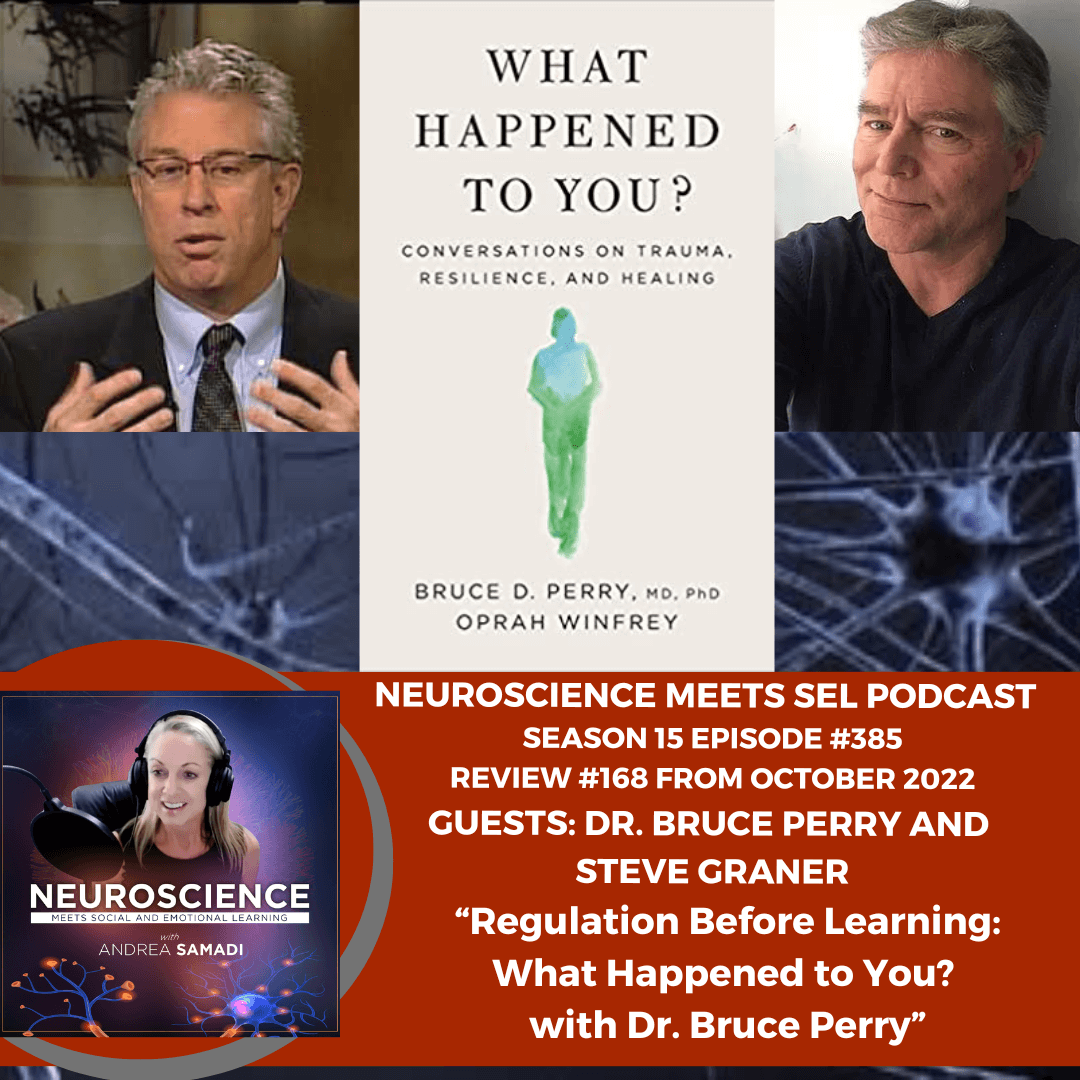
Neuroscience Meets Social and Emotional Learning
Safety First: Why a Regulated Brain Is the Key to Learning (Revisiting Dr. Bruce Perry)
00:24:37
Loading summary
Transcript6 lines
- [00:02]
A
Welcome Back to season 15 of the Neuroscience Meets Social and Emotional Learning Podcast. I'm Andrea Samadhi and it's here that we bridge the science behind social and emotional learning, emotional intelligence and practical neuroscience so we can create measurable improvements in well being, achievement, productivity and results. When we launched this podcast seven years ago, it was driven by a question I had never been taught to ask. Not in school, not in business, and not ever in life. If results matter, and they matter now more than ever before, how exactly are we using our brain to make these results happen? And most of us were never taught what to do. Very few of us were taught how to think under pressure, how to regulate our emotions, or how to sustain motivation, or even how to produce consistent results without burning out. And that question led me into a deep exploration of the mind, brain, results connection, and how neuroscience applies to everyday decisions, our conversations, and most importantly, our performance. And that's why this podcast exists. Each week we bring you leading experts to break down complex science and translate it into practical strategies that we can all apply immediately. And if you've been with us through season 14, you may have felt something shift. That season wasn't about collecting ideas, it was about integrating these ideas into our daily life. As we launch our review of our past episodes across conversations on neuroscience, social, emotional learning, sleep, stress, nutrition and mindset frameworks, we heard from voices like Bob Proctor, Jose Silva, Dr. Church, Dr. John Medina, and so many others. But one thing became clear. These aren't separate tools that we're covering in each episode. They're parts of one operating system. When the brain, body and emotions are aligned, performance stops feeling forced and it starts to feel sustainable. Season 14 showed us what alignment looks like in real life. We looked at goals and mental direction and rewiring the brain, future ready learning and leadership and self leadership, which all led us to inner alignment. And now we move into season 15. That's about understanding how that alignment is built so we can build it ourselves using predictable science backed principles. Because alignment doesn't happen all at once, it happens by using a sequence. And when we understand the order of that sequence, we can replicate it by repeating this sequence over and over again until magically we, or predictably we notice that our results have changed. So season 15 we've organized as a review roadmap, where each episode explores one foundational brain system and each phase builds on the one before it. And last week we began with phase one, regulation and safety. As we revisited Dr. Belangelow's interview from back in June of 2020, 2. And this episode sits at the foundation of season 15, Dr. Bilan Jalal, a Harvard neuroscientist whose work explores how sleep and imagination and curiosity shape the brain's capacity to learn and how to create. Now, what stood out to me then, and even more now is that learning doesn't begin with effort. It begins when the brain is rested, when it's regulated, and when it's free to explore possibility. And our conversation with Dr. Bellangelle reminded me that creativity isn't added later, it's built into the brain when the conditions are right. And it's here that we remember that before learning can happen, before curiosity can emerge, before motivation or growth is possible, the brain must feel safe. And and what better place to begin with safety in the brain than with Dr. Bruce Perry, who we met back in October of 2021, back on episode 168 and a reminder of Dr. Bruce Perry's background. Dr. Bruce Perry is a Senior Fellow of the Child Trauma Academy out of Houston, Texas, and he's also an adjunct professor of psychiatry and Behavioral sciences and at the Feinberg School of Medicine in Chicago. And he joined the podcast to help us to better understand how traumatic experiences shape the developing brain. And at the time, I was deeply concerned about the generational impact of the COVID 19 pandemic. This all stemmed from me after I had heard one of Dr. Perry's trainings where he had referenced research that was conducted after Hurricane Katrina in 2005, which showed that families who were exposed to prolonged stress experienced increased rates of substance abuse, not only in those directly affected, but in the next generation as well. And as I began hearing reports of rising depression, anxiety and substance use during the pandemic, I wondered, what could we do now to reduce the long term neurological and emotional impact on our children, on our schools, and our Future generations? And Dr. Perry agreed to come on our podcast to share insights from his work and to discuss his book that he co authored with Oprah Winfrey. What Happened to you? All about conversations on trauma, resilience and healing Dr. Bruce Perry challenges one of the most common questions that we ask in education, in leadership, and in parenting. Instead of asking, what's wrong with you? He asks, what happened to you? In this conversation, we explored how early experiences shape the brain, how trauma disrupts regulation, and why healing begins with rhythm, safety and connection. And you can actually go back and find a link to our full interview in the resource section in the show Notes and and this episode anchors season 15 by reminding us that a dysregulated brain cannot learn, no matter how good the strategy is. So let's go to our first clip with Dr. Bruce Perry and look deeper at how we are all born with potential, but our experience builds the rest.
- [07:05]
B
As a species, we have contained within our collective DNA all kinds of amazing gifts, including a lot of these brain related capabilities. But not every one of these genetic gifts is given to every person. So everybody has, out of the total collective of what you could get, we get some portion. And then out of that portion that is you, we only express some part of that. And the parts that we express are determined by our developmental experiences. So for example, you know, we're speaking English to each other, but both of us, all three of us have the potential to speak Russian. But because we never had any early developmental experiences with those sounds and those words and those sentences, we never built that genetically, that genetic potential to speak Russian into a functional capability. Now that's kind of an obvious example, but the truth, it's the same thing with, you know, I don't have the current motor capability to manipulate a joystick like my nine year old grandsons. There are a whole range of things, both motor, cognitive and social emotional capabilities that are are unexpressed in many, many people.
- [08:19]
A
Some key takeaways from this clip. Takeaway one, we are all born with vast genetic potential. And as a species, as a human, our DNA carries extraordinary cognitive, motor and social and emotional capacities. But two, not all potential becomes functional. We don't automatically get every capability encoded into our biology. And three, experience determines the expression of our genes. Early developmental experiences decide which neural networks are built and strengthened. And four, the brain builds what it repeatedly uses. Language, coordination, emotional regulation, these are all constructed through patterned expressions. Exposure. And five, unexpressed potential is an absence. It's just under development. And that capacity may exist, but without the experience, it may remain dormant. So what does this really mean? We weren't bad at math, we weren't not athletic, we weren't not leadership material. We simply just may not have had the pattern developmental inputs required to wire those systems. So in plain language, skills grow where there's repetition, rhythm and experience. The brain is use dependent. It builds what it practices, it strengthens what it repeats. And this research leads us back to some of our early episodes number 37 and 38, but we'll cover those later in our review. Moving on to some tips to put these ideas into action. Number one, no more labeling. Start assessing exposure to these genetic capabilities. Think, what experiences did I have or not have to build myself instead of Saying, I'm not good at this. Ask have I had enough patterned exposure to build this skill? And it's interesting when I talk to people about this podcast journey. It's only been seven years, but we've gone deep into understanding the brain, body, emotion, connection. And I always remind people we all begin somewhere. When I go back to the very first interview that I had with Ron Hall, I remember that my audio wouldn't work, and we nearly couldn't figure it out. It turned out to be a simple setting on my end, and this was about a year before zoom became a part of everyone's daily life. But at that time, I was also being introduced to experts like Horacio Sanchez and. And I was still building my own understanding of the brain. I wasn't an expert. I was just exposed repeatedly. And over time, repetition turned into fluency. And there's the point. We can all learn almost anything with focused effort and persistence. And it becomes easier when we love what we're building because the brain wires what it practices and. And passion fuels the repetition. Number two, create micro repetition environments. Skills build through rhythm, through repetition, through emotional safety and low threat. And this is where your regulation and safety phase becomes critical. A dysregulated brain, one that feels threatened, overwhelmed, or chronically stressed, cannot efficiently build new neural networks, and it defaults to survival, not growth. And if we want to become an expert at anything, a sport, a podcast, leadership, communication, it requires consistent, patterned practice. And I can use this podcast again as an example. There were seasons when my corporate responsibilities consumed most of my attention. And during those times, I wasn't producing weekly episodes. And when I returned, I noticed something interesting. The automaticity that I had built through consistent repetition had faded slightly. It didn't disappear, but it needed rebuilding. I didn't have the ease, the rhythm, or the flow that only returned through repetition. And I know this to be true in sports as well. Athletes don't rely on motivation. They rely on structured repetition in a regulated environment. If you miss enough practices and your timing feels off, then you return consistently and the neural pathway strengthens again. That's how the brain works. Not through pressure, not through labeling, through repetition. Number three, build dormant capacity intentionally. If you want to improve emotion regulation. If you want to strengthen your focus, you want to build confidence with your speaking, start small, short, repeated exposures beat intense, occasional effort. One of the main reasons that I continue to produce these episodes is that because I've seen what this repetition does over time, speaking consistently into a microphone has strengthened my own ability to communicate. Clearly, outside of this podcast, my confidence in meetings, interviews and presentations has grown. Not because I became more confident overnight, but because I built the neural circuitry for fluent expression through repetition. Confidence wasn't something I waited for. If you go back to our early episodes, the first 50, you'll see that confidence was not there from the beginning. It was something that I wired. That's one of the unexpected benefits that I've noticed from this podcast. And the skills you build in one environment often transfers to others. When you practice articulating ideas consistently, you strengthen verbal fluency, emotional regulation under pressure, cognitive organization and presence. And that's why I encourage anyone, if you feel called to, to launch a podcast. Not because you need an audience, but because the process will build capacities in you that extend far beyond the microphone. The brain generalizes repeated skill. What you practice intentionally in one domain often strengthens performance and many others. Number four. This tip is for parents and educators. If a child struggles, don't assume inability. Look at developmental history and ask what patterned experiences may be missing. Remember, brains are built, they're not fixed. And five is for leaders and coaches. High performance isn't talent alone. It's structured repetition in a regulated environment. That's how you build motor precision, decision speed, and emotional control under pressure. Potential lives. In our biology, Dr. Perry reminds us that we have tremendous potential within our DNA performance lives in our experiences. And the difference between the two is how we develop them. Now, in clip number two, I asked Dr. Perry what it was like writing a book with Oprah and how he was able to mix his neuroscientific parts with her story based parts. And this is what he told us.
- [16:01]
B
One of the things that Oprah has always been really good at, and I still have to relearn it all the time, is how important stories are to communicating information. And she's always been very good at that. She's always been very good at eliciting people's stories and then finding the one point or one concept that sort of is going to, you know, emerge from the story that people can walk away with. And those of us who are sort of in the academic teaching world, you grow up with this idea that you want to teach concept, fact, concept, fact, concept, fact, concept, and maybe put a little bit of a story in there. But in reality, what I've learned from Oprah again and again and again is that you don't ever want to tell. You can't tell everybody everything you know. And so you need to resist the temptation to sort of tell too much.
- [16:48]
A
Some Key takeaways from clip number two Number one Stories carry concepts farther than facts alone. Oprah's strength, according to Dr. Perry, is her ability to elicit powerful stories, to identify the core concept within them, and to help people walk away with one clear takeaway. Stories anchor memory Takeaway two Academics default to information overload. Traditional teaching often follows this pathway concept and fact concept and then a fact concept and another fact with maybe a small story inserted. But information density does not equal impact. Tip 3 you can't teach everything you know. This is the most important line. Trying to share all of your knowledge overloads working memory, reduces retention and and weakens clarity. Depth is far more powerful than volume. Tip 4 Effective communication requires restraint. To teach well, you must select a core idea, wrap it in a story, and leave space for integration. Restraint is a skill. So what does this really mean? The brain remembers emotionally relevant narratives. Stories activate emotion, imagery, relational circuitry, and meaning making networks. Facts alone activate cognition, but stories activate the whole brain. And learning sticks when multiple systems are engaged. Some tips to put these ideas into action Tip one Teach one core idea at a time. Before speaking or writing, ask yourself what is the one concept that I want who I'm teaching to walk away with today? Not three, not ten one. Tip 2 Lead with a story and then anchor the science in there. Instead of a concept with data and then more data, try a story first with a concept and then apply that concept. And this mirrors how the brain encodes our experiences. Tip 3 Resist the urge to prove how much you know, especially for educators, leaders, experts, and even myself as a podcaster. Clarity builds authority more than volume does. Tip 4 Create memory hacks. Use personal experiences, case examples, metaphors and relatable moments. People remember how something felt, they don't remember. Slide 27 of your presentation and then how do we apply this to our work? Well, let me think about this podcast for an example. Early on, we leaned heavy into our research, our frameworks and our structure. But as I looked back at some of the video clips from our interviews, I knew I had forgotten a lot of what we'd covered over the years. And that's what brought us to review these episodes. Season 14 showed us what alignment of the research looks like in real life. We looked at goals, mental direction, rewiring the brain, future ready learning and leadership and self leadership, which all led us to inner alignment. And now in season 15, it's all about understanding how that alignment is built so we can build it ourselves and using predictable science backed principles. Because alignment doesn't happen all at once. It happens by using a sequence. And when we understand the order of that sequence, we can replicate it. And what better way to replicate something than with a story? Dr. Belangelel taught us on our last episode how Thomas Edison used his sleep state to generate creative ideas for his work with a story of how he used to fall asleep and then let a spoon drop onto a plate to wake him up right at the most important creative time. That was right in between sleep and wakefulness. That's Oprah's influence in action. It's also where I can see my own growth as a communicator with this podcast. How about you, the listener? Where can you apply Oprah's storytelling concept to solidify the ideas that you want to bring to life in your teaching? You can't tell everybody everything you know, but you can help them to remember what matters with a story. So to review episode 385, today we were reminded of two foundational truths. First, we're born with extraordinary potential, but experience builds the expression of our potential. And second, even the most powerful knowledge must be communicated in a way that the brain can absorb it. Dr. Perry taught us that the brain is use dependent repetition wires. Capacity and safety precedes our skill. And from Oprah's influence, we learned that story makes science stick, restraint builds clarity, and one idea remembered is better than 10 forgotten. And this is phase one at work. Regulation, rhythm, repetition, and relational safety. And without those, learning just doesn't land. So looking back, season 14 showed us what alignment looks like. And season 15 now is showing how it's built. And today's episode answers the first question. Critical question in that sequence. Is the nervous system safe enough to learn? Because a dysregulated brain can't build a new skill, it won't sustain attention. It won't integrate complex ideas or retain what it's being taught. That's why regulation and safety come first. Not motivation, not performance, not our goals, but safety. And I'll leave you with two questions. Where in your life have you labeled yourself? Instead of assessing exposure to develop more of your genetic capabilities, where are you trying to communicate too much instead of helping someone remember what matters the most? Remember potential lives in our biology, performance lives in our experiences, and. And the difference between the two is development built through repetition, through regulation, and through relationship. And if this episode resonated with you, revisit the clips, share the story, and choose one idea to practice this week. Because alignment is not accidental. It's sequential. And we're building it one phase at a time and I'll see you next week as we continue Phase one Regulation and Safety as we revisit a past episode with Dr. Sui Wong. See you next week.
- [24:11]
C
If you're enjoying the Neuroscience Meets Social and Emotional Learning podcast, please don't forget to subscribe so you'll stay up to date with our new episodes. While you're there, please feel free to give us a review or a five star rating as it helps others find us. For more information on our programs, books and tools for schools and the workplace, Visit us at www. AchieveIt360.com.