← Neuroscience Meets Social and Emotional Learning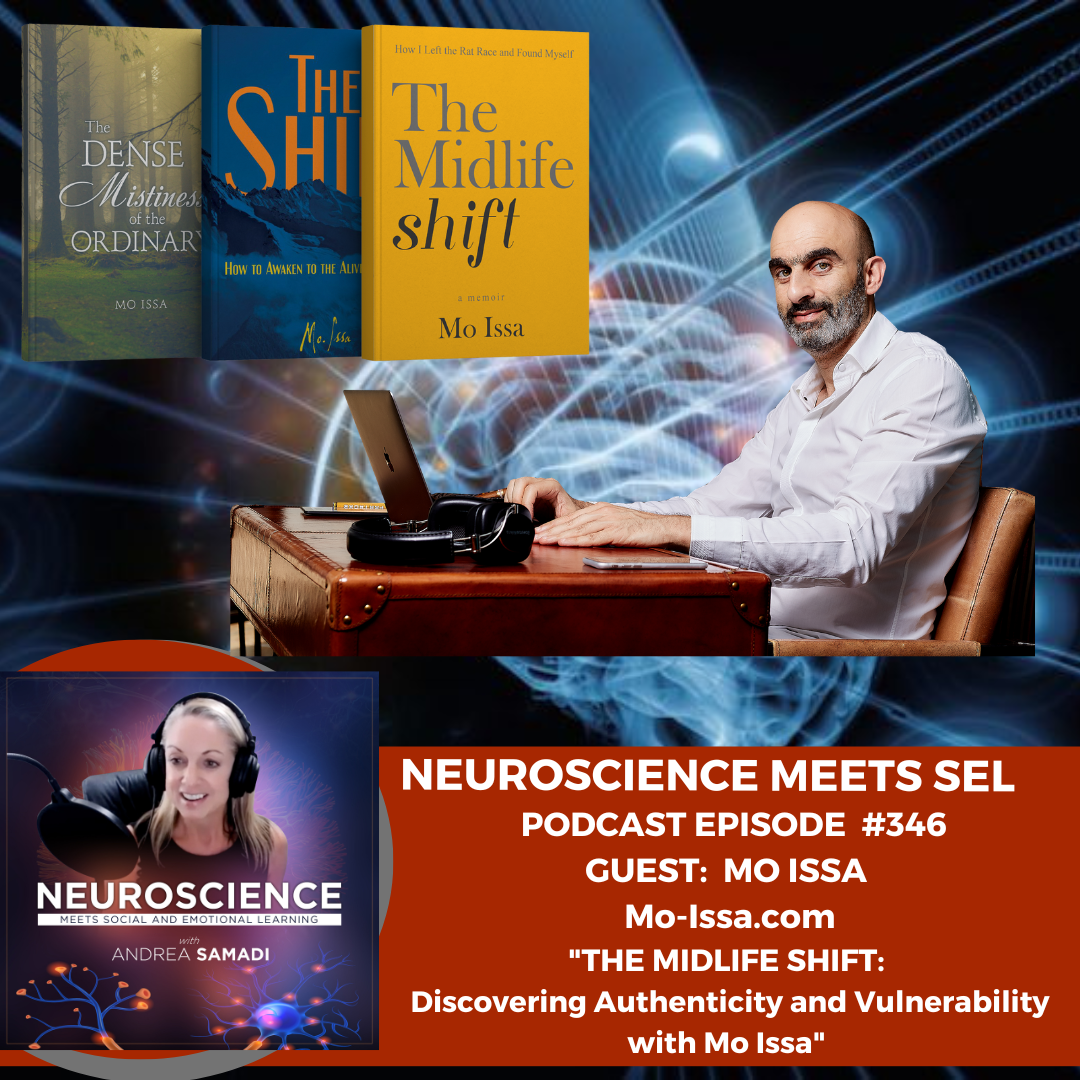
Neuroscience Meets Social and Emotional Learning
The Midlife Shift: Discovering Authenticity and Vulnerability with Mo Issa
00:57:21
Loading summary
Transcript77 lines
- [00:00]
A
Foreign of the Neuroscience Meet Social and Emotional Learning Podcast where we connect the science based evidence behind social and emotional learning and emotional intelligence training for improved well being, achievement, productivity and results using what I saw as the missing link since we weren't taught this when we were growing up in school. The Application of Practical Neuroscience I'm Andrea Samadhi, an author and an educator with a passion for learning and launched this podcast six years ago with the goal of bringing all the leading experts together in one place to help us to apply this research in our daily lives. On Today's episode number 346 we meet with someone I've known over the years. It was about 10 years ago that I was connected to our next guest through our mutual friend, motivational speaker Bob Proctor. At the time, I had no idea how much of a supporter to my work he would be over the years and he's one of the influencers who's helped me to discover and live on my own authentic path. He was one of the first to use our curriculum for teenagers for a soccer school that he ran in Accra, Ghana and his belief and trust in me helped me to see this in myself. We never forget those who've helped us along this journey called life and I'm forever grateful to have met Moisa when I was starting out on my own journey of self discovery where I left the corporate world for a 10 year period to make an impact on our schools. Over the years I followed Mo's work, specifically his writing, which until reading his book that we'll cover today, the Midlife Shift, I had no idea how much Mo's writing would inspire me to keep going, to keep learning and growing on my own path. Right on the front page of his website you can read his own words. He says, I'm a writer who believes when we find ourselves stuck in life, it's because we lack meaning and we don't feel challenged. In his books, essays and podcasts, he encourages making small changes to embrace self discovery, simplify life and focus on a deep sense of fulfillment. Let's meet Moisha, an author of three books who's spoken regularly at conferences and workshops including TEDX ACRA Conference. Someone who's read 50 books a year for the past 10 years and see what we can learn about living our true authentic life and improve our own self awareness in this discovery process. Let's meet Mo Isa. Welcome Mo Isa Mo. It's been a long time since we've spoken. Thank you so so much for coming on the podcast to share your Work with us. I can't even tell you how much your writing specifically has helped me over the years. This is such an important and special interview for me. Thank you so much for being here, Mo.
- [03:27]
B
Oh, wow. Thank you. Thank you for such kind words. Honestly, I'm, I'm, I'm taken aback now.
- [03:34]
A
Well, this is, this is special, Mo, because you know, our. For our audience who might not know your work and stuff and, and how we met, like it, it's pretty special that you came through. One of my mentor, Bob Proctor, supported my work over the years and, you know, people might not know, you know, your journey over the time you published. Is it three books now? This one, we're going to talk about the midlife shift. It's three, right?
- [04:01]
B
Yeah, yeah, yeah. The first one was a short book of poetry. And the other two, one one is called the Shift, which is more like self help book. The midlife. This one now, it's more a memoir, it's more storytelling and about my life in the past 10, 12 years.
- [04:18]
A
Yeah, it was impactful for me. So this is, I'm so happy to have you here. So for our audience who might not know what I know about you, can you just share, you know, what brought you to this place now where you started with, I saw your writing come through. I used to watch you like posting on Twitter and on social media and, and I was a part of your newsletter and I would read your writing and I was captivated by it. So can you just start with, you know, where did your writing begin and what led you to where you are now with three books? Where did it start?
- [04:57]
B
I mean, the funny thing is I never thought of writing as something that I'd do, even though I studied law and many lawyers are writers as well, but I never practiced law. And I remember once we were in a birthday party, some friends, a group of us, and so we're all saying, if you were living an alternate life, what would you want to be? So I just blurted out, I'd love to be a writer. And I never really took any notice of that, but I mean, I guess it was hidden somewhere. And as my journey unfolded, you'll see through the book and when we go through more our conversation here, there were some reflection points. There weren't any Hollywood aha moments people expect. Like, woke up and became a writer. No, it didn't work like that. But I was struggling for a while to find my voice, my authentic voice, and that's when writing sort of fell on my lap. And one of the Chapters I write about both running and writing sort of fell, fell on my laps and then I started slowly I started. But, but honestly it's the reading that, that always leads to writing. Right. The more you read, the more you want to write. And expressing myself, I, I, I guess I didn't, I wasn't expressing myself all along the years I reached maybe, I would say around maybe mid-40s and I still wasn't expressing myself. So I'm definitely, I'm a late bloomer. It all started using Julia Cameron's morning pages book, right. The journaling in the morning. And I found myself like gushing out with all these emotions and feelings and thoughts and ideas and it was only when I put pen to paper that all these things came through before it was like a blank page. It's as if I need time to sort of think and write. Some people are very good in saying what they want, what they feel. I'm not. So that's part of the answer. It's a long winded answer to your question. But we can continue further down that road, right?
- [07:00]
A
Yeah. Just reading your book, Mo, I related so much to the writing helped you, it started with the reading and then it comes through you through writing and your exercise, your running helped it come through and I noticed. So I write my interview questions and then I will go take a hike and I think what else can I ask that goes deeper? I don't want to just ask, you know, hey, tell me about your books, Mo. No, I want to know more. I want to know who you are inside. And so tell me a little bit about that like how you started getting the deep stuff to come out even further through, through it all.
- [07:43]
B
Yes. So after that time of reflection when I started journaling and sort of becoming more aware of all of a sudden what I think I came back from a trip, I'd broken my hand, the freak accident. So I, I was regularly jimming, I couldn't gym anymore. So I said, you know, there's nothing else I could do. I was on the plane and I was reading a magazine and this big thing about running and athlete. So I said, you know what, that's how I'm going to start doing running. So I get back to Ghana and I start running regularly and without knowing it I started getting very emotional in my runs I would run early in the morning, I would, sometimes I'll be running with tears and running down my cheeks and I really didn't understand it. But afterwards I began to understand more and more that really it's Self awareness alone is not enough sometimes. And you need some kind of bodily activity sort of to release some of these obstacles in us. So I think, I'm not a neuroscientist, I'm not a psychologist, but I think that's what was happening. I was sort of a lot of these, and I say it in one of my chapters in the book. Danny Shapiro calls them some, some scarabs, which are like knots of energy that are, that are sort of being, becoming obstacles in our, in our body. So when I ran, I was running all these, all these little tiny knots in my body were sort of untying and opening me up and it was so blissful for, for like six months before my knees started giving me issues. It was beautiful, beautiful way of expressing myself. Running. And I would come back after the run and as you said, after a hike, after a walk, your mind is just okay, I get the run as high during the run, but afterwards even it continues like I'm such on a different plane. And I was writing deeper things. And from there I started sort of writing short articles and I got published with Elephant Journal and Rebel Society and I started regularly writing a column for them. So really it all started with that period, the running and the writing and the journaling all together.
- [09:49]
A
Got it. And so what I was thinking was, when your knees cut out, what do you do then? Because it's happening. I'm over 50 now and things are starting to hurt with the exercise that I was used to, I was used to really pushing it and I can't do as much as I used to. So how did you still get that awareness? Did walk still work? How did you get those knots out without pushing the body?
- [10:19]
B
Exactly. Now with the running, I think what I did, I adjusted my, myself like more stretching before and after physiotherapy. So that helped for a while until I had a, I had an accident where I broke my, my right ankle in two places. So I. Running is pretty hard. But now what I do is walk and hike. I'm just back from a holiday in Peru where we hiked for 10 days. Sensational. Yeah. We got up to 4800 meters, which I don't know how many in feet. So definitely walking does it now. I do what? That's what I do. I regularly walk. I do some kind of like, I play paddle, it's called paddle tennis. It's a racket game. I'm a bit obsessed with it, so it keeps me going. But I, I, and, and after reading, I don't Know whether you've read the book the Body keeps the Score, right?
- [11:08]
A
Yeah, yeah.
- [11:15]
B
Yeah. So I mean he explains it very well. I didn't understand it then, but I mean if our body is part of us and, and we keep on forgetting that, you know, it's like we keep on thinking mind and cerebral and, and, and refer. But our body also talks to us. And I think when we move and whether it's walking, dancing, hiking, running, it really helps with the self awareness isolated. You see, some people do things isa without the self awareness just movement alone I don't think really helps transform you. And likewise when you do the self reflection alone, journaling without the bodily movement, again, you get it intellectually but you don't get it emotionally. And that's just my take on what happened to me. So I don't know neuroscience or how psychologist Basil keep the school body keeps us going to explain that, but that's what it works for me.
- [12:09]
A
Yeah, definitely. Over, over the years I've asked this question because in order for me to do difficult work like understand the neuroscience, I would have to exercise really hard to, to be tired before I could focus. And talking to some experts, they said, you know, that was an important process to be ready to take in deep work and be ready to focus. So, you know, and then, then I'm noticing, well, what if I don't have time for that before I need to do some deep work, what else can I do? So it's, it's good to know that, you know, going for a walk with the dogs or something would still be enough to do that reflection.
- [12:52]
B
I think what it is, bottom line is it's, it's you trying to remove your egoic mind aside that voice, that chattering voice that keeps talking and talking and talking and one, and when you exercise and you're tired, it sort of just shuts up and then the subconscious comes out and more of your real deeper thoughts and feelings come out.
- [13:12]
A
I think that's totally it. That is totally.
- [13:14]
B
Yeah.
- [13:15]
A
So, so I'm remembering when we were first planning this meeting and we were talking on, on chat and you said to me that, you know, I'm happy and inspired that you've got the one thing that gets you up every morning. So, so I figured out that, you know, recording these podcast episodes, doing the research, writing the questions, learning and then asking you about them, that's what drives me in my whole outside world. It makes me a better worker, it makes me better at home. So, you know, but then when routines change, I just wonder you know, with all the times that you've changed routines, you've moved countries, you've got to start over in new places. How do you make sure you don't lose that thing that inspires you every day?
- [14:07]
B
I mean, that's a great question. Because honestly, if I want to be honest, I keep losing it and sort of realigning to it. It's not easy. And that's why I said, I really do envy people like you. And who helps that one thing sometimes? And I know you have your struggles. I'm not saying I'm sure you do, like all of us. But what I've tried to do over the years, especially the last seven years, is that I, I stick to like, my morning routine sort of helps ground me. I get up early, I like getting up early. By 5, I'm up 5:30 maximum. I read. The first thing I do is I read. Don't go to the phone or anything. I just read. Whether it's fiction or non fiction or poetry, especially somebody like Rumi or Khalil Gibran, the minute I read them, it just reminds me of who I am. Like I'm a, I am a soul, not just a human being who's a doing, doing, doing, doing person all the time. And then I journal some of my thoughts. I sometimes meditate. I'm on and off again. I'm not the perfect meditator. Sometimes it works for me for six months or nine months in a row, then suddenly it stops. But I find these. And then I try to write something after my journaling, whether it's an article or whether towards the book that I'm writing. So, so these are the things that sort of keep me grounded to who the real self is. But, but honestly, I'm, I'm, I'm challenged with it because I also run a business, my own company, for 30 years now. And business is dog eat dog really. And we all know that it's, it's not easy to be somebody who reads poetry in the morning and then go and face, face, face a business world and become effective in that. So, so I, I'm, I'm struggling. I still struggle till today with it, but I have these, these morning routines that sort of grind me.
- [15:57]
A
Yeah, no, I, I think that's the important part for sure. And, and what I'm trying to get back on track and sometimes routines change. Like I used to be able to have enough time in the morning, but I'm finding now my exercise has to go to night, so it's switching things around changing things up as, as you change and evolve. I guess it doesn't always have to be the same time. Just making sure the things that, that I need are in the day somehow. Right.
- [16:27]
B
But, but I find it so much harder to do everything at night. On the evening. Right. It's in the morning. Everything is easy then.
- [16:34]
A
Yeah, it's. To get it out of the way.
- [16:37]
B
Yeah, yeah, it's so much harder in the evening, whether it's exercise or writing or whatever.
- [16:40]
A
Yeah, yeah, you're. You're absolutely right. Yeah. So, so then, you know, when I, when I first started, you know, working with you back in the day, I remember that you had your TED Talk that came out rich, successful, strong, yet empty. I think it was around 2015. Was it about that year that it came out?
- [16:59]
B
Right, right. Yes.
- [17:01]
A
And, and I saw you as strong and serious as a real business leader back then. And you know, I knew you worked closely with Bob Proctor and I knew you spent time giving back people with these success principles. And I remember being surprised that you thought maybe you were living your life wrong. So could you just take me back or take us back to where you were living your life and what you discovered that was missing and how did you pinpoint what it was at that time?
- [17:33]
B
Okay, I mean it's, it's, it's quite a long story, but, but let me start from the beginning because around 2008, 2008, I think late so 2007, 2008, my two things happened, sort of really shook my world. And, and it's always when things happen strongly that you start thinking, you know, start or self reflecting. One of them was my nephew was in a near fatal accident and he was like proclaimed brain dead. But thankfully he survived. I mean he's, he's still going strong today, so it's fantastic. And, and then because I was seeing it firsthand with my brother and his, and his wife and I was supporting them, traveling to the, to England, watching him re. Rehabilitate. Rehabilitate. And at the same time I had the pressure of my business nearly going bankrupt because of a bank overextended bank loan. So, so I had this really strong pressure on me and I survived that my nephew survived. So within maybe 612 month everything was going well. I started having panic attacks. It's again my body reacts after a while. Right. And so I went to Lebanon, my home country, where I am from, and to, to sort of see a doctor there. And the first thing doctor says that it's, it's not a problem of the of the heart, because I thought it was something to do with my heart. He said, really, these are panic attacks. You should see a psychiatrist. It's more of a mind problem. And I was shocked. Like, really me, I'm strong, I'm powerful, I'm. I'm. I can. Anyway, to cut a long story short, so a psychiatrist, she prescribed antidepressants and, and Xanax and, and not knowing any better, I. I started taking them. But the funny thing is, as soon as I started taking them, I was in, in Lebanon. And then sort of a mini war just erupted while I was there. So the airport was closed, I was stuck. All. None of my family were there at that moment. So it was really me and with some friends and I've titled that chapter in the time of War. I found my peace. I found peace because the same thing, I sort of stopped. I let go, I surrendered. I allowed my friends to take out. I didn't know anything about Lebanon. I've never lived there in my life. So they were taking from town to town, sort of saying the best way how to get out. And I was being led. I didn't have to make any decisions again. It was as if my. This egoic mind, this controlling mind stopped and I was just surrendering. And one day I walk into, in one of the towns, I walk into a tattoo shop and I get a. Out of the blue, I get a tattoo done on my right shoulder, which is born to be free. And the next day also get a book called by Leo Torstoi called the Death of Ivan Ilyich. And really that's the book that really inspired my whole change because he, Ivan Ilyich had left, had lived a very good life. He was successful, he was going up the status ladder, prestigious. He started being, I think something in law, becoming a judge later on, and his well perceived by society. But then he has a fall and he contracts an illness out of the fall and he lays down dying on his bed and he starts thinking to himself, you know what? All this accolades of prestige. I wasn't really happy, except I was living all my life wrong. So with that moment of awareness, he thinks, he says, you know what? I did live my life all wrong. And he dies. So I saw a lot of, a lot of parallels and of course not as dramatic, but a lot of parallels in my life because I felt like all this lavish lifestyle, whether it's the Rolex watches, the lavish holidays, the cards, the homes, I wasn't really happy, I wasn't satisfied. But it took me all that time to really understand that. That point. And took me several more years later to, to get out of, of this situation, and I'm still in that. But I'm, I, I know how to balance both, at least now. But I knew from then that my values had changed. You know, my values are no more like getting up that success leather or the money symbols. Of course we need money. I'm not against money. Money is, is something that we need, all of us. But why do we need three, four homes? Why do we need five cars? Why do we need, like, lavish holidays when we can enjoy something much more pure? So that's when the journey of sort of finding my real self started and I decided that I was living wrong because of my wrong values.
- [22:05]
A
When I was reading your book, I was identifying with everything, even down to the tattoo. I remember when I turned 50, I got a tattoo on my ankle that motivates me daily. And, and then you're talking about your tattoo and was the name of your soccer school, wasn't it Born to Be Free?
- [22:21]
B
Right. Yes, yes. And that, that's what I, I named the, the soccer school, which, which I tried to. Yeah. As a foundation. It was called Born Free Foundation Tattoo first.
- [22:31]
A
Or did the.
- [22:33]
B
No, I had the. No, I had the tattoo first. Yeah. Yeah, it was. And even when I was doing the tattoo, the. I didn't even want to do a tattoo. I, I didn't really like tattoos, but the guy was just looking at me like, do you want to do a tattoo? I, I have time. I'm very busy. I'm one of the best tattooers in Lebanon. So I said, you know what? Get me an angel with Born to Be Free. That was just awesome.
- [22:52]
A
I loved it. I was like, laughing at that because there's so much in, in the book that I was going, yeah, I can see why that happened. And, and you're over across the world and, and I'm over here just relating to everything that, that you wrote about, especially the, the lavish lifestyle. Like, you know, why do we need all of it? You know, it's, it's like, that's why I do the podcast and don't make money. And people interview me on their shows sometimes and they say, so don't you want a brand? Don't you really want to take off with this? And I'm like, no, that's not what I want. They look at me like I'm crazy, but it's a give back. That's why I do it. It's not for me to make Money. That's why I do my corporate stuff right now.
- [23:40]
B
Yeah, I mean, that's. That's amazing. And. And I keep repeating, that's why you get up every day in the morning. Right. So that it helps you.
- [23:46]
A
Exactly. It. It has a purpose. And the purpose isn't the financial. It's all the other things that I get from practicing and studying and learning and trying to be better every day. So it's. It's worth way more than money to me.
- [23:59]
B
Yeah, absolutely.
- [24:01]
A
You know, so. So. So then your identity changed when you went. When you. When you did that TED Talk, you. You change for a less lavish lifestyle. And then. And then I started to See now in your book, it starts getting really deep. And I'm reading and I can't put the book down. And so you talk about how this inner journey is long and endless, but it's a human one. And I think that's why I'm so hooked on studying and learning and improving. It's that I see the results over time. And it's not like. Like, if you look back to where. Remember where I was when I was trying to show you my program that whatever software I use broke, and I'm like, pointing at the computer screen like, we're miles ahead now from where we were back then, both of us. And so, you know, I could just spend the whole podcast talking about this, but you write about how the unexamined life is not worth living. So could you maybe explain where your journey of this, of the mind began, of knowing that you wanted to change? And where are you now in this journey?
- [25:12]
B
Yes. I mean, when I. After being prescribed the antidepressants, I came back to Ghana, and I had one day, I was thinking to myself, like, me, of all people, should not be on these. And I. But to be honest, they did stop my panic attack. So I needed them, maybe, but I vowed that I want to change. Like, I want to get rid of them. So within six months, I think I kick them out. And so then started my real journey, because I started reading voraciously, like, I would read every day as I. As I mentioned. And all this knowledge and information was sort of feeding me. It was. I. You know what? I really sometimes wish I could go back to those days because it was so beautiful to read new books that give you. Sorry, books that give you new information. I feel like now a lot of the books are all very similar. So you read one book then. I don't know if I've read it somewhere before. And so the journey started Then. And I'll say, and why it's an examined life is not worth living because every day I'm examining myself. I feel. And we're all under this perception, or I was anyway, that change happens like this, like in the Hollywood moment, like, you know what. But really change, it doesn't really happen. While when you said you started from your computer not knowing what to do, and now with all your technology, how many years is that? It's probably 10, 15 years down the line. Right. So it's the same with change. It's. It's all very minimal change, maybe like 1% change every day. But for me to keep on doing it and examining my life, it's because that's sort of, I've taken that as my life purpose, you know, that's what I want to do. I'm not interested in anything else right now, so. And it's endless when I say it's endless because it just doesn't end because I. And I. And it's a human experience because I keep on going for I take one step forward and maybe two steps back once. And in my book I've written so many times that even though I try to live to my new values, I always fall back on some of the old values that I had that don't serve me anymore. And I feel so I felt several times I felt guilty and sort of really terrible, like somebody like me who's, who's become so self aware and yet still falls to the same mistakes that he has all his life. But then again, some I keep, I saw therapists, I saw coaches and they all help. And the message is always the same, that we need to be a bit more accepting, compassionate with ourselves because we are human at the end of the day. Right?
- [27:49]
A
That is true. That's the message that a guru gave me when he met with me and he just said at the end of our interview, he said, I want you to be kinder to yourself. Wow. How does he know that? Because everything's measured and when you make mistakes, I'm like, ah, how did I mess up on that? And it shows. Everything shows on the outside. People can see that. If you can see it, then it shows on the outside. Just be, be kinder to ourselves is a good message. For sure.
- [28:21]
B
It is. And it's easier said than done, as we both know. Right, so exactly.
- [28:27]
A
We'll get off this and we'll be like forgotten already and going out like.
- [28:31]
B
I forgot to ask that question. Oh, damn.
- [28:34]
A
Right, yeah, that's so funny. Well, well, My next question, Mo. It's it, it goes. It's gonna keep going deeper here. So you, you write about craving creativity, presence, simplicity, vulnerability and authenticity. And so these are all huge topics. Deep. And I remember years ago you asked me to think about what authenticity meant to me. And I had to look on my phone because I actually wrote pages and pages of notes on that. You're like, think about it. Let me know what you think. And we were going to do something with it, but I still had those notes. And I think the idea, the main topic I wrote was living who I am by design. And I know when I'm doing the things that make me feel alive and when I'm my best self. But I wonder what it was about this topic of authenticity that drew you in to look at it in the first place.
- [29:30]
B
I think when I found out that I was sort of not expressing myself for years and years and years, I was muted in a way. I felt I was being inauthentic to the real me. I was blinded by a formula that worked for my father and many of his friends, peers, and some of my friends as well. And, and I followed it like a robot, you know, like, this is how it's done. This is how you're going to be happy. And even though some of them are happy, happy till today, but that works for them. So I felt I was being inauthentic and I was sort of very quiet and not alive. Not me. And it wasn't till the stories I talked about when I started reflecting and really becoming more creative. And I think the creativity led. Becoming more authentic and authentic simply means. Doesn't just mean like you're being honest. It means like you being the real you, right? Not a, not a, not an imitation of like this 10,000 people the same as you everywhere. It's. We all have like a song to sing. We have something to do that's different to others. And when you start reading, and I started reading a lot of poetry, like Rumi Khalil Gibran on creativity, it sort of awoken me to being the true self that I want to be. And I wanted to write, I wanted to express myself, I wanted my message to be heard and to be seen. And I'm still. Till today. I have maybe sometimes I have a foot in the inauthentic world that I live in. And because. Because of my human fallibility, I guess. And I have another foot in my authenticity. So it's trying the challenge for me. And I write that in my book in the last is sort of to fuse the two modes into one. And that's why I like to be very honest all the time. Some people think I'm cynical, but I'm not gonna sort of blow my trumpet and say, you know, I'm. I'm 100% authentic. I found my way. And it's not true because I know myself very well. Lot of us are the same way. I'm always fighting this battle. So for me, when I say authenticity, it's a lifelong thing. So I'm, I'm. My goal is to be authentic. None of us can ever be 100% authentic. But it's a goal. It's something that, it's driving me. It's a pathway. Right?
- [31:48]
A
Absolutely. Mo, your writing is so beautiful. Like, I, I noticed that when you would send those newsletters on topics and, and I would read it and go into another world with, with. Your writing is deep. You. You wrote that you want to express the depths of your soul, and this allowed your muted voice to speak. And, and it helped you to better connect with people around the world. Like, this is, this is your aha moment here with your book. And, and then I wondered, well, how do we, once we identify what it is in our soul? Like, I know for me it's this podcast. It's. It's the reading, researching, and then teaching it. I've got to have a teaching. And if I was just reading, writing questions, putting it in notebooks and closing the drawer, I'm missing a part. I've got to get the teaching part out there. So, you know what, what I wonder is how do people discover what that is in them? It took me all these years to know what it is. That's the. Expressing the depths of my soul.
- [32:52]
B
I mean, that's a very challenging question because many people will live all their lives without even asking that question. That's, that's the truth. You know, don't follow the certain format, like how I was for 40 odd years, you know, without asking a question. And if it wasn't maybe for Tolstoy's writing, who awoke me and in a certain circumstance, I wouldn't have asked that question. And I think everything helps with the reading, even the, the self help, even though it's gotten to be too diluted these days, but reflecting and journaling and reflecting on yourself, like, is that really what I want to do? Is this a life that I want to live? Is this the partner that I want to be with? I mean, these are all really strong questions. Or, or how. How will I be perceived when I am dead, who will remember me? And all these kind of questions, they're very cliche, but they're true because at the end you're defining the life that we want to live, the intentional life that we want to design, not the life that's going to be. We're going to have a react to, basically so. And again, I'm not saying that many people are going to reach there or many people are going to ask those questions. Many people have to. Some people, I have some friends who don't want to ask any questions. And sometimes I look at them and they're happy. So I don't know, I get confused. Is it me who overanalyzes or is it me who asks too many questions? But I feel happier doing that. So that's what I'm going to do.
- [34:21]
A
Oh, you're just like me. Seriously. I ask like a million questions on topics I relate to what you write in the book and what you're saying now. I just keep asking questions, what else? And then when you ask those, there was so much in there. Creativity, presence, simplicity, vulnerability and authenticity. We could do a week on each one. But I want to talk about creativity because we did a deep dive into, into Jose Silva's work. And I, I did it with connecting the neuroscience to creativity. And so I just wonder, what do you do to become more creative? How do you write such beautiful phrases? Where does it come from?
- [35:05]
B
I mean, for, for me, I mean if I wanted to answer one, a one word answer, that would be reading, reading so many books, so many writers. But again, it's not only that, it's about doing. I've. I've done so many writing courses, I've even started. I did an mfa. I did it for one year, but then I had to change colleges and it didn't work out. But I want to, I want to finish my MFA in writing. And I'm saying this at 56 years old, so it's a passion that I love, the right, the writers world. And I'm still in touch with many writers. So it's like, and I've said it so many times, I'll say it again. Nothing makes you do something more than the environment around you, right? Or not do something. So if I, if I marry, marinate my mind with the writing world, with writers, with the books, that's how I become more creative. That's how I become a better writer. And I'm sure it's the same thing with whether you express yourself through yoga or through dancing as I said earlier, so it's marinating your world, setting up your environment for the. And. And I've noticed that when I go through like months on end sometimes without reading, I. I went through several times without reading, without connecting to readers. My creativity sort of stopped dead on, on the. On spot at this immediately stop. So it's. It's amazing. But the minute I pick up a book, any of the. The books I have here, literally good literary books, I'm sort of inspired, I'm alive and I want to awaken my creativity.
- [36:36]
A
Definitely. I mentioned to you when I took some time not recording, and even this past, I haven't recorded since the end of September and I had to focus on other things. So it was important that I took that time. But I noticed that it is hard when you get out of the system, you get out of the routine of doing it. And it wasn't easy for me to create the questions for you. I had to really think. Whereas when I was in the system of it, it. It's easy. It just flows. And I'm like, I want to ask more the right things. Like this is important. And it, it just took some time and thought and more effort than usual because I, I took. It was four weeks that was focused on other things from here. But, but yeah, it, that. That helps to just stay. Stay doing it and when you take a break, get back to it, whatever it is right. That. That drives you.
- [37:33]
B
I mean, that's it. And as you said, we need to. I would love to sort of read one part, just one paragraph, because it sort of confirms what we're just saying about creativity. And also I find for me the solitude and nature really helped me as well. I don't know whether that works for you as well, but I was in a visit to Lebanon. That was the last time I saw my mother. Actually. She passed away a short time afterwards suddenly. But. So I'll just read this if I can read this small passage because that sort of explains what I'm talking about, the creativity. So I, I was walk. I walked down to a spot by some cedar trees and just sat in all of them for a few minutes. I could swear they were talking to me, inviting me to come closer and observe how simply they live. I wondered if they were trying to tell me that they knew where they belonged in this mountain range, in this Lebanon. And I would later journal. We go through tough times in winter when it is cold and when we'll face strong and abrasive winds. We shed our leaves and our seeds and stand naked, yet we stand tall. We also go through the spring where we grow our seeds and leaves, and we stand beautiful and tall. However, throughout the year, we stand together, grateful, joyful, and accepting of what comes our way. I. I shared this passage, and I. I get goosebumps every time I read it because it's. It's through reading Khalil Gibran, and he was Lebanese, and he lived in. In the. With the cedar trees. And. And I. When I walked towards the cedar trees, I sat down. I felt that they were talking to me, and I felt. So that. And that passage that I wrote in the journal came directly from that. So that's the creativity I'm talking about. Exactly that. So I'm. I'm in this place, and it's sort of. I become like a vessel for it to talk. Basically, it's not me who's writing.
- [39:22]
A
I get that. Where I am right now, it's noticeably quiet. There's a stillness in the air. And I go in the backyard and I hear nothing. Whereas where I was before I could hear, I was right next to an Amazon distribution center, and I could hear the trucks always in the background, and I hear stillness now. It's the first time I've heard quiet at night in a very long time or in the air. And now I need to do what you're doing and listen for the messages to come through. So that's. I love that Mo. That's beautiful. Beautiful.
- [39:59]
B
Right. Thank you. Thank you.
- [40:02]
A
So. So, you know, just creativity was one of those words that you talked about. And. And then when I got to chapter four, unlocking the Power of Vulnerability, this. This is, you know, where I couldn't hold back my tears because I felt your emotion come through. And, you know, I know you're a strong business leader, and to talk about your emotions the way you did, you know, made my eyes tear up. And so I just wonder, you know, can you share from a male point of view, what it's like on now, not being afraid to show your emotional side and what this has done for you?
- [40:43]
B
I mean. Yes. I'll sort of give you some context as well, where my age 56, our generation, where I'm from the Middle east, it's. It's very hard to share your emotions. Right. It's not something that comes readily by. And also in general, whether it's the Middle east or the west or everywhere from. From men, it's. It's tough because we don't have friends. Like. Like women have good friends. Right. You talk to each Other you're from when you're young, maybe you talk with your mothers and it's always like you communicate very well. We don't communicate very well. For us, it's taboo to share our emotions. And it's. It's sort of looked down upon like you're weak, basically. Vulnerabilities. I remember that one of the first, when I wrote an article on vulnerability, I got a call from one of my friends and he couldn't believe I was saying these things on. On paper. And. And to him, vulnerability was weakness. And you don't admit your mistakes. Right. But. But I. I learned the hard way. The more vulnerable I became, the more all these fantastic words we talked about, whether it's authenticity or whether it's connection with, with my kids, I was. I was a typical sort of unemotional father till the breakthrough I had with the running and the writing. I became more emotional. I became. I would hug more, I would express my feelings. I'm still not the huggy type. I'm not the type who goes around hugging people. But. But at least with my words, I can express my emotions. And at the beginning, my kids were surprised. I wouldn't. I'm not going to deny that. And I'm still not very good in. In the public sort of showing affection. Don't know what the kids call it. Something. Is it pda? Public display of affection? Yes. So I. I'm not good at that. And. But the, the main point is vulnerability is strength. It really is. Because the more you. The more you show that you're vulnerable, two things happen. First of all, you sort of for yourself, you. You shed that tough armor that you have on. You become much lighter. It's like when I was running and all these tears were falling, I was becoming lighter more. I felt more vulnerable. And so you're shedding this armor, you're becoming lighter automatically. The, this lightness attracts people around you who really want to help you. Because you. If a person is vulnerable who talks about these issues, automatically, yes, you got some people, you have some people who maybe sneer or make fun of fun of you, but then you get some real people who want to talk. And in our position, in my position as a, As a man who's running his own business, a CEO, I don't have many friends. It's very difficult to discuss business SEO issues. And some of the stuff even I've written in my book, going Through Bankruptcy, even towards the end, the last few years, I've struggled and I've bounced back again a Lot of my friends don't even know about this, but then other friends know about it because I've become more vulnerable and closer to them. So. And. And I think a lot of the work by Brenny Brown, bringing it to. To the fore, right? Explaining to us in simple terms what vulnerability really means. Vulnerability doesn't mean that sharing your heart out, like how a lot of people do it on Instagram or Snapchat, like, I'm having a bad day, please come and console me. No, you could have one person who you're vulnerable with, and that alone is enough.
- [44:12]
A
I think it's interesting because you talked about it with your children. And for me, over the years, I feel like with my kids, I was always. Though my husband traveled a lot, so I was the one that was, you know, the homework enforcer. And so I felt like I had to be strong and not vulnerable. And then over the years, I noticed my husband was way more vulnerable with them. And they would. I could tear up with this. So they would.
- [44:43]
B
They would react to him more, maybe, right?
- [44:45]
A
Yeah. And I was like, why can't I be like that? Because I have to be the strong one telling them, you know, you gotta get your homework done. You've gotta stay focused. And. And then. So when they were in their sports and they would get injured, they would run straight to the one that was vulnerable with him, my husband. And I was like, how do I be more like that? And it wasn't a natural thing for me at all. It has taken so long, and it's only recent that my girls come to me because I'm trying so hard and so taking the time. It's like when they have issues with homework, I'm like, well, don't forget I taught science. You need some help with science? Come to me. And. And now my daughter is taking. She's taking like an. An AP biology class. Like it's college level. And she comes to me, she's like, you said you could help me with science, right? And she comes with all these macromolecules. She's like, can you tell me, you know which one's a protein? I'm. I don't even know this, but. But I'm trying to be more vulnerable with my kids and make that connection that my husband just does so naturally. I don't know where he got. Got it from, but it was that chapter mo that hit me like a brain.
- [46:05]
B
Yeah. I mean, some people are natural at it. We can't. It's. It's hard to compare with them. But we. If you're like me, we need to work at it. I think, I think the beginning is hard, but then you see, it's sort of. It's like a wall that breaks and it becomes much easier. Right. How old are your kids?
- [46:21]
A
So, so 15 and 13 now. So they're the teenage age and, and they need their mom. But I'm. I'm the one that's always like the strict one with them. So I'm trying to say, you know, you, you have an issue, come to me, because Dad's not always here, but, but when he is, come, go to him too. There. We each have our own. Our own way. But. But I just would. Would love to have that where you hug them and, and they know you're there. I haven't had that over the years. It's. It's been a process.
- [46:56]
B
Yeah. And I mean, you still have a few more years, but. And soon they'll be gone to college as well. So that's going to be. I don't want you tearing up again, but that's going to be a tough time again. Yeah. So that's.
- [47:09]
A
Yeah, it's. Enjoy them now, which is why when they, they come and they have questions when, you know, you're busy in the middle of something, like, I've got to just do this one thing and press save. And they come and they have a question, I put it down and, and turn my focus because I, I know that the time is short. So, you know, the vulnerable chapter. I just sat there and thought, wow, this is, this is me. I've gotta, I've gotta learn to do this a little bit more. In, in a way that you said that that works. Not, not in a way that, that, you know, just. It, it's a tough line. Right. Of letting people know who you are without being too much.
- [47:49]
B
Exactly. And, and you've got to have the right people. I think that's the most important thing, obviously, apart from family. I'm talking about friends, because it's. And you don't need too many people as well. Right. And also sometimes we overanalyze the whole concept of vulnerability. And I think I heard Bernie Brown say in some interview, I love that part where she said that it's not about big issues all the time. It's sometimes about somebody at work just putting their hands up and asking, you know what? I don't understand this concept you're talking about. Can somebody explain it to me? Yeah. That to me is strength. Because you're being vulnerable, you're being Strong. And you actually show that you. You're focused at your work, not. Not the other way around.
- [48:34]
A
I mean, yeah, you could just be zoning out, right? Yeah.
- [48:37]
B
Yes, exactly. Exactly.
- [48:40]
A
Well, let's. Let's go on to another part of chapter four on vulnerability. So you actually wrote this. We all need to have one thing at our core, a vehicle for going deep into our essence, exploring the mysterious places of our hearts, venturing into our past and confronting painful moments stored away in our subconscious, which somehow you said in the writing process has bubbled to the surface. So I just. This is another layer deeper. We talked about, you know, finding what's inside that drives us. How do we more explore mysterious places in our hearts and bringing things to the surface that we need to work on without going to therapy? You know, this has been pretty therapeutic for me to know that I want to be more vulnerable with my kids. How do we do this?
- [49:37]
B
I think the place to start, like therapists would start with them, but maybe with me. I found journaling about it, like my youth, how when I was young, how my parents handled me, and analyzing both parents. And I think we're all marked by our parents, whether they know it or not. For me, I understood my mom was not very emotional. She was very aloof. And that explains why maybe I was sort of unemotional when I was growing up. And the second part is also when we were younger and 10 years old, we had to leave Ghana, go to the uk. And it was such a shock for me. And when I wrote that down, I understood it. I understood because I started having sympathy for. I was 10 years old. I was trying to adjust to a country on my own. My mom didn't speak any English. She couldn't help me in anything. My siblings were older and busy with their lives. My father was busy saving his life and business in Ghana. So he wasn't with us. So I was on my own. 10 years old. I was making decisions adults don't make. So of course I'm gonna grow up. That's where I started reflecting the sympathy I had. I went deeper with my. Of course I'm going to be controlling. Of course I'm going to be somebody who. Who is not very emotional and very calculating because I've had to do that since I was 10 years old to survive and surrounded in the cold English country. Coming from a very warm, naive, beautiful country like Ghana, going to somewhere more. The English are cold. You'll have somebody. I saw somebody on the train for six months. They never said hello to me. And Then they won't. So it was a big contrast to where I came from. So all these things sort of marked me, and that's the deeper layer I started unraveling. Like, these things have marked me. So I have. I can sympathize with myself now. I know what the issue is, and I can start sort of. You know what? I don't have to be the same way. I don't have to be cold. I can be a warmer person than that. I don't have to be aloof. I can be more vulnerable. I can be more so. And. And sometimes it's just the awareness, you know, when I wrote it down on. For me, anyway, when I wrote it down on, on paper, of course, I went through emotional. Like, I would. I would cry sometimes. I would cry when I was journaling a lot of the times. So that was helpful. And the deeper layers started, sort of deeper layers started unfolding. So it's a really weird. Like an iceberg. I love this. I. I don't know what. That's. Bob Proctor, who said it once. It's like we're like an iceberg, right? Everything we see is at the tip, but the bottom is all of. All of us, all of our upbringing, our thoughts, our feelings, everything is there. So how are we going to bring that to the forefront and open it up?
- [52:28]
A
I remember he also said that when we cry or when tears come out, that you're noticing a truth, that it's something to pay attention to when you're.
- [52:38]
B
Absolutely, absolutely. It's true. It's. It's absolutely. It's so true. Because I'm not trying every time I get emotional and it's, It's. It's the truth. Yeah, it is.
- [52:49]
A
It's interesting. It's interesting. Well, you know, we're. We're coming close to, to the end of the hour here, and I, I just don't want to have missed anything with you, Mo. You know what? Have I missed anything in my questions? And, and how would you summarize your mission with your work? And how can people work with you, reach you? Just the whole thing. What, what would you say to kind of bring this all in together?
- [53:17]
B
I mean, we could go on for another two hours, for sure, with a lot of these topics and concepts and. But. But I would say we've. We've covered the, the most important ones, but the most important, like my message has always been to, to examine the. The unexamined self is not worth living for me. That's, That's a reality and especially Today, especially today, because it's even harder for our kids now with so much distraction going on. The. Whether it's the media, which is not real anymore, or whether it's the social media that it's, it's ever taking them, they don't have a second to rest and think about themselves or what they really want. That's a really up threat. So that it's, it's crazy how, how things are progressing so fast and, and I even look at myself now, when I started doing all my readings, I had, it was more sort of quiet and I had more time for myself than now, even though I'm doing less things now. So it's only got to be the noise outside that we need to cut out. So for me, the message has always been to try to cut out the noise from outside. What your friends, what society are doing doesn't necessarily mean that you have to do as well. You have to sit down on your own, understand who you really are and to become more intentional in designing your life. It's as simple as that.
- [54:41]
A
It's beautiful.
- [54:42]
B
Mo.
- [54:43]
A
Mo, you know, for people that want to find you your website, I'll put links in the show notes and then what's the other ways that they can reach your writing?
- [54:55]
B
Yeah, I have a newsletter, weekly newsletter on Substack. It's on my website as well. So if you put that through, that's, that's fine. These are the two main areas. I'm trying to avoid social media because it's so crowded and so busy, so. And yeah, these are the Two Men and my books obviously, which are on the website. I hope by the 12th of November it will be launched on Amazon on Kindle.
- [55:21]
A
Awesome. Okay, I'll make sure I have all the links for that. And Mo, I want to thank you so much for the support you gave me first of all, all those years ago and believing in me when I was first starting out on my path of self discovery and I was looking for answers and I'm so grateful we connected and then stay connected over the years. So thank you so much for joining me today and for all you've done.
- [55:47]
B
Thank you. Thank you very much for giving me this opportunity for discussing my book and my thoughts and hope we can reconnect sometime soon.
- [55:56]
A
Absolutely. Mo, thanks so much.
- [55:58]
B
Thank you. Thank you.
- [56:02]
A
Some final thoughts. I knew this episode was important for me as reading through Mo's book, I could see where I knew I had more work to do as I'm working on ways to become more vulnerable with my family. It really didn't take much and I can already see changes occurring. Watch for the Midlife Shift to come out on Amazon around November 12th of 2024, and I highly recommend reading each chapter, take notes at what resonates with you, and then look for the action steps you can personally take to gain more self awareness in your own journey of the mind. And I'll see you next episode as we continue back with our final chapters of Grant Bosnik's Tailored Approaches to Self Leadership. I'll see you next time. If you're enjoying the Neuroscience meets Social and Emotional Learning podcast, please don't forget to subscribe so you'll stay up to date with our new episode. While you're there, please feel free to give us a review or a five star rating as it helps others find us. For more information on our programs, books and tools for schools and the workplace, Visit us at www. AchieveIt360.com.