← Neuroscience Meets Social and Emotional Learning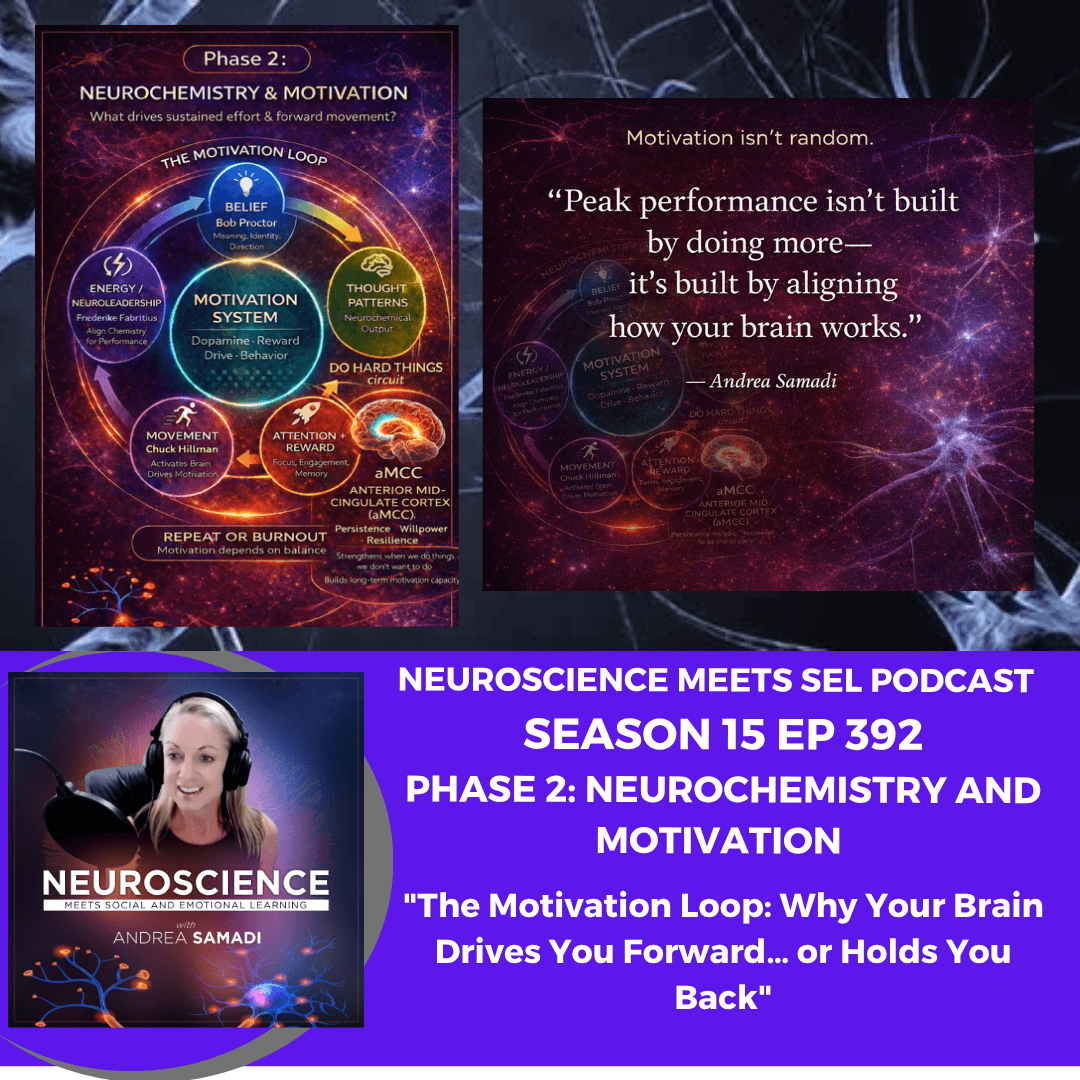
Neuroscience Meets Social and Emotional Learning
The Motivation Loop: How Your Brain Decides What’s Worth Doing
00:19:20
Loading summary
Transcript2 lines
- [00:03]
A
Welcome Back to season 15 of the Neuroscience Meets Social and Emotional Learning Podcast. I'm Andrea Samadhi and it's here that we bridge the science behind social and emotional learning, emotional intelligence, and practical neuroscience so we can create measurable improvements in well being, achievement, productivity and results. And if you're new here, welcome. We're currently reviewing past episodes as a part of season 15, organized as a roadmap of the brain's foundational systems. Instead of treating neuroscience, health, mindset and performance as separate topics like we've done in the past 14 seasons, we're now exploring how these systems come online in sequence. We started with phase one, regulation and safety, with episode 384 with Dr. Bilanjal, who taught us how learning begins with curiosity, with sleep, imagination and creativity. And we reviewed anchor episodes with Dr. Bruce Perry looking into trauma, rhythm and relational safety. Dr. Sui Wong on autonomic balance and Rohan Dixit on HRV and Real Time self regulation and nervous system literacy. Now we're moving to phase two, diving deeper into neurochemistry and motivation. And then we'll cover movement, learning and cognition. Then perception, emotion, social intelligence, and finally, integration, insight and meaning as we put all the phases together. Because peak performance isn't built by doing more, it's built by aligning the systems underneath. And the truth is that most of us were never taught how these systems drive our behavior and our results in the first place. So as I continue to explore and better understand these systems myself, I want to thank you, the listener, for joining me on this journey so that together we can learn how to align our brains and use this understanding to unlock what's truly possible for us to achieve. Because I do believe we're capable of achieving so much more than we think is possible with this understanding. So today we move into phase two of our roadmap, neurochemistry and motivation. So just a reminder, in phase one, we asked a foundational question. Is the nervous system safe enough to learn? Because without safety, nothing else in the brain fully activates. But once the brain is regulated, a new question begins to emerge. What actually drives us forward? What determines whether we start something, whether we stay with it or if we stop it altogether? So we'll cover six parts in this episode where we answer this question and we'll give some real world examples and come up with some action steps to help us to all build motivation the right way or it's sustainable in our day to day life with our brains in mind. Starting with part one, the motivation loop, and at the center of phase two now is a system that's always running in our brain. And this system is where belief, thought patterns, neurochemistry, action, and feedback all come together to shape our behavior and results. It's the motivation loop. Because learning isn't just about understanding what to do. It's about having the drive to actually do it. Because motivation isn't random. It's built. And this loop determines what you will start, what you will stick with, and what you'll typically avoid. And my hope is that by the end of this episode, we can recognize our own motivational loops happening in real time and understand how our brain is guiding us to either push us forward or. Or backwards to let go. Just a quick overview of this loop. It starts with belief and expectation. We think something that we're doing matters, and it's worth doing. Then we get into our neurochemistry, where our dopamine is involved. And this rises before action takes place. Then we put in the effort and the action. We begin doing what we're gonna do. Then we'll get feedback. We either get a reward or we don't. The brain will evaluate the outcome, the and it will allow us to either repeat the activity or it will urge us to avoid it. So our behavior is reinforced or not. So what are the actual steps that drive the sustained effort and drive us forward with movement? Let's look at each of the steps. Step one. Expectation through what you believe. And this starts in the prefrontal cortex, the thinking brain. This is where we set a goal or we form a belief. We think this matters. This will feel good if we do it. This is worth doing. This is a critical step because the brain is predicting the future. If the brain expects something to matter, something that you choose to do, dopamine begins to rise before you even start it. So think ahead. What matters most to you right now? What do you expect to achieve? Because what you expect is what your brain begins to move towards. Step two. Your thought patterns. Your thoughts shape your brain chemistry. If you have positive expectation, your dopamine increases and your effort rises. Or if you have negative thinking, your dopamine drops and your motivation decreases. Your thoughts are not neutral. They're chemical. And this is where things start to shift internally. Your thoughts don't just stay in your mind. They directly influence your brain chemistry. And we'll dive deeper into this area with Dr. Carolyn Leaf's work. But think ahead. Right now, are your thoughts helping you to move forward, or are they holding you back? Are you thinking this matters? I can do this. Or are you thinking this is too hard? I'm not sure if I can. Because once you notice this, you'll know exactly where your work lies. Step three is attention and reward. Now, the brain engages here. You've got your motor and your attention systems that engage. Dopamine fuels your drive. Then you've got movement. It turns on the brain for motivation. And we'll learn more on this area with focus, engagement, memory formation with John Medina. But until then, think ahead. What would it feel like if I fully engaged myself in this? What's one small action I can take to get started? And how will I feel once I've begun? Because this is the moment where the brain shifts from thinking to doing. Now we go to step four. We go to feedback. You either get a reward or you don't. The brain evaluates the outcome. Dopamine either spikes and it's better than expected, or it drops if it's worse than expected. So immediately there's attention and there's a reward. The brain asks, was that worth it? If you look at the diagram in the show notes, you'll see an orange arrow that either goes forward in the loop or backwards if there's no reward. Moving on to step five. That's learning and repetition. The basal ganglia in the brain encodes the behavior and that activates habit circuits to strengthen or weaken. Your brain is deciding, is this worth repeating? A key insight here. The brain isn't just tracking what you do. It's learning what's worth doing based on what you actually believe. So do you see how this motivation loop works? This is really exciting to me because it shows me that we have a lot of control over, over what we want to achieve based on how we think about it from the very first part of the loop. And we'll go deeper into each of these steps next week with our anchor episode, starting with Bob Proctor on belief and then Dr. Carolyn Leaf on the power of our thoughts. But moving into part two. Here, there's a rule about motivation. This leads us to one of the most important rules in neuroscience. If dopamine comes too easily, effort stops feeling worth it. If dopamine is earned, effort becomes rewarding. This just isn't about mindset. It's brain based. You've got dopamine that comes with anticipation, not just pleasure. Most people think dopamine is the feel good chemical, but it's not only that. Dopamine is the this is worth doing signal. It's released when you expect a reward, not just receive it, it drives Effort, focus, and persistence. Dopamine doesn't just reward you after the fact. It pulls you forward before you begin. And we covered this on our Think and Grow Rich book series way back in 2022. And it always amazes me when a book that was first published in 1937 connects to the success principles that we're learning today, almost 90 years later. Expectation and belief were integral components to chapter one, the power of thought, of Napoleon Hill's Think and Grow Rich book. Moving into part three, now. Building willpower. Thinking back to the motivation loop, I always wondered, what is it that keeps me motivated on one thing and then dragging my feet with another? Understanding how the brain works has helped me to understand this question. And one of the most fascinating discoveries in neuroscience today comes from the research on a part of the brain called the anterior mid cingulate cortex. It's the amcc. On our diagram, we covered this important discovery about the brain on episode 344, the neuroscience of Building Stronger Minds and Teams. And on this episode, we covered some fascinating research From Stanford Professor Dr. Andrew Huberman with his guest David Goggins, as they discussed how to build willpower. And what scientists are finding is that this area doesn't grow when we do things that are easy. It grows when we do things we don't want to do. When we push through resistance, when we finish the workout, when we say no to something tempting, this part of the brain actually strengthens. And it's now being linked not just to willpower, but to resilience, to longevity, and even what some researchers are calling the will to live. So motivation isn't about wanting to feel ready. It's about doing hard things, especially when you don't like it, because it's what actually builds this system and makes it stronger. So just to review this part of the brain, the anterior mid cingulate cortex, it's responsible for persistence, for willpower, and for doing hard things. And this part of the brain grows when you do things you don't like doing. The moment you want to quit is the moment that your brain is changing. So it's growing when you do things you don't like doing, but you do it anyway. And you can see the AMCC part of the brain on the motivational loop diagram, right where the orange arrows either move us forward to movement or. Or backwards. So understanding this part of the brain helped me to understand why I want to quit sometimes when I'm doing things that are difficult. But the important part is pushing through to build a stronger, more resilient brain Moving on to part four now looking at borrowed versus Earned dopamine and this one made me think because I always hear people looking for a quick fix for motivation, my family members included, as I recently have been asked the question, hey mom, can we buy these energy drinks to help me get motivated before I go to the gym? And my answer is always a solid no. But I didn't have the best explanation as to why I don't think this is the best idea until writing this episode. So understanding the chemicals in our brain helps to explain this one and the fact that not all dopamine is equal. So looking at borrowed dopamine, it's fast, it's easy, it's immediate. An example is like scrolling on your phone before starting something, or eating sugar when you're stressed, or an energy drink before a workout. It feels good before you put in the effort. The result? It weakens the motivation loop and it lowers motivation over time and then it creates dependency. Now on the other side you've got earned dopamine. It's slower, it's effort based and it's long lasting. An example of this is finishing a workout or writing when you don't feel like it, or completing something difficult when you feel tired, like going to the gym. It feels good after the effort and that strengthens your motivation loop. It builds internal motivation and it rewires the brain if we want to go deeper. It builds a stronger anterior mid cingulate cortex. So key takeaways here. Borrowed dopamine feels good now, but earned dopamine builds your future. Moving into Part 5 let's apply this to real life. We all experience this. Activities with meaning and progress are easier to start versus activities with a delayed reward are harder to begin. Think about what's easy for you to do versus where it's more difficult for you to begin. This is where the work begins as the harder to begin activities will build a stronger, more resilient brain when you can push through. And just some personal insights here. I have a hiking insight at the end of a long hike one day I noticed something significant. Now I'd hiked the same distance the day before so I was tired. But this day I noticed the last 30 minutes were really difficult for me to complete. The effort had increased, the reward dropped, the loop broke and my motivation dropped. And I saw it in real time at the end of the hike. I thought I need a break from these long hikes. It was a long and difficult walk to my car. Some key insights here. When effort outweighs Reward repeatedly, the brain begins to lower motivation to protect you. So I could see and react real time. My motivation loop breaking and it was going backwards. It wanted to keep me safe. And if I didn't think about the benefits of doing difficult things on my brain, I might have given myself a weekend off. But doing difficult things builds my anterior midcingulate cortex in the brain. And this aha moment has kept me pushing through challenge to build a stronger, more resilient brain. Part 6 let's connect back to the loop now. So every action trains your brain. If you get an easy reward first, you get a weaker loop. But if you have effort first, you'll get a stronger loop. And the long term result is that effort stops feeling like resistance and it starts feeling like progress if you can keep going. And this is what happens when we get into the groove, like when we keep going to the gym or when I push through with my hikes. And I made them non negotiable. And also for me, why it's easier to write these podcast episodes when I do them regularly every weekend. Taking time off weakens the loop and it makes it more difficult to get started again. Some tips to put these ideas into action now so we can build a stronger, more resilient brain with our motivation loop. Build motivation the right way. Start easier than you think. So create some early wins. Reward yourself after the effort, not before. Train the correct loop. A stronger loop. Stop before you get exhausted to protect your motivation system. I saw right away how easy it was to break it and then repeat before increasing your difficulty consistency. Builds a stronger loop over time. The simple rule, with effort you get a reward and then the loop will repeat and build stronger. So to review and conclude episode 392, as we launch phase two on neurochemistry and motivation, let's bring this all together. Motivation isn't something you have. It's something you build through a loop of belief, action, feedback and repetition. It's a loop that looks at what you believe, what you do, what you experience and how your brain evaluates it. Then a reminder. Borrowed dopamine weakens your motivation, but earned dopamine builds it. Just connecting back to phase one, we looked at regulation and safety where we stabilized our energy system. Now in phase two, neurochemistry and motivation, we activate it. Because peak performance isn't built by doing more. It's built by aligning how the brain actually works. And I hope you can now see how to build a stronger, more resilient brain with this understanding of the motivation loop and we'll see you next week as we dive into our anchor episodes, beginning with Bob Proctor, where we explore the role of belief in driving behavior, results and direction. We'll see you next time.
- [18:52]
B
If you're enjoying the Neuroscience Meets Social and Emotional Learning podcast, please don't forget to subscribe so you'll stay up to date with our new episodes. While you're there, please feel free to give us a review or a five star rating as it helps others find us. For more information on our programs, books and tools for schools and the workplace, Visit us at www. AchieveIt360.com.