← Neuroscience Meets Social and Emotional Learning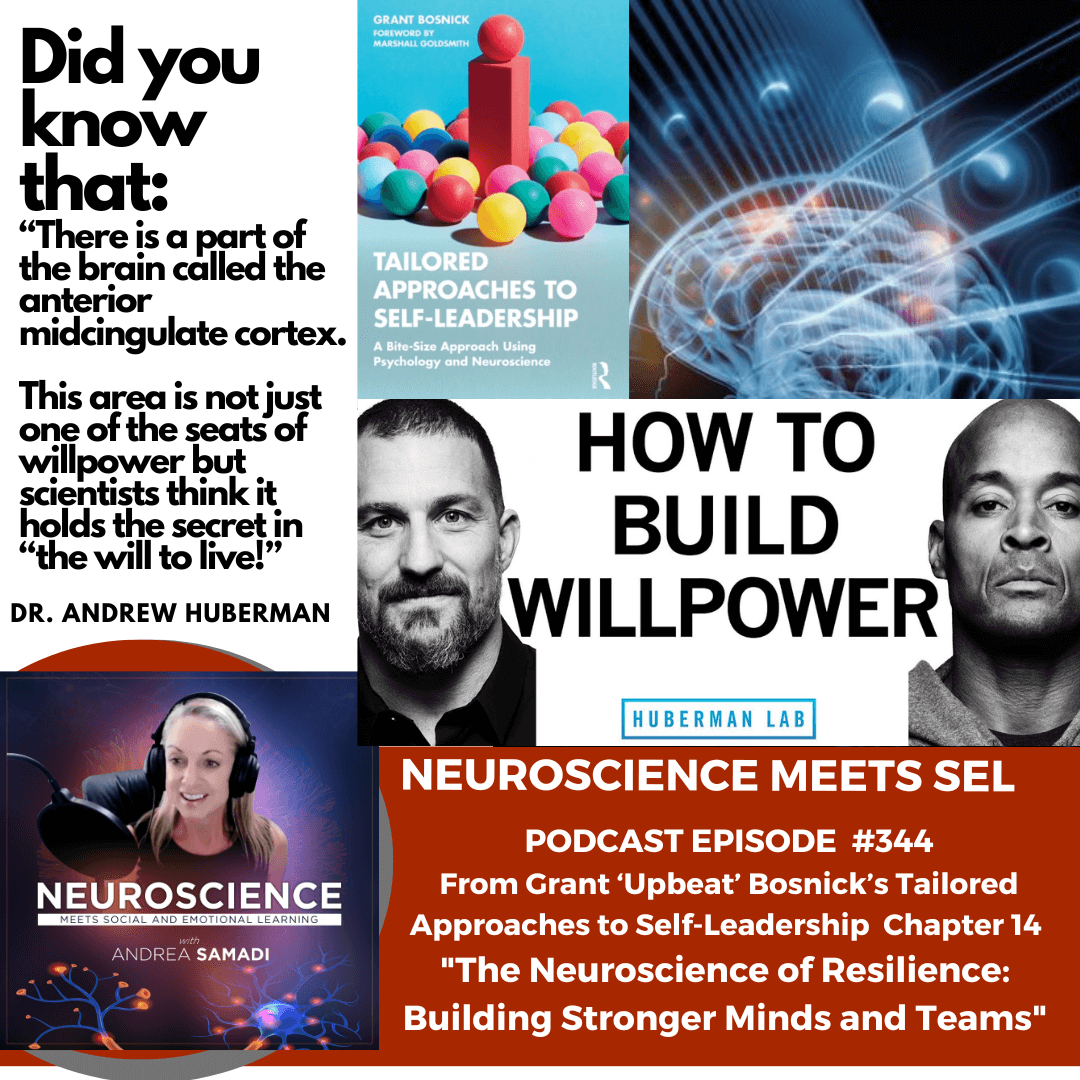
Neuroscience Meets Social and Emotional Learning
The Neuroscience of Resilience: Building Stronger Minds and Teams: Insights from Grant Upbeat Bosnick (Chapter 14)
00:23:08
Loading summary
Transcript2 lines
- [00:00]
A
Foreign welcome Back to season 12 of the Neuroscience Meets Social and Emotional Learning Podcast where we connect the science based evidence behind social and emotional learning and emotional intelligence training for improved well being, achievement, productivity and results using what I saw as the missing link since we weren't taught this when we were growing up in school. The applic of Practical Neuroscience I'm Andrea Samadhi, an author and an educator with a passion for learning and launched this podcast six years ago with the goal of bringing all the leading experts together in one place to help us to apply this research in our daily lives. On today's episode number 344 we continue with our 18 week self leadership series based on Grant Bosnik's tailored approaches to self leadership that we first dove into with Our Interview Episode 321The end of January. The goal was that each week we focused on learning something new from Grant's book tied to the most current neuroscience research that builds off the prior week to help take us to Greater Heights in 2024. On today's episode number 344 we're moving on to chapter 14 reviewing the neuroscience of Resiliency and this is a topic we've covered a few times on this podcast, all the way back with Horacio Sanchez who named his educational consulting business Resiliency, Inc. And we met him back on episode 74 and then we did a deep dive Brain Fact Friday on episode 286 and that was on Building resiliency, grit and Mental Toughness. On this episode we reviewed Horatio Sanchez's definition of resiliency as a collection of protective risk factors that you have in your life, and that there are some factors that we're born with. Others come in through childhood, family, school life events and social experiences. Horatio reminds us that if you have little risk, it takes less to be resilient, but if you have a lot of risk, it takes a lot more protective factors to offset the scale. And this is why two people can possibly respond in two completely different ways. After a traumatic experience, one person walks away and dusts themselves off and recovers quickly. They had more reservoirs of resilience to tap into, while the other has a completely different outcome and needs more assistance to get back on track. With resiliency, we can overcome adversity or difficulty and have good outcomes in our life. But you can see why not everyone is born with exactly the same protective factors needed so we don't all have the same levels of resiliency. Horatio mentioned that 25% of the population are naturally resilient and his work focuses on instilling this trait in those who are not naturally resilient due to the number of risk factors associated to them. To this day, he continues with his mission, flying around the country helping our next generation of students to become more resilient. Now, resiliency came out as a low priority for me to focus on this year with 0% in pathway 5 along with change in agility, and it makes more sense to me now that I understand the protective and risk factors that I faced growing up as a child, from my family, from school life and social events. When I review the list that you can see in the show notes, I can see that I was fortunate to have more protective factors than risk. And if you've taken the leadership self assessment, look to see if resilience in Pathway five, along with change and agility is of a low medium or a high priority for you to focus on this year. And if you haven't listened to episode 74 or 286 where we dove deeper into building resiliency, grit and mental toughness, I highly encourage that you listen to both of these episodes and in addition to what we're going to uncover today on resiliency so what does Grant Bosnik have to say about building resilience in ourselves and our teams? In chapter 14 of his book well, he opens up the chapter with a situation with a farmer and his donkey who'd fallen into a hole in the ground. It was actually a well and the donkey couldn't get out. Finally, after trying to get the donkey out, he gave up and he decided to shovel dirt into the well since the donkey was old and he thought he wasn't worth saving. And at first Grant writes that the donkey cried with the dirt being shoveled on top of him until he eventually stopped and he was quiet. And when the farmer looked into the hole, he was amazed at what he saw. With each shovel of dirt, the donkey would shake it off his back and use the dirt to climb up higher until he was able to easily step out of the hole and trot off happily. What Grant is showing us at the start of this chapter is that we'll all have dirt shoveled on our backs in our life and that we can either get buried in the dirt or shake it off and take a step up. Each adversity we face is a stepping stone and we can get out of the deepest walls by shaking off the dirt and taking a step up. Now, there was another analogy in Grant's book that I liked. It was about a carrot, an egg and a cup of coffee. And the story went like this. There was a young woman who went to her mother one day and she was complaining that things were difficult for her in her life. Her mother took her into the kitchen and she filled three pots with water and placed them on the elements, bringing each one to boil. One pot, she placed carrots, in the second, an egg, and the third one, coffee beans. And after 20 minutes, she asked her daughter what she saw. And her mother's explanation was eye opening. She explained to her daughter that each of these objects faced the same adversity. Boiling water, each reacted differently. The carrot went in strong, hard and unrelenting. However, after being subjected to the boiling water, it was softer and became weak. The egg was fragile, but after being in the boiling water, its inside became hardened. The ground coffee beans were unique. However, Bosnik writes that after being in the boiling water, they change the water. And the mother asked her daughter, when adversity faces you, how do you respond? Are you a carrot, an egg, or a coffee bean? And Grant asked the reader of his book to think about this question. Which one would you pick? Are you the carrot that seems strong, but with pain and adversity, wilted and became soft, losing its strength? Or are you the egg that starts out with a soft heart but hardens with the heat? Or are you like the coffee bean that actually changes the hot water? The very circumstance that brought the pain? I'm hoping we all desire to experience change with the adversity that we face. Bosnik gives two real life examples of famous people who took their pain and changed for the better because of it. Terry Fox, a distance runner from British Columbia, was his first example. And Kawhi Leonard, a professional basketball player from the NBA. And you can look up these stories if you don't know them already. But growing up in Canada, I remember Terry Fox's story well. Terry Fox took the pain of a cancer diagnosis that led to one of his legs being amputated and replaced with an artificial leg. And rather than giving up or becoming hard or soft, he changed the situation like the coffee bean in the water, with his marathon of hope. And this marathon of hope was first held in 1981 and has now grown to involve millions of participants in over 60 countries and is now the world's largest wealth one day fundraiser for cancer research with over 750 million Canadian dollars raised in its name. And Bosnik reminds us that resilience is not about bouncing back from adversity, but rather it's about surviving and thriving through the stress caused by the adversity and changing our situation to make it better now. After Bosnik focused on building resilience in ourselves, he went on to show how to build resilience in our teams. And he mentioned a book that we've recently talked about with mediation expert John ford from episode 340. I love making connections with past episodes and when I read Bosnick mentioned the Five Dysfunctions of a Team by Patrick Lencioni, I went straight back to that episode with John ford. In chapter 14, Bosnick outlines the five dysfunctions of a team absence of trust, fear of conflict, lack of commitment, avoidance of accountability and inattention to results. Next, he outlines the five functions of a high performing trust, absence of fear of conflict, commitment, accountability and attention to results. Bosnik writes that when we feel accountable and we have attention to results, we adopt a mindset or attitude of control, control which enables us to take direct hands on action to transform changes, adversities and the problems that they may cause. And if we believe that we can influence the outcome of an adverse situation, we're more apt to push ourselves to deal with it. If the opposite is true, we may question our ability to turn adversity around and stop trying to and when I think of a recent time that I faced adversity and had to be resilient in the process, if I didn't think it would be possible for me to be successful, there's no way I would have persevered. Each individual on a team must also have this mindset as they go through change and adversity. The focus must be on Lencioni's work building a high functioning team with trust, absence of fear of conflict, commitment, accountability and attention to results that will lead to proactive behaviors and increase our own personal resilience and the resilience within our team. Bosnik offers a reflection activity in chapter 14 where he asks the reader to first, think of an adverse situation that you're facing at the moment. It could be in your work or personal life. Second, consider how this situation is making you feel. And I'm going to add that if you feel like the situation is in control of you, then you're not going to win. You've got to be confident that you're in control of whatever it is you're going through. Third, how can you adopt a more pro social mindset to see the adversity as opportunity to make things better for yourself and for others? Thinking of the carrots, the eggs and the Coffee beans. What will it take for you to become the coffee bean? And fourth, how can you help yourself and your team to be more high functioning? Thinking of Lencioni's five dysfunctions of a team, how will you help your team to move towards trust? Absence of fear of conflict, commitment, accountability, and attention to results. So what will it really take for you to become more resilient and overcome adversity? It will take a highly developed willpower. And we've talked about how to develop this faculty of our mind on episode 294, where we dove deep into the six faculties of our mind with our willpower being one of them. I do highly recommend listening to this episode if you want to review these important faculties. Since I can always use a refresher myself. I'll highlight what we covered on this important faculty that we need to develop to overcome adversity. Your will. This is one of my favorite faculties. It's one out of six. Along with our ability to reason, use our intuition, our perception, our memory and our imagination. And this one, the use of the will gives you the ability to concentrate while sitting down to write this episode. I've gotten up from my desk a few times, but I'm determined to finish writing this so I can record it and release it later today. And this is the will at work. You can also use the will to hold a thought on the screen of your mind, or choose thoughts of success over thoughts of failure. Or use the power of your will to overcome the adversity that you face. Or like Terry Fox or Kawhi Leonard, if you have a highly evolved will, you'll lock into doing something, block out all distractions, and accomplish what you set out to do. So how do you develop this faculty to overcome challenge or adversity? Developing the will takes practice. Meditation can strengthen your will, but also so can staring at a candle. Flow flame until you and the flame become one. And I tried this activity in my late 20s and I remember actually took a few hours of staring at this candle flame before I was able to block out the distractions of the outside world. And the flame extended towards me, and me and the flame became one. This faculty, the use of the will, like the others, takes time and practice. But once you've developed this faculty, you'll know that you have the ability to sit, to focus and do anything. An extension of this activity could be that once you and the flame have become one, once you've done this, try to change the color of the flame in your head. Just say the color blue. Blue Blue. And watch the color of the flame change. Turn to blue right in front of you. Then pick a different color and see if you can quickly change the color of the flame from blue to red or orange or whatever color you think of. This activity will definitely strengthen your will. And it was here that I wondered, what does neuroscience have to say about this topic? And we've covered the neuroscience of resiliency on past episodes, but we've not yet covered some new research that Dr. Andrew Huberman discovered this past year about what happens to our brain when we have a highly developed willpower that will need to overcome adversity and challenge. This new research actually made the famous scientist, Dr. Huberman Jump out of his chair. Did you know that there's a part of the brain called the anterior mid cingulate cortex? And this area is not just one of the seats of willpower, but scientists think it holds the secret in the will to live. When I first heard about this part of the brain, I knew it was important for overcoming adversity and helping us to become more resilient. Scientists discovered that this part of the brain increases in size when we do something we don't want to do, like exercising when we'd rather not, or diet or resist eating something we know is bad for us when we'd rather eat the old way. And Dr. Huberman shared on this eye opening episode with his guest David Goggins, that when people do anything they don't want to do, it's not about adding more work, it's about adding more work that you don't want to do, which makes this part of the brain area get bigger. And this part of the brain is larger in athletes, it's larger in people who overcome challenge. And as long as people continue to do difficult things, this area of the brain keeps its size. And to me, this shows that building resilience in ourselves and our teams is not just good for whatever challenge we're looking to overcome, but we're building stronger, more resilient brains, specifically stronger anterior mid cingulate cortexes. So to review and conclude this week's episode 344 on the neuroscience behind building resilience in yourself and your teams, we covered a review of episodes 74 and 286 where we covered the neuroscience of resilience with Horacio Sanchez's work reminding us that our protective or risk factors in our lifetime will determine how resilient we'll be in our life. While 25% of the population are naturally resilient, Horatio asserts that if you have little risk, it takes less to be resilient. But if you have a lot of risk, it takes a lot, a lot more protective factors to offset the scale. And Horatio has dedicated his life to helping our next generation become more resilient. Next we looked at Grant Bosnick's book Tailored Approaches to self leadership, chapter 14, where he gave us the analogy of the donkey who fell into the well and demonstrated resiliency when he used the dirt shoveled on him to climb out. And this example taught us that we'll all have dirt shoveled on our backs in our lifetime and that we can either get buried in the dirt or shake it off and take a step up. Each adversity we face is a stepping stone and we'll get out of the deepest walls by shaking off the dirt and taking a step up. Another analogy we learned was through the mother and the daughter story and that when adversity faces you, Bosnik asks us to reflect, are you the carrot that seems strong, but with pain and adversity wilted and became soft, losing its strength? Or are you the egg that starts out with a soft heart but hardens with the heat? Or finally, are you like the coffee bean that actually changes the hot water, the very circumstance that brought the pain? And I'm hoping that we'll all desire to experience change with the adversity that we face like the coffee bean. After learning about building resiliency in ourselves, we next learned about building resiliency within our teams. And we looked at Patrick Lencioni's the five Dysfunctions of a the absence of trust, the fear of conflict, lack of commitment, avoidance of accountability and inattention to results. Then we learned to turn this around using the five functions of a high performing team trust, absence of fear of conflict, commitment, accountability and attention to results. Then we looked at how we develop resiliency using our willpower from episode 294 where I shared an activity to strengthen this faculty of our mind either through meditation or with an activity of staring at a candle flame and with time, effort and sheer willpower blocking out everything else around you until you and the candle flame become one. And finally, we looked at the fascinating new neuroscience behind the part of our brain, the anterior mid cingulate cortex, that becomes bigger when when we use our willpower to do those difficult things that we don't want to do. Scientists believe this ability to use our willpower to do difficult things which builds our resiliency is what's really behind the will to live. I hope you found this episode on building resilience in yourself and your teams as valuable as I have, and that when challenge comes our way in the future, that we continue to lean into it using every ounce of our willpower and become a coffee bean, emerging stronger than the challenge we faced and knowing that this process is building a part of our brain, our anterior mid cingulate cortex, and this part of our brain will become bigger, helping us to continue to do difficult things in our future. And with that thought, I'll close close out this episode and I'll see you next time with two interviews coming to help us to continue to build stronger versions of ourselves and others this year. I'll see you next week.
- [22:40]
B
If you're enjoying the Neuroscience Meets Social and Emotional Learning podcast, please don't forget to subscribe so you'll stay up to date with our new episodes. While you're there, please feel free to give us a review or a five star rating as it helps others find us. For more information on our programs, books and tools for schools and the workplace, Visit us at www. AchieveIt360.com.