← Neuroscience Meets Social and Emotional Learning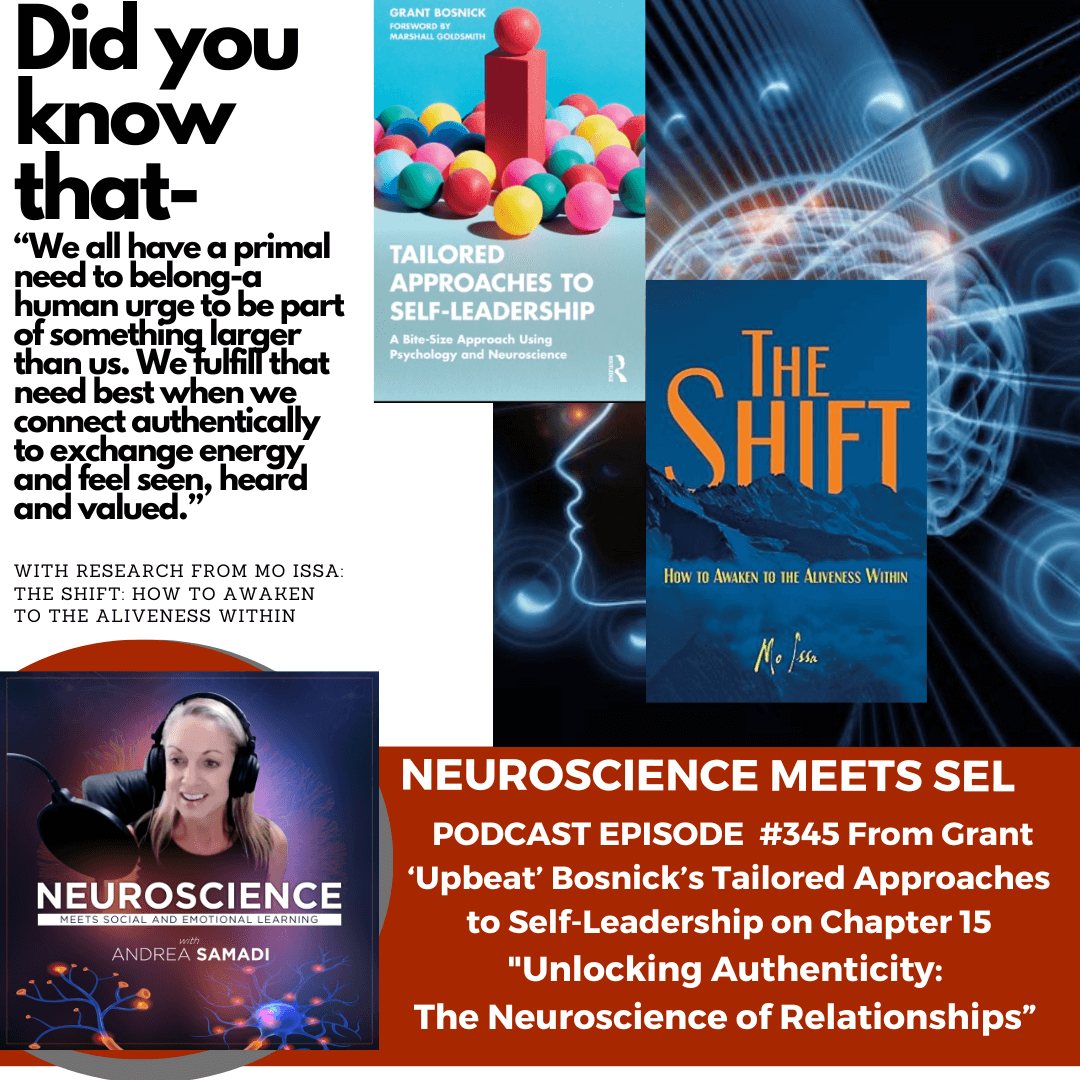
Neuroscience Meets Social and Emotional Learning
Unlocking Authenticity: The Neuroscience of Relationships
00:23:46
Loading summary
Transcript2 lines
- [00:00]
A
Foreign welcome Back to season 12 of the Neuroscience Meets Social and Emotional Learning Podcast where we connect the science based evidence behind social and emotional learning and emotional intelligence training for improved well being, achievement, productivity and results using what I saw as the missing link since we weren't taught this when we were growing up in school. The applic of Practical Neuroscience I'm Andrea Samadhi, an author and an educator with a passion for learning and launched this podcast six years ago with the goal of bringing all the leading experts together in one place to help us to apply this research in our daily lives. On Today's episode number 345 we continue with our 18 week self leadership series based on Grant Bosnik's tailored approaches to self leadership that we first dove into with Our Interview Episode 321The end of January. The goal was that each week we focused on learning something new from Grant's book tied to the most current neuroscience research that builds off the prior week to help take us to Greater Heights in 2024. For today's episode number 345, we're moving on to chapter 15 reviewing the neuroscience of Relationships and Authenticity we covered relationships on this podcast right back to the beginning we with Greg Wolcott on episode seven with his book Significance 72 Unleashing the Power of Relationships in Today's Classrooms. Greg Wolcott, an Assistant Superintendent from Chicago, Illinois has dedicated his life to this topic through his work@significance72.com and it's here where you can learn about Greg's relationship mindset, movement, his books and his tools and his resources to help improve student teacher relationships in the classroom. Relationships are also one of the six social and emotional competencies that we built our podcast framework upon, knowing how important relationship skills are for our well being and future success. Social relationships, both quantity and quality, affect mental health, health, behavior, physical health, and even our mortality risk. If you've taken the Leadership Self Assessment, look to see if Relationships and authenticity in pathway 6, our final pathway in this book study, along with biases, trust and empathy, is of a low, medium or high priority for you to focus on this year. I was not surprised to see this pathway is a high area of focus for me. While we've covered relationship building often on this podcast, the one topic we've not covered yet is authenticity. This is interesting timing for me as I'm currently reading a book by a good friend, Mohammed Issa, where he covers the topic of authenticity in depth and it's the title of Chapter 8 of his forthcoming book, the Midlife shift and I remember years before Mo wrote this book, his third book, I could tell he was thinking deeply about this topic. In 2021, he sent me a message and he asked me, what does living an authentic life mean to you? And I take questions from Mo seriously over the years. I know he's not messing around. I can go back to my notes from 2021 and can see that I wrote a few pages of what authenticity means to me. These notes are important for today's episode and when we meet with Mo the middle of next month. I wrote, authenticity is being genuine or real. What's authentic? For me personally, it's living life according to my values. And this takes ongoing refinement. I know what's important and what drives me daily, and it's health. Health is at the top of my value chart and I'd never compromise it. It's the first thing I focus on the minute I wake up and when I close my eyes at the end of each day. Living life authentically for me is putting health as the backbone of strength, which I found helps me to skyrocket my personal and professional life. It's been this way for me as long as I can remember. Living an authentic, original life for me also means living who I am by design. After health, I prioritize what unique expressions I want in my life. Growth and challenge comes next and these things that I value make me authentic and uniquely me. I have to fight for these values in my life. I've got to go after them and keep them at my forefront because only I know what's best for me here. If I'm not putting my health first for myself and for my family, or learning, growing, researching and then disseminating and sharing what I've learned, I'm not living my true authentic self and it will hurt my productivity if I compromise who I am at this granular level. And I did take some time off from producing episodes earlier this year and and while it was great to have this extra time, I ended up using this time for things that didn't truly make me happy at the soul level, like this work does. What about you? What does authenticity mean to you? Do you know when you're living a truly authentic life? It's eye opening once we know this about ourselves so we can course correct when we veer off this path of authenticity. Do you know what's special about you? What are your unique gifts and talents that make you stand out from others? A talent that you know deep inside you must keep working and perfecting as it's this talent that awakens your aliveness. I love how Mo EASA defines authenticity, which shows up as a theme in all of his books. After years of self reflection, Mo believes that true authenticity means being ourselves, not an imitation of what we think we should be or what others want us to be. We all have a unique gift and we must find and nurture it. Getting back to chapter 15 of Grant Bosnick's book, what does Grant have to say about being authentic? Bosnick says that before we can build authentic relationships with others, he has us consider what authenticity means to us first. And he says being authentic is being real, being honest and true with yourself, being vulnerable, letting go of our ego, not looking only at what you like about yourself, but also the darker part that can be improved or changed. And I've heard this called our shadow work. And then having the courage, humility and discipline to take a hard look in the mirror at who you are. Bosnick covers what holds us back from being authentic, and he lists fear of being vulnerable, fear of rejection, fear of judgment, fear of abandonment, competitiveness, insecurity, self protection, jealousy, fear of not being good enough. Well, I pretty much resonated with the entire list. Some of his lists more than others. But right up there for me would be fear of not being good enough, which I've been working on for the past 25 years. When I finally let go of caring what other people think of me, it was probably the most freeing experience I've ever felt. Sure, it's nice to be liked by others, but also to know that not everyone will connect with who I am, the authentic me. And to let go of caring about that is freeing. Do any of the items on Bosnick's list keep you from being truly authentic? He asks us some reflective questions. He asks what might be holding you back from being truly authentic. What can you do, even small steps to help you to feel more comfortable with being who you are, being truly authentic. Bosnik goes on to describe why some people show up as fake or superficial. I always think of the character Eddie Haskell from the TV show Leave it to Beaver when I'm thinking about a fake person. He was always trying to impress Mrs. Cleaver, and he came across as insincere. We can all spot people like this, and Bosnick reminds us why people come across this way. He says that it's within our comfort zone. We want to be liked. It's easier. Our ego gets in the way, and the change can be difficult. When we don't have the courage, humility and discipline needed to take a hard look in the mirror at who we are. So what are some reasons for not being authentic? Bosnick thinks insecurity, jealousy, inner competitiveness, fear and self protection can keep us from not showing others our true selves. And in turn, we can appear fake or superficial. Brene Brown writes about the power of vulnerability as the birthplace of joy, belonging, authenticity and love in her 2012 book, with suggestions for how to prevent us from appearing fake in the process. Her book teaches us how to practice courage and accept imperfection, to embrace vulnerability and acknowledge our fears. She dives into exploring the power of authenticity, of being true to our feelings, our thoughts and our actions as the backbone to living an authentic life. With this in mind, going back to Bosnick's book, he mentioned that he struggled with being vulnerable, with letting others see his true, authentic self, and he felt he needed to protect himself. And when he let people see the real me, it was so rewarding and it felt so good and freeing. He said. He decided to have the courage to be authentic and real, and he was fully aware that some people might not like him, but he knew that was okay and that he would build the right relationships with those who did. Next, Bosnick has a reflection on how to be authentic. He asked the reader to reflect what holds you back from truly being authentic and how can you become more comfortable with with being authentic day to day. And I went back to Moisa's definition that we covered in the beginning of the episode, that true authenticity means being ourselves, not an imitation of what we think we should be, what others want us to be. We all have a unique gift and we must find and nurture it. And we'll go deeper into Mo Issa's work when we meet with him next month. But I think that this is what we're supposed to discover about ourselves, first through self awareness. And only then, once we're clear on who we are, can we build more authentic relationships with others. To close out Bosnick's chapter 15 on relationships and authenticity, he does cover being self focused versus other focused, valuing differences, overcoming our own egos and putting other people first, which was the theme of Simon Sinek's famous book Leaders Eat Last. Simon Sinek penned his book when he noticed that some teams trusted each other so deeply that they would literally put their lives on the line for each other. Other teams, no matter what incentives were offered, were doomed to infighting, fragmentation and failure. Why? Sunk, wondered. Well, the answer became clear During a conversation with a Marine Corps general who said officers eat last, Sinek watched as the most junior Marines ate first while the most senior Marines took their place at the back of the line. Great leaders sacrifice their own comfort, even their own survival, for the good of those in their care. Bosnik calls this other focus and reminds us that in order to build truly authentic relationships, we need to overcome our own ego and put others first. Bosnick covers the different needs of extroverts and introverts that we covered on episode 186, as well as different behavioral styles that help us to learn how to better interact with other people who have different styles than we do. And then to close out chapter 15, Bosnick goes into the neuroscience of our social brain and he covers the story of the famous Phineas Gage. And this is neuroscience's most famous patient. Without going too deep into the neuroscience, Bosnick explains that we have two systems in our brain. We've got the X system and the C system. The X system or reflexive system is automatic, responsive, like dislike, reward or threat. Since this part of our brain is non thinking, it's not affected by our mental load. Then we have the C system or reflective system and it's controlled conscious with executive function and executive control. Motivation and effort are required to engage this part of the brain and it can be affected by our mental load. So X system reflexive is automatic, C system reflective. We need motivation and effort to activate it. So the story of Phineas Gage goes like this. In 1948 in the US he survived a blast while building a railroad which shot a tamping iron through the front part of his brain. Remarkably, he survived. However, his behavior had changed. Where before he was a mild tempered respecting person, his behavior was now to seek reward without consequences, operating only by habit and he turned into a rude person. He destroyed the C system, his controlled thinking, operating on the X system only. In other words, he had no control over his automatic reflexive system and his behavior became unbearable as a result. He treated everybody as an object for his own personal reward. The C system that requires motivation and effort to activate, Bosnick explains, is important for self reflection and understanding self and other relations and occurs in the front middle part of our brain and we know this part of our brain as the default mode network and the part of our brain where we take breaks for creativity, thinking and learning to occur. And he adds to our understanding here by saying that when the brain is at a resting state, this specific system kicks in which is focused around social Understanding, thinking about yourself, others thoughts and others actions. Bosnik reminds us here to stare out a window and do nothing. And he says your life will thank you and it will help you to build more authentic relationships. And this was the whole idea behind episode 48, using brain network theory to stay productive during times of chaos. Next, Bosnick reminds us to go slow to go fast. And I can't even tell you how many times I've heard the phrase go slow to go fast this week. And here it is again at the end of chapter 15. Bosnick says that in order to build truly authentic relationships with people, we need to go slow to go fast. He suggests that we slow down the conversations with people, truly listen to them empathetically to be fully present with them and this will build the relationship to be deeper. Go slow with the conversation and communication in order to go fast with the depth of the relationship. And Bosnick suggests the following reflection activity for building more authentic relationships. Step 1. Think of a person in your business or personal life that you'd like to build a more authentic relationship with. Step two, how would you describe them? Are they introverted or extroverted? What are their behavior styles and how do they approach authenticity in relationships? Step three, Let your brain go into your default mode network. Stare out of a window and think what could you do to build a more authentic relationship with each of the people you're thinking of? How can you go slow to go fast? And I'll add a fourth and final step that came from the quote from Moisha and suggest that once we've done the work ourselves and we know what makes us truly authentic, we know our own unique gifts and talents and we continue to nurture and grow them. Then we can next look outward and recognize the unique talents and gifts in others. And we covered this practice extensively on episode 214 with Dr. Marie Gervais. By learning to see the spirit in others. And I'm confident that by practicing these steps with each person, we want to build a deeper, more authentic relationship with, whether in our personal or professional lives, that we'll notice strides of improvement. Once we've identified and appreciated our own authenticity and uniqueness, then we can recognize it in others for the magic to occur. To review and conclude this week's episode 345 on the neuroscience of relationships and authenticity, we covered Moisa's definition of authenticity from his book the Shift how to Awaken the Aliveness From Within. Mo believes that true authenticity means being ourselves, not an imitation of what we think we should be or what others want us to be. We all have a unique gift and we must find and nurture it. We looked at my reflection reflections from 2021 when Moisha asked me what does authenticity mean to me? And I wrote down what's authentic to me is living life according to my values, living who I am by design. Then we asked you, the reader, to consider what makes you authentic. How do you know when you're truly living an authentic life? Have you identified your unique gifts or talents that make you stand out from from others? Do you know what might be holding you back from being truly authentic? Then we looked at our social brain. We have two systems, the X system and the C system. The X is our reflexive system that's automatic and responsive. Our like dislike, our threat and reward. Then we've got the C system, our reflective system that's controlled, it's conscious that exactly executive function and executive control. And we need motivation and effort to engage this part of our brain. We reviewed the famous story of Phineas Gage who destroyed the C system in his brain and was operating only on his X system. In other words, he had no control over his automatic reflexive system and his behavior became unbearable as a result. And we learned that the CSIS technologies that requires motivation and effort to activate is important for self reflection and understanding ourself in another. We know this part of the brain as our default mode network. And the part of our brain where we take breaks for creativity, thinking and learning to occur. When the brain is at a resting state, this specific system kicks in and it's focused around social understanding, thinking about yourself and others thoughts and others actions. We learn to get to this resting state by staring out of a window. And then we do nothing except reflect on what else we can do to improve our relationship. And this knowledge that we'll uncover will help us to build more authentic relationships. We learn to slow down the conversation with people, truly listen to them empathetically and be fully present with them. This will build the relationship to be deeper. Go slow with the conversation and communication in order to go fast with the depth of the relationship. And finally we had four steps for building more authentic relationships. Step one, we think of a person in our business or our personal life that we'd like to build a more authentic relationship with. Step two, we get to know them on a deeper level. How would we describe them? Introverted, Extroverted? How do they approach authenticity in relationships? And then three, let your brain go to the default mode network. Stare out of a window and think what could you do to build a more authentic relationship with each of the people you're thinking of? How can you go slow with your conversation to go fast with the depth of your relationship? And finally, we looked at the quote from Moisa that suggests that once we've done the work ourselves and we know what makes us truly authentic, once we know our own unique gifts and talents and we continue to nurture and grow them, next we can look outward and recognize the unique talents and gifts in others. And I'll close out this episode with a quote from Moisa's second book, the Shift that says we all have a primal need to belong, a human urge to be a part of something larger than usual. We fulfill that need when we connect authentically to exchange energy and feel seen, heard and valued. Let me know what you think. Did this episode help you to improve your authenticity and deepen your relationships? I know this episode will take time to practice and refine. It's taken me my lifetime so far to embrace my unique talents and gifts where I recognize my own authenticity. Now I've got the rest of my life to take this understanding to help me to build stronger, deeper relationships with others. And with that thought, I'll see you next time where we'll cover Chapter 16 from Grant Bosnik's Tailored Approaches to Self Leadership on Biases. See you next time.
- [23:19]
B
If you're enjoying the Neuroscience Meets Social and Emotional Learning Podcast, please don't forget to subscribe, so stay up to date with our new episodes. While you're there, please feel free to give us a review or a five star rating as it helps others find us. For more information on our programs, books and tools for schools and the workplace, Visit us at www. AchieveIt360.com.