← Neuroscience Meets Social and Emotional Learning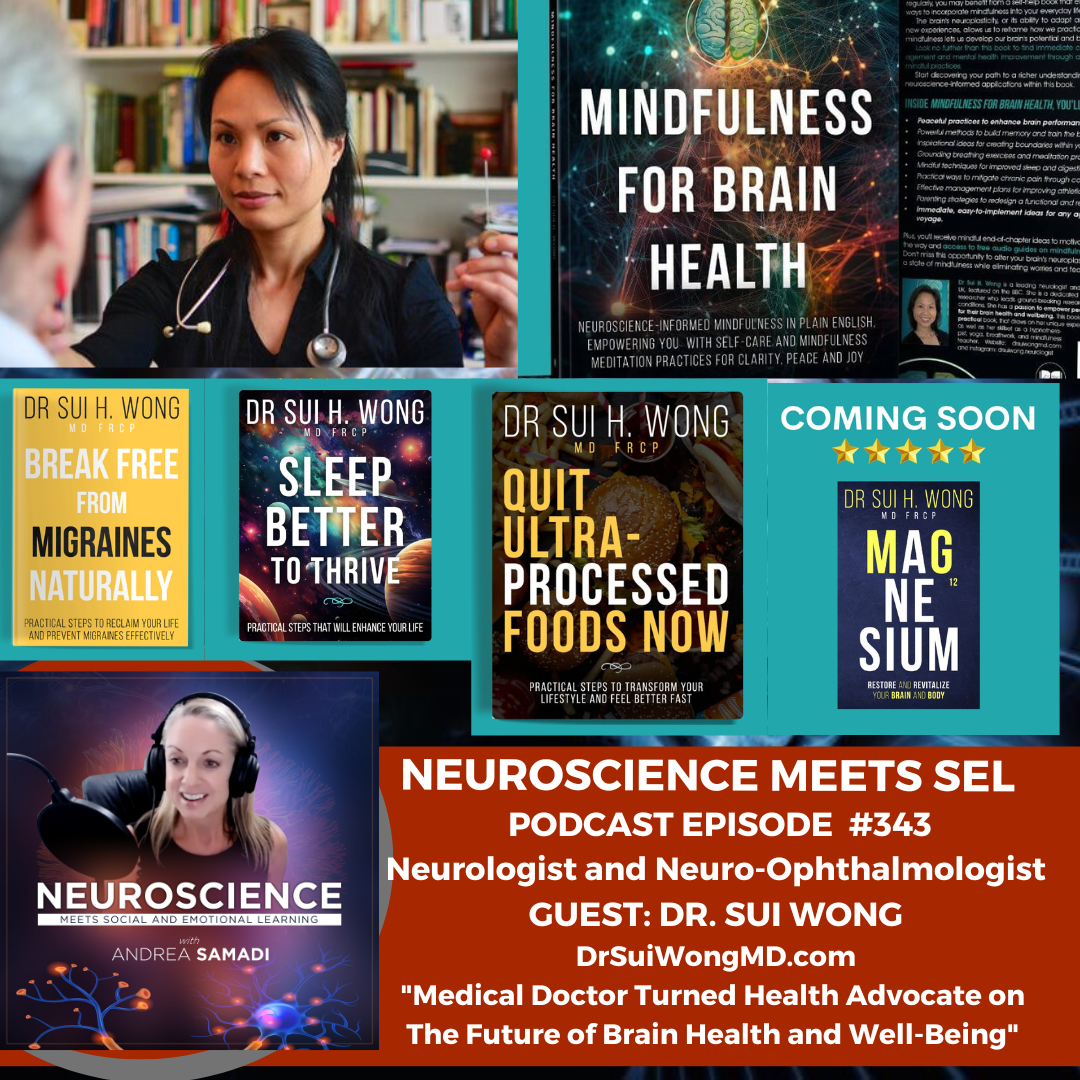
Neuroscience Meets Social and Emotional Learning
Unlocking Brain Health: Insights from a Leading Neuro-Ophthalmologist Dr. Sui Wong
00:53:01
Loading summary
Transcript63 lines
- [00:02]
A
Welcome Back to season 12 of the Neuroscience Meets Social and Emotional Learning Podcast where we connect the science based evidence behind social and emotional learning and emotional intelligence training for improved well being, achievement, productivity and results using what I saw as the missing link since we weren't taught this when we were growing up in school. The Application of Practical Neurosc I'm Andrea Samadhi, an author and an educator with a passion for learning and launched this podcast six years ago with the goal of bringing all the leading experts together in one place to help us to apply this research in our daily lives. On Today's episode number 343 we meet with Dr. Sui Wang. She's a neurologist and neuro ophthalmologist based in London, United Kingdom. In addition to her clinical work as a medical doctor and physician, Dr. Wang is an active neuroscience researcher who translates pertinent and clinically relevant questions into research to improve person centered patient outcomes. Additionally, she has the qualifications and experience to consider a broader spectrum of lifestyle specific interventions. Dr. Wang's holistic approach in empowering patients has been recognized with many awards and this is just the beginning for her. When I was introduced to Dr. Wang, I I knew I had to speak with her. She's a widely published author and researcher with over 110 peer reviewed publications in medical journals, chapters and conference abstracts to date. I looked at the articles Dr. Wong has published and one caught my eye. She's done extensive research that you can find in ophthalmology journals, like a recent article that I'm going to paraphrase here, but it was called Visual Snow Syndrome which is a neurological condition where individuals see persistent flickering white, black and transparent or colored dots across their whole visual field after mindfulness based cognitive therapy. We've spent quite a lot of time on this podcast walking through pubmed.gov and if you go there and put mindfulness into the search bar, you'll come up with over 30,000 results. I'm so curious to see what Dr. Hoang has uncovered with mindfulness and the future of our health. Let's meet Dr. Sui Wong and see what we can learn from her decades of research and her thoughts on what lifestyle specific interventions that she recommends for us. Welcome Dr. Wong, thank you so much for coming on the podcast today and meeting me all the way from the UK where I was actually born. I'm from Worthing, Sussex. Welcome.
- [03:13]
B
Thank you so much. I'm so delighted to be here. I've been so impressed with the work that you've been doing through this Podcast really helping a lot of people. So I'm just really very honored to be invited. And call me Sui, by the way.
- [03:28]
A
I will, I will swee. Thank you so much. Well, this is an honor for me. I had a look at your website, the work you've done, the publications you've created over the years, and now I'm learning that there's books that I didn't know of. So we're going to get to everything. But can you just first of all share and give an overview of why you chose this path and ended up in neuro ophthalmology with an explanation of what you're doing now. Just transition us.
- [03:58]
B
Indeed. Thank you. So I'm at heart, medical doctor, a clinician, and that's the only thing I ever wanted to be. I'm so, so lucky that I was inspired by my dad. When I was growing up, he was a medical doctor. He would talk about the lives that he's, you know, the, the kind of people who come to see him, the diagnosis he made, the ways that he's helped them. So it touched me so much. So that's the only thing I ever wanted to be. I wanted to be a doctor to make a positive change in this world. So that was the, the genesis of it all, which then I went to medical school. I loved all of medicine, I loved all of medicine and I couldn't choose what specialty. And then I came upon the rotation of doing neurology and wow, I was so impressed by how we can use our skills. The art of medicine combined with the science of thinking through things in a very methodical way, using really our hands and our thinking to get to the diagnosis and assisted by investigations where appropriate, and really having the change to help people. Because back then when I first entered neurology, that would be 25 years ago, it was a case of there was this perception that there is not much we can do for people with neurological conditions. And of course what I've seen is the way we can help people through different ways of empowering them, whether it's medications or guidance, understanding what's the. What to what's to come with the condition and what they can do to influence it. So that was the base of being a neurologist, a medical doctor, neurologist. And in the uk we are also a general medical internist. So we look about the whole body as a system. And then towards my final year in the uk, it's much longer without training. So for example, the residency equivalent is something like 15 years compared to 5 years in the U.S. things are changing. Thankfully things are changing or have changed rather since I entered that area. So towards my final years. So equivalent to a senior resident in the US in neurology residency. Equivalent. I thought, you know, the eye, the vision side of neurology is so important and I feel I don't have enough of an exposure to it to be really good neurologist. So I went to a leading expert in this area when to learn from him, and I was so inspired that he continued on my journey. So I continued further training to become a neuro ophthalmologist. So my practice is as a neurologist with a focus and expertise in the vision side of neurology. So neuro ophthalmology, it's.
- [06:39]
A
It's really cool because I, I follow Dr. Andrew Huberman. Right. And so I. So I've got a lot of practice saying ophthalmology because that's a hard word to say, but I've heard him say it over and over again and I didn't know before listening to him that our eyes are actually attached to our brain, that they're extension of the outside of the brain. I didn't know this. This is.
- [07:03]
B
Some people think of the eye as an extension of the brain, or depending on where you come from, the brain may be an extension of the eye.
- [07:14]
A
True, true. Interesting.
- [07:16]
B
It's all connected.
- [07:17]
A
It is. Well, so. So you gave us a good overview of where you got into this. Now when you mentioned when we just came on that you have four books, this is the direction that I've been interested in with the podcast. Like it really took a turn around the pandemic time towards health and wellness. And then I started following Dr. Perlmutter and he was doing Alzheimer's prevention strategies and I was starting to really see how important our brain was. Of course, Dr. Daniel Amen over here. We went and got our brain scanned, my husband and I, just to see, you know, we were curious, like, what. What's going on in our brain? Because we don't know. So I just wonder, when you're looking at eye health, what other neurological disorders come to mind or preventing in the future for us, like Alzheimer's? And then could you maybe go through your books? Because I see they're all tying in.
- [08:17]
B
Amazing. Thank you. So to answer firstly the question about the neurological and eye thing, there is increasing, exciting research in that front. So you have the people doing research using AI scans, eye scans, to either look at prediction models or even clues for diagnosis. So that's cutting edge. It's not quite coming into the clinics just yet. From the clinical aspects, what I can see is there is a huge overlap. So for example, in Alzheimer's disease it's weak sometimes we oftentimes see a visual perception issue processing what people, what people are seeing when they have this neurological condition. And rarely people may present with problems with seeing. So it's a form of cortical blindness. So the brain cannot process what is being seen. So they present as being blind. But the eye health is okay, but it comes from the brain. So this is an example how it can present through the medical. And for example, in Parkinson's disease, it's a condition where it's a neurodegenerative condition related to worsening of the movement control. And in that condition, people's movements slow down and the eye blinking could slow down, their eyes could jack dried out. And oftentimes they get other visual symptoms related to that. You know, eyes drying out. And they also have difficulty pulling the eyes together, so called the convergence movement. So then when they're reading they oftentimes get double vision. And such are the examples of the manifestations. They are also oftentimes affecting people who are older. And we know that as people get older it's more likely for them to have other eye conditions such as cataracts and all that could affect the sensory input. And we know that in terms of dementia prevention, having the sensory inputs manage so important such as sight and hearing. So that's the clinical, medical things I see in my clinic. In terms of the books, it's actually a newer direction I'm taking at the moment. That's why I'm so grateful to be here, particularly from having a very much a patient facing direction in clinic to now a more public facing health advocacy, empowering people through my books. So what I did not share in terms of my journey actually was also about how I'm really into lifestyle and holistic approaches. So I didn't mention that. I'm also a yoga teacher, I'm a hypnotherapist, I'm a breathwork teacher, I'm a mindfulness teacher and researcher. And I used to separate it completely. You know, I go to work in the hospital and then I do my yoga teaching or I teach at 7am and then I go to the clinics. Kind of like you doing your podcast now before you start your so called day job. But you know, you try and do things, they're trying to fit in things, so. But the yoga people did not know I was a medical doctor. And my medical colleagues did not know that I taught yoga because at that time I thought, oh, this is too separate. What would people perceive? And then I realized that there is definitely there is more openness to lifestyle aspects. I started talking more about it with my patients. I'm getting the feedback and about how they are improving, their transformation of their behavior. And I started doing all these things as medical doctors we like to do. We get certified board certified in International Board of Lifestyle Medicine Doing things certification as a mindfulness teacher through Oxford, which led on to my research, which we'll probably talk about, I'm sure. And then other aspects and what I've realized that I could start to bring them together in a more public way to benefit more people. Because if the people are benefiting so much in my clinic, I feel why am I not talking about it more to others in, you know, basically translating signs to what is practical and what is useful. So the books, the first book I've written, I've been working on it for a while, but I finally had the courage to put them out. Actually there is a. I did not dare put it out at first, but the first book was on mindfulness for brain health. So that was so inspired by my research work with people using that for a neurological condition to treat it. And we found that it worked and the transformation change that they have, what they're saying really touched me to the level of like, you know, goosebumps level. I was so touched deeply and I thought, oh, there is so much that I could share with more people. So I've written a book, Mindfulness for Brain Health for the public, this little book here and it came out, oh, maybe you can't quite see it, but on Amazon. Oh, amazing. Thank you, thank you. And yeah, it's a self care based approach. There is a neuroscience basis about mindfulness shared there in a approachable way. People enjoy reading it. And then each chapter, for 12 chapters there are lists for people to consider self care, mindful moments. So it's not necessarily about, oh, mindfulness is something I have to set aside half an hour to sit quietly and focus on my breath, which is one of the practices should somebody choose to do that. And it could be an entry level of just moment mindful moments. Self care strategies stabilize things for their well being to then be able to bring in more of these mindfulness strategies as they choose whatever works for them. So that was a mindfulness book. And then I shared in the migraine book, which is break free from migraines naturally book also on My Amazon. It's about my systematic approach. I like systems and I thought, well actually the way I've been helping people with migraines, it really boils down to building brain resilience and balancing the autonomic nervous system. So I put it together into my signature brains program. B, R A I inverted commas, sorry in parentheses NSI with the vision side of me and it spells as brains. And so the building brain resilience come from foundational brain health aspects such as sleep, physical activity, blood sugar, metabolic health, nutrition and nutrients, gut health and so and so forth. And then other balancing of autonomic nervous system, such as coming from mindfulness, breath work, yoga, other somatic movement type practices. And they all interlink with each other really well. And that kind of stabilizes a whole system for better health and reducing migraines. And then. Oh, oh, sorry, two.
- [15:09]
A
There's two more, right?
- [15:10]
B
Yes, that's right.
- [15:12]
A
This is crazy because I'm, I'm an author as well and I know what it's like to put one out.
- [15:18]
B
Yes.
- [15:18]
A
The world of when you were talking like you didn't know, you had so much to share, but you were hesitant. I remember that feeling. And when my website went live, I was like, yes, absolutely. I don't know. People are going to know who I am. And then eventually it becomes not about you, it's the material that you're sharing and then you get out of your way. Right, yeah, that's who you are. Now you've got four books. This is amazing. What are the other two?
- [15:50]
B
Oh, thank you so kind. The other two are workbook style, helping people to transform their behavior step by step, practical guides. So one is on sleep. So over six chapters, people start to work through the aspects that they can improve their quality of sleep. I cover things like the importance of sleep, the science behind it, why it's important and really we dive straight into the practical applications, the challenges, the tips and things. And then the other one is a six weeks approach to quit ultra processed food. As we know, ultra processed food is rampant in the U.S. for example, I think the latest statistics, if I'm not mistaken, is 60% of food in the US is ultra processed. It's not about vilifying things, it's more about actually understanding what's the impact on our health. And with understanding create choice. Because some people, they may not realize it or some people, they may go, oh, why am I really so why am I craving certain types of foods all the time? And understanding that actually it's not about them Being weak, inverted commas. It's actually there are things in foods and how it impacts our brain and our health and also then it comes to the gut health and what else? Other health aspects from our metabolic risks, from, from heart attacks, cancer risks, you know, lots of other health inputs. So for me, those two aspects about sleep and ultra processed food were the practical guides I've put out. It's funny because I used to create these practical guides in my clinics, but I used to print them in using the printer and just stapling them and giving to people.
- [17:34]
A
So yeah, eventually you got to put it out into a book. This is amazing because it's funny because I moved from Toronto to, to the US in around 2001, right before September 11 happened. And I remember this young man was showing me where, where my house was. Like he, he was someone son that I worked with and we were driving by where I was going to be moving to and he was pointing out all these fast food restaurants. It's like, here's Jack in the box and I'm telling you, I've never eaten fast food. I don't eat it. I never have. Maybe when I was a kid, my parents bought us McDonald's when I was less than 10, but I don't, I don't eat it. And I remember this young man going, pointing out all along the road where all these places were and I thought, wow, this is so sad that, that he thinks this is the attraction. I'm like, where's the gym? Where, where's the parks? And, and you know, what just wasn't what was on top of mind for, for that generation, which just shocked me.
- [18:37]
B
Effy. Yeah, and sometimes these things happen inadvertently because actually a lot of these came from my own struggle, school and medical training to become a specialist. Hours were long and I found myself just buying convenience foods, whether it's foods that's prepackaged and I just microwave them or foods I just buy, or when I'm like just working one clinic or the morning goes into the afternoon, I don't get a break. I'll just go to the vending machine. I'll just get the, what you call in the US soda pop, you know, fizzy drinks, the chocolate, the, the potato chips. And I realized that, you know, I was craving a lot of them. And you know, sometimes it just became a vicious cycle. And it took me a lot of work to slowly build habits. And I therefore speak from my experience about how hard it is actually about transitioning and understanding that sometimes our environment really influences Us. So I think there's a. Definitely a health advocacy role that for people who are able to, is to say that actually they are food deserts in certain places. All they have are the convenience stores that sell ultra processed foods. What about having fresh foods? And why is it so expensive? Why are we not creating better access? So there's this bigger part to it.
- [20:02]
A
Right, Right. Oh, this is, this is exactly why I get up and do this work before work. Because so important. And, and we don't have all the answers here. And we need people like you who have all the research that will advocate for why. Right. This is.
- [20:20]
B
Yes.
- [20:21]
A
Is why it's so important. So, so sweet. I listened to one of your recent podcasts. You did? It's listed. I'll list it in the show notes. And I don't have a case for you. I'm not a medical anything. I'm just, you know, Andrea over here, very interested in health and love putting stuff out to the world, as I'm learning myself. But we don't know a lot of this stuff about our eye health. You know, we go to the eye doctor, they don't. They just check our eyes and send us off. And I had this really weird, scary eye experience. It was years ago and I feel like my husband was traveling, so I was on my own and had to drive the kids somewhere. And one of my eyes just went blind and could only see out of one eye. And I was freaking out. I was like, what's happening? And. And I found out it was just an ocular migraine. It was common, normal. It went away after 30 minutes. But I just wondered, what should we all understand about our eye health? Like, that was normal, but when should we start to be thinking of, you know, what you were talking about, the symptoms for Alzheimer's. When should we be taking our eye health and. And think there might be something we should look at?
- [21:34]
B
Yeah, I love what you just shared about your experience. It's just a scary experience, isn't it? The shock of it all. And you know, I see a lot of people who have vision expressions of migraine just exactly as you have. And then they come to me and hence that whole way in to go. How can we help prevent this in a more systematic way? In terms of eye health generally, I would say having a healthy lifestyle approach really has a big impact. We joked a little bit about the. The eye is an extension of the brain, the brain is an extension of the eye. So the approach that I talked about with brains has got this translation with eye health so it comes down to foundational strategies. The practices that we do that gets to a regular sleep pattern helps with things like clearance of toxins and reducing inflammation, improving stress respons and all that will help with aspects to do with the eye as well. It improve improving on blood sugar regulation. We know that is so important with our eye health. Reducing the risk of cataracts or other conditions affecting the blood vessels in the retina at the back of the eyes, for example, eating healthily. The gut health. The gut brain axis is. There is also the gut eye axis. You know, it all links because hormones or the molecules that's created by our gut just go across our whole body. And there is that interface with other things such as reducing inflammation or energy pathways and antioxidants, so and so forth. So what other things? You know, the whole stress management, whether it's through mindfulness or whether it's through breath work or somatic movement. So mind body movement, some things like yoga or similar practices that connects the brain and the mind, the mind and the body. I mean, so those are really very key. So those are the lifestyle foundation aspects. I definitely advocate people have regular eye tests. There are certain eye health conditions that we don't get symptoms of. For example, sample the condition of glaucoma or glaucoma, depending on where you're from, how you pronounce it. It's a problem that's related to a pressure of the eyeball itself. And people can lose parts of their vision, their fields of vision without them realizing it until it's too late. So having a regular check with the optician or the optometrist would be an important thing. There are some people who need spectacles and they don't use it and they start straining the eyes and they get headaches. So all these things are also relevant with the comfort even of the eye.
- [24:25]
A
And I had to just look it up because the last time I was at my eye doctor, he told me, look up Drusen. He said, drusen is just starting to happen to me. And I thought, what is Drusen? I put it in my phone and then. And then that was the last I ever. I didn't look at it because I don't have any symptoms or that I know what is Drusen and is it something that's common?
- [24:49]
B
So it's common depending on where it is. Well, sorry, let me just change it. Sometimes I forget how common things are because I see rare things.
- [24:58]
A
True.
- [24:59]
B
So I commonly see a lot of rare things. So Drusen comes from the word drus. I need to remember, is it Greek or is it Latin? It's one of those words that influences medicine a lot. It really stands for crystals, formation of crystals. You have drusen that can deposit in the retina. So that's. The retina is the back of the eye. I kind of describe it simply like the old school camera film where the light comes in, the electric signals gets created at the level of the retina and then it transmits through the optic nerve and the optic nerve, which is the extension of the brain nerve number two. It kind of connects into the brain. You can also get an optic nerve head drusen. So at the optic nerve itself you get drusen. So that one is rarer and certain thinks. The kind of conditions I tend to see in neuro ophthalmology we look at the things related to the nerves particularly. So yeah, it, there is a. It could stand for a few different types of distribution. So I'm not sure which one it is for you.
- [26:02]
A
Yeah, he told me it wasn't concerning to him where it was. But we have to watch and make sure it doesn't go probably near the optic nerve.
- [26:11]
B
That's ah, I see, I see, I see.
- [26:13]
A
Very interesting. This is helpful and, and so you've talked about it a little bit, the connection between migraines and our gut brain axis. But what are some common neuro ophthalmology cases that, that you see? You see some rare common ones. What would you name some things that you see in case our listeners say okay, that's what I've got.
- [26:37]
B
Yes, yes. So it ranges from the very rare, from the rarer categories like genetic causes of visual loss like labors, optic neuropathy, to the inflammation kind, optic neuritis, whether it's linked with Ms. Or autoimmune diseases or other autoimmune eye movement disorders like myasthenia gravis that just affects the eye to a rare condition that affects the pressure of the head which causes the nerve to be swollen. Idiopathic intracranial hypertension, a condition that's linked with excess weight and almost exclusively in women, also happens in men, but 95% or so in women of childbearing age. So very interesting why that's happening. A lot of lifestyle approach will help with that to the. I would say the most common neuro ophthalmic thing probably would be migraine, because migraine is so common. Migraine is so common. In terms of the impact of this. I was just looking up some of the statistics relevant to the U.S. and so let's see, 35 million people in the U.S. get migraine. And predominantly affecting younger age, working people 18 to 44, 1 in 7 people globally. And it's a top cause of disability in young women. And sadly it's a hidden disability. And what we have to realize is that migraine is not just a very obvious classical attack where people get severe pain, they vomit, they shut themselves in a dark room, it passes over a few hours. Oftentimes I see the non headache symptoms being more debilitating than the headaches. Often it's the symptoms such as mood swings, brain fog, not quite thinking right, not quite getting the words right as ongoing, kind of a dull brain fogginess effect and that really constant dizziness. These are the things that could really affect people. And it's not visible. It's not visible. That's the sad thing. And that's why I think there are actually great advocacy groups for championing people for migraine. And for me, I feel like my little area is to champion lifestyle aspects where appropriate. There's a role for various things. And for me it's about empowering people with choice so that they have the choice of medications, should they go down the medication direction or actually building the lifestyle aspects. Because migraine is a neurological condition. It's not just headaches, as we heard, it's a neurological condition. It's related to a genetic tendency. So oftentimes we see it running in families, a tendency to get migraine. And sometimes it's so subtle where we have to dig it up a little bit, where there are biological tendencies for expressions of migraine, but not recognized by people as migraine. So it's a biological tendency and it's to do with sensory processing stability, particularly at the base of the brain, the brainstem. And that's influenced by environmental factors. So my approach, therefore I shared about the brain's approach. So it's not just like, oh, avoid foods with MSG or avoid caffeine. So it's not just like one thing. It works for some people. For some, for the people who come to see me, it's just more debilitating. So we then have to clear the decks. I think of migraine attacks like boiling pot of water that's over boiling, overflowing. We can pour cold water, just stop the pot from over boiling. That's like giving painkillers, but we can't give it forever because then the pot will overflow again. Then it's about turning down the fire, which would be all these factors to stabilize and reduce the tipping over effect into migraine attacks. So it's a systematic approach because sometimes one thing may not be sufficient. We have to systematically address all these aspects which interlinked. So yeah, I shared a little bit earlier about the brain resilience aspects and the balancing of the autonomic nervous system.
- [30:46]
A
There's so much, and I love how your books and everything is coming into your practice because I can see how you would be doing this and bringing this knowledge to your patients. Which is why when I looked at your publications I saw, now I don't, I don't know, like when you go to pubmed.gov I've been going there and learning probably since 2014 and it still is a lot because you know, we don't have or you know, an average person doesn't have training and what to look for. So it's in depth but I'm trying to not be afraid and learn from, from PubMed. So I saw, you know, your publication, the Visual Snow syndrome study that improved with mindfulness based cognitive Therapy and I, and, and I thought when I was learning I took a certification for neuroscience and we had to go on PubMed and learn mindfulness is like, I don't know, 37,000. You put that word in and you bring up tons of studies. So I just wondered, you know, first of all, where did you get your mindfulness background from which you've kind of covered. But then what did you learn from mindfulness with that study?
- [32:03]
B
Yeah, that was a really interesting story. So I talked about being a clinician and for me part of delivering impact is delivering high quality research because I feel that I have a duty in some ways because I am trained in a clinical way. So I know what are the questions that's relevant in the clinic. I have the research background so I've got research training and I know how to do good quality research and I'm also really passionate about lifestyle things including mindfulness. The mindfulness thing, it started off with there was this long standing concept in my mind that oh, one day I shall learn to meditate. This concept that one day I'll get there. But I always felt that I was too, you know, restless to be able. I can't do it well, just told to sit and observe my breath. After, you know, about five minutes I'm like, okay, I think I'm done. But what that was like as I was younger and then I started to get into yoga and I started to learn and practice yoga as part of a mindful Movement approach, synchronizing my breath, getting in tune with my body. And then, and then I'm starting to practice a mindful approach with then developing a sitting practice. And I thought if I want to bring this to my clinics because by that time I was like really into healthy lifestyle approach, learning the evidence basis, doing the International Board of Lifestyle Medicine certification diploma. And I thought if I'm saying to my family this is really important, if I'm practicing it myself, why am I not doing this with my patients? And I was really quite worried about talking about these things, thinking, oh, is it okay to talk about it? Do I need to be certified? Hence I do the certification thing. And that's also where mindfulness came in. Because I thought, okay, if I want to talk about mindfulness, I don't think I can just use my yoga certification, a yoga teacher. So I thought I better. So I went to Oxford to train in to deliver mindfulness and they have this eight week program, facilitation teacher training for the Mindfulness Based Cognitive Therapy program. The Mindfulness Based Cognitive Therapy Program MBCT was, was a follow on from John Kabat Zinn's work. You may have heard. So inspiring, man. He does not know me, but if he listens to this podcast I would love to get in touch with him.
- [34:34]
A
I quoted him before and I've done a masterclass.
- [34:38]
B
Yes, absolutely. So as you will know and your listeners may know that he was like one of the pioneers to bring mindfulness into the secular sector, starting with programs for chronic pain. This eight week program called Mindfulness Based Stress Reduction. So in about the just around the early 2000s, in the late 90s to 2000s, so there were other researchers from Oxford and elsewhere who started pulling together the mind, the Mindfulness based stress reduction 8 week John Kabat Zins program with other tools with cognitive behavioral skills into this new eight week program called mbct. That's why Oxford is one of the homes of mbct. And that's where I went to do the training to be a teacher for it. And it's an intense eight week program. And during that program, teacher training, I had watched a video of John Kabat Zinn. I remember the precise moment where I thought, oh my God, I'm so moved. I need to do a piece of research to change the minds of conventional medical colleagues to share this as a treatment approach in a neurological setting. And I also see my job as you know, in the clinics I see neuro ophthalmology and I was seeing people with this condition called visual SNORE syndrome. Visual snore syndrome is a condition where people are getting a lot of visual symptoms from snow or static across the vision, like the out of tune analog television like or noise inverted commas in the system. They see lots of excessive floaters after images and a whole variety of visual symptoms. And their eye tests are normal, their brain scan, the mri, standard mri, brain normal. It's actually a brain network dysregulation. So it's like a software glitch. So from the inspiration from John Kabat Zinn, I thought, okay, I need to do this research. So in 2019 I finally put everything together. I could not get funding easily, but I was so driven by this passion I managed to get just enough money to pay for a psychologist. I didn't want a newbie, my newbie status to affect the outcome of the research. So I co delivered it with an experienced psychologist in MBCT and just enough for coffee and tea for the participants. I was doing everything else. I was stapling, I was preparing the handouts, I was packaging everything for them. I was, et cetera, et cetera. But this was so important to do. It started in 2019. It's a group program, like group learning, Group learning. And the first group finished in March, actually the last week of February 2020. And then you know what happened? Coronavirus pandemic. Which means in the National Health Service in the uk, research stopped by because you know, everybody go to the front line to do COVID 19 work for their health, for the public. So research stopped. And of course it's a group program, you know, people cannot meet because of coronavirus pandemic. So there I was thinking, oh, that's it. After so much effort.
- [38:00]
A
Oh wow, sweet.
- [38:01]
B
But, but what happened was there was an opportunity. So that was the time to do an interim analysis. It's the first time you have this online conference programs in big neurological conference. I presented my data in the American Neurological Association. It was a virtual meeting. The results were amazing. Just from this first group with the questionnaire 0 to 10 scale. And that allowed me to reach out to a charity called Visual Snow Initiative to then ask for funding for the functional mri. Functional MRI is not the standard MRI people get in their clinical care. It's a research basis. It looks at brain network connections. And we know that in the people with visual snore syndrome there's a dysregulation like a software glitch, brain network connection change. So I got the money to then add on functional MRI for the second and third groups that went through it. And we finally finished it in 2022. We presented the results. It showed a change in the brain networks.
- [39:05]
A
Holy moly.
- [39:06]
B
That's, that's just, yeah, just with training the brain, just with training the brain with mindfulness techniques. That was really powerful. And it was also the first study to show a treatment for this condition in that way, actually, because I was very touched by the, of people suffering from this condition where people firstly didn't really understand, they felt stigmatized, they felt dismissed, and there was no treatment. I mean, people offer various things, but not really evidence based. And I thought, I need to do something useful here, present research done properly. So that led to the next bit where now we're doing the gold standard, which is what we call a randomized control trial, where people get randomly allocated to either get the treatment or a control group, which is standard of care at the moment, which means no treatment. So we have head to head comparison. So we are well in the weeds of our randomized control trial. So, yeah, that is, that is kind of how it evolved. And it was that moment, John Kabat Zinn inspired me, which is why I said, if I ever get to meet him, I will thank him in person. I thanked him in my book Mindfulness for Brain Health and I thanked him in my research paper. I don't think he ever gets to see these things, but there you go.
- [40:20]
A
Oh, my goodness. I've reached out to so many people for these interviews. You should just send them and let them know, like, find him online and send it to him and say thank you. Just. He'll get it.
- [40:32]
B
Yeah, yeah, yeah.
- [40:34]
A
It's, it's important, I think, for people to know, like, as, especially as you get out into the world.
- [40:39]
B
Yes.
- [40:40]
A
And you're putting your books out into the world and helping people. You have no idea how many people it's going to help. Like, I, I didn't know the, the outreach of this podcast until I started looking. You know, I, I, I began six years ago and started, you know, just maybe 30 to 100 downloads. I thought, okay, it's, you know, my mom and my friends. Thank you, thank you. And then it just was in that first year, it went exponentially and globally and then it just kept, people want to know this information. We don't, we don't get taught this in school. You know, we, we go through our education system. I started with social emotional skills. We don't get taught, you know, that in school, but it's starting now. And then, and then I went the direction of neuroscience and health around the pandemic time, you know, around the time that it became obvious I couldn't talk about anything else. This was at the forefront of what I started, getting guests. People would. Would come to me and say, you know, I want to talk about gut brain access. I'm thinking, okay, I will. Let's talk about it, because I don't know. And that's when the podcast turned. And so as people influence you and you'll influence others, I think it's important to let people know. So I hope I'll do some research and see if I can find where you send it to, and I'll let you know.
- [42:03]
B
Oh, that'd be amazing. I sent various emails, actually, and contacting people who kind of knew him, but I don't think my emails ever reached him. So, actually, post would probably be a good idea, but I'm not so sure what's the correct address. And I must say that I love the work you're doing, the mission you have with your podcast. And, yeah, I think the listeners listening now and the reach is really a testament to the good that you're putting out there and the thirst for that knowledge. So, yeah, thank you for doing all that.
- [42:34]
A
Thanks so much, Swee. And it really helps to have guests like you. When I do episodes and I have to write them myself, it's so much effort and takes a lot out of me, doing this before work and on the weekends, but when I interview someone like you, it's so much easier because you have the knowledge, and then I just do the questions, and it's. This. This is my joy, really. But it's. It is so important that someone is helping to navigate and showcase. I. I figure, you know, why not. Why not gather everyone in one place and showcase the work you're doing? So. So thank you for. For being someone that I can interview, because this is. This is what's exciting for me. Wow.
- [43:22]
B
Amazing. Thank you.
- [43:23]
A
So. So you. You talked a lot about now, how. How you took your mindfulness and where that came from. And. And as you were talking, I just went straight to, you know, the pandemic time. And this is when I started getting asked, you know, let's cover Gut Brain axis. And. And I started getting people coming to me, like Neurohacker Collective, that. That I only saw on online. And then suddenly I get to know, well, who are the people behind Neurohacker Collective? There's an organization that creates supplements for gut health and Focus and. And then Dr. Perlmutter and his Alzheimer's prevention work and So I came up with these top six health staples. Really from listening to, you know, what was out there like daily exercise, sleep, healthy diet, gut microbiome came in as huge intermittent fasting, came in as a way to cleanse ourselves, get rid of zombie cells naturally without taking anything. And then of course, stress reduction. Someone, I had five in the beginning and someone said, don't forget stress reduction. You're missing one. So when you look at those, do you, do you see anything that, that you would add to those for helping us to age gracefully with your knowledge and research.
- [44:43]
B
I love your list. I was looking at your list in preparation of this podcast. I was just thinking, oh, this is such a wonderful list. I will put in one thing to add. Well, perhaps it's a spin on it. And I just wanted to add a little bit to what you have listed there so beautifully. Certainly a healthy diet. What I would also say, it's not just the macronutrients. So in terms of the proportion of how much protein or you know, or carbohydrates or healthy fats, it's also about the, the nutrient density. So remember the micronutrients. So it's things like we get from having a whole variety of plants, the different colors from the plants, whole foods based. So that, you know, there is then the link in with the gut and stabilizing of our blood sugar, how we can time our foods, our order of foods, the types of foods, the, the, the, the kind of composition for stabilizing our blood sugar. So I wanted to add in there for sure. The thing about intermittent fasting, definitely there's a role for that in terms of the rest of the gut. And also there are nuances that I oftentimes say to be aware of, like for women versus men, how many hours, also having the sensitivity for some women where they may have a history of being very focused on food and to be aware that it doesn't become a food restriction method based on some people with certain eating patterns or even at its more difficult aspect of eating disorders. So being sensitive to that, I think I'm always aware when I talk about and people ask me a question of oh, should I do intermittent fasting? There are nuances that often share. So I love all the list. The thing I would add would be mindset. Yes, mindset is so key. And for me it's actually about not about the striving, optimizing, being the best, it's actually more about, about the quality of it, that sense of allowing, you know, the, the openness, curiosity, non Judgment, kindness, that whole care kind approach. I think for me it's really one of the key aspects.
- [46:57]
A
Love that. Sweet. That's good. That's very helpful. So, so we've, we, we're kind of getting to the top of the hour here and I just want, if, if people want to reach out to you, what services do you provide? Just give us an overview of how you're looking to transition now to getting yourself out into the world. What would people do to reach out to you?
- [47:22]
B
Thank you. So as you mentioned, heading towards more of a public facing health advocacy, writing good quality books, empowering people. So as part of that I have of course my books which we mentioned and I've got a few more in the pipeline. So people can follow that either by signing up on my mailing list or visit my website, D r S U I W O n g m d.com and then I have a book page there. And actually the thing that I'm really enjoying now is my Thursday tips. Every Thursday I write little bite sized brain health tips to thrive. So it's my little newsletter which also then people have the option to be updated about books or other webinars that I do or masterclasses so they can follow up on. Bit lybit L Y forward slash D R W O n g brain health Dr. Wong brain health D R W O N G B R A I N H E A L T H so yeah, those, those would be a great ways. I'm also on Instagram and LinkedIn. People can search for me as well. Dr. Swee Wong Neurologist on Instagram for example.
- [48:30]
A
I'll make sure I put all those links in the show notes and I'm definitely going to follow your newsletter. Definitely. This is exciting. I love this. And this is just the beginning. Sweet. There's a lot here and I'm just so grateful that I had the chance to interview you before the big people get to you and you go really big.
- [48:50]
B
Oh, I'm so, so privileged to be here. So, so glad and grateful. Yeah, like I said before, I love the work they're doing. Love that your listeners are so engaged. So I would love to continue to, you know, be in touch and support in any way I can.
- [49:06]
A
Thank you. I would love that. Have I missed anything in my questions to you? You know, we, we, we covered a lot of where you came from, where you're going, your website, your newsletter. If, if you're going to think about, you know, words that you would say. What have I missed? Any topics that are Important here.
- [49:26]
B
Oh, actually, you haven't missed. But if I. If you don't mind me adding that, just been people being in touch, particularly as we. We spoke so much about migraines. I do have online programs that people from the US can join, mentorship programs or master classes on migraines as well, so they can follow the links that you'll put in your show notes. In terms of anything else, I would say we have covered the important things, and I just wanted to leave people with. This approach of. Of caring for ourselves is part of also being able to care for others. And this gentle, kind approach to it all is really key because I think sometimes when we talk about optimizing things, improving, that we have to realize that there is another side to the coin as well. If we add in that gentleness, that openness, that curiosity, because what we know today, maybe something that we realize is not quite the full picture. So that whole openness, that, you know, curiosity, really, and then also the kindness to ourselves and to others.
- [50:36]
A
It's really good advice and timely for me. I just did an aura reading, so.
- [50:42]
B
I went, oh, nice.
- [50:44]
A
In Arizona, we can go and, and get our aura read. But I, I was interviewed on someone else's podcast and, and they said, said, andrea, I see a lot of deficiencies in your aura. And I thought, I'm, I'm meditating. I do the infrared sauna. And. And he said, you need to be more kind to yourself, like you just said. And. And I thought, well, I'm gonna go get my aura read and see what comes up. And then the lady that did my aura said, you know, you need to be more gentle. You. You're in a profession where you have to push, right? So my, when I turn around and I do my. My day work, it's sales, and I have to be pushy. And she gave me the advice to be more gentle and calm and just exactly what you ended up with. So it. It was timely advice for me to hear it because it's the second time I've heard it. To not be so hard on myself, to, you know, that there's always another side when we're learning, you know, don't go all in. Just be open to where it might take you. So thank you so much for that advice.
- [51:50]
B
Oh, absolutely. Absolutely. Thank you so much for sharing that. I really appreciate it. And you're in Arizona. I may be going to Arizona next year, so I'll reach out to you. We'll go for a hike somewhere. I love Arizona.
- [52:02]
A
Thank you. This is, this would be really cool. Dr. Dr. Wong Sui, I want to thank you so much for your time meeting with me today. This is just the beginning. We're going to be good friends. You're going to come. I'll take you on the mountain, mountains and oh yes, I'll kick your brain the whole hike.
- [52:17]
B
So yes.
- [52:19]
A
But I just want to thank you so much for helping us to all make this connection with our brain health and longevity with your background. So thank you so much for this. This is, this has been a blast.
- [52:30]
B
It's a great pleasure. Thank you so much, Andrea.
- [52:34]
C
If you're enjoying the Neuroscience Meets Social and Emotional Learning podcast, please don't forget to subscribe so you'll stay up to date with our new episodes. While you're there, please feel free to give us a review or a five star rating as it helps others find us. For more information on our programs, books and tools for schools and the workplace, Visit us at www. AchieveIt360.com.