← Neuroscience Meets Social and Emotional Learning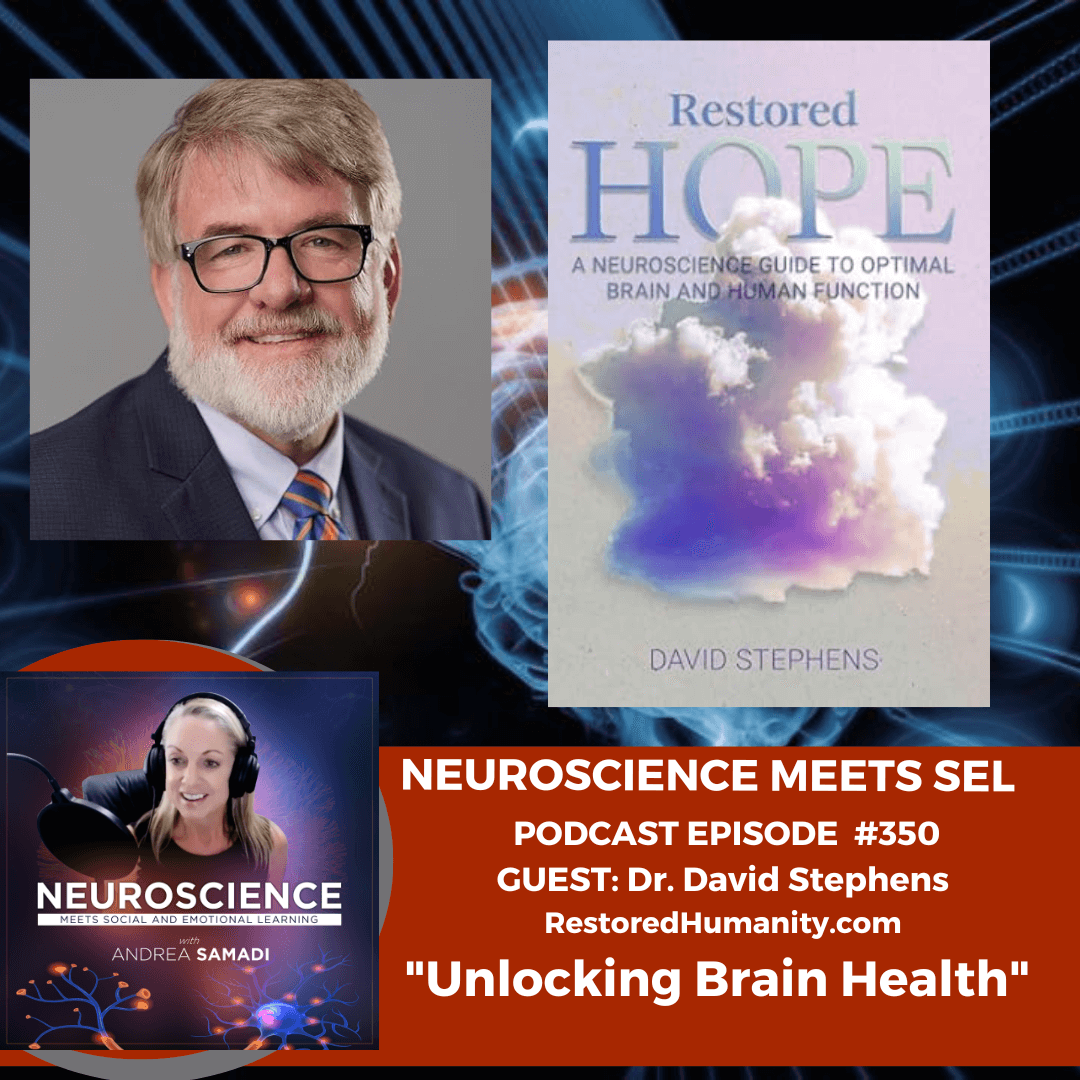
Neuroscience Meets Social and Emotional Learning
Unlocking Brain Health with Dr. David Stephens
00:47:46
Loading summary
Transcript94 lines
- [00:00]
A
Foreign of the Neuroscience Meet Social and Emotional Learning Podcast where we connect the science based evidence behind social and emotional learning and emotional intelligence training for improved well being, achievement, productivity and results using what I saw as the missing link since we weren't taught this when we were growing up in school. The Application of Practical Neuroscience I'm Andrea Samadhi, an author and an educator with a passion for learning and launched this podcast six years ago with the goal of bringing all the leading experts together in one place to help us to apply this research in Our Daily on today's episode number 350, we meet with Dr. David Stevens. He's a clinical psychologist, neuropsychologist and consultant with extensive experience in brain function restoration and mental health. Some quick facts about Dr. Stevens he was the former Director of Mental Health for three state prison systems. He's overseen mental health services and jails throughout the U.S. he was an academic Dean of an accredited graduate school of psychology. He was a correctional and architectural neuroscience consultant which is a fascinating practice that takes into consideration how we feel in certain environments for our success. And he provides brain restoration services to individuals. What drew me to Dr. Stevens is that our podcast took a turn towards health and wellness after the pandemic and a huge part of this direction has been focused on our brain health and we've met many experts along the way who've shared tips and strategies to help give us hope in our journey of life. But Dr. Stevens will take this hope to new heights if we can keep our minds open. And I'm talking about myself specifically, while the front page of his website features the headline Humanity Restored. When I went to the research behind his work, I was taken back a bit. It was all about glucose and its restorative effects on the brain and body. Then I went to the peer reviewed studies to learn more and I realized that my understanding of glucose, what it is, how glucose is different from sugar that I consider poison, and how can glucose be used to restore brain function. All of my questions I realized needed to be addressed before this interview. So I watched some of the interviews that Dr. Stevens had with other podcasters and learned how to cure depression and other ailments with glucose and also where his work began, where he connects hard science to and neuroscience to spirituality. Now we're talking. Let's now meet Dr. David Stevens where I'll ask him to share his work and his research that he felt divinely inspired to share and see if we can take this new knowledge and understanding to break through our current paradigms mind specifically and Move towards improved physical, neurological, mental, emotional and spiritual functions of our Brain Health. Welcome Dr. David Stevens. Thank you so much for joining me today.
- [03:53]
B
Thank you so much for having me, Andrea.
- [03:55]
A
Oh, absolutely. And have we reached you in the snowy Colorado Springs? Is that where you are?
- [04:04]
B
Fortunately, not too, I mean, not too snowy. We had snow the day before Thanksgiving, but it's all melted. But definitely getting in the holiday spirit.
- [04:13]
A
Got it. I have seen photos of that area. I've got some good friends that moved to Arizona for the sunshine from there. So I've seen it. It's a beautiful place there.
- [04:26]
B
We love it. Yep, very gorgeous.
- [04:28]
A
Well, I love the spirit in the background here. And it goes right in line with what our conversation's going to dive into today. And Dr. Stevens, before I even get into your research and you've got a couple of books that you've writt written and your mission with your work, can we begin with where this journey began for you? And I really want to acknowledge how you feel like you were divinely guided with this work because I really do think that's important to address right off the bat.
- [04:59]
B
Great. Yes, it very much was, I'm a person of faith and very much, I would say, inspiration from God. So I was in the middle of researching pretty diligently what happened from the moment there was impact to the head. So I was doing pre participation cognitive assessments for kids before they played sports. And to kind of give you the shorter version, but was finding that parents, I would ask parents and the kids themselves if you'd ever had a concussion, ever had a fall, ever been in a motor vehicle accident, whatever. And they would say, no, no, no, no, no. And then I would do the cognitive testing and find out that probably 75% of them, their test results were consistent with the history of multiple head injuries. And so I thought that was very shocking. So I would ask the parents, you said your kid had never had any head injuries, no difficulties, but the test results really are consistent with somebody with multiple head injuries. And any thoughts about that? And it was the stories weren't funny or the events weren't funny, but what they said was a little humorous. Because then I would get stories from parents like, well, he fell out of a second story window and landed on his head. Could that have been a concussion? And I would say, yes, that could have been a concussion. And the most dramatic was a woman said, well, my daughter went headfirst through a windshield and was unconscious for a few hours. Could that have been a concussion? And I said, yes, of course, that was a concussion, but probably 80, 85% of the parents would say, I can't account for those results, but I don't think there's ever been any injury. And so I thought that was curious. So I was doing the research and then in October of 2017, was awakened in the middle of the night with, I would say, inspiration, try glucose. Which was a very weird thing to, to wake up with. So I wasn't going to immediately start recommending to people that they take glucose because I had this happen. So I did the research. It's harder to find this research now, but found out through pretty exhaustive research that glucose is not harmful in any amount, in any way. So once I knew that, then I had a new guy coming in. He was 41 at the time. Estimated he'd had 50. No, I'm sorry, 15 concussions in his life and so did very poorly on the test. At one point, again, a 41 year old guy broke down crying because he couldn't make heads or tails. In one of the visual tasks, he said it looked like somebody took a box of jigsaw puzzle pieces and turned it upside down and it made no sense at all. So we finished the testing and I said to him, I put on my best salesman's hat and I said to him, I have no idea if this will help you. What I know for sure is it won't hurt you. Would you like to try? And he said, okay, I have a little vial of 10 glucose tablets and gave him three or four and he took them and probably 10 to 15 seconds later turned to his wife and said, you know that pressure that's always in my head? And she said, yeah. He said, it's gone. And I think I was as shocked or more than he was. But his wife said, no, it's not. He said, no, really, it's gone. And from that point on, I just kept giving it to people. Probably the first hundred people, I would say that literally that same thing. I have no idea if this will help you. What I know for sure is it won't hurt you. Would you like to try? And then that just happened with everybody and has just continued. So this is very much for me a life mission and something that I say to people. It's kind of interesting that it was, in my view, inspired by God, but it also happens to be the most scientific thing out there as well, which works together kind of nicely, in my opinion.
- [09:20]
A
Exactly. There was so much about one of your talks that, you know, when I was doing the interview questions, trying to get my head around how I was going to ask you this because you're talking to someone that, that thinks sugar is evil and poisoned. And how am I going to do this? And so it's it for me. I had to just let my shield down and say, you know, there's got to be some science here that I don't understand. Like way back to, you know, back in the day when we wouldn't eat butter. You know, butter evil, bad for us. And, and I don't even think twice about putting butter on stuff, but I think about other things that I put in to my body. But can we go to understanding and unpacking glucose and sugar and harmful sugar and the science behind glucose sucralose just so that our listeners can get their head around. Why are we even. Why is she doing a podcast on sugar for health? It just is kind of goes against everything that I personally believe in. So can we go there?
- [10:32]
B
Yes. And so glucose is the fuel, the primary fuel for our bodies and our brains. If our body doesn't have enough glucose, we'll die. If our brains don't have enough glucose, we'll die. And so that's really the starting point. And I talk in the book that I think you said is referenced in the chat, the new book Restored Hope, My talk in there about rest, what I'm calling restoration science, that when we have the right amount, the required amount of the three primary fuels, water, oxygen, glucose, we will function the way that we're designed to. So full brain, cognitive, emotional, physical function. And so glucose is a very simple compound chemically. The chemical formula is C6, H12, O6. That makes it a simple sugar or a monosaccharide. And so the C6 is six atoms of carbon, the H12 is 12 atoms of hydrogen, or basically water. And the O6 is six atoms of oxygen. And that's the entire makeup of glucose. And all of those compounds or all of those chemicals are absolutely necessary for plant, animal, and human survival. And there's nothing in there that's corrosive. There's nothing in there that's acidic. It can't harm you in any way. And so sucralose is actually an artificial sweetener, but kind of loosely based on sucrose, which is chemically twice as heavy as glucose. It's a disaccharide, or even some people call it a polysaccharide. But that chemical formula is C12, H22O12. And so it's too heavy chemically to get past the blood Brain barrier. So sucrose cannot fuel the brain. It must be glucose.
- [12:49]
A
Got it. Okay. So that's the difference. We're talking about glucose being fuel for the brain. And sucralose is the one that we're worried about in soda and treats.
- [13:01]
B
Yeah.
- [13:03]
A
And. And then I just have to ask this because I'm sure you've heard this so many times. If you got that message, try glucose. Why not the other one? Why not try ketones?
- [13:18]
B
Because ketones are really a tertiary or safety net fuel.
- [13:26]
A
Okay.
- [13:28]
B
So glucose is really a significant part of fat or the long term storage of fat. And so what happens in the ketosis process is fat is burned and converted to glucose for fuel. But it's inefficient. A portion of everything we eat, our bodies, primarily stomach, but also the liver, convert to glucose, and then it goes into the bloodstream to fuel our body and then goes to the brain. But I think we'll talk about this a little bit later. But the glucose getting to the brain from the blood is limited by sympathetic nervous system activations. And so our brains get progressively less and less glucose from our diet. But that is kind of the gold standard way that we're designed to get glucose is via that mechanism, not via the indirect. Take stored fat and burn it and convert it to glucose.
- [14:37]
A
Is that. Is that how it works with ketosis? It's actually. Okay, so glucose is still a part of the equation. It's just when you're fat adapted, it's not gone. It's still in there. Okay.
- [14:52]
B
Right. So it really is a starvation safety net.
- [14:56]
A
Okay. And. And just to bring that part to a close, you. You've heard of some people saying, you know, when you're intermittent, intermittent fasting, that there still is benefits to the brain. How is that different than the glucose benefits that you've uncovered?
- [15:16]
B
It isn't any different.
- [15:18]
A
Okay.
- [15:18]
B
That you're still getting some glucose to the brain, just in limited amounts.
- [15:24]
A
Okay. With the ketosis.
- [15:26]
B
Right.
- [15:27]
A
Okay. All right, so now let's go to the brain. I understand that. So I'm getting my head around sugar. It's hard.
- [15:34]
B
I know. It is a big leap for many, many people.
- [15:38]
A
I'm sure. I'm sure as. But I did it with butter, so if we can do it with butter, I can. I've just opened my mind here. So now let's go to the brain. Can you just go into what parts of the BR are fueled first? And then what's the problem that you're seeing with these concussions and the emotional Issues that are happening, what's happening in our brain that cause this deficiency of glucose?
- [16:07]
B
And what a great question that what gets fueled first and foremost, above everything else is the brain stem. And the reason for that is the brain stem is primarily the part of the brain that keeps us alive. So respiration, heartbeat, not all, but a significant amount of digestion happens in the brain stem is controlled by the brainstem. So that has to be fueled. If that doesn't get enough glucose, you'll die. So after that, it really is very interesting that our brains have been called a self organizing system. And so part, a big part of that self organizing is the brain is continuously scanning inside itself and inside our bodies looking for threats. And low glucose is one of the most important threats, one of the most dangerous threats that exist. So the brain is very aware of glucose level. And so what it will do is it chooses in any given moment which functions to fuel, which are the ones most important for survival and which ones it can neglect that of course you want everything to be fueled, but when there's not enough fuel, then the brain makes choices and it can be different from day to day. And so sometimes people I'm working with before their brains are fully fueled on one day, they may have a headache, and then they may go three days with no headache, but then have floaties in their vision, or then maybe no more floaties in the vision, but ear ringing. And so the brain again is choosing every moment. What are the functions most important in that moment for our survival and our function? That's where it provides fuel and limits fuel to other functions.
- [18:13]
A
Got it. So it starts with the brain stem.
- [18:15]
B
Yes.
- [18:16]
A
And then I'm guessing, does it go to the prefrontal cortex next for thinking and focus?
- [18:24]
B
Yeah, the. It's another great question with a kind of complicated answer. There's a school of thought called localizationalism which says that certain parts of the brain are what regulate certain functions. But that's not how the brain works. The brain, every function in the brain is multiply represented. So people will tell you that language is right here on the left side of your brain. And what's called the temporal lobe, what's called receptive language, meaning us hearing words, and expressive language, meaning us speaking words. But there's language functions here, there's language functions here. So language is multiply represented throughout the brain. So we can't really just say, well, the, the glucose goes to a specific area for a specific function. It goes to specific functions that are throughout the brain.
- [19:28]
A
So just thinking of the images of the neural networks in the brain as, as we're thinking here. And then what happens? How do you even know it's not the same as low blood sugar? Because sugar in the blood is not the same. Right. So how do you know you have this issue?
- [19:51]
B
So, and you make a great point, a very, very important point, that the brain glucose system and the body blood glucose systems are two distinct systems. They overlap, but they're not the same thing. So you can have low glucose in your brain and high glucose in your blood or your body. If you have high glucose in your brain, the likelihood is that you'll have high or sufficient glucose in your body and blood. But that isn't always the case. But so the way we know, there's really two ways to know, one of which nobody wants to do, which is to get a lumbar puncture that would tell us the ratio of glucose to cerebral spinal fluid. But the other way to know is if a person is having symptoms really of any kind, that tells us their brain glucose is low.
- [20:53]
A
And some of these symptoms, I know you've mentioned them, like, you know, from, from your books, the anxiety, depression, brain fog, these are all so common. How are we going to pinpoint and say, could it possibly be a deficiency of glucose? I don't think I've ever had anyone.
- [21:12]
B
Say, I'm sure you haven't, but you have.
- [21:17]
A
But this isn't a part of a normal conversation. Usually it's right some more sleep or, you know, so.
- [21:26]
B
And that's part of the point we talked off camera before we began about what's the purpose of having this conversation. And a big part of the purpose is so hopefully it becomes a part of everyday conversation. I have a headache. I know that means I'm low on glucose. I also know I can take some and my headache will be gone. So really, symptoms of any kind, like I said, and you mentioned a number of them, but headaches or ear ringing or light sensitivity or balance problems or pain or a number of illnesses, all those things are ultimately due to low glucose in the brain.
- [22:12]
A
Got it. And so then can we talk about how this could possibly occur? Specifically because I have two girls who are gymnasts and one's had a concussion or, you know, we went to the ER and she didn't do the mri, but she definitely hit her, her head hard enough that we know she had a concussion. Especially knowing that you could just tap your head on a wall and it's. It's enough.
- [22:39]
B
Right, right, right.
- [22:41]
A
How does that factor in now and what should anyone whose kids are in sports be aware of?
- [22:49]
B
Well, a couple of things. One is that a concussion is not a tissue injury, it's a chemical injury. And so the vast majority of people, even if they hit their head and they think they may have had a concussion, most people will not get a diagnosis of a concussion because it will not show up on an MRI or a CT scan. So the way we know that you've had a concussion is if you have symptoms afterward.
- [23:20]
A
Right, right.
- [23:21]
B
And every single sympathetic nervous system, or fight or flight or freeze system activation, those are the same thing, just different names, results in a limitation of glucose to the brain. And the amount of limitation really depends on the severity of the injury or psychological trauma is chemically, a concussion has exactly the same effect on the brain, limiting glucose as does a concussion or a traumatic brain injury.
- [23:55]
A
And so what actually happens with that fight flight system here?
- [24:04]
B
Yes, so what happens is in the brain, in cells in the capillaries, there are what are called pericytes, P E R I C Y T E S. And they really have been the subject of much more research in probably the last seven or eight years. And they, their current research indicates that they are primarily responsible for regulating the permeability of the blood brain barrier. So glucose is in the veins. Glucose is carried throughout the body. That way, the pericytes, or what, allow glucose to get past the blood brain barrier and into the brain. When there's a sympathetic nervous system, fight or flight activation. And again, it can be a bump on the head. It can be like your daughter's hitting their head in gymnastics. It can be your daughters, if one of them hides in the hall and jumps out and scares the other one. Physical abuse, sexual abuse, all those things activate the sympathetic nervous system. When that happens, the brain greatly increases the permeability of the blood brain barrier through the pericytes. So essentially all the glucose that's in the blood can get into the brain and that lasts for about 20 minutes. That if it lasted longer than that, the brain could drain the body of glucose, which would kill you. So obviously that can't happen. So after about 20 minutes, the pericytes tighten up the blood brain barrier, but not to where it was before the first injury or sympathetic activation, but make it a little less permeable than that to protect the glucose supply in the blood. And then it stays that way until the next sympathetic activation when the pericytes open up the blood brain barrier, make it more permeable, essentially all the glucose gets to the brain for about 20 minutes. Then the pericytes tighten it up again and tighten it even a little more than it was the last time. So with each new concussive injury, with each new fight or flight activation, the amount of glucose getting to the brain drops every single time. And then when it drops enough, then you begin to have symptoms. And as it continues to drop, those symptoms get worse and worse.
- [26:43]
A
That's where they come to you and they find you because they're looking. That's working.
- [26:50]
B
Right?
- [26:51]
A
And not just. You usually don't see someone like me saying, I'd like to optimize my brain health and try glucose. Right. That's not normally the case because I had to have had an injury or symptoms that have shut down my glucose that's naturally going to my brain. Would you say that would be right?
- [27:16]
B
Yes. But everybody has symptoms of glucose limitation. They just attribute it to something else. Like you said earlier, if somebody has a headache, often they'll think, I'm dehydrated. It's not dehydration. It's insufficient glucose. People will think, oh, I can't think of the word that I know. And that's just normal aging. But that's not normal aging. When a brain is fully fueled, that doesn't happen no matter what the age. And so very often a family member will come to me. And it really varies whether it's a kid or an adult or a grandparent or whomever. But they're having significant difficulties. And like you said, often they've tried multiple other things that haven't worked. So when I have a discussion with the family member, I'm seeing very often a husband or the other parent or whomever is there as well. And they'll say, wait a minute, I have difficulty remembering words sometimes. Maybe I should try this. And so as awareness grows that any symptom that I'm sensitive to light, that indicates your brain is low on glucose. And so people are learning that if I take it, I also get rid of symptoms just like the person who originally came to me.
- [28:53]
A
Got it. Got it. This is. This is mind blowing. And you hear it all the time. And when I was first researching this, I was drawn to have you on the show. And then I went to your website and I thought, oh, no, how am I going to ask questions on this? Because I was. I had to understand it first before I could, you know, get my head around it all. And so I ran to all the supplements that I take, because I do a lot of podcasts on, you Know, optimize your brain with this.
- [29:27]
B
Right, right.
- [29:28]
A
And I was looking for glucose in. In there, and I don't see it's not anywhere. So, you know, what would you say to that? Is it. Is it because the research is still so new? What. What would you say?
- [29:43]
B
Yes, I think that is a big factor. And it was interesting. In my doctoral program, I specialized in neuropsychology and had what was the class was called physiological psychology. And in that class, there was literally maybe a paragraph in a textbook about glucose. And what it said is, the brain is a glucose hog, that it uses 20 to 40% of all glucose created in the body, even though it weighs maybe 2% or less of the total body weight. And that was it. Nothing else about it.
- [30:24]
A
Interesting.
- [30:25]
B
So people haven't understood. And then all of the fear around diabetes has contributed to anything with sugar has to be bad.
- [30:37]
A
Exactly.
- [30:38]
B
And so people will say, oh, well, glucose isn't that sugar? Yes. Oh, well, then it must be bad. But in fact, it is absolutely necessary for survival and function.
- [30:50]
A
Got it. And so, so after I ran and was looking for glucose, just to see, you know, anywhere. Is it in any of these things that I've done podcasts on that that I know make me feel good and focused, but it' not. And then I thought back to when my youngest was born. She picked up a virus. So, you know, you can't give them any medicine. We had her at the children's hospital and they gave her this tube of something. It was a pink tube. And I remember they opened it and they're like, this is all we can give her. And then watch and hope she recovers. And I remember thinking, like, by her side, what is this tube? You know, thinking, it's like some miracle medicine that's gonna save my daughter from being ok. And they're like, no, they said it's. It's sugar water. Do you think it was glucose that it was?
- [31:43]
B
Without question.
- [31:45]
A
Oh, my goodness. I. I just thought that. And. And then they said, you can get it over the counter. And I remember thinking what I left there that I'm gonna go find these pink vials of magic, whatever it was, you know? Exactly. Because I thought this saved my daughter's life because they wouldn't give her anything else. They're like, she. She's too young for anything else. I remember them giving the nurse coming in because I stayed next to her, like 24 hours, and they would come in with this little tube, and I remember saving it, going, I'm taking this home with Me. Whatever this is. So you can buy glucose over the counter, right? Like a.
- [32:25]
B
Yes.
- [32:26]
A
Walmart, Walgreens.
- [32:29]
B
Yes.
- [32:30]
A
And so. So. So that was mainly. I wanted to make sure I understood that part. So then can we go to the fact that on this podcast, I've covered so many different episodes on the damaging effects of sugar. And mostly because it was my foot doctor, his name was Dr. Jacoby. He wrote a book called Sugar Crush and it was all about reducing inflammation in the body. And he said to me when I was having issues with my feet, he's like, you just gotta stop sugar, get off sugar, stop bananas. And he had me change my diet completely. Completely. And I reversed some issues that I had back then. So what should we understand about the fact that getting off sugar is not the same? I know we covered it in the beginning, but it's such a vein in my podcast. I just want to make sure we clarify the difference.
- [33:28]
B
Yeah. So the. The difference between glucose and other sugar.
- [33:33]
A
Yes. Like why. Why did get me getting off sugar turn my health around? And what do I need to now know about glucose? That it could. Glucose could possibly do the same thing for myself or others.
- [33:49]
B
Yes. So we talked about it a little bit earlier, but glucose gets to the brain. It's the brain glucose system is distinct from the body glucose system. And glucose does not get to the brain when you take. It does not get to the brain via the stomach and the digestive system. It appears, and I will say this is not yet proven, but it appears that it's likely. It gets to the brain via the cerebral spinal fluid system and is absorbed via mucous membranes into that system and gets immediately to the brain. What we do know is that within literally three to five seconds of ingesting glucose directly, it is at the brain, not quickly.
- [34:41]
A
Yeah. And I could attest to that with. When they gave her the glucose. My. My daughter and I remember her changing. She went from. It was. It was scary to I think she's going to be okay with whatever they gave her glucose.
- [34:57]
B
Right.
- [34:58]
A
Because it went straight to her brain, not in her blood. That we worry about with sodas and.
- [35:04]
B
Right.
- [35:04]
A
Doesn't cross sucralose, doesn't cross into the brain, but this does. Okay.
- [35:09]
B
Right. So it's getting to the brain directly. That's how it has the positive effect. It's interesting. So it's necessary to ingest glucose in the way we're talking about, whether through tablets or gummies or dextrose. Dextrose and glucose are the same thing. But you can buy Dextrose powder breweries, at vitamin stores, at health food stores, but taking it that way, or Smarties candy is pure dextrose. You can buy glucose tablets, but ingesting it directly gets it directly to the brain. So that's so important to ingest enough glucose that isn't limited by the blood brain barrier, but it's equally important to pay attention to glucose burning. And so visual activities burn glucose faster than almost anything, that the visual system is the most complex system in the brain. And so driving burns glucose quickly. It's not uncommon, particularly for people that have had identified head injuries or trauma, that sitting at a traffic light, they'll get dizzy watching the cars go by, or they'll drive and feel nauseous. And that's because it really exhausts, depletes their brain glucose system.
- [36:38]
A
So if there's people listening right now that think maybe this could help them, what, what would you say? Would you say to like the average person to, to monitor and try it out, or would you say read, read more, understand, get all your questions answered. Like, I had to get to a certain place of understanding. And I think the place of understanding for me was the difference between the fact that sucralose does not go to the, to the brain, so how could it help it? So I think that solved it for me. I understand. So what would you say to someone listening right now that might think, I've got brain fog, I've got, I'm exhausted at the end of the day of being on the computer, would you say to try it out, read your books? What, what do you think would be a first step of, of changing someone's paradigm like you've changed mine?
- [37:34]
B
Yes. So if a person is, we'll say, roughly under age 35 and hasn't had a history of multiple diagnosed concussions or traumatic brain injuries, they can probably just start taking glucose. And I recommend for anybody over about the age of 14 that they start by taking three tablespoons of dextrose powder or six glucose tablets anyway, 24 grams three times a day. And for those, for younger people with relatively uncomplicated histories, they likely will notice a difference fairly quickly. And they can continue by increasing by a tablespoon per dose every week. So you start at 3 tablespoons 3 times a day of dextrose powder. You can mix it in any liquid other than, I kind of half jokingly, but also seriously say, probably alcohol isn't the best thing to mix it in, but tea in coffee, in water, and then you can add juice and Smoothies, really, in just about anything. And so for those people, they likely can do most, if not all of it on their own. For people older than about 35 or with complicated histories, it's pretty difficult to do the process on your own for a variety of reasons. One of the biggest is what I said earlier, that the brain will alternately fuel different functions on any given day based on what it interpreted interprets to be the need of the moment. So that can be very confusing. Like, my headaches are gone. I haven't had a headache in three weeks. All of a sudden I have a headache. Does that mean it's not working? Does that mean I'm backsliding? Does that mean something's wrong? And it doesn't mean any of that. It just means on that day, the brain decided that the functions that keep your head from hurting were less important than other ones. But. So I recommend for most people, working with me or somebody I've trained is really very important to be able to do it successfully. And I say when I'm doing these podcasts, it isn't about me making money. That the way I do my fees is. The short version is people pay whatever they can afford. And at any given time, probably 25% of people I work with don't pay anything. So nobody has to be nervous that they can't afford to talk to me or somebody I've trained because of money, because literally, if you can't afford anything, you don't pay anything.
- [40:30]
A
That's phenomenal. Thank you for that.
- [40:32]
B
Yes.
- [40:34]
A
So. So for people that want to read your books and learn more about you, perhaps try this out and maybe, you know, book some time with you is the best place Restored Humanity.com your website.
- [40:50]
B
Yes, and my email is D Stevens S-T H N S@restored humanity.com.
- [40:58]
A
Phenomenal. Do you think I've missed anything in my questions to you?
- [41:04]
B
You've asked a lot of very good questions, and I can tell you jumped into it and looked at it pretty exhaustively. So I guess a couple of summary comments would be that. And this is really, to me, it's still kind of a wild statement. I don't talk like it, but I'm one of the biggest skeptics there are. And so when I first started, roughly the first hundred people, I think I said earlier, I would say to them, excuse me, I have no idea if this will help. I know for sure it won't hurt, right? What I say now, after probably roughly 1500 people all recovering, and just to be clear, everybody that's completed, the treatment, has fully recovered. And about 10 to 15% of people that start the treatment, treatment don't complete it. So just so people are aware of that. But now I say to people, if you complete it, there's no way you cannot recover. It's really based on how humans are designed. And when our bodies and brains have the amount of fuel that's needed, they function the way they should it in every respect. Thinking and memory and emotions and physical function, autoimmune illnesses, diabetes, autism, whatever.
- [42:43]
A
All.
- [42:44]
B
Those things are completely restored when the brain is fueled.
- [42:50]
A
And so that just brings us back to the title of your book and your mission. It's really to restore humanity with this aha moment that you got in the middle of the night to glucose. And, and, and that's really been your mission since that happened. And, and that's phenomenal. It's, it's really been quite a paradigm shift for me because I didn't know how I was going to get through this. Anyone? My kids leave donuts in front of me and say just have a bite. And so at least now I understand. I thought, how am I going to promote this, this theory, this understanding if, if I'm the biggest sugar critic. But sucrose is not glucose, right?
- [43:35]
B
Right. And fructose is not glucose. Fructose is a monosaccharide, but it's chemical arrangement means that it, or it is what's called a ketose, meaning it primarily goes to fat storage. Glucose is an aldose, which means it has an active function in your body. But one other thing I wanted to mention, although it looks like maybe you have a question about that.
- [44:03]
A
I, I sort of do. And can I, can I just get it out? Because it has to do with the, the ketones. Because so if, let's just say for anyone listening, there's, there's a lot of my friends that are on the keto diet. So this wouldn't make sense for them because it would kick them out of ketosis or, and they just keep doing what they're doing. Although we know we're pretty clear that it's not the best diet long term because it's starving the body, the brain, but just let them, you know, diets are hard because. So it's hard to go there. But I'll, I'll have some people that will say if I, if I'm, you know, doing the keto, is this for me? And it's not, it's not an option that just keep doing keto and eventually what would you say to someone doing keto.
- [44:54]
B
I would say a couple of things. One is that that is a starvation safety net. And even though you may have had some improvement in function, you can't have complete restoration of function because you just don't get enough glucose through the keto diet. And then some people that are concerned about weight gain taking the glucose will do the keto diet and take glucose. So they're not in ketosis, but they are limiting fructose ingestion by doing that. And that helps maintain weight balance.
- [45:35]
A
Got it. And then to wrap this all up, what would you say is, you know, I know that we've asked some pretty deep questions here. Do you think that, that I've done a good job at debunking the paradigm of, of what glucose is from, from these questions?
- [45:54]
B
I think you really have. And I think it means a lot for people to hear somebody who was very much a firm believer in no sugar actually considering it. And it, it is such an important thing to know that glucose cannot be harmful really in any amount. And then the one other thing I would say too, that's also very important, thoughts of self doubt, thoughts of something's wrong with me, I'm not good enough, I'm not acceptable in more severe forms, I'm unworthy, I'm worthless. Suicidal thoughts, all of those come from low glucose. And when a person's glucose level is restored, they know and understand that they are without deficit or defect, that they are infinitely worthy. There isn't anything wrong with them in any way.
- [46:54]
A
Well, Dr. Stevens, I want to thank you so much for your time today to help us to understand how we can improve our life and our results by understanding the importance of glucose and our brain. For people who wanna learn more, they can go to your website, restoredhumanity.com and I wanna thank you so much for your time today.
- [47:14]
B
You're welcome. Thank you so much for having me on.
- [47:17]
A
Thank you.
- [47:19]
C
If you're enjoying the Neuroscience meets social and Emotional learning podcast, please don't forget to subscribe so you'll stay up to date with our new episodes while you'. Please feel free to give us a review or a five star rating as it helps others find us. For more information on our programs, books and tools for schools and the workplace, Visit us at www. AchieveIt360.com.