← Neuroscience Meets Social and Emotional Learning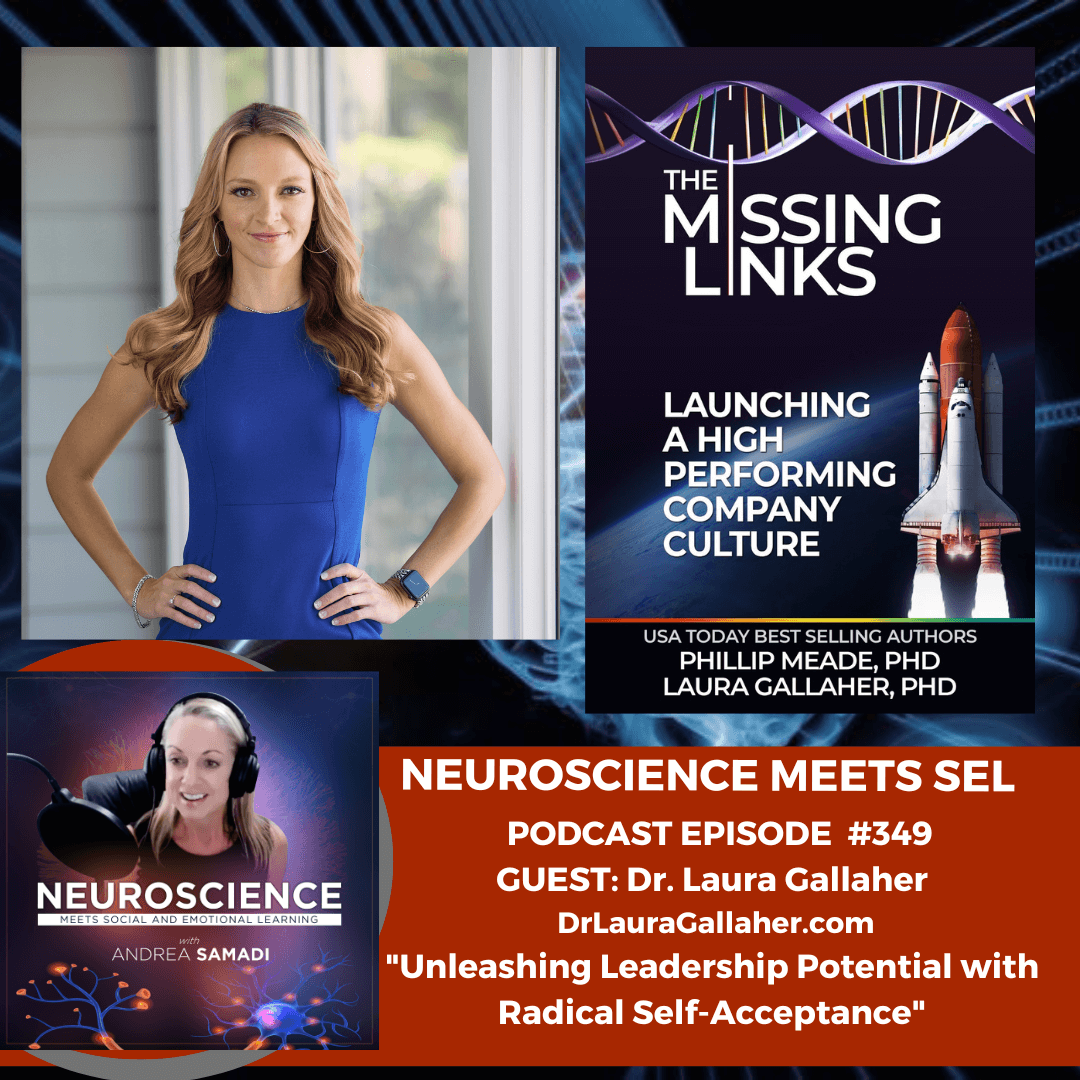
Neuroscience Meets Social and Emotional Learning
Unlocking Radical Self-Acceptance: A Journey with Dr. Laura Gallaher
00:57:16
Loading summary
Transcript111 lines
- [00:00]
A
Foreign.
- [00:06]
B
Of the Neuroscience Meet Social and Emotional Learning Podcast where we connect the science based evidence behind social and emotional learning and emotional intelligence training for improved well being, achievement, productivity and results using what I saw as the missing link since we weren't taught this when we were growing up in school. The Application of Practical Neuroscience I'm Andrea Samadhi, an author and an educator with a passion for learning and launched this podcast six years ago with the goal of bringing all the leading experts together in one place to help us to apply this research in our daily lives. On today's episode number 349, we meet with Dr. Laura Gallagher. She's an organizational psychologist, speaker, facilitator and executive coach. She's the founder and CEO of Gallaher Edge, which she started in 2013 where she works with busy executives to help you to get your arms around the challenges in your organization. They work with you from the inside out, helping your executive team have conversations that you didn't even know you needed to have. They help to increase self awareness, team alignment and share accountability until your organization runs like a well oiled machine. And organizations she asserts are just like people. Her noteworthy career began after the space shuttle Columbia exploded upon re entry in 2003. Following the tragedy, NASA hired Laura and a team of organizational psychologists to change the cultural influences that were deemed to play a role in the accident. She worked for eight years to positively influence culture, develop leadership capacity and improve organizational performance at Kennedy Space Center. She holds a Bachelor's degree in psychology and a Master's and PhD in Organizational Psychology. Let's meet Dr. Laura Gallaher and learn together where we could possibly take our personal and work environments to new heights. Welcome Dr. Gallaher. Thank you so much for joining me today. Are you based out of Orlando? Is that where I've reached you?
- [02:43]
A
That's right.
- [02:44]
B
Okay. And I know that you have deep roots in in the Phoenix area. I do so many other places. So could you like just share your, your background of where you've been all over the world?
- [02:56]
A
Oh, absolutely, yeah. So I was actually born in Arizona and then I spent a few of my youngest years up in the freezing cold of Minnesota and then came back to Phoenix where my family still is. I did college there, Arizona State, and then I came out to Florida for graduate school. So it was pursuing my PhD in psychology that brought me out east and I had the chance to work for NASA while I was here, which is absolutely incredible. It's part of what kept me here I think at first, which was so, so Exciting. And after I'd been here for maybe 15 years or so, I spent a year traveling internationally, working and traveling, which was incredibly tough. It was like 11 countries over 12 months. Oh, wow. And I didn't think I would come back to Orlando. I didn't know where I would end up. But at the end of the year, I was just feeling really called to come back to Orlando again. So I've been back here in Orlando for another six years. It's been almost 20 years in total. Oh, wow, that's.
- [04:01]
B
That's cool. And I understand the call to be to a place because that's really how I ended up in Arizona from Toronto.
- [04:09]
A
Oh, wow.
- [04:09]
B
You know, it was like there was something about this place. I traveled with the speaker I worked for back in the late 90s and, and when I got out of the airport, I walked the doors open and the heat hit me and I thought, this is it. This is where I've got to go.
- [04:26]
A
You liked it? That's good.
- [04:27]
B
Yeah, I'm the only one, I think.
- [04:29]
A
In kind of like an oven.
- [04:34]
B
And I know the cold, you know, that's quite cold. Yeah, that's what drew me to, to look for something else where, where I could be outdoors mostly.
- [04:44]
A
Yeah, here.
- [04:45]
B
So that's. I understand the call to be to a place, but, you know, I thought it was interesting. I watched your TED Talk and you know, you talk about how to feel at home anywhere and your ability to discover your inner confidence and cope with the world so any place can feel at home. What drew you to do a TED Talk on this? Because I know you've been to many different places and it's not an easy thing to make a place feel at home, but when you can do it, it's pretty powerful.
- [05:15]
A
Yeah, well, gosh, you know, towards the end of my TED Talk too, you might recall that I said something about it's more aspirational than anything. Like I wasn't standing there on stage saying, I have mastered the ability to feel at home anywhere. I. I was using a lot of the traveling experience to grow my self awareness and pay more attention to what did I like, not like, where did I feel comfortable, uncomfortable? What were some of the social norms that I had just eased into and I took for granted, like a fish and water, not even realizing that it was water until maybe they're in a different environment. And so I definitely don't feel like I mastered it at all. But while I was traveling, the local Orlando TEDx organizers actually reached out to me because their theme was Home. And they're like, hey, you've kind of thrown caution to the wind over this last year and you left home and you're doing this thing where your home changes every single month. I would love to hear your thoughts on home. And so that's what drew me to do the talk. And really, the message that I think I wove throughout because it was so salient for me during that year, was that it really takes a high level of self acceptance to feel truly at home, even in surroundings that are unfamiliar or potentially challenging. But it's always self concept. Right. It's like, how. How do the norms here challenge who I think I am and how I want to see myself? And it was such a challenging year for me. It was cool and extremely challenging for me. And so it really brought to light that I still have so many self acceptance gaps, areas that I still so desperately want to work on so that I can feel more genuine everywhere that I am. Yeah. And not get so wrapped up in some of my own subconscious fear.
- [07:06]
B
Well, it was so interesting watching your TED Talk because, you know, you were talking about a, ordering tacos, and I forget which country because there's so many and you didn't want to order too much cheese. I'd be on the other end going, a little more cheese, please.
- [07:22]
A
But it was Prague. Oh, I think so. I don't know. I just.
- [07:26]
B
Yeah, yeah, that sounds right. But I was just laughing because it's so true. It's like it depends on where we are, how we order things. And you don't want to ask for too much or too little or, you know, am I being too picky? Are they going to. What are they going to do to buy food? Because I've asked for, you know, how.
- [07:47]
A
How might they judge me? How might they judge me for. For what I'm doing? And I assume actually plenty of your listeners find themselves in the situation, just even at home.
- [07:56]
B
Right.
- [07:57]
A
I remember. Can I tell you a very silly story? Oh, yeah, for sure. I used to carpool with my roommate over to NASA because we lived about 50 minutes away. It was a long drive. And sometimes we would stop at Moe's Southwest Grill on the way home. And every time I would order, I would want them to provide extra chips, like, more chips in the bag. And I would always feel compelled to explain it, which is so, like, silly. But I would literally say, can I have some extra chips, please? I like to only put a little bit of queso on everyone. And then I don't want to run. Like, I would Explain myself. Completely unnecessary to do that. And so there's tiny little things like this that show us, like, oh, gosh, I'm explaining this away because I don't want them to judge me for something as silly as, like, wanting more chips. There's all these little things that became even more obvious when I was traveling, but I think people can start to notice it even in their daily lives here if they want to.
- [09:01]
B
For sure. This is. This is a huge topic. So, you know, when I. Before I even read your bio, you know, I get asked for a lot of guests. You know, it comes at me, and I just sift through them because it has to fit into what I'm focused on right now or just doesn't make sense, right? So I saw the image of you in on your one pager, and I thought, wow, there's some story here. I don't know what it is, but I didn't. And then that's what made me look a little deeper. There was something about you that I knew there was a whole bunch of other stuff behind it. And then I read the whole NASA thing and your book and culture and then saw the TED Talk, and I thought, wow, what goes on on the inside of. You showed up in, like, five seconds for me. On the outside, it was just a really powerful thing for me to see. Can you just tell me, from what I've told you about, you know, your mindset on the inside, what. How does this story of radical self acceptance show up to you on the outside?
- [10:09]
A
Ooh. So radical self acceptance is something that I practice every single day. And some days I am rocking it, and some days I am struggling. It's very much a journey. I literally got myself a tattoo like, five or six years ago here on my wrist that says journey.
- [10:27]
B
Oh, cool.
- [10:28]
A
That's really cool. No, not the band.
- [10:32]
B
People ask, right?
- [10:34]
A
They do ask, or they. They tease me about it. That's my next tattoo right over here. Not the band, but, you know, it really is a journey. So. So radical self acceptance is genuinely being okay with who you are right now without changing a thing. Because most people, when they think about accepting themselves or feeling okay about themselves, they had this list of like, well, here are the things that I know I want to improve about myself or change about myself. And then we lie to ourselves, and we go, once. Once I do those things, then I'll accept myself and we tell this lie to ourselves over and over and over again. And so I've had several big light bulb moments in my life where I've recognized that fallacy of oh, every time I think that this is the magic or suddenly I'm going to feel like I'm enough, I recognize no, I've just fallen back into that same pattern of looking at the gap between where I am and where I want to go. And so it's a lot of unwinding for me. And a lot of the high achievers that I work with have a very similar experience. And so I feel really passionately about sharing this whole idea with as many people as I can or as many people that want to hear it. But I'd love to share a bit about my experience with NASA and where some of my self acceptance gaps first became really obvious.
- [11:59]
B
Yes, definitely.
- [12:01]
A
So I was working with NASA, as you know, because of the Columbia accident in 2003. And so I won't go super deep into all the details of what happened, but NASA's investigation, or rather the external investigation, said that NASA's culture was as much to blame for the accident as the actual foam that struck the wing of the orbiter during the launch. And so for your listeners who maybe don't quite remember what happened with Columbia, when Columbia got the green light to come back to Earth, they didn't realize how badly damaged the orbiter was and it didn't make it coming through the Earth's atmosphere. The heat shield failed because there was a hole in a wing in the wing. And they didn't know how badly the heat shield couldn't make it. So it was so tragic. And obviously they could look at the specific aspects of what happened with the foam. But to say the culture was to blame, okay, that might raise some eyebrows or make people think that NASA was some terrible place to work. You know, overbearing managers, disgruntled employees, people disengaged. And really wasn't true. In fact, NASA had just been rated the number one place to work in the government. So you had some of the most engaged employees, you had civil servants who would give back tens of thousands of their paid time off back to the government because they were so engaged in the mission. I worked there for almost eight years. I never met a single soul who didn't care deeply about the lives of the astronauts. And so it really made us look at if culture was to blame, then what is culture? Exactly. And so that's the work that we were doing. It's the work that I was brought in to help with. And a lot of it came back to psychological safety. Is that a word that you're familiar.
- [13:49]
B
With or term so Maslow's hierarchy of needs, that's where I think that's what.
- [13:55]
A
Yeah, so, yeah. Cause he gets into, like, sort of basic needs, right. And it kind of moves up, you know, all the way to self actualization, or really self transcendence is above that. But that version isn't published very often. So psychological safety, it was big in 1999 when Dr. Amy Edmondson first coined it. And then it kind of got a resurgence in 2016 when Google did their internal research about what really makes teams work well together. And so psychological safety means in an environment, does it feel okay? Does it feel safe to be vulnerable? And I know you've talked about vulnerability. I've watched some of your past episodes. So it's looking at the environmental factors to say how much, especially the leaders, do the leaders create psychological safety here in the environment? And what we learned is that there was not enough psychological safety for the level of vulnerability that was required to continue to raise the red flag within NASA. So there were teams at the agency that were really concerned about the phone that hit the orbiter. They wanted more data. And without having the data, it felt very, very challenging for them as an engineer, to stand up in front of a room of people with all levels of management, people multiple levels above you, and say, hey, don't have quite enough data to really support my massive concern here, but I think this might be catastrophic. Just a gut feeling. They didn't want to do that. Right. They. They desperately wanted the data. And when they couldn't get the data and they were shut down in various ways over the course of the mission, they kind of convinced themselves that, like, well, maybe it's not that bad. Maybe it'll be okay. And so psychological safety and then individual self deception were huge factors ultimately in a series of bad decisions that led to NASA losing all seven astronauts. So when I was brought in, that's a lot of the work that I was asked to do as an organizational psychologist is work with these leaders, help them to create psychological safety within their teams. But where the story gets more personal for me a little harder is that after a couple years, I was doing well. I had a good reputation. My internal customers really liked me. The leadership above me thought I was doing a great job. And I did several, actually 360 assessments. Have you ever done one of those?
- [16:24]
B
Yes. Yeah. Yeah.
- [16:26]
A
So I. There was one in particular. I had moved into a role of leadership, and a lot of my results were very positive, which felt good. But I remember, like, sitting and I was in this leadership Workshop. And I'm sitting there in the cafeteria during our lunch break. Cause I'd just gotten my report back, and I'm flipping through the pages and I see this page, and something just hits me like a punch to the stomach. And there was a section where I got feedback from the people on my team that they felt like sometimes I would bully them intellectually. I was so horrified by that feedback. Horrified by that. Here I am, right? A psychologist who's come in, and I am coaching leaders on how they can create this psychologically safe environment. And I was failing to do that for at least a couple people on my own team. And so it was such a. A difficult moment for me, truly. I mean, it was really hard. I remember my. The coach that was assigned to me. It was a very strange response. But I was talking to her about it and how hard that was, and she goes, oh, I saw your face when you were looking at the report. It's hilarious. Like what? Hilarious.
- [17:45]
B
Not to me. Is that right?
- [17:46]
A
Well, funny to me, but I'm sure it was just like this stricken horror face. I don't even know what my face looked like, but it was sobering. And I realized it's not enough to know. I'm kind of putting no in air quotes, right? It's not enough to know. I. I understood psychological safety very well, but I didn't know myself well enough to know when I was creating this kind of environment, when I had these behavioral tendencies that were impacting people in ways that I didn't intend and I didn't want and was very counterproductive. And so it kicked off a much deeper journey for me of introspection, for me to figure out, like, what. What's going on for me and what are some of the ways that I'm judging myself so harshly that anybody could perceive me as, like, bullying them intellectually. So I. I saw that I really, very much wanted to work on my own radical self acceptance.
- [18:44]
B
This is. This is huge. And coming from the personal development industry, we. We did that all the time. Like, we would, you know, just have a group of people look at you and say, how are you showing up? Do you realize how you're showing up? And. And I. I remember I had just moved to Arizona from Toronto, and I didn't feel like I fit in. That was what I was thinking inside. And, and, and it was just crazy how that was picked up from every single person in the room. You don't feel like you belong here. I never said it out loud, but it was an internal Thing, all these things that we can learn from feedback from other people and you know, getting those, those evaluations from your team members are valuable, but what about from home? Like that same thing with our kids. We're like, we asked our girls, how are we showing up to you as parents? And then it was with horror that we got told how, you know, like bullying people intellectually. So like, how do I encourage my kids to keep their rooms clean? Well, along those lines. So it's hard to get feedback from your teammates, from your family that you're not making the cut and, and, and, and to take that and say, what am I going to do with this now? How can I now take this feedback and, and, and improve? That's like you said, it's a kick in the stomach. It's not easy. But to see who you are from your peers, from your family, how are you showing up and then take that feedback that there's nothing like it. So I, Yeah.
- [20:31]
A
And good for you. I'm so impressed that you brought that to your children and got feedback from them. That takes a lot of courage and a lot of vulnerability. I know on a recent episode you were talking about wanting to, you know, work to be more vulnerable with your kids. I was so moved actually by, by how you shared that. But that takes so much courage.
- [20:51]
B
Yeah, I know, I know Mo isa well, but not face to face. Well, you know, a lot of our interactions have been email and his writing is very deep. So I felt comfortable enough to tell him that. And also because I'd read his book and I knew he had done the same thing with his kids. But it's not an easy thing to say. I think I could do better when you think you are doing better to figure out that you could still go a layer better.
- [21:25]
A
Yes. So here's what I, I love too so much about you asking your kids for this feedback. I imagine that that was just a like sit down conversation that you were having face to face. Is that right?
- [21:38]
B
Yeah. No, we were all, I actually was on vacation. We're all in a swimming pool and we were together each other kind of, you know, like under, you know, it was, it was, it was an interesting thing because I had come into the circle of my husband always being very caring with the girls and me wanting to jo in because I'm often not the, the one that shows the emotion he is. So I came into the circle to see what's going on and I found out that they, our, our dog had just died of lung cancer before we left on the trip. And I come into the circle to uncover that they had been researching dogs that they were going to look at when we got back. So I was like, okay, I'm not ready for this. And then I thought, okay, no, I want to be a part of this. So I to learn how to step back. And after we had looked at the pictures of the new dogs that are now are part of her family, that was when the conversation came in. It was like we had to be all together, away from our environment to say, you know, hey, how am I showing? And we just asked the question, the girls asked it. How am I showing up as a kid to you? What could I do better? It was just, I. I don't even know where it came from. Probably all. All the years of personal development where I know that other people had done it. It just kind of came out while we're standing there in the swimming pool.
- [23:09]
A
That is so cool. Oh, my gosh. I want to meet your kids. They seem incredible.
- [23:14]
B
So they are smart, but it's like if I only I could keep their rooms clean, like one of us is residents. I don't know the secret sauce to that. It's.
- [23:23]
A
Oh, my gosh. Well, I'm not a parent, so I don't know how to help with that piece of it. But, you know, keeping your room clean actually ties back to self acceptance too, at least for me.
- [23:32]
B
Okay.
- [23:33]
A
Yeah. Another one of my moments. And I do kind of want to come back to the kids giving you feedback, but on the keeping the room clean. So have you ever had the experience of you're going to have company come visit people over for dinner? Or maybe it's people that are overnight gas and in preparation for their visit. You clean the whole house and you really make everything look nice. Right. Pretty normal thing. Yeah. So I was doing the same. And I. I had this moment. I think this was like 2017, where I made my entire condo look very nice, very clean. I had like a couple candles lit and I was looking around before anybody arrived. And I was just admiring, like how nice this was. And it suddenly occurred to me, why do I only do this for other people? Like, notice how much I like. I like this. I feel good. This is like, I feel calmer and I feel more at ease. And I only do this when people are coming. What am I doing for other people? I mean, sure, it's lovely for them, but I started to do it more for me. I started to pretend other people were coming over so that I could treat my home with that same kind of regard. And then I was the one that got to enjoy it. And it's these little things that we. We do sometimes that send signals back to our own brain, our own soul that say, well, don't do it for you, do it for them. And on the one hand, that seems lovely. Cause it's like, oh, do it for others. But it's. Actually, there's an element of self neglect and it's. You could argue that it's minor, but there's even research on how clutter in your physical environment creates more clutter in your brain. Right. So that was a cool moment for me too, recognizing that me choosing to straighten up, tidy up, clean up, that could be something that I do. For me, that's an action I can take. Especially if I'm maybe having like a. A tough day or a tough afternoon, I can do that for myself. And that is a way for me to show myself that I matter and I care for myself and I'm going to do something nice for me.
- [25:47]
B
Love it. I love.
- [25:49]
A
Maybe that's a piece that you could bring to your children and see. I don't know if that would resonate. I don't know. I don't know if that's very.
- [25:55]
B
Well. What was interesting was the feedback that I got. My only negative feedback is how I deliver that message, how to keep your room tidy. Because I just get so frustrated. I don't understand how. How someone would just not want to put the clothes away. I don't get it. Like. But. And. And I go back to when I was a teenager. You know, we kept our rooms tidy. We didn't have much, but we kept our small amount of things tidy. It. So I just don't understand it at all. Like, how, how we could live, like, unorganized. Because I do feel like you just said the lack of organization goes into our minds. It impacts our. Our. Our mental capacity for school works for whatever. So it's. It's. I. I can get better at delivering my message. I don't know how to. How to ease up on how I deliver. Like, how can you. What I don't get.
- [26:55]
A
So may I dig into that with you a little bit?
- [26:58]
B
For sure. For sure.
- [26:59]
A
Okay. So. Because one of the phrases I use a lot to help illustrate how important radical self acceptance is, goes like this. What bugs me about you is really about me.
- [27:14]
B
Got it. I. Yep. I agree.
- [27:16]
A
Oh, and I got this from a wonderful friend and a mentor and somebody that I've used as a coach. Her name is Gabriella Buich. So what bugs about you is really about me now? At first, when people hear this, they think it means, oh, yeah, that you do that thing, and it bugs me. I must do the exact same thing. And that's why it bothers me sometimes. But that's actually not what the phrase means to me. What it means to me is when somebody's behavior triggers me or bugs me. Whatever phrase you want to use, there's some part of my brain, usually it's subconscious, that is making that person's behavior about me. I'll give you a simple example. If I'm meeting a friend at dinner, and she's 20 minutes late, and I'm sitting there by myself in the restaurant, getting more and more frustrated and, like, pissed off because she's late. How am I making that about me? Okay, so there's a story I am telling myself in my head that she wouldn't treat me like this if she felt differently about me.
- [28:22]
B
Right?
- [28:23]
A
And we use the Firo theory. It's the fundamental interpersonal relations orientation. It's such a mouthful. Firo theory. We want to feel significant, competent, and likable to varying degrees. So if you find that useful, use it. If not, you can use something else. But if you keep coming back to those. So if I'm frustrated that my friend is late meeting me, what's the story in my head? It's probably like, she would show up on time if I was more important to her significance.
- [28:53]
B
I've been in that exact place. That was exactly what I thought. I don't feel significant to this person. That's why they're half hourly. Just never do that.
- [29:05]
A
And so, but this. This is a story, and we're making it up. We're making it up because a lot of people will feel bothered by that. Even when it's somebody who's chronically late and they're late all the time, and they're late to meeting lots of people, there's still often a part of us that will personalize that person's behavior. Pragmatically, it actually has nothing to do with us. And that's very difficult for us to see. So when it comes to your kids and they. Their rooms are messy, there's something about that, right. Where you're personalizing that behavior. There's some way, subconsciously, that you're making their inaction about you sort of like, well, gosh, they would clean their rooms if they thought that I was more.
- [29:53]
B
Right.
- [29:54]
A
Yeah.
- [29:55]
B
Yep. More anything.
- [29:57]
A
And it could be significance, especially if you've asked them to do it before. As soon as you have to ask somebody a second or third time to do something, it's like you're not listening to me. If I was more important to you, you would listen to me. Right. Or maybe it could feel like it's reflecting on your competence as a mom. If, if you've got a story in your head that a quote, good mom would always have their children's rooms be clean, then every time they're not doing it, that could trigger fears for you of, am I not as competent as a mom as I want to be? I hear you could even make the story about, like, your lovability or your likability. Like, gosh, if they, if they liked me more, then they, they would really do this for me. They would do this as a sign that they care for me, that they care for this phone that I've helped provide for them.
- [30:45]
B
Right.
- [30:45]
A
So the story can be kind of anything and sometimes it's all three, which is when we get the most triggered. Does that make sense?
- [30:53]
B
It totally does. And what was interesting with this whole thing, the feedback thing, was that our kids, they're pretty open with how they feel and they told us that they actually like us as parents, which at this age, it's very unusual. I remember my parents at this age. I definitely wouldn't have said I like them until I got a little older and, you know, then, you know, I could see them as people. But teenage years, when they're like, coming down on you for this and that they weren't our friends at all and, and not that I want to be friends with my kids because we still have to have those difficult times where, you know, I'm, I'm going to do things that they don't like. It was interesting to me that I, I, that they said they liked us as people.
- [31:41]
A
And, you know, you're saying that it's interesting, but I actually think it's much deeper than interesting. I think that there's a deeper feeling for you around how that felt to hear that from them.
- [31:53]
B
Yeah, it was, it was definitely shocking, amazing. Like all the years of doing things a certain way were worth it to, to get feedback from people that you created and put into the world that they actually think we're okay human beings. Like, there's nothing like that, I think.
- [32:13]
A
Beautiful. It's so beautiful. Yeah. And that's the crazy thing about, about self acceptance because you can be faced with clear evidence, like your children saying, I really like you as a parent and I really like you as a human you can hear that. And that can absolutely help. And if there are, which there are for all of us who are human, deep rooted distortions and how we see ourselves, and there's some part of you that questions from three years old, six years old, how likable you are, it can still creep up as a story in your head. And that's why it's useful to let yourself know what's. What's the story I'm telling myself here that's actually creating this reaction in me. Because if you were to share that, if you feel vulnerable enough willing to share that, you'll probably get feedback about what is true for them. Like, no, mom, I absolutely do like you. Or they might hear from you like, oh gosh, I don't want you to think you're not important to me just because I didn't follow your instructions the first time, like, I'm sorry, I'll make sure I get it done. Like, it can change the conversation, it changes the narrative, it changes relationships.
- [33:29]
B
So can we take that to the workplace? Because, okay, so, so feeling that acceptance from your teammates or your manager or the CEO, for instance, like, how do we get this self acceptance and take it into the workplace? I guess I want to say, so.
- [33:51]
A
We do ask leaders to go first. Leaders impact the culture of an organization disproportionately, mostly because people on a team are going to observe that leader more than they observe one another in a meeting, talking about a discussion. The tendency is that employees are going to keep an eye on the facial expressions and the body language and certainly listen to the words that the leader says, because we're looking very clearly for the cues of what do they think, what do they want, and working to kind of get that acceptance or approval or whatever it might be. And so it really does start with the leaders getting that their own self acceptance to a high enough degree that they themselves can show up vulnerability. Like, what I wouldn't want is for anybody to think that they have to show up perfectly all the time. Actually, perfectionism is rooted in deep insecurity and very low self acceptance. That's from which I come. That was what I discovered about myself in my 20s and through a lot of my 30s, I would say too. But for the leader to be aware of their own emotions, paying attention to their own physiology, checking their own story in their head, and then sharing as much of that authentically as they can, that is what gives permission implicitly to the rest of the team to do the same. And one of my favorite phrases, and it Always kind of takes me a second to think about it to make sure I get it right. But vulnerability is courageous, and courage is contagious. So when the leader starts to show up with that vulnerability, with that authenticity, even without trying to set expectations verbally, which can also be very useful, other people tend to follow suit. They tend to also express the emotions that they're feeling. They're more likely to admit if they've made a mistake if the leader does the same. They're more likely to admit if they don't understand something that's being discussed, if the leader is willing to do the same. All these little moments of vulnerability that a lot of people will just hold in, and it stifles communication in the workplace, and it reduces the effectiveness of all the decisions that we make.
- [36:18]
B
So would you say the most critical leadership traits today would be vulnerability and courage? I'm just curious. Or is there more?
- [36:32]
A
I think that's really high up there, and I think that it's deeply related to what I would probably say is the most important, which is that self acceptance. This is going to sound hyperbolic, but radical. Self acceptance genuinely is the key to making everything in your life easier. Literally everything is easier. And, you know, I'm talking about examples of vulnerability like, that might feel more on the negative side, like, oh, I don't understand, or I made a mistake. There's just as much vulnerability in the positives. There's vulnerability in expressing joy, in celebrating and saying, I feel really proud of myself for how much progress I've made on this. All of those things are just as vulnerable as things that are on more of the, quote, negative side. And I think when leaders are able to show up with this high level of self acceptance, it really affects all of their behaviors. And a big product of that is that they have the courage to be vulnerable. But the funny thing, too is that the higher your self acceptance, the less vulnerability you tend to feel. It actually stops feeling like you're taking such an emotional risk. You're not worried as much about other people judging you because you're not judging you.
- [37:51]
B
Yeah. I'm just going back to that moment where I was vulnerable with Moesa.
- [37:56]
A
Yeah.
- [37:57]
B
I remember thinking, gosh, I'm going to cut that out. Oh, I really did. I was like, oh, I'm cutting this out because I don't want to cry on camera, let alone with, like, this serious CEO Mo Isa. I like it. That was where my head was. And then at the end, Mo said, please keep that in.
- [38:18]
A
Oh, I'm so glad he did?
- [38:20]
B
Yeah. He's like, it's important that you don't cut that out. That's the key to everything we talked about. And I said, okay, fine. You know, like, edit, good for you diet.
- [38:32]
A
I really was. I was so moved by Andrea. Like, I. Those are the moments when we feel connection, when we feel genuine connection with each other. You know, when we jumped on this morning, I was like, hi. I feel like I know you. And it's true. It's because. Because you, you know, you let everybody in. You let all of your listeners in just a little bit more when you did that.
- [38:55]
B
And I almost didn't until Mo said, don't you dare. And then I talked to my husband about it before, because sometimes I'll ask him questions. What do you think I should, you know, say on this podcast? Or I talk too much about the family. You know, I don't want, you know, too much going out into the world. And sometimes I'll get. He'll say, if you're asking me, maybe it's not the best thing to have in there. But he said, do not cut that part out. And I'm like, but I was crying. I was crying on the podcast. He just keep it. And. And it was hard. I just looked down when I was. When I was editing, because you want to look a certain way in front of other people. And I remember thinking, yeah, I don't want the world to. To see me cry. But, oh, well, it's.
- [39:37]
A
It's just such a human experience. And. And I can guarantee you that 90 plus percent of people listening could relate to that exact feeling. They've had that feeling before. They've had that response before. They felt those tears before. And so I think it's so beautiful. And thank you. Thank you for your courage. And thank you, Mo, too, for your encouragement. And thank you to your husband. I think that sharing more of that is so useful. The story I shared towards the beginning of our conversation was such an embarrassing story for me that I got feedback about bullying people intellectually.
- [40:16]
B
Right?
- [40:17]
A
I'm. I'm still horrified by that. I'm horrified by that. Like the perfectionist in me and the psychologist in me and the coach in me, I mean, I still work every day with executive leaders on how they can be more effective in their role. And so to put out there in the world that I got feedback about bullying intellectually, I could get really stuck in my own fears about people judging that, people thinking, gosh, she must not actually be very good at what she does, or, like, ooh What a night. Like anything.
- [40:49]
B
Yeah, for sure.
- [40:50]
A
And it took me a few years to share that story publicly. Right. I mean, that was probably, like, 13 years ago now. So it's easier for me to share that because I want people to know. Other people have had those moments, too, where they get feedback and they're like, oh, this is so awful. This is so humiliating. I don't want anybody to know about this. What's wrong with me? Why am I broken?
- [41:12]
B
Right, Right.
- [41:13]
A
And when we hear others share their stories, it helps us realize we're not alone.
- [41:18]
B
Exactly. Exactly. And the whole part of why I do this podcast why was, you know, to take us all back to the introduction of neuroscience, which is, you know, I. I didn't come from a science background. I taught biology in ninth grade, but that was the closest to sciences that I've ever had. And then suddenly we have. Were. Were told, you know, let's understand this in schools and the workplace, and. And an educator gave me all these books, and I was overwhelmed and. And thought, could I do this? And I thought, okay, if I can do this and. And make people see that, you know, I don't really always understand what I'm talking about. I listen to my background. But we can still take these difficult concepts and learn them and apply them and grow from there. And so. So I think that was the whole point of the podcast. And it's not just about science. I'm learning there's so much more that. That's difficult that we can learn from that. You just brought in the social and emotional side.
- [42:25]
A
Yeah.
- [42:26]
B
You know, bring in and. And learn from still.
- [42:30]
A
Yeah. And, you know, we talk about it as the science of human behavior. Right. As a psychologist, that's my background. I. My doctoral dissertation was actually on humor, so a little bit different. But I looked at what happens when people use humor during a job interview, and how does it impact people's perceptions and so even bringing something, you know, like the scientific method, because I actually designed an experiment and I ran it and collected all kinds of data and. Yeah, you know, we use science and scientific method to better understand our human behavior and our human thoughts. And there's a lot we don't know, but there's a lot we do, and there's a lot that people can take from the field of psychology to apply it directly to their own lives. It's part of what I loved about it from my first psychology class as a freshman at Arizona State University, I was just obsessed, like, this is so cool. I love learning about what drives Us as human beings, like, what a cool thing. And you know, Mo kept talking about the unexamined life is one not worth living. I might have butchered that quote, but I agree wholeheartedly. The ability to introspect and better understand yourself actually reduces how much you distort everything else that you see. We all see things with some degree of distortion. Nobody sees a perfect version of reality. We all see it through our own lenses, filters, biases. But the more I understand myself, the more I can remove those biases and those lenses and I can better understand everybody else. And that's just where really beautiful things start to happen. When it comes to it could be family relationships at home, it could be team relationships at work. Truly everything.
- [44:18]
B
What did you learn about humor from your study?
- [44:21]
A
What was the so I actually thought that the gender of the person delivering the humor was going to matter a lot. So I was looking at expectancy violation theory, which says that people tend to have a stronger reaction to something if they're surprised by it.
- [44:40]
B
Yeah.
- [44:41]
A
And there's a good amount of literature that suggests that people tend to expect humor more from men than from women. If you look, I think I found a study in my lit review that said like 90% of professional stand up comedians at that time were male. And this was quite a while ago. So I think it's changed, which is great. So I thought that looking at affiliative humor, which is like positive and tends to bond, and aggressive humor, which is humor that puts somebody down, I thought that women would be judged more harshly for using aggressive humor because it wasn't expected from women and it was negative and that they would be more rewarded or seen even more positively when they were using humor that was affiliative in nature and that men, you would see the same pattern, but it wouldn't be as extreme. But I actually didn't find that the gender of the person delivering mattered nearly as much as the gender of the person receiving the humor. So if the interviewer was female, she had very little patience for aggressive humor. And it didn't matter if it was coming from a man or from a woman, she would judge them more harshly. She was less likely to recommend them for hire. And men didn't mind so much the aggressive humor for them. What mattered more was just how funny do I find this person to be? So the funnier they found the candidate to be, the more likely they were to recommend them for hire. Now I say that, and I'll caveat it a bit. I didn't manipulate how much Humor somebody used, I'm sure that you could overdo it, but how much they personally found that person to be entertaining. They rated them stronger interpersonally, they thought that they were warmer. They assumed that they would be more effective working with people in the organization. So yeah, gender of the interviewer mattered more. So gender of the audience was important. And for the most part, humor was very positive. People saw it and said, this is good quality.
- [46:40]
B
Yeah, love it to hear that. So going on to something that we all have and that's stress, do you have any secrets that you can share to make it easier for us to all manage?
- [46:54]
A
Yeah. So stress also connects back to that self acceptance idea that we keep talking about. And I'm going to say something that sometimes makes people mad, or at least it made me mad the first time that I learned it, which is that stress is actually a choice. This is where I look around if anybody wants to throw anything at me. Just kidding, happy, we've got a screen. So stress is a choice. And the reason for that goes back to what I was saying before about that story in our head. So in the same way that I'm not responding, you know, you're not responding to your kids cleaning their rooms or not, you're responding to the meaning you're putting on what's happening. You're telling yourself a story like, what does this mean about me? That's what you're reacting to. And so the same is true about stress. And this probably feels true even, you know, at its face. If you think about, have you been in a situation where there's a couple of you and you're in the same spot, you're in the same situation and one of you is really stressed out and the other one is chill for sure. Right. Happens a lot. And you've probably been on either side of it where on the one hand, like you're feeling stressed and you're like, why are you not stressed out? And you've also probably been the one that's chill going, why? Like what's, why are you so bugged out about this? And that's because we actually choose the story that we're telling ourselves about whatever the situation is. It's usually subconscious choice. It's not usually in our conscious mind, but our subconscious is choosing a story to say this is what's happening. Let's say that I have more work on my plate than I know what to do with. Let's say I have two or three deadlines and they're all tomorrow and my day is Stacked with meetings. And I'm thinking, what am I going to get these things done? And I'm feeling stressed. Probably relatable, right? People will go, of course you feel stressed. That's a stressful situation. Well, there's actually a lot of choices that I'm making in my own mind that are leading me to feel stressed. The first one is, what do I think this means? And so it might mean like, oh gosh, this might mean I miss a deadline. The story in my head is I'll miss a deadline. The story in my head is I will deliver inadequate work that's subpar, that's not excellent, that's not up to my standards. The story in my head is I am going to let somebody down. Story in my head is I'm going to make somebody angry. Right? I am telling myself a story about the meaning of what's happening. I have too much work and multiple deadlines tomorrow. The next choice I'm making is how am I actually making this about myself? How is what's happening here threatening my self concept? What does it mean about me if I let somebody down? What does it say about me if I piss somebody off? What does it say about me if I hand in work that is not up to my standards? So there's some view that you have of yourself and the situation that you're in in this lifetime is challenging that self concept. Like, but that's not what a rock star at work does. That's not what a good employee does. That's not what a good leader does. And so the stress we feel is never actually about the situation that's happening in our external environment. The stress that we feel always comes back to how is this threatening my self concept? How I want to see myself.
- [50:24]
B
So true. So I've noticed people that can handle and manage stress well just don't care. Like that's. And, and, and I go back because I gave this example to a couple of people that were freaking out about something. I'm like, okay, remember that movie Office Space back? You know, he was let go or something happened. I don't remember that. He just. He let go of caring about.
- [50:49]
A
He was hypnotized. Yeah. Died. And he was stuck in his hypnosis.
- [50:54]
B
Exactly. So he was chill all the time. And I'm like, and, and I was looking at this one person that was not affected at all.
- [51:03]
A
Yeah.
- [51:03]
B
Like, okay, we need to be more like that. It. Do. Do you think that's the answer to just.
- [51:11]
A
I love the question, you know, I love this question. Because I think that's often the first place people go is they're like, so am I just not supposed to care? No, I don't recommend just not caring. This is why self acceptance comes in and it creates so much powerful nuance. You can absolutely still care. I can care if I'm going to let somebody down. I can care if somebody's angry because I missed a deadline. I can care if my work isn't as high of a caliber as I want it to be. I can care about all of those things but I don't have to judge myself around it. That's the main thing. And so if for example, I've got three deadlines tomorrow and I'm freaking out because I just don't know how I'm going to hit all of it pragmatically think about all the things we've been talking about, the courage and the vulnerability and the authenticity. If I go to them and I say, listen, I notice I am really struggling right now. I want to apologize because I have absolutely over committed myself and I notice that I'm feeling so much discomfort in this deadline being tomorrow because my day is so slammed and I fear that if I hold that deadline I'm going to give you something you're not happy with. Can we please renegotiate the deadline? Right, I mean, right, like yeah, that's probably going to go pretty well. And I'm not going to do that if I'm like no, I have to be on time, no, I have to be great. No, I can't look. So there's again that willingness to be vulnerable which is rooted in my own self acceptance, the willingness to admit I made a mistake over committed. And I do care and I care about you and I care about what this project means for you. Do we talk about it? And maybe they say, you know what, I actually still do need it tomorrow because I've got a deadline, a Friday morning or whatever it is. So we can negotiate it. Right. And I can do the same with the other places where I've over committed. We tend to, tend to have so much respect for people when they show up like that.
- [53:14]
B
So true.
- [53:15]
A
Yeah. And it gives others the permission to do the same and it helps us learn. It helps us learn the next time that they say can you get it to me by Monday? And it might be like Friday at 2pm and I'm like, well I would have to work over the weekend to get it to you by Monday morning. So I would rather not do that to myself. I would like to be able to hold some boundaries. Can we make it Wednesday at noon or whatever? Because we've learned from that past experience where we were real about what was happening.
- [53:45]
B
Dr. Gallagher, this is such good information. Thank you so much for, you know, diving in deep here. This is opening up my self awareness and that's really what I just want to ask you here as we're coming close to the end here. How do we take all of this now and bring it together to become more self aware, to be better in our personal, in our work lives?
- [54:13]
A
The idea here. So we actually created a, an assessment, a quiz, because that's one of the great ways to grow your own self awareness is just trying to kind of gauge where, where am I on this self acceptance spectrum. And so if your listeners are interested, it's self acceptancequiz.com it'll only take you about three or four minutes to complete. You'll get a report right away and the report is actually going to share that you're in one of four quadrants. Please know this is only a for now. It's like this is where you are right now. You are welcome to come back and do it repeatedly right when you're feeling differently after you've done like, this is a for now. This is not like you are stuck here forever. But one of the most important things that people misunderstand about self acceptance is they think it's the opposite of self improvement. And that's why they don't want to accept themselves. They fear that means I'll become complacent, I'll stop growing, I'll stop getting better. But the opposite of self acceptance isn't self improvement. The opposite of self acceptance is self judgment. In fact, one of my favorite quotes comes from Dr. Robert Holden and he says there is no amount of self improvement that will ever make up for a lack of self acceptance. Two totally different dimensions. And so this quiz, the self acceptancequiz.com is going to show you where are you on self acceptance and self improvement because you can be high on both. And that's really the goal.
- [55:47]
B
Well, I'm going to take this as soon as we finish and I'll make sure I explain where I got with my results and I encourage our listeners to do the same. And Dr. Gallaher, I just want to thank you so much for your time today for diving in deeper. That's what I like to do on this podcast, not stick to the surface. I like to go a little bit deeper and see what we can uncover to bring ourselves to greater heights. So I want to thank you so much for your time today. And if there's anything that where people can go and learn more about you, would it be your website, drlauragallaher.com is that the best place or.
- [56:24]
A
Yeah, that's a great place to go. We link actually to the self acceptance quiz from there too. And I'm also on LinkedIn quite a bit.
- [56:31]
B
Okay, perfect. I'll make sure I put all this in the show notes and and I just want to thank you so much for this time. I've had a a blast with you learning and trying to do things a little bit differently to reach those greater heights.
- [56:44]
A
Thank you so much for having me. This was really fun.
- [56:47]
B
Thank you.
- [56:49]
C
If you're enjoying the Neuroscience Meets Social and Emotional Learning podcast, please don't forget to subscribe so you'll stay up to date with our new episodes. While you're there, please feel free to give us a review or a five star rating as it helps others find us. For more information on our programs, books and tools for schools and the workplace, Visit us at www. AchieveIt360.com.