← Neuroscience Meets Social and Emotional Learning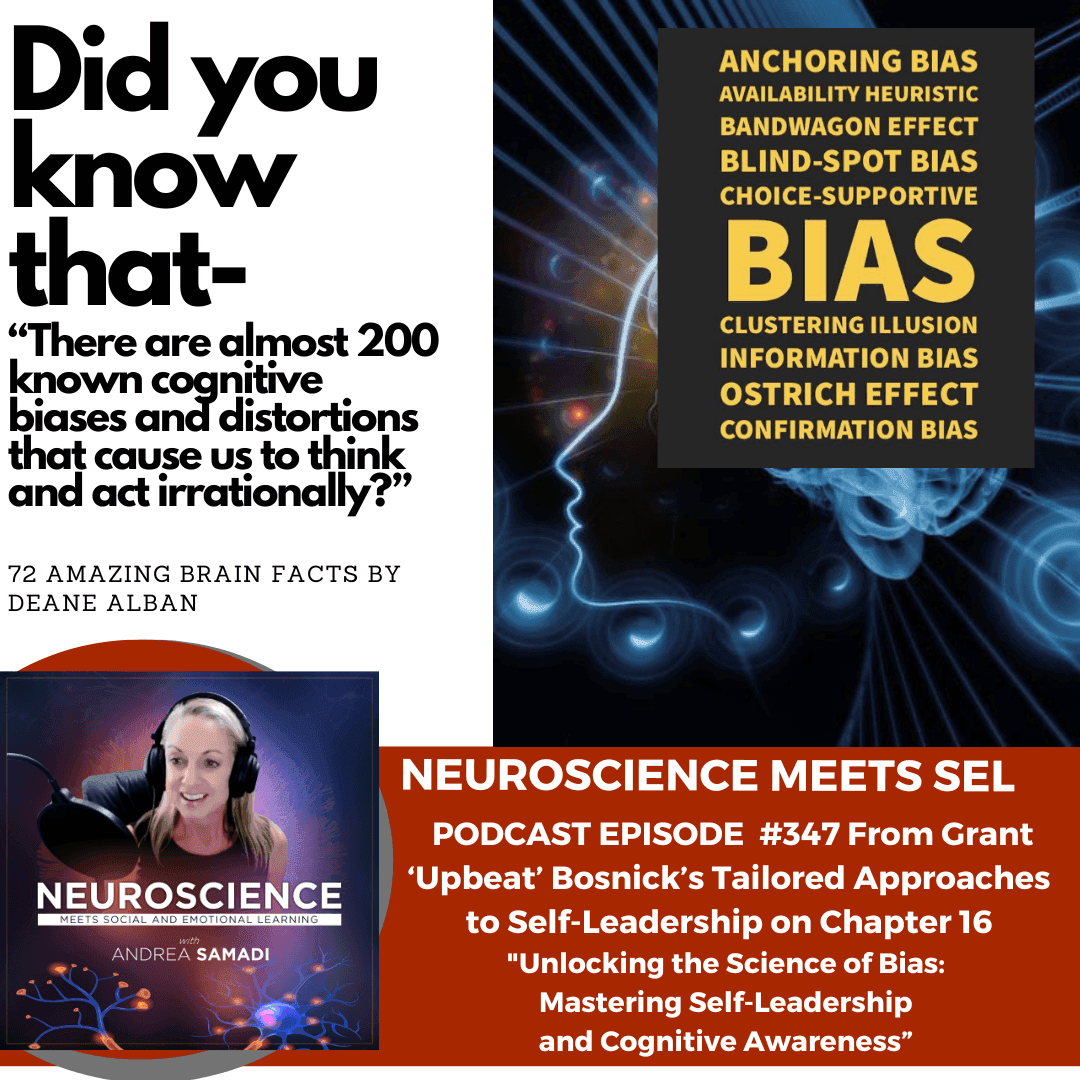
Neuroscience Meets Social and Emotional Learning
Unlocking the Science of Bias: Mastering Self-Leadership and Cognitive Awareness
00:14:06
Loading summary
Transcript3 lines
- [00:00]
A
Foreign.
- [00:05]
B
Welcome Back to season 12 of the Neuroscience Meets Social and Emotional Learning Podcast where we connect the science based evidence behind social and emotional learning and emotional intelligence training for improved well being, achievement, productivity and results using what I saw as the missing link since we weren't taught this when we were growing up in school. The applic of Practical Neuroscience I'm Andrea Samadhi, an author and an educator with a passion for learning and launched this podcast six years ago with the goal of bringing all the leading experts together in one place to help us to apply this research in our daily lives. On Today's episode number 346 we continue with our 18 week self leadership series based on Grant Bosnik's tailored approaches to self leadership that we first dove into with our interview on episode 321, the end of January. The goal was that each week we focused on learning something new from from Grant's book tied to the most current neuroscience research that builds off the prior week to help take us to Greater Heights in 2024. For today's episode number 346, we're moving on to chapter 16 reviewing the neuroscience of biases that we first covered on episode 17 with Harvard researcher Jenny Wu. On this early episode on our podcast I mentioned I had just learned that There are almost 200 known cognitive biases and distortions that cause us to think and act irrationally. Then we explored cognitive biases even further with episode 146 with our first interview with Howard Rankin on How not to Think, where he explains why the more we know the the more we realize we know nothing at all. If you've taken the Leadership Self assessment look to see if biases in pathway 6, our final pathway in this book study, along with relationships and authenticity, trust and empathy, is of a low medium or high priority for you to focus on this year, I was not surprised to see this pathway is a high area of focus for me. I remember being surprised at how many common problems occur with our human thinking process and I wondered how to be aware of all these cognitive biases. Learning is a continual process and awareness that our thinking contains these biases is the first step towards improving our thinking process. So what does Grant Bosnick have to say about biases in chapter 16 of his book Tailored Approaches to Self Leadership? Well, he opens up the chapter with an exercise that came from Daniel Kahneman's book Thinking Fast and Slow, a book that sold more than 2.6 million copies. And if you're listening to this episode, look at the image in the show notes and don't forget how you went on to solve this puzzle. Read the instructions and then solve the puzzle. It says spot the error. We'll come back to the solution at the end of this episode. Bosnik next goes on to define what cognitive biases are, reminding us that there are mental shortcuts that allow us to quickly sort, categorize and make decisions on pieces of information in order to navigate the world in an efficient way. They can be positive, negative or neutral, although most of us probably associate them with the more negative side. Biases, Bosnik says, can be conscious, like when you can relate to someone who's similar to you, or they can be unconscious and we have them and unknowingly use them to make judgments every day. We did learn from Howard Rankin that we need to be careful about how we think, and Bosnik agrees, saying that biases can impact the quality of our thinking, judgments and decisions. And Bosnik's advice to us is that in order to make better judgments and reduce bias, label the biases and mitigate them using appropriate mental and behavioral processes that we'll examine today. So what is the neuroscience of bias? Bosnik brings us back to the two systems in our brain that we first saw on episode 345, the neuroscience of Relationships and Authenticity, where we looked at the neuroscience of our social brain with the famous story of Phineas Gage, neuroscience's most famous patient. With this example, Bosnik tells us that we have two systems in our brain, the X system and the C system. The X system, or reflexive system, is automatic, responsive, like or dislike, reward or threat. And since this part of our brain is non thinking, it's it's not affected by our mental load. Then there's the C system, or reflective system, that's controlled conscious with executive function and executive control. Motivation and effort are required to engage this part of the brain and it can be affected by our mental load. Remember, Phineas Gage destroyed his C system, his system two, his reflective system. When the iron railroad rod went right through his brain, his controlled thinking was impacted, so he was left operating on the X system only. In other words, he had no control over his automatic reflexive system and his behavior became unbearable as a result. He treated everybody as an object for his own personal reward, without control. So going back to the neuroscience of bias, the X system is where we think on autopilot like Phineas Gage, and it's fast thinking and the C system is the more deliberate, slow thinking, reflective system and it's much more demanding on our cognitive resources than the X system. Which means it's easy to go to automatic reflexive thinking and much harder to think with our reflective high road, intentional and controlled thinking. Bosnik reminds us that we can't operate with system 2 all of the time or we'll burn out. We need some automatic thinking to navigate the world. And we all know this. We've all heard of productivity hacks like what Steve Jobs did to make his life easier by wearing the same clothes all the time. He said this reduced his cognitive load by eliminating the small decisions that he had to make. He was putting the load of the small task thinking on his X reflexive system to make more space for his C reflective system. Now that we know how our brain operates, going back to these two systems of thinking, Bosnik asks us to think back to the problem that he listed at the start of the chapter to see how we went about solving it. And I gave one of the two examples that he listed in his book the Maze that says Spot the error. How did you solve this puzzle? I'll tell you what I did. It started with looking at the maze and I was looking to see for where the maze had errors. I couldn't see any. So I figured that there was more to what I was looking at than what I was seeing. And Bosnik shares that the error is in the center of the maze where the instructions say find the the error. So I learned that while writing this episode I was cognitively busy and I reverted back to my X reflexive system to scan the diagram and see if I could find the most obvious easy to spot error. And if I thought this way with this example, where else am I reverting back to either consciously or unconsciously to this automatic thinking? And Bosnick's chapter goes on to explore three out of the almost 200 known biases and concludes his chapter on ways to manage them. He says that biases are a natural part of the human condition. We cannot get rid of them. Therefore, we need to understand them and manage them. So he suggests three steps for understanding and managing our biases. Step one, he said, accept and admit that we're all biased. It's a natural part of being human. The exercise from Daniel Kahneman's book showed me how quickly I reverted back to System X, reflexive automatic thinking. This self awareness has helped me to consider where else I make quick judgments without thinking reflectively. Step two, Label the bias. While Bosnik covered three examples, he covered similarity bias, making a quick conclusion about people who are similar to you. The urgency bias where we put non urgent tasks on hold to push through to do something that requires our immediate attention or experience bias where we believe our perception is the truth and that others who see things differently from us are wrong. Knowing there are close to 200 different biases, it's a start to be aware that our thinking could possibly be flawed. And then step three he says to mitigate the bias. We aren't going to solve all of our biases at once, but once we're aware that it's human to have them, we can begin with looking at strategies to mitigate each. He suggests four strategies. First, slow down. Bosnik goes into detail on how to mitigate the top three biases that he listed and the strategy that he used was to step back, slow down and access your system 2 reflective thinking to see what you notice. And the maze exercise showed me that I could benefit from slowing down my thinking and not jump to conclusions. Second, he says be mindful when talking to others. Work on engaging our system two thinking. The more mindful we are, the more we can engage our mental breaks, increase our self awareness, reduce emotional impulses and reduce our susceptibility to unconscious bias. Being mindful of others will help us to learn to appreciate different perspectives as well and other people will connect to us more when they can sense that we're thinking from their point of view. And third, learn from other people. Talk to others so you can learn how to get out of your own experience bias and appreciate other people's perspectives. This will help us to get out of our autopilot easy route thinking of the urgency bias to have a deeper, more robust and deliberate way of thinking. And fourth, ask for outside opinions. Find others that you can brainstorm with to come up with fresh ideas and to help you to think in a different way. Ask for feedback to gain a new perspective and this is just the beginning of this topic for us. On this podcast. While writing this episode, I had a message from our good friend Horatio Sanchez, our third time returning guest from episode 111, who let me know he's releasing a book on this exact topic coming out in March of 2025. So we'll have him back on for a fourth time today to dive deeper into this topic of biases. So to review and conclude this week's episode 346 on the neuroscience of bias, we covered a review of past episodes where we first talked about biases. We looked at Chapter 16 of Grant Bosnik's tailored approaches to Self leadership on the Neuroscience of Bias, we reviewed our two types of thinking, our X system, our reflexive automatic thinking, and our C system, our reflective intentional thinking. We looked at three steps to understand and manage our biases and four strategies for mitigating our biases. And this is just the beginning. Knowing there are close to 200 known cognitive biases that cause us to think and act irrationally, I know I'm looking forward to learning more on this topic from Horacio Sanchez, whose forthcoming book will cover this topic. And in the meantime, I'm working on ways to slow my thinking down and hope that you've also found it helpful to take a look at how we think. And with that thought, I'll see you next time as we cover the Neuroscience of Trust. Have a great week.
- [13:39]
C
If you're enjoying the Neuroscience Meets Social and Emotional Learning podcast, please don't forget to subscribe so you'll stay up to date with our new episodes. While you're there, please feel free to give us a review or a five star rating as it helps others find us. For more information on our programs, books and tools for schools and the workplace, Visit us at www. AchieveIt360.com.