← Neuroscience Meets Social and Emotional Learning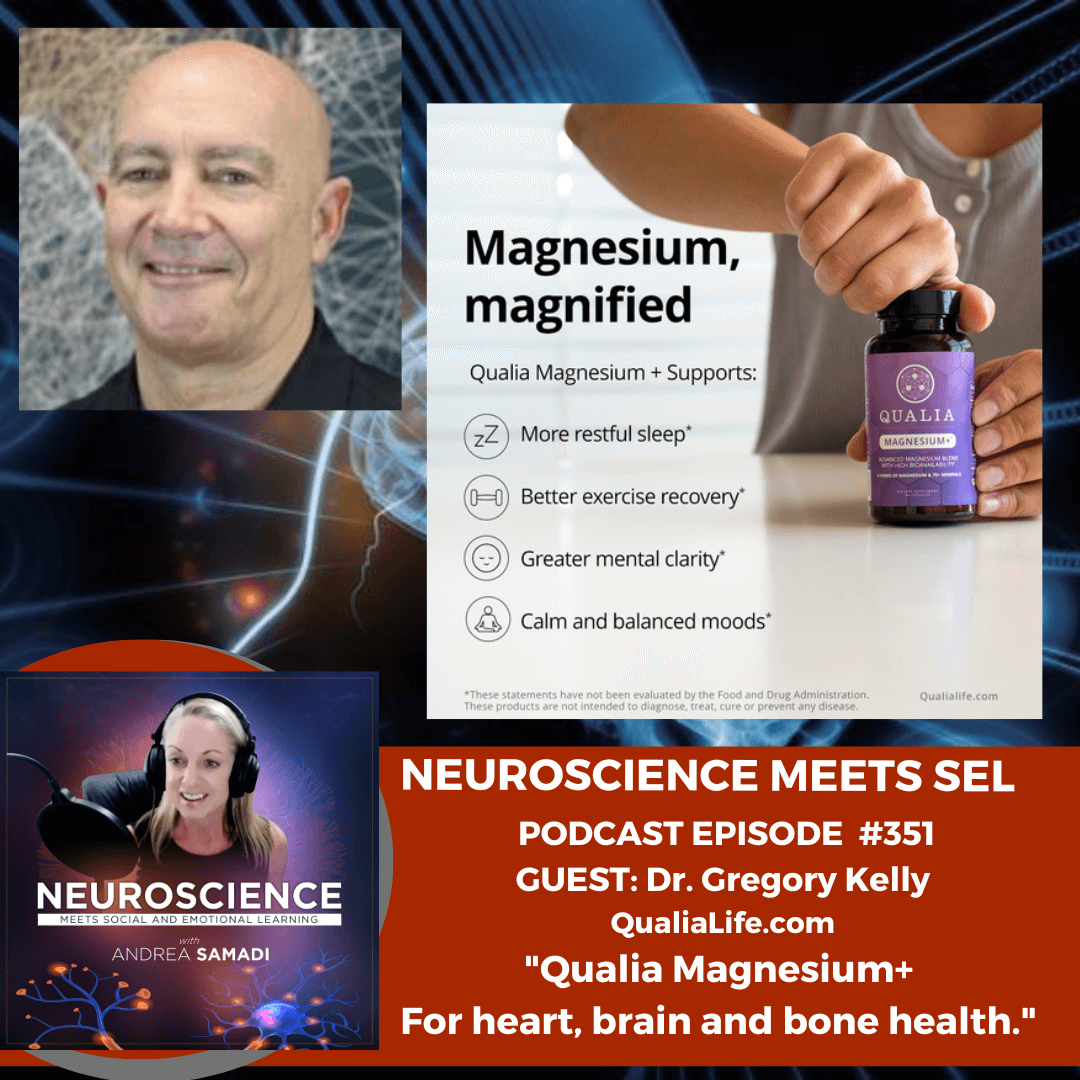
Neuroscience Meets Social and Emotional Learning
Unlocking the Secrets of Magnesium for Brain and Body Health with Dr. Gregory Kelly from Qualia Life
00:56:17
Loading summary
Transcript74 lines
- [00:00]
A
Foreign of the Neuroscience Meet Social and Emotional Learning Podcast where we connect the science based evidence behind social and emotional learning and emotional intelligence training for improved well being, achievement, productivity and results using what I saw as the missing link since we weren't taught this when we were growing up in school. The Application of Practical Neuroscience I'm Andrea Samadhi, an author and an educator with a passion for learning and launched this podcast six years ago with the goal of bringing all the leading experts together in one place to help us to apply this research in our daily on today's episode number 351, we meet with a returning guest for the third time, Dr. Gregory Kelly from episode 285 where we first met him and covered Qualia Cinelytic and it's something I've been taking ever since that interview to optimize aging support cellular function. And then again, we met him on episode 305 where we covered Qualia Symbiotic to optimize digestion and mood. Today we're covering their most recent product release, Qualia Magnesium that I've been taking for the past two weeks so we can learn together why this specific product is unique and different from other brands of magnesium on the market and what I'm noticing since taking this supplement. Just a bit about Dr. Kelly. He's the Director of Product Development at Qualia Life Sciences. He's a naturopathic physician and author of the book Shapeshift. He was the editor of the Journal of Alternative Medicine Review and has been an instructor at the University of Bridgeport and the College of Naturopathic Medicine, where he taught classes in advanced clinical nutrition, counseling skills and doctor patient relationships. Dr. Kelly has published hundreds of articles on natural medicine and nutrition, contributed three chapters to the Textbook of Natural Medicine, and has more than 30 journal articles indexed on PubMed. His areas of expertise include nootropics, anti aging and regenerative medicine, weight management, sleep, and the chronobiology of performance and health. Let's meet Dr. Gregory Kelly for the third time and see what we can learn about the benefits of adding magnesium to our wellness protocol. Welcome back Dr. Kelly. It's so awesome to see you again. How are things going for you?
- [03:07]
B
Great. It's been a wonderful end of 2024 for me. How about with you?
- [03:13]
A
Oh, that's so nice to hear. Yeah, same same here. Everything's cool. We moved into a new place so I've got new recording studios here and we're just trying to get the lighting right, but we're getting there, but it's nice to see some familiar faces here.
- [03:27]
B
Thanks. Yeah, I was excited when I saw you pop up on my schedule as well.
- [03:32]
A
Oh, fun, fun. Well, we're here today to talk about Qualia magnesium and do I say it Magnesium plus. Is that.
- [03:40]
B
Yeah, the official name is Magnesium plus, and because we have both magnesium, but we have some other things in it we'll talk about as well.
- [03:50]
A
Okay, that sounds good. Well, this is. This is fun. So to open up, can we just talk about magnesium and why it's critical for the human body just to start off with.
- [04:02]
B
Yeah, so magnesium's a co factor, meaning it's, you know, something that works with about 500 different enzymes. And enzymes are the workhorses in the body. Right. They're the ones that, that move things through the, you know, complicated pathways. So that's one of its reasons. Another, you know, you would know of ATP. Many listeners, I'm sure, have heard of ATP. Right. The energy currency of cells that is made in mitochondria. What you usually don't hear, but what's true is that magnesium's invariably, in humans, always complex with ATP. So whenever you hear ATP, always think magnesium ATP complex, because they're inseparable. So for ATP to do its work, magnesium needs to be there. And then magnesium's super important in stress. There's something called the magnesium stress vicious cycle. But on a cellular level or a tissue level, one of the things that occurs when we're under a lot of stress is that cells and tissues dump magnesium from inside to outside. Why, I couldn't tell you. But that's part of the stress buffering solution. And if we don't have enough magnesium, we're obviously going to respond poorly to stress. But the reason I call it a vicious cycle is because stress then depletes our ability to absorb well and use magnesium. So if we're stressed, we lose magnesium, and if we don't have enough magnesium, we're more prone to become stressed. So it's that vicious loop. So those are some of the big reasons why it's important. There's many more. Like I said, it has about 500 different jobs when we add all of them up. I know at Qualia, we think a lot about healthy aging, and there's a framework called the hallmarks of aging, where there's 12 cellular or whole body characteristics. These are things like mitochondrial dysfunction and buildup of senescent cells and telomeres becoming too short and DNA being damaged. And long story short, magnesium has been linked to all of those. So you Know, magnesium status is super important for healthy aging. And then the last piece would be, this is really common in aging. We struggle to absorb and use magnesium. Well, so because of that, not only does do we need it to counter these things that occur with aging, but we often struggle in aging, as just one example, to get enough. And the truth would be, and we'll get into this a little bit more, many people in our world don't get enough magnesium to optimize their levels.
- [06:46]
A
So. So I've definitely heard of magnesium for sleep and as well as, you know, when you, you, you hear about some people going on the keto diet, let's say take magnesium so you don't get muscle cramps. I feel like I heard that.
- [07:03]
B
Yeah, I've heard of.
- [07:04]
A
Yeah, those two uses.
- [07:07]
B
Yep. So there's, there's something, I think it was developed by some functional medicine clinic in Australia. But it, it's a questionnaire called Magnesium status questionnaire. Know, we don't own it, but if you googled it for listeners, you'd be able to find it and look at it. And part of the questionnaire is looking at things like maybe a medication that would be known to tax magnesium status. But a lot is just asking about subjective symptoms. So things that you just mentioned. Right. Muscle cramps would be an example. But also muscle twitch twitching or eyelids twitching. Right. Is often thought of as a, you know, a clue that you might need more magnesium. Pretty much every mood thing, right. You know, like feeling irritable, anxious, you know, periodically, like blue. All of those are strongly linked to magnesium. Sleep you mentioned. Right, Sleep. Super important magnesium for that. Cognition in general. Right. Like focus, things like that. Like in qualia mind plus we have a small amount of magnesium as an example, you know, and so when you go through that magnesium status questionnaire, you really look. Or that's asking about many different areas of health and it's because magnesium touches on all of them.
- [08:23]
A
Got it. So what is the link between magnesium levels and brain health? Like, I know you, this is what you do. This is what your products are for. You're, you're always coming up with the most innovative. But what are some studies that you have found that you said we've gotta have Qualiab magnesium plus as a part of our portfolio.
- [08:46]
B
Yeah. So mechanistically, like, one of the stories I often will tell about the brain is a lot of it boils down to energy, right? ATP. And as I mentioned, magnesium, super important for activating ATP. But magnesium is also a mitochondrial nutrient. I've seen it estimated about 30% of our magnesium is stored in the mitochondria where they use it. So, you know, because the energy demands of the brain are so much higher than any other tissue, it, it needs magnesium for that. But then there's certain receptors, especially the ones that make our nervous system and brain a little more calm. They're dependent on magnesium. They like, you know, bring it in and out of neurons to, you know, help those neurons perform well. So those and many other things in the brain rely on magnesium. So I mean, long story short, for listeners, when just think of magnesium as being a brain essential nutrient. And so the, the brain, you know, that's why mood, sleep, irritability, cognition are so often dramatically impacted by adding more magnesium to our diet.
- [10:01]
A
Got it. So we think of the fish oils. You know, you've got to take fish oil for brain health. You're saying fish oil, magnesium. Is there anything else?
- [10:11]
B
Yeah, there's, there's quite a few things that are, that the brain can't make for itself that it has to get from the diet. So choline would be another. It's Qualbind as an example, has two different forms of choline to have nutritional support. You know, lutein and zeaxanthin. They're, they're things often described as macula carotenoids. Right. Like the, the carotenes we need for, for good vision, but those are also concentrated in the visual part of the brain. So there's really quite a few things. Our brain relies on us to get it either through what we eat or by supplementing our diet.
- [10:51]
A
We know that we're not always getting it through what we eat. So this is why I'm so interested in what you always come up with, because we need these supplements. It's hard, it's really hard to get the nutrition from food alone. It's, it's more like a time thing, I think. It's, you know, just waking up and knowing that I'm getting the. What I need right off the bat helps a lot. And then I don't have to stress and worry about having to make stuff.
- [11:20]
B
Absolutely. And I think often, you know, when we get the things our brain needs at the beginning of our day, the rest of the day, our brain has more resources to pull on. Right. To get us through the. You maybe the tougher parts of our days.
- [11:34]
A
Yeah, definitely. Like, since our first interview, we've been using the qualia senolytic. You know, definitely, you know, getting rid of those zombie cells and, and that feel, it just feels good. It's like a clean out and then the focus ones, Qualia focus. My husband swears by it for the amount of calls he has to be on and the focus and being able to think and draw on his brain power hour by hour. So he said he wanted to just thank you for that because they're helping him immensely.
- [12:08]
B
Oh, wonderful.
- [12:09]
A
Yeah. Since we've been doing these interviews, we are using the products and it's amazing what we've noticed. And so I've just gotta mention, and I don't know if two weeks is enough, I've been using the Qualiam magnesium for two weeks. Would you say I should notice something? Because I noticed like I measure with my whoop band and I noticed a spike with improved sleep right off the bat and then it evened out because life is stressful and I can't always like it would be great if I could sleep in all the time, but sometimes I just, you know, it, it went down a little bit based on my work schedule. But is two weeks enough to notice? What do you think?
- [12:51]
B
So I. So one of the interesting things with magnesium. So we'll get to that, we'll step back first before we answer it.
- [12:58]
A
Okay.
- [12:58]
B
Is that I had alluded that magnesium is one of the most common nutrient inadequacies, meaning all of us, even someone eating a horrible diet is getting some magnesium, but most of us aren't getting enough. And there's at least two big bucket reasons. One would be soil depletion. Right. Like our soils aren't as replete with minerals because of reliance on fertilizer. The microbes that the roots systems rely on to absorb minerals don't work quite as well. So food isn't as abundant in magnesium as it would have been like in my great grandparents time as an example. But then the other thing, so I hear that talked about a fair amount, people are aware of soil depletion and foods not being as great a source of some minerals and vitamins. But where else would we have got a lot of magnesium historically? Do you have any thoughts?
- [13:55]
A
No, I have no idea.
- [13:58]
B
We would have got. And I've never seen like an, an actual number pinpointed, but probably about 15 to 20% of our magnesium we would have got from drinking mineral waters like hard water. Right. That would have naturally been high in a variety of minerals, but magnesium being one. So as an example, there's a mineral water and for people that know how to speak German, I'm probably saying it wrong, but something like Gerol Steiner. Right. That's A really high in magnesium carbonated mineral water. But many mineral waters have been tested for magnesium. And even some of the best brands, like the most expensive mineral waters, are pretty low in magnesium, you know, maybe like 110 of what would be in a Gerolsteiner. So most mineral waters nowadays aren't, you know, you know, great. And magnesium, because most water supply isn't. And then because many of the listeners here will know, like, oh, like, you know, there's maybe impurities or other things in my water, I should filter those out. We use things like, you know, reverse osmosis or other things to purify our water. And reverse osmosis strips about 97% of the magnesium and other trace minerals out of the water. So by purifying the water, we also make it devoid in these minerals that historically, we would have got a meaningful amount of our magnesium from the water we drank. Our ancestors at least would have. Right? And so that also adds into it. So whatever, you know, would be in, you know, like nutrition tables always leaves that piece out that we would have drank a lot of our magnesium historically. So I think that's, you know, one of the reasons that people often feel magnesium, even if they're getting a good amount. And so now to get to your question, when we move the needle from not quite enough to enough, then often good things happen. And sleep is sleep and stress, magnesium status questions like the muscle cramping or muscle twitching, those things tend to improve pretty quickly.
- [16:01]
A
Yeah, it was noticeable. Like it jumped up higher than ever. And I'll put the graph in the show notes of, of where, where it jumped up to. And so low magnesium levels. You. You couldn't look at me and say, hey, Andrea's not eating enough or getting enough of this mineral. Right. It's not something that you could see, like her skin looks a certain way or how.
- [16:25]
B
How can you tell the. Yeah, it's more like I said, like in that status questionnaire. Maybe I can find a URL and link that in the show notes for people that just want to take that on their own. But it's more like subjective symptoms, right? The, the irritability, the mood, the sleep, you know, general fatigue, brain foggy type of complaints. And then, you know, the, the cramping, the muscle twitching, you know, other muscular things. And so, yeah, it's not visual. And then the ways you would normally test if you went to a doctor aren't. So I guess stepping back, it's super easy to test magnesium and plasma, basically blood levels, but that would be outside of cells. Right. Extracellularly and that's really tightly controlled. So if that shows up abnormal, then like there's for sure tissues long ago stopped having the right amounts. And so, you know, when I would have been going through naturopathic school, you know, it's very common to do what are called red blood cell magnesium. So you're looking at the magnesium inside red blood cells as a better marker. But even that doesn't necessarily track super well what's, what's in tissues like our muscles or brain. So you know, often it's, you know, the symptoms like how we're performing that are the real true acid test with do we need it? And the answer is probably most of us do. But then pay attention to the things that repleting magnesium status should improve. And it's, if it's improving those then yeah, you, you weren't optimizing it prior. And you're not alone. Right. Most of us, you know, aren't optimal.
- [18:10]
A
Well, it was it. It's interesting if anyone gets it just to measure and see. That's what I always do. I always look to see what's. What do I notice. And sometimes it's hard, but like you said, when it's not there at all or it's completely deficient, that's when it's like when you're, you're, you're able to notice things more a change in something. Especially when I'm doing everything the same. But I added in something else. Why did I get such a different score on sleep? So it was, it was noticeable for me for sure. So, so what about, what would you say would be a comprehensive approach to supplementation for, for people like you've got qual magnesium plus here. What, what do you suggest for people to do to optimize for magnesium?
- [19:01]
B
So I think there's, there's kind of two ways to go about it. But in general for magnesium because it's so safe and the truth is the gut microbiome, the organisms that live in our gut also really need magnesium. So I, I know the daily value like the RDA amounts probably under count how much we would actually need to have optimize our tissue levels. And, and so I usually would just say start with the two capsules a day of quality magnesium. Plus if you want you can separate them out to different times of the day and just kind of go from there. I mean I tolerate magnesium really well. I typically just take both of mine around dinner time. And I, I do personally like magnesium more as a middle to end of the day supplement where Qualia Mind as an example, is my, you know, my start of the day product. Same with Qualia Nad Plus. Like those are my beginning of the day magnesium's in my either lunch or dinner stack.
- [20:09]
A
So I wondered, I've been taking it close to bedtime. Should I be taking it with food? Is. Does it matter?
- [20:17]
B
It it. Not too much. So the, the. There's many factors that impact to a small extent how well we absorb magnesium, and it's maybe slightly better absorbed with food. Okay, so. Okay, well, but it's not gonna. If you need it, you'll absorb a good amount of it no matter what time you take it, no matter whether you take it with or without food.
- [20:44]
A
Got it. I always love talking to you because I find different ways of how I'm taking products, and it's always helpful to have direct access to the person who was behind creating it and how it's supposed to be taken. So this is really helpful. Dr. Kelly, so what about the value in redundancy when it comes to magnesium supplementation? What should we be thinking of with. With that?
- [21:14]
B
So by redundancy, I want to make sure I understand what you mean.
- [21:17]
A
So does it matter how much, like, could I take too much of it?
- [21:24]
B
So the way it would work, and magnesium's not alone, iron would be another mineral is the. If we need more, we'll absorb a higher percent of what we take orally. So, you know, if a listener on the phone call was really deficient, like way low, they would absorb a higher percent of qualia magnesium plus than I would because I've been taking it for a while. I'm probably fairly good. And so the kind of, the next thing is if what we don't initially absorb then does go to our gut microbiome, right where it's used there, and then some would pass out in the stools. If we absorb more than we can use and get into cells, you know, so it gets into our blood, but we don't need all of it. Then we send out through our urine. So, you know, at extreme levels, yes, we could take way too much, but you need to be probably taking four or five times the recommended amount of qual magnesium plus to get there. And then, you know, you'd imbalance things a lot because magnesium's one of many electrolytes, but calcium, sodium, those, you know, if you, if you skew one way out of reason, too high or too low, it will, you know, kind of muck up all the electrolyte balance. So the, the two Capsules that we recommend is in the sweet spot for most people. And if in doubt, one capsule will fill in a lot of the gaps in terms of what you may not get in your diet. And so that's a really safe place to start as well.
- [23:01]
A
Just opened up a whole bunch more questions with the electrolytes because I just started drinking element for the electrolytes with more sauna use, more exercise and being in Arizona, so it's completely safe to add magnesium to the amount of electrolytes that would be in, let's say, an element drink.
- [23:23]
B
Yeah. So element and other more hydration electrolyte drinks are designed first and foremost for hydration. So you'll hear the word electrolyte, you'll hear hydration. Sometimes they're mingled together, but for hydration, really. So I'm almost certain that the one medical like knowledge advancement that saved the most lives since I was born. And for listeners, I was born in 62, so antibiotics were before me. But something that was discovered after I was born, figuring out what's called oral rehydration salts. Like how for someone. So in the third world, what historically killed a lot of people were things like dysentery or cholera, not because of the infection, but because you would lose so much fluids because of the loose stools and the diarrhea that you'd become dehydrated and die from that. And at some point, by the early 1960s, they discovered that if they could just give IVs to people, right, like IV saline to just keep them hydrated, then many of them would survive. And so it was hard to get IVs to these remote places in India or Africa. And so through a lot of the decade of the 60s into the early 70s, they tried to figure out how we could hydrate orally. And they figured that out. And so I saw a blog probably about two years ago that estimated that had saved 55 million plus lives and many of them children. And I don't think there's anything even remotely in that zip code in terms of a medical advancement that's served that much. So that's what I mean by hydration. Like when someone really needs hydration, Electrolytes then are the things of a group of things, right? Salt, potassium, magnesium, like the whole collection of these types of minerals, some of which are more and less important for hydration when you really need it.
- [25:27]
A
God.
- [25:28]
B
But that's why, like in the element that you mentioned, you'll see sodium really prominent, right? Like sodium, our cells evolved in the ocean, like saltwater Right. So that is what our mitochondria, what our cells evolved, they were bathed in that. Right. Because we were organisms that evolved originally in the ocean ourselves. Right. And so something of that, what they would use the term osmolality, right. Of that quality is what then allows things to get into our cells. So like one of the things with magnesium as an example, I'm, you know, see brand after brand is like, our magnesium's great because it's bioavailable. And what they usually mean for that by that is that we took it orally and magnesium in the plasma, like in that went up. But what's more important is it did our body hold onto it and did it get into cells? So hold onto it, that's retention and then getting into cells, it means that our body can actually use it. And because something goes up in the blood doesn't mean we'll hold onto it or that it will get into tissue as well. And that's why that advancement that I mentioned with hydration and oral rehydration salts, it was absorbed well, but then the body didn't just eliminate the fluids, it held onto it, it got into cel, actually hydrated. Right. So yep. So anyways, I don't know if that clarifies things, but I know when I was looking at, okay, we want to build a qualia magnesium plus like I thought of bioavailability as the entry level thing. Important that all the magnesium types we used are bioavailable and that that would be in a Peter Attia framing, necessary but not sufficient. So then the next thing is, okay, can what types of magnesium have had studies where it was retained better in the body? So then that was the next tick mark. Like they, they all had to be, well retained forms. And then the last part is like, okay, well, you know, are there studies I can find where they measured tissue levels, not red blood cell, but actual tissues like brain or muscle. And those, you know, went up with the form of magnesium. And that was the most important of those tick marks. Right. Because at the end of the day, just because it transiently went up in our blood doesn't mean it was able to get into tissues. And what was interesting in that is some really, you know, thought of as highly bioavailable forms of magnesium did not improve tissue levels in the studies I found. So they were ruled out like bioavailability, you know, necessary but not sufficient. They, they need to be retained and get into tissues.
- [28:19]
A
So right on the front you have advanced magnesium blend with high bioavailability Right. I, I wondered what that meant.
- [28:26]
B
Yeah. So that, that's, like I said, that's the, you know, the entry card to be considered for the Qualia magnesium. And then the most important thing to me, and probably to all the listeners is always does something do what it's supposed to do. And by that, with magnesium, it's some of the things we talked about, right, like sleep and mood and brain function. But one of the cooler things and for listeners, my first career was as an officer in the Navy. So I went through Navy ROTC in the early 80s, graduated in 84, was an officer in the Navy from 84 to 89. And my background was engineering, my undergraduate degree. So I worked in the engineering spaces on my first ship, which had loud machinery and other things. So you would use what was called double hearing protection, meaning those soft squishy things you put in your ears, you put those in, but then you'd put the big soundproof head ear protection over that. Right. So double hearing protection because there was high decibel noise in those spaces. And then you would have your hearing tested every year. And I had mine tested when I left the Navy because they were really sensitive to the, that environment could cause hearing loss. Mine actually did well, I was like left the Navy with good hearing. I have good hearing still all these years later. But this is something maybe listeners don't know. Like, one of the few nutrients that's been shown to help protect our ears from noise induced hearing loss or noise stress is magnesium. So when I say, like, does something do what it's supposed to do? That would be what it's one of the things it's supposed to do. Right. Like, you know, did taking maybe a very specific form of magnesium help with noise stress? And if yes, then we know it must have been bioavailable. Right. Because it did this more important job. So that was the ultimate criteria. Like, did a form of magnesium do something to markedly change our health? And in the Qualia, magnesium plus, it's magnesium aspartate, that's the one that was always used in those studies in the 90s for protecting hearing.
- [30:42]
A
What about lifestyle tips to help us maintain these levels? Do we always have to take something or is there something else that you can suggest that I should be doing in addition to this? Because I can't imagine it's not coming from mineral water. So to take it and it's gotta be a certain one that goes into the tissues and do what it's meant to do. But what else should I be Doing.
- [31:11]
B
Yeah. So this, I haven't seen a lot of research on it, but I'll tell another story if, if, you know, be patient. So back around 24 years ago, you know, most of my friends were like, oh, like I only need four or five hours of sleep. Or like, I remember being sleep shamed when I told like a friend that I need like seven or eight hours of sleep. And anyways, I had this friend that I would categorize as a true short sleeper. So he does really well. He thought at the time if he got four hours, but in reality like five, five to five and a half. He performs really well. So. So unlike most people that think they do well on not enough sleep, he does genetically need less sleep than average. I don't, I need, you know, like closer to 8 hours to perform at my best. But at the time I remember him trying to convince me how, you know, like, that he did great on four hours. I'm like, I don't know, I'm not sure I buy that. And then around the same time he's like, you know, he was a big exercise and he's like, oh, I get muscle cramps all the time, but if I take a lot of magnesium, then I don't, right? So, so I do, I take a, you know, much more magnesium than normal humans will. And so I looked and I found a study at the time and I'm probably going to misstate some of the details because this is 24 plus years ago. But the gist of it is when we're sleep deprived, our cells become magnesium resistant, so it becomes harder for magnesium to go from our blood into tissues. Think insulin resistant, right? In insulin resistance, you have plenty of insulin in the blood. It just can't get into tissues like muscle and do its job. So the gist of this study, as I recall, it was that sleep deprivation and they measured magnesium realistically caused like a magnesium resistance. You could have be taking plenty. It could look great in your blood if we did blood work, but you'd be functionally have symptoms that were showing up like you needed more magnesium, which was exactly what was happening to him, right, with the muscle cramps and things if he didn't take crazy high amounts of magnesium. So to get back to your question, that would be one thing, right? Like if, if our, if we're not getting enough sleep, our magnesium status in our cells is one of the things that's going to suffer. We'll just need more to perform at a higher level because the magnesium we're taking in Our supplement or getting in our water or diet may be getting to our blood fine, but it's not able to get into tissues as easily. And then the other is what I mentioned earlier, that stress, magnesium, vicious cycle. Right. Like stress always taxes magnesium status. So, you know, anything we can do to improve our heart rate variability or lower, you know, our stress response would tend to, over time mean we could do more with less magnesium.
- [34:02]
A
Such a process, trying to get all of it balanced. Right. Like, you've been at this for how long? How long have you been creating products for this?
- [34:12]
B
So, well, I went to naturopathic school and graduated in 96. So that was, you know, after my Navy time. So, you know, I've been in the naturopathic doctor, you know, world either making supplements, working with supplements for 28 years at this point.
- [34:29]
A
Right. It's such because I've been doing the podcast, getting the information and then applying it. And it doesn't always happen the way that, you know, like we could talk and say, oh, it's, it's, it's going to do this. But it's so much, there's so much involved in changing behaviors, making sure you're going to bed at certain amounts of time to be rested, to then lower your stress. Like, then we've got a whole other layer. So, you know, it just comes at you from all different angles. So I'm just wondering, how do you mitigate all these things that we're supposed to do to maintain these high levels?
- [35:10]
B
Yeah. So I think so sleep going back, you know, like I said, I had that conversation with that doc 24 years ago. Even then, I would have put myself in the rare category that really understood how important good sleep was. And part of the reason I understood was from the Navy. So when I was on Navy and my first ship in engineering, there was someone always had to be awake and on watch in the engineering that ran the show there. And There was only two of us on my small ship of 200 something people that could do. So when we were out at sea, one of us was on watch for six hours and then switched with the other one and back and forth, and then you still had to do your job. In the time you weren't standing that watch, if you wanted to exercise, you had to fit that in somewhere. You had to eat, you had to sleep. So the long story short, a lot of my time at sea in the Navy was sleep deprived by circumstances. Right. I didn't have any choice. You know, it was more stressful because, you know, at one point we had missiles locked on us for 62 days in a row by another country. And, you know, so there was, you know, stress. I remember when I applied to naturopathic school to one of the schools, the interviewers at the time said, oh, like, you know, Greg, how are you gonna deal with the stress of naturopathic school? I started laughing. I'm like, really, like, this is school. I've been, you know, like, in this, you know, awful thing that's really like real world threatening, stressful from, you know, two plus months. And they're like, no, no, no, you're not understanding. Like, naturopathic school is stressful. And I'm like, all right, well, I'll do yoga and meditate. But, like, going back to it, I think always the first step is realizing when we're not doing as well in an area, right? Like, we're not delusional about it. And, you know, with sleep, there's still people that don't prioritize sleep enough, even though they know what's really important. And for me, nothing is more important than sleep. And the, the analogy I used in my book, which had a chapter on sleep. My book's like 12 years old, right? So it's not new. But sleep is like a bus that pulls into the station on certain schedules. We either get on or we miss the bus and we have to wait for the next one. And so the sleep bus doesn't come on our schedule. It comes on its. And it doesn't come every five minutes, it comes maybe every 90 minutes. And so when I start to feel sleepiness. So I was just away in Las Vegas at a big longevity conference last Thursday, got back yesterday Monday, and I never sleep quite as well in hotels. And anyways, long story short, my normal bedtime's closer to 10pm but last night, somewhere around 9, I felt like sleepiness building, right? I felt, all right, the sleep bus is coming early tonight. I'm just going to get on. So, you know, as soon as I felt that I stopped what I was doing and got ready for bed, I was probably asleep by 9, 10, right now, tonight, it may come more on its regular time, but whenever it comes, I'm aware. Like, sleepiness is building. That's my time to step on the bus. And otherwise, like I said, like the next one, if I missed that nine, the next one might have come at 10:30 or 11. And by then I'd be like, oh, like, why can't I fall asleep? Because you missed the bus.
- [38:42]
A
I get it.
- [38:42]
B
That's. That's to me, like, that would have been what I taught patients. Like, let's just build your awareness of the sleep bus and what that feels like. And then when you feel that, you may choose to, like, I'm going to keep binging Netflix or whatever you're doing, but you'll easily go into deeper sleep if you jump on that first bus.
- [39:04]
A
That's the best advice I think I've heard in a long time. That's really good.
- [39:09]
B
Yeah. So like, I think you said you use whoop. I used an Oura ring for a long time. I use a different ring now. But whether it's that or with my, you know, Garmin type of watch, my normal result is I'm. I'm asleep so quickly that sometimes it dings me for that, like, I fell asleep too fast. And for their algorithm.
- [39:31]
A
Oh, interesting.
- [39:32]
B
But it's because I only go to bed when I feel like sleep is just about to hit.
- [39:38]
A
Yeah, no, I think I'm gonna, I'm gonna try that. That's a really good advice. So, so just going back to magnesium. So I, I got this. And, you know, I'm telling my husband, you know, I'm gonna take this. And he's been taking magnesium for sleep for a long time, and he's got his bottle on his side, and I'm like, okay, I'm using the qualia here. This is, this is good stuff. But what would be different with your magnesium than probably what he just picked up at.
- [40:10]
B
Yeah, so the, so there's a. I mentioned there's lots of forms of magnesium. Right. So you have things like magnesium glycinate that's also called bis glycinate. If you see those, they're. They mean the same thing. They're ones. A more chemical name, but magnesium bisglycinate, glycinate, those are both magnesium bonded to glycine. And glycine is a more calming. And that would legit be like a sleep or brain form of magnesium. But then you have magnesium citrate, which works in the brain. And in one of those studies that looked at tissue, it was a form of magnesium that caused magnesium levels to go up in both muscle and the brain. It worked in both tissues. Then you have something called magnesium acetyl taurate, which is really new to the market, and I think is the best brain magnesium and the most calming form of magnesium. So you have all these different types of magnesium, and all of them would have the magnesium in common. Right. Some of these forms, like I said, magnesium malate. I'm going to throw that under the bus for listeners. Sorry. But magnesium malate is a really well absorbed. It would be definitely a bioavailable form. But that study that looked at brain and muscle levels and tried a few different types of magnesium and looked magnesium malate did not cause increases in either muscle or the brain. So we don't have it in qualia magnesium plus you'll see it widely used because it's bioavailable. So to answer your question, one of the things that makes ours different is that we put a blend of things that actually are well retained and get into tissues. And the thing that it's the magnesium attached to, like, so we have magnesium taurate, which is a taurine bonded. So taurine does important jobs too. Taurine's super important for hearing. Our eyes concentrate taurine. So really important for vision. Taurine's gotten a lot of buzz over the last year and a half in the longevity community because it's a mitochondrial nutrient, it's an antioxidant, it's, it has quite a bit of animal evidence that it's important for longevity or healthy aging. And so magnesium taurate. Yeah, let's have some magnesium from that. That's also going to contribute enough taurine to, to top off your body stores of that. We have a magnesium bonded to creatine. So creatine is having, you know, a day, I would say, at this point as well. Right. Like, we can make a little bit of creatine, but we really need some to come through our diet. And many people, women especially, do better when they get more creatine, typically by supplementation. So we put some magnesium creatine, chelate, magnesium chelated to creatine. So all in all, we put nine different types magnesium that each contributes some other important organic acid or amino acid or something like creatine that helps cellular health as well. And then the other thing that I think makes ours really distinctive goes back to that idea of the ocean and water. So most magnesium in the world would be in the hydrosphere, meaning it's in water. It's in our oceans, in our, you know, like a, you know, good quality running water, mountain springs, things like that. And, and in that, just like the ocean, magnesium wouldn't be alone. It would be there with, you know, like in the ocean there's, you know, 70 plus other trace minerals. And so one of the forms of magnesium we use is called Aquaman, which is magnesium taken from the ocean water off the coast of Ireland. And then, you know, they, they concentrate the magnesium. But they leave in all the rest of the trace minerals. And then we have another thing in our product called concentrated seawater minerals that's got about 12% magnesium, but also, you know, the full blend of these and the way I think of it, it's magnesium the way nature intended it. We were never just supposed to have magnesium on its own. It would always in our food or water have been surrounded with the full gamut of these other trace minerals. And most of them we don't know, you know, like what jobs they do in cells. But is it likely that they're important for helping magnesium actually get into cells? I'd say yes. Right. Like, because that's what our cells were bathed in. So that would make ours different. Right. That, that blend of a bunch of really important, well used magnesiums with these really important, you know, ocean full of trace minerals.
- [44:50]
A
That, that blew my mind when I first saw there were nine, because I didn't know there was nine forms of magnesium when I was first looking at it. And the different functions, I just thought take some magnesium. I had no idea they were different.
- [45:06]
B
Yeah, and what often happens if you take like even a really good form like magnesium citrate. So ours would have 350mg of elemental magnesium in two capsules. And for listens listeners, the elemental means that's the amount of magnesium. But it would take a lot more of these different forms to get that 350. But as an example, if you just say used magnesium citrate to provide the 350mg of magnesium, most people will have looser stools or GI issues if they just took magnesium citrate alone to get that. Because when these are chelated to these different things or attached to these, some of that is absorbed with the thing it's attached to. So my no one's ever done these studies, but just based on what we see with people tolerating quiet magnesium plus much better than they would an equal amount of say magnesium glycine or magnesium citrate means to me less is getting to the lower digestive tract and then causing the looser stools. So by blending, you know, this mix, we're getting that benefit too. We're probably taking in more of what we are consuming in the capsule because the magnesium acetyl taurate might be coming in in a different door, so to speak, than the magnesium citrate or the glycinate.
- [46:29]
A
And what about some results from your pilot study? What have you heard? Like you heard me, you know, it's only Been two weeks for me. And, and I like to test things out for long periods of time. But what did you hear from other people?
- [46:44]
B
Yeah. So for listeners at Qualia, before we ever bring a pro product to market, we do what we call, you know, often a beta study, but it's a pilot study is how science would call it. So there's no placebo. But what we do is we'll make enough of the product to do some kind of a study where we give, you know, people that have volunteered the product and we'll always measure something. And so for magnesium, we use, we use three different questionnaires. First, we use that magnesium status questionnaire. You know, so the muscle cramps and the mood and all those. And what we saw over two weeks was about a 30% improvement. So their scores got lower, their magnesium status improved a lot. Then we used a sleep questionnaire, something called the Promise sleep questionnaire. And what we saw was about a 20, I think it was 26% improvement in how people rated these different areas of sleep over two weeks. And the third thing is we, you know, did a, something called the perceived stress scale, it's the most common stress question are used. And we saw stress symptoms decrease again in that, like, you know, mid 20 to 28% range. So in a relatively short amount of time, we saw, you know, all these areas of magnesium status and stress and sleep on average improve in a meaningful way. And this was again, you know, subjective questionnaires. So we weren't using, you know, like whoop or something. But that'll be. Then the next thing we do is will repeat that study, but then probably test levels of magnesium in red blood cells, which I mentioned, it's not, it doesn't track great with tissue levels, but it's something. And then, you know, we'll integrate in some of the, you know, the, the wearables to see how we're impacting sleep.
- [48:33]
A
Oh, this is, this is fun because I love, I love testing this stuff out to see, you know, what, what do I notice and how am I feeling? And there's always, I don't know, but I just trust you guys over at Qualia. So when something comes, I'm, I'm getting ready, what am I going to feel? And I always do feel so much better. And I don't know if it's because I'm deficient in something like what you, what you said when, you know, if there's something that I'm missing, it's really going to be absorbed in. So I almost feel like that's what it is for me. But I noticed it right away. Just a general feeling of well being enough that I want to take it every night. You know how sometimes you're like, oh, I don't really notice anything, but I thought, I've got to take this again and see if I, if it's repeatable, do I still feel good the next day. So it'd be interesting to see what listeners, you know, if they, if they come on board and get it, what they notice as well. What is next for Qualia? Because you've, you've gone through, you know, we, we had you on for the senolytics with the zombie cells. We've talked about the focus, the digestion one now magnesium. What, what are you working on now?
- [49:45]
B
So the work's already been done. We have a, I think it's going to be called Qualia Joint Health. And that one, the, the re ingredient research, the prototyping, the pilot study was all, you know, completed a while back and that's being made right now. And I believe it's anticipated that that will officially launch for sale around April 8th. Before that, we'll probably send some to you to try out because we'll love it. We'll have it made, I think by the end of February. So we'll have like, you know, a time period we'll probably, you know, get some in the hands of some of our friends to, to try. So that one's like done but not launched yet. And then what is really soon here going to go into the prototype and pilot study phase is one for stem cells. So the idea would be that it.
- [50:38]
A
Would, would you say like for.
- [50:40]
B
Yeah, I mean, so for stem cells in general, one of the, like, it's one of the hallmarks of aging is called stem cell exhaustion. It's one of the 12. And, and by exhaustion they mean a couple different things, but they mean that compared to like a young 20 year old, someone that's, you know, say 60 or 70 would have fewer stem cells just on a daily basis floating around in circulation. When they need more to heal from something, it also means that they activate or mobilize fewer. And so that's one of the reasons that for listeners, if listeners have young to teen children or family or friends that are in their early 20s, they usually recover from things a lot quicker, like a grandparent would, because they do have the stem cell pool to draw on when they need it. And so the, the goal of the product is really going to be something that periodically you would take More to, like, gradually, you know, promote healing wherever it's needed. And, you know, I'm 62. Like, I know my. You know, I have needs that I wouldn't have had when I was 20 to heal. So, you know, so this would be something that you wouldn't do every day because, like. Like, as an example, you know, if. If the issue with stem cells as we age is exhaustion and we're, you know, maybe taking a supplement every day, thinking, oh, I'll mobilize them. I'll mobilize. I'm like, that's just gonna make the poor things more exhausted over time. Right. Like, we need to, like, you know, mobilize them, but give them a long break to replenish. So that'll be the focus of our product. Right. Like. Like, you know, activating senescent cells for be. Periods to, like, in waves, you know, amplify healing.
- [52:28]
A
Interesting. I'm really interested in the joint one because I'm, you know, 53 now, and the joints aren't the same after exercise. It's like, I don't know what's happening.
- [52:38]
B
Yeah, sure. Yeah. So that. That one I'm excited about, too, because I'm 62 and I'm in the same boat. Like, my, you know, I. You just feel inflammation build up quicker than would have been when I was younger and, you know, like, squatting as an example. Right. Super important. I want to keep my legs strong and powerful going into older age, and squats cause more inflammation now than they did when I was younger. So, yeah, like, my body could use a little extra nutritional support for that.
- [53:12]
A
Oh, I love this. Dr. Kelly, thank you so much for this. So for people that want to try out Qualia Magnesium plus, you've got a link that I'll put in the show notes. It's qualia life.com andrea code is andrea. All small letters. I'll put it all in and you could get 15% off for anyone who wants to try.
- [53:34]
B
And.
- [53:35]
A
Dr. Kelly, I just want to thank you so much for continuing to innovate and come on the podcast and share and really teach me what I need to know to share with the listeners. Because, you know, science was not my background and. And as we're getting older, I want to understand this, but you explain it in a way that, you know, I really. I really get it and can understand why Wall E instead of just go to the grocery store and pick up something from there. So thank you so much for this.
- [54:07]
B
Oh, my pleasure. It was lovely to get to spend time with you.
- [54:09]
A
Again, absolutely. Well, just to final thoughts to close this out, you know, just, just some sum it all up for, for our listeners of, you know, what, what you think we should be thinking of health wise and all that.
- [54:26]
B
Yeah, I mean, sometimes. So I don't know who said this, but I saw there's a blog, Farnum Street. Um, I think it's maybe fsblog.com or anyways, Barnum street would be the name of the, the blog. And at some point that blog put on Axe, the former Twitter. Something like, you know, success in most things is a matter of doing the obvious things over and over for long periods of time. And there's a lot of wisdom in that. Right. We always want like, well, what's the trend, trendy thing, what's the new thing? But really doing the obvious things well over long periods of time is what delivers the results. And the obvious things are things like, you know, getting enough and better sleep and reducing stress as two of the big ones, like improving our mood. Right. Because our mood colors a lot of, you know, if we're feeling anxious or down in the dumps, you know, it's harder to do some of the good things. And I just mentioned that because magnesium hits all of those bases. Right? So magnesium seems like a simple thing, but it would be one of those obvious things that if we just do over and over for long enough periods of time, it ends up being a fantastic investment.
- [55:45]
A
Thank you so much for your time today, Dr. Kelly.
- [55:48]
B
My pleasure. If you're enjoying the neuroscience meets social and emotional learning podcast, please don't forget to subscribe so you'll stay up to date with our new episodes. While you're there, please feel free to give us a review or a five star rating as it helps others find us. For more information on our programs, books and tools for schools and the workplace, Visit us at www. AchieveIt360.com.