← Neuroscience Meets Social and Emotional Learning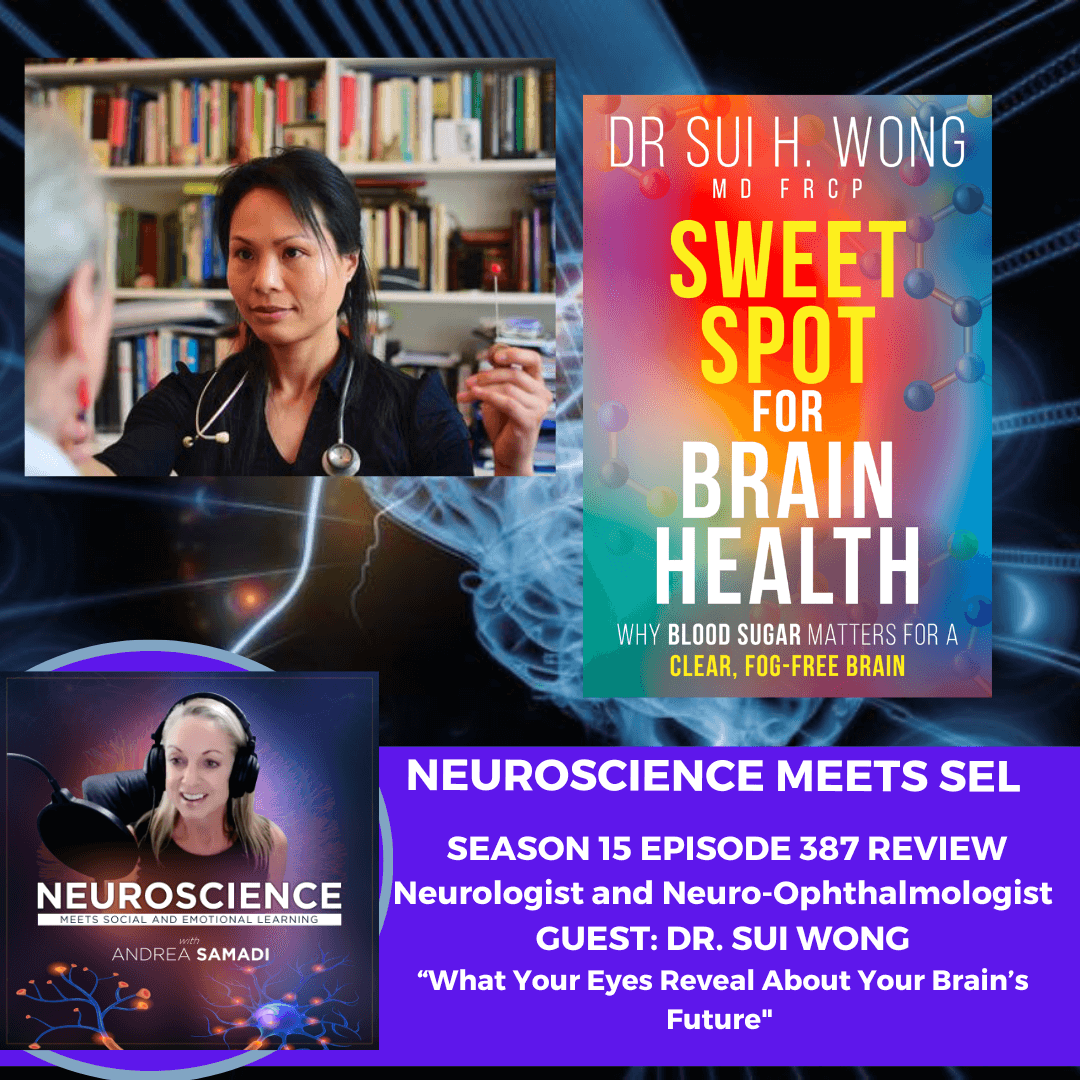
Neuroscience Meets Social and Emotional Learning
What Your Eyes Reveal About Your Brain's Future (Revisiting Dr. Sui Wong)
00:18:08
Loading summary
Transcript8 lines
- [00:00]
A
Foreign. Welcome Back to season 15 of the Neuroscience Meets Social and Emotional Learning Podcast. I'm Andrea Samadhi and it's here that we bridge the science behind social and emotional learning, emotional intelligence and practical neuroscience so we can create measurable improvements in well being, achievement, productivity and results. Now, when we launched this podcast seven years ago, it was driven by a question that I'd never been taught to ask. Not in school, not in business, and not in life. And the question was, if results matter, and they matter now more than ever before, how exactly are we using our brain to make these results happen? Now, most of us weren't taught what to do. Very few of us were taught how to think under pressure, or how to regulate our emotions, or how to sustain our motivation, or even how to produce consistent results without burning out. And that question led me to a deep exploration of the mind, brain, results, connection and how neuroscience applies to everyday decisions, to our conversations and our performance. And that's why this podcast exists. Each week we bring you leading experts to break down complex science and then translate it into practical strategies that we can all apply immediately. When the brain, body and emotions are aligned, performance stops feeling forced and it starts to feel sustainable. Season 14 of our podcast showed us what alignment looks like in real life. We looked at goals and mental direction, we rewiring the brain, future ready learning and leadership and self leadership, which all led us to inner alignment. And now season 15 is about understanding how that alignment is built so we can build it ourselves using predictable science backed principles. Because alignment doesn't happen all at once, it happens by using a sequence. And when we understand the order of that sequence, we we can replicate it. And by repeating this sequence over and over again until magically or predictably, we notice that our results have changed. So season 15 is organized as a review roadmap where each episode explores one foundational brain system and a quick review of phase one on regulation and safety. We've reviewed Dr. Bellangelal where we were reminded that before learning can happen, before curiosity can emerge, before motivation or growth is possible, the brain must feel safe. Then we looked at trauma and relational safety with Dr. Bruce Perry's book what happened to you? And now we move on to Dr. Sui Wang with automatic balance, lifestyle medicine and brain resilience. So for Today's episode number 387, we revisit our interview with Dr. Sui Wong, who's not only a neurologist and neuro neuro ophthalmologist based in London. She's a bridge between clinical medicine, neuroscience research and personal centered lifestyle interventions. With more than 110 peer reviewed publications, book chapters and conference abstracts, Dr. Wong has built a career translating complex neurological questions into research that improves real patient outcomes. Her work is deeply scientific and deeply human. We first met Dr. Wong on episode 343 in August of 2024 where we explored her four books and discussed how protecting our eye health may help us to prevent neurological disorders in the future. Then again, we met her on episode 361 where we dove into her book Sweet Spot for Brain Health why Blood Sugar Matters for a Clear fog free Brain explaining how metabolic health directly impacts our cognitive clarity. So for today's episode 387, we're going back to the beginning to one of the most powerful concepts she shared. And in our first conversation, I told Dr. Wang that I had learned to confidently say the word ophthalmology after hearing Dr. Andrew Huberman open each of his episodes of the Huberman Lab podcast with that introduction. And it was through that repetition that I first understood something profound. The eyes are literally an extension of the brain. And Dr. Wong expanded this idea beautifully, explaining that depending on your perspective, the eye may be an extension of the brain or the brain may be an extension of the eye. Let's see what she has to say. I follow Dr. Andrew Huberman. Right. And so I've got a lot of practice saying ophthalmology because that's a hard word to say, but I've heard him say it over and over again and I didn't know before listening to him that our eyes are actually attached to our brain, that they're an extension of the outside of the brain. I didn't know this.
- [05:33]
B
This is Some people think of the eye as an extension of the brain or depending on where you come from, from the brain may be an extension of the eye.
- [05:42]
A
True. Interesting.
- [05:44]
B
It's all connected.
- [05:44]
A
It is. And some key takeaways from clip number one with Dr. Wong. Number one the eyes are brain tissue. The retina is neural tissue. It develops from the same embryological tissue as the brain. So what affects the brain affects the eyes, and vice versa. So eye exams may offer early clues about neurological conditions. Takeaway 2 Brain health can be seen. Changes in retinal blood vessels or optic nerve structure and inflammation may reflect neurodegenerative disease risk, vascular health, or metabolic dysfunction, or early cognitive decline. So prevention may start with what we can literally see. Tip 3 Language Shapes Understanding when we think of the I as separate from the brain, we miss some connections. When we understand the I as brain tissue prevention becomes integrated so the brain doesn't operate in isolation. And neither does our health. Tip 4 Prevention is practical. Dr. Wang's broader message the lifestyle factors influence both ocular and neurological health. Her tips included blood sugar regulation, cardiovascular health, sleep, inflammation control, and stress management. And this maps directly to our six health staple framework that we've been discussing on this podcast. Some tips to put these ideas into action. Here's how we can translate these tips into our daily behavior. Tip 1 Don't skip your eye exams Comprehensive dilated eye exams can detect microvascular changes, early signals of diabetes, hypertension effects, and neurological red flags. And I just went for my yearly eye exam and my doctor told me that we're monitoring something called Drusen in my eyes. They are small yellowish deposits that can appear on the retina and and right now mine are small and they're scattered. And my doctor reassured me that small amounts can be a normal part of aging as long as they don't increase in number and as long as they stay away from the optic nerve and central vision, we simply just watch them. But here's what changed for me. I now understand that these tiny dots aren't just eye dots. They're neurological information. Because the retina is neural tissue, subtle retinal changes may reflect broader vascular or metabolic shifts in the body. And in some cases, researchers are studying how retinal biomarkers may correlate with brain pathology over time. And this means that the eyes can give us early insight, and insight gives us opportunity. So instead of ignoring it, I'm staying proactive and I'm keeping my yearly eye exams. Tip 2 Protect your blood sugar Blood sugar spikes affect retinal vessels, brain clarity, and long term cognitive resilience. Tip 3 Protect retinal blood flow. Support vascular health through regular aerobic exercise, taking those omega 3s, managing blood pressure and hydration. Tip 4 Prioritize sleep the optic nerve benefits from sleep. Chronic sleep deprivation increases inflammation, impacts retinal function, and accelerates that risk for cognitive decline. And finally, tip five is to reduce digital strain. Encourage that 2020 rule every 20 minutes. Look away for 20 seconds from your computer, moving on to clip two. In this clip, Dr. Wong explains that migraines affect 35 million people in the US and one out of seven people globally, making it one of the most common neurological conditions and a leading cause of disability in young women. She emphasizes that migraine is often misunderstood. It's not just the dramatic severe headache attacks where someone retreats to a dark room. In many cases, she Said the most debilitating part isn't the pain, it's the neurological symptoms that surround it.
- [10:17]
B
35 million people in the US get migraine and predominantly affecting younger age working people 18 to 44, 1 in 7 people globally and is a top cause of disability in young women. And sadly it's a hidden disability. And what we have to realize is that migraine is not just a very obvious classical attack where people get severe pain, they vomit, they shut themselves in a dark room, it passes over a few hours. Oftentimes I see the non headache symptoms being more debilitating than the headaches. Often it's the symptoms such as mood swings, brain fog, not quite thinking right, not quite getting the words right as ongoing, kind of a dull rain fogginess effect and that really a constant dizziness. These are the things that could really affect people. And it's not visible, it's not visible. That's the sad thing.
- [11:07]
A
Some key takeaways from clip number two with Dr. Wong. Takeaway 1 Migraine is common and it's underestimated. 35 million people in the US experience migraines one out of seven globally and it's the leading cause of disability in young women. And the most affected are ages 18 to 44 working caregiving in those high demand years. So a key insight, it's not rare, it's not dramatic, it's neurological. Takeaway 2 Migraine is a brain condition, not just pain. Dr. Wong makes a critical distinction. The headache is often not the most disabling part. It's the neurological symptoms that follow. Brain fog, word finding, difficulty, mood changes, sensory sensitivity, cognitive slowing and early emotional volatility. This reframes migraine as a network dysfunction in the brain, not just simply a pain event. Takeaway 3 Hidden disability because symptoms are invisible, others may not understand, employers may not recognize it. People may feel dismissed and because of this, they may push through and worsen their recovery. It impacts productivity, communication, confidence and emotional regulation. Takeaway 4 Migraine brains are often highly sensitive, highly reactive to stress, sensitive to sleep disruption and sensitive to blood sugar swings. And also sensitive to light and sound. Some tips to put these ideas into action. Tip 1 Track your patterns, not just your pain. Try tracking your sleep quality, hormone cycles, blood sugar patterns, stress levels, screen exposure, dehydration and food triggers. Migraine is often predictable when patterns are recognized. Tip 2 stabilize blood sugar fluctuations can trigger neurological symptoms. Practical steps Eat protein at breakfast, avoid high sugar spikes, don't skip meals, add fiber and healthy fats and go for a walk after your last Meal. Tip three, Protect sleep aggressively. Sleep deprivation increases our sensory sensitivity and inflammatory markers. Migraine brains need consistent sleep timing more than most. Tip 4 Reduce sensory overload for high performing professionals, build screen breaks into your day, use blue light filters at night, lower overhead lighting and create quiet reset moments. Even every five to ten minutes, a sensory reset matters. And tip five, support emotion regulation. Because mood swings and irritability can precede headaches, make sure to build in HRV breathing, breath work, short walks outside low stimulation recovery windows and honest communication at work and home. And make it normal to say that I'm having neurological symptoms today. And tip six, don't minimize cognitive symptoms if you're experiencing challenges with word finding, issues with brain fog, with visual disturbances or ongoing cognitive dullness, migraines can be managed. And suffering silently isn't necessary. And this clip on migraines reminds us that the brain is not just an organ of thought, it's an organ of sensitivity. And when it's overwhelmed, it whispers long before it screams. And to review episode 387 as we wrap up today's episode, revisiting our first conversation with Dr. Sui Wong, there's two powerful reminders that I'm taking with me. First, the eyes are not separate from the brain. They're brain tissue. When we protect our vision, we're protecting neural tissue. And when we monitor retinal changes, we're gathering information about vascular, metabolic and neurological health. And that yearly eye exam, it's not just about seeing clearly today, it's about preserving clarity for our future. And second, migraine is not just a headache. It's a neurological condition that often shows up as brain fog or word finding. Difficulty, mood changes and cognitive dullness, especially in young, high performing women. And because it's invisible, it's often dismissed. But invisible doesn't mean insignificant. Both of these conversations reminded me of something foundational. The brain doesn't suddenly break, it dysregulates over time. And it gives us signals long before it gives us crisis. And the question is, are we paying attention to these signals? And this episode fits into our season 15 review. Because alignment doesn't happen by accident, we don't build brain health by waiting. We build it by monitoring, by regulating, by stabilizing and preventing. Through our sleep, through our blood sugar management, through stress management, through our vascular health and through awareness. Small actions repeated consistently over time. And if there's one final takeaway from today, it's this. Prevention begins before symptoms become severe. And often it begins in places we wouldn't expect. Expect, like the back of the eye or the foggy afternoon where we couldn't find the right word, the brain whispers before it screams, and when we understand that, we can respond with curiosity instead of fear. And I want to thank you for joining me for the season 15 review. If this episode opened your eyes, literally or metaphorically, share it with someone who might need a reminder reminder that brain health is something we build daily. And I'll see you for our next episode where we're having a returning guest to come back on the podcast and take a deeper dive into blood sugar management. See you next time.
- [17:41]
C
If you're enjoying the Neuroscience meets Social and Emotional Learning podcast, please don't forget to subscribe so you'll stay up to date with our new episodes. While you're there, please feel free to give us a review or a five star rating as it helps others find us. For more information on our programs, books and tools for schools and the workplace, Visit us at www. AchieveIt360.com.