← Neuroscience Meets Social and Emotional Learning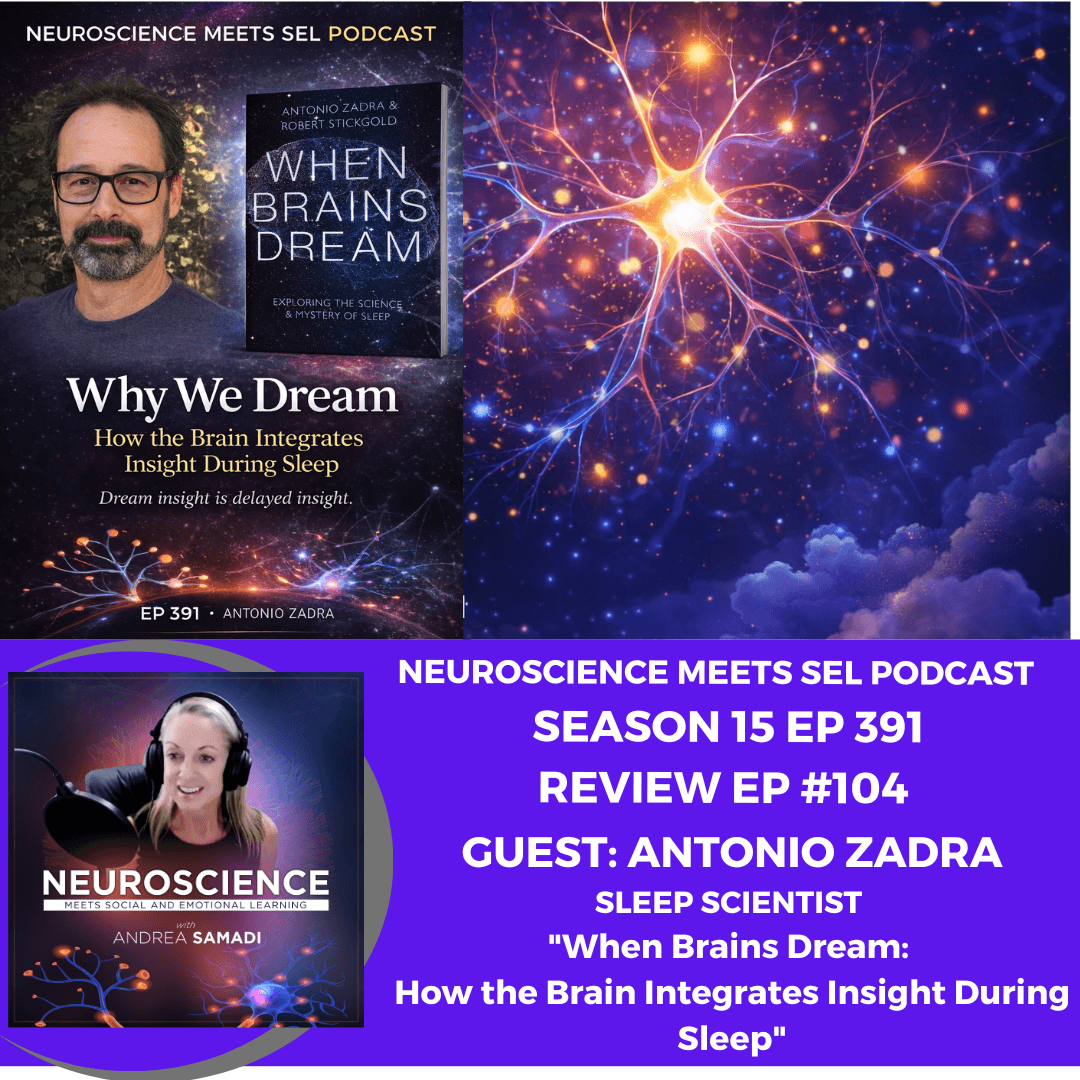
Neuroscience Meets Social and Emotional Learning
When Brains Dream: How Sleep Integrates Emotion, Insight, and Creativity (Revisiting Antonio Zadra)
00:21:31
Loading summary
Transcript6 lines
- [00:03]
A
Welcome Back to season 15 of the Neuroscience Meets Social and Emotional Learning Podcast. I'm Andrea Samadhi, and it's here that we bridge the science behind social and emotional learning, emotional intelligence, and practical neuroscience, so we can create measurable improvements in well being, achievement, productivity, and results. And if you're new here, welcome. Season 15 is organized as a roadmap of the brain's foundational systems. Instead of treating neuroscience, health, mindset, and performance as separate topics, we're exploring how they come online in sequence. Each phase builds on the one before it, beginning with regulation and safety, then then neurochemistry and motivation, then movement and cognition, perception, emotional and social intelligence, and finally, integration, insight, and meaning. Because peak performance isn't built by doing more. It's built by aligning the systems underneath. So season 15, where we are now, we've organized as a review roadmap, where each episode explores one foundational brain system and each phase builds on the one before it. So today, as we close out this first phase of season 15 on regulation and safety, we come back to one of the most essential, yet often misunderstood functions of the brain. And it's sleep. But not just sleep for rest. Sleep for integration. Because if phase one is asking the question I, is the nervous system safe enough to learn? Then this episode takes us one step deeper. What does the brain do with what we've learned once it finally feels safe enough to process it? So today we revisit our conversation with Antonio Zadra. He was a leading researcher in sleep and dreaming, and we explore why the brain dreams. How REM sleep integrates emotional experiences, and how insight, creativity, and problem solving don't happen during effort, they happen during release. And this conversation brings us full circle, from safety to regulation to recovery. And then we move to integration. Because the brain doesn't need input to grow. It needs space. Space to connect space to reorganize space, space to make meaning. And as you'll hear in this episode, insight isn't something we force. It's something that emerges when the brain is finally allowed to do what it was designed to do. So to deepen our understanding of dreams, Antonio Zadra along with Robert Stickle, introduce a powerful new framework. In their book When Brains Dream, they propose an innovative model. It's called NextUp, which stands for Network Exploration to Understand Possibilities. Now, this is my type of book. At its core, this model suggests that dreaming is not random. It's the brain actively exploring possibilities, making connections between past experiences, current challenges, and future scenarios. And through this lens, dreams begin to make more sense. So whether it's a vivid nightmare, a lucid dream, or even what feels like a prophetic dream, they're all a part of the brain's attempt to simulate, test, and integrate information. So what this book reveals is something powerful. Dreams are not meaningless. They're psychologically and neurologically significant experiences. They help us to process emotions, solve problems, and unlock creativity. Antonio Zadra. He's a professor at the University of Montreal and a researcher at the center for Advanced Research in Sleep Medicine. He has spent decades studying the science of sleep and dreaming. His work was featured in PBS's Nova and the BBC's Horizon. And he helps to bridge the gap between what we experience at night and how it shapes our waking life. So let's dive into clip one, where I shared with Antonio something that I learned early in my career. That keeping a dream log could unlock powerful personal insight. But what Antonio helped clarify completely shift my perspective. We often ask others, what do you think my dream means? As if dreams can be translated like a language or decoded with a fixed formula. And Antonio reminds us, dreams don't work that way. They're not universal symbols to be interpreted by someone else. They're personal creations, more like a work of art than a message to decode. Just like an artist doesn't hand over a painting and ask someone else to define its meaning, dreams belong to the dreamer. So instead of asking others what our dreams mean, the better question becomes, what does this dream mean to me? Bob Proctor, that I worked for back in the late 90s, he said, you know, write down your dreams. You can gain a lot of personal insight from them. But you taught me a valuable lesson that we cannot interpret other people's dreams, only our own. Can you share why this is important for all of us to understand and why we probably have to, like, stop that urge to ask, what does this dream mean? And what should we be asking instead?
- [06:04]
B
Okay, well, that's an excellent question. First of all, I'd say, you know, people can certainly help others better understand their dreams, but what often happens is that this process takes place without any input from the dreamer. And so the one analogy I like to often make is that dreams are created by the dreamer, no one else. And so it's like a work of art that is created by an artist. But art, artists don't go around with their work of art and say, oh, take a look at this, whether it's a sculpture or a painting, and can you please tell me what it means? And so no one does that. And so it's particular that we do that with our dreams. It also implies that dreams have a unique, singular meaning. As if I was telling you, oh, I heard this sentence in Japanese. Can you tell me what it means in English? So as if you could just have a dictionary and translate things Some key
- [07:00]
A
takeaways from clip number one first, dreams are self generated. They're not externally defined. They're created by your brain. They're shaped by your experiences, by your emotions and your memories. Takeaway 2 There's no universal dream dictionary. Symbols don't have fixed meanings across people. Context matters more than content. Takeaway 3 Interpretation requires the dreamer's input without your personal associations. Any interpretation is incomplete or inaccurate. And I would agree here because my dream journal would not make sense to anyone other than me. Anyone else would think it's a big log of a bunch of nonsense. Takeaway 4 Dreams are more like art than language. They're expressive, they're symbolic, emotional, but not literal translations. And takeaway 5 the value is in the reflection, not explanation. Insight comes from exploring the dreams, not labeling them. And what I've noticed from keeping a dream log is that the insight doesn't always come immediately. Sometimes it's later when I revisit my dreams that I experience these aha moments. And this is where connections begin to surface that I didn't initially see. And then I find myself asking what was that dream really about? And the answer often becomes clear when I look at what's happening in my life at the time of the dream. It's almost as if the dream was processing something in the background, and meaning emerges only when I'm ready to connect the dots. Some practical Tips so how do we use our dreams for insight here? Tip 1 Start your own dream log and instead of just writing the story when you wake up, include what emotions you felt, what people or symbols stood out to you, and any current life situations that connect to the dream. And this turns your log into a reflection tool, not just a record. And if you can keep this dream log going, you'll be amazed at the messages you receive when you're sleeping, if you're lucky enough to write them down when you wake up and then have a chance to analyze them later. Tip 2 Look for emotional patterns, not just symbols. Don't just focus on water means this or flying means that. Focus on I felt anxious or free or overwhelmed. Emotions are the bridge between dreams and the waking Life takes Tip 3 Connect dreams to our current life. So ask yourself, what am I currently working through? Where does this feeling show up in My day to day life. And this aligns with our season 15 theme integration happens when the brain connects experiences. Tip 4 Use dreams for problem solving. Before sleep, think about a challenge or a question and let your brain process overnight. In the morning, capture anything, even fragments. And this ties directly to Zadra's work on dreams supporting insight and creativity. And finally, tip five don't over interpret. Not every dream will have deep meaning. Sometimes dreams are just emotions processing or memory consolidation or random recombinations. The goal is awareness, not to force meaning. And moving into our second clip, Antonio Zadra shared a perspective that completely changes how we think about dreams. He explains that dreams are not just something we need to remember in order for them to be useful. He said, in fact, most people don't remember their dreams at all. And even those who do only remember a small fraction of what happens throughout the night.
- [11:06]
B
Dreams probably execute their functions as they are happening. And the reason we believe that is that very few people remember their dreams. And even those who remember their dreams almost every morning, which is a minority, remember only a small fraction of the dreams that we experience all night long. And some people go through their entire lives without ever remembering their dreams. And so if we had to remember them, let alone work on them for them to have a function, then it'd be such a colossal waste of time because for entire segments of the population, dreams have no function. You know, young babies spend a lot of time in REM sleep and presumably dreaming. They probably have very little recall of those experiences. And so it makes a lot more sense to believe that dreams execute their functions as they are happening. That being said, that does not preclude the idea that you can certainly use the dreams that you remember to better understand something, including yourself, your concerns as a source of creating creativity as a source for self exploration. So that is quite something else. But next up, by detailing how we think the brain goes about picking salient concerns from your daytime, how it goes about trying to link them to past experiences, gives you maybe a better sense of how dreams are built and why they are built that way.
- [12:28]
A
So our key takeaways from clip 2 takeaway 1 dreams work without conscious recall, so their primary function happens during sleep, not after sleep. Takeaway 2 Remembering dreams is not required for your benefit. Even if you never recall a dream, your brain is still processing. Takeaway 3 the brain is filtering salient concerns. What stands out emotionally or cognitively gets prioritized in your sleep. Takeaway 4 Dreams connect past and present experiences. This is the brain's integration system at Work and recalled Dreams are an optional insight tool. They're not necessary, but they're powerful if they're used intentionally. Tying this to Antonio's next step. In our framework, the brain is exploring possibilities automatically. Integration happens whether we notice it or not. So tying this into our season 15 map for phase one sleep enables the process for regulation and safety. And concluding our phases. When we get to phase five, our dreams reveal the integration, insight and meaning. So how do we apply these tips to our daily life? 1. Remove the pressure to remember your dreams. If you don't remember your dreams, nothing is missing. Your brain is still doing the work. Tip 2. Use Remember Dreams as a bonus tool. If you do remember a dream, ask what feels most important here? What concerns from my day might be related to the dream? And what past experience could this be Connecting to tip 3. Identify salient concerns before you go to sleep. Ask yourself at night, what's most on my mind right now? Or what would I like to solve or better understand? This increases awareness and sometimes can help with dream recall. Tip 4 Trust the brain's offline processing. You don't need to analyze everything or force meaning. The brain is already organizing, filtering and integrating. And finally, tip 5. Use dreams for creativity when they appear. If a dream stands out, capture it quickly. Don't over edit it and revisit it later. Dreams don't need to be remembered to work, but when they're remembered, they can teach us something. The brain doesn't wait for awareness to do its work. It's already connecting the dots while we sleep. And our role isn't to control it, it's to recognize it when it shows up. So as we close out episode 391 with Antonio Zadra, it was our review from January of 2021, episode 104, where we explored why the brain dreams and how sleep helps to integrate learning, solve problems and spark creativity. And now we come full circle circle on one of the most fascinating and often misunderstood functions of the brain, dreaming. What we've learned today is simple but powerful. Dreams are not meant to be instantly understood. They're meant to be integrated over time. While we sleep, the brain is not idle. It's working in the background, sorting, filtering and connecting past experiences, present challenges and future possibilities. This is the brain's offline processing system at work. And most of this happens without our awareness. We don't need to remember our dreams for them to serve their function, because that function is already happening as we sleep. But when we do remember a dream, that's where opportunity begins. Not for quick interpretation, but for reflection. Because insight doesn't arrive on demand. It emerges when conscious awareness catches up to what the brain has already been working through. And this is why dream insight is delayed. Insight, meaning doesn't come from forcing interpretation. It comes from reflection, timing, and connection. So if season 15 has showed us anything, it's this. In phase one, we asked, is the brain safe enough to learn? And we fast forwarded to phase five to see what happens when it actually is safe. Safe. The brain begins to integrate, not through effort, but through allowing. Dreams remind us we don't always need to figure things out in the moment. Sometimes the most important work is happening beneath the surface, quietly connecting the dots until one day it all makes sense. So remember, insight isn't something we force. It's something the brain reveals when we give it the space to do its work. And as we close out phase one, regulation and safety, we come back to the most foundational question of this entire journey. Is our nervous system safe enough to learn? Because before focus, before motivation, before performance, the brain must feel safe. And across these episodes, we've seen that regulation is not optional, it's the foundation. Through sleep, stress regulation, autonomic balance, and recovery, we've learned that the brain cannot engage, build, or connect until it's first of all stabilized. And what we've just uncovered through dreaming may be one of the most powerful examples of this. Because when the brain is safe enough, it doesn't just rest. It begins to integrate quietly in the background, making connections between past experiences, present challenges, and future possibilities. So before mindset, performance, or success, the brain must feel safe, rested, and regulated. But safety isn't the end of the story. It's just the beginning. Because once the nervous system is regulated, the brain is ready for something else. Not just recovery, but activation. And now we move into phase two, neurochemistry and motivation, where we begin to ask what drives our behavior, our focus, and our sustained effort? Because safety allows motivation to activate, regulation creates the conditions, but motivation determines the direction. Because once the nervous system is regulated, the brain is no longer stabilizing. It's ready to engage. And so here we move into the midbrain and reward systems, where motivation is shaped, calibrated, and sustained. And moving on. In phase two, we'll be exploring dopamine and reward pathways, stress, chemistry, and burnout cycles, belief systems that drive behavior and how attention, focus, and persistence are built. Because motivation isn't just willpower, it's chemistry, it's wiring, it's alignment between what we believe and how the brain responds to what we believe. So in phase two, we'll begin to understand what fuels our attention, our drive, our persistence and our goal directed behavior. Because safety allows motivation to activate and without regulation, there's no sustainable drive. But once the system is stable, the brain can move from surviving to engaging. And throughout this phase, we'll learn from experts who help us to understand the connection between brain chemistry and behavior. We'll Revisit Bob Proctor, Dr. Carolyn Leaf, John Medina, Frederica for breaches, and and Dr. Chuck Hillman. And if phase one asked us is the brain safe enough to learn? Then phase two asks us, what is it that actually moves us forward? And we'll see you next week as we launch Phase two, Neurochemistry and Motivation.
- [21:03]
C
If you're enjoying the Neuroscience Meets Social and Emotional Learning podcast, please don't forget to subscribe so you'll stay up to date with our new episodes. While you're there, please feel free to give us a review or a five star rating as it helps others find us. For more information on our programs, books and tools for schools and the workplace, Visit us at www. AchieveIt360com.