Loading summary
Transcript147 lines
- [00:04]
Christy Soares
When did making plans get this complicated? It's time to streamline with WhatsApp, the secure messaging app that brings the whole group together. Use polls to settle dinner plans, send.
- [00:15]
Lulu Lavey
Event invites and pin messages so no.
- [00:17]
Christy Soares
One forgets mom 60th and never miss a meme or milestone. All protected with end to end encryption. It's time for WhatsApp message privately with everyone. Learn more at WhatsApp.com Tito's Handmade Vodka is America's favorite vodka for a reason. From the first legal distillery in Texas, Tito's is six times distilled till it's just right and naturally gluten free, making it a high quality spirit that mixes with just about anything from the smoothest martinis to the best Bloody Marys. Tito's is known for giving back, teaming up with nonprofits to serve its communities and do good for dogs. Make your next cocktail with Tito's, distilled and bottled by 5th Generation Inc. Austin, Texas 40% alcohol by Volum Savor responsibly.
- [01:02]
Ryan Purcell
Hi folks, this is Christy and Ryan, hosts of Soundscapes NYC, a podcast about the sounds of the 70s that have shaped New York City.
- [01:09]
Christy Soares
Soundscapes NYC has been named a finalist for the Best Indie podcast at the 2025 Signal Award.
- [01:14]
Ryan Purcell
The judges recognized our episode Shining a Spotlight on the Forgotten Women of Disco. From Regine Silberberg, who opened the first modern discotheque, to Sharon White, the trailblazing DJ who broke the gender barriers at the Paradise Garage.
- [01:26]
Christy Soares
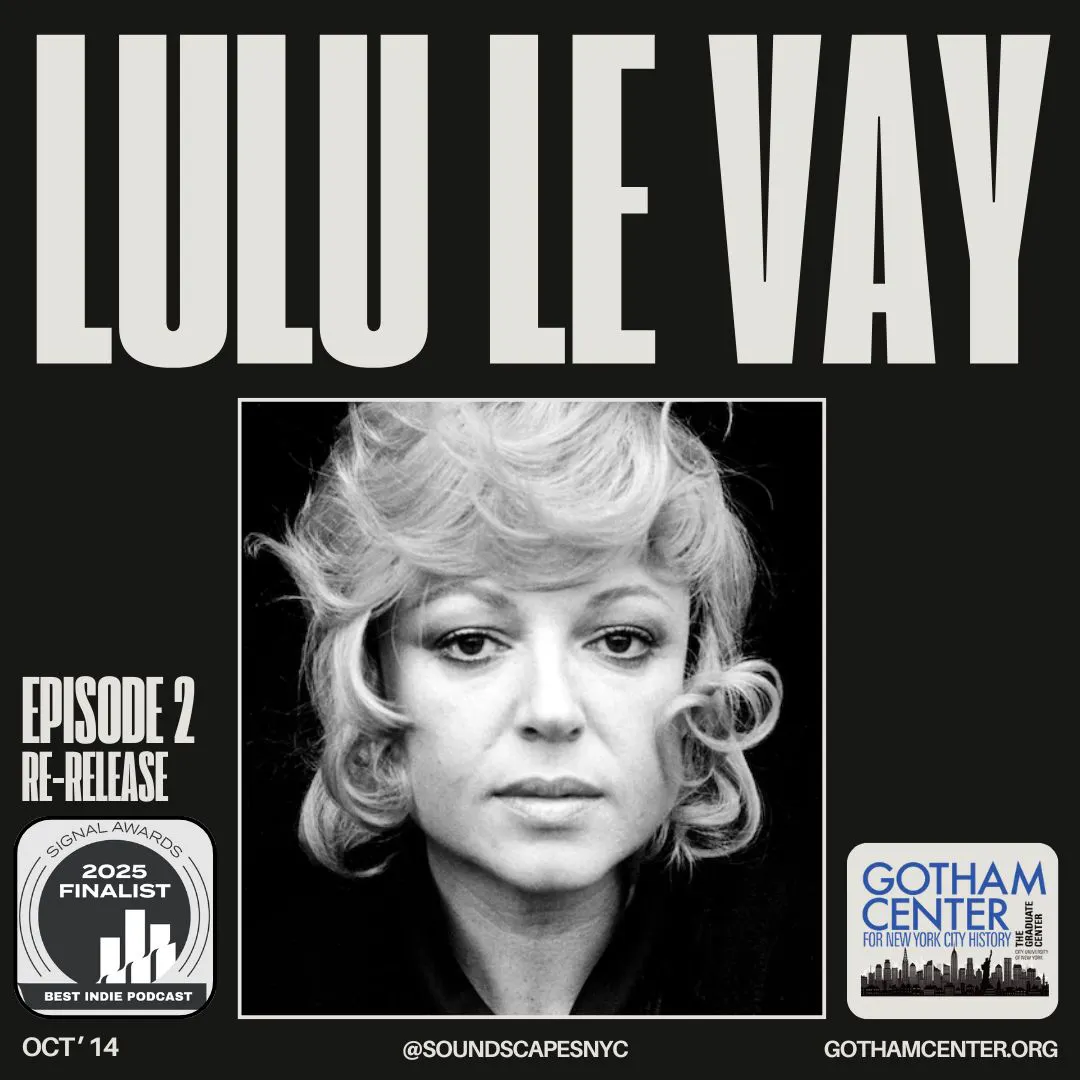
You can learn more about the Signal Awards and how to vote for your favorites@vot.vote.signalaward.com and thanks for listening to soundscapes right here on the New Books Network. December 14, 1975 New York's elite DJs gather at Sun Seconds nightclub for a press photo. Sixteen men slouch in leather jackets and unbuttoned shirts, radiating the practice coolness of celebrated artists. And then there's Jenny Costa, the lone woman perched cross legged in a dress and heels, hands clasped like a schoolgirl among disco kingpins. I was the only girl with a skirt on and heels, costa later laughed. But she wasn't just breaking into the boys club of New York nightlife. By playing as a DJ in clubs like Lachey, she was infiltrating the male dominated spaces of the city's record pools and music reporting industry as a Billboard correspondent. While many of those leather clad men faded into obscurity, Costa's career outlasted them all. She's been spinning on 103.5 KTU since the station's launch, a living testament to the overlooked women who shaped disco's history. I'm Christy Soares. And I'm Ryan Purcell, and this is Soundscapes. In this second episode of Soundscapes nyc, we're going to be talking to Lulu Lavey. Lulul, also known as tj, Lulu lavonne is a professional dj, academic, and journalist who's carved out a unique niche as a Ph.D. j. Combining her Ph.D. in sociology from Goldsmiths with her passion for music. Starting as deputy editor of cult 90s fanzine Sleaze Nation, she went on to write for major publications including the Face id, The Guardian, and the Observer. As a dj, she's brought her eclectic mix of disco, house, soul, funk, and hip hop to festivals including Love Box and Bestival, and is a regular at Ibiza's legendary Pikes Hotel. She shared lineups with DJ royalty like Blessed Madonna, Smoke and Joe and Honey Dijon. Lulu also lectures at universities, hosts her podcast Where Love Lives, and presents music shows for soho and Rundam Radio, truly embodying the fusion of academia and dance floor culture. Hey, Ryan, how you doing today?
- [04:08]
Ryan Purcell
Hey, Christy, how are you? How did you meet Lulu?
- [04:10]
Christy Soares
So Lulu and I met at a disco conference that I helped throw about a year ago now. And when I met her, I knew she was doing something special because she told me about this documentary she's working on women DJs.
- [04:23]
Ryan Purcell
That sounds like an amazing documentary and something that really resonates with the project that we're attempting here.
- [04:28]
Christy Soares
Absolutely. I mean, so much of the history of disco in the 1970s New York is the history of men. So I think Lulu's scholarship and her documentary are really sorely needed. And I'm really excited for this episod because she got into such detail about the legendary women that help build the disco scene and the club scene.
- [04:46]
Ryan Purcell
Now Lulu's a dj, too, and also a songwriter, is that correct?
- [04:50]
Christy Soares
That's right. And she is releasing a song actually next month in August. The song, which we'll hear a little bit from later in the episode, is called the Journey Part 1, and it's released by Love Underground featuring Gabriella Groves.
- [05:06]
Ryan Purcell
Well, I'm really excited about the journey ahead of us. Let's dive right in.
- [05:10]
Christy Soares
Okay. Lulu lavey, thanks for being with us today.
- [05:13]
Lulu Lavey
Hey, Christy, how's it going?
- [05:15]
Christy Soares
So good to see your face and hear from you.
- [05:17]
Lulu Lavey
And I know we're in the Zoom Land. Zoom Land. Com is it? I wonder if anyone's taken that yet. Zoom Land.
- [05:24]
Ryan Purcell
Not yet.
- [05:25]
Christy Soares
That could.
- [05:27]
Lulu Lavey
Yeah.
- [05:28]
Christy Soares
So, so you're speaking from London, I'm in Colorado. And Ryan, you're in New York.
- [05:34]
Ryan Purcell
I'm in New York. And Lulu, I'm super excited to talk with you about your projects and especially about your upcoming documentary.
- [05:40]
Lulu Lavey
Thank you. Well, hopefully upcoming documentary, if we can get it off the ground, that is. It's five years in the process. We're going to get there eventually.
- [05:48]
Christy Soares
Well, Lulu, let's start there. So your documentary is called Dance Floor Queens. It tells the story of women DJs and three DJs in particular. What made you want to make this film?
- [06:00]
Lulu Lavey
Well, I was actually approached by the director, Sonia Phillips, and Arthur Baker, who obviously you've heard of, obviously he's been a very well known producer of artists like New Order. They had this idea of working on this documentary to kind of make visible those female artists, female DJs who just haven't been recognized throughout the, throughout history. And so they approached me to come in as kind of like a co producer on the project. So of course, like, I was very excited to get involved in it.
- [06:36]
Christy Soares
And you were excited because you're an academic researching DJs, but also because you're a DJ yourself, is that right?
- [06:42]
Lulu Lavey
Well, yeah, academic. I've had like experience as researcher on TV actually as a DJ myself. And because I was excited because I'm kind of pissed off quite a lot of the time. Right. I'm generally pissed off about things. So the only way I can manage it is to actually do something about it. So most of the work that I do is. And everything from actually making myself stay up till 2am to DJ somewhere or lecture in front of music, mostly male music production students. This everything is about me being pissed off about the gender imbalance in, in our music culture as we stand.
- [07:24]
Ryan Purcell
I would love to start talking about this documentary too, but I also want to back up a little bit. Talk about your professional career. You seem to have found a synergy between an academic, lecturer or journalist, your DJing, you know, practice as well. Do you find that there are ways of balancing these things or that these different practices are actually mutually reinforcing? Is there a common ground between all these different venues you're involved with?
- [07:50]
Lulu Lavey
Totally. I mean, when I first started out, I mean, well, I was a, a dj, artist manager, I ran club nights, I run raves. I did all of this for like 20 years. And then simultaneously as I, I got more into academia. So it's kind of these worlds got kind of feeding into each other. It's kind of like practice based Research, it's practice research. So it's kind of like a circular relationship between the two. I mean I have quite a kind of jolly little sort of name that I call myself PhDJ just because it's kind of funny and I don't like to take myself too seriously. But it's like everything that I've learned out in the field I can bring into the classroom and it works really well together. So you, I, I don't think you can have like being an academic. You need to have the life experience, the insights to bring into, into that space. I think it's really important, otherwise you can't, it doesn't work in my view. You have to have both.
- [08:47]
Ryan Purcell
Well now, now you're on to documentaries. Is this your, is this your first documentary or you have, have you done some before?
- [08:54]
Lulu Lavey
It's my first one but it's the director, Sonia Phillips, she's made a few before. So it's the first one, us working together and my first foray into documentary. Although I did work on the Joe Wiley, I don't know if he had a radio Wiley. She's quite a well known DJ here in the uk. Years ago I worked on the tv. There is a late night TV show where she would interview guests. Well, I worked on that as a scriptwriter and a senior researcher. So I have, all my experiences have kind of come together to kind of work in this. It seems like the natural next step.
- [09:33]
Christy Soares
So that's, that's three, three male dominated fields minimum that we're talking about so far. Certainly DJing, music, academia and filmmaking.
- [09:42]
Lulu Lavey
Yeah, all of it. I mean I am generally just one of these kind of like, what is it Sarah Ahmed called it a feminist killjoy. I'm kind of like one of those kind of like. But not like, but not in a way that is to antagonize is, but to educate, not to cancel, but to support and to like to build these communities. It's really important. And to educate is primarily at the center of all of this.
- [10:08]
Ryan Purcell
Yeah, and that's, that's what it seems like your documentary is going to be doing very well. One of the things I'm really fascinated by with this project is the way in which you trace these transnational connections of dance music scenes, you know, going back to the unsuspecting origins in the 1960s with Regine Silberberg. So can you talk about, you know, what are some of the ways in which these sites, I.e. london, Paris and New York, how are they connected in your project? Or this is it via DJs traveling, is it via commercial channels? What connects these sites over time?
- [10:42]
Lulu Lavey
It's the stories, it's the human stories that we're tracing really. It's kind of like we're still in the process of trying to. We got the picture. So we, you know, we have from the 60s in Paris, obviously with Regine to then seeing how that then translates to the whiskey a go go in LA with Joanie Lebine and, and it's just we're trying to trace it through the sort of timeline of how it's moving around the map. That is the way that we're looking at it. And we're still in the process of working out how we're going to actually shape the stories. We have the stories, but we're still, still in that process of how we're going to present it. Which is. That's the tricky bit that I've learned about with documentary filmmaking. You're in this kind of weird, not weird, but you're in this relationship with the, the production company or the platform that is going to take the project. So depending on what, what they want to a degree, that's how we have to shape the stories, if that makes sense. So it's not just like we, it's not just like we want to make it in a certain way. Of course we do. But like any creative project there has to be that kind of two way relationship trying to give the client what they want and trying to get the stories out that we want. Does that make sense?
- [11:57]
Christy Soares
Yeah, it's. It's a story of industry, isn't it? It's the story of the music industry.
- [12:01]
Lulu Lavey
It's very tricky. And that's real. Exactly. It's the same kind of thing when an artist is writing music for a major label. It's that. It's that creative tension between the commoners and the artists. We're still trying to work it out. But for me that's the most frustrating thing actually about any creative project such as this, particularly if it's in a medium that will reach. Has far reaching possibilities. I don't want the stories to be watered down. So it's kind of like it depends. We may find a platform that might be a big platform, but if they don't let us tell their stories correctly, then we won't let them have the stories. So that is a bit of a compromise.
- [12:46]
Christy Soares
Maybe you can tell us the story is unedited here and then we'll know that it gets out. Let's actually start with Regine. Zaberberg, who, of course, has sort of a very compelling story for film in that she was Jewish, she hid from the Nazis in World War II, and went on to open a chain of the most influential nightclubs in dance music history. What made you want to talk about Regine and what is it about her story that you thought was important to share?
- [13:13]
Lulu Lavey
Well, the story. There's evidence to show that she was like the first ever dj, actually. I mean, obviously, you know, the evidence to support this, a lot of it is hearsay. Unfortunately. She's. She's no longer with her, so we can't get her own voice herself. But as legend has it, she has. She was the first ever DJ during the 60s when she opened her club in Paris, Whiskey ago 1953, the first ever discotheque. So legend has it that she was the first to create the dance floor and the. The DJ area and to have, like, music continually playing one track into another. So obviously this is a story that most people probably don't know of. There was a lot of talk in the. Through the kind of historian, music historian approach, that Jimmy Savile, I don't know if you've heard of Jimmy Savile was one of the first kind of DJs in. In the UK anyway. But this is kind of like there's evidence to support that. Actually, it wasn't. It was regimental. So it's like retelling the stories is really important because they'll just get lost. So it's like we need to. What I want to do is make sure that we have ever. Not necessarily evidence, but it's more archival, that we have it in the. In the. In the popular cultural discourse, that these stories of these women were just as important, if not more important, than the stories that we have been shown already.
- [14:45]
Ryan Purcell
There's one quote that comes up by Regine about Whiskey a Go go in the 1950s, where she says, I laid down the linoleum dance floor. I put in color lights and removed the jukebox. I installed two turntables so there was no gap in the music. It was the first ever discotheque and I was the first ever disc jockey. You know, when I think about two and two turntables, I think automatically about, you know, New York DJs, like, for example, Nikki Siano for who we interview on this show, or Francis Grosso at the Haven. But this story kind of breaks that mold in a sense, because it's totally predating those. Those stories from the late 1960s, 1970s, and also places places this History in Paris, not New York, which is fascinating to me.
- [15:32]
Lulu Lavey
Yeah, it is fascinating. But again, it's like finding the evidence, like it's, it's tricky. There's lots of arguments. That's why we say in academia, as you know, it's kind of, you know, one argues, one suggests, you know what you can't. Won't prove anything really, you know, unless you were there. It's just difficult. But the argument and the evidence that we have suggests that she predated artists like Nikki Siano and the early hip hop. Hip hop scene. Cool Day Cool J. Oh my God. Sorry. This is what happens. Cool. DJ Herc of all that period at that time. It's all happening at the same time. There is evidence to show that this was predating that.
- [16:13]
Christy Soares
And then of course she is an important figure in New York as well in the time period we're looking at. We're looking of course at 70s New York. This season is on disco. And then she goes from being so influential in Paris to actually opening up Regines in Manhattan.
- [16:28]
Lulu Lavey
That's right. And actually it was interesting because your dad actually Christy was, had. Had he worked with Regine or worked in the club, I seem to remember.
- [16:38]
Christy Soares
Yeah.
- [16:39]
Lulu Lavey
And he was telling me a really interesting story. Again, this is why we have to talk to those voices who were there. They had the lived experience rather than it just being like these second hand stories. But he was saying that her husband was actually really instrumental in her role setting up these clubs and being a DJ in her career. So that was another side of the story that I'd be interested to explore. Explore more because it's that generation. Where were women as financially independent as their husbands or where was this financial support coming from? So that dynamic we, you know, that's still subject to investigation.
- [17:19]
Ryan Purcell
So the clubs were called Regines in outside of Paris or Shea Regime, I.
- [17:24]
Lulu Lavey
Think it was Shea Regime. Shea Regime, as far as I'm aware.
- [17:28]
Ryan Purcell
That's incredible.
- [17:29]
Lulu Lavey
I think they had like 20 clubs, like globally.
- [17:32]
Ryan Purcell
I think that's a disco empire.
- [17:35]
Lulu Lavey
That's a lot. Yeah.
- [17:36]
Ryan Purcell
Wow.
- [17:36]
Lulu Lavey
She was just such a personality. I don't know if you've seen any clips of her performing, but she was a singer in, in her own right as well. There's some brilliant clips on YouTube. Extremely charismatic. There are some people that I know actually who've hung out with Regine and they have some amazing stories of like what big personality. That she was quite a force, a tour de force.
- [18:03]
Ryan Purcell
It sounds like she had to be based because these, these industries are so male dominant. She had to be a big force to kind of carve a space for herself within this kind of these cultural zones.
- [18:16]
Lulu Lavey
Absolutely.
- [18:17]
Ryan Purcell
You know, maybe this would be a good time to. To, you know, listen to a clip of the. The Sizzle, and we can maybe talk about some of the voices that we're hearing.
- [18:25]
Christy Soares
Yeah.
- [18:28]
Lulu Lavey
I didn't know any female DJs. I literally looked up and I was like, hang on a minute. Why are there no women up there? I thought, right, I'm gonna do it.
- [18:37]
Ryan Purcell
We know we're good.
- [18:38]
Lulu Lavey
We didn't see it as being brave. We just did it because we also enjoyed it. We generally played the music that we loved.
- [18:45]
Christy Soares
Liza Minnelli was there a lot. Halston, Donald Trump.
- [18:48]
Lulu Lavey
I used to lock the door as soon as I see him. The more success you have, the more you're gonna have people who are going to be critiquing you, horrified people looking at you like, what is that person doing behind the deck? I was angry. I didn't feel safe. There comes a point where we need to say, well, actually, we're here too. And if we don't have the evidence, it's like we're making it up.
- [19:13]
Christy Soares
People underestimated me.
- [19:15]
Ryan Purcell
You know what? They were raw.
- [19:21]
Lulu Lavey
We play from the heart. We play from the passion. You realize that we're all just the same because we just want to dance.
- [19:28]
Christy Soares
It was the biggest rush in the world. It just looks like Nirvana. So we just heard the voice of Sharon White there, who was a queer black DJ who played really famous clubs in New York city in the 70s, like the Saint in Studio 54. Lulu, how is Sharon White's story significant in the broader story that you are telling about women DJs?
- [19:48]
Lulu Lavey
Oh, my God. How's it not significant? I mean, she is kind of the most important. I would say she's the most important voice in this documentary, which is the quality of the interview that you just heard in the. In the Sizzle isn't very good. So we are trying to get out to her to actually do a proper interview in person. She was like the first woman to play at the Saint in New York. She was the only woman to play at the Paradise Garage. So it's like. It just seems almost unfathomable. That's quite a difficult word to say, unfathomable. Now, to think that, you know, that at that time there were no women DJing at all. So it's absolutely vital that her voice is shared in this documentary, as she is a key person at the foundation of this whole narrative about women, the canon of women DJs over this period. Absolutely.
- [20:42]
Christy Soares
And we should talk about why she's left out. There's an obvious, which is there is of course sexism in the music industry and in DJing, but also she's a black queer DJ. How has that come into the way her narrative is told or not told in your view?
- [20:59]
Lulu Lavey
In my view that's very instrumental. I mean, I can't speak for the reasons, but you know, obviously the intersection of gender, race, sexuality has always been a triple barrier, hasn't it, to being visible. So I mean, you know, you got, you got the triple threat. I mean we have a well known DJ now called DJ Paulette. I don't know if you've heard of her, but she's also a queer black woman dj and her story has, is almost kind of mirrors what was going on with Sharon White back at that time, but within a 30, 40 year time span difference. So her story in Manchester, like it's very difficult for her to get gigs in the early days and suffered a lot of racism and prejudice, but this was like decades after Sharon White's experience. So it's like the, the sad thing about this, or not sad but hugely disappointing thing about all of this research is to show that what has actually changed. You know, Paulette has just had her first, you know, the only black woman DJ biography autobiography has just come out and it's, it's done so well. She's had another surge of, of gigs off the back of it. She's always been quite successful but now her story's out there and she shares everything about race, gender, her sexuality, all these different prejudices. And she actually worked in Paris as well, which is not ironic, but it's a nice synergy with Regine's story as well. It's just, it's not just in the, in the DJ industry, it's across all industries. It's a deeply systemic issue everywhere about the big, you know, what not fitting the norm of what is required.
- [22:41]
Christy Soares
I'd love to ask a follow up question about that. You said it's systemic. Of course it is. You, Lulu yourself are a dj. Of course there are individuals who harbor all sorts of prejudices, but this goes far beyond that. And I wonder if you could talk about the way that sexism in DJing, in the music industry and also other forms of racism, you know, homophobia, whatnot, are systemic to the industries themselves.
- [23:06]
Lulu Lavey
Let's start with looking at how the history has been documented. So if we're looking at kind of the literature that's like. Because obviously we as a society learn through what is being represented to us through whatever medium. So if we're looking at dance music, literature is in publishing, all the stories that have been told so far have been written by white heterosexual men, for the most part. So we've got the. Kind of. The book, Bill Brewster's book, Last Night DJ Saved My Life, which has been kind of the Bible. We got Tim Lawrence's book, Love Saves the Day. These are all great books, but there's a. There is. The focus is. Is skewed to the point Where Last Night DJ Saved My Life was reissued nearly 20 years after. It's not 20 years, I can't remember, but after its initial publication with a chapter that talks about women's contribution. So if we're talking about issues with the systemic sexism and racism, that's one area that we have to look at is like, who is telling these stories? And also the. There's the deeply systemic sort of prejudice goes. It goes right through to. It's not only the people who are writing about the culture, but the people who are allowing the culture to happen, I. E. The bookers and the promoters of events. So with all the people that I've interviewed or spoken to over the years, particularly my recent research, which I can talk about later if you're interested. One of the main issues are the gatekeepers of the scene, who tend to be white men. And this is this. These. These are the gatekeepers that are kind of blocking entrance of more diverse. More diverse talent into the scene. And that can go all. You can trace that all the way back to the loft, Paradise Garage, the Saint, Studio 54. All the way back. You could trace a line all the way back to that time to now.
- [25:05]
Christy Soares
And you're referring there, when you say that, you're referring to the fact that not suit 54, but the others were invitation that you got into the club.
- [25:12]
Lulu Lavey
Yeah, they were invitation, but also the. As far as. Yeah, but as far as invitation from the people running the parties, they had the power to introduce a range of different DJs. That wasn't it. That was like that one. That was nothing to do with the membership model. They were able to. Like they're the gatekeepers. They could. They had the power to bring in new voices. When I say new voices, new talent. Quite often a lot of the women who eventually did get work djing in that. In that stage, in those scenes back then was because Larry Levan didn't. Was. Didn't turn up or one of the other DJs didn't turn up. That was the way that these women got their DJ slots. That was how Sharon White got her gig at the Paradise Garage, because, Larry, he didn't turn up. So she got the call. That's always the way that I've noticed so far anyway.
- [26:07]
Ryan Purcell
And, and so once she gets the call, then, you know, the management understands that, you know, she plays music that responds, that the aud responds well to, and then she's, okay, this is, this is a good dj. Let's hire her again. Is that how it goes?
- [26:19]
Lulu Lavey
Yeah, that's how it goes.
- [26:20]
Ryan Purcell
Yeah.
- [26:21]
Lulu Lavey
Yeah.
- [26:21]
Ryan Purcell
Okay. Well, I mean, there's a lot in commonality, it seems, between Regine Silberg and Sharon White. These are, you know, very important stories that really change this, change the whole, the whole game. When we're talking about the history of dance, music, culture internationally as well. There's another character here. There's another historical figure that I think is a lesser known historical figure. London, Smokin Joe. So Smokin Joe, How. How is Smokin Joe's story related to both Sharon White and Regine Silverberg? Or is it different in some ways? Does it represent a change in the history, you know, a new chapter in that history?
- [27:00]
Lulu Lavey
You know, not really, because again, another woman of color, of course, she also, like Sharon had, unlike DJ Paulette, who I've talked about has been had to deal with racism and sexual sexism in the field. She talks a lot about that. We've done quite a lot of filming with Smoking Joe, actually. And she's another person who's also just had her autobiography published recently. And she's on another wave of her career, which is really brilliant to see. But again, it's kind of, you know, I talked to Joe quite a lot about this idea of her book, and she was quite unsure about, like, well, no one wants to hear another. There's only room for one black British female DJ to talk about her story. No one's going to want, like this. She was always saying that it's like either it was either her or Paulette, that there wasn't room for both of them. And if that isn't kind of gatekeeping and keeping these women of color, these bodies of color under control. If you want to look at power, for example, docile bodies, if you want to. I mean, you know, I could go off from Foucault, but that's not for now. But it's kind of like only if these. Only one is allowed, you know, and it's kind of like, this is ridiculous, you know, So I was very encouraging for Joe to kind of get the book out, and it's done really well. And it's just like, this is what we're looking at. You know, we have these women not getting booked on the same lineup because it's one or the other, or they get muddled up with each other. You know, like, Joe often talked about how people get her muddled up with Honey Dijon. It's just like. It's that they're nothing like each other. They're complete. They're not even of the sun of the same country. And it just blows your mind that that is, like, this is quite recent. This. We're talking in the last two years, two to three years. It's shocking. It shocks me, the books that you.
- [28:58]
Ryan Purcell
Referenced and talking about the assemblage of. Of. Of stories and also the dissemination of these stories. The books. The books that you ref. Maybe we can also include Alice Eckel's book as well. You know, they kind of frame the dance floor as a space of liberation. However, your project kind of frames it a little bit differently. It's a space of contestation and gatekeeping, which I think is very, very important. It's not a celebratory, you know, overly celebratory history. It's one that kind of contends with the realities. The social realities of the dance floor. It may be liberating for some people, but for other people, it's a. It could be perhaps a battlefield for representation.
- [29:38]
Lulu Lavey
Yeah, absolutely. Which is. Yeah. Which is the irony is. Is not lost, is it? I think about this a lot. Like, you know, the whole point of, you know, Valentine's Day, 1970. David Mancuso, the Loft, you know, that was like an integral moment in the history that we've been told of. A moment where, you know, the dance floor is a liberatory space. Homosexuality was illegal outside those doors. It was a space. But who's. But whose stories are we telling? You know, it's kind of like, whose rule is this under? Like, there's a set of rules that apply. It's all very kind of idealistic to. I mean, I. I am almost disappointed myself. The more I've been researching, the more I've been educating myself about it, the more sad and disappointed I get because I've always been a big fan of Dave Mancuso and the Loft. I have Love Saves a Day tattooed to my arm in Danish just because I'm trying to be a little bit different, because I'm half Danish, but all the same it means a lot to me and it's, it's. I find it really sad that, that there is this, this, this tension between like liberatory and oppressive happening at the same time. That is still happening. And actually the chasm I think is actually getting worse. If we're looking at the broader development of dance, of dance music to EDM culture from New York 1970 to what we have now, even to what we have now across like the global dance music as it is is a whitewashed heterosexual scene. And you know, what's. The queer black roots of where that came from has been is coming completely rubbed away. And I talk about, to my students about this all the time and you know, they get shocked. They have no idea that the electronic music that they listen to is, is rooted in black queer culture, but it's a male black queer culture.
- [31:35]
Ryan Purcell
That's what I think is so important about your project. And you're focusing on two historical DJs here. Could you talk about some of the other voices that you've interviewed for this project that. To help tell these stories?
- [31:46]
Lulu Lavey
Yeah. So so far we've interviewed Smokin Joe because she's a key person in this project field in the, you know, in the uk. I mean, obviously, because what we've been able to do so far has been in London because that's because we've been self funded so far. So we talked to her and her experiences. We've talked to, well, actually Colleen Murphy Cosmo, who she was, I think she was, she would probably say that she was the one of the first female DJs at the Loft on. In that loft bracket. So David Mancuso took her under his wing when she was in her, I think late 20s. She's around my age now, a bit older, like mid to late 50s. So we were lucky to have quite a long interview with her as well because she just happens to be. I think we're lucky because we've got a good range of contacts only because I've been working in the industry for such a long time and I booked Colleen when she moved to the UK after she had a baby to play at one of the nights that I was promoting in, in East London. And she still says to this day that that meant so much to her back then because she got dropped because she'd had a baby, she'd been dropped by her agent, she wasn't getting any gigs. Like no one wanted like to book her because she was a new mother. I mean Based on what it's like, the prejudice, like, the discrimination was just like. And for me it was normal to book her, like, why wouldn't I? But for her, it was a huge thing to get her back up and DJing again.
- [33:21]
Christy Soares
Let's take a step back and explore the soundscape that we've been illustrating. Here's DJ Sharon White spinning a tribute for her mentor, DJ Rory Thod at the Saint in 1982.
- [33:36]
Lulu Lavey
SAM SA.
- [34:29]
Christy Soares
Now listen to DJ Jenny Costa, who we heard about in the intro to this episode, spinning some disco tunes in the 1970s.
- [35:19]
Lulu Lavey
Sam.
- [35:55]
Christy Soares
We can hear the reverberations of that disco sound in this house track, The Journey Part 1 by Love Underground, a new collaboration between DJ Lululem and producer Tommy D, released in 2025 by Chili Funk Records.
- [36:11]
Lulu Lavey
It can feel too much but it's safe to say that I am here to stay.
- [36:19]
Christy Soares
I am here to stay.
- [36:26]
Lulu Lavey
I am here to stay Come on, man. I am here to stay it's the only way I am here to stay Come on. I am here to say it's the only way I am here to stay Sp these feelings grow so hard to show you get for me forevermore that's not the love.
- [37:26]
Christy Soares
Now let's get back to our conversation.
- [37:28]
Ryan Purcell
Well, it sounds like the dance floor is still a contested space, something that's still being battled over, but yet there are some grassroots organizations that are emerging to increase the agency of female and queer POC DJs on the dance force. So that's. That's inspiring.
- [37:42]
Lulu Lavey
It is inspiring. Yeah, exactly.
- [37:44]
Christy Soares
Can you shout some out, Lulu? If just kind of naming some of the groups that are trying to remedy the larger systemic issues in DJing. DJ Mad Dogs, Vinyl Bitch. You just mentioned Ms. DJ BB.
- [37:58]
Lulu Lavey
I interviewed her. She's the promoter and DJ of Super Nature in Manchester. Super Nature Disco has done extremely well. That's still doing well.
- [38:07]
Christy Soares
DJ Frankie Elise, who heads up Polka Dot Disco Club in Scotland, is another one promoting women and non binary genderqueer DJs as well.
- [38:18]
Lulu Lavey
Oh, that's right, correct. Yes. But it's a very small minority. But the good thing is there is movement in that direction. But as far as kind of the older women DJs, just to kind of. On another positive note is that most of the women and non binary persons who I interviewed, interviewed for the project, they aren't going anywhere like they are. They're like sod everyone. I'm not going anywhere. I'm just gonna still be here. I'm still going to represent. Even though there has Been kind of a broad recognition of the emotional labor involved in representation. It's tough work. It's a lot of heavy lifting, isn't it? You know, you have to like, the women that I talk to, they're like, they know as soon as they enter a space, they feel eyes on them. They know they're being judged, they know they're being critiqued. And you have to have a like quadruple thick skin to kind of get through the, the night and play all set. You know, I've had women telling me that they've been locked out of their own DJ booth with because the security guard won't let them in because they don't look like a dj. I've had women saying that. People have been saying, oi, grandma. And just saying like, oh, you, the cleaner, like, who are you? You're not DJing here. And just like this, this barrage of abuse from, from their audiences. So it's kind of like, it's like going into like a, again, it's this dance floor, like being a zone, not a safe zone.
- [39:50]
Christy Soares
Lulu, maybe, maybe we should harp on that word, safe and we should say the, the, maybe the unsaid, which is that is is oftentimes. Sorry, let me start again. The dance floor and the DJ booth are oftentimes physically unsafe spaces as well for women and non binary DJs. Can you just comment on if that has come up at all in your interview?
- [40:09]
Lulu Lavey
Yeah, I say of course it has. But yeah, it has. I mean, Jo Smoking Joe, she talked about when someone actually punched her over the decks once a gig by a woman, actually a scrap broke out. I've had like the amount of sexual harassment and sexual violence has been. That's a very broad. Most women that I've spoken to have had some kind of issue with that. Not like to the point where There are some DJs I've heard of now who are building in safety riders into their riders. So they have someone to accompany them up to the decks and then after, and then after they set, like take them across the club into the back room, into the car. It shouldn't be, it shouldn't be that. It shouldn't be that hard to be able to go to work as a, as a woman, regardless of age, sexuality, race, class, all these things. It shouldn't be like that.
- [41:08]
Ryan Purcell
Lulu, is this, do you see this as an uptick and sexual violence towards DJs or is it a persistent kind of historical thing that goes back to Regine and Sharon White?
- [41:20]
Lulu Lavey
I don't know. I Mean, I, I'd have to look at the data. Yeah, I've got some really interesting statistics here. Although they are UK based, but they could still be applied. Help Musicians is a really well known organization here and recent research from last year, they claim that women musicians are more represented in age brackets. Well, we kind of know that with 47 of musicians age 16 to 55 being women, women, but this drops significantly, significantly when they get older. So another big drop of 26% after the age of 54. So that is the quite. That's a big drop. That's a big drop.
- [42:04]
Christy Soares
Yeah. And I, I don't, I don't believe we have reason to believe that the statistics would be very different in the United States or that the statistics would have been very different in 1970s New York disco DJ culture.
- [42:16]
Lulu Lavey
I don't have any answers, but I am airing concerns and I do think that through representation in popular culture we can make some changes. I do, I generally think that, I do think like the more that kind of, you know, the kind of the, the non normative idea of a dj, if you like, is being seen. The more we kind of like push back against that contour of normality, of what is normal and create these kind of new, new ideas of what is normal. And it's repetition, isn't it? It's like this kind of, this idea of resistance and repetition that will create change. I believe that's the only way we can do it.
- [42:57]
Christy Soares
Lulu, I want to ask you a question that you asked the DJs that you interview in your documentary. We've talked a ton about the structural way that djing as a woman or non binary DJ is different than djing as a cisgender male dj. But I want to talk about how you DJ Lululevan is your DJ name actually dj. And the question you ask is, do you think you DJ in a way that is different from men?
- [43:21]
Lulu Lavey
I'm quite good at asking questions, aren't I? I wasn't expecting to have that asked back to me though. Christy, you've tricked me. No, that's, I mean it is an interesting question and well, most, the women that I, I know you've asked me for, most women DJ say they do DJ differently. But my experience, I feel as a dj, I'm, I'm more connected. This is very general. I'm not saying this is the same for like, you know, the division between men, women, non binary, trans, how everyone DJs. But I feel more connect, I feel more connected to the dance floor than the, the male DJs that I've experienced seeing or DJing with. So in my lived experience of this question, I feel I connect more to the dance floor. I feel like my. I'm. I'm. I feel like I am more emotionally open, which kind of. Kind of fits into kind of gender normativities to, like, gender performance of some. Some way that we are more open and emotional than men are, which. Which I don't like to think that's the case, but I definitely feel more open.
- [44:30]
Christy Soares
What comes up for me is the idea of how big an ego someone has and whether someone with an enormous ego can really open themselves up emotionally to the experiences of others.
- [44:40]
Lulu Lavey
So quite common. Yeah. All the deep male DJs that I've seen usually, usually heads down, not connecting to the audience, pretty much. If you did a research project that I did an analysis of, like, an observation analysis that heads down, not maybe not connecting or with the crowd at all. But for me, I'm always head up. I'm, like, open, like, listening to. Not just listening to their voices, but that. It's like an energy, isn't it, that you're reading in the room constantly. It's just like, you feel it and being really open and the ego. I will play music that will keep the dance floor jumping. Not just, like, nerdy, like, not to, like, oh, I must play this new release that, like, no one knows about. It's like, it's about the dance and keeping the dance floors going and having fun, rather than being super nerdy and trying to, like, play to one's own ego.
- [45:38]
Ryan Purcell
Oh, okay. So are you saying that maybe egos diminish the connection between the DJs and the audience?
- [45:44]
Lulu Lavey
Absolutely do. 100.
- [45:46]
Ryan Purcell
That makes a lot of sense.
- [45:47]
Lulu Lavey
Like, I'm gonna play Diana Ross if I want to get the dancer goes. I love Diana Ross. And so what if it's. It's like, oh, it's a wedding song or these. You're like, I've been described as a kind of hip, trendy wedding dj. I don't care. Call me what you want, but, like, I like being a hip wedding DJ because it's good music that people want to dance to and have fun. Isn't that the point?
- [46:11]
Christy Soares
There's also different frameworks there. There's a framework of control. I am controlling as dj, the crowd, and there's a framework of connection. And that's a little bit what I'm hearing.
- [46:20]
Lulu Lavey
Yeah, I mean, it's a bit of both, really, but it's like. I mean, I've Talked to male DJs who they. They won't even take requests or anything. They were like. Someone actually, like, put on a mix and went sat in the car at some corporate gig.
- [46:34]
Christy Soares
That's a power move. I don't know, which is quite funny. Kind of like that one, actually.
- [46:40]
Lulu Lavey
It's my partner, he told me a story, I admit. Sorry, Tom, but he was just getting so much harassment from by asking requests. He actually put on a mix, went sat in his car outside.
- [46:49]
Ryan Purcell
Oh, gosh. At that point. Yeah. What's. What, you know, what's the point? Maybe having a DJ if you're having. You just put on a Spotify playlist if you want.
- [46:58]
Lulu Lavey
Exactly.
- [46:59]
Ryan Purcell
Well, Lulu, if for listeners that are. That are in the UK, where can they go see your DJ sets? Where can they hear your. Your. Your performances?
- [47:09]
Lulu Lavey
Mixcloud. Okay, so mixcloud@lululevan. And they can follow me @lululevan on Instagram too.
- [47:17]
Ryan Purcell
Well, I. I don't have any further questions for you. I mean, it's been a real. A real pleasure to talk with you and hear about your different projects. Very important stuff. Very important stuff for the history of dance, dance music, culture. And very grateful that you took the time to talk with us.
- [47:31]
Christy Soares
Thanks, Lulu. We appreciate you.
- [47:33]
Lulu Lavey
That's all right. I appreciate you.
- [47:35]
Christy Soares
All right, I'll talk to y' all soon. Bye Bye. That was our conversation with PH DJ Lulu lavey. I hope it was as fun for you to listen to as it was for us to record.
- [48:02]
Lulu Lavey
Cord.
- [48:02]
Christy Soares
Ryan, what'd you think of that conversation?
- [48:04]
Ryan Purcell
Christy? I loved our conversation, and one of the big takeaways for me was learning more about this DJ Sharon White, who in my mind reframes this history of disco in New York city during the 1970s.
- [48:15]
Christy Soares
Absolutely. And especially because she DJed many of the most popular clubs. Paradise Garage, the Saint, Studio 54.
- [48:22]
Ryan Purcell
This leads us to our next episode where we'll be talking with Jesse Rifkin, the author of this Must Be the Place and the owner of Walk on the Wild side Tours. Jesse is going to be taking us on this historical tour of many of these spaces associated with disco in the 1970s in New York. And I'm so excited to share that with you.
- [48:38]
Christy Soares
That's fantastic. I know you all went to the site of Paradise Garage, so I can't wait to hear more about that in your walking tour.
- [48:44]
Ryan Purcell
Well, yeah, it's not much more than a site now. The original building has been demolished, but the memory remains, and I hope that our podcast and Jesse's work can help revitalize that memory for future audiences. I want to give a few shout outs first to the Gotham center for New York City History at the CUNY Graduate Center. I want to give thanks also for the generous support of the Urban History association and to Sarah Lawrence College, where I teach American Studies.
- [49:07]
Christy Soares
Thank you also to the Society for American Music for their funding and to the University of Colorado Boulder Presidents Fund.
- [49:14]
Ryan Purcell
Stay tuned to Socials to hear more about upcoming episodes and events associated with the podcast at Instagram. That's Soundscapes NYC Soundscapes nyc.
- [49:24]
Christy Soares
Till next time, I'm Christy Soares.
- [49:26]
Ryan Purcell
And I'm Ryan Purcell.
- [49:39]
Lulu Lavey
Back to me I'm back to me.
- [49:43]
Christy Soares
I'm back to me.
- [49:45]
Lulu Lavey
Oh.
- [49:48]
Christy Soares
Limu Emu and Doug Limu and.
- [49:51]
Ryan Purcell
I always tell you to customize your car insurance and save hundreds with Liberty Mutual. But now we want you to feel it.
- [49:56]
Lulu Lavey
Cue the emu music. Limu Save yourself money today.
- [50:02]
Christy Soares
Increase your wealth.
- [50:04]
Lulu Lavey
Customize and save. We save.
- [50:08]
Ryan Purcell
That may have been too much feeling.
- [50:10]
Christy Soares
Only pay for what you need@liberty mutual.com Liberty Liberty Liberty Liberty Savings Very underwritten.
- [50:16]
Ryan Purcell
By Liberty Mutual Insurance Company Affiliates. Excludes Massachusetts.