← Scrolling with Hayley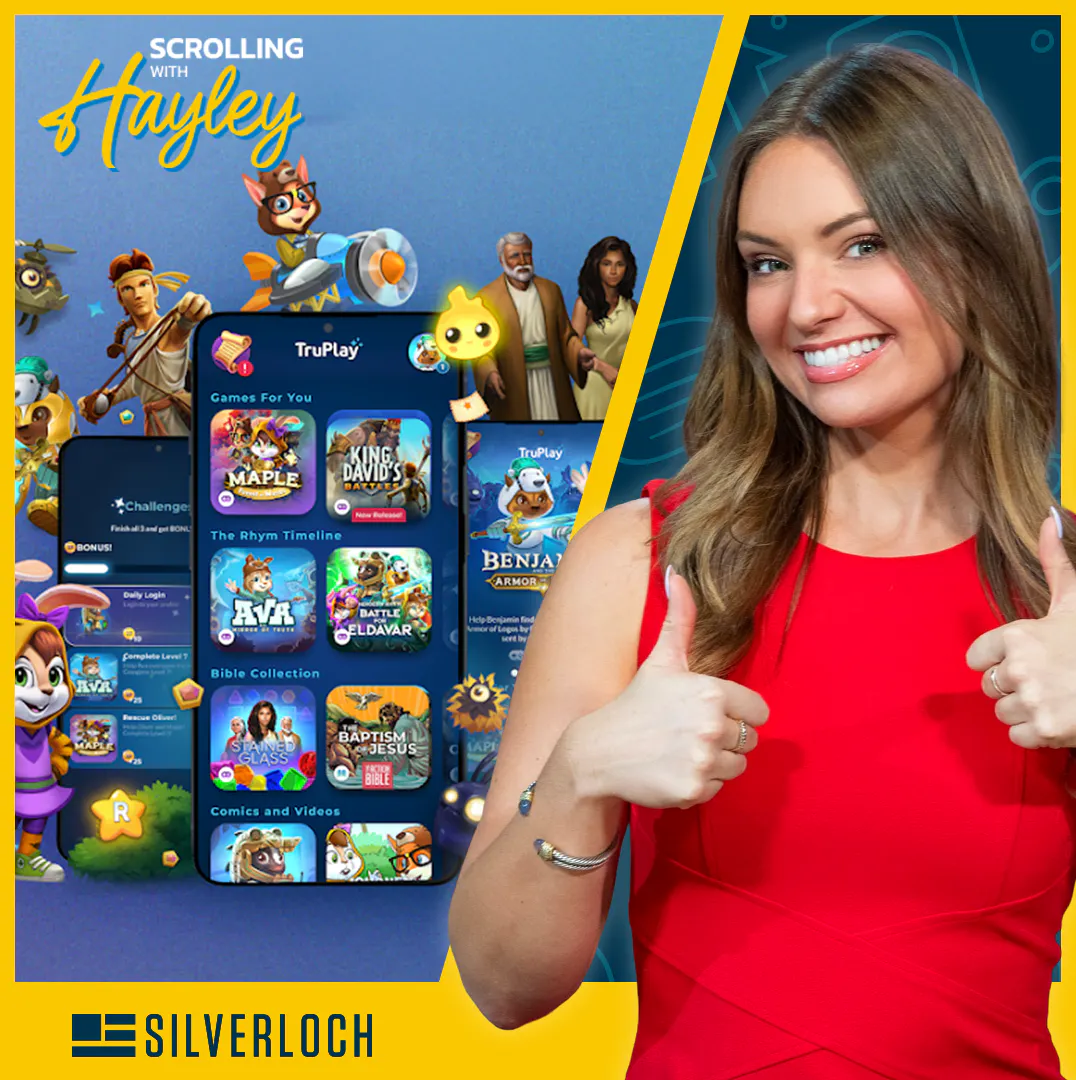
Scrolling with Hayley
Christian Video Games For SAFER Kids! - Scrolling w/ Hayley (Ep. 290)
00:48:17
In this episode of Scrolling: I am joined by the CEO and Founder of TruPlay, a Christian video game platform for kids. Inside the dangers typical gaming platforms pose, and ways parents can take back control of their kids’ online education and entertainment.
Loading summary
Transcript64 lines
- [00:00]
A
Welcome to Scrolling with Haley. I'm Hayley Carnea and I'm excited to be joined today by the founder of a faith based video game for kids. A much needed alternative to Roblox and other gaming platforms targeted at children that do more harm than good. But first, I want to tell you about the sponsor for today's show and that is Blackout Coffee. You know how important my morning coffee is, so let me tell you about the one I've been loving lately. Blackout. Blackout is a premium American coffee company known for bold flavor, hot, high quality beans and roasting fresh right here in the US Every order ships straight to your door, so you always have an amazing cup whenever you need it. What I love is how smooth and rich it tastes without any bitterness. That perfect blend and balance of flavor and energy getting me through busy mornings and long days. You can try their subscribe and Save program. So you can always have a fresh cup of coffee on hand, switch flavors anytime, pause or cancel whenever you want. Plus you get discounted pricing, free shipping and reward points on every order. It is simple, flexible and saves you money. They offer dark roasts, flavored coffees, espresso blends and more. Something for every coffee lover. So now's the time to try Blackout coffee. Go to blackout coffee.com and use code scroll for 20% off your first order. Once you try it, you won't want to go back. And without further ado, trueplay CEO and founder Brent Du Singh joins this episode of Scrolling with Haley. Brent, welcome to the show. I'm so excited to have you here.
- [01:35]
B
Good to be with you, Hayley.
- [01:36]
A
So tell me what trueplay is and what inspired you to start it.
- [01:41]
B
Trueplay is an entertainment platform for kids. Video games, digital comics, animations, really, really high quality content where every piece of content we have on the platform has a faith based foundation to it, whether it's games and stories out of the Bible, whether it's a universe of characters. You can see a little bit in my background where characters we've created where they live in a world where God is real and the Bible's true, but they're battling real evil. They're battling challenges kids face today with bullying and parents being divorced and maybe just being a little egotistical. But they're going on great adventures in forests and finding bad guys and flying out into space and, you know, fighting monsters. But they're also growing in their faith. We started true. Yeah, we started True Play because things have never been worse for kids than they are today. Consider this anxiety, suicide and depression Rates are all time highs for kids. The average male gets exposed to pornography in this country when he's 12. Only 31% of Generation Z believes in God, without a doubt. And only 2% of children in America now have a biblical worldview. So things are terrible for children. The reason, and you know, you've heard all the stories with, you know, all the child abductions happening that, you know, pedophilia stuffs or what goes on on Roblox every day, which is a gaming platform 100 million kids use. All these reports, all these lawsuits of child abductions and sex trafficking on Roblox. How did we get to this point? We got to this point because of screen time. You know, screen time is every mother's number one issue. And I'm sure if you're a grandparent listening today, you probably think about that too. The challenge is there's so much toxic content. It's not that video games are bad or any more than movies are bad or books are bad. Right. It's the message inside so many things is what's bad. There's a lot of demonic, very sexual, very, you know, hyperviolent content.
- [03:40]
A
And why do you think that is? Why do you think it's so sexual and so violent? And why do you think it's gotten to this point where, you know, you mentioned these statistics, you know, there's a lacking amount of faith based, you know, content for children and people don't even believe in God. How did we get here? Why is that?
- [03:59]
B
Yeah, three major reasons. One, there really are evil people who create a lot of the content and run a lot of the platforms that children see. And if, you know, if you don't believe that the, you know, the idea of mutilating children and promoting that, you know, the idea of making video games like Grand Theft Auto where you beat up prostitutes and shoot police, or you know, satanic games where you're, you know, getting into really demonic, you know, really dark spiritual stuff and you're promoting that to children. There's some level at which you probably really do hate kids if you're making that stuff.
- [04:31]
A
Yeah.
- [04:31]
B
The second issue is because there's been a lack of Christians who are willing to stand up and do anything about it. And, and that means making great content. That means taking a risk and building something. And the third reason is because people have gotten inoculated. It's like the idea of boiling the frog. How did we get to Drag Queen Story Hour? Well, there were a lot of incremental steps along the way. There was, well let's not have prayer in school because that offends people. Well, let's start to teach this version of sexuality to children because we want to be inclusive. Well, let's start to. These small incremental steps eventually start to compound and snowball. And frankly, for Christians who want to see change in the world, you've got to go support people who are making those changes. You know, it's our responsibility to build great content. But if you want this for your family, then you've got to come, you know, check it out and support it and get behind it. And that's true, you know, whether it's your podcast or our video games or somebody who just made a Christian movie.
- [05:31]
A
Yeah, because you think about Hollywood and how the left and some demonic evil people seem to have a stranglehold on not just all the content that we see, but a lot of business owners. I feel like, you know, if you're on social media platforms, kids can be exposed to things that they shouldn't be exposed to at an early age. And, you know, you. You think about, there's Angel Studios, for example, is making some Christian content, or at least better content in the Hollywood world. But I always wonder, is it harder to make that content? So for you, and you can answer this from a video game platform CEO, I mean, is it harder to get people to sign on, whether you're working with other engineers or is it hard to find Christian people to work with?
- [06:16]
B
It's a great question. It's harder and it's easier. And here's what I mean, the easier part is when you find people who are really in it for the right reasons that are really in it for the mission, they're really in it to see change happen, or God's put a dream on their heart, it's easier because you're like, oh, my gosh, this is where I want to be. This is where I'm supposed to be. God's called me to this. It's harder in that, sure, there are some people, if we were making a game like a Candy Crush or sadly, there's probably a lot more people who would rather make a game about demons fighting each other than they would about talking about the Bible. There's probably a large percentage of game developers who would go for the former. So sometimes you do get people who say, I don't want to do it. Or sometimes you get people. There's that story in the Bible. You get people who say they want to get on board. But the moment there's any challenge or there's any obstacle, there's any barrier, they jump out. You've did a story, famously in the Bible, where the rich young ruler comes to Jesus and he goes, well, just sell everything and follow me. Or there's another story early, early on in the ministry where there's a bunch of people following Jesus and he says, I'm going to misquote this, but Jesus says some version of, look, it's going to be hard. You're going to have to leave people behind you. It's not going to be an easy road. And everybody else leaves but the 12 disciples. That's not an uncommon story when you're doing Christian mission.
- [07:42]
A
That's very cool. And you brought up something recently that you were talking about, this violent and sexual content for kids. And I think, you know, I remember because I grew up in the 90s and I remember the Columbine shooting, and a lot of the discourse around that was, oh, well, kids these days are playing, you know, dangerous video games. And I think there is some truth to that where the content that you show kids can sort of. They grow up. And they think that, you know, misusing firearms and things like that is okay, or committing crimes is okay. But do you have any information on really what happens to a kid's brain when they are exposed to violent and sexual content early on? I mean, what, what is the real life impact of this? Are kids, you know, worst case scenario, becoming school shooters? Like, what does that look like for most kids?
- [08:37]
B
Yeah, I've got a lot to share about that. Let me ask you this. You said you remember the Columbine shooting. How old were you when that happened?
- [08:43]
A
Uh, I don't remember, but I remember learning.
- [08:46]
B
And you remember it happening?
- [08:47]
A
Yeah, yeah, oh, absolutely. And I remember learning in school about it was drills and what to do in this situation. Like, all throughout school, I remember doing, you know, shooting drills and bomb drills and things like that. So definitely grew up in that time.
- [09:02]
B
That's why I asked. So I was 21 when that happened. I actually happened to be in South Africa at the time, so I just saw it on the news. So I bring that up because I grew up in the 80s and I saw, you know, there was. That never happened. Right. And there's not even a concept of a school shooting you may remember. I mean, everybody listening doesn't remember the Wild west, but, you know, thinking about the 1800s and the wild west, you know, post the Civil War, everybody had a gun. Everybody had a gun. You know, out in the frontier, I was just having breakfast with A friend of mine yesterday, who's in the 70s, who grew up in Kentucky, who was talking about how everybody, you know, owned a gun, they had it out in their home. There were no shootings. It wasn't the availability of firearms. Here's what changed. What changed was the content and the culture of what people were listening to. The Columbine shooting was actually, you know, people were listening to satanic, dark, demonic music. There's videos you can watch of the two shooters talking about satanic concepts with home videos that they made. And then there's accounts you can listen to these sad, sad testimonies of parents whose children were killed, where the shooters were walking to the school and asking if people believed in Jesus, and if they said yes, they'd pull the trigger. So that clearly was the motivation. More recently, the Uvalde shooting, which happened in 2022, about two hours from my office in south part of Texas, there was a guy who was playing an online first person shooter loses and says, now I'm gonna go shoot some kids. And unfortunately, that's exactly what he did. In 2023, there's a shooting at a Nashville Christian school by a transgender shooter. In 2025, I believe there was a shooting in. Oh, and sorry, by the way, that transgender shooter was playing a transgender game on Roblox that was about shooting people who were transphobic. 2025, the shooting in Minneapolis was, again, another trans shooter. That was a Catholic Christian school. The shooter, you know, you saw the. I don't know if you saw the drawings, but, you know, drawing a picture of himself and a demon in the mirror put names on bullets or just dark messages on bullets. And clearly the Charlie Kirk shooter was, you know, deeply involved in the trans thing. So the point of it is it's not that just because you play a shooting game or you get into trans ideology, do you. Do you become a shooter? But what's true is that all of the shooters that have been. That you can think of, in most of these cases, they're shooting in kids. Most of the time, they're shooting Christians, and they are involved in dark, demonic content. The Bible says the eyes are the window to the soul. The rise. You asked about statistics, Haley. The rise in anxiety, in suicide and depression rates are all tied to social media exposure and toxic content exposure. We have this mental health crisis that we didn't have for kids in the 80s you didn't have when you grew up in the 90s. And it's all because of these. The messages that they're receiving on these Platforms.
- [12:01]
A
Absolutely. And they're selling these kids this, I don't know, this quick fix. Like if you're unhappy in your body, well, we can fix that, you know, and then they end up mutilating these kids and then of course, they're depressed because it didn't fix anything. It just made the issues worse. So then, you know, we see that there is this uptick in suicides when kids go through transgender surgeries. And it's just, it's really a really deep, dark and demonic kind of vicious cycle. And when you get into this, these sex conversations with kids, it starts desensitizing kids to it and they start grooming kids even younger. And this content, I mean, Netflix put out a show, Jurassic World, and it's like a cartoon, I believe, and I forgot, forgive me if I don't know all the details. I don't have kids, so I don't know and I haven't watched it. But there is this scene that I saw go viral on X and people were talking about how there were. There was like a lesbian kissing scene in this show for kids. And I feel like you would be a great person to ask about this because when parents, they see Jurassic World and it's a cartoon, they probably don't even ask questions. It's just great. This is something for kids. Let me just put this on and this will be safe for kids, right? Because the people making this content surely are not showing my kid any sex stuff or gay stuff. And then it is. So how much of this content for kids is actually not for kids at all?
- [13:34]
B
Well, you can go on to Netflix and log on today and look at their options for children. And you'll see by the actual. Just the title cards. You don't even have to watch the shows or read the summaries, just look at the title cards. And half of them have some demonic or witchcraft reference to them. Things as young as, you know, Cocomelon, which is on Netflix for kids as young as 2 and 3 very famously. And this also exploded on X about a year ago. You know, we're encouraging a two or three year old boy to wear a dress and dress up like a girl. And he has two dads. Look, there used to be this trust, this understanding, this mutual understanding. And if you were going to allow your kid to experience a certain amount of content, then the content creator was going to generally respect boundaries and was going to generally try to be uplifting. Consider the early days of Disney, the fairytale movies, even the Lion King from 94 is my favorite Animated movie of all time. It's about a boy becoming a man. It's brilliant. There was an understood trust between the content maker and the parent. You didn't have to worry about it.
- [14:40]
A
Right.
- [14:40]
B
I grew up in the 80s. You had, you know, Star Wars. You had Christopher Reeve's version of Superman. You had even Hulk Hogan, who was a huge deal. You know, he would wear a cross in the ring and, you know, do this and talk about saying your prayers. You know, Rocky, same deal. Rocky was one of the biggest action heroes. Also would wear a cross and talk about his faith and went and saw his priest before the big fight. That kind of stuff that has now all shifted where everything is positioned as demonic. I mean, it's really interesting, HALEY. So over 100 million Americans go to church every Sunday. 65% of Americans identify as Christians. But if you just looked at Netflix and you would think, nobody went to church. There was no interest in Christian anything. Right. Because the people who make the content actually have a dark agenda. If they were just trying to make money, they would try to serve as many audiences as they could. Right. You'd have a bunch more Christian movies on Netflix. They would fund those things. They intentionally choose not to. And they intentionally. Back to your question. They intentionally choose to put in toxic sexual content for children because they're evil and because they're grooming.
- [15:51]
A
Yeah. And I want to. I want to talk to you about grooming, too, because once you get the child used to sexual content at a young age, and kids are watching Netflix when they are babies, Babies. I mean, parents are putting their kids in front of screens very, very young. And if sexual content gets into their brains when they're, you know, very vulnerable, then. And their brains are still growing, I think that this is a way for groomers to essentially be able to. For pedophiles to get victims and get them on board sooner, because either they're going to be a victim of the transgender ideology where, you know, well, you could be whatever you want, and you can, you know, date whoever you want and kiss whoever you want, and all of this is normal. So then they grow up, and then they're able to transition. These kids, you know, when they're 8 years old, 10 years old, 12 years old, crazy before even puberty. But then I also think that getting these kids having sexual conversations younger opens up the opportunity for. On video game platforms and Roblox and things like that, for adults to start having sexual conversations with children. And it seems normal because they. In all their content, it's sexual and evil and demonic. And then when an evil and demonic sexual predator is talking to them on Roblox or some other video game platform, it's not seen as, ooh, stranger danger. It's seen as Roblox.
- [17:17]
B
If you're listening, one of the things I'd advise you to do is not let your children or your grandchildren use Roblox. Roblox is used by 100 million children every day. Roblox has multiple lawsuits from multiple state attorney generals in America. Active right now, Roblox has had over a decade worth of stories of child porn, children being preyed upon, children being abducted. As recently as January Haley There was a kid, his name was Thomas Medlin. He was in Stony Brook, New York. He was playing Roblox. He was 15. That's the last thing he did. He walked out of his house. They couldn't find him for six weeks and sadly they found him dead in a river in New York City. Just happened this year.
- [17:57]
A
Yeah, and he went to go meet someone that he had met on Roblox. I remember I covered that story. And it's not just him. There are so many other stories of kids meeting people that they met on Roblox, traveling state lines to go, you know, have sexual intercourse with this random person, this predator that they met on online. And again, this is a platform that parents are willingly allowing their kids to go on. Because you could go on Roblox, I'm sure, and have a great experience and you're playing a video game and nothing happens to you. But what if you become the, however percentage, whatever percentage it is of kids who end up, you know, dead in a river. That could be your kid too. And this is why platforms like yours are so exciting and, and helpful for parents. And I want to get into that in, in a few minutes, but I want to talk to you because I saw this video when I was scrolling on X yesterday and I thought this is perfect. I have to ask Brent about it. So this is an MRI study on what happens to kids brains when they are exposed to screens. Watch this. Can you see the screen?
- [19:05]
C
All right, this is five year old Rose. She was one of 60 kids to undergo an exhaustive study in the US using an MRI machine to scan the brains of kids aged 3 to 5 years old. The results, truly shocking. Interactive screen time causes a loss of white matter in the brain.
- [19:29]
D
Well, in the simplest terms we could actually refer to as some measure of brain impairment or brain damage.
- [19:35]
C
Professor Mike Nagel from the University of the Sunshine coast has spent a career studying Child brain development.
- [19:43]
D
So white matter in the brain is a material called myelin. So what myelin does is it wraps around the axons of neurons and acts like an insulator conductor, not too dissimilar to the plastic coating of a wire. So if we're seeing definites in myelin production early in life, we're probably seeing deficits in neural connectivity.
- [20:00]
C
The study shows the more screen time a child is exposed to, the greater the loss of white matter. Can you remember your first reaction to those results not only as a professional in this field, but as, as a father?
- [20:15]
D
My gut reaction was, wow, I was not anticipating seeing anything like that. It hadn't occurred to me at the time that something as little as, and it said two hours a day was having such a profound effect on the white matter associated with sort of language development and by association, literacy. It was a shock, to be honest.
- [20:32]
A
This was shocking for me to watch because I have an addiction to my phone and thankfully my brain is fully developed, but certainly not immune to the kinds of issues that can happen when you're addicted to your phone. Certainly. And I can't imagine what is happening to kids if they are put in front of screens.
- [20:53]
B
Yeah, look, it's, it is super concerning and that's why I think every mother's number one concern is screen time. And it's, it's absolutely true that you have to be careful how much, you know, time you give your kids. Where we come from @Trueplay is, look, kids are going to be on screens, the average kids on screens, 50 hours a week. That's way too much. But it's hard to find 50 hours a week.
- [21:19]
A
That's like a full time job for kids.
- [21:21]
B
Exactly. Well, that's exactly right because a lot of children get home at 3 and they go to bed at 10 and the screen's on the whole time.
- [21:28]
A
Wow.
- [21:29]
B
So there are, you know, that said, it's hard to find children that are under 10 by the time they reach 10 years old rather that have never had any screen time. Right. So our perspective was, look, we've got to be where people are. And so if kids are going to be on screens, then let's go build something. That's incredible. That's beautiful. That's a lot of fun that they actually want to use. But that every time they get on board, they're learning something about God. Not just for their spiritual development, for their life skills, Courage, courage, bravery, faith, standing up against evil, hope, prayer, the importance of respecting other people. Those things are things that they learned inside the trueplay platform. And that's really where we came from to really meet people where they are.
- [22:18]
A
That's amazing. And I think True Play can be a really good compromise because I think that strict parents create sneaky kids. So maybe there are some parents and grandparents watching that say no video games. And I don't know in 2026 that that's really possible to raise your kids without screens. I think you can try. And I, I'm pretty sure that, you know, child development experts say that before two years old, you should really try to have zero screens at all. But I think it's difficult. You know, I was at the nail salon with my friend and she had her newborn baby. There was a TV on and she said, my son is watching the tv. I said, I know, because this is, it's meant to be to, to grab your attention. And thankfully it was just like a screensaver. But she was like, it's impossible to raise your kid away from screens. It's like in this world, a screen will find your kids even if you are trying to raise your kids without it.
- [23:12]
B
That's exactly right. It will. You know, the screens are everywhere. And you know, you're right, if a kid's under 2 or 3, you shouldn't expose them at all. But when we built trueplay, the thought was, look, we want it to be a safe place. So there's no chat rooms, there's no ads, there's no hidden purchases. You pay a subscription, but that's it. And then you can trust as a parent that not only will your kids love it, they're not going to have to force them to do it. Like maybe the stuff that you grew up on in the 90s or I saw in the 80s where you just. Kids didn't really want to play the Christian thing. No, it's going to be amazing and incredible and fun, but every time they're on there, they're exposed to a concept from the Bible about God, about the reality of Christ. So you know that your child's taking something with them for the future and not only, you know, for eternity, but also, frankly, just for their own mental health. Insanity. You know, there's a reason why people who are think about Frederick Nietzsche. So he was someone who famously said, you know, God is dead. He was very, very, very, very anti Christian. In fact, one of his last books he wrote was called Antichrist. He died essentially insane the last 11 years of his life, lived in the top floor of a house in Weimar, Germany and was insane. Darwin was again someone who really pushed against the Christian movement with his evolutionary biology viewpoint. And he wound up living a life of misery. It's very well documented. I actually took a class on college and wound up with a pretty miserable life. Karl Marx, another one who very much against the church, wanted to see the church destroyed, famously called the religion as the open to the masses. Probably did the most damage of all the people I've talked about today. Because Communism, Russian Communism really was a holocaust against Christians. And Chinese communism wiped out tons and tons of Christians. Even it's doing so today. He also lived a miserable life. He lived in poverty, hated Christianity, wound up dying in poverty and misery. So there is a level at which to kind of bring it back, that the more you turn away from God, the more hopeless, the more depressed that you get. And so of course the reverse is true. The more you can learn things about God and the reality of who he is and that you're made to be loved, especially unique creation, that you have a purpose in your life and there really are reasons to have hope and have courage to face whatever you're facing. Those are things that turn into positive mental outcomes for human beings, whether they're as young as 4 or 5 years old.
- [25:48]
A
Yeah, absolutely. Good is always going to prevail over evil. And if we can at least inject some good content, some good faith based content into these video games and content and other content for kids, the better, because my goodness, I mean, if they're going to be on it anyway, at least we can do some good while they're on these phones. So I was going to ask you with True Play, is there any parental control or is there any screen time, you know, clock where you can say, okay, my kid is as great as the content is because it's all Christian, you still don't want your kid to be on the platform for, you know, eight hours a day. So do you have any kind of parental controls on there?
- [26:28]
B
We don't. We, we essentially allow, you know, kids and families to, to use it and know that they can trust any piece of content that's in there. Kind of leave it up to the parents to decide how much time they want to allow their kids to have. We do have some guidelines, summaries of what the games are, what they're about, if there's things you want your kid to learn in particular, or you know, what it's about, or age, you know, age range, recommendations. We do have things like that.
- [26:53]
A
Yeah, I mean, I'm all for parental rights. Right. I, I think the parents are the ones in charge, they should be the arbiters of what their kids are taking in and what they aren't. So I think that that's. That's wonderful. I was going to ask you if you think this is a. A platform problem or a parent problem or both, but I think you. You answered my question.
- [27:11]
B
Yeah. I think what I would say is I think it's too easy to blame parents. You know, we, We. You talked about the Columbine shooting, actually. And if you remember, there were people like Eminem, the rapper and Marilyn Manson and probably Michael Moore who tried to go blame the parents. And it's like, you know, that's a real cheap shot, because I think for a parent to expect every parent in America to know what every piece of content contains, it's like standing at the edge of the beach and trying to hold back the ocean with both of your arms. You know, there. There's. There's not. There was always this level of trust in which, if I'm going to allow my kid to use your product and invest their time and my money, usually, then I'm going to trust that you're going to respect my child as a human being and have messaging and content in there that's essentially for their betterment or there at least isn't negative. And again, for the longest time, companies like Nintendo and Disney did exactly that. I mean, you know, to be fair, they really did. And then things, you know, then there's this incrementalism, kind of like we talked about earlier, where things kind of get worse and worse and cascade to where we are today, where. And we haven't even touched on this yet. I can't advertise. Trueplay cannot advertise on Google or TikTok. But Roblox, who you talked about, which has a decade's worth of child abductions, has run ads with pentagrams and blood and dismembered bodies on the floor with transgender and pedophile flags. In ads on Roblox. They're allowed to run Diablo, which is a game about Satan. They're allowed to run, but we can't run ads about a little girl who says, God tells me to be strong and courageous. And so that's how sick and twisted we've gotten when the biggest tech platforms, Google and TikTok, view what Trueplay is doing as negative and view what Roblox is doing. What Diablo is doing is something that needs to be encouraged for children.
- [29:06]
A
Wow. So tell me a little bit more about that. I mean, you tried to run a Christian ad on TikTok and they said no, they took it down. They. Did you try to appeal it? I mean, what happened?
- [29:17]
B
Yeah, yeah. So here's the story. So. So when you run a digital product like, you know, this is trueplay, is an app you can download on your phone or your, your iPad. Sadly, today you have to advertise on Meta, TikTok and Google. Those are the three biggest channels. You know, you can also advertise on X, but you know, people don't really watch TV anymore. They. Billboards don't work anymore. Radio doesn't really work for what we do because it's a visual product. So you've got to use those three channels starting in 2024. Google and TikTok both sent us violations. I don't mean just one violation, Hayley. I mean dozens and dozens of violations. TikTok saying things like, you are. You are pushing messages that are harmful to our users. Your account has been permanently suspended. And when you look at the ads we're running, and this has been well documented, it's been covered by Fox News and the Blaze and the Federalist. When you look at what's been said, it's been. We were saying things like fun Christian games for kids. Turn game time into God. Time to get the idea out of your mind. We're not out condemning people or calling people woke or anything like that. We're literally just saying, here's fun, beautiful games for kids that, you know, teach the Bible a faith filled adventures. God tells me to be strong and courageous. Those types of messages. So Google blocked all these ads. So then you appeal through their chatbots, which are completely useless. You finally get a human being on the phone, but who's junior and they say, we'll try this. We'll kind of dumb it down and take out all the stuff about God in the Bible. Well, Haley, you live in South Florida, right? I'm sure there's a lot of great restaurants in that area. If you saw an advertisement for a restaurant that says we have food, you're probably not going to go there, right? What kind of food do you have? What's it like? You know, what's it look like, what's it taste like, what's the cuisine? Who else goes there? You've got to describe your product and your ads. If you can't describe the fundamental thing you're offering people, you know, again, you're a car salesman. We have cars. You know, you got to do a little better than that. The ads don't work. We then spoke to somebody inside Google who was more senior, who said, look, I get it, this is ridiculous. Went back to talk to the executives and they said, listen, we're not going to change policy. So what Google says is you can't promote religious ideology in your products. The problem is they allow satanic ads to happen again. Roblox, this has been well documented. There's in articles that have come out about us in Fox, there's pentagrams in blood. Satanism is a religion. That's how they get after school programs. That's how they get statues in state houses. They can run ads. Diablo, Satan's the main character. They can run ads. Buddhist products can run ads. So Google, you can, you can find all type different types of Buddhist products that can run ads where you can buy Buddha statues or do meditations and okay, that's their right, but then we should be able to run ads as well. And so it's, it's a very overt hatred of Christianity.
- [32:04]
A
What happened to religious freedom? It seems like everyone in this country is free to, you know, you know, they are following the religion of politics and of other evil content. And then when there's actually Christian content that's good for kids, they decide, no, you can't advertise this. That doesn't make any sense. I mean I can think of so many demonic ads that I've seen on TikTok and Google and YouTube and all these things. And of course something about God can't. I wonder if other Christian content creators are having issues Because I mean I, I post Christian content, I post conservative content. Not all the time, it's not my main thing, but I, I post about politics a lot. And I will say I made a video once and I, you know, Tik Tok said, do you want to promote this video? And it wasn't about politics, it wasn't about religion, it wasn't about anything. It was me getting ready. I was going to the super bowl and I said something bad about Taylor Swift because I, I'm just not a fan of Taylor Swift and I'm not allowed to promote any videos on TikTok until 2037. So they banned me for over 10 years. I can't promote anything on my account. At least I would probably have to make a new account. But I didn't say anything that I just said I don't like Taylor. So she's, I'm just not a fan of hers. And in that video, for whatever reason, I think her fans probably saw the video and maybe reported my account or Something. So I'm wondering if maybe it's just users that are so anti Christian that see the ad and report it or they didn't even allow the ad to go up.
- [33:44]
B
No, it's a conscious choice. And I'll give you one other detail and then I'll explain how we got here. So even today, we're dealing with this today. Like today, today when you release an app on Apple, you also use Google Play because if people have Android phones, you go to the Google Play Store. Our latest update to our product, Google is not allowing to be released because they say you have really violent content for children. This is not appropriate for kids. What it is is we have a cartoon image of Jesus on the cross that's not even bloody, but it's literally a cartoon image of Jesus on the cross that we're not allowed to show. Yet again, Roblox can show ads with blood all over the floor, blood on the wall, drawn to a pentagram, a dismembered body, severed heads, all types of things. They're allowed to run those. So here's the thing, Haley. The people, this has been talked about kind of at length. There's a set of people in this country, especially those that run big tech platforms, who are not Christians. They're not anything close to Christians. They view Christianity as something between a waste of time and the worst thing you could possibly do. I went to Harvard, I went to college with these people. I was in Silicon Valley for 15 years. I worked with these people. The vast majority of people who make decisions at tech companies, and especially those that are in charge, hate the things of God. And that comes out when you look at the choices that are made by the content Disney makes, by the way that, by what Roblox has been doing for 15 years by Google and TikTok actively blocking us from being able to just run benign, positive ads about the things of God for children. And it's the same reason why you turn on Netflix and you see no Christian content. I mean, even abc, CBS and NBC back in those days when those channels mattered, 75% of the country was Christian. They almost never made a Christian show. It was once every 10 years they do a version of the Jesus story, the Jesus of Nazareth TV series or the Bible series in 20, 2013 or whatever. But they, you know, they never invested in that demographic because it's what, what did Mel Gibson experience when he made the Passion of the Christ? The most successful R rated movie of all time, the most successful independent film of all time, and essentially got kicked out of Hollywood for 10 years. You talk about getting banned because the people in charge hate Jesus Christ and they hate the things of God. And Jesus called this back 2,000 years ago. He says they're going to hate you because they hate me. Because sunlight, because a light shines in the darkness and the darkness can't overcome it. That's really how we got here, is that the people in charge of big tech and content, by and large hate Christianity. And the evidence is all over the place.
- [36:34]
A
So how do you overcome this? I know you said that we just need to be better as Christians and conservatives to support other Christian and conservative platforms. But how do you make money off of this? How do you become successful? How do you become bigger than Roblox? How do you do this? Is this through ads? Is this through paid subscription? How does this work?
- [36:55]
B
Yeah, so for us, specifically for trueplay, we continue to make great content that people love. We got a lot. We have a new game that just came out last month. We have devotionals that are coming out in about a week. So every day when you log on, there'll be a new daily devotional for the kid. We have some fantastic stuff we haven't announced yet that's coming out later this year related to music and some videos we're doing. There's incredible content that I think.
- [37:19]
A
So it's not just video games.
- [37:21]
B
No, no, no, no. There's digital comics, there's videos. We got music coming out shortly. Just fantastic stuff and really, really high quality stuff that I think kids will love. That'll be a lot of fun. And so for us, it's continuing to grow, to build more content, to grow and deliver great messages and things for people. That's what we're about now in terms of as you're listening, how else do we combat this? We need to get. And this tech discrimination issue has affected a lot of people. It's affected the Billy Graham association, you probably know them. If you're listening, you may have heard of amac, which is association for Mature American Citizens. There's like the Christian version of aarp. They've been affected by platform discrimination. There's the pregnancy resource centers. There's a lot of other Christian groups who have had the same problem. The Western journalist and other as a publication who's had this problem. And so what we've got to do is press for legislation to accomplish two things. One, the Christian worldview cannot be discriminated against by big tech or AI. The Christian worldview is the reason this country is what it is. Is is not because Google or Facebook were invented here. It's because the country was founded by people who believed in a real God. The second thing we've got to do is that AI AI is making more decisions for everything. It's AI that's blocking us. It's AI that reads what we're doing at trueplay is dangerous and harmful and that reads what Roblox is doing. And Diablo is positive and uplifting messaging. So as, as AI becomes more powerful, as AI makes more decisions for our society, it has to have a set of values inside it. And it can't be leftist, communist, atheistic values, which is what it has today. Right. It has to have the same values that the US was founded on, or US Constitutional values, which is the Western Christian worldview. There is a God. Human life should be respected, property rights should be respected. I mean, these aren't revolutionary concepts. They're all over the Constitution. But if we're going to concede authority to AI, we're in a different world. We're not in the same world as the Internet is just a different form of television and the radio. We're in a world where AI is making decisions. It's making active choices and has agency and choices. People won't even see that happen. They'll just have happened and people will move on. That AI has to have a set of moral principles by which it operates if it's going to make massive decisions about our entire society and culture and civilization.
- [39:54]
A
Yeah. So have you tried to. Are there any lawsuits going on currently where platforms like yours are fighting this? I mean, is it possible to get Congress on board? Have you talked to anyone?
- [40:06]
B
Yes, it is. Yes, it is. And yes, we have. And there are, there are some courageous people who are behind this and who are taking this very seriously. And there'll be a lot more coming out about this shortly. But there are. I will tell you this. Don't. One thing I'll tell you if you're listening. Don't give up hope on everybody that's elected. There are some really good people. There are some really good Christians who are serving in the administration, in Congress, in both houses who are people who are serious Christians who really want to see the best happen. I've met some of them. There are people who are taking this very seriously because it's affected people they care about and it's affected them. And I think people are wising up to everything that Big Tech has done that has destroyed our society and culture for the last 20 years. Look at social media, social Media didn't make us more social. They made us antisocial. It didn't make us more connected. It created the exacerbation of anxiety, suicide, and depression rates. That whole video you just showed 20 minutes ago about young children and having a lack of brain development. You remember when the Internet exploded In the late 90s, the idea was we're all going to be more intelligent because there's more information. No, we've become dumber because we've been inoculated and inculcated and we've become consumers instead of producers.
- [41:17]
A
Yeah. You mentioned social media and how it's made us antisocial. And I feel like there is a trend now where parents are exploiting their own children on social media, but parents are allowing their children to be on social media. And I know that you don't have a communication platform on trueplay, but would you ever consider, I mean, is there any way to safely allow kids, kids to communicate with each other on these platforms where you can say without a shadow of a doubt that predators aren't going to get in here?
- [41:48]
B
There are. There are. There are safe ways to do that. We don't offer that on trueplay. To be clear, if you're. If you're listening, don't worry about that. We don't have that. But there are ways to make it safe. Which is one of the worst things about Roadblocks is, you know, they don't lack for money. They're a $40 billion public company and they don't lack for time. The product's been around for 20 years. So everything I talk about Roblox, you know, it's not like it all happened last week and all of a sudden and we're rushing to fix the problem. It's gone on for a decade and a half and. And honestly, they've even kicked people off. There's a guy named Aslep who was kind of going in there and trying to expose predators. Kind of like, you know how Batman goes around Gotham Cities and tries to catch the bad guy without the cops, but then the police arrested Batman. So in other words, Roblox kicked off the SLEP from their platform because he was. You know why?
- [42:32]
A
You know why he was exposing the problem?
- [42:35]
B
No. It hurts the business model. So, see, with Roblox, they make money by people choosing to pay. You can play for free, and then you can buy extra stuff inside the platform. Well, the way you make money in those types of games, again, True Play is different. We charge a subscription. There's no hidden fees. But in Things like Roblox, you choose to spend money in those platforms as you wish. Well, who has more discretionary income, Haley? A 10 year old boy or a 50 year old man?
- [43:04]
A
Right?
- [43:05]
B
Kick those 50 year old men off the platform, they're not gonna get less dollars coming in the door. And that's I believe, I believe that's why the schlep got kicked off and that's why they haven't done anything about the problem in 15 years. Wow.
- [43:17]
A
Ugh. Screw them. That makes me so angry. I don't even have kids yet. I'm mad for my future kids that don't exist. One more thing that I wanted to talk to you about too was a lot of people talk about this cocomelon show and other shows that are targeted towards kids, of course. And they are programmed to essentially give our kids ADHD and other attention deficit disorders because they are so fast. The cuts are so fast. They're super colorful. There's things moving around all the time. It's sort of training our kids brains at such vulnerable ages to need constant stimulation and constant entertainment. So how do you, how do you wrestle with that? I mean, obviously you want kids to be to paying to be paying attention to your game, but you also don't want it to do damage to their brains at the same time. So how do you do both?
- [44:09]
B
Here's how we do that because two main pillars. One is we do want to entertain, right? This is a video game platform, it is entertainment. So you want to entertain but not manipulate. And there is a difference, right? There's a difference between me sitting down to watch again things I enjoyed. Star wars the Lion King or the video game series Zelda versus Manipulation, where you're inside a game that's encouraging you to spend money in a very manipulative way. You only really win if you spend a little money and they kind of boil your frog. So you spend a little more and a little more, a little more. So there are differences when you design these products and I've been doing this for a long time to entertain and delight versus trying to manipulate. Secondly, it's the message you tell, right? If the message is all about sexualization or violence or witchcraft or some version of those things, well then you're going to be going down a much darker path psychologically than if the message is about, hey, God tells me to be strong and courageous. Hey, this little girl is getting bullied at school and she learns her identity is not what people tell her who she is. Her identity is who God made her to be, hey, this boy, he's a skunk in a crocodile rocket suit. But his brother died a year ago and he's autistic and he's trying to make sense of it all. And he goes off into space and he has this great spaceship battles with these bad guys, but kind of figures out over time there really is this God who loves him and has a greater purpose and there really is a meaning of life. And so it's the message. It's also the way that it's communicated. Those are all the things that matter, I think, as you're entertaining the youngest generation and we hope at trueplay, if you're listening out there for your children or your grandchildren that you give us a try that we can, you know, we worked hard to earn your trust. We are parents. I'm a parent. Most of my colleagues, people who work here are parents. We started this because we care not just about our kids, but your kids too. And, you know, we'd like you to give us a shot and hope we've earned your trust.
- [46:05]
A
So where can people find out more?
- [46:07]
B
Go to trueplaygames.com T R U P L A Y games.com youm can also go to the App Store or the Google Play Store. You can still download us on Google Play. You just can't get the latest version until Google decides Jesus on the cross isn't offensive. And you can get it right on your device and check it out. We hope you love it.
- [46:24]
A
Brent Dew Singh, thank you so much for joining me today.
- [46:27]
B
Great to be with you, Haley. Thank you.
- [46:29]
A
Well, for everyone watching who has kids of their own or grandkids of their own or even if you have kids in your life, I know we all have kids in our lives that we know and love. This is something that you need to share with them because protecting our children online and in real life is so, so important. There's nothing more important. This is a fight that we all need to fight to protect children. So thank you for being here. Thank you for watching. You can follow me on social media. Ayleycarania make sure that you subscribe to this show and of course you share it with a friend and I'll see you right back here on Monday by.