← Nonprofit Nation with Julia Campbell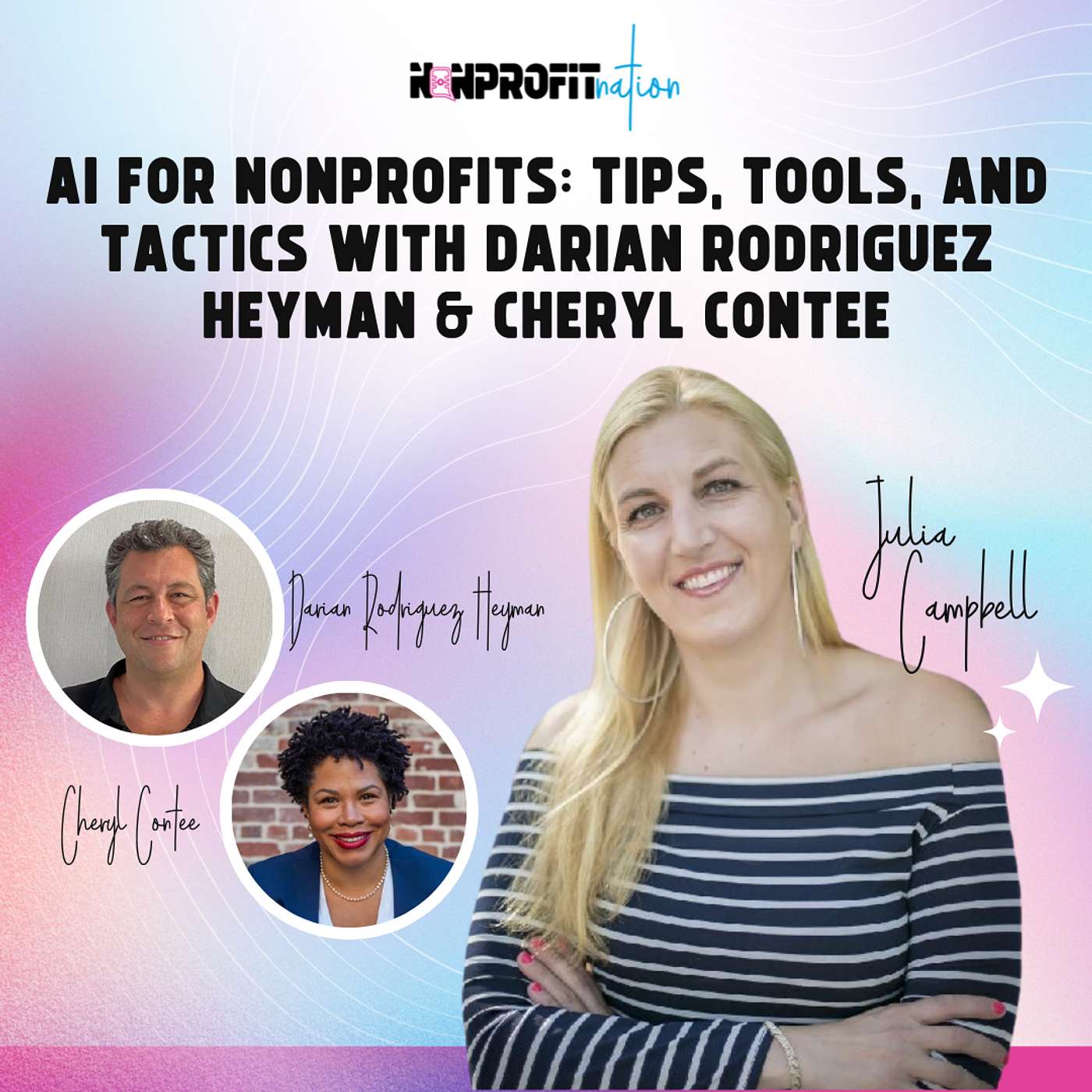
Nonprofit Nation with Julia Campbell
AI for Nonprofits: Tips, Tools, and Tactics with Darian Rodriguez Heyman & Cheryl Contee
00:39:42
Loading summary
Transcript76 lines
- [00:00]
A
Hey, nonprofit friends. Julia here. If you're already dreaming up your next big fundraising win, I want to let you in on something special. BloombergG's annual conference, GiveCon, is coming up May 17th through 20th, and trust me, this is the place to be if you want to sharpen your fundraising and communication skills. I'll be there leading a session called From Passive Posts to Powerful Campaigns Social Media that Drives Donations. If you've been wanting to turn your content into real conversion, you're going to love love this one. But here's the part you don't want to miss. Givecon's lowest registration rate is available right now through January. Prices go up on February 1st. So this is the perfect moment to grab your ticket and save your organization some of your budget. Join me and an incredible community of change makers at Givecon. Learn more and register@givecon.com that's givecon.com now.
- [01:01]
B
On to the show.
- [01:05]
A
Hello and welcome to Nonprofit Nation. I'm your host, Julia Campbell and I'm going to sit down with nonprofit industry experts, fundraisers, marketers, and everyone in between to get real and discuss what it takes to build that movement that you've been dreaming of. I created the Nonprofit Nation podcast to share practical wisdom and strategies to help you confidently find your voice, definitively grow your AUD audience and effectively build your movement. If you're a non profit newbie or an experienced professional who's looking to get more visibility, reach more people and create even more impact, then you're in the right place. Let's get started. Hello, this is Julia Campbell, host of Nonprofit Nation. Thank you so much for being here with me today. Wherever you are listening Today we're going to talk about using AI to power social impact. And joining me are Darian Rodriguez Heyman, social entrepreneur, nonprofit strategist and founder of ai4np.org a national hub for AI education in the social sector, and Cheryl Conti, a pioneering technology expert and digital transformation expert and chief innovation officer@brightworksai.com and the two of them co authored the brand new book AI for Nonprofits Putting Artificial Intelligence to Work for your Cause. And AI for Nonprofits is a practical resource rich guide based on interviews with 57 nonprofit leaders, including me, who are successfully leveraging AI to enhance fundraising, streamline operations and engage supporters more effectively. So I was so thrilled to be a part of this book and a part of this project and I'm thrilled to have you both on the podcast.
- [03:15]
B
Thank you so.
- [03:16]
A
Oops.
- [03:16]
B
Thanks so much for having us.
- [03:17]
A
Yes. So Darian I first met you years ago when you organized the Social Media for Nonprofit Summit in Boston. I don't know what year that was, but that was fantastic. And that was really, like, one of my first. Yeah, that was one of my very first speaking engagements. And that was where I met John Hayden, who became a really good friend of mine, and Joe Waters, who actually became a good friend of mine. So I just wanted to give you a shout out for organizing that. Thank you.
- [03:49]
C
Yeah, my pleasure. It was, I think, the first global conference series focused on social media for social good.
- [03:54]
A
Yes.
- [03:55]
C
This really builds directly off of that model in terms of what we did with the book, but also the National Learning Lab series that we're propping up.
- [04:04]
A
Yes. I'm so excited. So, Cheryl, let's throw it to you. There is no shortage of hype around AI, and I've had several guests on discussing AI for nonprofits. But this book really takes a grounded and tactical approach. Why do you feel this resource is so urgently needed for the sector right now?
- [04:29]
B
Oh, urgently needed. Just because AI is not in the future. It's now. It really is happening now. And in fact, AI has been with us for the last 10 to 15 years. So I think both Darian and I would occasionally talk to nonprofits and foundations, and they would say things like, oh, well, here at this nonprofit, we won't be using AI. And I, at least for one, would be like, oh, sugar baby, honey doll, you have been using AI for the past 10 to 15 years. And moreover, it's been using you. That's called classifier AI, but it's been in the background, right? So that's your spam filters. That is how your Amazon packages find you on Amazon and then find you via UPS at your house.
- [05:14]
A
Right?
- [05:14]
B
It's, you know, all of, like, inventory. Like, it's all of those things that are operating in the background now. Of course, in 2022, we had that leap forward with generative AI, and that's AI that can create, and everyone now participate, you know, in that if they want to. What's coming and what is, you know, we're right on the heels of agentic AI. And agentic AI is AI that can think, plan, and act. So an example would be skedge.com, which I use for my scheduling, sk e j.com and Lexi, you know, my AI assistant, you know, and Darian has experienced her. You know, I just CC her when someone says, hey, girl, you know, let's. Let's talk. And I say, lexi, find us a meeting. And she'll just go out and she'll do all of the back and forth. She can even look at people's calendars online. And then she'll just put the meeting on my calendar with a zoom or a Google Meet. So we're entering this world where everything we know is going to change over the next 10 years. And it's so vital that nonprofits take the reins in this moment because they can lead and show how we can use this technology in ethical, responsible, and powerful ways that help people. Absolutely.
- [06:26]
C
The other thing I would add quickly is just that I think to all of Cheryl's points, there's this unique moment in time. We're sort of at the precipice and this technology is really just hitting the hockey stick and the growth curve. And people hadn't really communicated with nonprofits and foundations to help them understand, as mission led organizations, how can AI be a tool that advances their work with fundraising, with marketing, with programs, with back office? And so, you know, really getting into the tactical and practical tips and tools, that was really the gap that we felt like, needed to be filled.
- [07:02]
A
Oh, absolutely. So building on that, Darian, you. You both interviewed 57 nonprofit leaders for this book. As I said, it was honored to be one of them. But what surprised you most about how organizations are actually using AI?
- [07:19]
C
I guess the short answer is that they're not as organizations. Right. Like, to Cheryl's point, this stuff has been happening for years. Whether it's, you know, all the different types of examples you mentioned. And in general, the state of the union in the nonprofit sector is that over 80% of nonprofits are using AI to some extent, in terms of someone on their team is playing around with the tools, it's very common. But if you look at what percentage of nonprofits have actually taken the time to create a simple policy and think about AI at an organizational and a strategic level, it's under 10%. So, you know, it's kind of the wild west where everyone is bringing their own AI to work and they're using it increasingly in the workplace. But in terms of us as nonprofits, as foundations, very few of us have actually taken the time to get serious about the technology and to think about, to Cheryl's point, what does responsible use look like for us? What is the sensitive data we need to protect and how do we do that? What are the most painful and recurring functions that we need to do every day or every week or every year that can be augmented or enhanced by AI and really to start to document acceptable use and Put some guardrails in at the organizational level.
- [08:33]
A
And Cheryl, what surprised you about the use or non use of AI in the sector?
- [08:39]
B
Well, you know, your chapter, Julia, is all about social listening. And as you say, you know in your chapter, social listening isn't really about marketing. Marketing, it's empathy at scale. And I think what is surprising to me maybe is how scared people are about losing their jobs. And that's actually not a thing that we're seeing much of because you still need the human in the loop, which is actually a technical term in the AI community. You still need people, you can automate things, but the things that are best automated, in my opinion, are the things that are the most tedious, the most repetitive, the boring things, the time consuming and expensive things. You know, if you're able to get those off your plate, that leaves more time for people to do what people do best. And the reason you got into this work in the first place, which is to help others, to listen to them, right? To touch them, right? To change their lives and their outcomes in a positive way. So, you know, what has been surprising is, you know, that people want to continue that empath, you know, and they're concerned that that AI is going to take away their ability, right, to do their jobs, you know, the way that they wanted to do them. And I would, I would posit to you that actually this is an opportunity for you to move all of the worst parts of your job off your plate and actually do more of the, the human work that you got in this to do.
- [10:10]
A
That's really where I think a lot of nonprofit leaders are worried. They're worried about balancing automation with authenticity. They're worried about donor trust. I mean, we know trust in the sector is completely decimated. Trust in institutions, trust everywhere is just decimated. So can you walk us? I guess I'll throw this to Darian through a favorite use case where AI has made sort of a real, a real difference either in fundraising or operations.
- [10:44]
C
Yeah, I mean, I think fundraising typically tends to be the place where most people, their mind first goes because it's been at the top of every survey of every executive director since I've been in the sector for 25 years in terms of the biggest pain points and needs. And I think the reality is the use case that most people come to AI through is around content creation, whether that's write me an email or a bio or a summary of this, this long document. And when it comes to fundraising, especially on the institutional side, where I do a lot of work with foundations and companies, there's a lot of paperwork and there's a lot of information, some of which is based on stories we've been telling in the past. So to be able to not necessarily hand the robots the keys, but engage AI tools to, number one, identify prospects that we haven't thought of, number two, to think about, how do we streamline and facilitate the communication with these folks, not in cookie cutter language of trying to explain our mission in the same way to every funder, but embracing what I think of as the single biggest determinant of success with foundation fundraising, which is helping them understand that you understand their goals and are somehow in a unique position to advance those. And if you could make that point in a sentence or two, it is like rocket fuel for your fundraising efforts and grant writing. And so identifying that sort of Venn diagram and facilitating the communication, the follow up, you know, thinking about as you finally get that meeting on the calendar and prepare for it, what are the big questions I should ask to sort of open the conversation up? What are the parts of our work that are most compelling and most relevant for this funder and within what frame? You know, managing the follow up and sort of that alarm clock functionality of staying on top of it and building the relationship over time. So it's kind of every single part of the fundraising pipeline and process flow can be supported and enhanced, which is true for almost any activity, whether it's bookkeeping and accounting or risk management or other forms of fundraising. And so I think that was really the lens through the book, was looking at these different key use cases and applications and what are the things that nonprofits need to do on a regular basis and really answering that question at the level of whether it's social listening in the case of your chapter or the grant writing chapters or the, you know, the bookkeeping and accounting books.
- [13:08]
A
I love that. Cheryl, do you have a favorite use case or something that just jumps out at you?
- [13:13]
B
Sure. You know, and Dari may have already touched on this, but you know, Susan Mernett, who is great, you know, she wrote a chapter about grant writing and one of the things that she's doing out here or recommending is, hey, you know, you can do research and write grant reports in a whole new way, right? Like, you have maybe a target list of found that you'd love to have a grant. You know, you can sort sort of line up, like, here are the programs that we have. Compare that the language we're using to the language that the X Foundation is using in their annual reports. Right. And how would we rewrite it such that it's more, you know, in the language that they're using and what might be more comfortable and resonant for them? Which is super smart. Right. There's also the, you know, you can research a lot more foundations and maybe find, you know, more, you know, high net worth donors than ever before. You know, if you're using, you know, AI tools to help you.
- [14:12]
A
I think that is so smart because I know that when I started my business I was a grant writer for hire and a lot of the nonprofits that hired me, it was just totally quantity. It was like just send out a bunch of grant proposals and if I had had something like a chatgpt to help me research, is this a good fit? You know, like what do they actually fund? What have they funded in the past? What is their typical size of their grant? Rather than just sort of grasping at straws and kind of throwing spaghetti at the wall and seeing what sticks. I think using it for research is just such a hugely. It's going to save so much time for people. I think for me, when I talk about AI, I use it in some of my presentations to talk about social media content creation and how to like turn your annual report into, you know, 10 social media posts or take a blog post and, and cut it up and repurpose it. I think for me. So I'd be interested to know how you both address the common pushback to AI in the sector. So one is for environmental organizations. I mean, this is something I definitely don't know how to answer. So I'm just like interested to pick your brain on how you address that. I know that I've had environmental organizations say they are very stringently against using any kind of AI because of the environmental implications. So I don't know how you address those and other common challenges. Like what other challenges have you heard and how do you address these challenges?
- [15:50]
B
Well, I'll start with environmentally because it is a question that comes up a lot. It comes up a lot sector, and that's good. It is important that we're thinking about this. And that's, it's not the kind of question that came up, for example, with social media. Right. No one was really thinking about that, but we are, which maybe we should.
- [16:08]
A
Because they have data farms too, data.
- [16:10]
B
Servers or the NSA or, you know, there's lot, you know, there's lots of data centers out here. You know, what I tell people is, look, a couple of things. First, that cheeseburger that you had last Tuesday is probably way more intense on the environment than the last 10 prompts you put into a cloud or a chatgpt. Like, let's just keep it real. That doesn't mean that there isn't an impact and that we should not be mindful. But I think it's important to measure things. The other thing that I say is, yes, this is a problem today. Like those methane. Why would he choose, why would Elon Musk choose methane to power his data center? Like that seems like an unnecessary choice, but like, yes, that is poisonous and uncool at the same time. Clean energy is on a snowball of acceleration. California, where Darian and I live, is now 2/3 clean energy. It is the largest economy in the world. To do that, we are the fourth largest economy in the world. Europe at this point is just about 50% clean energy. Saudi Arabia, one of the largest oil producing nations in the world, says that they're going to be 100% clean energy by 2030. We'll see if they get there. But the point is that we're moving very rapidly, probably within the next five to 10 years towards majority clean energy.
- [17:33]
A
Right?
- [17:34]
B
So, and so these people, all of these executives will convert to clean energy, if for no other reason than it will be cheaper than something like a methane. You know, because what do we know about clean energy? It's actually just technology at the end of the day, what do we know about technology? It gets over time, cheaper, faster, more powerful, smaller, more widely available. So, you know, I would say to people, if you're really worried about energy use, continue your work towards adopting clean energy, because that really is ultimately the answer. The answer is not we can't have data centers and we can't have AI, because again, as we said in the beginning, you've already been using AI for the past 10 to 15 years. It's not a choice, it's not right, it's not an option.
- [18:22]
A
If you have an iPhone, you have Siri in your iPhone, and that is AI.
- [18:26]
B
AI is everywhere and it's going to be in everything. So instead, how can we make our use of AI as clean and powerful as possible? Possible.
- [18:35]
A
Exactly. I just didn't mean to put you on the spot, but that's a question that I get all the time. And I just feel like I'm not an environmental expert and I'm definitely not an AI expert in any way. Another big challenge I know that is covered in the book is data privacy and compliance. What do you think nonprofit teams really need to know and understand to protect themselves, like both legally and ethically.
- [19:03]
B
Do you want to take this one, Darian?
- [19:04]
C
Yeah, sure. I think in general, Julia, what I would say is part of the problem that I've seen in the AI for good movement is number one, we fail to recognize that we're talking to mission led organizations and we need to start with framing AI as a tool that can advance that mission first and foremost. And number two is people do have some of these fears and concerns and we tend to talk around them and try to make people feel stupid for even raising them instead of tackling them head on, addressing them and talking about how to mitigate them because they're valid. Whether that's the environmental concerns or to your point about data security, that's one of the other top things, along with job loss and some other things that people are very understandably concerned about. And they should be, because the bottom line is data is the currency in today's AI economy. And the way these models work, unlike when I studied computer engineering, you know, 30 years ago, where you had to map out every like, if this happens, then do that to give the illusion of intelligence. Nowadays, the current technology is just based on dumping a ton of data into these large language models and letting it identify the patterns, right? And so as a result, you know, these companies are hoovering up as much data as they can and a lot of the predictions are sharing that they're going to run out of of publicly available information to suck up next year. So they're looking for data wherever they can find it. And one of those places is when you enter a prompt in a chatgpt, unless you are paying for that model or you've changed the settings, that data is going into the next training model, right? So if you're not paying for the product, you are the product. And I think that's really important to recognize. There are ways you can go into settings and say, I don't want to share my data as part of the training data. And then you can decide depending upon how sensitive it is, if you're dealing with HIPAA records or you're serving youth and there's personally identifiable information, probably not great to add into ChatGPT, even if you move that slider over realistically, there's sort of better and then ideal solutions to the data security issue. Having your own custom large language model where you have using a platform like Change Agent or causewriter, where they will sort of put your data in a sandbox so that it's secure. And oftentimes they will also purge that data anyway. So if there's a leak or some kind of hack, there's nothing there. So that's sort of the current standard and sort of a good option. The ideal scenario is you're actually going to take all of your personally identifiable information and change it over to Disney characters or numbers or whatever. So there's nothing in there that someone could potentially access.
- [21:42]
A
Right.
- [21:42]
C
That's also a lot of work and takes a significant amount of extra energy that a lot of nonprofits don't have. And so that tends to be out of reach for a lot of groups. But if you're dealing with a small data set, you can do it manually or just do, you know, find and replace. Typically, though, a custom large language model is sort of the right way to address that need for a sandbox and keeping that data secure.
- [22:02]
A
So, Cheryl, what do you think are the most important elements of a nonprofit AI adoption policy? Like, what should we be thinking of if we don't have one at our organization?
- [22:13]
B
Studies pretty reliably show that 30 to 50% of employees in any given workplace are already using AI. They might be using it overtly, they might be using it under the table, but you're already at risk, right. Because how are people using it? Are they uploading proprietary or confidential information? No one wants to lose their job for using AI. In fact, they're using AI, presumably to do a better job. But if you aren't providing parameters and guardrails and even just information on how to keep themselves and the organizational safe, you're. You're really asking for trouble. Right? So I think that, you know, oftentimes it's helpful. One of the things that, you know, I've been doing in my practice or just starting with organizations with, you know, the CEO or leader just doing a fireside chat. Right. With the staff or with the leaders. Like, let's just talk about it. Let's just break the ice. Because people are afraid to talk about it. They don't want to get in trouble.
- [23:13]
A
Right.
- [23:13]
B
For using AI, Even though, again, many of them are.
- [23:16]
A
It's like the first early days of social media.
- [23:19]
B
Yeah, no, I will. I won't name names, but there was a, A large company that wanted me to write a blogging. Remember blogging. A blogging policy back in the day? And they were like, okay, so can you write it such that they can't do it? And I said, no, because that is unconstitutional. Like, you can't. But nobody wants to get fired for blogging, right? So let's just figure out, you Know what. What feels safe for our organization, you know, our giant corporation, and what's safe, you know, for individuals. So, you know, I would encourage people to at least start the conversation right internally, you know, just get people talking about it, maybe even do a survey and let people know you're not going to get in trouble. Nobody is.
- [24:03]
A
We're not.
- [24:03]
B
We're just trying to assess who's doing what and then figure out, you know, how can we analyze our workflow again to figure out the pain points, you know, and then put in technology that's going to help us and that we can all teach each other and learn and do more in a day than we could have possibly done before.
- [24:23]
C
And if I can, and if I can just add a couple of quick comments, I think what you're asking here, Julia, is really at the heart of what needs to change and happen in the nonprofit sector is that just having a policy, Even if it's 1, 2, 3 pieces of paper, that immediately puts you at the head of the class and means that you are embracing a culture of innovation and bringing AI out of the shadows, because to Sheryl's point, people are using it already anyway. And if you're putting no guardrails in place, that's really dangerous. And it's also incredibly common right now, so it doesn't need to be a big leap. There are a couple places out there, like Inten and Fast Forward, that will give you a template and a starting point. And then I would just invite you to share that with the team. And to Cheryl's point, have conversations, Fireside chats and talk through does this feel right? Is it too detailed? Not detailed enough? What is it missing? What feels uncomfortable and not aligned with our values? And, you know, to answer your question, though, the most important things to have on there are, you know, how do we suggest and what is the approved use of AI? Which tools are approved for which purposes? Number one. Number two to your earlier question, what is the sensitive data, the personally identifiable information PII that we handle, and how should that be handled as it relates to AI? And then number three, if you want to go for a little bit of extra credit, is what are the most painful processes and needs that we have in our organization that if someone could rub a magic genie lamp, we would love to automate or streamline or enhance or augment and just putting that on paper as like a wish list, that is a great starting point. It can be a couple pages, and just by documenting those three things, all of a sudden you have thought about AI as an organization instead of just, you know, letting it be the Wild west and people running around with tools and not necessarily any coordination or strategy behind that.
- [26:16]
A
I remember creating social media policies way back in the day. And it's so important, especially for like a school or anyone working with youth, because you have to say, oh, are teachers allowed to friend parents? Or are teachers allowed to go into public Facebook groups and talk about certain private information? I think of nonprofits, they have policies around everything. They have policies around how they handle information, they have policies around communication, and they have just policies around almost everything that they do and procedurally and programmatically. So having an AI policy. But I love that just quick little framework. So speaking of frameworks, the book really includes a lot of step by step frameworks, which I love. Tactical, practical information. So, Darian, what is one small action that a nonprofit leader could take this week to really start integrating AI into their work?
- [27:18]
C
Yes, I mean, I think to your earlier question about a policy that is like the thing that really represents at an organizational level, we're being intentional and strategic. But I would kind of zoom out to answer that question and talk about sort of a crawl, walk, run framework of, you know, people get overwhelmed and daunted by like, we're busy, we've got too much going on. I don't have the headspace to think about this new tool. Maybe later. And it doesn't need to be that complicated. You can dip your toes in the water. Some of the easiest ways to get the started are, number one, encouraging people to use the tool at home. Whether it's learning a new language or making up recipes or planning a trip or whatever, it is just personal use cases so they get comfortable with the technology and what it can do is number one. Another thing that Sheryl mentioned earlier is bringing it out of the shadows and creating some kind of regular forum. It could be a monthly roundtable or the first Monday of every week when people first get back in the office and we hand out bagels and coffee and just go around the circle and everybody share and get invited to share. Have you used AI this last week or last month? And what was it like? What did you learn? What was cool, what was bad, what was inspiring, what was lackluster? And just opening up that conversation to create that culture of innovation is really, really important. And then finally, just because I know so much of what you're focused on is on the social media side, that is really low hanging fruit, AI is really, really valuable. The chapter that you helped lead in the Book gives some really practical tips for how to identify what content's already working based on our history. What gets the most engagement, the most clicks, the most shares. Great. Let's use AI to create 10 more posts like that, along with taking that blog or that article or annual report and turning it into a podcast, like a five minute audio version of it, turning it into an infographic, because that's going to get twice as many likes, comments and shares on social media. Using Soar to create a short video that's going to get four times as much engagement on average. You know, anything that helps you break through the clutter in today's attention economy, especially when instead of handing the robots the keys and saying, go, you know, write this and post it. No, it's sort of give me some suggestions. Share 10 different potential posts based on what you've learned about what our audience finds most engaging and which hashtags are most relevant. Great. And then you can look through and pick the three that really feel most aligned and on brand for you and your organization.
- [29:51]
A
I love that. Cheryl, what would your advice be for one thing that like, maybe a nonprofit fundraiser can do this week to start integrating AI in their work?
- [30:01]
B
Sure. Just play around. You know, I was talking to a foundation, a small foundation yesterday, and you know, the CEO was saying, look, you know, which is a thing that we've heard a lot actually. CEOs or executive directors saying, look, I'm down to do AI. I understand strategically that it's important for us. It's my team that is pushing back.
- [30:23]
A
Right.
- [30:23]
B
So I'm hearing a lot about that. So, you know, I would say just play around, you know, like, you know, she was, she was saying, you know, my team won't even touch it. I mean, they literally have refused. Like I've opened it on the laptop and they just literally run away.
- [30:39]
A
So.
- [30:39]
B
So don't be that person. The water is warm. It actually can be really fun, you know, like write a song. Go to Suno S u n o and just write a song and just be silly, you know.
- [30:49]
A
S u n okay, yeah, go to.
- [30:52]
B
Suno or anything.com is really fun. You can just literally write a prompt, you know, and say, build me this app. You know, maybe it can be something silly and simple and it, you can watch it write the app and even debug itself right in front of you. Or, you know, my kid has this girl, you know, that he has a crush on and you know, in order to impress her, he used replit r e p l I t to Build her a game in which you can shoot zombies off a train. He's nine.
- [31:24]
A
Oh, my gosh. You can build a game. My son would love that.
- [31:28]
B
Five minutes. He did it in five minutes.
- [31:30]
A
Oh, my gosh.
- [31:31]
B
Reptile. Cinematic quality. No? Or Descript. Right, Descript. Or in video, you know, like Opus. I like Opus. AI. It can take a long video or audio and it will actually create mini clips that are social media friendly.
- [31:48]
A
Right.
- [31:49]
B
For you. It does it for you. And then you can just pick and choose and it will even rank. Like, here are the first, the top 10 we think that you should use, that'll be the most effective. I mean, it just does all the work for you. So just mess around, you know, just have fun with it, you know, before you decide, okay, let's sit down and really figure out an implementation strategy.
- [32:10]
C
And if I can just add a couple additional tools that I've been playing around with lately that I love. Tools, especially from a fundraising standpoint. To the point of your question, Julia, what I would say is, like, I come across a lot of nonprofits that are trying to get a proposal or an annual report or some kind of article in front of a busy donor, and it can be really challenging to get their time to read it. Or especially if you're dealing with a program officer and you're hoping to get through to the CEO too, taking using a tool like NotebookLM and turning that proposal into a five minute audio clip that is at the level of like an NPR quality podcast. Like, it's really impressive.
- [32:47]
A
I've heard the Notebook LM podcast. They're great.
- [32:51]
C
You can go to ai4mp.org and listen to the R600 page book as a five minute podcast. And you can't tell it's robots talking. Like, it's amazing. So that's one great way to break through the clutter from a fundraising standpoint. Another one is using tools like Gamma or I really like Nano Banana, which is Nano Banana. Nano Banana, where you could feed it an article, an annual report, a blog, or whatever, and it will create essentially an infographic that summarizes everything in there as a visual amazing. And unlike the tools three months ago, even that had all kinds of typos. And anytime you were dealing with visuals, it was kind of janky. Like, we've hit that tipping point now too. And to Cheryl's point, we're at the tipping point with video too. Like, OpenAI just did a deal with Disney, so you'll be able to be your own Star wars character pretty soon. Like there's some really cool stuff that's coming, and some of these tools are super easy to use, and you can also play around with them for free.
- [33:48]
A
I love the tools that you are sharing, mostly because I talk a lot about content repurposing and using your own content, but using it smartly. Like, if you have a video, a very long video, why are you going to spend the time to go through and do the video clips and do the edits? Riverside, which we're filming, in, which we're recording on, also can do that. They do magic clips for you. There's so many different tools that can actually pull out, like, the best nuggets and some of the best information. I think it's just working smarter and not harder. But we. We could talk for hours. I want to wrap it up, but I know that you are very excited about the audiobook that is coming out. So, Cheryl, tell me, where can we get the book? Where can we get the audiobook? What's coming on down the pipeline?
- [34:42]
B
Sure. Well, the book is on Amazon and it has done really well. You know, during its launch, it was number one in the office automation category for weeks. It was top 10 in business and finance, which is a huge category and tells us that, you know, even businesses want to implement AI ethically, practically responsibly. Top five in AI, of course, number one in nonprofits and organizations. So, you know, it's had a strong response. You know, people seem to like it. People tell me about it all the time, which is really fun. So, you know, you can get it on bookshop, you know, if that's preferred. It's. It's on all of the, you know, all of the sites. The audiobook will probably be just on audible to start, and that should be out in early 2026.
- [35:31]
A
Oh, that's so exciting. And you said something daring about there's. There's something new coming down the pipeline. Did you say about a learning cohort? Maybe I missed.
- [35:43]
C
Oh, you're talking about the learning labs.
- [35:44]
A
Yes, the learning labs.
- [35:45]
C
Yeah. So, you know, basically there's a few different intertwined pieces of this ecosystem. There's the book which Cheryl just talked about, that's out, you know, Amazon and all the other book bookstores. There's the website, which is AI, like artificial intelligence, the number four np, like nonprofit, which is a nonprofit fiscally sponsored by Inten, that ultimately is really aimed at becoming a central clearinghouse for all things AI for good. So whatever you're looking for, you should be able to find it there. And Then as part of the nonprofit, besides the website, we're also planning on, you know, doing a series of trainings all around the country to really level up the capacity of nonprofit leaders and foundation leaders at scale. I have to be honest, we're so of mid pivot around that right now because there's a lot of free content out there, there's a lot of interest in AI, but there's also not a lot of ability to pay right now. And so we're really only able to charge 50 to 75 bucks for a conference around AI for nonprofits. We just had a sold out event with Beth Cantor in Silicon Valley. We have a bunch of venues lined up that are excited to host us and partners. But we need funders, we need partners, sponsors and underwriters that are interested in bringing these trainings to their town, whether that's in D.C. or Chicago or New York or LA. We have sort of a whole national series teed up and what we discovered is, you know, we can't sell tickets at a break even price. And so at this point we're looking for partners with whom we can collaborate to really, you know, bring the series of learning labs to their community.
- [37:17]
A
I love that. Well, I hope you come to Boston. So we should work on an event here.
- [37:22]
C
I would love that.
- [37:23]
B
So the book, I just want to add.
- [37:24]
A
Oh yeah, sure.
- [37:24]
B
I just want to add one, one thing. And thank you, Darian, for saying all of that. Just quickly. I know there are people listening. You might be listening and thinking, I am going to use ChatGPT or Claude or Gemini over my dead body. And I, you know, like I get, I get feeling some sort of way about Sam Altman. Okay, no question. I am the co founder of a great alternative to those LLMs called change agent AI. So if you're looking for an LLM that cares about eco friendly, right, that is built on your values and is designed to keep your precious data on human beings secure and private, I would really recommend heading over to the Change AI. Lots of folks are using it. It's definitely on everybody's lips. So check it out.
- [38:14]
A
I love that. I will recommend that to my skeptics. The change AI and also aifornp.org the book is AI for nonprofits putting artificial intelligence to work for your cause. Cheryl and Darian, thank you so much for being here. This was wonderful. Thank you for having me in the book and thank you for all the work that you do. Well, hey there. I wanted to say thank you for tuning into my show and for listening all the way to the end. If you really enjoyed today's conversation, make sure to subscribe to the show in your favorite podcast app and you'll get new episodes downloaded as soon as they come out. I would love if you left me a rating or a review because this tells other people that my podcast is worth listening to and then me and my guests can reach even more earbuds and create even more impact. So that's pretty much it. I'll be back soon with a brand new episode, but until then you can find me on Instagram @JuliaCampbell77 Keep changing the world, you non profit unicorn.