← Nonprofit Nation with Julia Campbell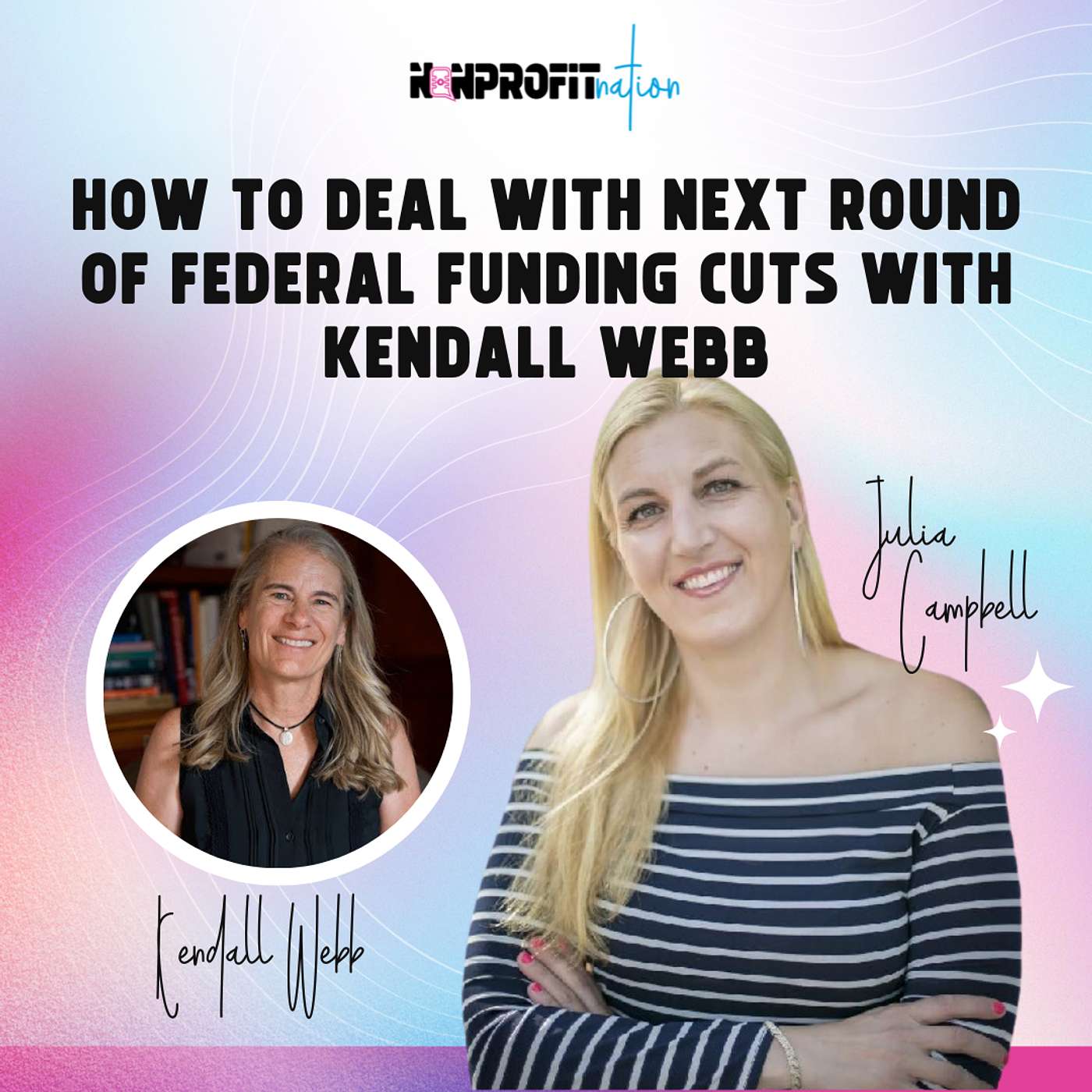
Nonprofit Nation with Julia Campbell
How to Deal with Next Round of Federal Funding Cuts with Kendall Webb
00:34:00
Loading summary
Transcript56 lines
- [00:00]
A
Hey, nonprofit friends. Julia here. If you're already dreaming up your next big fundraising win, I want to let you in on something special. BloombergG's annual conference, GiveCon, is coming up May 17th through 20th, and trust me, this is the place to be if you want to sharpen your fundraising and communication skills. I'll be there leading a session called From Passive Posts to Powerful Campaigns Social Media that Drives Donations. If you've been wanting to turn your content into real conversion, you're going to love love this one. But here's the part you don't want to miss. Givecon's lowest registration rate is available right now through January. Prices go up on February 1st. So this is the perfect moment to grab your ticket and save your organization some of your budget. Join me and an incredible community of change makers at Givecon. Learn more and register@givecon.com that's givecon.com now on to the show.
- [01:05]
B
Hello and welcome to Nonprofit Nation. I'm your host, Julia Campbell, and I'm going to sit down with nonprofit industry experts, fundraisers, marketers, and everyone in between to get real and discuss what it takes to build that movement that you've been dreaming of. I created the Nonprofit Nation podcast to share practical wisdom and strategies to help you confidently find your voice, definitively grow your AUD audience, and effectively build your movement. If you're a non profit newbie or an experienced professional who's looking to get more visibility, reach more people, and create even more impact, then you're in the right place.
- [01:46]
A
Let's get started. Hi, this is Nonprofit Nation. I'm your host, Julia Campbell. Today we're going to talk about how to navigate federal funding cuts, which I know a lot of you are suffering from. A lot of you have lost critical federal funding overnight. A lot of you are very anxious about how to prepare for even greater funding shifts ahead. But you're in good company. My guest this week is Kendall Webb, a pioneer in digital philanthropy and the founder and executive director of Charity Bridge Fund, which is a new nonpartisan platform that connects donors with nonprofits that have lost federal funding. And with over 25 years of experience at the intersection of giving, technology and impact, Kendall is going to share with us both a big picture perspective and some practical advice that we can use to take into the new year. Kendall, I'm so excited to have you on the podcast and just thrilled to meet you, Julia.
- [02:54]
C
I'm honored to be on here. We love your podcast.
- [02:58]
A
So I know that you've been at the forefront of digital philanthropy since the early 2000s. I'm really excited to hear, you know, kind of your journey. What first drew you to this space?
- [03:10]
C
Interestingly enough, I was in San Francisco on the for profit side in the new Internet world in the early 90s when people were selling CDs. What are those? Nobody knows what they are now. CDs.
- [03:24]
A
Selling what?
- [03:26]
C
CDs.
- [03:27]
A
Oh, CDs. Okay, yeah, I know what a CD is.
- [03:30]
C
Yes, yes, yes. Many don't. My child, a compact CDs and books were being sold on the Internet. And I got into a situation where I was working for a great company, a startup. We were selling products from drugstores. So I found myself putting skus on toilet paper and toothpaste. And I looked over into the philanthropic sector and I said, this is a great service, the Internet, but we're selling toothpaste and toilet paper. What is the philanthropic sector doing with this great tool? And there was nothing. It was expensive at the time. There were a lot of VCs investing in for profits. But meanwhile, the nonprofit sector did not have access to the ability to put their information online, which was expensive, and also to use it as a giving tool for their donors.
- [04:20]
A
So.
- [04:21]
C
So I looked around. Nobody else was doing it. I decided to launch a nonprofit myself called Just Give. It was a platform where we uploaded all. At the time, there were 600,000 charities and we uploaded all their information through their 990s so they had equal access and donors could come on and find even the smallest organization next to the largest organization, which was very important at the time because very few small and medium sized organizations had name brands. But now donors could find them. And then equally, they could use that service to enable their donors to give online. And donors would have the ability to track all of their giving in one giving history. So it was a really, really incredible experience that I did for 22 years. Wow.
- [05:08]
A
I love that. How have you seen digital philanthropy evolve over the time that you started just giving till now?
- [05:15]
C
Oh, so much. It was amazing. When I started, as I mentioned, there was no online giving at all. And there was no democratization of information even across the small, medium and large organizations. So what we saw was donors finally had access to all this information. The small donors had visibility. And what we loved is there were all these amazing tools that were created to integrate donors in a much more daily basis, not just for end of year giving, but all around yearly giving. So there was a lot of peer to peer tools, a lot of fundraising pages, crowdfunding, as we all know now, that was all new. We started charity gift cards. So in lieu of gifts, you could give a charity gift card to somebody and they would give it to their favorite charity. It used to be you'd give a donation in someone's name, which didn't always work. Well, that happened to me once, and I didn't like where they. They gave it. They gave it to the San Francisco Orchestra, and I thought, oh, the homeless need it so much more. So charity gift cards were a way to enable the person to actually give it to the cause that they cared about. And then we also saw real. A really interesting way of getting credit card points back to charity. So we did a product with American Express where they. I asked them if they could do a third category, not just frequent flyer miles and retail, but actually charitable giving. And I said, if you can have people redeem their points, I'll send it over to their favorite charity. And they said, great. If you can build it with technology, we'll do it. And millions of dollars flowed through instantly. So the Internet really opened up a whole scope of access to the philanthropic world to also enter the retail spending world.
- [07:02]
A
I'm so excited to talk to you about Charity Bridge Fund because it does combine digital philanthropy, technology, and it's just something that is so relevant and timely and urgent. So what inspired you to create Charity Bridge Fund? And, you know, what is it doing? How can we use it?
- [07:22]
C
So it all started, actually, back last spring when I was hearing about all the defunding that was happening in the federal cuts. I first heard about it through an organization that I knew well in Tanzania that I was working with. And I saw the disruption that happened when they lost their USAID funds and the chaos that it created internally for them and the inefficiency. And then a month later, I got a newsletter from another organization that I'm connected with that was a school lunch program. And they announced in their newsletter that they were scaling down from 18 states down to eight states. So now I'm seeing not just disruption. I started seeing actual decrease in services. So that got me curious about, well, who's going to fill those services? And even to the point of how many other organizations are impacted by this. It wasn't getting in the news. It still isn't getting in the news enough because there's so much political news that's dominating, and a lot of people aren't able to listen to as much news nowadays as they used to. So these stories that used to be at the forefront of different parts of our history as a nation, when this happened are getting kind of buried in the news. And what I found was there was nobody centralizing this information even on the Internet. When I looked, the stories were very fragmented. They were very few and far between. Articles that somebody might have written on one organization, like the two I just mentioned to you, they might have written one organization, but nobody was writing about the scale and scope of this issue. And when I dug into it, it scared me so much because it was across all sectors, not just one or two. Like normally during COVID for example, it was medical and food, and everybody could focus on those two sectors and really help. Nowadays, it's all the sectors all at once. So nonprofits also started, I found, not telling their story. In the beginning, they told their story about what their needs were, but then they, they decided, oh, I maybe shouldn't live in that world of uncertainty. I want to show strength. So we launched Charity Bridge Fund. It's a place for donors to get informed on all things defunding. They can understand the scale and the scope in a certain sector. We break it down very simply with these three page summaries. And then for nonprofits, we enable them to upload their profile with their story, which I think is the most important thing in the world, is to be able to that story tell what's. How it's. You're being impacted. And what I love the most that we're doing is we're really helping nonprofits and donors understand what is that connection back to all of us as a community. So even if we're not using the service of the specific project that was defunded, why is that important for us as a country, as a people, as a nation to support that? And how does it affect all of us and economically and socially down the road? I think this is a time where donors need to be re educated on that because we took it for granted these safety nets would be supplied by the government. But now that they're not, it's important for all of us to understand that. And this is a place, a safe place for nonprofits to tell their story.
- [10:42]
A
I think telling the story is so important. I also think that nonprofits kind of need to be shouting this from the rooftops, like not Chicken Little, the sky is falling, but really helping donors and people that do not work in the sector understand the dramatic implications of these federal funding cuts and also what it does to the sector as a whole in terms of decimating trust and just kind of, you know, just sowing animosity towards the nonprofit sector and skepticism. I Think that overall it's been incredibly damaging financially, but it's been incredibly damaging emotionally and mentally. I think for organizations that already there's so much uncertainty in the work that we do and there's so much increasing demand and then to not know where our next grant is coming from or if we're going to get the federal funding that we've been relying on, or the state funding we've been relying on, it's affecting our ability to really deliver good services and good programs. And I love that you have a way for donors to connect with us and for nonprofits also to connect with us.
- [11:59]
C
Can I add to that? Absolutely. Our big role is to let these nonprofits tell their story. But to your point, we are taking this platform to donors, large donors, in terms of volume and ability to give. And we are screaming on the rooftops for these nonprofits because we feel like they need to do their job, fill in the holes in the boat that they just, you know, got in there. They need to focus on their programs. And what we want to do is provide a new funding channel for them by bringing this platform to the banks. At the donor advised funds, we have two out of four that have already agreed that we could go partner with them and talk to their donor advised fund holders where there's $250 billion. I saw you did a podcast on donor advised funds. So you know the magnitude and the growth and the, it's very dynamic system right now of transient funds that are dedicated to the charitable sector. So we are talking to them and philanthropic wealth advisors who are also very eager to talk to us to give this information to their donors so they can be more informed. And we are saying give now, give more. Give to all the organizations you were giving to before, which were the ones that your passion projects is what I call them. But now we are in a state of we need to give what's urgent and what's necessary in our communities. And so give more, give now. It's going to cost less money for you to give now than to wait. A lot of donors are saying, well, let's wait and see how, how it comes out. And to your point of let's see if they can get the government grant or the foundation grants or other access to funds. And I say don't wait. These are really important services for our communities and if we wait, then we're going to lose the effectiveness and the scale of these services that have been built up over the decades and it's going to cost a lot more money. Both to rebuild these organizations that are having to scale down. But also if we lose those services, it's going to cost more in the repercussions. And we really walk donors through that. We take like a school lunch program and we say, even though your child isn't using school lunches, this is how it will affect your community eventually. And we tie it back to the large donor.
- [14:26]
A
Oh, I 100% agree. I think that people don't really understand the ramifications of some of these programs, especially like the free school breakfast, free school lunch, just how it's destigmatized now because it's free and it's fine and anyone can get it and doesn't matter like your income. Like you can get your free school lunch or you can get, you know, your free after school program or you can, you know, go to the local food pantry and they're not going to ask you any questions and you're just going to be able to get your turkey for Thanksgiving or I think that especially with the SNAP defunding and the cuts to snap. What I see, and I'm sure what you see, Kendall as well, is once there are cuts, the money doesn't come back. It does not come back. So maybe with a new administration or maybe with a new philosophy from the top down, some of the funding might come back. But in my experience, when something is cut, it does not come back and it doesn't come back in the same full force. So.
- [15:31]
C
Right.
- [15:31]
A
Speaking of cuts, like looking ahead to the 2026 federal budget, what are some of the biggest shifts you anticipate in terms of like how it's going to affect our sector and charitable funding?
- [15:44]
C
So this is, this is a hard one to swallow because when we started Charity Bridge Fund, we were hoping to be a bridge of funding for that first level of cuts. And to your point, we knew it was going to be something that was hard hitting, but it was something that we could get funds for those. Now we have to hunker down and wait for the next set of funding. And I feel like it's a compounding effect. This is why I'm even have a bigger megaphone on the roof of the building for donors is to say these cuts were not singular. Just last spring, there's another round. And so the destabilization that you were talking about of the nonprofits, I think they are resilient nonprofits in general, they're full of. We are all passionate and strong in who we are, but we can only take so much in terms of Creating good out of very small resources. And this second set of funding worries me. Where I see them hitting the hardest is in youth. We defended that area last spring. But the youth after school program, sort of the Education Department of Education, is going to get a hit. So that's really hard. SNAP spending, we're going to see more reductions. Could be by state, but it's definitely by who's eligible. And then the cuts in Medicaid and public health in general is going to be hard. And the reason why I find this compounding so hard is I always look at the example of. For donors, I outline the example of food. So food banks were cut across the board 35%.
- [17:23]
A
Meanwhile, inflation is up 10%.
- [17:26]
C
Yes.
- [17:26]
A
So they can't buy the food because.
- [17:28]
C
And the need is higher than ever because of the cost of living and the cost of goods. Then you add the government shutdown, which added temporarily, but for a month more need because of all the furloughed workers. DC had lines around the block that month. And then now we have the SNAP benefits being decreased. And on top of that, you have the Medicaid benefits being decreased. All of that comes down to food. And right now, our food system can't handle that magnitude. And you may have heard this statistic, but it was so shocking when I heard it. I think it's worth repeating is that for one food, one meal that a food bank gives across the nation, SNAP gives nine meals. So when SNAP is affected, it's not just an incremental 10% need on a food bank, it's exponential. So with that kind of need, it's really hard to sustain. And so therefore a family won't be able to get fed. Because the lines around the block in D.C. for example, during that time, they had to say, I'm sorry. So people then have to use their money to pay for food because they are. Because they're hungry and they have kids at home. And what happens is after a month or two or three, they cannot pay their rent. So this is the mathematical equation that I give to donors. As I say, think about the person not being able to pay rent. Now you have a family that's homeless. Now you have kids that can't get to school. You have homelessness. You have nutrition issues and medical issues. Because of that, you could then get into drug and crime. There's other areas that then are risky. And so one meal is so powerful to prevent so many other unnecessary social destruction that this is why it's important for the nonprofits to tell their story and Bring it back to the risk of not supporting. This meal, I think, is a really, really important voice to have out there.
- [19:30]
A
I always say to my clients, to my students, can you answer this question? What would happen if you close your doors tomorrow? And what would even happen if you close your doors for a day, for a week? And what would the ramifications be? And we need to really be honest about this. I love how you put it in such simple terms. And I know not everyone listening is working in food insecurity or, you know, feeding the homeless, but what you're doing is filling a gap, and there are going to be severe consequences if you close your doors or if you reduce your services or. I mean, I'm even just thinking something as simple as, like, I'm on the school board here, and we have a meeting tonight, and we're discussing the budget, and costs have gone up so much that our budget increase is 13%, which is, like, not palatable to the communities. But then you think if you have to cut. There are job losses, there are losses to services, and there are losses to special education. And I think that what people need to understand is that a budget and what we fund is a reflection of our values as a society. It's a reflection of what we believe in and what we stand for and what we think is a priority. And I just really, how you framed it, I think is incredibly powerful.
- [21:01]
C
Yes, it's humanity. It's.
- [21:03]
A
It's humanity.
- [21:04]
C
What most countries do is they take care of their people. And, yes, what's, I think, really frightening here is we've been hit across. Like you said, all sectors are important. The arts are being hit. Public health is being hit. Youth programs are being hit. Even the parks, the national parks are being hit right now. And we're trying to tell that story as much as we can and louder so that we don't lose that, because those are the values of our country. And I love telling the story about. A lot of people say, oh, but it was money that the government was giving, and the nonprofit sector is an optional thing. And I said, no, it's not. Back in the 1960s, the government wanted. They outsourced the social services to the nonprofits. So some governments choose to do it internally, especially the basic needs areas. Our government, they're not giving money out of generosity or goodwill to the nonprofit sector. It was a purposeful thing in the 1960s to say it's more efficient and effective to get to local communities. If we outsource these programs to really knowledgeable people who Know their communities the best, and can understand how to use this funding the most efficiently. So the irony of this was it was used to not create a big, expanded permanent public agency in the government, but to actually outline it to the local organizations on the ground. And on the ground, the government is having the nonprofits do the work that they would like done. Many of it, as you know, is contracted out. So I'm also explaining to donors, these were contracts that the government wanted done often.
- [22:51]
A
Oh, these are congressional funds. These are funds allocated by Congress. But apparently that doesn't matter anymore. Government.
- [23:02]
C
Yeah. So I love telling that story. And donors eyes open up so widely because I feel like they've missed going back to the importance of storytelling. I feel like all of us need to tell these, remind ourselves and tell everyone who doesn't remember this why the social sector exists and why it's so important. And the government isn't taking care of these things. So the social sector is. And as a people and as a values, like you said, what do we want and who do we want to be as a nation? That's why we should step in at this moment, at this critical time.
- [23:41]
A
So what else should nonprofits be doing right now? What are some concrete steps they can take to prepare for these funding cuts and this disruption and charitable giving?
- [23:51]
C
I think, yeah, the biggest thing that I am seeing that is very effective is connecting to other organizations in your sector. So I've been in a few groups by issue area. It's been very helpful to share both the learnings, the hardships, if you're not in the hardships yet, so you can prepare. But if you're already in the hardships, to learn from other people in that area, but also to connect to ones that can help. So I've seen a lot of partnerships, very unique partnerships and collaborations that weren't happening before because the sector was very concerned with the donor not getting confused about which services were done by which organization. So therefore, who should I donate to? I think that is pushed aside now and the nonprofit sector has an opportunity to partner in the most efficient and effective way. And I think it actually is really good for brainstorming and also strengthening the services that we're doing and maybe even having efficiencies of scale on the back end. Save the Children always talks about now collaborating with other organizations that they would never dream of doing that. Even in places like Gaza, they'll combine food and send one truck, because they can only send one truck in now, barely at that. So that kind of collaboration with Defunding I think can really work right now. And then the second part is engaging your donors in a more deep conversation not to shy away from this topic. I think donors can handle it. I think we are getting them ready to talk about this and to have them as real thought partners with you and don't be worried about scaring them away.
- [25:36]
A
Oh, absolutely. So smart. So you've had a front row for a while to donor behavior and how it's changing. Kind of what shifts are you seeing right now and how people give and what's important to them?
- [25:51]
C
One big one that I am just starting to see and I think it will really expand in the next few months is philanthropy is going to change for a donor drastically. It used to be that you had the luxury as a donor to pick a passion area. Mine was girls education in Tanzania. Somebody else's might have been, you know, porpoises in the Gulf of Mexico. And I feel like now people are going to really focus on need and a lot of it will become possibly more localized. Most importantly, the need of our nation as a whole. And I think as we see those gaps happening and donors get more educated, I think they are going to step in in bigger ways than just being sort of an arm's length donor. I think we will see donors giving money, getting involved, setting up networks, finding solutions. And that goes back to my advice to nonprofits of don't shy away from telling the real story of what you're going through. Donors want to participate in more ways than just money and networks is very effective. One donor giving you six other very knowledgeable people, people who can either give pro bono services or more funding or more exposure to other donors, whatever it is really can strengthen an organization. So use your donors, educate them, make them stronger and you'll be stronger.
- [27:27]
A
Oh, I love that so much. So I know a lot of people, including you and I are feeling pretty anxious about the future and I just want to ask, you know, what's giving you hope right now? Even in the face of all this uncertainty?
- [27:44]
C
The one thing that lets me sleep every night is that I am more and more impressed. I've been in this industry, in this sector for 30 years, but I passion of people in this sector. I've worked in the private sector for 30 years and I've worked in the nonprofit sector. And I tell you, the people in the nonprofit sector are kick ass.
- [28:07]
A
They are.
- [28:08]
C
I don't know if I'm allowed to say that, but yes, of course, passionate, they are strong, they are resilient, they are Gritty. And we are being tested now more than we have ever been tested. But I do have hope in the sense that the goodwill of the people in this sector, people are not going to run away from this. We might burn out occasionally, but we have a fuel tank that can be refilled. And that's why I say, you know, we lean on the other people in your sector. Whoever gives you that ability to refill your tank. I feel like we are tough and we are strong and we will get through this. And the second part that really gives me hope is I feel like through disruption, we've seen this in other sectors. You get innovation. And if we're not scared of disruption, which right now we are, I am too, at times. I try to hold onto the fact that this nation has gone through lots of disruptions and some good things have come out of it, and it's been hard, and you go through them, but then you come out with some stronger models. And so I feel like at this time, we are going to go through this disruption. It's going to be painful, but we are going to be stronger on the other end, and we're going to be ready for other disruptions. We're going to be more independent.
- [29:28]
A
We're going to.
- [29:28]
C
We're gonna be stronger and more resilient because of it. So I think right now is the time to just lean on with each other. We have a big, for example, volunteer program at Charity Bridge Fund right now for that reason.
- [29:42]
A
Oh, great.
- [29:43]
C
There's so many people out in this country right now who say, boy, I wish I could do something. I wish there was something I could do. Well, for all the nonprofits out there, tell them, yes, there is something you can do and give them something to do. There are millions of people that want to help right now, and they just need some direction on how they can help you. We are building a little AmeriCorps, like a Mini. In honor of AmeriCorps. We're calling it Bridge Corps to help reach out to non profits and donors. And we're building it around all the states, whatever. That's our thing. That's our way of giving somebody something to do. And they call it therapy. All my volunteers say, oh, so therapeutic. And I said, I know, it's therapeutic for me, too. If you can find a way to engage these people. They're even called orphans, like USAID orphans. They're smart, motivated, hardworking, passionate people. Same with the Department of Health and Department of Education. They're out there, and if you can find A volunteer mechanism. That is the hope that I hold onto right now. A lot of really great, strong people. Oh, wanting to do good.
- [30:59]
A
Yes.
- [30:59]
C
I love that.
- [31:00]
A
On that note, where can people learn more about Charity Bridge Fund? And where can they learn more about how to connect with you and just learn more about what you're doing and the work?
- [31:13]
C
Everybody and all starting with nonprofits, please come upload your story. We welcome that. We will be in the new year bringing that to the large donors. So we would like as many nonprofits that have been affected by defunding to come tell their story on our website. You can go to charitybridgefund.org we have webinars and also office hours to help you if you're trying to figure out what your story is and how to tell it. We have a lot of experienced team members doing that and feel free to reach out to any of our staff. We have contact information on our website. You can contact me directly if you'd like. I'm happy to talk to all nonprofits. I do it all day long, and I know it's a very, very, very hard time. I really feel it every minute of my day. I do feel like we can get through this. And I am going to bring your story to some of the largest donors and shake them awake and shake them off the couch. So help me tell your story to them by joining, joining this. I think it's very important right now.
- [32:22]
A
I do, too. Thanks, Kendall. This was inspiring. I learned a lot. I know that a lot of my listeners are incredibly anxious right now, and I hope this provided a little bit of a ray of hope and that we're all in this together. You're not alone. The work that you do matters. There are donors out there. There is funding out there. And as much as we can connect and do the work together, I think that's going to, you know, rising tide lifts all ships. That's what I really believe. So thanks so much for being here, Kendall.
- [32:54]
C
Thank you, Julia, for helping all of this sector get stronger.
- [33:05]
B
Well, hey there. I wanted to say thank you for tuning into my show and for listening.
- [33:10]
A
All the way to the end.
- [33:11]
B
If you really enjoyed today's conversation, make sure to subscribe to the show in your favorite podcast app and you'll get new episodes downloaded as soon as they come out. I would love if you left me a rating or a review because this.
- [33:24]
A
Tells other people that my podcast is worth listening to.
- [33:29]
B
And then me and my guests can reach even more earbuds and create even more impact. So that's pretty much it. I'll be back soon with a brand new episode, but until then you can find me on Instagram.
- [33:41]
A
Juliacampbell77 Keep changing the world you non profit unicorn.