← Not All Hood (NAH) with Malcolm-Jamal Warner & Candace Kelley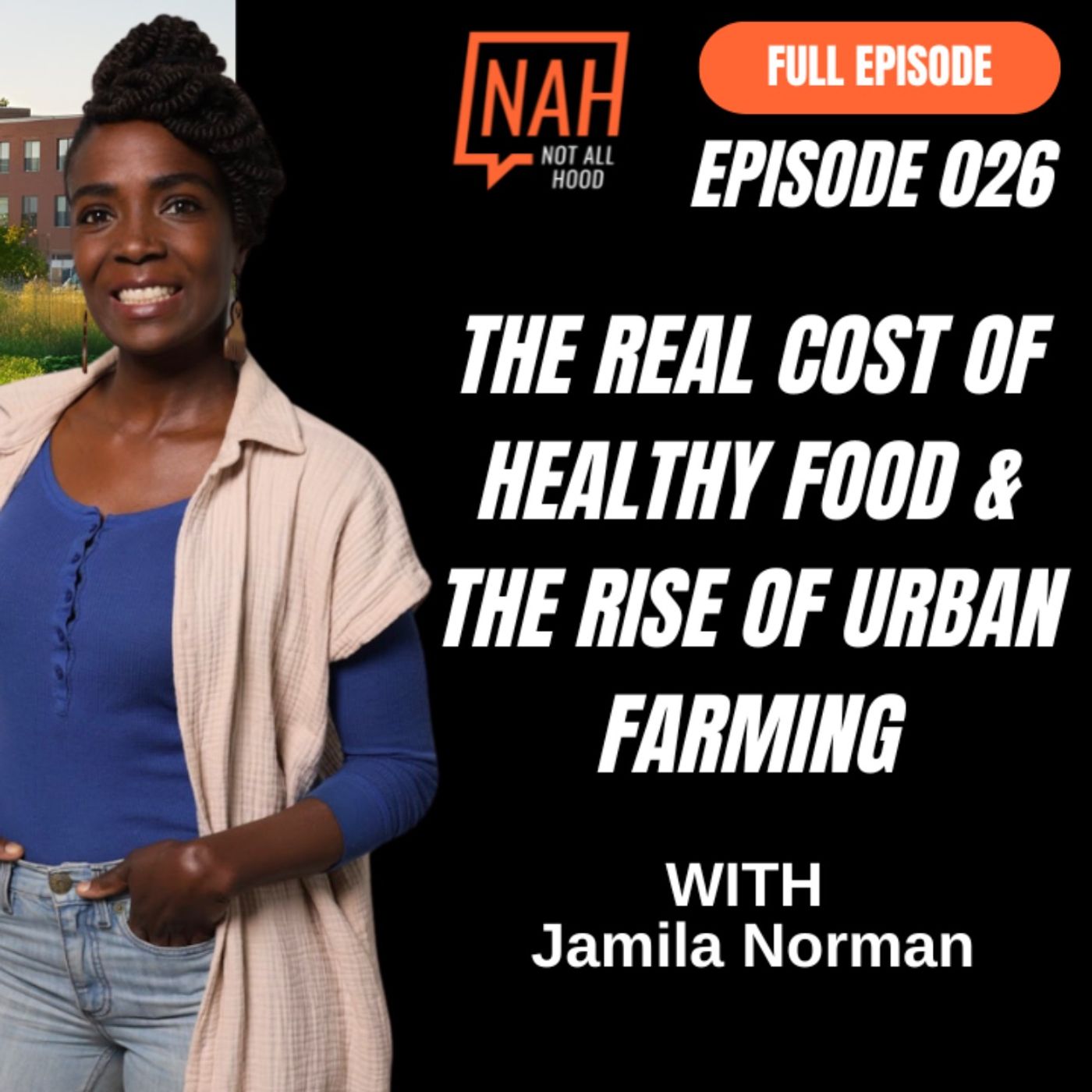
Not All Hood (NAH) with Malcolm-Jamal Warner & Candace Kelley
026 - The REAL Cost Of Healthy Food & The Rise of Urban Farming w/ Jamila Norman
01:10:57
In this enlightening episode of Not All Hood, Malcolm-Jamal Warner, Candace Kelley, and guest Jamila Norman—urban farmer, food activist, and host of HBO Max’s Homegrown—dive deep into the hidden costs of eating clean, the systemic erasure of Black farmers, and how corporate agriculture manipulates our food choices. Jamila shares her journey from growing up Caribbean to building Patchwork City Farms in Atlanta, fostering fresh food access and sustainable agriculture. The conversation unpacks how engineered foods, misleading plant-based options, and privatized food systems impact communities of color. The hosts and Jamila also discuss the importance of reconnecting with farming traditions, the challenges of urban gardening, why American grocery culture is broken, and how creating generational health through conscious eating is as critical as wealth-building. Whether you're a parent wanting healthier choices, an aspiring urban farmer, or someone rethinking their food habits, this epis...
Loading summary
Transcript621 lines
- [00:01]
Wix Advertiser
Running a business can be exhausting. Building your website shouldn't be. With wix, you can express your ideas, give direction, then leave the heavy lifting to AI, from site creation to branded content and images. Have fun with the details, customize what.
- [00:16]
Consumer
You want the way you want, and.
- [00:17]
Wix Advertiser
Manage your whole business from a centralized dashboard with expert AI tools. Build, scale and enjoy the incredible results. You can do it all yourself on on Wix. On WhatsApp, your personal messages stay private between you and whoever you send them to. So things like the passport numbers for your honeymoon stay between you and your fiance. And that video call for your gran's 80th stays in the family. Even your streaming password stays between you and your college roommates, who still ask for it every week in your group chat. Because on WhatsApp, your personal messages are yours. No one else can see or hear them, not even us. WhatsApp message privately.
- [01:00]
Jamila Norman
Look for quality. Right. It's not to say you can never eat a pizza because pizza is bad. Right. Because their countries, their whole culture is pizza.
- [01:09]
Consumer
Yeah.
- [01:10]
Jamila Norman
They're not walking around 4 or 500 pounds. Right. You have countries where like lots of meat, lots of, you know, dairy, lots of butter, lots of fat, pastas. All the things that we would say here in America, oh my God, stay away from that food because that food is bad. It's the engineered, it's the mass produced aspect of that.
- [01:39]
Podcast Host
Comrades, welcome to another episode of Nah, Not All Hood. Today we have Jamila Norman, urban farmer, food activist and host of Homegrown, which you can catch streaming on hbo. Max. She's the founder of Patchwork City Farms in Atlanta, growing organic fruits and vegetables for local markets and building fresh food access in her community. What I love about Jamila is she champions sustainable agriculture and empowers communities of color through urban farming. Today we dig into the real cost of clean eating, the roots of Georgia's red clay, and why plant based meats might not be as healthy as they seem. Stay with us. It's a conversation worth digging into. Sorry, I had to enjoy the conversation. The whole idea of like when I think of farmers, like, let me think of like black farmers, right? Just like we think of cowboys, we always think of farmers, we always think of cowboys as white.
- [02:39]
Jamila Norman
Yeah.
- [02:40]
Podcast Host
And it's like, I guess like, like everything what we've done has been co opted and become mainstream and become whitewashed.
- [02:50]
Consumer
Yeah. And I guess it depends upon where you're from. Right? Because if you're from down here and you've grown up with farmers, then your perspective is Different.
- [02:56]
Jamila Norman
Ye.
- [02:57]
Consumer
But if you're really kind of trained by the media, the media is gonna try to tell you it's just a white farmer thing.
- [03:02]
Jamila Norman
That's right. Yeah, exactly. Yeah, exactly.
- [03:05]
Consumer
But it's a big difference.
- [03:06]
Jamila Norman
Yeah. Very big difference.
- [03:07]
Consumer
Cause look at you.
- [03:08]
Jamila Norman
I mean, my family's Caribbean, so, like, you know, you live on the land. You know, even though great grandparents were the last to farm, it's like that story, that experience was always kept fresh for us. My parents, my mom, my dad, you know, we lived on the land. We was organic before that was organic, you know, all that, like. You know what I mean? Like. And they didn't get much from the stores, you know, So I knew I always wanted to, like, end up on some land somewhere.
- [03:44]
Consumer
Right, right.
- [03:44]
Jamila Norman
I didn't think I was gonna be a farmer. I thought, oh, I'll retire on, like, you know, big piece of property, grow some food, chill, you know, tend to my garden. And then farming found me much earlier in life.
- [03:57]
Podcast Host
I've always seen just growing up, like, just farming. Just the farming life is, like, that's just hard. I don't want to. I don't want to do that. Put that kind of work in. But now that I'm older and I have a daughter.
- [04:08]
Jamila Norman
Right, right.
- [04:09]
Podcast Host
And now that I'm way more conscious of what goes into the food and what we're buying and pesticides and all of that, I've been totally into, like, growing our own food.
- [04:22]
Jamila Norman
Right.
- [04:23]
Podcast Host
Like when Covid. When Covid happened. And again, you know, Covid was clearly. Was fucked up. Fucked up for a lot of people. But at the same time, it was also almost a godsend for people who knew how to pivot.
- [04:37]
Consumer
Right.
- [04:37]
Jamila Norman
Yeah, right. Exactly.
- [04:39]
Podcast Host
And for. So for us, we started doing. We started growing our own vegetables in our backyard.
- [04:44]
Jamila Norman
Right.
- [04:45]
Podcast Host
There was a school across the street because kids weren't going to school. We were using their plot.
- [04:50]
Jamila Norman
Yeah.
- [04:52]
Podcast Host
I don't know if you're familiar with the Wild Center.
- [04:54]
Jamila Norman
Yeah, yeah, yeah, yeah, yeah.
- [04:55]
Podcast Host
So we had applied at the Wild center so far. Oh, my God.
- [04:57]
Consumer
You're local.
- [04:57]
Podcast Host
Yeah, Yeah.
- [04:58]
Jamila Norman
I had no idea.
- [04:58]
Podcast Host
Oh, yeah, yeah.
- [04:59]
Consumer
No farmer Malcolm at the table. Shut up.
- [05:03]
Podcast Host
My wife's the farmer. I'm just like, the farmer, you know?
- [05:06]
Jamila Norman
Exactly.
- [05:06]
Podcast Host
I'm the founder, builder, Hammer Hair.
- [05:10]
Consumer
But, you know, it's interesting that you said, you know, oh, my goodness, a farmer's life seems kind of hard and committed. But, you know, growing up, because I guess my parents, since they were from the south, and I would hear, all right, and it Sounded very lovely to me. Like, my dad and I were early risers, you know, so it felt very natural. So when I was growing up, I always wanted to grow. And we grew some things like peppers and lettuce, those kind of quick six to eight week kind of turnaround things. And then as I got older, I wanted chickens. And my father was like, we moved here from the south to get away from. To get away. He says, do you. Because what I was trying to do, I was. I was trying to get it all together. Like, I was committed to the chickens. I said, all right, I get some chickens, but what happens when I'm away? All right, I'll ask my parents. They were like, who do you think you are asking to take care of your chickens?
- [05:59]
Jamila Norman
Right?
- [06:00]
Consumer
And I was like, well, yeah, just a little bit, you know, how. So my father, he sat me down, he said, and this is. I knew. He's like, remember I used to actually pick cotton in the South, Right. I used to actually, like, go through the things that you read about in the books. He was like, I mean, I would watch your chickens, but really, they're dirty. And, you know, we went through the whole process.
- [06:19]
Jamila Norman
Cause where were you?
- [06:21]
Consumer
New Jersey.
- [06:22]
Jamila Norman
New J.
- [06:23]
Podcast Host
Okay.
- [06:25]
Jamila Norman
But you know, it's funny because I'm originally from New York, and we grew. We. We woke up the chickens just about every morning. Because, I mean, it's a big immigrant community, and like, roosters are waking us up. And so people will try to bring some aspect of their culture with them. It doesn't matter where they are.
- [06:41]
Consumer
Exactly.
- [06:41]
Jamila Norman
You know, so chickens woke us up in Queens, you know, somebody's rooster. We didn't have much green space, but people, you know, they try to grow in a pot. They try to have something.
- [06:53]
Consumer
Yeah.
- [06:53]
Jamila Norman
You know, to remind them of, like, where they came from.
- [06:56]
Consumer
No, absolutely.
- [06:56]
Jamila Norman
Just to be connected. Yeah. I have friends who were like, their parents used to send them out and be like, you know, go pick some dandelion. They'll be like, finding wild greens, you know, in New York.
- [07:07]
Podcast Host
Wow.
- [07:07]
Jamila Norman
Like, because they're from the south and, you know, just go find.
- [07:10]
Consumer
Right. Just forage anyway.
- [07:11]
Jamila Norman
Just forage, right? Yeah. You know, because that's what they know, you know, so it's interesting how, like, even though we. We. We get violently snatched off the land. Right. Like, people still find ways to connect. And then you're, you know, like you said, your. Your parents or your grandparents are like, what. You're interested in this. Like, we ran away from this. And. And I think for me, especially being a Farmer in the south because my family, again, is Caribbean, so I don't have the black American Southern experience, you know, in terms of, like, sort of like, you know, what it was to be like in the south and then have to, you know, move. But what I try to explain to people was that black people did not leave the south because they didn't love the land. You know, that's fair, right?
- [08:01]
Podcast Host
Yeah.
- [08:01]
Jamila Norman
Yeah, right. Like, these are people who were enslaved and still wanted to farm after that, still wanted to make a living on the land. Still want. I mean, by the millions, you know, and it was a campaign of, like, you know, white violence, terror, all of that, that drove people to the north because it was not about trying to see black people make it, you know, after we just owned you. How dare you now out farm me? Well, dude, you weren't farming anyway.
- [08:35]
Consumer
Right, Right.
- [08:37]
Jamila Norman
Who don't be farming? You know what I mean? So, like, they were doing really well. They were amassing land, they were building communities, all of that. And, you know, white folks were just like, nah. And so it became like, we're going through these towns, y' all got to sunrise, and people just packed up what they had, and that's what drove them to the north, you know, so. But now I see a big transition of people coming back. Some people were able to keep family land, and a lot of people are coming back, and they're just realizing, like, that. That, you know, the. The story of, like, go to the big city and make it, like, it's been so hard. Like, I love New York, but New York is hard. Yeah. You know what I mean? Like, cities are hard. So people want to come back to the land. They're realizing, like, that connection is important, and also the.
- [09:28]
Podcast Host
The.
- [09:28]
Jamila Norman
The.
- [09:29]
Podcast Host
The necessity of it again.
- [09:31]
Jamila Norman
Yeah.
- [09:32]
Podcast Host
When you understand, you know, what goes into the food that we're buying.
- [09:39]
Consumer
Everything on the inside aisle.
- [09:41]
Jamila Norman
Right, Right. Yeah.
- [09:42]
Consumer
I mean, the outside is where the produce and the.
- [09:45]
Jamila Norman
Right, The. The. The basic good stuff is.
- [09:48]
Podcast Host
But even. But even. Even the produce now. Right.
- [09:51]
Jamila Norman
That's true.
- [09:51]
Podcast Host
Like, I remember. I remember Cat said to me, this is like, probably like 15, 20 years ago.
- [09:58]
Jamila Norman
Yeah.
- [09:58]
Podcast Host
And he said, when you go into the grocery, the produce section.
- [10:04]
Jamila Norman
Right.
- [10:04]
Podcast Host
You don't see any bugs on their vegetables. He's like, you don't want to be anywhere where you don't see any bugs on the vegetables.
- [10:14]
Consumer
I see.
- [10:15]
Podcast Host
Right, right. If they're putting all of this. Whatever they're putting into this, the produce to keep the bugs away. You're ingesting that.
- [10:23]
Jamila Norman
Yeah. Yeah.
- [10:24]
Podcast Host
You know, and there's a. So there is a, A. A necessity, I think, as people become more mindful.
- [10:31]
Jamila Norman
Right.
- [10:32]
Podcast Host
Realizing, you know what there. I'd be better off growing my own.
- [10:37]
Jamila Norman
Yeah, yeah.
- [10:37]
Podcast Host
Especially if I'm going to go to. Remember the. There was the documentary Food Inc. Yeah.
- [10:42]
Consumer
Yeah, I remember that.
- [10:43]
Podcast Host
And they did they. This section on this family when they went to. They went to the grocery store and a head of lettuce was like $3.
- [10:53]
Jamila Norman
Right.
- [10:53]
Podcast Host
And then they took that same family to Burger King and they were. And it was a family of four.
- [10:58]
Jamila Norman
Right.
- [10:58]
Podcast Host
And they were able to feed the whole family at Burger king for like $8.
- [11:03]
Jamila Norman
Right. You know, and those become the choices.
- [11:08]
Consumer
Right, Right. Yeah, absolutely. And then too, you know, they always say, okay, oh, well, my, my father or my mother had diabetes and it runs in the family. Or heart disease and it runs the family. But really it's the habits that run the family.
- [11:22]
Jamila Norman
Yeah.
- [11:22]
Consumer
You know what I mean? You're passing down, going to burger King or McDonald's. And so normally if you see somebody. I don't know if this is fair, but generally, if you have parents that might be big or, you know, eat a certain way, their kids normally follow suit as much as they don't want it. But it's the same types of food. I remember being down south and I had a cousin, we were in Mississippi, and she had what I thought was a tomato, and I had a cousin who ate a tomato. Like an apple, right?
- [11:50]
Jamila Norman
Yeah.
- [11:50]
Consumer
You know, lots of people do that and some people eat potatoes like that, too. I mean, when it's. When it's.
- [11:55]
Jamila Norman
Onions. Potato, onions. Southerners, boy, Southerners, okay.
- [11:58]
Consumer
They will make every.
- [11:59]
Jamila Norman
You know. Yeah.
- [12:00]
Consumer
But it was a pig's foot.
- [12:02]
Jamila Norman
Oh.
- [12:02]
Consumer
And I was like. I mean, I was so. I was little too. I was like, what is that? And she just was just loving it.
- [12:10]
Jamila Norman
I mean.
- [12:10]
Consumer
And honestly, it made me want it, too. I didn't eat it, but I was like, wow. But that was in her culture, right? To take a pig's foot and eat it like an app.
- [12:18]
Podcast Host
How old were you?
- [12:19]
Consumer
I was about 5 and she was about 7.
- [12:23]
Jamila Norman
Yeah.
- [12:23]
Consumer
And I remember.
- [12:24]
Jamila Norman
Yeah. I remember coming to Atlanta and, you know, seeing jars of pickled pick feed and people used to eat like pickles in class and just all kinds of interesting things. Yeah. And I was like, what is happening? You know what I mean?
- [12:37]
Podcast Host
Just a little bit of a country.
- [12:39]
Jamila Norman
Right. But, you know, I mean, but, but, but see, when we, when we talk about farms and we talk about healthy eating and we Talk about all of that. I think, you know, while I'm like pretty much 80, 80% plant based, like for a lot of people living on the land, like, meat is also part of that. And the meat that you eat, like, so people raise their own animals, they raise their own chickens, beef, cow, all of that pork. And when you raise your own animals and you feed them good stuff.
- [13:19]
Podcast Host
Yes.
- [13:19]
Jamila Norman
You know, and you know, what you're feeding, that's a very different type of meat than what you're getting in a grocery store. Yeah. So that's the other thing that it's like, that's part of the experience of having to try to, you know, educate people on, you know, because people feel attacked when you say, you know, meat, it's so bad, you know, and they're like, that's their culture. Like they grew up with that. Right. And so we're not trying to demonize eating meat, but you have to understand the meat your grandparents ate is not the meat that is on the store shelves today. Like, and the clarification. Oh yeah, it's not so.
- [13:54]
Podcast Host
Yeah, it's not, it's not, it's not so black.
- [13:57]
Jamila Norman
Right.
- [13:57]
Podcast Host
It's how the meat's, it's where you.
- [13:59]
Consumer
Bringing your meat from? Right.
- [14:01]
Jamila Norman
And it's how it's raised. It's full of antibiotics, it's of. Full, full of growth hormones. It's full of just like. I mean, you don't want it up.
- [14:11]
Podcast Host
Yeah. Eating healthy is, is unfortunately, it is a luxury.
- [14:15]
Consumer
It is.
- [14:15]
Jamila Norman
Yeah.
- [14:16]
Consumer
It literally is expensive luxury.
- [14:18]
Podcast Host
There are two. We get our meat from butchers. So there are two different butchers we go to. So the meat we get is grass fed. Like it's, it's. I can't think of the word right now.
- [14:28]
Jamila Norman
Pastured.
- [14:29]
Podcast Host
Pastured.
- [14:29]
Jamila Norman
Pastured.
- [14:30]
Podcast Host
But what is ethically. Ethically grown? Yes, but that is, and we've only said that that's. It's expensive. But my wife has actually done the comparison. So you get, you know, you get a whole chicken from Whole Foods. Yeah, it's not much more. I mean, it's, it's, it's, it's, it's not much less than getting that same whole chicken. Not the same whole chicken, but getting a whole chicken from a butcher we go to. So it's worth the drive to go to the butcher, then go to Whole Foods if I'm only, if, if, you know, if I'm spending, you know, a dollar more.
- [15:06]
Jamila Norman
Right.
- [15:06]
Consumer
No, it is, but it is, but.
- [15:08]
Podcast Host
It is a luxury.
- [15:09]
Jamila Norman
Yeah.
- [15:09]
Podcast Host
To be able to eat Healthy and eat clean. I think part of it is it's designed that way.
- [15:14]
Jamila Norman
It is designed that way. And the interesting thing is it's also very American. Like, when you travel globally, like, people shop every single day, week for their fresh vegetables, for their fresh meat, for the like. What we see as a luxury is just a way of life for a lot of other people, Right?
- [15:33]
Podcast Host
Yeah.
- [15:34]
Jamila Norman
And. Exactly. It's a system that's been designed to where now that becomes inaccessible just to, like, eat fresh.
- [15:45]
Consumer
Yeah.
- [15:45]
Jamila Norman
And what we're marketed is all the processed fast food. This is that. And the other. That's what. But. But the other thing is, like, grocery stores. And the whole concept of grocery stores is only like, maybe 40, 50 years old. Previous to that, people were shopping from their butcher, their baker, you know, the local farmer coming into markets. So, like, there was a whole culture shift in how you're shopping, who you're connected to, moving away from rural communities, concentrating people in cities, you know, all of that. So it just divorced you from the whole process. You know?
- [16:21]
Consumer
Comrades, if you're enjoying this episode, join the conversation and make sure to, like, share, subscribe and comment below. Na, na na.
- [16:29]
Podcast Host
Is there a black farmer's market in Atlanta?
- [16:32]
Jamila Norman
There is not a black farmer's market because there's not that many black farmers. But you will find black farmers at local markets.
- [16:39]
Consumer
Yeah, yeah. Like doing their own thing, but not.
- [16:41]
Jamila Norman
On a very large. Large scale, because, I mean, again, we in this country were almost a million black farmers. And now I think the last census that came out, they did 2000. They do agricultural census kind of like every 10 years.
- [16:55]
Consumer
Yeah.
- [16:58]
Jamila Norman
And 30. 32,000 in the nation.
- [17:02]
Podcast Host
Really?
- [17:03]
Jamila Norman
Yeah. So.
- [17:06]
Consumer
And then along with that comes the loss of land.
- [17:08]
Jamila Norman
Exactly. So loss of land, all that. So, I mean, so very dispersed. And a lot of farmers are in rural communities. You know, everybody's rural.
- [17:19]
Consumer
I remember going once to Whole Foods, and it was for a funeral or, you know, you went to Whole Foods for a funeral. Sorry. Yeah, that didn't come out right. I did not go to Whole Foods for a funeral.
- [17:31]
Jamila Norman
You know, I was like, we should shop in for the funeral, baby.
- [17:35]
Consumer
And I told my sister, I will get, you know, the food that we're gonna pick up. And I said, I'll get. I'll get some ham. And so went over and they were. I was on the phone and they were slicing the ham. And when I got to the car, it was not pink. It was not the black people's ham that we know. Do you know what I'm Saying it was, I guess it was not processed in a way, it was more brown. But in other words, I mean, it made me realize how much the food, like a ham that we get, you know, like that solid ham that you get is processed well. And obviously because ham, you know, pigs.
- [18:08]
Jamila Norman
Don'T look that way.
- [18:08]
Consumer
They're not that contained and all the same size, but it was not the same color. It was processed in a different way. I mean, I have, I haven't eaten ham since I was like, wow, you know, that was a lot just to see the whole process and how different it is depending upon whose hands it's in.
- [18:24]
Jamila Norman
Right.
- [18:24]
Consumer
And I did not bring it to where I was going.
- [18:29]
Jamila Norman
She's not getting handed.
- [18:30]
Consumer
No, I say it. No, I could not, I couldn't. No, no. I could not explain what it was. But it was from Whole Foods, but it was not processed in the right way in the same way. The other thing that kind of gets me is, you know, people who are vegan, but then they get that, that meat, what's that meat called? Thank you. Start shaking your head and it bleeds.
- [18:52]
Podcast Host
Oh, yeah, yeah.
- [18:53]
Consumer
And you cook it.
- [18:54]
Jamila Norman
Nope.
- [18:54]
Podcast Host
Should we not say the name company?
- [18:56]
Jamila Norman
No, I'll name all the companies and then I don't do it.
- [19:00]
Consumer
And as I was cooking it, I was so confused. I was like, why is it bleeding? And then why am I trying to eat a meat replacement anyway?
- [19:09]
Jamila Norman
Why are we trying to make vegetables bleed?
- [19:10]
Consumer
Why are we trying to make. Yeah, it didn't make any sense.
- [19:12]
Jamila Norman
No.
- [19:12]
Consumer
Yeah, yeah, yeah, yeah.
- [19:14]
Jamila Norman
That, that is my, my problem with some of the vegan propaganda right now. I'm going to call it propaganda.
- [19:23]
Podcast Host
Yeah, that's fair.
- [19:24]
Jamila Norman
Yeah, there's definitely some propaganda. And, and the thing again, that's a movement that's been co opted, right? Yes. There's a lot of greenwashing in that industry. So for a company like Impossible Burger to be like, oh, we have this vegan burger that's a GMO based technology where we, you know, they have created a process where vegetables are now able to produce hemoglobin. Hemoglobin is in blood, right?
- [19:58]
Podcast Host
Yeah.
- [19:58]
Jamila Norman
Right. Vegetables produce, you know, chlorophyll, photosynthesis. So that's what vegetables do. Anything in the animal kingdom does hemoglobin. So they have engineered soybeans to produce hemoglobin because they've injected fish genetics into the soybeans. And so that's, that's the flavor. That's what gives meat its flavor. And then, then you package it with 20,000 other ingredients, so extremely processed. And then you like, oh, we have this burger that's plant based, that can. No, it's not. It's.
- [20:35]
Podcast Host
Right. The problem.
- [20:37]
Jamila Norman
Eat some. Go eat a black bean burger. Like they've been veggie burgers made from all kinds of vegetables on the market that you can also make yourself for like 50, 60 years. But all of a sudden, like, this is the thing and they, and they're, you know, people, people need to pay attention to what the market. And it's for Impossible Burger markets to meat eaters. That's really their audience. They're trying to get meat eaters to feel like, oh, I can use this as a replacement to meat sometimes. It really is not for plant based. You know what I mean? That's really their market. And then everything that I just found out that I just told y' all about Impossible Burger is on their website. Gotta do a little reading, gotta do a little digging. They got videos, they're like, this is what we do. We're in the lab and we've got big vat of soybeans and here comes blood out of the soybeans. And then we put that in our burger and people are just like, oh, wow, that's. It's so plant based. And I'm like, it is not.
- [21:39]
Podcast Host
You're better off eating the burger, right?
- [21:41]
Consumer
Yeah.
- [21:41]
Jamila Norman
You're better off eating clean meat. And that's what I tell people when people are like, what should I'm like, eat clean meat, please don't go buy. If you want to eat meat, go eat good meat.
- [21:50]
Consumer
It's like the vegan with the oreo. I thought you were vegan. Or it is. And you're like, it is.
- [21:56]
Jamila Norman
But wait, come on, come on. What are we doing? What are we doing? Yeah, like, are we vegan? Just to say we're vegan. Are we vegan because we're trying to be healthy? Because if you're trying to be healthy, you're not eating all that. I don't now need to know that, you know, ho ho's and dumb dumbs and all that is vegan. So I could just be like, oh, no, I'm vegan, right?
- [22:13]
Consumer
I feel better about myself, but still have the health concerns, still have all.
- [22:18]
Jamila Norman
Of the issues, right? Because what are we trying to do? Are we trying to heal ourselves? Are we trying to get better? Are we trying to be our best selves?
- [22:26]
Podcast Host
But if we get. There are industries that are there for. There are industries that will go out, go out of business, they will collapse Right. Really lived a healthy lifestyle and eating healthy. Like there's.
- [22:40]
Jamila Norman
But there'd be lots more industries that will be servicing us in those healthy ways. You know what I mean? Like, I mean, if, like a transition's gotta happen, you know, we can't be like, oh, well, they're gonna go out. Well, honey, pivot with the times, you know, like if people no longer want a thing, industries pivot. That's why big ag pivots.
- [23:02]
Podcast Host
Sure.
- [23:02]
Jamila Norman
But they saw a vegan was rising and it was 10, 15% growth rate every year, they said, oh, we can do that. We can offer you all something vegan, you know, we can offer you all plant based. That's what you're saying you want, but highly engineered.
- [23:18]
Podcast Host
Sure.
- [23:19]
Consumer
Yeah. The question of economics, though, comes up too.
- [23:22]
Jamila Norman
Yeah.
- [23:24]
Consumer
But then on a farm, I'm just wondering if I wanted to go full fledged and turn my backyard into a farm, would the economics add up? Would the, you know, depending upon what I grew, vegetables are expensive. Now I'm one of those people who, when I shop, I go two and three times a week. I like going shopping.
- [23:43]
Jamila Norman
I like you looking at me like.
- [23:45]
Consumer
Oh, okay, that was.
- [23:46]
Jamila Norman
Especially if you're shopping. Sorry.
- [23:50]
Consumer
You know, I mean, I, I like the, you know, most people when they go, when they, they. Well, I know I do. You go. If you're looking for someplace to live. The first place I want to know, besides the dry cleaning is who are the grocery stores around me? Because I, you know, some of these stores have really made it an experience. You know, you go to Wegmans or if you. Or Trader Joe's. Two totally different experiences. And then Whole Foods too. So I like the experience of going to the grocery store every day. Plus I find that when I buy vegetables, I do not use them quick enough and I hate for them to go bad.
- [24:23]
Jamila Norman
Exactly.
- [24:24]
Consumer
Yeah.
- [24:24]
Jamila Norman
Yeah.
- [24:25]
Consumer
But I really am wondering, what if I wanted to really go home today and begin transforming my backyard into a full throttle farm? Full throttle. Just place for where I could go.
- [24:39]
Jamila Norman
Out, get a potato, get a, get.
- [24:42]
Consumer
A green pepper, get some herbs. Right. Like you and your wife did. Is that a possibility for me? Like, I mean, I know it's a big feat.
- [24:51]
Podcast Host
You know, how many people does it.
- [24:53]
Consumer
Take and how many people does it take? Right, right, right. So, I mean, my husband's gonna be mad at me. Cause I'm gonna be like, you gotta get up too and do this.
- [25:00]
Jamila Norman
Yeah, yeah, yeah. You know, it is work. You know, it's funny, like, following people on social and they're like, you know, like, my girlfriend's into, like, you know, designer bags. They're like. But my wife is into, like, gardening. And the thing you're saying is you're gonna spend a lot of money. Like, you think, oh, we're gonna grow our own vegetables. All people think are, like, seeds and soil, and they think, that's it.
- [25:25]
Consumer
Yeah.
- [25:26]
Jamila Norman
And you're like, you gotta water it. You got, like, there's, you know, you gotta fertilize. Like, sometimes it don't all make it.
- [25:34]
Consumer
Yeah.
- [25:34]
Jamila Norman
And you know what I mean? There's loss. There's. You know, so there is. There's gonna be an upfront cost, and there's. You're gonna need to work. You gotta put the work in. You know what I mean? Like, it does not grow itself. This idyllic sense of, like, oh, vegetables.
- [25:56]
Consumer
Are just out there.
- [25:57]
Jamila Norman
You just put the seeds and they just grow. And I just go and, you know, have a Disney princess moment and just.
- [26:02]
Consumer
Pick it and take your Instagram pictures and you're good.
- [26:06]
Jamila Norman
Put in the work. And it is a. The payback period is a little bit long. So I get a lot of people that reach out to me because I have the show. And, you know, we do all these transformations. I will say, like, average. First of all, we advertised that we needed you to spend a minimum 40,000, but the average transformation took us about 60, 70, 80. Some people were spending over a hundred thousand American dollars. Yes.
- [26:33]
Consumer
Okay.
- [26:34]
Podcast Host
And how big of a space we're talking about?
- [26:36]
Jamila Norman
We talking about a backyard.
- [26:37]
Consumer
Talking about a backyard.
- [26:38]
Jamila Norman
Yeah. You know, but it's like setting up all that infrastructure so, like, Atlanta has a lot of trees. You cannot grow vegetables under trees.
- [26:47]
Podcast Host
That was our problem with our garden.
- [26:48]
Jamila Norman
You do, like, you need full sun.
- [26:52]
Consumer
I see you were saying that with the shade.
- [26:54]
Jamila Norman
So. Yeah, sometimes. First thing we had to do was clear some trees.
- [26:58]
Podcast Host
Yeah.
- [26:58]
Jamila Norman
You know how much it is to clear one tree?
- [27:00]
Podcast Host
Let me tell you, something.
- [27:04]
Jamila Norman
Got deep and gutter.
- [27:06]
Podcast Host
We have oak tree in our backyard. And, you know, where we live, there's an ordinance. You can't cut down oak trees.
- [27:11]
Jamila Norman
Right? Oh, really? Yeah. I mean, they're magical trees, but, I mean, so you're having a. Get some sun. So we always encourage people. Well, we could put the garden in the front yard, but nobody wants it in the front. You know, everybody wants to put baby in the back. I'm like, stop trying to put the garden in the back. Like, you trying. Like, you ashamed of it. Full sun. Like, so you need full sun. And then people might have to do some grading. You know, sometimes, like, things are hilly. Irrigation, drainage, all of that. You know, you can't plant in the area that's just gonna have a lot of water. Like, it's just gonna suffocate. Your plants, they're not gonna grow well. So it was just like, all of that stuff. And then if you want it pretty and you want the raised beds and, you know, your compost area and all of that, like, it adds up. So you had.
- [27:59]
Consumer
You had me up until. This is where I leave you.
- [28:03]
Jamila Norman
And when you start and then you just realizing, like, oh, I need to go get this, and you're like, just. I mean, I gotta get tools. I gotta get.
- [28:10]
Consumer
Yeah.
- [28:11]
Jamila Norman
I'm like, this stuff is expensive.
- [28:12]
Podcast Host
Yeah.
- [28:13]
Consumer
But I guess little by little, you.
- [28:14]
Jamila Norman
Know what I mean?
- [28:15]
Podcast Host
More compost.
- [28:16]
Consumer
Yeah. Right, right.
- [28:17]
Jamila Norman
How much. How much is compost?
- [28:19]
Consumer
Right? And yesterday we were talking about the fact that, you know, the deer and the fox come. I have seen. I've seen my neighbors, and they defend this.
- [28:29]
Jamila Norman
I'm telling you, it's like, oh, my goodness. Never felt so, like, connected to Bugs Bunny and Elmer Fudd and all of that.
- [28:39]
Podcast Host
It makes sense. It totally makes sense.
- [28:40]
Jamila Norman
It makes so much sense. You're like, I want to get a shotgun. Yeah.
- [28:45]
Podcast Host
Like Peter Rabbit. I finally understood Peter Rabbit.
- [28:47]
Jamila Norman
Right? You finally understand Peter Rabbit, and you finally understand all these things, and you're like, the animals just come out of nowhere. Like, right now I am right now. Last couple nights ago, I'm googling deer fence, trying to figure out critter. Like, critter borders. So I got to get rabbits out of there. Groundhog. Not groundhog. Moles. They come from underneath. They come from underneath.
- [29:12]
Consumer
Oh, but two words. We talked about this yesterday. Fox pee. What am I gonna find? I understand you can buy it.
- [29:20]
Jamila Norman
The Internet, man.
- [29:21]
Consumer
And then I said to myself, how they getting it?
- [29:24]
Podcast Host
I heard it's probably. Some of. It's like, genetically, I can't.
- [29:28]
Jamila Norman
I can't. I can't with the Internet. It's too much information out there. But, yes, I've heard.
- [29:33]
Consumer
Yeah.
- [29:33]
Jamila Norman
You know what up.
- [29:34]
Consumer
I was in service one day, and the p. The pastor was talking about something he was talking about.
- [29:39]
Jamila Norman
Yeah. People say, I've seen the Internet say you can use fox pe. I mean, how do you get. Depending on how.
- [29:45]
Consumer
How do you even get it?
- [29:46]
Jamila Norman
How real you want to keep it?
- [29:47]
Consumer
Yeah, yeah, yeah.
- [29:48]
Jamila Norman
So, you know, we're animals, too.
- [29:50]
Consumer
Yeah.
- [29:51]
Jamila Norman
So you.
- [29:52]
Consumer
You.
- [29:52]
Jamila Norman
You can go. You can go. You can go lay out your scent on the perimeter. Too.
- [29:58]
Podcast Host
Never thought of that.
- [30:00]
Consumer
No.
- [30:01]
Jamila Norman
We already ate like a predator, so.
- [30:03]
Podcast Host
You can go, well, that's real. You just threw some real.
- [30:06]
Jamila Norman
Whoa. I mean.
- [30:07]
Podcast Host
Yeah, okay.
- [30:08]
Jamila Norman
You know, we were talking about it at the farm the other day. I was like, bro, you might have to go and hit the corners of the woods, because these deer are eating up my food.
- [30:16]
Consumer
Yeah.
- [30:16]
Jamila Norman
But. Yeah, you know, and they are bold. Oh, they don't care. But you got to keep it up, though, if you're gonna do this, because after the rain washes the sun, toss. So you.
- [30:26]
Podcast Host
It's a lot of work.
- [30:26]
Jamila Norman
That's a lot.
- [30:28]
Podcast Host
And that was our experience. It's a cute idea.
- [30:31]
Jamila Norman
It's cute.
- [30:32]
Podcast Host
You know, and again. And during COVID it was great because it was just the three of us.
- [30:36]
Jamila Norman
Yeah, right.
- [30:37]
Consumer
And the time.
- [30:38]
Jamila Norman
And you had that, too.
- [30:39]
Consumer
Time, time.
- [30:40]
Jamila Norman
That was the thing. And that's. And I think for my show especially, that's why it kind of went almost a little bit viral, because it was. We launched. First of all, we filmed during COVID During COVID Yeah. And then that was a time where a lot of people were at home. A lot of people were like. I mean, health was so such a big, you know, concern, and people, oh, we got to grow our own food. And it came out at that time, and so it was just, like, perfect timing. And then people just, like, went bananas. You know what I mean? The interesting thing is the production company that I shot with, she said she had pitched that show idea years before, and they was like, nobody wants to see anybody garden, like, garden to turn anything into a farm. Because she worked a lot in home and garden space, and she was like, oh, we transform people's, you know, inside their houses, or, you know, we'll flip a front yard. She's like, why don't we flip it into food? And of course, they were like, what are you talking about? Nobody wants that. And then pitched it again years later, you know, to the right network at the right time. And then, of course, people were like, yeah, but, yeah, I mean, growing food now, there is also an inexpensive way to do things, but it just means a lot of labor.
- [31:55]
Consumer
Okay?
- [31:55]
Jamila Norman
So there's, you know, I mean, it's like, you can use the soil in your backyard, right? Like, you can go and, like, dig up until the virgin soil and, you know, add compost and things like that. And don't have raised beds and, you know, go out there with your watering can. But, like, you know, it's time, time, time and money.
- [32:15]
Consumer
Yeah.
- [32:15]
Jamila Norman
You know what I mean? Those are the kind of two things that you're sort of traded. And then, you know, when you do it in that way, it also takes a longer time because we just got clay out here in Georgia, all the top solids in the Mississippi river, you know, back when, you know, they got us off the land and then they tried to farm themselves, didn't know what they was doing, and all that topsoil just blew all the way over to the Mississippi river, you know, and that's why. That's what. Yeah. And so then we got. Right, look. Wow.
- [32:50]
Podcast Host
You know, it makes so much sense.
- [32:51]
Jamila Norman
Yep. Then we got all the ag universities. And so when you hear Martin Luther King have that speech where he was talking about, you know, and then. And then the US government came in and, you know, and they created schools to teach them white farmers how to farm. Then they gave us this. This was after they kicked us off the land and sent us up north. And then they tried their hands at it and just, Just raped the land. Just. It was that. That's why we have no topsoil in Georgia. We're at the clay layer. You go up north, New York. Oh, my God. The soil up there, amazing. You know what I mean? Farmers up there, like, they did. It's just black soil, you know, like certain parts of the country that hadn't experience that extractive agricultural practice.
- [33:36]
Consumer
So New Jersey is the Garden State.
- [33:38]
Jamila Norman
So I'm feeling a little ahead.
- [33:40]
Consumer
That's where I'm from.
- [33:41]
Jamila Norman
Yeah. Yeah.
- [33:42]
Consumer
Okay.
- [33:42]
Jamila Norman
They used to have huge greenhouses. They grew a lot of flowers in New Jersey back in the day. But we've exported a lot of local floral growing to other countries, and now they're trying to rebuild that. That industry back in the US but so much.
- [34:00]
Podcast Host
There is something about. Again, it goes back to the luxury, though.
- [34:04]
Jamila Norman
Yeah.
- [34:05]
Podcast Host
In terms of supporting local farmers.
- [34:07]
Consumer
Yeah.
- [34:07]
Jamila Norman
Yeah.
- [34:08]
Podcast Host
We get a lot of our vegetables from like, fresh harvest.
- [34:10]
Jamila Norman
Yeah.
- [34:11]
Podcast Host
You know, where you, you actually getting vegetables from the farm. They get delivered to you.
- [34:16]
Consumer
Yeah.
- [34:16]
Podcast Host
But again, that's an expense.
- [34:18]
Jamila Norman
It's an expense.
- [34:19]
Podcast Host
It's, It's.
- [34:20]
Consumer
I have done this. I have shared it. I mean, well, one, the expense to just. When you go and you get these. Oh, it's escaping me where you go and you, you, you, you get fruit and, and vegetables.
- [34:34]
Jamila Norman
Like a vegetable subscription program. Like a csa.
- [34:37]
Consumer
Exactly.
- [34:37]
Jamila Norman
Yeah.
- [34:38]
Consumer
But it was so much that we split it.
- [34:39]
Jamila Norman
Yeah.
- [34:40]
Consumer
Just so much stuff.
- [34:41]
Jamila Norman
Or that we lose it.
- [34:42]
Consumer
And that was nice. And it's actually. They give you whatever. You don't know what it is.
- [34:46]
Jamila Norman
Yeah, it's whatever is in cd. Yeah.
- [34:47]
Consumer
And it's just like, I mean, there are a couple things I'm like, I don't even know. Okay, this is a rutabaga. Okay. Like, do I have a recipe for a rutabaga?
- [34:53]
Jamila Norman
Right. You know what I mean?
- [34:54]
Consumer
You have to go to the Internet. And that was fun going through that process and figuring out, all right, how do I get the hodgepodge of everything that is grown from the land and make it work? Because you really can make it work. And it was a healthier process and choice.
- [35:09]
Jamila Norman
Yeah. It's a commitment and a lifestyle, you know what I mean? Even though like we used to say to people at market, I'm like 15 years in this year, which is a little bit mind blowing to me farming, but we used to say, look, you can pay us or you can pay your doctor. You know what I mean? It's gonna be way more expensive. So it is a, it's a choice. Like, you know, definitely for some people it is a luxury, you know. And so we also participate in programs where like we make sure we accept EBT in every market that we're at. And then there's a couple or there's some organizations that we work with that makes. Where if you're spending your ebt it's like 50% off. So it's like half price. Like, so we try to create opportunities for like where it's accessible and price is not an issue for people. You know what I mean? So try to make things affordable. But again, like you were saying, even with the meat, like when you do the calculation over time, you are saving more and you are getting a better quality. Right. Shopping at Whole Foods is expensive. If you're thinking, I'm going to transition if they, I'm going to just go shop, I like a whole food or something like that. Yeah, you just coming out of pocket on stuff. But if you go to your local farmer's market right around the city and more and more are popping up and you're buying things in season, you end up having a lot less food waste because it's fresher. It doesn't go bad as fast. Like people will be like, I bought that from you and that thing lasted like two weeks in the refrigerator. It lasted like three weeks, you know, because it's literally picked a day or two ago.
- [36:55]
Podcast Host
Sure, right. So.
- [36:56]
Jamila Norman
So it's much fresher. Right? So it's fresher, it lasts longer, it's better for you. But you also have to be committed to know how to, like, cook.
- [37:05]
Consumer
Right.
- [37:06]
Jamila Norman
With fresh ingredients. Yeah. You know, and then, you know, some people also go into, like, you know, if you. Let's say right now, we're very abundant in greens. Oh, my God. It's like collards and kale. Like, it's just. This is the season, Springtime. All the greens are just abundant.
- [37:24]
Consumer
I got to come see.
- [37:25]
Jamila Norman
Go buy. You know, I mean, you buy a bunch of it if you have the space. Like, cut it up, stick it in the freezer. Like, I'm still eating some things that, like, I put away, you know, from last year, you know, so it's a whole lifestyle shift, you know, but if you're just like, ooh, I'm gonna just throw a little healthy on top of, you know, what I already be doing.
- [37:49]
Podcast Host
You know, I'm gonna drink this Diet Coke with these fries.
- [37:53]
Jamila Norman
Burger and fries. Let me put a little leak beef.
- [37:56]
Consumer
Oh, my.
- [37:57]
Jamila Norman
You know, Triple bypass burger.
- [38:01]
Podcast Host
We're actually triple bypass.
- [38:04]
Consumer
There. There is this place out in. Maybe y' all know it, it's out in Las Vegas. And it is called. It's not called triple bypass, but it's something like that. It's a playoff of word off of a heart attack.
- [38:17]
Jamila Norman
Yeah. Yeah.
- [38:17]
Consumer
And they come. They come in and you. You get on a scale, and if you weigh over 450, your food is free. Like, it's a whole thing.
- [38:25]
Jamila Norman
All. All the.
- [38:27]
Consumer
The waitresses are dressed.
- [38:28]
Jamila Norman
I think it's like something coronary, something corn.
- [38:31]
Consumer
Yeah. All the wages are just like they're at a hospital. But it's a whole thing. And all the food is big and, you know, a thousand calories a plate. I can't remember, maybe somebody if you're over 450. Yeah. Something around, and you get up on a scale in front of everybody.
- [38:47]
Jamila Norman
Oh, my.
- [38:47]
Consumer
But, you know, that's just. That's just our culture. We have such big. We do have big offerings and servings.
- [38:54]
Jamila Norman
We waste. Yeah. Food. Waste a lot of food. Yeah. Yeah. And again, that's changed. Yeah. You know, that's changed over the years, too. Super size me. Make it big. That's, you know, the American way. Everything's bigger and better and bigger and, you know. But. Yeah, it's crazy.
- [39:11]
Consumer
Yeah, it's crazy.
- [39:13]
Jamila Norman
It's crazy.
- [39:14]
Podcast Host
We're actually seriously considering. With another families, really, really close friends. They've got a lot of space in their backyard. We're really considering investing in a greenhouse.
- [39:26]
Jamila Norman
Yeah.
- [39:27]
Podcast Host
You know, because of. Because of where they are. They're, you know, they're deer and their Father.
- [39:30]
Jamila Norman
Yes.
- [39:31]
Podcast Host
And whatnot. So we're like, we're, we're. My wife is doing the research now. Greenhouse.
- [39:36]
Jamila Norman
Yeah.
- [39:37]
Podcast Host
And you know, we understand it's a lifestyle.
- [39:42]
Consumer
Yeah, that sounds like a real big, you know, change and investment.
- [39:46]
Jamila Norman
Invest.
- [39:47]
Podcast Host
Yeah. Hey comrades, if you are enjoying the episode, join the conversation. Like subscribe. Leave a comment below. Don't get yourself blocked.
- [39:56]
Consumer
Keep it clean with the greenhouse. So before I go to YouTube University. So you have the greenhouse, which specifically is for what as opposed to an outside garden. What's your idea about what you want to do?
- [40:10]
Podcast Host
It's enclosed.
- [40:11]
Jamila Norman
It is, yeah.
- [40:12]
Podcast Host
So. So it would, you know, to help to prevent the animals.
- [40:16]
Consumer
So it's mainly just an animal thing. But I thought there were some things that you just grow in a greenhouse. Or am I wrong about that?
- [40:21]
Podcast Host
Yeah, I think, I think that's the point. Growing it in the greenhouse to keep the.
- [40:26]
Jamila Norman
So, yeah. So I mean, what a greenhouse, definitely you have an enclosed structure.
- [40:29]
Consumer
Right.
- [40:30]
Jamila Norman
You know, they haven't figured out how to open doors just of yet, you know. Right, right, right, right. You know, with that. But then also you'll be able to grow things longer and earlier. Right. Because. Because of the season, you know. Right. Because now it's keeping things warmer than just being outdoors. Right?
- [40:49]
Consumer
Yeah, yeah.
- [40:50]
Jamila Norman
So a little different. So. Yeah.
- [40:52]
Podcast Host
So you know, that's what we're, that's. That's the, that's where we're.
- [40:55]
Jamila Norman
Yeah. Because you can. Y' all thinking like a big beautiful.
- [40:59]
Podcast Host
Well, I have. What kind of. We're, we're doing research now. I know. We're doing the research now.
- [41:03]
Jamila Norman
Yeah.
- [41:04]
Consumer
She's about to make you an episode.
- [41:05]
Podcast Host
What's the cost effectiveness?
- [41:07]
Jamila Norman
Uh huh. I'll.
- [41:08]
Podcast Host
I'll put you there. For my wife.
- [41:11]
Jamila Norman
Yeah. I'm like, not. Because I've like when I lived in Athens, I had a friend, his dad had a greenhouse. I mean they had money. This greenhouse was gorgeous. I mean he was pulling out tropical fruit. He had a. You know, because most like greenhouses. So there's like passive. Right. A passive greenhouse where you're not adding any heat or anything like that. It's just like sun's coming in, heating things up. But if it gets really, really cold, it's. Eventually it's going to be cold inside. I mean it only can keep it warm to a certain level. Then there's like actively heat in the greenhouse where you have heaters in there, whether it's electric or something like that. And that way you maintain a certain temperature all year long, no matter What? And so he had this huge greenhouse and instead of buying like regular heaters, he had a fireplace. Really? Like heated wood in the winter.
- [42:06]
Consumer
Oh, yeah.
- [42:07]
Jamila Norman
You know, he had like a little creek running through it. Yeah. You know, oh, you got money. You can build all kinds of things. So it was just like this little mini, Just magical place. Like, man grew everything in that greenhouse. But the possibility. That's six figures.
- [42:25]
Podcast Host
Okay.
- [42:25]
Consumer
Yeah, yeah, yeah.
- [42:27]
Jamila Norman
But yeah, I mean, there is a spectrum of kind of like what you want to create. Sure. You know, and what you want to invest in.
- [42:35]
Podcast Host
Yeah, we probably. We probably won't have the.
- [42:36]
Jamila Norman
Yeah, yeah, probably not that.
- [42:38]
Consumer
No fireplace, mountain.
- [42:41]
Jamila Norman
Wood and feed to keep your plan.
- [42:43]
Podcast Host
I love the idea.
- [42:45]
Jamila Norman
Doesn't it sound just.
- [42:49]
Consumer
So you know, YouTube University will teach a lot of people a lot of things. I know that you self taught also.
- [43:00]
Jamila Norman
Yeah. Reading. Reading is fundamental. I grew up reading rainbow. Read a book, people.
- [43:05]
Consumer
LeVar Burton strikes again.
- [43:08]
Jamila Norman
Strikes again. Always. He's never out of a.
- [43:13]
Consumer
Yeah, first.
- [43:14]
Jamila Norman
No, like, seriously, like, I knew again. I love the outdoors. I grew up like Captain Planet. I grew up with like, I just, I just loved outside. And I went into environmental engineering because I really wanted to be like, you know, I wanted to hug trees and save the world from pollution and all that. I was like a tree hugger. Greenpeace, all of that. That was me from day one. And I knew I was gonna land on some property somewhere and I was gonna be growing some food and just being a Disney princess, you know, with all the animals. And so I used to just read gardening books like people read novels. I just, you know, just consuming information, you know, putting it in there for, you know, when I retire. And yeah, so I, I have a. Actually, I'm like launching on my social, the series of like my favorite garden of books right now. So if people are like, well, what. What are some good books? If I want to start a garden, go to the Instagram, go to the newsletter, whatever. But yeah, so I just consumed all of that. And then once I started, just kind of connected with other farmers and YouTube University, they're like, really? I mean, literally, there are some good people on YouTube that have really great content that are not doing the. Oh, you know, I put a seed in five minutes later. Like, they're giving you like the real, real. So just like between all of that, that's how I really just kind of taught myself.
- [44:41]
Podcast Host
So are you, Are you, you teaching and consulting?
- [44:44]
Jamila Norman
I am not teaching and consulting just because I'm running a farm. That's a lot yeah. Yeah.
- [44:51]
Podcast Host
So how many people. How many people do you work with?
- [44:54]
Jamila Norman
Yeah, so we have myself and three other people that work with me, and we all. All black people run a farm.
- [45:02]
Consumer
Wow.
- [45:02]
Jamila Norman
Like, we grow year round, seasonally, producing. I mean, right now, I mean, the property is just an acre and a half. So it's. It's big for the city, and you can produce a lot on an acre. So about, you know, somewhere around £10,000 of food that we produce yearly. And we just sell every single week, you know, at the farm stand and multiple markets. So my employees at market right now selling food, you know, we had people at the farm stand, you know, yesterday on the farm. You can come to the farm and buy every Friday through five. I mean, three to six. Yeah. Where's the farm? The farm is in Atlanta. Like, southwest Atlanta, Oakland city. So just south of West End.
- [45:47]
Podcast Host
Okay.
- [45:48]
Jamila Norman
Yeah, just south of West End.
- [45:50]
Consumer
I'm thinking about the history that you said and how grocery stores are kind of relatively new. And I remember there was a whole big turn in food when it came to TV dinners. Right. That was a big turn in terms of how. Then we have, you know, the fda and we talk about the four food groups, and there's, like, a lot of information that were being sold. I feel like now we're in the. In this. In the. In the time of just excess. And, like, when I go online, when you see YouTube and you see somebody, you know, make cheese fries with pepperoni and then put it in the oven, and, I mean, the stuff that they have out there, it feels like we are in that era of excess when it comes to food abundance of the wrong type.
- [46:34]
Jamila Norman
Yeah.
- [46:34]
Consumer
And I'm curious about what your assessment is in terms of where we are with how the media is portraying food and how we're consuming it.
- [46:42]
Jamila Norman
Yeah. And I think, yes, I'm there with you on. Sometimes I look at the food content, and I'm like, do we really have to take macaroni and cheese and wrap it with bacon?
- [46:56]
Consumer
That's right.
- [46:57]
Jamila Norman
And then fry it and then dip.
- [47:00]
Consumer
It in a sauce.
- [47:01]
Jamila Norman
Right, exactly. And then put some hot honey on it. Right, exactly. Put it on top of a waffle with girl, two scoops of truly. That is. What is Benedict sauce? You know what I mean?
- [47:12]
Consumer
Right. And it's good for breakfast and lunch, you know, Truly.
- [47:16]
Jamila Norman
Good for the casket, too. You know what I mean? So it's like, there's a lot of that, but then it's also not my world. So I'm in a very different world because that's the world I'm in. Like, I'm growing fresh vegetables and like, you know, we're at market and it's like green city and, you know, all of that. So the, the regular media will have you going a certain way. Right. Because you have, you have big ag and you have these big companies that have invested millions and billions of dollars in our food system.
- [47:52]
Podcast Host
Yes.
- [47:53]
Jamila Norman
And they are the very same people that have also invested in our healthcare system. So there is a direct correlation of them wanting you to eat a certain thing so that you can end up in their doctor's offices.
- [48:09]
Consumer
Right.
- [48:10]
Jamila Norman
So that you can be on their medication.
- [48:13]
Podcast Host
Yeah.
- [48:13]
Jamila Norman
I don't want you dead. They want you alive and continuing to buy medication. To buy medication. Right. And all of that is like a really big engineered system. So, like, when I went to University of Georgia, you know, I realized, like, you know, they have food sciences and, you know, I mean, you don't really think about, like, what food science is. You're like, oh, I'm going to learn about veggies. No, food sciences is like. Like, I'm in the lab and I'm figuring out how we engineer food to make it addictive for people. They're figuring out what are the key markers in your food that really attaches to your pleasure senses. You know, like, people go to food for comfort, people go to food for culture, for all kinds of things. They just want you eating, eating, eating, eating, eating. Right. And so all of that stuff and all those middle aisles of the grocery store, that's it. I mean, like, it's sugar, it's fat, it's salt. By design, by design, by design. And so when I say to people, it's not just free will, because you actually don't have free will if you're just following the standard American protocol of, like, I go to the grocery store, I buy my stuff here. Like. Like, right.
- [49:33]
Consumer
It's part of, you know, just who you are.
- [49:34]
Jamila Norman
That's the program. You've been trained and programmed to go eat this thing. And then you're sitting there and you're like, oh, my God, that was just one bag of chips. And I'm just down this whole thing. And then your body's like, well, there was no nutrients in that can you, like, your body is now triggering you to eat more because it's looking for nutrients. And you keep buying the same thing. So you're gonna have to eat. Eat more of the same thing unless you shift into something else that is more nutrient dense. Right. Like, but if you Keep eating all those empty calories and highly processed stuff. There's not enough you can consume that meets your actual needs for your body. And that's why people just overeat. And it's just this vicious cycle we.
- [50:15]
Consumer
Talk about legacy of passing on money down to the next generation. But there's also this idea of passing along good eating and nutrition to the next generation. Is that something that you have thought about with your kids specifically in terms of. All right, I like pizza and tacos. I know we've had that conversation, but I don't want my daughter to necessarily hone in. Are you like specifically cognizant about that and how you pass along your eating habits?
- [50:44]
Podcast Host
My wife was very intentional in terms of establishing our daughter's palate. So I don't know many five year olds who want asparagus.
- [50:56]
Consumer
Neither do I.
- [50:57]
Podcast Host
But like at 5, my daughter, you know, asparagus, mushrooms.
- [51:01]
Jamila Norman
Wow, Mommy, we want chanterelle mushrooms, bougie, jam, bougie.
- [51:07]
Podcast Host
For a snack, my daughter would ask for vegan cheese.
- [51:12]
Jamila Norman
Really?
- [51:14]
Podcast Host
Yeah. Yeah. So my wife's been very intentional about that. And you know, my daughter, you know, she's not a sugar person. She's never been a candy person. Like Halloween, ever since we started doing trick or treating. My daughter's favorite part of Halloween is when kids come to the house and she can give the candy away.
- [51:35]
Jamila Norman
Right.
- [51:36]
Podcast Host
At three, four years old, I remember seeing my daughter playing with candy corn like it was toy she was making. She was having a whole thing.
- [51:44]
Consumer
I could see that though.
- [51:45]
Podcast Host
But she had no, she had no inclination to eat it. Yeah, like candy bars and stuff that like, if she, like the few times that we've actually gone trick or treating and she's gotten candy, she'll take that candy and save it for when she can give the candy away. But like, she's not a, she's not a, a sweets person at all. And my wife was very intentional about that.
- [52:07]
Jamila Norman
Yeah. And I think the, like, the key thing there is like training your palate. Right? So if you start your kids off early with all of that sugar, right. Soft fat, you're training their palate to want that. Right. So my kids, vegetables, all of that from day one. And like, I mean, for us, like, I don't put sugar in a lot of stuff. They don't really eat sugar. So even when we say things like pizza and tacos and things like that look for quality, right. It's not to say you can never eat a pizza because pizza is bad. Right. Because their countries, their Whole culture is pizza.
- [52:48]
Consumer
Yeah.
- [52:48]
Jamila Norman
They're not walking around 4 or 500 pounds. Right. You have countries where, like, lots of meat, lots of, you know, dairy, lots of butter, lots of fat, pastas. All the things that we would say here in America, oh, my God, stay away from that food. Because that food is bad. It's the engineered. It's the mass produced aspect of that. So, like, if we're gonna eat pizza, we're going to, like, a proper pizza. We're eating the pizza or we're making pizza. Oh, yeah, yeah. Oh, you're gonna make it. You know, but, like, you have to train your kids how to see quality and how to see, you know, tell the difference between, you know, this is a good taco, this is a bad taco. This is good pizza. Because, I mean, they're out there in the world like your kids. You don't have them forever. Yeah, they're at school, you know.
- [53:39]
Consumer
Yeah.
- [53:40]
Jamila Norman
There are other places. So they have to be able to, you know, discern the difference between, like, what's right, good for me and what's not and ask questions at a restaurant.
- [53:53]
Consumer
You know, I went to this restaurant the other day, so I. Someone did not know that I don't eat fish.
- [53:57]
Jamila Norman
Yeah.
- [53:57]
Consumer
And so we went to a restaurant.
- [53:58]
Jamila Norman
It was called Fish.
- [54:00]
Consumer
So we went in and so I just. Oh, you know, just get some potatoes or something. But they made everything in the same oil. They fried everything in the same. And I mean, that makes it even.
- [54:12]
Podcast Host
Is it an allergy thing or you just don't.
- [54:13]
Consumer
Yes, an allergy thing.
- [54:14]
Jamila Norman
It's both.
- [54:15]
Podcast Host
Okay.
- [54:16]
Consumer
And I have the nerve to be a Pisces sign of the fish. But it. It is. It is an allergy thing, and it's just a taste thing, too. But, you know, my sister, she's vegan. I have seen her in the kitchen talking about. Talk about commitment making cheese. And it took her a long time, I'll tell you that. I mean, in my head, it's like, I know that there's some vegan things that I have learned from her and my other sister, but, boy, the time, the commitment.
- [54:43]
Jamila Norman
Yeah.
- [54:44]
Consumer
And it was good cheese.
- [54:45]
Jamila Norman
Yeah.
- [54:45]
Consumer
But, you know, I was, you know, after a couple movies, I was like, still with that cheese, huh? We wait for it.
- [54:51]
Jamila Norman
Yeah.
- [54:51]
Consumer
But, yeah, time.
- [54:53]
Jamila Norman
Yeah, yeah. You know, time. Especially when you're trying to create the substitutions that, like, you would find.
- [55:01]
Consumer
Yeah.
- [55:02]
Jamila Norman
You know what I mean? That's the thing about it, you know, like my family, Jamaican, Trinidadian, we grew up Muslim, lived in New York. Like, My palette is very global. And when you have a very global palette, you realize, like, Indian food and so many other cultures have just naturally vegan. They do, like, you know, stuff and you know what I mean? So, like, when you expand your sort of, like, what you're cooking to go beyond just like your standard American diet or just cuisine, then the whole need for kind of like trying to replace, you know, the meat version into the vegan version of this thing, I don't think it. For me, it's not as much like, I don't have that need to be like, oh, I gotta eat, you know, vegan cheese, because I just miss cheese. Like, I don't know. I eat so many things. I don't even have cheese as a ingredient.
- [56:06]
Consumer
Right.
- [56:06]
Jamila Norman
To begin with. Right to begin with. Yeah. And so I think, you know, I always say to people, especially people who are either considering veganism or want to go into it, I'm like, expand your palette. Expand it. Because that way you're not sort of stuck in trying to only work with maybe one cuisine and then trying to make that fit into a new lifestyle.
- [56:28]
Podcast Host
But then you also gotta. You gotta. You gotta bypass the programming.
- [56:32]
Jamila Norman
Yeah.
- [56:33]
Podcast Host
You have to do a little bit more active work. Because what's easiestly. What's easiest accessible is all. Yeah, the junk.
- [56:43]
Jamila Norman
Exactly. It's all the junk.
- [56:45]
Consumer
And what's crazy is that if you think about kids and the problems that they have in school these days, a lot of them, they don't. They don't have the. They don't eat a lot of food. They're not. They don't have the means to eat food. So when they go to school, that's when they get it. And so it's like we're in the world of excess with all these foods and things of that nature. But then kids go to school and they don't have enough food. They come hungry to schools and, I.
- [57:09]
Jamila Norman
Mean, school lunches are horrible.
- [57:11]
Consumer
Oh, they're terrible.
- [57:12]
Jamila Norman
But they didn't used to be. Yeah.
- [57:14]
Consumer
Wait, y' all remember.
- [57:15]
Jamila Norman
Horrible.
- [57:16]
Consumer
Y' all remember the square pizza? Do you remember the square pizza I used?
- [57:20]
Jamila Norman
No, I did not eat that. I did not eat that square pizza. No, but I read the square. That dough was barely baked, man. That was barely baked. It was dough.
- [57:29]
Consumer
Then the cheese would not quite.
- [57:31]
Jamila Norman
It would melt.
- [57:32]
Consumer
It did the M and the E.
- [57:33]
Jamila Norman
But it wouldn't do the full M, E, L, T. No.
- [57:36]
Consumer
Right.
- [57:36]
Jamila Norman
It didn't cross over that.
- [57:40]
Consumer
He went for Pizza Day.
- [57:41]
Jamila Norman
He went for Pizza Day. We all. I would like My parents, they, they, they were little hippies back in the 70s, you know, so we packed our lunches. But and it's interesting because I will say again, like, I lived in New York, then I moved to Connecticut and then we came to the South. And I remember in elementary school in Connecticut, because we lived in Hartford and then New London, they were cooking food like from scratch. Like from scratch. They got vegetables and whatever in every.
- [58:13]
Podcast Host
Day at the school.
- [58:14]
Jamila Norman
At the school. Elementary school.
- [58:15]
Consumer
Wow.
- [58:16]
Jamila Norman
And they cooked. And we would go up and you, I mean, you had, you had the hot lunch line, you had the cold lunch line. This is elementary school. You had salad line, the grinders. But you know, we call them like, they call them grinders in, in Connecticut, but like no hoagies or what we call subway sandwiches. Fresh, fresh. Like they cut open the bread.
- [58:41]
Consumer
Really?
- [58:42]
Jamila Norman
This is elementary school. So we had like public school. This is regular public school, but in certain school, just. And then when I move to the South, I was like, what? What is this?
- [58:52]
Consumer
What is this?
- [58:53]
Jamila Norman
Yeah, what is this? What are they feeding us? What is this? Heat and serve. Pre frozen people are not cooking. But then there are people whose grandparents are like, oh, yeah, they used to be the lunch lady. They used to cook back in the day in schools.
- [59:07]
Consumer
Yeah.
- [59:07]
Jamila Norman
So again, that became co opted. Yes. And that, that whole. Right, so this is what, this is also what's happening right now. Like when we're looking at our current shall not be named president, okay. And all of his people, there is this constant takeover of corporate America, of government. Right. And so big Ag saw, whoa, government is feeding a bunch of kids. That's a lot of money we could be making. If we start lobbying Congress, we could be the ones that are serving, you know what I mean, where people were shopping, buying vegetables, you know, whatever that process was. So they co opted that. So now the cafeterias are controlled by corporations, Cisco. Like they don't. City of Atlanta does not control Atlanta Public Schools cafeteria. So the first farm I had was at a public school. It was at a middle school. It was a functioning middle school. It is literally, it was like, you know, 20ft to the back door of the cafeteria. And we were like, perfect, we're going to grow vegetables and we're going to get into the cafeteria and these kids gonna be eating good food. No, they don't control the cafeteria, Cisco. This big ginormous company. They're like, oh, you would have to get a contract with them. They service the school district. They have jurisdiction over the cafeteria. So we were talking to A cafeteria lady, she's like, we are. We're renting space from them. They run, and so they just bring. She said, nothing. We don't cook anything here.
- [60:54]
Consumer
So I was speaking.
- [60:55]
Jamila Norman
So it's that level of control, and then that's what you're feeding kids when that's the only option they have to eat. And then we got the school, the prison pipeline, and then kids can't sit in their chair. And then this. I mean, it's just.
- [61:10]
Consumer
It's all connected.
- [61:11]
Jamila Norman
It's all connected and just diabolically crazy. Diabolic. Diabolical.
- [61:15]
Podcast Host
Yeah. Like, it's intentional.
- [61:17]
Jamila Norman
It's so intentional.
- [61:19]
Consumer
I was speaking to our producer, Troy, about black Wall Street. You remember the gentleman who oversees that? He was saying that exact same thing I was telling him.
- [61:28]
Jamila Norman
I'm like, oh, wow.
- [61:29]
Consumer
He was really breaking down the food thing.
- [61:31]
Podcast Host
Black Wall street in Atlanta.
- [61:32]
Consumer
In Atlanta.
- [61:32]
Jamila Norman
Yeah.
- [61:33]
Consumer
Exactly. In Atlanta. And so what he was saying was that if you think for a moment that the money that they're taking from farmers.
- [61:42]
Jamila Norman
Right, okay.
- [61:44]
Consumer
Especially black farmers that they don't have a plan B for. Just like you said, to have corporations come in.
- [61:51]
Jamila Norman
Exactly.
- [61:51]
Consumer
That's exactly what they're doing. He said this is the best time for anybody. And we weren't even talking about farming.
- [61:57]
Jamila Norman
Right.
- [61:58]
Consumer
He just brought. He's like, this is the best time to have a farm, he says, because corporate is coming in and the government. He's in his opinion, is coming in, and they want to see every single place. They're chopping down everything as we see where they can make money. They can. And this is the best time, he said, to have a farm.
- [62:14]
Jamila Norman
Yeah, yeah, yeah. And connect to the people. Because it's a money grab right now. It's a money grab by corporate America in government. They've spent a lot of years letting us know that government doesn't work, government is bad. All that. And not to say there aren't issues in government. There definitely are issues in government. I worked in government for 10 years in environmental protection, so I definitely see the issue. But that transition of privatizing, that's what's happening is they want. That's a big Government has the biggest contract, right? And they want that. No, we don't need individual farmers feeding and providing vegetables to, you know, local school districts and food banks. I big ag. I want to be the one to do it right? So I'm going to dismantle whatever system is in place so that I can be the one to come in and I will feed you what I think you should eat. Yeah.
- [63:10]
Podcast Host
They will privatize everything.
- [63:11]
Jamila Norman
They want to privatize everything. That's what's happening. They want to privatize everything. And by everything, we do mean everything.
- [63:18]
Podcast Host
Yeah, yeah.
- [63:20]
Jamila Norman
They want the post office, they want the radio stations, they want everything. Think about any service that government provides. They want to come in water.
- [63:31]
Podcast Host
Did you ever think we'd have to pay for water, like, as a kid? Everything. We have to pay for air.
- [63:37]
Consumer
Right, true.
- [63:38]
Podcast Host
You know?
- [63:39]
Jamila Norman
Yeah, yeah. They trying to figure that out next. So, yeah, so, I mean, so it's so, so, so, so important to. As much as you can figure out how you can get connected to these. Essentially right now it's like fringe, you know, communities and alternate systems of, like, plugging back into people that are growing your food, plugging back into people that are making clothes. We think of farms. We only think food. Farms are food, clothing, shelter, medicine, all the things.
- [64:06]
Consumer
Sure, sure.
- [64:08]
Jamila Norman
Okay. Yeah. We ran away from cotton, but cotton is what most people wear.
- [64:12]
Consumer
That's exactly.
- [64:13]
Jamila Norman
Hello.
- [64:14]
Consumer
And you're going to take, you know, animals and knit from what they have.
- [64:18]
Jamila Norman
Right? Animals and knit. Right, okay.
- [64:21]
Consumer
And make forestry.
- [64:23]
Jamila Norman
That's agricultural. That's our houses. Okay. And really all of that.
- [64:29]
Consumer
And pass it along to the next generation. I remember being in Montessori school. What age is that?
- [64:35]
Jamila Norman
You went to Montessori?
- [64:36]
Podcast Host
You went to Montessori?
- [64:37]
Jamila Norman
Yeah, I'm like, my kids went to Montessori.
- [64:39]
Podcast Host
That makes so much sense.
- [64:41]
Consumer
Does it? Okay, wait, I love that.
- [64:44]
Jamila Norman
I'm like, you went to Montessori?
- [64:45]
Consumer
I went to Montessori school. And I remember. And you know what? This is all connection now. This is. Y' all are helping me out here. We had a day where each of us, we would go upstairs and we would make bread from scratch. And it was just one person who was.
- [65:02]
Jamila Norman
It was a one on one thing.
- [65:04]
Consumer
And I would knead it and all that. And then it would bake. It was so beautiful. You could smell the yeast. Oh, you know that smell. And we put it in a bag and the bag would be just a.
- [65:13]
Jamila Norman
Little bit greasy from the butter.
- [65:15]
Consumer
And honestly, to this day, the best thing I make. But I do make a lot of good things, but I make a good bread.
- [65:20]
Jamila Norman
Yeah.
- [65:20]
Consumer
You know, and I'm thinking, of course that makes sense because I was little and I was. I was literally kneading bread and all that really stuck with me.
- [65:28]
Jamila Norman
Yeah, yeah, yeah. It's amazing how those small experiences. So it's like so important to infuse that into schools, into kids Lives into, like, you know, the things that they, you know, do and have access to. Because. Yeah, I grew up making bread. I love making bread. Yeah.
- [65:42]
Consumer
What kind of bread?
- [65:43]
Jamila Norman
I mean, all kinds of bread.
- [65:44]
Consumer
It's all kinds of bread.
- [65:45]
Jamila Norman
But I'm not really a sourdough gal. I'm gonna say that. Like, I just never got into, like, sour.
- [65:50]
Consumer
Yeah. Like that little kid. That little acidy stuff. Yeah. I'm not with that either. I'm really, like, more of, like a yeast roll.
- [65:56]
Jamila Norman
Yeah. I do rolls. I like flatbreads and, you know, like. Yeah. I went to Italy with a friend and, you know, we went to a pasta making class, and the guy was like, wow, you're really good. I was like, yeah. I mean, bread, you know, because you just gotta need the pasta, though. He was like, wow. I was like, yes, I make bread. You know what I mean? But, like, I love it. I mean, there's no bread better than either, like, bread that you make or, like, you're buying from somebody else that's making it fresh. I mean, you're like, my God, what am I eating in the store?
- [66:26]
Podcast Host
I've had sourdough in the refrigerator right now.
- [66:28]
Jamila Norman
Yeah.
- [66:28]
Consumer
Really?
- [66:29]
Jamila Norman
I know.
- [66:29]
Podcast Host
She's making.
- [66:30]
Jamila Norman
Yeah.
- [66:30]
Podcast Host
And then. So once a year. Once or twice a year, my wife and daughter go to this Earth skills.
- [66:35]
Jamila Norman
Oh, yeah. Oh, what's that?
- [66:36]
Consumer
Exactly.
- [66:37]
Podcast Host
So this one that's. We're going to one next month in. In North Carolina, basically, you go. You're pretty much off grid. And their workshops. So it's from learning how to make fires.
- [66:49]
Jamila Norman
Yeah.
- [66:50]
Podcast Host
Blacksmithing.
- [66:51]
Jamila Norman
Yeah.
- [66:52]
Podcast Host
But it's all of that. It's all. It's. You're literally learning Earth skills.
- [66:55]
Jamila Norman
Yeah.
- [66:56]
Consumer
I love that. Do they make you put your phone away and all that?
- [66:58]
Podcast Host
Oh, yeah, yeah, yeah. You're off.
- [66:59]
Jamila Norman
You're off. Okay.
- [67:00]
Podcast Host
Yeah.
- [67:00]
Jamila Norman
Okay.
- [67:01]
Podcast Host
I mean, every. You know, there's. There. There are. There are areas where your phone will work.
- [67:06]
Jamila Norman
Yeah.
- [67:07]
Podcast Host
Because I still. To be in touch with.
- [67:08]
Consumer
I say you. I think you found those areas, didn't you? Yeah, Yeah.
- [67:11]
Podcast Host
I still have to have contact with them, but you literally go and you learn. So. So they've gone. So this is going to be my first. My first time going.
- [67:18]
Jamila Norman
Okay.
- [67:19]
Podcast Host
Because I'm usually working, but I'm, you know, I'm looking forward because I'm like, I want to take the blacksmithing.
- [67:24]
Jamila Norman
Yeah.
- [67:25]
Podcast Host
It's all of these things. So when we think about. Again, when we think about. I'm all. I'm always talking about the pivot.
- [67:31]
Jamila Norman
Yeah.
- [67:31]
Consumer
Yeah.
- [67:32]
Podcast Host
And just when we're looking at, you know, what the world is, you know, we don't quite know where the world is going.
- [67:42]
Jamila Norman
Right.
- [67:43]
Podcast Host
But this is the time to figure out, you know, how we navigate what this is going to turn into. Like, we were talking about the news. We were talking about the news yesterday.
- [67:54]
Consumer
Yeah.
- [67:55]
Podcast Host
How I am. I'm backing off of having to be informed on every little thing that's happening. Because what happens the most is, you know, I found about all these little things, and then I just. We sit around and commiserate with our people.
- [68:12]
Jamila Norman
Yeah. Up.
- [68:13]
Consumer
This is.
- [68:13]
Jamila Norman
Right.
- [68:14]
Podcast Host
Whereas now I'm like, my. I need to split that. That energy because my energy is more. It's more useful to spend that energy figuring out.
- [68:25]
Jamila Norman
Right.
- [68:26]
Podcast Host
What are my pivot points? What are the. What are the new skills that I need to learn? I need to make sure my family knows.
- [68:33]
Jamila Norman
Right.
- [68:34]
Podcast Host
So at whatever turn, there are certain skills that we have that are going to help us navigate.
- [68:40]
Jamila Norman
True, true, true.
- [68:42]
Podcast Host
For me, that's more useful.
- [68:44]
Jamila Norman
Exactly. Yeah. I.
- [68:46]
Consumer
We want to report back, too, Mr. Blacksmith.
- [68:49]
Podcast Host
Oh, yeah.
- [68:49]
Consumer
I want to hear.
- [68:50]
Jamila Norman
Yeah, really?
- [68:52]
Podcast Host
Because you're gonna.
- [68:53]
Jamila Norman
Exactly.
- [68:54]
Podcast Host
You're going to have some skills to offer.
- [68:56]
Consumer
Yeah.
- [68:56]
Podcast Host
At some point, be able to.
- [68:58]
Jamila Norman
You want to have skills to be able to, like you said, navigate whatever world is coming, you know, or that you create for yourself and for your people. You know what I mean? Because I don't need to just sit around and wait to see what the plan is.
- [69:12]
Podcast Host
Yes.
- [69:13]
Jamila Norman
You know, make a plan for yourself. Because we know that is never in our best interests as black people, as people of color in this country. So. Yeah. I'm not waiting around to see what you got in the store, because I know it's not good. Right. So I'm gonna just move with the people that I move with and just do what we can. I have a guy that works with me, He's a farrier people. Like, what is that? He works on horses. Right. And he changes their horseshoe and things like that. But you have to be into blacksmithing to be able to know sometimes you gotta fashion a horseshoe specific to that horse or, you know, do whatever. So, you know, those are skills that our people had. Metal, you know, being able to work with metals, being able to build. You know, men ain't got skills these days. Y' all need to get into some plumbing, some carpentry, some electrical work.
- [70:10]
Consumer
Yes, some.
- [70:11]
Jamila Norman
Some. Some land clearance, some farming, some, you know, because I don't know how it.
- [70:15]
Consumer
Is down here, but up north, if you see new construction I do not see. No, I don't see black.
- [70:21]
Jamila Norman
Yeah. And like my family, Caribbean's my mom was like the house that they grew up in, all of her uncles are the ones that built it. My uncle ran the plumbing into the house. So, you know, they used to have kind of like an outhouse. And then, you know, you learned about plumbing and brought water. Like the first in the village to have, you know, running water inside the house. Like they ran the plumbing, you know, they're into electrical, like all these trades, you know, like it's super important. That's how you build community, society. Like, if we don't know how to like physically build a community for ourselves, also going to be at the mercy of somebody else. So you need people in all of those fields both intellectual and very much, you know, hands on farming, growing food. If you eat meat, Do y' all know how to slaughter animals? Do you know how to hunt? I'm starting to think I need to go learn how to shoot.
- [71:18]
Podcast Host
Right?
- [71:19]
Jamila Norman
Yeah. You know, I think like all those things are important skills.
- [71:24]
Podcast Host
I think at the end of the day, whatever direction the world is going to take, it's going to knock us all out of our comfort zone zones.
- [71:37]
Jamila Norman
Oh, yeah.
- [71:37]
Podcast Host
Which is not necessarily a bad thing.
- [71:41]
Consumer
True.
- [71:42]
Jamila Norman
Yeah.
- [71:43]
Podcast Host
Hey, comrades, come join us on our Patreon page.
- [71:46]
Consumer
Ah. Where you can get behind the scenes footage, discounts on merchandise and exclusive content.
- [71:51]
Podcast Host
We'll see you there.
- [71:57]
Jamila Norman
Running a business is hard work. Building your website shouldn't be. With wix, you can express your ideas, give direction, then leave the heavy lifting to AI, from site creation to branded content and images. Have fun with the details, customize what you want the way you want, and manage your whole business from a centralized dashboard with expert AI tools. Build, scale and enjoy the incredible results. You can do it all yourself on Wix.
- [72:28]
Wix Advertiser
On WhatsApp, your personal messages stay private between you and whoever you send them to. So things like the passport numbers for your honeymoon stay between you and your fiance. And that video call for your grand's 80th stays in the family. Even your streaming password stays between you and your college roommates, who still ask for it every week in your group chat. Because on WhatsApp, your personal messages are yours. No one else can see or hear them, not even us. WhatsApp message privately.
- [72:59]
Jamila Norman
Mmm. Oh. Whatcha eating?
- [73:01]
Podcast Host
The new banana split cookie from AM pm. All freshly baked with real butter with banana, chocolate and strawberry flavors.
- [73:07]
Jamila Norman
Wow, that sounds amazing. Can I have a bite?
- [73:09]
Podcast Host
I'm sorry, but no, but you can't.
- [73:11]
Jamila Norman
Split the banana split? Not even a little. Not even a crumb.
- [73:15]
Consumer
What if.
- [73:15]
Podcast Host
No, please. Mine. When it's too legit to split. That's cray venience. Get a 3 pack for 99 cents with our app AMPM. Too much good stuff. Plus tax where applicable. Prices and participation may vary. Terms and conditions apply.