← Not All Hood (NAH) with Malcolm-Jamal Warner & Candace Kelley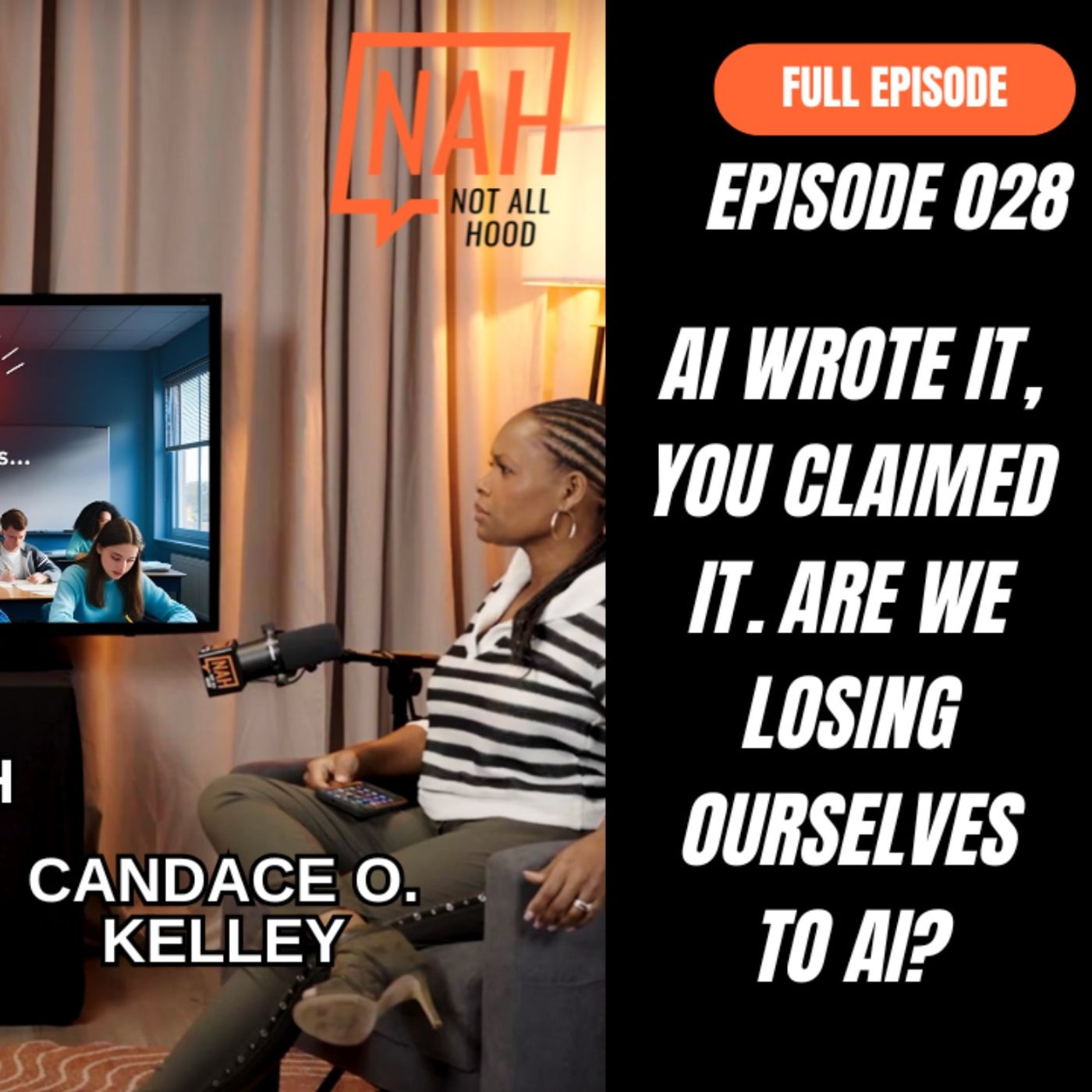
Not All Hood (NAH) with Malcolm-Jamal Warner & Candace Kelley
028 - AI Wrote It, You Claimed It Are We Losing Ourselves To AI?
00:40:38
Artificial Intelligence isn’t just changing our work—it’s reshaping who we are. In this compelling Not All Hood conversation, Malcolm-Jamal Warner and Candace Kelley dive into the unseen influence of AI on our creativity, our thinking, and our emotional lives. As AI tools make it easier for anyone to sound brilliant, the question becomes: what makes us truly original? They discuss how tech like auto-tune and AI-generated writing have blurred the lines between human and machine-made, and why the real power lies with those who know how to use AI without losing themselves. From students fiercely defending their AI-aided essays to professors requiring handwritten work just to ensure authenticity—this episode questions what ownership, authorship, and creativity really mean in a digital world. We also tackle the shifting landscape of DEI (Diversity, Equity & Inclusion) and how language and branding around it are being reimagined in real-time. 🎧 Tap in for a mind-bending discussion th...
Loading summary
Transcript233 lines
- [00:01]
A
On WhatsApp, your personal messages stay private between you and whoever you send them to. So things like the passport numbers for your honeymoon stay between you and your fiance and that video call for your gran's 80th stays in the family. Even your streaming password stays between you and your college roommates, who still ask for it every week in your group chat. Because on WhatsApp, your personal messages are yours. No one else can see or hear them, not even us. WhatsApp message privately nothing brings us together like Eglin's best eggs, always so fresh and delicious. Plus superior nutrition. Like 6 times more vitamin D, 10 times more vitamin E, and 25% less saturated fat compared to ordinary eggs. For us, it's eggs any style as long as they're the best egglunds Best Better taste, better nutrition, better eggs. Visit eglansbest.com to learn more about People who really will be ahead when we talk about AI are the people who know how to find that balance and actually be a better human being irt in real time. You know what I mean? Otherwise, AI makes us all great writers. It makes us all great thinkers. In fact, you'll find some of the same phrases in my great writing that's in yours.
- [01:20]
B
I think to that regard, it it makes it even that much more crucial for us to really be on top of the AI game so we know how to use it to enhance what we already who we already are, what we already do. Because if I'm a creative person, I'm not going to let the AI take over my creativity.
- [01:50]
A
Welcome to not All Hood. Artificial intelligence isn't just changing our jobs. It's changing us from the way we think to what we believe. It's silently shaping our decisions and even our emotions. It raises the chilling question, who's really in control? So we're diving into the unseen influence of AI and why it's something we should all be paying attention to right now. Seems like science fiction. And for the record, what you just hear was created mostly by AI on purpose. But listen, AI could not have shared the emotions I was feeling during the recording of the show. Kind of like those robots serving food at restaurants across the country. Something would have been missing. Enjoy the conversation.
- [02:47]
B
I don't know if reverb and compression and those effects qualify as artificial intelligence.
- [02:55]
A
Well, not artificially, but the interruption of technology and not even necessarily interruption.
- [03:01]
B
Natural technology interrupting.
- [03:04]
A
Yeah, someone's natural. The way they naturally sing. We were already there in a sense. I think because of the fact that you could put somebody's voice in an auto tuning machine 10 years ago and make it sound really crisp and sublime. And that's not the way it went in there. So I'm saying we're just, Aren't we just deeper in it? A lot deeper. But we're deeper.
- [03:26]
B
Well, I mean, definitely deeper. But the. I think before it was taking something to affect a real thing as opposed to now. We got AI that's just creating, coming up with its own thing. Right. It's not based on anything already existing like you're creating from. Again, those effects, reverb and compression and delays, that's all.
- [03:56]
A
It's all affecting something that's already solid and tangible.
- [04:00]
B
Yeah. And putting a polish on that.
- [04:05]
A
Let me tell you something.
- [04:06]
B
Yeah.
- [04:08]
A
Students that I have heard about from colleges across the country and even in my own school, when they are approached with this AI project or this essay you've written is not yours, it feels AI because, you know, you can tell they make great arguments that, no, yes, it is mine. Because that prompt that I put in, that was mine.
- [04:31]
B
Wow.
- [04:31]
A
I finessed the prompt. I asked the questions. I finesse and I finessed and I finessed. I asked. And they will not. They will not say that it doesn't belong to them. They will not. They will stick to the end and fight to the end and say, that is my work. I'm the one who created the prompt. Now, what's interesting is that you showed me a prompt today just as an example, Right. And I was like, wow, what prompt did you put in? That's very interesting. Because it doesn't, you know, it had our names in it. It was. So to a certain extent it is the prompt. But that is not somebody's work. And there are already lawsuits saying, hey, you know, you're using my information, you're using my book, and you're coming up with a prompt for somebody else. Where's my money? Because my book is my intellectual property. So, I mean, so that's one aspect of it.
- [05:22]
B
So is the argument. So it's part of the argument. Not just I put in the prompts, but it spit out something and then I reworked it and put it in my own words.
- [05:30]
A
Yeah, that's right. All of that. Exactly. It's all of that. It's that before this even was spit out, I was the one who came up with the beginnings of it to make whatever was spit out, call it mine or not, I started that ball in motion. And that actually, technically is true. That's the problem. Right, right. That is the problem. But, you know, I think eventually it makes people just less creative.
- [05:55]
B
Yeah. You know, one thing I love about Dr. Black, our resident guest.
- [06:00]
A
Right, right, right.
- [06:01]
B
You know, he says that he now makes his students write their papers in class in front of him.
- [06:09]
A
That's the only way to do it. Now I'm taking a course, and the first thing that we had to do was write a paragraph so that they could see our writing style.
- [06:19]
B
What's the course?
- [06:21]
A
I hate to even say it's a DEI course. It's a certification course that still exists. See, and that's why I hate to even say it. That's why, you know, and I'm a part of some DEI groups, and they are now going through the process of, you know, we need to change the name, like some people call it all in, but not. Not using the word dei because it triggers a lot of people in different ways, positive and negative. They want a clean slate. They, meaning the people who work on DEI committees and DEI work. Some of them want just a clean slate. They don't want the triggers.
- [06:53]
B
Sure.
- [06:54]
A
So, but that's. So that's the coursework. And. And the reason that she's doing that, she didn't say why, but she wants to see our writing as it is, in the raw, so that when writing does come in, she'll be able to say, hey, yay or nay.
- [07:08]
B
Yeah, you know, so this doesn't really match.
- [07:10]
A
Yeah, this doesn't really match. You sound like the New York Times here. And here. You sound like, you know, some, you know, a fifth grader's blog. Big difference.
- [07:18]
B
But I think the interesting thing, like, even I remember being in school and, you know, you do research papers and, you know, so you don't get flack for plagiarism, right? You take the thing and you rework it. You do, and you put it in your own words.
- [07:33]
A
So let me ask you this. Do you think that AI is plagiarism? Right. So the true meaning of plagiarism is using someone else's work and passing it off as your own. And for me, it kind of fits the. It fits the mark. It fits the definition.
- [07:51]
B
So if you're using somebody else's work, as I'm saying, devil's advocate. If you're using someone's work as a foundation, right? And then you're reworking it to put it in your own words. So again, like, when you do research papers, right, You. You know, you're. You're researching the subject, the topic. You know, you're gleaning information from this paragraph, but, you know, you can't do it word for word. So you're taking the information here and you're reworking it. You're putting it in your own words.
- [08:24]
A
At that point, you were at ground zero. So the information that you even started with, it's not yours. I think there's a good argument to be made there too. So, for example, let's say, you know, it spits something back. And the refrain is, I have a dream. Well, you can't use that as your refrain. And your. Even though you changed it a little bit, the I have a dream portion we know belongs to somebody else. Do you know what I mean?
- [08:49]
B
Yeah.
- [08:50]
A
So. And I use that one to say, hey, we know that as an example. That's a familiar one, enough for us to know. Yeah, that's not theirs. Similarly, whatever refrain you're using that you got from somebody else, even though it's just a foundation, you only got there because of AI.
- [09:07]
B
Right. So. But so given, given that example, you would have to be smart enough not to use that refrain.
- [09:15]
A
Now, that's okay. No, that's true.
- [09:17]
B
So you take that reframe, you say.
- [09:18]
A
Okay, well, but you sound like the students who say, yeah, so I switched it up. But I guess that leaves us to the same kind of circular argument of, well, then who created it?
- [09:31]
B
Right.
- [09:32]
A
I mean.
- [09:32]
B
Right, Yeah, I gotta do that.
- [09:33]
A
And you know, it's like we can spew. You can a movie script. You can say, I want it to be these characters, that characters, and it will spew out a whole movie that belongs to you.
- [09:47]
B
But I think the movie that the script that it spits out isn't necessarily going to be that good.
- [09:54]
A
True.
- [09:55]
B
Right. So it's gonna give you. It's gonna give you a foundation, but you've gotta go. And so I think this is where people miss the mark, you know, and get lazy with the AI, Right. Because there's the concern of AI is going to take over everything. But I think what I was saying earlier, I think with AI, what happens now is the human aspect almost becomes. It becomes crucial because there's a difference. When you see something AI generated something writing, you know, it's AI you do. Right. So there are. There are human nuances that it's not going to spit out for you.
- [10:41]
A
Right. It cannot create it because it's not a human.
- [10:44]
B
Right, Right. So it's incumbent upon the person. Okay. Now, so I inputted all this information. It spit out the script for me, but now I actually have to go in and do the work to make it a script, like it spit out words and a concept, but now I've got to make it an actual script that's actually going to move people and actually going to connect. I think there's that, that human part that becomes. Again, there's the tool. But then, so, you know, you can have a hammer, but a hammer is only going to do what it's going to do. Right.
- [11:17]
A
And you need that human to use it to hammer.
- [11:19]
B
Yeah.
- [11:20]
A
I'm just wondering about how. Okay, so the speed with which you're able to produce, that's a good thing. Right. But with the same token, look at the speed at which we have produced things online and what that's created without a lot of intervention, without. It's moving so quickly that we can't keep up. Actually, social media still is moving so quickly that we just can't keep up and now it's out of our control. Ask Marker, what's his name? Mark Zuckerberg. Right. Nah, that's okay. We're not gonna have anybody check to see if anything is factual. No fact checking. We're gonna do community fact checking.
- [11:58]
B
Yeah.
- [11:59]
A
Well, who's in the community? How are we doing? Yeah, yeah, yeah. So I guess, you know, my argument is not even for or against AI. It's just a matter of we have got to keep up with it or else it will take over. Because I think that the analogous situation is social media. It has taken. It's gone. Yeah, yeah, it's gone. We're at 500 billion with Stargate and Elon Musk and that creation. We are at, you know, no fact checking. We are at people, you know, being. Wanting to blow themselves up because of something that they have read online. So I'm not sure what the answer is though. Comrades, if you're enjoying this episode, join the conversation and make sure to like, subscribe and comment below. Na, na, na.
- [12:50]
B
I think at this point it's staying ahead of it as much as we can. Again, using understanding, using the AI as a tool.
- [13:01]
A
Yeah.
- [13:02]
B
You know, so again, you have a marketing Plan, you have two different people and say they both use ChatGPT.
- [13:10]
A
Okay.
- [13:10]
B
Cause we're talking about, you know, how does that equal, you know, equalize it.
- [13:14]
A
Right. It levels the playing field.
- [13:15]
B
Yes. Then I go, okay, well, not necessarily, because the person who type, you know, did all the creative prompts for chat GPT and it spit out its thing and that's what they use. So there's that end result. Then you take the person who's making Marketing plan. They run through chat GPT, it spits it out. And now the operator.
- [13:40]
A
Yes.
- [13:42]
B
Goes in and adds the human connection. Right. So now I'm going to put in the details. So this, this brand that I'm doing this marketing plan for, I'm going to make sure that this directly applies to who I'm submitting it to.
- [13:59]
A
Right. So that's the, that's the human part.
- [14:01]
B
Yeah. So when you get it right, you're going to, you know, you may get the, the just plain chat GPT, the plain AI result. Wow, that's really good. Then you get the other one that has been, that has the human element to it. It's gonna have different nuances. It's going to make it more fuller and more complete. And you go, okay, well, I'm gonna go with this one because this one speaks to me more. This is cool.
- [14:26]
A
True.
- [14:27]
B
But this one speaks to me more.
- [14:28]
A
Yeah.
- [14:29]
B
So I think to that regard, it makes it even that much more crucial for us to really be on top of the AI game. So we know how to enhance what we already. Who we already are. What we already do. Because if I'm a creative person, I'm not going to let the AI take over my creativity. I'll use it as a foundation. So now I can put my. So now instead of starting from a blank slate, now I've got a foundation and now I can add my creativity to that. To that.
- [15:08]
A
And in fact, if you didn't do that, you would be behind. You'd be the person who's not on steroids running in the race. Yeah, yeah, you, you have to take the steroids or else you are behind. Now that's the other thing. Right. So you, it, it's good. Let's get it equal. And then you're right, you are right that you're going to have to have that. Add that particular human element and maybe that sets you apart. But then you'd mentioned something earlier when we were off camera and that overall we're just using the human element and human touch. People don't even know how to look at each other. I've talked about this before on the show. You know, you can really type out something, but you cannot even look at a person. And at this point, you can create an AI version of yourself, type in the script and that version of yourself will actually say it.
- [15:58]
B
I know.
- [15:59]
A
Now, I mean, that is remarkable. Talk about taking the human just out of everything.
- [16:07]
B
Yeah, but I, but I go back to how much does that, how much does that AI connect to the viewer. And there are actually two things with that, because one, even if as a viewer, you can't put into words that this. There's something sterile.
- [16:34]
A
Right.
- [16:35]
B
That, you know, you can't put your finger on it. But this feels sterile.
- [16:39]
A
But. But 10 years from now, will it feel sterile? Because we've been trained that that's the base norm part of it.
- [16:46]
B
That's the part. All of the. What we were calling it. Digital. Digital junk food.
- [16:50]
A
Yeah, exactly.
- [16:52]
B
You'll have a. Yeah, we'll have a mass of people who. Who won't care about quality.
- [16:59]
A
Yeah.
- [17:00]
B
That's the flip side of it.
- [17:01]
A
It is. I think the people who really will be ahead when we talk about AI are the people who know how to find that balance and actually be a better human being irt in real time. You know what I mean? Yeah. Otherwise, AI makes us all great writers. It makes us all great thinkers. In fact, you'll find some of the same phrases in my great writing that's in yours. We have a list of phrases that the profess or share. Like, these are the phrases that are out there, you know, unbeknownst to me. Come on. You know what I mean? Or just those phrases. You're like, you don't write like that, but AI writes like that. Yeah, Yeah.
- [17:40]
B
I think it's a matter of what makes the person stand out or what makes the product stand out is again, what the human, what the operator has put behind it, what they've put into it that gives it those, again, those certain nuances. And I think if we flash forward 10 years from now where that won't matter to the mass, it'll still matter to some people. The numbers may be lower. It's like art, right? Art that is not pop art that has not made it to the mass acceptance. You're still putting out your art. And there are going to be people who appreciate, just may not. It may not be in the numbers and it may not have the monetary return as the art that has, you know, gone pop or made mainstream.
- [18:38]
A
Yeah.
- [18:38]
B
But you, you're still going to create the art.
- [18:43]
A
Yeah.
- [18:43]
B
You're still going to be. You're still. So, so I. I liken that to the. Again, the AI, like, it's the human aspect that makes it above average.
- [18:57]
A
Sure.
- [18:57]
B
Because if everybody's just using the AI on its own, it's average.
- [19:01]
A
Right.
- [19:02]
B
So, I mean, ultimately, I think now we're in a society where the mass doesn't really appreciate above average because we're.
- [19:10]
A
All trained on average.
- [19:11]
B
Yeah, yeah, yeah. So I think we're living some of that today.
- [19:15]
A
One thing that I've been thinking about is if we think about AI, think about everybody who's created AI, big tech AI, any social media platform, whether it's Zuckerberg or whether it's Elon Musk. You've got OpenAI, Sam Altman, then you've got Bill Gates at Microsoft, then you've got all these people. What's common about all these people? So you really are boiling it down to about six, seven white men who are creating how we are thinking and interacting with each other. That non diversity can't be good. That's the way they want us to think. You know, this is the reason why everybody's feed looks the same. It's gonna look the same now if our phones are within reach. Now we're all thinking the exact same thing. That diversity thought is gonna kill us. Well, or the non diversity thought.
- [20:14]
B
You can't control of people if they're all thinking for themselves. Right. So yeah, it's all, it's all by design. It's so funny because the older I get, the more the Matrix movie makes sense.
- [20:35]
A
You are so right.
- [20:36]
B
Like when I first saw it, I was like, oh, this, oh, that's so deep and so powerful. This is great.
- [20:40]
A
But now you see its application. Big difference, right? No, it is. Yeah. And you know, but that's kind of reflective of the work that we live in, which is why we don't have diversity of thought. We've got this group and this group, we have some people in between, but generally we're like this. We are like this. And this side thinks that they're right. This is their truth. This is what. And this side thinks that this is ridiculous. I think a lot has to do with social media. I really do. It has been training us for years and, and if you look at the person or people behind the curtain, it's all the same. Now do I think that was intentional that all? No. These are people who have come from different decades and different times. Bill Gates was decades ago and this.
- [21:26]
B
And that you said no. You don't think it's intentional?
- [21:28]
A
No, I don't think that those seven men got together. Why you have other thoughts?
- [21:33]
B
Because I think there's a certain group of people who think like, do you have a five or ten year plan?
- [21:45]
A
I do, yeah.
- [21:46]
B
Okay. There are people who have 100 year plans.
- [21:50]
A
Okay, I see where you're going. I see where you're going. Right, okay.
- [21:54]
B
So yeah, I don't know if it's I don't know if it's less than a concerted effort, an overall concerted effort.
- [22:06]
A
That you. I see what you're saying. That's kind of a common thread that happens to be the same because they all come from the same fabric.
- [22:17]
B
There's. Yeah, there's.
- [22:18]
A
Okay, I see what you're saying.
- [22:19]
B
There's that power base.
- [22:21]
A
Okay. There's that power base.
- [22:22]
B
And that power base is generational. It's passed down from generations, and it.
- [22:28]
A
Looks and sounds the same.
- [22:29]
B
Yeah.
- [22:30]
A
Okay, that. I agree.
- [22:32]
B
Yeah. Yeah. Like, we talk about the 1%.
- [22:34]
A
Yeah.
- [22:34]
B
You know, there's always been a 1%. Like, when you think about. They were called the planter class. Right. The plantation owners.
- [22:44]
A
That's right.
- [22:45]
B
Right. There was the. There's always been a 1% versus the 99%.
- [22:51]
A
So where does that leave us? What do we do?
- [22:54]
B
You know, there's always that conversation about fighting against hopelessness. You know, I mean, for me, it's often a common concept that I have to be aware of.
- [23:07]
A
Yeah.
- [23:08]
B
Because again, go back to the Matrix, right? When you're. When you are bombarded with all of social media and all of the disinformation, misinformation, information that is set on your algorithm to make you feel a certain way. Right. Because, I mean, mostly most people. Scrolling, scrolling, scrolling. You see some positive stuff, and it's kind of cool, but it's the. It's the thing that triggers us that.
- [23:41]
A
Makes us act, man.
- [23:43]
B
It makes us.
- [23:44]
A
That makes us buy.
- [23:45]
B
Yeah. And. But it also makes us mad.
- [23:47]
A
That makes us mad.
- [23:48]
B
It makes. It makes us buy into the chaos that is designed for us to not be, I guess, to be moved by.
- [23:59]
A
Right.
- [23:59]
B
Really?
- [24:00]
A
Yeah.
- [24:00]
B
You know, um, so I think the effect of having all of this information that is parsed out to us based on what our scrolling habits are.
- [24:16]
A
Yeah.
- [24:16]
B
Like, I think it's. So much of it is. Is very intentional. Like, I've got friends, you know, who are on, you know, you know, a different. Have different political views than I do. And we'll have conversations and conversations where we don't necessarily agree with each other. But I'm listening to them. I'm listening to me, and I'm saying, oh, our stuff is based on what's coming across our algorithms, and it's an.
- [24:46]
A
Echo chamber, repeats itself.
- [24:48]
B
Yeah. So there's so much power that comes with social media and the designers of social media, and I feel that so much of our. So much of the discourse, it's by design.
- [25:12]
A
Yeah, yeah. And you mentioned something really interesting. And that's the algorithm that we have on the phone. But then we also have an algorithm in life. I knew you were going to say that we. Yeah, that we need to intentionally change. Yeah, the same way I have gone in and changed my algorithm. I got caught up in watching too many, like, I don't know, small puppies being born. And that's all I was seeing was. Was ducks being born, cows being born, horses being born. I was watching everything being born. And, you know, they were. They were still kind of, you know, enticing. And I was like, your whole algorithm. These, you know, cows being born now and puppies, like, and cats. That's ridiculous. We need. And I had to go in and I changed. I had to look at other stuff. I had to do other things to finally change it. But we need to do that sometimes in life, too.
- [26:05]
B
Yeah.
- [26:06]
A
Change your algorithm and reset.
- [26:08]
B
Yeah. Yeah. Hey, comrades. If you are enjoying the episode, join the conversation. Like, subscribe. Leave a comment below. Don't get yourself blocked. Keep it clean. Sometimes I think about, do I need to get a social media manager?
- [26:27]
A
I'm telling you, right?
- [26:28]
B
It's like, I do all of my social media myself. So if it takes me a long time to respond, it's because I do it all myself. And part of my fear of having someone else manage my social media for me is that it's not me. So you're not gonna get my. My nuance.
- [26:48]
A
Okay. But let me ask you, what you're putting out there. Is that you? Anyway, I'm just curious how much of what you put out is really you.
- [26:57]
B
I think for me.
- [26:58]
A
Oh, I know that personally.
- [27:01]
B
For me. You ever seen my Instagram page?
- [27:04]
A
I have.
- [27:04]
B
Right. So.
- [27:05]
A
But I also know you here.
- [27:07]
B
Right.
- [27:07]
A
So is that 100% you?
- [27:09]
B
Oh, if it's not 100%, but it's me, it may not be all of me, because obviously all of me is not for public viewing. Like, you're not gonna see my wife and my daughter. Social media.
- [27:20]
A
And that's a huge part of your life. And that's why I'm saying it's not you.
- [27:23]
B
But what's on there so represents you. So. So what I hear. So what I hear when you say that is, oh, I'm posting stuff that's not representative of me. And I go, no, what I post is very much me and very much. You know, I think there aren't even with things I talk about on the podcast, they aren't incongruent with what I post on my page. I think that We, I think one of my, one of my strengths, for lack of a better word, I guess, or one of the, or one of my strengths or one of my appeals is that I'm pretty transparent just with who I am. I think because I spent my life in the public eye, it would take too much work to have a public Persona and then have a private Persona that's completely different. So on social media, for me personally, what I'm posting is very much me. It just may not necessarily be all of me.
- [28:29]
A
Right.
- [28:30]
B
And that's definitely by choice.
- [28:33]
A
Right.
- [28:35]
B
As much work as I've put into my career and my public life, yeah. I put the same kind of work into keeping a private life as well, a personal life as well.
- [28:50]
A
But you know what? I think that that speaks to how people operate online, which is. And not you specifically, but everybody operates in that way. I'm going to show you a certain part of me so that there's this whole world out there, it's not even real then. Do you know what I mean?
- [29:06]
B
Yeah, yeah.
- [29:06]
A
And of course you do that in real life. You don't share the full part of you with people when you see them on a day to day. But again, those nuances of this human interaction, the selection that I can make by inviting you in or out, as opposed to something coming into my life being forced because it's heard me on the phone or because I've, you know, just, just because I think about a small animal being born, I only think about it one day in real life, online, it's every day, you know, so that's what I mean. Those nuances of differences just make a big. And I guess it's incumbent upon us and you know, let me wrap this up here for me. I guess it's just incumbent upon us or myself to make sure that I don't get caught up in that social media because you can really get lost. I had a student to call me and I have several students who call me from, you know, different arenas, not just at the one school where people might know where I teach to say, listen, I'm really, I'm having a problem because my parents, they're not legal here. And so a couple of them, I'll say, well, let me ask you, what have you been doing all day? And this was before Trump was elected. What have you been doing all day? Well, I've been on social media. How many hours? Nine. Okay, so that means I'm not saying don't worry, but that's feeding a lot into your anticipatory worrying for something that hadn't happened yet. Okay. Now we are in 2025 and it's different. I understand that, but I'm just. That's an example of what this will do and how it will make you think.
- [30:41]
B
Sure. And the getting caught up part is it's almost inevitable, unless you're not on social media. Like, my wife is not on social media, so, you know, I'll be sending her stuff and she's like, okay, but I don't really, you know, I don't care about that. Like, you're come see me at home.
- [30:58]
A
Right, right, right.
- [30:59]
B
I'm not interested in that thing that has you riled up.
- [31:01]
A
Right.
- [31:02]
B
I'm not invested in that the way you are.
- [31:04]
A
Yeah.
- [31:04]
B
So I don't. That doesn't really do. It's not doing for me what you're expecting it to do or something.
- [31:11]
A
Yeah. That's a whole other conversation. But you're right.
- [31:12]
B
But I had a. I remember one time I had a really interesting conversation with. With Chris Tucker, and I don't know. I don't know Chris Tucker well at all. We were at. We were at some event, some music event in la, and we were talking about living in the public eye. Right. We're talking about all of the trappings of fame, if you will, and how people get caught up. And I was saying that it takes an extraordinary person not to get caught up.
- [31:50]
A
And did you find yourself trapped at any point?
- [31:56]
B
I.
- [31:56]
A
And I do mean that word in a little. Like, you felt trapped. Like, you know, I had no other choice. Have you ever found yourself trapped?
- [32:03]
B
Trapped in terms of.
- [32:05]
A
Well, you know, you're trapped like you can't eat. Like. Like, literally, like. I really. You didn't feel like you didn't have a choice?
- [32:10]
B
No, no, no, no, not that. When I say. And when I say caught up, I mean caught up in the fame. By. Caught up in everybody's loving you.
- [32:17]
A
Okay, have you been caught up then? Okay, so answer the question, counselor.
- [32:24]
B
So prior to that conversation with Chris, I would say no.
- [32:28]
A
Okay.
- [32:29]
B
Because again, my assertion was it takes an extraordinary person not to get caught up. I. E. I'm one of those extraordinary people who didn't get caught up to get caught up. And Chris, he said it was brilliant. He said, no, you actually do get caught up. You can't help but get caught up. The trick is being aware of it and catching yourself. And I was like, yeah, that's actually much more accurate. And I go back to myself. So. Not that I'm that extraordinary person. But I'm the person who was able to catch myself or in, you know.
- [33:08]
A
And make a better decision.
- [33:09]
B
Yeah. And not that it was just, you know, one occasion in my whole, you know, 40 some years.
- [33:17]
A
That's the point. We're not, that's the part we're not hearing on Instagram. We are not getting 100%, Malcolm.
- [33:24]
B
But I guess to relate that back to social media, it's like, yeah, you're going to get caught up. If you're using social media, you're going to get caught up. You're going to find yourself scrolling and 45 minutes go by. In some cases nine hours go by. But the trick is to be able to catch yourself in the moment and go, you know what, I need to put this down.
- [33:48]
A
Right.
- [33:48]
B
You know, I need to. Sometimes I'll go on a social media hiatus and sometimes they last longer than I intend for them to.
- [33:59]
A
What's the longest you've been off?
- [34:01]
B
I think three months.
- [34:02]
A
Oh, that's good.
- [34:03]
B
Yeah. And it wasn't intentional, but I just realized that the time had gone by and I just kind of noticed that I felt a little lighter, you know.
- [34:13]
A
So what made you go back then?
- [34:16]
B
I need, I need social media for work purposes, for promoting shows, for my music, for my poetry. So that part I need like I've got. This will air, I'm sure this will air after. But you know, I got two sold out shows going on, three at City Winery here in Atlanta. Based on social media. Social media.
- [34:42]
A
Right, right.
- [34:43]
B
Based on what I'm posting. And so for that, and because, you know, with my music, I'm not on a major label, so I don't have a marketing team behind me pushing my music. So I need the social media. And again, because I do it myself, there is an engagement that I have with followers who rock with me and have been rocking with me and my music even before social media. So that's an important part of what I do.
- [35:14]
A
Yeah. And you know what you say there's an engagement and there's a whole arena of AI that's now being developed to help people who want to be engaged, who need to feel that someone else is interacting with them because they feel lonely. There is a whole field of loneliness and people now coming in to come up with things to make people feel less lonely. That is, that's open, it's an open season for it right now. Yeah, that's a huge thing. And I will say that if we're talking about a good thing that social media does, it does connect people it does make people feel like somebody's listening to me or somebody. I'm part of somebody's world. But with the same token, that human touch, that human. Did you see this viral video of this woman and black woman, and she was just talking about the fact that she hadn't been hugged in so long that she wanted to connect and she was crying. She was real. She really wanted to connect with someone. She was crying. She hadn't been just touched or loved. And she wasn't talking about it sexual way either. Just a hug, just to reach out to someone. And the reason it went viral, because I think a lot of people understood. Yeah. You know, that that human touch is. It literally translates into something that is more than just physical. It's mental. It keeps you grounded. It's almost therapy when you actually touch someone. And that's what social media doesn't have, that physical touch. That's why I love when we talk about this show. I love doing this show, sitting here talking, bringing in guests. But what I love more is going out, like the way that we've gone to with all the people in the audience, the live people come up and you really get to hear because you know that they've even gotten up, gotten dressed to make an effort to come see you. You know what I mean? You're out in the world. It's a totally different thing. It's a totally different thing.
- [37:06]
B
That's what I love about performing. Like, if I'm on stage with my band or even on stage by myself and me at a mic and doing poetry, there is. There is that engagement, there's that human. There's that connection, there's that interplay. I started on theater, you know, when I was nine. I'm on stage. So even from doing, at nine years old, doing my very first play.
- [37:30]
A
Right.
- [37:31]
B
Being in front of people who are. You're getting that immediate reaction. You're getting that immediate gratification. You said something funny and they respond.
- [37:39]
A
Right, Right.
- [37:40]
B
You know, there's an emotional moment and, you know, the audience is feeling that. So I think for me there's, you know, my life has always been my art. And having a human connection with an audience.
- [37:53]
A
Yeah, yeah.
- [37:54]
B
And I think now with social media and all of the. All of the AI I go back to, it's going to make human connection that much more important.
- [38:05]
A
Yeah. And that's why I like those meaningful, in person, on purpose things, because I think it means more to people. It definitely means. It's like, you know, during COVID people were interviewing People on Zoom, right?
- [38:18]
B
Yeah.
- [38:18]
A
Oh, you got the job. But the job is yours now. Or you're Covid, so you're going to work it from home. And then I've heard a lot of accounts where the people will come in. You know, they finally come in, Covid's over. They're totally different. Mean. I mean, I'm not trying to be funny, but maybe there's a cologne you don't like. Maybe they invade your personal space. Maybe they're a whole lot taller or shorter. I mean, I know this might sound, you know, very. Just minimum, but it makes a difference. When you're in person with someone, it's something that even Zoom, where you're looking at a person, it cannot replicate. You have got to experience a person, you know, in real time to really get their real feel.
- [39:00]
B
Yeah.
- [39:01]
A
Yeah.
- [39:01]
B
Well, I think. You know, it's funny because we spend so much time on Zoom calls.
- [39:06]
A
Yeah.
- [39:07]
B
Sometimes you have your camera on and sometimes you don't.
- [39:10]
A
That's right, I do. Most times I don't.
- [39:13]
B
Candice used to have her. You used to have your camera on all the time.
- [39:17]
A
I did. I did. But you know what? Once I established a physical connection with everybody in person, I was like, well, they know who I am. I felt like we had crossed a bridge. But at first, you're right. I wanted you to know, okay, well, who I was. I wasn't just a voice. And. And then we met in person, and then I was like, he knows who I am.
- [39:36]
B
I keep my camera off.
- [39:38]
A
Truly. Like, he. You know. What did Troy say? No, we want to see Candace or just, you know, in her bathroom? I said, no, you don't. No, you don't. You know, but I think with.
- [39:50]
B
Because we spend so much time on Zoom.
- [39:53]
A
Yeah.
- [39:54]
B
And obviously, we have a good rapport and the whole team, like, you know, we. I mean, our Zoom calls, you know, they're always a couple of hours long.
- [40:03]
A
Yes.
- [40:05]
B
So we all have a great rapport because we live in different places, and Zoom provides that. But there is something really cool when you come into Atlanta and we actually have to do the show. It's like, yeah, the Zoom thing is cool.
- [40:21]
A
Right.
- [40:21]
B
But being in front of each other and being able to see each other in person and not on the monitor.
- [40:27]
A
Right, right. Like, earlier today, you were stretching. Right. And I was like, what is he doing? I had no idea what you were doing. You know, it's something you wouldn't do on a Zoom call.
- [40:39]
B
Unless my camera was off.
- [40:40]
A
Yeah, unless your camera was off. And we do that too. And I was like, what are you doing? It was just this strange pose and you were like, I'm stretching. Yeah, you know, I mean, that's just an interesting fact to know about you that I would not have known during zoom. Now I know you got a bad back or whatever's going on with you.
- [40:58]
B
Don't have a bad back.
- [40:59]
A
Oh, you don't have a bad. Okay, I'm not sure. I'm not sure. Then what? I'm not sure.
- [41:03]
B
My bad back is good.
- [41:05]
A
I'm not going there for anybody. Malcolm's not a. Well, I don't know what you were.
- [41:12]
B
Stretching might be tight a little bit, you know, but back is all good. Hey, comrades. Come join us on our Patreon page.
- [41:24]
A
Ah. Where you can get behind the scenes footage, discounts on merchandise and exclusive content.
- [41:30]
B
We'll see you there. Amazon One Medical presents Painful Thoughts.
- [41:40]
A
I've been on hold to make a doctor's appointment for 23 minutes now. The automated voice has told me 47 times that my call is very important to them. Hmm, I'm starting to think that they don't think my call is important at all.
- [41:55]
B
With Amazon One Medical 24. 7 Virtual Care, you'll get help fast without having to remain on the line to make an appointment. Amazon One Medical Healthcare just got less painful.
- [42:06]
A
Did you know Tide has been upgraded to provide an even better clean in cold water? Tide is specifically designed to fight any stain you throw at it. Even in cold butter. Yep. Chocolate ice cream. Sure thing. Barbecue sauce. Tide's got you covered. You don't need to use warm water. Additionally, Tide pods let you confidently fight tough stains with new coldzyme technology. Just remember, if it's gotta be clean, it's gotta be Tide.