← Not All Hood (NAH) with Malcolm-Jamal Warner & Candace Kelley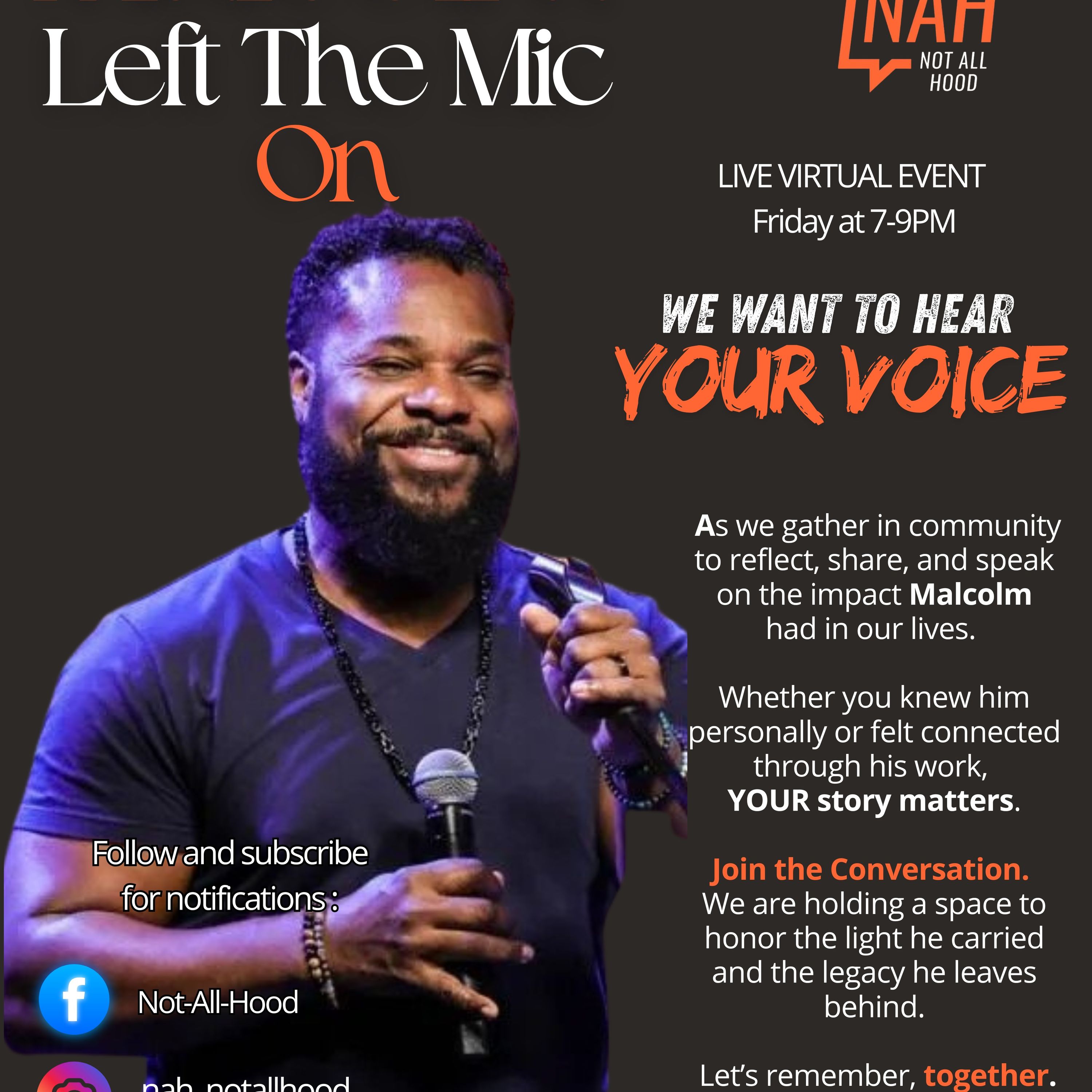
Not All Hood (NAH) with Malcolm-Jamal Warner & Candace Kelley
Malcolm Left The Mic On Tribute pt2
00:54:20
A powerful community tribute to Malcolm‑Jamal Warner—anchored by Candace Kelley, Troy W. Harris Jr., and Layne Fontes—centers on the legacy Malcolm insisted we carry: that in 2025, new media lets us shape our own narrative. The conversation spans authenticity, code‑switching, cultural impact, and collective healing, with moving appearances from actor Lamman Rucker and Isaac Hayes III (Fanbase). Rucker recalls 40 years of brotherhood, stage work, and the discipline behind Malcolm’s artistry—from the National Black Theatre Festival to late‑night poetry sets. Isaac shares how Malcolm’s example—fitness, stretching, and integrity—quietly mentored him and why platforms like Not All Hood are vital for Black storytelling and ownership. The team revisits viral Buteco jam sessions where Malcolm lived on the bass, plus memories from press runs (Sway, Breakfast Club), and live callers reflect on why the Cosby era felt like home. This episode is part celebration, part blueprint: take the mic, b...
Loading summary
Transcript151 lines
- [00:01]
Verizon Representative
You're the owner of a small business, which means you could use another pair of hands like the experts at Verizon small business days, August 11 through 17, get a free tech check and special deals like a free 5G phone. You know you want one. Call 1-800-483-4428 or visit verizon.comsmallbusiness to book your appointment. Verizon Business available for select 5G phones, new line Device Payment agreement and select data plan. Required credit applied to account over agreement term up to 36 months. Terms apply. Offer ends 8172025 this podcast is sponsored by Talkspace.
- [00:32]
Lamond Rucker
Last year I went through many different life changes.
- [00:36]
Isaac Hayes III
I needed to take a pause and.
- [00:38]
Lamond Rucker
Examine how I was feeling in the.
- [00:40]
Isaac Hayes III
Inside to better show up for the ones who need me to be my best version of myself.
- [00:45]
Verizon Representative
When you're navigating life's changes, talkspace can help. Talkspace is the number one rated online therapy, bringing you professional support from licensed therapists and psychiatry providers that you can access anytime, anywhere.
- [00:58]
Isaac Hayes III
Living a busy life, navigating a long distance relationship, becoming a first stepfather, Talkspace made all of those journeys possible. I could speak with my therapist in the office. I could speak with my therapist in the comfort of my home.
- [01:10]
Lamond Rucker
I was never alone.
- [01:12]
Verizon Representative
Talkspace works with most major insurers and most insured members have a $0 copay. No insurance, no problem. Now get $80 off your first month with promo code SPACE80 when you go to talkspace.com match with a licensed therapist today at talkspace.com save $80 with code SPACE80 at talk.
- [01:31]
Angel Bush
After we recorded our tribute to Malcolm Jamal Warner, we heard from listeners around the world.
- [01:36]
Keisha
So many said it gave them space to release emotions they didn't know they had about Malcolm's life mission and the.
- [01:43]
Isaac Hayes III
Memories his work created.
- [01:45]
Lamond Rucker
Some said it felt like the conversation they needed. Others shared stories about how Malcolm's work and words literally shaped their lives.
- [01:52]
Angel Bush
That's the power of legacy and the reason we did a tribute to our friend Malcolm.
- [01:57]
Keisha
We this is part two of our celebration of him.
- [02:00]
Lamond Rucker
Enjoy the conversation.
- [02:02]
Angel Bush
Angel Angel Bush I said Angel, I apologize. Angel angel asked what's what's one of the legacies that we continue to impart through not all hood? We try not to use the nword.
- [02:22]
Keisha
You know, wonder one of one of you know, I think I've kind of articulated it a lot, but succinctly. One of the legacies is that especially with new media, we all have the ability to shape up, to shape the narrative. We could pop on and start a YouTube channel right now and do something good and shape the narrative and still get that platform. The bigger it is, the better. And there are a lot of media companies don't get as many views as some of the things that we've put out. So we have to understand the power that we have in music for good. So the legacy is really in kind of the way that I think the way that new media now shapes what people are thinking about culturally, what's in people's algorithms. And so to understand that and to really take this seriously and know that we can shape Cape how people see us literally, that's the legacy that I would like to. That I would like to continue. And I've always believed in. My thing is, you know, my joke is if someone has said, hey, have you seen. I will say, yeah, I've seen it especially. I've watched it. I've watched it. I've watched the white stuff. I watch it all, you know, because I'm a big consumer like that. So I know that now there's a role and there has been for the past what you and have. In order to imagine that, I'm kind of people worried that he. Just for those of you who are with us, we've got Lamond Rucker coming up a little later, as well as Isaac Hayes, as well as your voice to really kind of talk about Malcolm. A collective healing, a collective understanding about blacks in this world and in America and what his legacy meant to you. I've seen some really amazing posts from people that he's at his touch, which is really why we wanted to do this. This was one of the last major projects that he was very involved with, Brandon. You know, he had his band and he had this, and he's appearing on shows. But for the past year and a half, as Corey says, you do the math or you spoken to him, you know, at least 100 times working on this. And so we know him in a way and bringing on people that we hope can kind of share a different side of him. You know, we were on the phone just to kind of really bring it down. I don't know if you remember on the phone and I think one of his pipes busted in the house. You know what I mean? We were on that level. It's just like, okay, just kind of regular talking and work and oh, wait, I think it's pipe busted. And my daughter's birthday is this week. You know, we. We saw that Amalf. And then we were reminded. I remember going to New York you know, talking about regular stuff and it's like, oh, yeah, we have love and icon here. You know, and sometimes you would forget because of his humility until people were swung around him. And then all of a sudden, Lane, you were like, okay, I'm now bodyguard. I'm not bodyguard. You wait. We. We pivot. We pivot and I'm the bodyguard. And you know, so that, that was really. That's just really something to. To be a part of for him just to, you know, come back, soup down with lunch. It's not going to talk about it. We just talk about regular things. And that's. That's who we want to bring out. All the good bends, which is somewhere.
- [05:56]
Angel Bush
The same through line about Malcolm. It's just the same through line about his authenticness, his goodness is, you know, so I think you. You said it best in the quote that, you know, if you thought you knew him in your head and you really did.
- [06:15]
Keisha
Yeah, yeah, yeah. I think it was Dr. Black, he said Malkin was also very easy to. He liked, you know, really asked questions. I call it the Malcolm pause. You know? You know, you saw someone say, did I lose you? You still bet? No, I'm just thinking.
- [06:39]
Angel Bush
He. That's one of the first things. Let me tell you. The most prolific thing that I learned about Malcolm is Malcolm always processed and thought before he spoke. And it could be some of the. And it didn't have to be some complex thought. He was very thoughtful and intentional around his words so that you hit that on the nose. So true. That always bring out having conversations with Malcolm. I would always stop and go, I wonder what he's thinking right this very moment. And then you get it right. Because you don't get it right away. You get it after his cross process and it's thought through so you don't just get fly out the mouth.
- [07:22]
Keisha
That's right. That's right. That's right. Oh, yeah.
- [07:31]
Angel Bush
Welcome, welcome.
- [07:34]
Keisha
Appreciate you this evening. You. You wanna. One of our first shows. Lot of people love. Yeah, yeah. You were. That was our first recording day that you came down, share some stories. Yeah, yeah, absolutely.
- [07:52]
Isaac Hayes III
I didn't know that.
- [07:52]
Lamond Rucker
I'd have never known that. Y' all look like y' all been rolling for a few weeks.
- [07:57]
Keisha
Yeah, yeah. Album would say, I'm a good actor.
- [08:01]
Lamond Rucker
My voice is right.
- [08:03]
Keisha
I'm a good actor.
- [08:03]
Lamond Rucker
Right, right.
- [08:04]
Keisha
But, you know, I certainly crossed paths with him for really decades and I just wanted, you know, we're bringing on people just to share whatever they would like. You know, people Are talking about the cultural context, personal stories, brotherhood stories, whatever you'd like. The flooring.
- [08:26]
Lamond Rucker
Man. We talking, you know, 40 years of, like, who knows what to bring up? You're gonna have to be more specific than that.
- [08:39]
Keisha
But, you know, do you have a story that you think speaks to him as a person? That's what we've really been honing in on. Even when it comes to his acting and the types of parts that he took, he'd be very, very specific. And I know that that's a thing that you have also talked about, like, all right, the types of parts that I want to take, I could be particular because I'm speaking for the masses in many, many ways.
- [09:07]
Lamond Rucker
Yeah. So. So naturally, I've been. You know, we all kind of naturally just go down memory lane. Like, you know, I think one of the fascinating things about. Even if we talk about the miracle of birth, we need to talk about the miracle of transitioning just the same. Right. So when you do that, literally, I think not only does that person's life kind of flash before our eyes was told as our own. And sometimes I wonder what, you know, what other purpose there is sometimes in. In these times and in these experiences. And I think it is to be reminded of being appreciative of what you have and even what you had, as well as how important it is to really be present, Cherish life. Obviously, don't take it for granted, but it makes you think back about all the many different times you laughed or cried together or, you know, we've talked a lot about the trials and tribulations of relationships. You know, and, you know, I was. You know, I was there for it. You know, we got. We've. We all. We've been through some things. Right? So. But it also really sends me back to, like, I can see, like, I have a. I have a picture even in my head now of our mothers sitting and talking. You know what I'm saying? Like, there's these other things.
- [10:51]
Isaac Hayes III
And.
- [10:54]
Lamond Rucker
I was so looking forward to getting our wives together soon and having the kids meet each other and, you know, like, so, you know, just the fact that we didn't have that chance and that opportunity is heartbreaking. But I think a lot of Was trying to remember the details of the first time we ever met. And this is something that keeps popping up, even with people that are in your life in, however, so many different ways you think back. You're like. One of the greatest questions is you remember when we. Just. When we first met, and most people don't Remember, Most people actually don't remember. And I. There's something about that. Either way, I think that's fascinating, and it can speak to the intimacy of your relationship, whether you remember every detail or whether you have no clue when that first moment was.
- [11:50]
Isaac Hayes III
Right.
- [11:50]
Lamond Rucker
Because sometimes you're so present with that person, you don't even remember when that first event. Right. Happened, all the little nuances that were happening within or around you. And then there's other people because the connection was so significant. You remember every single detail.
- [12:10]
Isaac Hayes III
Right.
- [12:11]
Lamond Rucker
So I can see Malcolm's face right now, as of. You know, I think he might have been 14, I think, and I was 13, you know, and the irony was that he was actually a special guest. He was like a featured performer in this show that I was in with other peers and classmates of mine. And now some of those people are my dearest of. Dearest of friends. You know, again, we've grown up together since.
- [12:45]
Isaac Hayes III
Right.
- [12:45]
Lamond Rucker
Since those days together. And just the fact that the same. Like, it's really as if no time has passed. The same vibes that we had then are the same vibes we have now, you know, and at the time that he was already coming into his celebrity, right. As a. As a young teenager, you know, he didn't. He might have been relieved even that I was around. You know what I'm saying? I know how it is. Sometimes you go certain places and you're like, nah, it ain't nothing but women here. You're like, oh, wait a minute. I think there's another dude. But, you know, like, we could even be like that with black folks. You go somewhere and you'd be like, man, they ain't none of them like, oh, oh, those black. You know. You know, it's like, is that.
- [13:35]
Isaac Hayes III
Is that a brother?
- [13:36]
Lamond Rucker
You know, so who knows? He could have been like, yes, you know, like, you know, another guy, like, you know, my age, you know, but similarly, it was. You know, we were all excited to meet him, but then just that quickly, it was just two regular dudes, you know, two teenage boys just kicking it. Now, we had to be on point because we were in a show together. I can't even remember the name of the play, but I think it was actually. It might have been the Warner Theater, coincidentally, in Washington, D.C. i think it actually might have been at the Warner Theater because I don't recall it being at the National Theater. And a Diddy. Yeah, okay. And so anyway, just remembering, like, just how. Down to earth again, what I'm really speaking to is how down to earth he was, how grounded he kind of already was, right? I think one of the reasons why even the Cosby show spoke to so many of us was not just for some, it was so different, right? Remember, I don't know, you know, many of you remember, people were like, oh, that ain't black people. Black people don't live like that. They don't make that kind of money. That's not realistic. You know, again, everything from both parents in the home, all this foolishness, the narratives that a lot of people were perpetuating were that, oh, this is a lie. This ain't real black folks. So one of the reasons why, unfortunately, it was groundbreaking, is that it wasn't a demographic that we really saw a lot of, especially in national television, right? But one of the most profound things about the show, I think, is that regardless of their economic demographic, right, was that they were very relatable, regular, down to earth, real black folks, right? That would talk to you in a very articulate, educated way at the same time, held you accountable. As a child, there were high standards in this family. The elders were present and part of the equation. The community was diverse. It really did look and feel like most of our environments, right? When people really paid attention. But it was the fact that you could tell that environment, even as a work environment, was the same, grounded down the earth, right? Kind of environment that was very similar to the homes and the communities that we were also raised in. So there's been thankfully, like a consistency, right, that not only our homes and our childhoods, but also the professional environments and the people who set very early standards for us, um, you know, they, they helped to confirm and create a foundation that grounded us both in very similar ways throughout our lives, throughout our personal and professional lives. So we kept in touch, you know, here and there throughout our, you know, kind of like college age years. And, you know, and then I continued to stay in school and again, I played ball and I did this and I taught. And then, you know, we often kind of crisscrossed or we catch each other here and there. But then once I got to la, and then once I started going to the National Black Theater Festival in Winston Salem, and I think my first official year, full force, was like 2001. And once we reconnected there, then it was like, boom, we picked up full throttle as if, you know, we had never missed a full time beat. And by that time, you know, we 30 years old, you know what I'm saying? And although it's a big leap from 13 to 30. There was still enough connective tissue there. And again, always knowing kind of who your cats are, who your boys are, right? And those people that are kindred spirits on and off screen. And when we had the time to really, like, spend a week together, and we were together all day, all night, right? And then we started this whole, you know, again with some other peers, naturally. We were the generation, the younger folks that are coming in. And that was the year we started this whole midnight poetry thing that now is a mainstay of the National Black Theater Festival in Winston.
- [18:16]
Isaac Hayes III
Slayer.
- [18:16]
Lamond Rucker
It was just a weekend then, but we were like, literally, we had to kick people out. 3 o' clock in the morning, you know what I'm saying? So we were kicking it all day, all night. And then we did this stage reading. And I talked to my man Gavin the other day, the stage reading and the name of the play, I think, was Cut Flowers. And we killed this thing, man. Got a standing ovation. And again, it was one of those other moments where we looked at each other and we was like, we got some shit here. You know, we need to be doing more of this together. Like, you know, so again, it was just this thing, you know, and there's often an unspoken thing. It's the thing sometimes amongst men. Hold on. I hear you. It's. It can be, you know, it's. It's. It's. It was always the kind of vibes where, you know, you could give each other a look, or we might both be getting bombarded with pictures and photographs, and we, you know, share a look, and it'd be like, yeah, you ready to go? Yeah, me too. You know what I mean?
- [19:20]
Isaac Hayes III
Or, you good?
- [19:21]
Lamond Rucker
Yeah, I'm good. You? You good?
- [19:23]
Isaac Hayes III
Yeah, I'm good.
- [19:24]
Lamond Rucker
Without having to say a word, you know, like, yeah, man. Hey, this is what it is. Sometimes even, like, I'm tired as hell. But, you know, we're actually fortunate to have this kind of love from our community, this respect from our, you know, from our peers and younger people, and be here, you know, rocking with our elders and on the. Back on that wood, you know, on. Back on the stage, which is where we know it really goes down, right? So they were just. There's so many different, you know, so again, if I were to jump another 20 years from there, then we're in our 40s, you know, right? And early 50s now, and it's like, you know, so it's just really. It's really a profound kind of arc to just have, you know, been here then here then There, then there, then there and again. Part of what breaks your heart is that, you know, we won't have another 20 or 40 years of stories to. To recall and create together. But these last 40 have been. Have been remarkable and. But yeah, just. Just one of those guys. Like, I can't think of him without thinking of his smile.
- [20:39]
Isaac Hayes III
Of his laugh.
- [20:41]
Lamond Rucker
I remember how jealous I was that he learned how to play that fucking bass before I did, you know? And it was also kind of like, listen, man, I'm trying my best not to look like a copycat, but I'm still gonna learn how to play that thing. And we might be thumping. We might have to thump side by side, you know, I ain't gonna have my chest hairs out and shit. You know what I mean? I might. But I might be rocking a toothpick or something, you know, old school, you know, with my shit, like, to the side, you know, and you. And if I don't talk to nobody, just understand, you know, that's. I'm in my shit, you know, like, that's. You know, that's my. That's called. You know, like, so, I mean, you know, it was just like all kind of. And we could just be completely silly at any given time. And at the same time, you know, as you all know, he's somebody that was so sharp and cerebral, yet, you know, not so in his head, that is. That his heart doesn't work. And we could check each other, we could challenge each other, we could disagree. Even though there are a lot of things we agreed on, there was a. There was plenty more things that. Even if. Just in the detail and the nuance, you know, it'd be kind of like, yeah, I hear you, Mom. Yeah. You know. Yeah, now, I love you. I love you. But that's. You. You. That's bullshit. Like, you know, like, there's. There's not always a lot of people, period, let alone a lot of other. Other men that, you know, can really communicate in a certain way with a certain level of, again, purity, honesty, vulnerability, even transparency. Always love and respect. But that. But we're not. We're not the same person, and we might not always see things the same way. And that's. And that's good, actually. That's fine. You know what I'm saying? And that's actually how you should even prefer it, in my opinion. I'm not interested in yes. And then, you know, so I'm interested in people who have their own brain, who think for themselves. And, you know, if. If there's Something that I don't agree on that I don't like. You don't have to. You have to prove it to me. At the same time, if, if I say back your shit up, you, you, you might want to be, you might want to be able to back your shit up. You know what I'm saying? And if you, and if you can't, I might call you on it or I'll say, hey, you know, you can't back it up. But you obviously still entitled to your opinion, you know, so. So we never tried to change each other, which is one of the other things I appreciated, you know, Although I do believe in many ways we kind of motivated and inspired each other even when we articulated it or even when we, when we didn't. So. And I can't, obviously can't speak for him. And I wish sometimes these are the questions you might actually ask somebody, but that's not really necessary to ask somebody something like that. Sometimes you just kind of know and again, you know, hey, he might have been more important to me than I was to him. Like, who knows? You know what I'm saying? So you never know how people really value relationships and friendships.
- [24:01]
Isaac Hayes III
But.
- [24:03]
Lamond Rucker
He articulated it enough and, you know, and we definitely had a relationship and an understanding that, that I know I'm not fooling myself about, you know, and it was definitely, and it was definitely like, like, you know, you know who, you know, who not only your soldiers are, you know, who the soldiers are, you know, and even if. And when some real shit hits the fan, who's, who's not tucking their tail and who's going to do the very best they can, you know, to stand up and, and fight, you know, and shout and. Yeah, take care of themselves, but not necessarily, but not only take care of themselves, you know what I mean? Self preservation is key, but there's some, you know, when shit really hits the fan, the only thing they gonna do is, is look out for who shares their last name.
- [24:57]
Isaac Hayes III
All right, give me that.
- [24:59]
Keisha
Hey, you know, on that note, with your son, I know that you had some serious conversations with him about fatherhood. That's what I remember with you. I thought that that was lovely to see when you did come in to use the show.
- [25:17]
Lamond Rucker
So.
- [25:18]
Keisha
Lam Ruck, we thank you. We thank you very much this evening for adding a lot of color because you took us back over 40 years with not small Walmart, two young, two young kids who grew up and still respected each other. And you really can't do that. Really appreciate.
- [25:36]
Lamond Rucker
Yeah, big, big dreams Just, you know, big dreams at that time. And y' all gotta remember, man, looking back, you know, it's easy to, to assume and to think that, you know, we would be in the faith that, you know, we've been in, right. Even from a professional career, you know, if you wanted to look at that, the career success, right, or whatever that we've had. But think about it. At 13, any, anything's possible, you could have never seen his faith again after that show. You know, how many people we've seen on one show, you never saw him again. You know what I'm saying? How many? And for all the numerous reasons that could be the case. Right? So there's no guarantee that we would, you know, would, would there still be some, you know, a level of, of, of immortality, if you will. Right? As we, as we say in, in serial television, when your shows just like, will continue to continue to live on forever, likely. But also there's a lot of things and a lot of people that to some degree have been forgotten. So I think it just says a lot about the real texture and character of a man and of our brother in particular, where the ability to sustain and even to transcend a role that sometimes people can only see you as this when they see you. And that's very hard as a young actor to be able to move beyond that. And that's one of the things that I always thought was, you know, not only very fortunate and that he was privileged to, to have, but that I, I definitely believe is a. It was a reflection of, of him, not just his favor, but of how special he was. Because that doesn't happen for everybody or, or, you know, or for all of us. And you really see or know my face so significantly later. I just took a different, you know, different route. I didn't get to come in to the industry, you know, with full fledged as a teenager. Even the hot boy in my 20s and all that, you know.
- [27:49]
Keisha
Those times.
- [27:51]
Lamond Rucker
I miss those favorites. Hey, and I'm actually happy that I didn't because there's a lot of people that flamed out, got exploited, got fooled, got tricked, got sucked up, spit out, you know, all of that. So I'm glad that I actually took my time and to some degree waited my turn and at the same time didn't wait for shit. I kicked the door in when I was ready and when I felt prepared and equipped. And a lot of that was not just as much professional development as it was spiritual, emotional and character development. And I think that's why we're still standing. Love came to us lately. Like I said, like we said, parenthood came to us late. But again, I'm glad everything and everybody does things in their own way, in their own time. So I'm happy for the delays that I've experienced. You know, I think they're. They're for there for good reason, and it teaches you discipline and patience and diligence and all of those things. So. Yeah, man, you know, glad I could pop in, man. And I hope y' all keep not all hood going in some form or fashion, so, you know, I can be an asset to whatever you all pivot to or however you continue things. But I would hate to see, you know, that product, that production, that concept, and also just the community that I think you all have established and really, you know, kind of a nice. You planted a strong seed, and I hope you can keep the wheels turning.
- [29:31]
Keisha
All right, well, we'll thank you and thank you again. A part of that ride from the beginning, that Kappa's wheels turning and Lamar Rucker, you must see and speak to you soon. Appreciate you.
- [29:49]
Lamond Rucker
Yeah, we know it always. You know what I'm saying? It's just more motivation. More motivation. That's what it is, you know?
- [29:58]
Keisha
Yeah.
- [30:00]
Lamond Rucker
Make lemons out of lemonade.
- [30:02]
Keisha
There we go. All right. Good to see you. We are going to move on with people to the feeling I was going to give.
- [30:18]
Lamond Rucker
That bootecho is such a vibe. Oh, my God, that. But it was crazy.
- [30:23]
Angel Bush
Like, let me tell you, I say all the time, if you have not gone to Koteco to see Malcolm in the. And. And. And the damn play. The.
- [30:32]
Lamond Rucker
The.
- [30:33]
Angel Bush
The.
- [30:34]
Lamond Rucker
They. They.
- [30:35]
Angel Bush
They are phenomenal. They, like, honestly, they just. They keep the vibe doing for hours and hours and hours and hours. And it'll go from one song to the other. It's a small screen, but they make it feel like it's really huge. And the rotation just happens all night. It's. It's unbelievable.
- [30:55]
Keisha
Yeah. For people who miss it, that was bootech. Oh, I happened to catch one the last time I was there May 1st. Forced myself to go because I was far away. But I said all the stars aligned. And you're right. Those people loved it. They lined up. It was a whole vibe. And you can see Malcolm married to that face like. Like he was born to play it. Really amazing. Mixed all type of song. T.C. carson was there performing the night that I was there, and you never know he's gonna come out on that stage, that he again provided another stage. And after, you know, he Took in all the people, all the things, patience and grace that we've been talking about all night. But there's a really good transition to go to Mr. Isaac Hayes III, who we know. Look at him. Look. We know he's.
- [31:54]
Lamond Rucker
I knew he was going to be produced.
- [31:57]
Keisha
Super produced. Super produced. Hey, Isaac, how are you?
- [32:02]
Isaac Hayes III
How are you guys? How you doing?
- [32:04]
Keisha
Doing well. Listen, we've been talking about Malcolm the man. We thank you so much for being with us today. I know that he had a lot of things lined up with you, which I won't go into, but you did come on the show. Your show is going to be, you know, an amazing show. But I also know that speaking to you, you talk about the cultural context in which black people are really the leaders in so many things. And I'm sure that you have a very interesting lens about Malcolm in that particular cultural context and how he moved through the decades to kind of this place where we are now. We're seeing how he is just.
- [32:53]
Isaac Hayes III
Yeah, well, I mean, you know, first off, I'm going to see how you guys are doing. We've been in contact, but, you know, I know you guys are closely grouped. Even being in that environment for the time that when we filmed our episode, it was just great to see you guys and people, you know, owning their destiny and making content and creating something that they felt was needed, which absolutely is needed and still needed for black people. When it came to Malcolm, one of the things that I'm really big on in our community is honoring our icons. And I think a lot of times we don't really. We move on from people that are so significant in black culture because we are so innovative. But we don't really think about the impact, the lasting impact that Cosby show and Malcolm's character had on our community. Grew up in that era. Malcolm was a little bit older than I am, but, you know, I. He is that individual that is part of America's black family. You know, the cousin or brother that you always know and have always known. And when you see them doing well and doing things, you look up and say, like, there's still. You know, there's still living the life and living up to the character that they displayed as a child. And I think it's really something to talk about with Malcolm, because in Hollywood, it's such a very vicious game. And I love the fact that he made it through that crew. A lot of people don't. A lot of young child stars don't. And that, you know, the. The kids from that show really navigated, you know, through to. To adulthood, achieving and following their dreams. And Malcolm was one of those people that did that when it came to not all hood. And I think that this important is because when. When we think of the idea of what a black person is, we've not always been in control of that in pop culture, in the media, We've not really been able to decide who dictates that, because we don't. We don't really control the distribution of our content in a way that we get to decide how people see us. And so I understood immediately, like, why this podcast was important, because, ironically enough, I think our episode came about, and I remember then we were going to save it for the show, is that he was like, you know, black people are not a monolith. My response was, you should be for a reason. And I understood what he meant because the way that we're portrayed, he understood that I have. I live up to the idea or I live up to the truth of what black people really are, as opposed to what Hollywood or the music industry or, you know, narratives that spin on about us try to tell us as that's something that we really need to be proud of collectively as black people and understand that that's. That's the black icon. You know, the episode with Keisha and Malcolm, I was really glued to that episode that. The premiere of season two. And I really loved to see the exchange between them as brother and, like, sister in real life and how those are just two, you know, people that wound up growing up to just be really good people. And I think that we don't ever have a conversation enough about the. The good people in our community, in our lives. We are attracted to the drama and the scandal and the tea and all those things. But, you know, I think Malcolm lived a life that was extraordinary, to be admired. You know, again, I. Your earlier guest was like, when did you. When did you ever hear Michael, Jamal Warner ever getting in trouble? It's like, not. It's in. And the funny thing about that is, is that you expect that from people that have success in Hollywood, that grow up around celebrity, especially at a young age. And I. I was. I was really struck by that in the time that we got to spend together. And I'll say at that time, when we did that show, that was a really tough time for me. But even before then, with what, you know, I've been building with.
- [37:54]
Lamond Rucker
With.
- [37:54]
Isaac Hayes III
With fan base, I know who my allies are, and. And Malcolm was and will always be an ally to what we're building because, you know, those people that. That understand what you're trying to do and what you're trying to build and what you're trying to be a part of and what you're trying to represent. And I appreciate him for that because that conversation was needed at a time for me where my faith was being tested in ways that people probably don't know, because doing these things are kind of hard. And you really wonder, do people really have your back and understand and really care about what you're doing? And Malcolm, you know, showed that to me.
- [38:36]
Keisha
And, you know, I think just, you know, the way you talk about, just the way that black people in America and how they're the mover and shaker of things, culture, like, nothing would be successful without us. I'm just really wondering what you think about his impact in that regard because of his history, because it is ovc. So many.
- [39:06]
Isaac Hayes III
Well, let me say this. We, you know, we are. We. Black culture is such a powerful thing, and we don't, you know, really have the opportunity, again, to control our narrative and say that. I speak highly about this show in particular, because we need more voices and shows like this. I know, again, that there's more to our community than a lot of the things that we are entertained by. But a lot of. A lot of content doesn't get the opportunity to be seen. And there's a lot of conversations that our culture need to have. And this platform was giving a perspective and is going to continue to give a perspective. I know you guys are going to continue to give a perspective that we, you know, we need to hear at all times. Also, personally, you know, I'm. I'm growing. I'm growing up in life, and I want to say that I took a lot of what Malcolm was saying in that episode and after the episode and what he was doing. Let me talk about that for a second, too, because everything has gone on in the last week just caught me so off guard because I just celebrated my 50th birthday not too long ago. And when I did you guys show, as soon as the show was over with, Malcolm gets up and starts doing these stretches, like, these poses, right? I know you guys know what I'm talking about, right? Yeah, I was literally like, like. And it's like. And he's. He's unapologetic. It's not embarrassing and nothing. Because it's like, these are some weird poses. Like, he's really doing some stretches. He's like, he doing it. And I'm like, hey, what are you doing? He's like, listen. He's like, the key to physical longevity is flexibility and muscle strength, right? And really, stretching is just a really big thing that people don't realize that that really gives you physical longevity. And I was like, I'm gonna remember that. Like.
- [41:24]
Lamond Rucker
Huh?
- [41:24]
Isaac Hayes III
I'm serious. I'm not. This is. I'm. I'm for real, right? So. So this is a true story. Last Thursday, my back starts hurting me for real. I'm like, yo, I'll never have no back pain. It's not anything like that.
- [41:37]
Lamond Rucker
But I was like, oh, man, I.
- [41:38]
Isaac Hayes III
Hope this is not what 50's like, it's all. So your tires give out on you. You know what I'm saying? So I said, I remember what Malcolm said. I'm gonna start stretching. So I really had a rough three or four days, like, to the point that I. I don't have very many sleepless nights. But Sunday, like, all Sunday night, I did not sleep. But the stretching is really what helped me and crazy that I met Malcolm, like, at this time in my life where, you know, we're. We have to take care of ourselves to the black men out there, you know, that's something that Malcolm taught me, is to care for our bodies. I don't drink, you know, smoke or anything like that, but I saw he's physically fit. I was like, yo, you know, look good. You know what I'm saying? And I was like, I need to really be mindful about that and just what I'm doing. And so I took that. I took that with me, like. And so when. When I got the news, I was like, that. Was that just the most bizarre thing to really have someone on your mind like that, in a way, and then you hear something about them like that. And I know we've been talking about, you know, even the. Even our episode. Cause I really. That was one of the most, I guess, kind of cathartic conversations that I've been able to have, because you guys caught me off guard. I'm like, are we recording? Yeah, we're going. We're going. Yeah, I'm talking. What is the podcast we started? We're having. We're having this whole conversation. So it doesn't feel like a podcast. It just feels like dialogue between black people that really need to be able to have those type of conversations. So it was cathartic. It was. It was inspirational. It was. It was really needed for me, and it was educational at the same time. And I think, you know, we left that conversation you know, changing our mind about a few things in ways I know, because, again, I'm glad that. That Malcolm got to experience Atlanta and the blackness that this city has. I saw when Keisha was talking about that, he's like, oh, it's just temporary. Like, Atlanta don't really work like that on you. Once you get around here and you kind of see, like, your people in the way that, you know, you know that we are in positions of power and brilliance and art and class, it kind of is like, I think I might want to stay a little bit longer. And before you know it, that kind of wins you over, you know what I'm saying? And I'm glad he got to experience the blackness of this city because I think that's something that he really enjoyed. And I really appreciated our time together. And I'll never forget, like, you know, that. That time that we shared.
- [44:41]
Keisha
Isaac Hayes, thank you so much. Thank you so much for those words. As you know, the episode falls high priority, has not been released. So you're going to make that a big one. You got to get back on fan base and do a live watch. Really appreciate all of your help with those live watches, too. And. And so they see. I actually called you and told you that, you know, we. We were texting about you, so I. I gave you the message that you gave, and we'll continue to be with us. You're part of the now, so we certainly appreciate you. Yeah, yeah.
- [45:18]
Lamond Rucker
You. You've called me. You've called me every day since, man. And I. I appreciate you for. For real. Like, like Candace just said, you're part of the family. You. You part of the game, man.
- [45:28]
Isaac Hayes III
We.
- [45:28]
Lamond Rucker
We appreciate you, dear.
- [45:31]
Isaac Hayes III
Thank you.
- [45:32]
Keisha
Absolutely. I taught my best when I called you, and then when I broke down, fine. I said, oh, wait, my. I'm not trying to make your day bad. You said so. So I thank you for that. Thank you.
- [45:42]
Isaac Hayes III
Absolutely. I mean.
- [45:44]
Keisha
All right. We will be in touch on a lot of levels. Isaac Hayes iii, good to see you.
- [45:48]
Isaac Hayes III
Good to see you, too.
- [45:51]
Keisha
All right. As we move on. Listen, I know. Lauren Laurent, what do you got for us? Because I know the exit. Thank you to Roland Martin. Unfiltered. While we are at it, we are on his platform. We are also on another show on his platform, too, tonight. So the phone lines are now open to join the conversation. Let's do a little bit of that. Yeah.
- [46:20]
Lamond Rucker
You know what we didn't talk about?
- [46:22]
Keisha
What did we not talk about?
- [46:23]
Lamond Rucker
We didn't talk about Malcolm's love for Lauren.
- [46:26]
Angel Bush
Yeah.
- [46:27]
Lamond Rucker
In fact, laron's doing this week. How do we just bubble over that? Yes.
- [46:33]
Angel Bush
On the asking that broken tradition, broken traditions and wins and lessons.
- [46:40]
Keisha
Yes.
- [46:41]
Lamond Rucker
No problem. And, you know, something was on my heart, like, let me call Troy, see if y' all need help. And, yo, boy, did y' all need help. I was. I was all right.
- [46:51]
Keisha
The whole back show. Hey, listen, we appreciate.
- [46:54]
Lamond Rucker
It's all good. It's all good. It's all good.
- [46:57]
Angel Bush
Watch this podcast. Both of them are.
- [47:01]
Keisha
Say the name of this podcast one more time. Broken traditions. Right?
- [47:06]
Lamond Rucker
And then lessons. We got. We got a. We got a caller coming in. Give me one second. Let me set this up and make sure this call is not listening. Spam or something like that.
- [47:15]
Isaac Hayes III
Okay.
- [47:16]
Keisha
Yeah. And then I just.
- [47:19]
Lamond Rucker
I was gonna say, I just remember when we brought up Lauren's podcast and I told Malcolm to take a look again.
- [47:24]
Isaac Hayes III
Right.
- [47:24]
Lamond Rucker
Usually it's a whole bunch of dialogue between all of us, not just Malcolm. And he looked and was like, we have to do this guy. You remember? He was like, I did the episode what I wanted to do.
- [47:37]
Angel Bush
He did the episode I wanted to do. That's exactly what he said.
- [47:41]
Keisha
Yeah. When he looked, when he knew, he knew. He used that phrase a lot. He liked me very, very hard. You know, it's funny because when Isaac was mentioning the stretches, I remember Malcolm and I saw him on the ground. He was like this. And I looked at him and I was like, hey, guys. I said, he's fighting. What you doing? Yes, yes.
- [48:05]
Lamond Rucker
We have Michelle of Southwest Georgia coming in. Let me try to get her on the line. Let's see.
- [48:11]
Keisha
Okay, welcome.
- [48:13]
Michelle Flowers
Yes, I can hear you, but I'm actually watching them visually. Okay.
- [48:19]
Keisha
Yes, we. We hear you.
- [48:23]
Michelle Flowers
Okay.
- [48:23]
Lamond Rucker
Welcome, welcome.
- [48:24]
Michelle Flowers
Hi, everyone.
- [48:26]
Angel Bush
How you doing?
- [48:27]
Michelle Flowers
It's in Bukum Increase to be on tonight. May we lay to rest our Ubantu Royal junior king, Malcolm Jamal Warner. When Lamond was on earlier and he made the comment that a lot of people couldn't family. I lived that lifestyle. I would be born in 1955, and I grew up at the street right off of Benjamin E. Mays Drive. And Dr. Benjamin E. Mays lived one block from me. When the fall season would come in, I could look right out my backyard, right into his backyard. There were doctors, lawyers, teachers, nurses. My late aunt, she worked for the first black doctor on Auburn Avenue in 1974. He would give the first $20,000 to start Moth Medical School. That was the late Dr. James B. Harry. I'm connected to Tiger Flowers. My great cousin and my great aunt would marry Martin Luther King's mother's first cousin. So I went to the Southwest High school class of 1973 right here off of Linfield Dryer, where I live now, and off of Benjamin Emce. We live the country. We literally lived it. We witnessed everything from the Jim Crow era to my grandfather was murdered in 35, and he was the second richest black man in historic city. And he would be murdered Georgia power plant. He would be on his wagon selling fruit. I don't even want to give the horrific detail of how he lost his life.
- [50:42]
Keisha
Can I ask what's her name again?
- [50:47]
Michelle Flowers
And I am very deeply honored to have the opportunity to share. Share my testimony. I'm Michelle Flowers of southwest Atlanta, Georgia.
- [50:58]
Keisha
Michelle, I want to thank you so much because I think what you said resonated with a lot of people who saw the Cosby show and saw themselves in it. And just hearing from someone in your age group especially means a lot to show how many people across decades. Malcolm. So we've appreciate.
- [51:24]
Angel Bush
Thank you, Michelle.
- [51:27]
Keisha
Okay, we got.
- [51:27]
Lamond Rucker
We got another caller. You guys want to take another call?
- [51:30]
Keisha
Okay, sure. Let's take one last call. I mean, we went a little over, but that's okay. We always go a little over on the podcast. Oh, just a little bit.
- [51:42]
Isaac Hayes III
Can you hear her?
- [51:43]
Keisha
No, my name is Angel. I can hear you. Can you hear.
- [51:46]
Lamond Rucker
Hi, Angel. How are you?
- [51:49]
Keisha
Hi, Angel. Wonderful, thank you. Hello. Am I on? Yes, you are. The call is yours. And we really look forward to your comment as we wrap the show.
- [52:01]
Michelle Flowers
Awesome.
- [52:02]
Keisha
Well, I just wanted to say that everyone has said how authentic Malcolm was, and he was. Guess that I had an opportunity to interview him on a podcast when podcasts weren't where they are now at the BEP Awards. And I just want to say he hugged with his whole heart and he transferred such positive energy to people. And I am just. I'm saddened by the loss, but I don't. Or an actor. I remember him as an activist. And I'm just so moved by all of you and your bravery, courage that you guys are showing us. And I am looking forward to not all hood. And I just encourage everyone to listen to his song I'm Ready from his selfless album. And I want to thank you all, Jeff, for saving space for us to have this conversation. Thank you so much, so much. Oh, thank you.
- [53:08]
Lamond Rucker
We appreciate you so much. Thank you for being here. Thank you for sharing that with us as well.
- [53:15]
Keisha
Thank you. You all have a good night.
- [53:17]
Angel Bush
Good night. Thank you for Being a part of the community.
- [53:22]
Keisha
Yeah, absolutely. Well, gentlemen, again, I think Troy said earlier is a strange call. That's two hours and over without Malcolm, because we had. But it was good to be in your presence like this and good to feel his presence too, with all of those stories. Let's give each other our final thoughts. Yeah, there.
- [53:54]
Angel Bush
There's one more good one that you. You missed.
- [53:58]
Keisha
Yeah, there is. Oh, I know what you're talking about. Yeah, there's one more good one. And it shows. I'm an Essie. Pulls that up. We began this, and we did a press tour, and we had the whole gang that was there, and we went to Sway in the morning. We went to the Breakfast Flower in our rounds with Andre. By the way, a big shout out for Andrew Andre, because he helped get out a lot of this for tonight, and he's been with us along the way. He's amazing. So as he pulls that out, just a little. A little prep about. About that freshman. What do you remember the most about that freshman? As we finished.
- [54:45]
Angel Bush
Man, I was just seeing that thing. I was like, whoa. Those were long days, too, right? Really? And the big moment. And I think we up in church back on this one when Sway was giving him his flowers and. And then the tears started coming, and then if you looked around the room, everyone started going. It was like. That was like the strongest moment for me.
- [55:12]
Lamond Rucker
All right, I got the video.
- [55:13]
Isaac Hayes III
When you guys ready?
- [55:14]
Angel Bush
I don't think now. Malcolm was not expecting that. And when it happened, when I started, I looked over at Troy. He was going. Kelly was going, yeah, yeah, yeah.
- [55:35]
Keisha
All right.
- [55:36]
Lamond Rucker
There's a. There's a freedom that we all in the black culture. There's a freedom that we should have to be able to express ourselves, even if they're. Even if our opinions may not be.
- [55:49]
Isaac Hayes III
Of the popular opinion.