← Not Dead Yet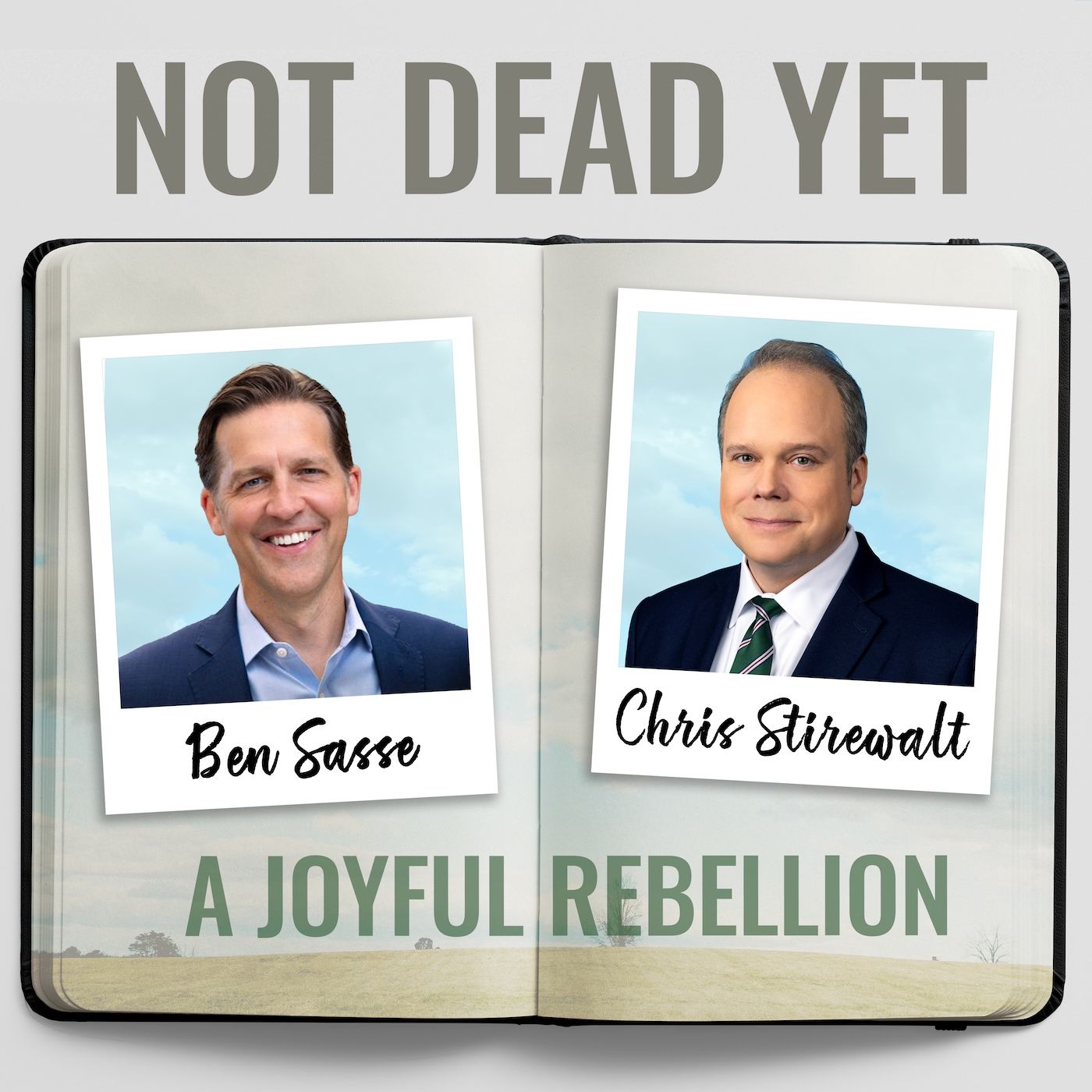
Not Dead Yet
Caitlin Flanagan
00:56:52
Caitlin runs circles around the guys. They talk about deadlines (for writing and living), living with cancer, raising families, how truth has the last word, and a little bit about California.
Loading summary
Transcript145 lines
- [00:00]
A
Foreign.
- [00:09]
B
Hi, I'm Ben Sasse.
- [00:11]
C
And I'm Chris Stirewalt.
- [00:12]
B
And this is not dead yet. We're all dying, but only some of
- [00:16]
A
us have been brought face to face with that reality.
- [00:19]
C
However long each of us have to do it, though, we all want to
- [00:22]
B
live a good life, one with meaning, love, and joy. And our guests are here to help
- [00:27]
A
us do exactly that.
- [00:29]
C
All right, you know, on this episode. Episode, we're gonna hear from Caitlin Flanagan. And let me just lodge a complaint here, which is the big problem.
- [00:42]
A
Let's have a festivus.
- [00:43]
B
Let's do a bunch of grievances because I got some with that lady too.
- [00:47]
C
The big problem with having a co host who has cancer is that I can't complain about anything. And it's. No, it's really bumming me out because I thought about it. I was like, as we were getting ready to record today, I thought, oh, you know, I'm tired, blah, blah. And I kind of hurt my knee a little, blah, blah, blah, blah, blah. And I was like, yeah. But I can't complain because this is a mainstay of podcasting is just the caveching. And you've taken that from me and I resent you for it, frankly.
- [01:16]
B
Honestly, my complaint is that that part of most podcasts bores me. So I thought, let's get cancer so that we could skip the complaining and just get right on with the interesting interviewers.
- [01:27]
C
Right over the top. Okay, wait, wait.
- [01:29]
B
Interviewees.
- [01:30]
A
That's morphine.
- [01:31]
C
That's morphine. Caitlin Flanagan is a lot of things. One of the things that she is is a person who publicly announced or started discussing her breast cancer diagnosis in 2002. And then in 2020, she had a long period of remission, and in 2020, she got stage four metastatic. Is that right? Yeah. So in the height of the adjective
- [02:11]
B
is metastasized, but if you want to throw it in front of it, it's metastatic.
- [02:17]
C
Metastatic. So she, in the height of the pandemic, shared with America that she had stage four metastatic breast cancer. But Caitlin Flanagan is. She has been on the staff at the New Yorker. She's been on the staff at the Wall Street Journal. She's been on the staff at the Atlantic. She's one of the best writers working in America. She is a superb cultural critic. She is the author of a couple of real banger best selling books. She is a person who. One of the things I like most about her, every time you think that, I think it was the guy Harry Jaffa The William F. Buckley joke is, if you think disagreeing with Harry Jaffa is hard, you should try agreeing with him. Caitlin Flanagan. Every time. Yeah, every. Every time she's about to get pigeonholed to something, she breaks right out. And she is an independent, absolutely army of one kind of person who is her own self. She became famous originally. She out of college, she went to uva, and after getting her master's in art history, she taught at Harvard Westlake, which is the swishiest school in la, and would later write about that experience. And her writing on feminism and pro and con faith in America, all of that stuff has been hugely formative.
- [03:58]
B
When you said you were gonna launch some complaints, this is where I was gonna go, too. She's too good a writer and it's not fair. I don't know how fast she is, but I'm both mediocre and slow. She's extraordinary and I suspect fast. So I've been a big fan of her brain for a time, for reasons very similar to what you just said, that you can't possibly pigeonhole her. You don't really know where she's going to come down on an issue when you start reading some article that she's written. And there's never been a time where I've read her. And at the end, there's some double negative in here. I've always had to acknowledge at the end that she took me down some circuitous path and made me rethink a bunch of assumptions I had at the beginning. So I'm excited that we get to spend time with her.
- [04:44]
C
She wrote a piece not too long ago about Pamela Anderson, and this is exactly the kind of article that Caitlin Flanagan can do in which you're like, pamela Anderson. Why are you writing about Pamela Anderson? And by the end, I wasn't entirely persuaded, but, boy, she took me right down that path. She is brilliant and I'm very excited to hear from her.
- [05:03]
B
Let's get after it.
- [05:05]
A
All right, Galen, we've already introduced you once, so it's too embarrassing for me to acknowledge in front of our gazillions of listeners that I've had a crush on you for decades, so I won't do that. That here, but would you bring me up to speed on how you do topic selection? Like, how do you. You've been in general on this podcast, we don't talk much about death. We talk about priorities, because everybody stands in front of death. You're a little different, though, because you've been dead for, like, 22 years.
- [05:35]
D
Yeah.
- [05:36]
A
So I imagine you go through a lot of phases with early cancer. Early cancer with kids at home. Oh, shit. I'm. Excuse me. Oh, we're gonna live a lot longer than I thought. Oh. Post 2020, things are different. Do you have deadlines? Like, do you. Do you agree to them or just say, hell no. I don't know. We're just. We're running it live. How do you do topic selection and do you agree to deadlines at the Atlantic or anywhere else?
- [05:59]
D
I guess I don't agree to them enough because I just got a review saying I needed to, which I promptly printed and shredded. But I mean, not to get into the big things through the small things, but I think you and I lived our. Live our lives in a similar way in that we got. We were so clear on what mattered in our lives from such a young age in terms of, like, I knew I was going to get married. I knew I was going to find my person I was going to spend my life with. I knew I was going to have children. I knew I was going to raise them as best as I possibly could. And so any single point along this journey that they said, oh, you're out, you know, you. You don't have much time, as painful as that has always been. And every single time it's happened, I say, I'll never be that scared again. I'll never be that scared again. And I'm that, you know, you get older and older. I was just about 40 when it started. Now I'm 64. Still gets that scary. But. But I always say to myself, well, I had a plan and the plan is being executed, is executed, and I've got that right person that I've built this life with, and my kids are filled with all of these things that there's no at all sense that I put the wrong thing first ever, when it comes to the most important things. So I could look back at my writing and say, oh, I should have focused more on that, or I missed this as rising in the culture when it did. So what? So what? And you're the person obviously ahead of anybody I've known or known of. Like every single step of the way. You said you knew. I just get a sense you knew it from boyhood. This is what's important. This is the next thing. This is how you build that good life. And just look at your family. I mean, all three of your children. You don't get kids like that when there's been a divorce. I'm sorry, it's really hard. Or when a parent is not devoted to their upbringing and to them being right, you know, living and right thinking people. And, you know, you made this promise in sickness and in health, and your wife suffered just the most, one of the most serious kind of challenges. And you've been there with her and you love her all the more. So I guess it would be. Don't sweat the small stuff. I just don't. I just think that you and I knew at a young age what was important. We didn't even know how right we were. But I just feel like I've always said I can pack my bags at any time.
- [09:10]
C
Ben, Caitlin made a series of accusations in her answer to your question. I wanted to say, and I'm. I'm going, I'm going to, I'm going to, to demand that you reply to her claims about you, your intentionality and your lovely family.
- [09:26]
A
Oh, thank you. I was gonna say, I don't want to argue with you, but man, that was wrong in so many ways. I am incredibly grateful to live in a family, the five of us in our nuclear family, that believe in real habits of frequent and daily repentance. But holy smokes, I'm fortunate to have that because the number of mistakes that I have made, we, you know, massive brain injury. When the girls were 3 and 5, Melissa had a vertebral dissection and then
- [10:01]
B
a whole bunch of strokes and you
- [10:02]
A
know, two months, we didn't know if she'd make it. 18, 19 months. She was institutionalized a lot of the time. And then at 19 months, so my girls are 5 and 7. They, we have massive neural regeneration. Melissa seems to be like 85% of her old self again and somehow just dumb as hell. I get drafted into this senate race a couple years later and I thought our life was pretty normal again. And so, yeah, that sounds like a fun challenge. I don't really want to be a senator, but campaigning, it'd be fun. I'm a competitor. Let's go try to win 93 of 93 counties. And honestly, my decision there was so foolish in that I knew it would be awesome. And I was right about the bus. Like we bought a bus. Our girls were 8 and 10 and we were pregnant. And Breck was born right before this. And so we went out on the bus with a brand new baby boy and 8 and 10 year old girls. And we spent 16 months living across all 93 counties in Nebraska. And it was some of the best family time ever. And then, unfortunately, I won and you had A job that was a couple of, you know, thousand twelve hundred miles away. And I'd fly away every Sunday or Monday and not get back till Thursday or Friday. And anyway, this is too long winded of a dissent. It's just to say that we took the family to D.C. about four months a year for the eight years and change we were in the Senate, but eight months a year, I commuted every week. And it was a really, really sinfully wrongheaded move to think that that was a good decision for our family at that life stage. And I've been digging out of that hole and everybody forgives me and they love me. In fact, frankly, they're annoyed if I ever apologize for it again because we've covered this ground. But I make prioritization decisions that are stupid all the time. And I'm not anything like you. You are arguably America's greatest writer.
- [11:52]
C
At least.
- [11:52]
A
At least the people who don't cover our most important subject matter, which is college football. But for those who are not sports
- [11:57]
D
writers, that's what I need to get into.
- [12:01]
A
Kurt Signetti column calling your name. But I'm not. I'm not a good writer. I'm a decent writer, but I'm not a fast writer.
- [12:09]
D
Okay, no more lying on the podcast.
- [12:12]
A
Okay, so you have an.
- [12:16]
C
This is correct.
- [12:17]
D
I first met you and I was like, oh, my God, I have to meet this senator. I had never sat down with a senator before, and I thought you were mad at me, and I was hoping. I was like, I'm going to get out of this, because I got the call that morning from your staff, and I was like, oh, I'm leaving DC on the red eye. And they're like, he'll meet you at 6 o'. Clock. He was like, you're meeting with.
- [12:41]
C
Anyway, this is correct. This is correct. Sass. Yes.
- [12:44]
D
And so then I found out just in talking to you, that why when you graduated from college and you're working in marketing, market consulting. Consulting. That thing that.
- [12:57]
A
Some strategy, something.
- [12:58]
D
Yeah. Thank you. And then at the same time, you were getting a PhD at Yale, and not only did you get the PhD on time, your dissertation won all the big awards, and I was sitting there like a liberal ish idiot, thinking, wow, I didn't know that there could be a Republican senator who is truly an intellectual. And I had you send me the dissertation. I read the dissertation. And so if you want to say later episodes of the podcast that you're not a good writer, that will fly. But it doesn't fly on this episode. Of the podcast.
- [13:37]
C
No, it won't fly. It won't fly.
- [13:40]
D
Make sure you check him on that throughout.
- [13:42]
C
I will not allow it.
- [13:43]
D
Okay.
- [13:43]
C
I want to ask you, Caitlyn, a question about the personal how to your work is intensely personal. Often I hide when I write. You know, Ben has written personally about his family and his family book was definitely in a look inside. But I, I, I've never been comfortable writing about myself and I flatter myself to say, well, I don't want it to be about me. But the truth is that it can be done, that you can write about your own experiences, your own life, your own self, including something like a very public struggle with cancer in a way that isn't solipsistic and isn't inward looking. Talk about how you have lived a life publicly written or written about your life publicly and maintained a real human life and not been a performative goofus.
- [14:49]
D
Well, you know, I got so attacked early in my career because I was really standing up for at home mothers. And the value of that work and the joy of it I don't think is part of the discussion at all anymore in the sense that like every second I did have that awareness that every second was so fleeting and I needed to keep stopping even though I was home with them. And I took so much attack, some of the attack was fair, that I wasn't making a big enough economic argument and the economy was changing so much that the idea of one partner supporting the whole family has really changed in the last at least 25 years. And I thought that was fair criticism. But the older I get and I look at my own life, I'm like, what the hell could I ever have done? What could I have done with my life that first place? It's just a level of joy that you don't know it unless you do it. You don't know it unless you do it. And it's definitely a level of frustration and, and it's hard, but, but so I put myself out there, I got really attacked. Then I got to the place that I learned that Ricky Gervais gave me this and I don't know if he came up with it, that you don't have any control over your reputation, none, but you have 100% control over your character. And so the more that I would get attacked out there in the places, the more I would say, well, my job is here, my job is with my family. And I know I'm doing, I'm not doing a perfect job, far, far, far from it, but I Know that I'm putting everything I have into it, and I know that it's important. So I guess, in a way, I kind of buttoned up a bit at that time and didn't so much write about myself. And then I got to the point that I felt, what am I really doing here? If the writing part of the job. And my kids were in college when I first wrote about cancer, if the writing part of my job is that. That's now the one that's in the, you know, the windshield, not the rear view. What am I doing to not talk about this? And what. What can they do to me in print? You know, like, what is print? What are pixels? You know, I'll just. I'll just tell the truth. And, you know, I always say the truth bats last, and it's like, I'll just tell the truth.
- [17:46]
C
So what do you mean? Unpack that sentence? What does that mean? What do you mean when you say it's.
- [17:50]
D
Everybody has a lot to say about who's gonna win this game. You know, everybody has. And then fortunately, it's not Casey at the bat. It's the truth, and the truth's at bat, and the truth's gonna win the game. And if you have. If we don't have the truth on something, well, he's not up to bat yet, so I don't think there's anything wrong. I think there's. I mean, even Freud so hard about these things, he would say it's in our vulnerabilities. I mean, I'm sure it's from Greek myth that he was getting this. But it's in those. That our strength will come and that we all. And this was a very. This is like his famous thing was that we all cannot admit to ourselves we have a full scientific understanding right now of what death is and how long life is and how quickly you could lose your life. But he said that we cannot, on the unconscious level, accept that because it's just too deep for the human mind to encompass that. And so we convince ourselves of our invulnerability. But I would say, and I am. I do respect Freud very much, not always for his theories, but it's the range of his thinking and of his erudition is matchless. But I would say Christianity is different because it's this constant reminder, whether we believe it or not, that we are immortal in the sense that, yeah, this mortal life goes, but we have our next home waiting for us, and it has been prepared for us, you know, and so. So there's nothing you can really do that's too wrong down here if you're doing it to just tell the truth.
- [19:46]
B
Here's way too big and awkward a
- [19:48]
A
pivot strategy consultant nerd in me you're fighting with Jeff Goldberg or Yoni wants you to write something and you don't want to, but you're nice and we're all partly pleasers and you want your editor to not be frustrated with you. How do you decide what you are going to write about and what share of it is still sex and gender now after 15 or 20 years, you know, girl land. You have moments where it felt like it was 80 or 90% of your story and then sometimes it feels like it's only 20%.
- [20:21]
C
What you're right about.
- [20:22]
A
These are super interesting topics that somehow our culture has decided to make really dumb, really simplistic political drab.
- [20:30]
D
You know, set them up as though it's high theory and you're dumb if you don't understand it.
- [20:35]
A
And, and the idea that everybody lives in a family and of course sex is one of the four, eight most important things in everybody's life and gender is both true and not like we're men and women are the same and men and women are super different. And teasing out differences between those two truths is pretty great. But you don't write exclusively on that. Now. What do you write about? What are your major themes and how much are you in control of that? And how much do you sometimes acquiesce to write about stuff that you really don't want to write about? And then do you really never feel guilty that you misprioritized? What are your boys, about 25, 6? 7?
- [21:13]
D
They're going to be 28 next month.
- [21:15]
A
Okay. You don't have any grandkids, do you?
- [21:17]
D
No.
- [21:18]
B
No.
- [21:19]
D
Don't touch a sore spot.
- [21:25]
A
I'm new to. I mean I've always believed a number in our days, but I'm new to the idea that you could put that on a weeks to months clock. And I still make prioritization decisions right now inside every day. And every week I'm at, I'm at MD Anderson Hospital in Houston part of every week and then I get a lead part of the time and trying to decide. I sleep fricking 15, 16 hours a day. This morphine knocks me out so I don't have much time to get stuff done. So I still feel latent guilt every day. But one thing that I'm good at right now at least is I don't feel guilty because Some editor wanted me to write something and I don't do it. You're a long way into this journey. Do you really never give in to setting deadlines? And maybe we should give in to still setting deadlines because other people's judgment about what's value added work is something we should probably take as wisdom for sure.
- [22:14]
D
On a professional level. Okay, this is a hypothetical. Jeffrey Goldberg is mad at me because he wants me to write something. Well, first place, he would never, ever match a subject to me that he. Any. Everybody knows where I'm going to. They don't know exactly how I'm going to come out on something, but they know, you know, he would never assign something. And the more somebody thinks it not a good match for me to write about something, the more I want to do it. But I guess I'm not a good camper in the. I was never born for a corporate life. And the Atlantic, you know, has become a very giant corporation. So I don't know. I'm a disagreeable woman more I'm a nice woman if you're nice to me, but I'm also a disagreeable woman because I'm. I really hold to certain values and certain ideas and. And yeah, yeah, I've taken as far as, like, missteps I have made, like, from the professional level, if I were to dispassionately, like, examine this woman's career, I would say, wow, she just really keeps setting off bombs in her own career. But if I looked at it from the standpoint of, oh, who is this woman and what does matter to her? I'm fine with the decisions I've made.
- [23:37]
C
I want to talk about disagreeability. It's a current focus and obsession of mine. And the value. And this is something you've written about, about the value and power of disagreeability and being good at being disagreeable. Right. There are a lot of people who are disagreeable, but you don't know it because it feels so pleasant when they disagree with you. Right.
- [24:03]
D
Yeah, that's not me.
- [24:05]
A
Right.
- [24:05]
C
And they decline, and you only realize later, like, oh, I think I got shut down there. I think I got. I think that was a no, but I couldn't really tell it until later. Talk about how when you're setting those priorities back to this question of priorities, and you have had what I envy, which is that you knew who you were and what was important to you from a very young age. I knew what I wanted to do, but I didn't know who I was exactly in the way that you did and in those core questions talk about the value of disagreeability, effective disagreeability, in protecting the priorities?
- [24:48]
D
I guess we'll talk to my employers about the value of my disagreeability. They'd have a lot to say about it. I spent a lot of my life trying to be more agreeable in my presentation of things. But again, as I look back, I. I think it's different if. Because I will talk about generational here. I'm a woman, not a man. So. And I was born in 1961. So the idea that I would gonna be building a career that would be one chapter after another. And that Scott Adams. I learned through Coleman Hughes that Scott Adams believed that your job isn't doing what your boss tells you to do. Your job is looking for your next job. Your job is to constantly be growing and be building your own portfolio of skills and positions. But I didn't grow up with that mindset. Well, I'll just tell you how old I am. I literally. This will sound like something that someone would put in a novel and we'd all scratch it out and tell the writer, that's ridiculous. Nobody would do that. I grew up during Vietnam and I clearly remember having this insight in the playground and telling my mother that day. She's the one who remembered. It's the way I remember it. And I said, it's so great to be a girl because. And did I say I could do anything because I'll never have to have a job and I'll never go to Vietnam. So. And I wasn't. It's like those seemed like pretty good deals to me. You know, I didn't want to run anything and I didn't want to go to this war that people were coming back from in body bags. Mother's sons that were 18, 19. I just really come from a different time. And so much of. I'm sure what's in me it has to do with coming from that time. But I really do know what things I believe, and so I don't get pushed around on those.
- [26:57]
C
I like that.
- [26:58]
A
Senator Sass, are we in a pendulum swing about this question that you said a minute ago? Raising kids is not just for moms, but for everybody. A pretty dang glorious calling and opportunity. Are we in a possible pendulum swing the last 24 to 36 months where there's a chance the culture might acknowledge that again? Or are we on. Is the fertility data the more important point? And every rich western industrial nation wants fewer and fewer and fewer and fewer babies and we're just stupid People, do you have any hope that the natalist crisis, which plays out in a lot of pop culture screaming, might abate at some point? Or are we on a decades long trajectory of just not understanding that babies and families and futures are kind of interesting?
- [27:50]
D
If we leave the argument to Stephen Miller and Elon Musk about why people need to have babies and if they bring their charts out and start demanding things, nobody's going to ever want to have a baby, because that's not the reason people want to have a baby. But to blame them, as I certainly do, for many things, all things they've ever done. But the whole thing about it is that feminism, second wave feminism, which started in the 70s, rising up as you know, because women really, in America, a lot of just basic, basic rights to even get a certain job or even apply to certain jobs was out, was, was not available to them. But to. And a lot of women responded to that and to the fact that they wanted something else in their life or the choice of something else besides being a housewife. But what the. So it was appealing. But what the feminists did very nakedly at that point was saying, and a term I use, because it's a quote, it's in one of my pieces, that the shit work as the term was of housework and doing all these things and driving the husband's train station, all that, that child raising was also part of the shit work. All those meals you have to make, all those diapers, you have to change all of that. Women shouldn't have to do that. And they were too naked about that because women's were, women were like, wait, I really, really want that. And during the 80s and 90s, the feminist movement was trying to backpedal from that a bit and say, well, you know, of course a mom working at home is working as much as a mom working outside of home. And of course, you know, we're going to bring motherhood into our jobs in all sorts of ways and we're going to demand childcare. The big corporations for a while even tried out having childcare, but it was, it's, I'm sure you would know, liability, you know, free for all to have childcare at the office. But so things kind of were going on that. And there was the culture wars, the working moms versus the at home moms. And that was kind of an elitist argument, I will admit. But it finally they've won big because it's young women saying, why would I want to do that? Why would I want to have a baby? When I can. It's all the things I. What I love to do. I love to travel, I love to go, go out at night and see my friends and I. They're giving the arguments that the stereotypical male of the 50s and 60s who's resisting proposing, like, why would I screw up my life like that? Now we've got a generation of young women who are saying the same things. They don't have any notion. And even the sort of famous women that rise to the front and they love being at home, but they're not like trad wives, whatever that means. They always lead with movie stars will say, of course there's all this and this and this problem, or I found a way to bring my baby to the set, which never works out. But right now, the feminists have won big on that and that you have young women saying, why would I want to do that? Why would I ever want to do that? It would screw up my body, it would screw up my sexual options, it would screw up my career path. Although now they're kind of backing off even on that as something that they have understandably much faith in. But what's going to rise back up will be at the closing 20 or 30 years. And those women will wonder as they age, a lot of them are going to say, who's around me?
- [31:45]
C
Yeah, yeah.
- [31:48]
A
I mean, I.
- [31:51]
B
At the risk of being way too
- [31:52]
A
historian nerd, I'm a little bit optimistic that if you think about all of economic history as four waves. You got hunter gatherers, you got traditional agrarianism, you have industrialization and you have whatever this thing is, the digital economy, the knowledge economy, the post industrial economy, which is why I was saying we
- [32:09]
C
don't know what it is.
- [32:09]
A
It's the after the last thing thing. The first two, hunter gatherers and agrarianism, your kids were at work. Industrialization is the outlier. Right. 150 years ago, all of a sudden, the rise of really big tools, the rise of factories, meant you couldn't take your kids to work. And so much of what's complicated about the economics of gender and about child raising and everything else is that work was separated from home. That was not true on the farm 200 years ago. It wasn't true in the Fertile Crescent 9,000 years ago. It wasn't true when you're following the buffalo herd, the new world. The digital economy has a ton of terrible stuff about our distraction economy on the supercomputers in our pockets, but it has a pretty dang awesome thing, which is the biggest tools that have ever been created. Digital tools are bigger than any industrial or factory tool and we all have them with us at home. So there's a chance that work and home come back together in a way that makes it possible for people to have home and have work without having to go away from your kids forever. And I think it's, you know, it's especially true for moms, but it's true for everybody. There's an opportunity in this moment, but it doesn't feel like there are any celebrants of that possibility. I mean, if you look at the data of all industrialized nations, the only people groups that reproduce at more than 2.1 live births per mom are Orthodox Jews in the US, Mormons everywhere and orthodox and secular Jews in Israel. Every other people group on earth is below 2.1. I think, you know, the net average across Everybody is like 1.5. That's a really small world. Orthodox Jews, Jews at the edge of battle zone in the Middle east, or Mormons, there's nobody else. Give me more hope that there's a chance that people will celebrate the economic opportunities of the digital revolution for work and home.
- [34:04]
D
The hope is the knowledge that God's in charge, we're not in charge, and God's plan is going to be revealed. And I don't think any part of his plan suggests that we live this way. We live without children, we live without a home that's truly a home.
- [34:19]
A
The lack of intergenerational experience is a really weird thing about our consumerism. Right? To not your point. About 20 or 30 years from now, a lot of these 25 year old women, women who today talk like, you
- [34:30]
B
know, weirdly stereotypical Western TV men from
- [34:35]
A
the 1950s, you say 20 or 30 years from now they're going to feel some regret about it. Be so much healthier if we all knew our grandparents and actually walk through halls of better and worse nursing homes and said, what would it look like to have Abuela live, you know, in the guest house above the garage? Because our kids, they need her to read to them and she needs community and we need each other.
- [34:56]
D
And that's how, you know, I always remember when Michelle Obama moved into the White House and her mom came with her. And that's where I was like, this is fantastic. And as hard as it was for those girls to be in that position and that just a hell that that family had to endure, you know, protected car the first day they all went, the girls went to school, she was always there. And that's why old People didn't feel so devalued because they were valued. You know, if you want to have kids and you live near your mother, that is. I mean, I know I'm hearing the leftist saying, but these grandmothers are being exploited because they need to do their jobs. But believe me, your mother wants to be with your kid. And if your mother says, if you say, I just can't afford the daycare, your mom's gonna have to stifle herself from saying, that's fantastic. That's her dream come true. Like, why not live, if you can, near the person who loves your child in a sense even more than you do, from what I hear talking to grandparents.
- [36:08]
C
So you a mother of sons. You know the. We've had an astonishingly flat and stupid conversation in the United States in the past year about the reductive description. And there was an essay that helped kick this all off. But the reductive description was basically when women entered full participation in the workforce, circa 1980, which is right about the time you were entering the workforce for
- [36:38]
D
my brief strut upon that stage.
- [36:42]
C
But that it was the arrival of women that gave us political correctness and wokeness and ruined everything. And that the reason now that Elon Musk is on a one man mission to get those birth numbers up, the reason that men are wounded, upset, bad feeling, unplugged people, is because women came into the workforce and took away men's place in the workforce and turned it into HR hell. How do you, when you think about the arc of your adult life, right? So let's say 1980 to 2026, talk about what happened to men and talk about and boys and talk about the argument that it was the women being at work, that that was at the
- [37:38]
D
root of that first place. There's no woman in the country who's going to hear someone breaking into her house and calls 911 and that they say, oh, we have two women in a patrol car. Oh, but there's also two men in another one. Which do you prefer? Cagney and license woman in the world? Oh, no. I want to be true to my sisters. No, I saw that Secret Service agent after the Trump, you know, attempted assassination. She couldn't even reholster the damn gun. And now there's a lot of. And I'm not saying this just as a. Because you're supposed to say it. There are great women in law enforcement. I've talked to a lot of them. I was very lucky that my job was. I was a teacher and I taught At a boys school. And I was like, it was a really great job. And I was like, oh, a boys school. But I love girls so much. I. It was seven through 12. I learned. I loved those boys. I love boys. I was so happy to find that I was having boys. And there are so many things about boys that people seem to not know. Boys, little boys, I think, are more sensitive than little girls are. They're just very sweet creatures and they. They're imaginative and they're sweet. And they. Very early on, they get this idea of it would be great to be a hero, meaning a protector. You know, you can try to give them that happy, happy gender equity story in print and television or whatever, and they're going to find that hero story, and that's going to be what they want for Christmas are those characters, those action characters. And just as there's. I would screw you, Judith Miller,
- [39:35]
A
also on my bingo card today.
- [39:39]
D
We're just free wheeling over here. There's something innate in us. There's something innate in us. Who knows who we are? And I'm not saying there aren't. Gay people are absolutely a part of God's creation. I know a ton of them. I'm not saying there isn't such a thing as a transgender person. I don't know. I've certainly met people who explain that they are, and I have no reason to say they aren't. No. Why would I? It's not my business. Except I don't want trans girls and women in sports. But that's not what we're talking about. But there's something in us who knows who we are, and our biology is connected to it. And boys somehow know. Nobody has to sit down and say, you know, you're bigger, you're stronger, you're faster and taller than all, than women on average. You know. Yes, there are some women who are all those things more than some men, but the overwhelming majority is that men are stronger and faster and taller and larger than women, and that has a consequence into how they think of themselves. And the more. The more you limit their avenues of expression to just that, the more you get what you have. Yeah.
- [41:06]
A
Plural callings. I know we have to let you go within five minutes, and I'll let Chris close us out in a second. But I. I do. I would feel I missed an opportunity tonight or next week if I didn't ask one of the wisest Californians I know. Can you explain California to people who love it? And I've. I'm 50. I'm 50. Three I've paid taxes in, I don't know, 15, 16 states. I've only lived in California once for a year and a half in the mid-90s. But I've probably done work in California on a quarterly basis for almost 30 years. I've sit on some boards in Silicon Valley and I feel like I kind of know California some of the time and I love it. And it's seeming collapse of any coherent conversation about what it would look like to plan for the future. It's something that makes me want to weep. But it also is just a mystical riddle like I can't understand it. Can you? As if this is a 3 minute instead of a 33 minute question. Can you explain what's happening in California and what you're hopeful about that 15 or 20 years? It's not just a complete hellhole because it looks like that's where the political and economic and cultural governance is going to take the state. Is there any good news about where California is going to wait?
- [42:38]
D
Those are two very different questions. What's going on? And is there any good news? I was born here. There was no place I can make a very good argument, and I have, that there was no luckier ticket to have in the entirety of the human experience than to be born in the state of California in 1961. The beauty of the place, the huge middle class that was growing around aerospace and all of those sorts of things. The University of California, a great university, one of the greatest in the world with no tuition at all. And a state where every single child there was a path for everyone to get a college degree. If you were in this portion of your high school diplomas, you were going to a uc. If you were the next tier down, you were going to a state Cal State. And if you were everything below, you were going to go to a California community college with automatic admission to the UC campus of your choice afterwards. It was a paradise. And right now we're doing everything we can to make it into a hell. And there's still tremendous beauty here. There's still the one great thing that lasts is the California Coastal Commission and those beaches being free and available to everyone, at least up to the waterline of the zillionaires houses and Sidebar I've never met more climate change enthusiasts who are simultaneously beachfront property enthusiasts in California. This is where it happens. It's just writ large all the weirdness. Right now I would recommend Paul Kingsnorth against the machine philosopher that we've got to get down to the most elemental things which were kind of known in California when I was growing up. That said, I grew up in extremely liberal household, but my father was a great. It wasn't intellectual. He could be both those things. So the wrong forces are in control is what's happened here. The wrong forces are in control and Silicon Valley should make their incredible advances that have. Every time I see a video of one of that young man who's kind of teaching himself to read as a high school student and to read aloud and he's got a book in his hands and he's got his iPhone in the other hand, he's checking the pronunciation of words so that he'll be able to pronounce words correctly as he speaks. I think this thing has changed the world and it could change the world in such a profoundly good way. But it's also. I have never in my life said this, but Paw Kings north has persuaded me otherwise. I think the devil's in it. And I think the devil's in it. And I think the devil lives here in California.
- [45:43]
C
Boy, Ben, you asked for a hopeful note. The devil's in California. Merced, I assume. I don't know. I don't know where exactly in California
- [45:58]
A
at 4pm every day.
- [46:00]
C
He likes a full bodied red. Definitely, definitely.
- [46:03]
D
But then God shows off because you get to the beach and you see that sunset and he's like, they're not in control. I'm in control.
- [46:10]
C
It occurred to me, my wife is many of the same sentiments that you express. She grew up in Orange County, California. Paradise. Her delightful growing up and the perfection of all of that. And we were out there one spring break, Disneyland. Best. We achieved the best Disneyland day ever. The perfect Disneyland day. No, Disneyland is great. And if you go with somebody from Orange County, California, you do it right. It is the perfect. It can be done. But it occurred to me while we were out there. Oh, California is France. The weather's too good.
- [46:45]
D
Yeah.
- [46:45]
C
It's too nice to be there. That you. The. The governance falls apart. Things fall apart because it's too good. Right? Like the. The earth is too bounteous. The wine is too delicious. The sunsets are too gorgeous. Everything's too good. And people are like meh, you know, whatever. I'm not. I. If you, if you live in Wisconsin, you have to be serious about everything. You have to be serious about everything. Because if you go outside at the wrong time of the year, you'll die. If you don't take care of California. It's too nice. What about that California is too nice to be governed.
- [47:20]
D
Well, there's kind of that loosey goosey theory that people like, I think someone must at some point have advanced it in a book way back. But that the colder the climate is, the more human beings have to work to survive it. And then you end up with Tahiti. Whereas life was always the culture that had it, you know. And there is an extant culture, ancient, but alongside luxury hotels now. But that there was no need to create or invent so much just to get through one single year. And that the warmest places tend to be. Because it's just so easy to live in them. Yeah, I think. But we're doing our level best to make it very hard to live here. So maybe look for great things from us.
- [48:07]
A
I want lots of credit for the self restraint of not extending us over time longer to talk about the difference between sex in Oslo and sex in Tahiti.
- [48:16]
C
Boy, I'm really gonna stop you. Right. This is definitely what we're on the list.
- [48:20]
D
I have my next article, so thank you.
- [48:24]
C
Ben is going to. Ben is going to go check into the ice hotel somewhere so that he can do. Do the field work.
- [48:30]
D
Oh, that kind of ice. Oh,
- [48:33]
A
I have a bottle of morphine next to me.
- [48:36]
D
Okay.
- [48:37]
A
I'll be playing the club all week. The veal is $9.
- [48:41]
D
Okay. All right. Oh, it's $9 veal.
- [48:43]
C
Caitlin, we could not be more grateful to you for doing this. You're. Again, I agree with your assessment of Ben's writing, but I agree with Ben's assessment of yours. You are in a very narrow group of people whose stuff I don't just feel obliged to read that. I want to read every time. And anybody who's not reading your stuff is missing the boat. So I'm really grateful.
- [49:05]
D
I want to say one thing to Ben.
- [49:06]
C
Say anything.
- [49:07]
D
Ben says, I love you.
- [49:10]
A
I love you too.
- [49:12]
D
I truly love you.
- [49:14]
A
Thank you for your humanity.
- [49:15]
D
And I will miss you. And you will get. You're going to get a place next to the dessert table in heaven. And you're going to find me sitting next to you.
- [49:24]
A
Soon enough, you and I and Luther are going to talk both theology and escape from the nunnery.
- [49:31]
D
Okay, Sounds good. All right.
- [49:35]
A
Thank you, friend. This meant a lot.
- [49:37]
D
All right, you too.
- [49:39]
C
Okay, professor, what did we learn today?
- [49:44]
A
She love hates California.
- [49:49]
B
I kind of love hate California.
- [49:51]
A
So I'm glad we asked her about that.
- [49:53]
C
Yes, this is true. Can I read you something from Caitlin Flanagan?
- [49:58]
A
I guess.
- [49:59]
C
I guess it's too late now. I've already I've already started. Are you someone who enjoys the unsolicited opinions of strangers and acquaintances? Acquaintances? If so, I can't recommend cancer highly enough. You won't even have the first pathology report in your hands before the advice comes pouring in. Laugh and the world laughs with you. Get cancer and the world can't shut its trap. I share it just because when I think about a person, and we talked about this with her, but I'm such a weirdo and unable to be myself in public. Right. I agree about you. Yeah, yeah, yeah, for sure. And her ability to do this right and be real about it, but not maudlin or not whatever, is pretty, frankly, amazing to me.
- [50:53]
B
I have been at a lot of conferences over the years. There are different kinds of conferences. There are conferences you go to because you're getting paid to speak at them. There are conferences you go to because you're willing to speak there as the entry bar or something morphine, as a way to get to learn from the other people there. There are conferences you're at because you are meeting up with old friends. There are lots of different kinds of places. I've been where she shows up, and whether she's there to speak or not, she ends up with groupies almost immediately because of how strong an effect she's had, lots of people's worldviews. And yet, as you say, she's still just like Caitlin over at the buffet line. Like there's no pretense or ego. She's a special human.
- [51:42]
C
Okay, so let me just. Let me just be terrible and just ask you. Are you sick of the unsolicited opinions and advice and people, all of that stuff, or how are you. How are you processing the well wishes and curiosity of the wider world?
- [52:00]
B
Well, I mean, to be sick of it would be a real jerk move because the people who want to ask about cancer or give advice about cancer are doing it out of kindness. And so I definitely have to overcome my rude impatience. I think impatience is both a vice and a virtue, but it's mostly a vice. And it's not my favorite topic. It's not my favorite topic now, but I've also just never been. I'm not that biologically informed or, you know, educated. And so it's not my topic of choice. But I think the first day. Don't quote me on this, but I think the first day that we announced that we had a terminal diagnosis, I got something like 1400 emails at one of my public email addresses, and over a thousand of them were very precise Recommendations that included a whole bunch of Sharpie in the corner of the email, making clear that there was some conspiracy out there from some drug company that was trying to get me strange four metastasized echinacea.
- [53:04]
C
Yeah, there's.
- [53:05]
B
There's some Area 51 stuff going on, but I think the only thing I can say I'm sick of is the essential oil recommendations.
- [53:13]
C
Well, I just, I want. I just want to make clear that my questions about this are not well intentioned. I'm just trying to exploit you for. For traffic and clicks. That's all that is.
- [53:25]
B
And you own a lot of stock in Ivermectin.
- [53:27]
C
Oh, you don't know what I'm doing on. You don't know what I'm doing on supplements, brother. You have no freaking idea.
- [53:34]
B
I didn't expect you to get essential oil tattoos, but you're wearing them.
- [53:37]
C
Well, it's henna. It's all over body. All right, so next week we're gonna hear from Mike Rowe, Mr. Dirty Jobs himself. And I expect that to be a rollicking good time.
- [53:51]
B
I have no doubt he'll make us blush.
- [53:54]
C
Yes, yes. And you share in common with him a love of visceral, manual, outdoor, manly labor. And those things which I do not share with him, but I do share with him the broadcasting background. And so I'm very excited to talk to him.
- [54:13]
B
I won't bore us with it now, but the way I got to know micro actually is, is we realized early in Senate life. So I was on a campaign bus. 2013, 14. Elected November 14, took office early 15. And by six months into office, I realized that town halls were not nearly as fun when you weren't elected as when you were campaigning. Because when you're campaigning, you're trying to accomplish something to grow the audience, and you'll take a little bit of drama, even if people are kind of. Some of the people at a town hall might be crazy once you're in office. A much higher proportion of the people who come to the town halls are really, really, really addicted to politics. And so they're not very representative. And so we added to our town hall touring a lot of dirty jobs work. I would do ag manufacturing. I worked feedlots. I did tasseled corn. I vended at every marathon and Husker sporting event. But in particular, I started working a lot of trash routes, and I started asking Mike Rose advice on more cat categories of dirty jobs and how to learn well while you're doing dirty jobs. And so I. I owe a debt of gratitude to him because he helped me get to know a lot of my constituents better in 2015-16. I'm a fan, you know.
- [55:31]
C
That's a very good tease I see. If I see a future in broadcasting for you, I, I like your chances.
- [55:37]
B
I think five or ten years from now I got a real chance.
- [55:40]
C
You could be big. I could. I know some guys in local TV. We could get that going for. For you. Okay.
- [55:46]
B
2037.
- [55:48]
C
Okay, that's it for this week's episode. We hope you'll like. Review and subscribe and tell a friend. Feel free to email us with your thoughts, corrections, questions or whatever else is on your mind. Write us at sass and styrewalt gmail.com this podcast was produced by Scott Emergut with the help of our colleagues at the American Enterprise Prize Institute. The music is from Drew Holcomb and the neighbors. Thanks for listening and keep living the good life.
- [56:16]
A
Go Big Red. Sam.