← Not Dead Yet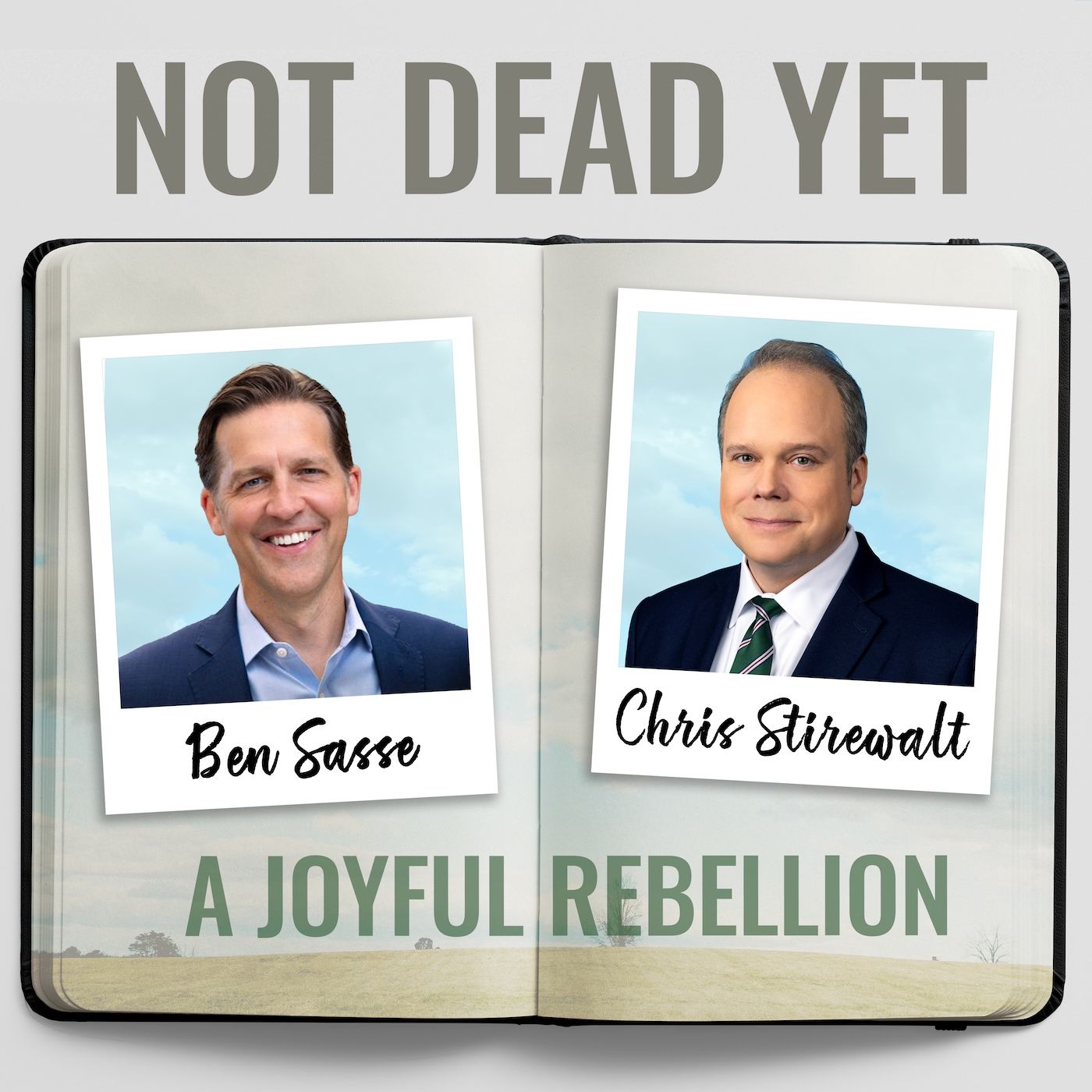
Not Dead Yet
David Zahl
01:06:10
Dave talks with the guys about the problem of replacing faith with the cheap imitations of disordered goods, the need for thick community, the emptiness of striving, and the need for grace. Come for the critique of moral therapeutic deism — stick...
Loading summary
Transcript152 lines
- [00:00]
A
Foreign. Hi, I'm Ben Sasse.
- [00:12]
B
And I'm Chris Styerwold.
- [00:14]
A
And this is not dead yet. We're all dying, but only some of us have been brought face to face with that reality.
- [00:21]
B
However long each of us have to do it, though, we all want to
- [00:24]
A
live a good life, one with meaning, love and joy. And our guests are here to help us do exactly that.
- [00:31]
B
All right, I. Ben says, I did not, I did not mean to take us to church this week because I don't want. This is. This is not a principally religious or sectarian podcast, but the. David Zahl and his book Seculosity just kept coming up in my mind thinking about how often we have, in I don't know what episode this is talked about.
- [01:06]
A
500 or 17, something like that, somewhere
- [01:09]
B
between 17 and 500, about how often we end up talking about the idle construction and how often we talk about priorities. And this is a book and a guy who, who has put this together. So I'm excited to hear from him and I'm excited to talk about it.
- [01:28]
A
I am, too. Seculocity was a book that I first learned about from you, and it's half a decade ago, but he has a new book, which I'm sure he'll distinguish for him a lot, distinguish them a lot for us. But in my mind, the big relief, the subtitle, something about the urgency of grace in a frenzied world or something feels very similar. But it, it is getting at the perpetual treadmills we all live on. And it is, I hear you, that we are always, to quote John Calvin, creating little idol factories inside our, our brains are idle factories. We're always creating little idols. And it's, you know, the distinction between theology and religion is pretty great. Theology is actually a substantive thing that we can debate about the God who speaks and saves, or you nature of God and his attributes versus religion, which is a subset of sociology. How do we organize ourselves? But the, the really interesting point that I think you've been driving us to when you suggested this guest is that we're so frenzied right now that everybody is creating these little idols constantly. But out of the crappiest little stuff, like if your idol was thunder and lightning. Okay, yeah, that's a little bit persuasive. But, but the idolatry of getting into a really good prep school. Oh, freaking boring.
- [02:57]
B
Well, I mean, it depends on how good. No, I kid, I kid, I kid, I kid, I, I, I certainly kid. And are you familiar with Mockingbird Ministries? Were you familiar with before this.
- [03:10]
A
I wasn't before this. I am now. But unpack it.
- [03:14]
B
So Mockingbird is pretty pop culture, E. MA it certainly. It is an outreach design for people like me. It is. Whoa, whoa, whoa.
- [03:31]
A
We gotta unpack. A lot of brokenness.
- [03:34]
B
Yes. Well, there's always a lot of unbrokenness to unpack, but it's. It is. It is a high traffic, high volume online. I'm sure they call it a community, but it is a resource, I guess, is what I would say. He's a writer. I'll just give you the brief bio on David Zahl. So he and his family live in Charlottesville, Virginia. I think he was formerly part of campus ministry at uva. I'm not sure about that, but he's on staff at Christ Episcopal in Charlottesville and he started writing places like the Washington Post or Christianity Today or wherever. And he was an essayist. And then that, I believe, led to Mockingbird Ministries and the work that they do there. And it's good stuff. And it's culturally, I guess I would say it is. If you are an elder millennial or a young Gen Xer, it's culturally attuned to that kind of mindset and speaks in that language.
- [04:48]
A
Well, I am looking forward to this because I think he simultaneously does a top down and bottom up, you know, a complicated nature of our idolatries and perversions, and yet a really simple summary that you ultimately need grace. The simple point is you need to know that your identity is given and you can be confident in it before you perform. And then you can go and perform from an energy of freedom as opposed to trying to work your way up to being accepted. And I love some of his stuff that is about our need for community and belonging and how in these thin communities, people strive so hard to be accepted that you get to narcissism of small differences. I mean, it reminds me of the old Emo Phillips joke about people who seemingly have lots and lots and lots of agreement, but then ultimately there's a little bit of disagreement somewhere and then we have to say, die, sucker.
- [05:43]
C
He said, I used to believe in God. I said, that's good. Were you a Christian or a Jew? He said, a Christian. I said, me too. Protestant or Catholic? He said, protestant. I said, me too. What franchise? He says Baptist. I said, me too. Northern Baptist or Southern Baptist? He said, Northern Baptist. I said, me too. Northern conservative Baptist or Northern Liberal? He says Northern conservative Baptist. Heiss and me too. Northern conservative Fundamentalist Baptist. Northern conservative Reform Baptist? He says Northern Conservative Fundamentalist Baptist. I said, me too. Northern Conservative Fundamentalist Baptist, Great Lakes Region, Northern Conservative Fundamentalist Baptist, Eastern Region. He says, Northern Conservative Fundamentalist Baptist, Great Lakes Region. I send me too. Northern Conservative Fundamentalist Baptist, Great Lakes Region Council of 1879 or Northern Conservative Conservative Fundamentals Baptist, Great Lakes region council of 1912. He says, North. The Conservative Fundamentals Baptist, Great Lakes region council of 1912. I said, die heretic. And I pushed him on.
- [06:59]
A
Because our performance is almost always relative and comparative then. And that's never going to be satisfying. It won't be an oasis of origin.
- [07:08]
B
This is probably the only time that Sam Kinison has ever been partnered with this sort of theological deep dive.
- [07:16]
A
I object. It's been done before. We'll do it again.
- [07:19]
B
We'll do it again. Let's get into it.
- [07:21]
A
David, welcome. Thank you for joining us. We are grateful to have you and you're prolific. Seculosity is why style got us talking about you a while back. And in addition, you have the big relief. Would you tell us, you know, kind of the double softball question for an author on a book tour, what are your books about? And how'd you get from one success to another output this fast? Neither Chris nor I have managed that well.
- [07:55]
D
Thanks for having me on, guys. This is really an honor. Seculocity was born out of 10 years of writing for the Web and noticing how anxious people were. There used to be a column in the New York Times called Anxiety, and I was just noticing over and over again that the anxiety that people were describing and talking about had like a religion. Religious tint to it, like a spiritual dimension to it. And I recognized it. It sounded like the. The anxiety about not feeling like you're enough or feeling like you have to perform at all times in all places. And the anxiety that, you know, the belonging that you were looking to politics to provide you or the belonging you were looking to for your gym to provide you the salvation you were looking to for from your spouse. It became this motif that I noticed and I thought, you know, gosh, wouldn't the. The subject of replacement religion or the way that various kind of, I guess secular avenues have become targets of religious devotion and therefore religious anxiety and producing all sorts of sort of the. The anxiety of the devout. I thought it felt like a fertile ground to explore. And at the time I didn't feel like many other people were talking about it. Since then, I feel it's become a little bit of a trope for people to say anything they don't like is, oh, that's the religion of such and such. But that doesn't change the fact that I feel like youth travel sports functions like a religion for a lot of my reach.
- [09:31]
E
Sweet.
- [09:32]
A
If only you could do youth travel sports for a mere tithe of your income.
- [09:37]
D
Exactly, exactly. I won't even, I won't mention, I can't even mention to my wife what we paid for youth travel baseball the last time around. It was, it's. I mean, sinful is the only way to describe it. But anyway, so that the book just like surveys a bunch of ways in which we lean on kind of not ostensibly non religious things for value, meaning, purpose, identity, enoughness and even, you know, redemption.
- [10:05]
B
And I want to just, I want to dive in here just to say, you're a Christian, you have a Christian ministry. This is a book that is suffused with your worldview. But it is not a book that if you are not a Christian, you will go, what is this guy even talking about? I can't imagine what he means by this. Talk a little bit about your ministry and talk about who you were trying to reach with this book. And the response, first of all, I'm
- [10:37]
D
always writing for myself and to people like me. That's my point of view. So I was writing from within each one of these replacement religions, each one of these seculoci, which is just like religious energy directed at a kind of a non religious target. And so I just felt like my peers. And I was also working with young people at the University of Virginia, a lot of younger guys through our ministry, our church. And I noticed the weight of perfectionism is almost too light of a term. It felt like this one false move in your dead mentality about life where there was no room for mercy, forgiveness, grace, etc. And I was doing everything I could with my day job to alleviate those burdens, to listen and kind of be a presence with these young men. But then also seeing it at my peers where folks were just freighted with pressures that maybe that I felt as, as a religious person, I felt like I had some insight into. I was like, you know, this feeling that you're feeling is a lot like being in like a really bad church, you know, and a church where there's no room to breathe and you don't hear about the grace of God. You only hear about demand, demand, demand, demand, and sort of these treadmills that people get on to justify themselves. So the book's really about self justification. It's addressed to me first of all, and then outward in anything I Write. I'm trying. I'm trying to write to at least the, what I would call like the non Christian corner of my heart, you know, that it's omnipresent, ever present.
- [12:18]
A
You said the, the line, the demand,
- [12:20]
B
demand, demand, demand of a bad church.
- [12:22]
A
I wasn't trying to take you to a third book, but you do also have another book that has law and gospel in the title. And I think about a mentor I had 35 years ago who said, you know, you're in a bad church. If it always feels like the language of a gym, of somebody giving you rah, rah, rah, you, you can make progress on the bench press and the squat and the deadlift and the military press. The, the right church is a hospital and acknowledges that people are sick and we're, we're broken and we're going to need a whole bunch of grace coming from outside of us. But go back to the seculosity. Remind me. Circulosity 2019.
- [13:04]
D
2019. Then I, I added a chapter about fandom in 2020.
- [13:09]
A
Okay. And the big relief is just, it came out earlier this year, right.
- [13:13]
D
2025.
- [13:14]
A
Okay, that's.
- [13:15]
D
But that's basically about pressure and relief and, and the way that grace plays out in all sorts of different, both non religious and religious ways.
- [13:26]
A
When did you start writing the second, the most recent?
- [13:30]
D
Well, believe it or not, I wrote a book in between those called Low Anthropology. So there's a trilogy of books that are really attempting to translate Christian ideas that I found to be really helpful for contemporary life into terms that are, I don't know, plausible, contemporary, intelligible. Without talking down to folks and acknowledging the very real difficulties that most of us live with. Even those of us who are not, you know, do not have the, the kind of diagnosis you've got right now, Ben. But so each one of those seculosity is really for. Spoiler alert. It's really about the idea of justification by faith, which is a central Christian doctrine that kind of have fallen out of fashion. And yet all I saw in my peers and in myself was just people trying to justify their existence, like according to this metric or that metric. But it's wearing us out. And I felt like the Christian faith had something to say and no one was saying it. So it was like it was, you know, that's always the, the advice people give to writers, like, write the book that you want to read or that you feel you could use in your work. And so that's what I've tried to do.
- [14:40]
B
So parenting is A word that has been around for, I don't know, at least a few hundred years, but it didn't get used very much until the 1970s. And to parent is something my parents wouldn't have said that they were parenting me. Right. A parent was something to be, not something to do. It was not an action verb. It was a state of being. And one of the things that you talk about in the book, and I hope I wish you would expand on the pressure that parents feel about, it's sort of bringing the metrics of work to parenting. Right. So instead of like, we're a family, we live here. I got problems, you got problems. I have a role to play. You have a role to play. We are together in this weird little kibbutz of existence. Instead it becomes, are we hitting, hitting our numbers? Right? Are we hitting our quarterly numbers for parenting? Talk about the replacement, the idolatry of parenting. Which sounds like it's a really good thing to do, right? Caring about your kids a lot and spending a lot of time thinking about your kids and working with them and working on them. That should be really good, right?
- [16:05]
D
Yeah. Most of the stuff that I talk about in the book isn't. It's bad in and of itself. It's just not meant to bear the weight of our self justification or our every, every kind of iota of meaning we have. So parenting is great. You know, the world is lacking in wonderful parents. So I would love to see more sort of present parents and sort of more responsible parents and more just frankly more loving parents. But the way that it works out in my contemporary setting at least is that your child's performance is what matters at X, Y or Z. And who are you if your child is not in this program, that program, or not getting accepted to this place or that, you know, it's not just your child's value that's at stake, it's your own. And so the amount of the ways we almost use our children as tools to, or props to make us feel good about ourselves, I think that that's actually a form of objectification that doesn't serve the child or the parent well. How many kids have I watched grow up and feel like they were totally responsible for their parents self regard and as a result they want to have nothing to do with their parents. Or at least there's. It's complicated, you know, at best, so the, and then you know, the parents for their own part, I mean they're not really a lot of it. They're afraid, they want their kids to be to do well. And they think if they don't enroll them in, you know, all star soccer at the age of six with you know, three practices a week and they hyper specialize earlier and earlier in that sort of accelerated way they think kid's going to get lose out on something. And we love our kids, we want them to be safe and we want them to be provided for. But it, it just quickly becomes a ladder to climb that just keeps getting higher and has no end. And it produces I think not just sort of enmity with other parents for everyone. You're sort of in this arms race which isn't really conducive to loving communities but it, it exerts a pressure on both parent and child alike that I'm not sure is ultimately fruitful or at least it doesn't set people up for long term loving relationships and support.
- [18:27]
A
So David, that it reminds me of the C.S. lewis quote about ordered loves and how the only proper way to get the right benefit of something is to make sure you don't first confuse it with being God. And so Lewis has the line about the little old lady doesn't just love her cat, but she decides that her cat is ultimate. And ultimately you don't just not get God out of that. You don't even get proper pet ownership because you can't have a cat if you think it might be God and get any benefits out of having a cat or a dog. And I think that what you're saying here about the idolatry of perfectionist parenting strikes me in a similar way. Like you, you want your kids to get the gritty benefit out of. You know, I think of the wide world of sports in the 1970s. The thrill of victory and the agony of defeat. You want to play sports on a team and you want to get some tribe and you want to grow in the ability to use your body well toward that sports outcome. And you want the grittiness that comes from the disappointment of failure in sports. All those things are only possible if you don't think that the identity of your kid is as a super athlete at 6 or 12 or 16. And I'd love to just hear your, your reflections on parents who, who do start to regard the perfectionism of their parenting as somehow the way that they're going to self justify but also the terrible signal that it sends to the kid that you're underperformance that your, your affirmation from your parents is conditional on your output.
- [20:00]
D
Yeah, I remember the Jennifer Wallace put out that book A couple years ago, Never Enough where she found that the kids that were most. It's an incredible book. And the kids that were most prone to most at risk for all of the serious substance abuse, depression and even suicide were high achieving schools. Like kids in high achieving schools who felt that their parents love was conditional. And you know, sometimes the parents don't even need to say this, that just by the nature of who they are. I mean I'm a parent, I have nothing but compassion for parents. It's really hard to be a parent right now. But if a child gets the sense that they are loved to the extent that they perform on such and such a test or in such and such a team, that's a recipe for. It's not a recipe for intimacy or closeness. It's a recipe for a kid hiding, not telling the truth, feeling like they just split into two different people or they simply rebel and never want to say hi again, never want to talk again. It's a catch 22. This same thing happens though in our romantic relationships. If we freight our potentials to the person we're dating is going to be the one who meets every single one of our needs and actually anticipates those needs and then has the power to save us from ourselves. I mean that's who wants to, who wants to. Who's going to sign up for that? You know, I wouldn't. And I'm not sure it's a recipe again for like a close relationship. But my sense is that we are dying to know we're okay. We're told by in every conceivable way we know that we're not. And there's a sense in which, I mean as a Christian I believe that, you know, people are broken and that we, that that sin dysfunctional. However you want to frame it, we actually are aware of it. And so we're trying to use some of these, all these, all these replacement religions also to kind of paper over some core pain that is. It doesn't work, unfortunately. I wish it did. I mean it would be. Life would be easier if I could just tell you that you'll feel better about yourself if your kid gets into Dartmouth. That's the number one way to do it. Then at least I know what I'm going to get. But from what I can tell, I mean as a writer too, everything I read about writing is that even no matter how successful a book is, it's not successful enough. You know, there's always one more echelon to climb before that internal whole is sort of, you know, soothed in some way.
- [22:40]
B
We're not very good in enough as a society. We are not very good at knowing the word enough. And it's a struggle for all of us. I felt, as the kids would say, I felt seen when you were writing about food, which happens to be my particular idol, which happens to be my false God. But when you were writing about food and basically how dietary purity takes on the same trappings in a secular world as dietary purity would for things to be kosher, to be halal or to be kosher, or in other restrictive dietary, religious sex and how all of that works. And it really drove it home. And it made me think about, it made me think about the Puritans and the people. If you need to show that you are elect, right? If you need to show that you are saved, you have to have the outward expressions of it. And what would be a better outward expression than being super annoying at every meal? What would be a better expression of your piety than stopping every waiter, interrupting your family and placing deep restrictions on what people around you are eating or will serve you?
- [24:15]
D
I mean, I, I, you're speaking my language. I remember that someone had gave the observation that it used to be that you knew someone well if you knew what their favorite food was, and now it's, you know, someone well if you know the things they can't eat. And that's, that's a huge shift. But yeah, I, I noticed that the purity word is, is so important because you go into, you know, whole foods or something like that, and you hear a lot about how purely everything's sourced or how pure these ingredients are. And, you know, you just. For me, with my own upbringing, a programmer is like, you know, purity around food that we're in, we're in church, guys. Like this is. And there was, there was a. Right at around the time I was writing this, the show Portlandia was being shown and there was this skit about people only wanted to eat the chicken if they knew that it had had, like a nice childhood. And so then they end up going to the farm to meet the people who raised the chicken.
- [25:10]
B
Ben, have you seen this? You have to watch it. They end up never even heard of it. So they. It's Fred Armisen Show.
- [25:17]
A
It's not on espn.
- [25:19]
B
It's not on espn. It's Fred Armisen Show. And they end up accidentally joining a commune, a cult, a cult in outside of Portland, Oregon, on their quest to find the best, most humanely raised organic chick.
- [25:33]
F
If you have Any questions about the menu, please let me know.
- [25:36]
D
I guess I do have a question about the chicken. If you could just tell us a little bit more about it.
- [25:40]
F
The chicken is a heritage breed, woodland raised chicken that's been fed a diet of sheep's milk, soy and hazelnuts.
- [25:48]
D
Okay. This is local?
- [25:50]
F
Yes, absolutely.
- [25:52]
D
Is that USDA organic or Oregon organic or Portland organic?
- [25:55]
F
It's just all across the board organic.
- [25:57]
D
How big is the area where the,
- [25:59]
A
the chickens are able to roam free?
- [26:00]
D
I'm sorry to interrupt. I had exactly the same question.
- [26:03]
F
Four acres. All right, so here is the chicken you'll be enjoying tonight.
- [26:08]
D
You have this information. This is fantastic.
- [26:10]
F
Absolutely. His name was Colin. Here are his papers. Okay, that's great.
- [26:15]
D
He looks like a happy little guy. Runs around a lot of friends, other chickens as friends, putting his little wing around another one and kind of like piling around.
- [26:23]
F
I don't know that I can see speak to that level of intimate knowledge about him.
- [26:27]
D
It's a, it's a trip, man. It's a wonderful show, but it gets at something that the idea is if I can get the most purely sourced thing into my body, I, I will sort of purify myself. And you know, that's just, that's a non starter. For people who read the New Testament,
- [26:44]
A
for example, there might, there might be a verse that says something about the, the evil stuff originating in me.
- [26:50]
C
Yeah.
- [26:50]
D
It's not what goes into a person which defiles them. And so all this anxiety, though, you know, what we're really dealing with is people. I would walk into these grocery stores, especially before COVID but during COVID too, and you're just, it's like a wave of anxiety that I felt I was absorbing. And so I hoped, yeah. To address it in some constructive way that didn't also make me sound like I was above it. Because you know what, Chris? Like, like I'm. Right now, I'm hot dog maxing. This summer I'm trying to find the best possible hot dog. And you know, I, I, I'm, I'm purity, I'm after purity of taste.
- [27:29]
A
Yes.
- [27:29]
D
Purity of ingredients. But I, I, nothing. Nonetheless, it's become a religious object for me.
- [27:35]
B
Last week we had the Harbaughs on. That was for Ben to talk about football. Finally I got somebody on here to talk with me about hot dogs. So, you know, the, the worm turns
- [27:45]
A
hot dog maxing does make me, even without nausea day sound, get a little bit queasy. But how much of this is a secular culture trying to create Liturgies that can give therapeutic deism stories, right? Like therapeutic ideas. That's good. I mean, it's an impersonal God in Deism, but you get, you get the therapy as a way to get to your point about knowing all the foods that I'm prohibited from eating. There's not a lot of redemptive stories in there. So how much of it is an attempt to find liturgy in life?
- [28:26]
D
It's almost all an attempt to. Liturgy is, is the word that I think Jamie Smith uses in his book about, about a lot of this stuff. Like you are what you love. And I think it's more, I mean, I frame it more in terms of justification, but I think the same thing is true. What it is, is, it's all, it's all law. If you're people, religions of law are laws that say if I eat well enough, if I vote well enough, if I love well enough, I will, God will love me or I will be enough. I will sort of be able to establish my own righteousness and I'll silence the voice of accusation that is sort of outside and inside, inside my heart. And so it's, it's, it is, yes, but there, as we know from our own struggles with any kind of framework that's like that. And you don't have to be a religious person to have these frameworks. They're everywhere. But we know that they don't work. There's just, there's never, there's no end point to them. And so part of the, I guess the thesis of the book is that we're always. It's not that we're less religious than we used to be, is that we're more religious about too many things. And the religious religiosity contains no mercy. There's no, there's no sort of forgiveness, you know, option. There's, there's no real recourse for the sinner. And all of us, you know, if, if you spend times in these hyper pressurized environments, which I've, I have at this point quite a bit, you realize that there's not a lot of serenity there. And there's a desperate need for things like grace, mercy, forgiveness. So yeah, I think we're chasing the religious impulse up all of these sort of rabbit trails that I, again, as I said earlier, I wish they worked. It would be nice if it was, if they could deliver what they promised, but they just don't. And instead what they deliver is not just anxiety, but despair. And we see that borne out all around us. I Deal with it on a weekly to daily basis in my own communities.
- [30:43]
B
So in my vocational life, I get to remind people frequently, or I'm cause to remind people frequently that politics cannot love you back. When people tell me that they love politics or they. And fewer and fewer people say, fewer and fewer people say that now, you know, I've devoted my vocational life to it. I find it endlessly fascinating. It tells me a lot about the country, tells me a lot about whatever. But participation in politics, you can get, you can feel love from the people you do it with if you're doing it in community, right. If you're Ben's ass and you're traveling around Nebraska in a Winnebago or Winnebago adjacent vehicle and you're going around and you're going to make runs with little old ladies and you're, and you're talking to people. There is love there, there is community there. But talk about abstract politics, tribalism, and the simulacrum of love and belonging that you get from being part of a political tribe.
- [31:55]
D
Yeah, well, this is, I don't think it's news at this point to anyone paying attention or involved in our American discourse, but the, the form of belonging that you get from kind of a political partisanship is very thin. It's just very thin. It's premised on you believing the right stuff and saying it loudly enough and never stopping. And so the people who. And then once it becomes, what do they call the purity spirals, it's like if you just look, look up YouTube arguments between different types of vegans and you'll understand what it, what it's like. It's like no one is progressive enough or enough. And the belonging, love is premised on your ability to kind of be the most of a certain thing, the most vocal. And then it becomes like the most opposed to such and such a person, another kind of person. So it's, it's a very thin form of belonging that I think is again, like everything politics is necessary. Like it's these, you know, I, I think one chair. It's not to, it's not to denigrate these things. It's just like, I don't. When I hear people refer to a particular ideological group as my people, I always, it makes me kind of sad because I, I've just seen it happen in religious circles so many times where once, once belonging and acceptance is premised on being vocal enough, zealous enough about a certain topic, it soon becomes a. That belonging becomes available to no one and and, or it becomes a means of antagonism. And so, yeah, I, I don't know if it's settled down a little bit, but since I wrote the book, I wish it hasn't.
- [33:42]
B
Don't, don't worry it hasn't.
- [33:44]
D
Wish it had. But yeah, that's, that's the world we're living in.
- [33:48]
A
I mean, going back to connecting this point to, you know, three or four minutes ago, while we were still sinners, Christ died for us. That's the unconditional love that we've been given and that's the love that you need from which to begin to act. Not your great phrase a minute ago, not to chase up the rabbit trail, Sisyphus or you know, the endless Jacob's ladder of climbing, climbing, climbing, climbing. Can I earn my acceptance? Hell no. I got infinite debts and I'm still going to screw up again tomorrow. You got to be accepted first and then love in your community because you've already been accepted. Not hope you can earn your acceptance. Right. And it, it just feels like you're rightly saying that every works based, law based attempts to earn my standing will never, ever, ever be enough.
- [34:44]
D
I mean, that's, that's it. Thank. I mean he said it better than I could, Ben. But the, the verse in Romans is the, is the great verse. And it's, you know, as a. What I believe is a Christians, we sort of begin from the place of forgiveness, of belovedness. We move out from there. You know, rather than for. We don't approach life for acceptance. We approach it from acceptance or from forgiveness. However you want to, whatever term you want to use. It's an inversion. It's not transactional. It's in fact you. So life's civic life, relational life, communal life becomes an overflow and an abundance that I. That's not neurotic. It's not keeping score is not an endless game of tennis to figure out who wins something. It's a sort of a give it all away approach to the freedom of a Christian. I think so, yeah. And that's what, you know, honestly, that's why that book, which was. Which I love so much and I feel it has some diagnostic power that remains like it led me ultimately to want to write a book that's just purely about grace. Because I think the experience of being a person in 2026 is to just. You're worn out. Like we're fatigue, burned out.
- [36:02]
B
I'm gonna, I'm gonna ask you, I'm going to ask you about that book. But before I ask you about that book I. Happiness is
- [36:13]
D
the way I
- [36:14]
B
think about happiness is that it's like the weather and your character is the climate. Right? Who you are in the world is. Should be not changeable from day to day. But how I feel, am I happy, am I sad, am I angry, am I glad, am I whatever that those are the clouds that roll, that roll through. And I have to be able to recognize that they're different things. We live in a society in which happiness. There are happiness gurus who teach happiness. You can take a course in happiness, you can learn happiness. And this is just my. You can feel free to tell me I'm crazy. But happiness has always struck me as an unworthy object because it is transitory no matter what. If we're doing CS Lewis, it's different from joy. Happiness is different from joy. Those are different animals. And I wonder if you think that the, the ephemeral nature of happiness, that making that into an end state and the, the sort of the Valhalla of this secular society, the seculosity that how do we really know that we're doing it is that we say I'm very happy, my happiness is great. You don't even. When you get there, you don't even get to stay. Like the. Am I crazy or is that a dangerous endpoint for people to have in mind?
- [37:49]
D
It's a very. I'm in agreement with you, Chris. I think happiness is what they call a self effacing end. It can't be approached directly. Happiness is a, I believe it's like a byproduct of other things. You know, you talked earlier, Ben, about sort of, you know, the having your sort of loves in the right order. You know, the problem in life is that we love the right things too little and the wrong things too much. Like, and so to love happiness above all else is just the worst possible way to actually get happiness. And I think that's born out, we see it all around us. I mean I want people to be happy, I want my kids to be happy. And when they're unhappy, like I'm talking like on a deep level when I think that they're unhappy, that hurts me. You know, I really, I don't want unhappiness for anyone. I just don't think you ever get there by trying to pursue it directly. And in fact, I think one of the counterintuitive ways that at least the Christian faith as well as like recovery programs understand is that people are. What actually increases happiness is service. You know, it's sort of a little bit of a self forgetfulness, you know that, that, that to borrow the phrase from Tim Keller, like that's there, there's a, that's where wisdom is to be found. Not in trying to accrue the most goods so that I will again that have this fleeting feeling that that comes and goes with weather. It comes and goes with how good the hot dog was I just ate. You know, if it's a bad hot dog, I'm all of a sudden very unhappy.
- [39:26]
A
So it is very flimsy International never let you down.
- [39:30]
D
I'm a subrette guy.
- [39:31]
B
Boar's head. Just get real. Just get boar's head. Just be honest with yourselves what a
- [39:35]
A
great term self forgetfulness is. And just think how Chris was harshing on the Puritans a little bit earlier. But how many great terms like that that we, we could get from literary history that are just gone in a world of short termism. You know there, there is something about the arrival fallacy that everybody knows and yet we forget it over and over and over and over. We think that if this thing I'm pursuing right now, if I get that thing, I'm going to have a step function baseline reset increase. Like everything in my life is going to be 12% better at minimum forever. The good ST will build on that new elevated plane and the bad stuff will be low, not as low because I moved up. And really all that happens is we just bake it into our baseline. The new assumptions are the faster computer or the bigger monthly paycheck. And I think I'm going to bank this stuff. I'm going to have a storehouse that's big enough that you know, Solomon thought a bunch of stuff in Ecclesiastes. What the hell did that guy know? I'm going to be able to achieve this thing I'm pursuing and life will always be better. And to be tempted by the arrival fallacy over and over again is because we pay ourselves too much regard. And I think your point is great David, that like self forgetfulness is a pretty good thing to do right after you either succeed or fail. Yeah, who cares about yourself a little bit less? Why don't we care about ourselves a little bit less and get onto the serve? And it's a pretty good inoculant against the arrival fallacy's pain and disappointment.
- [41:14]
D
I think so too. I mean it's, I need a little less of myself, you know, Like I think that when, and this is one of the reasons why I think something like a Church or something like an Alcoholics Anonymous are so powerful because there isn't a ladder involved. You're right there every week. It's a venue to be reminded of who you are in community. And it is a venue to serve sort of, sort of to divest yourself. Like it's like every time my wife and kids go away in the summer, you know, like I, I've got to stay home and work. It's. It's fun for like 24 hours, even less than that. And then I'm like, oh yeah, I remember this guy, this guy. I've spent enough time with this guy. I would like to be of use to someone else. And, and that is actually a much more enriching. I kind of need it. It's not like I want it, it's like I need it. Otherwise I get sunk in, into sort of introspection that doesn't really go anywhere positive.
- [42:16]
A
Sorry. Go Chris.
- [42:17]
B
No, you go ahead.
- [42:18]
A
It just reminds me of that old joke when you say I, I've been around this guy and he ain't that great. That old joke. If you were given the opportunity to push a button and you get 50,000 bucks but the person you hate the Most also gets 100,000 bucks, would you do it? And the right answer is hell yeah. That's an easy 150k.
- [42:42]
B
I will tell you. Here's something that you should.
- [42:44]
A
That's good. And heard that you, you've just.
- [42:46]
B
David, you've. You've been privy to something. So Ben Sass thinks that's what a joke is. It's not. This is, this is really. Nothing has better encapsulated my point about him not having. Not being funny is that he thinks that's a joke. It's. It is true though. It is. It is very true.
- [43:06]
E
Your.
- [43:08]
B
Your new, your latest book basically holds if and tell. Tell me where I've got the thesis wrong. Is that so we built this new performance based works based secular religion and we're burning ourselves out on it. And this I'm. This applies to a lot of American, but particularly to the striver class. Right. The class of individuals, college educated mostly, but whoever they are in performance based life, the Bobos are in paradise and they're not finding it too edenic. And you realized that these people need grace. They need grace from themselves. They need grace for each other. And we need this kind of the radical doctrine of forgiveness. So talk about the journey from the success of the prior book and how you came to write the most recent book.
- [44:14]
D
Sure. And what an honor it is to like or what a privilege it is to get to write books at all in a time when no one seems to be reading. But it's, it's. I think that the secular. What I was uncomfortable about, about seculocity was that it. There was a slight superiority to it or at it could be taken in that regard. I could dismiss anything that anyone cared about as a religion and that I've watched people do that with the book and I didn't like that because it's not supposed to be any kind of prop for self righteousness. So I'm writing from the chief of sinners point of view. So I knew I wanted to translate the Christian understanding of grace into contemporary language is as winsomely but also as thoroughly as I could. And the word I used to do it was relief. Because everywhere I went meant when people were describing good things in their life, they kept using this word relief. And it wasn't. It was the Stryver class for sure, but it was also all sorts of other people. You know, we were going down to Asheville to do hurricane relief. You know, I was talking to people who needed mortgage payment relief and, and everyone. Everywhere I went it was like relief from needing to keep up with Netflix versus and relief from needing from the discourse and the grief of COVID you know. And so it was my. I sort of use it almost as like, as a, as a stand in, as a euphemism for grace. And again, once again, I'm writing to myself as someone in the kind of 47, you know, the bottom of the U curve of happiness where your kids are still needing you, your parents need you, your job needs you. It's like the unhappiest age on planet Earth is what I just turned apparently 47. And so I was looking for relief everywhere I could get it. And I felt that I'd experienced relief at my church. And that was a place where I went for it. It was the one place where I could reliably find it. And I recognize that not everyone can at their church, but at my church it was definitely the forgiveness of sins is what we sort of major on. And so I just wanted to try to get that message out there. It felt urgent. And to write about anything else was, was a mistake. I used to work with college students, Chris at the University of Virginia. And I was talking to a guy who I used to work with and he said like 10 years ago when a young man would talk to me about, about. Wanted to talk about something private, it was Always something related to like the opposite sex and dating or purity, maybe pornography. And like ten years later, if they asked to speak with me privately, it's almost always a mental health emergency and it has to do with some form of despair. And I thought, oh my goodness, if the despair is that acute. And I'm talking as a guy who's, who lost one of his students this past week to suicide.
- [47:13]
B
I'm so sorry.
- [47:16]
D
I've thought, if I don't really have the luxury of talking about anything else, so why keep living? Where's the hope? And the hope, I think for me as a Christian, has to do with the grace of God.
- [47:30]
B
Amen. Ben Ben Sass, you wrote for, I
- [47:34]
A
think, forgive me for the paraphrase, but I think you wrote for Christianity to be experienced as a religion of grace, it has to speak about death more often.
- [47:44]
B
Why?
- [47:46]
D
Well, I think the great, I mean the heart of the Christian faith is a message about the resurrection. And the resurrection doesn't make any sense outside of death. It's why, why. What is resurrection if not for crucifixion or for death? There's been a real push, I think, in the Christian church, possibly as an overcorrection to certain loud voices in the 90s who said, oh, Christianity was solely about eternal life and getting into heaven. And so there was the push to sort of talking about, no, it's actually this beautiful ethical vision, humanistic love for neighbor, all these wonderful things. But you sort of want to say, well, and they say, oh, it's not just about getting into heaven. And you sort of say, well, it's kind of about heaven. Like it's not. Are we really not going to talk about that at all? And so I'm fortunate enough to be at a church where we have. It's very intergenerational and like that's kind of, that's increasingly rare even in churches. And so the message about when, when you were doing a lot of funerals, you were having to confront the high octane claims of the Christian faith. And one of them is that the dead will be raised and that eternal. This is not the end. Death is not the. What's Martin Luther King's like? Death is a comma, not a period. That's his quote. So I think that that is more existential by nature. It gets you out of the,
- [49:18]
E
out
- [49:19]
D
of the boxing match of kind of contemporary issues and, you know, all the sorts of things that the church sucks all of its energy out of and gets you to the real, you know, I think the Deeper strata of. Of our. Of the faith, which really does have to do with forgiveness, death, salvation, resurrection. So that's why. That's why I think if. When I'm stuck with people wanting to do culture war stuff all the time, I was like, well, let's talk about death a little bit bit. Because that is a way of evening the playing field.
- [49:52]
A
Oh, to have more church structures sit in the middle of graveyards. It is tough to do Hallmark Pa. Hallmark Pap. As a preacher, if you walked between some headstones on the way to the office.
- [50:07]
D
Amen.
- [50:08]
A
That's.
- [50:08]
D
I think that's my older brother who's a rector of an Episcopal church outside New York. And you've got a huge graveyard. And it just feels different walking to a church. When you walk through a graveyard, there are still churches that have them around. But for the most part, Americans have done all we can to what we turn the death. The parlor, where you display the dead body as of your loved ones, we turn it into the kwodo at the living room. I mean, it's just. It's pathological.
- [50:34]
B
Oh, I never thought about that little linguistic hijacking.
- [50:38]
D
It's a pathological aversion to the terminal diagnosis that we all share.
- [50:43]
B
Oh, I never. That is great. I never thought about that. Well, you know, we're. So you. You can tell that we're counter. Counter programming with this podcast, not dead yet. So that's. I'm gonna.
- [50:57]
C
I'm.
- [50:57]
B
I'm gonna go back to calling it the parlor. I'm gonna definitely go back to calling it the parlor, though. I'm not gonna want them to prop me up in there like they did my great great grandfather. I'm going to. Well, we'll let them outsource it, but I think I will go back to calling it the parlor.
- [51:13]
D
Yeah, it's a tougher sell for my wife, but I'll give it a shot.
- [51:18]
B
Give it a shot. Ben, any final question?
- [51:21]
A
Well, I do want to have one cultural analysis question about our technologies. The human soul is obviously designed for worship, so in a sense, the impulse of people to come up with substitute religions or even to take real grace and replace it with cheap grace. That's not new. But what do you think it is about this moment in our technology that leads people to be so tempted by your. Your mental health point. I thought that was very powerful. That when you said the, the guy said, if somebody wants to talk to me alone used to be a sexual sin or, or. Or something that was activist. And this is a, A passive Fear of how frail and feeble we are, but not looking for redemption, looking for more therapy. What, what, what do you think it is about our technologies that shape this moment?
- [52:19]
D
Well, I think our technologies for the most part harness our worst impulses and they harvest our attention by appealing to our worst impulses. And I, I don't think that has to be true. I, I, I, look, I, I see a bit, some sea changes in that regard, but it's a very, very strong headwind that we face every time we open up the, the, the social media which has become less of a sort of an option and more of like a necessity for folks. I mean I'm just talking for my own children. It's either have no friends or be on social media and that's not really a fair choice. So the comparison we're talking about the law earlier, like all social media is, is a non stop barrage of messages about how you should have better vacations and cooler friends and more money or whatever it may be. And that, that creates a, that exacerbates the gut level, not enoughness that's already there. It doesn't necessarily create it but it harnesses it and it plays it against us. So I mean there's all sorts of other things. I mean you could talk about the ease with which online gambling has sort of taken the, these young men by storm and that's a, to talk about a shameful thing that people don't ever talk about. I think that's, it's the most deadly addiction. It is gambling because people are so afraid to talk about it. But these are, again, it's just under the promise of, of almost self deification that a device like the omniscience and the 247 I can see anything at any time and ask for anything I want at all times. Like we're simply not, we're limited, you know, fractured creatures with major blind spots that are being I think leveraged for profit. And so it's, it's a, I don't know, I don't know what the road out of this one is Ben, but I know that the answer is probably local. It's almost always the same thing. It is for almost for everything which is relationships with other human beings and that are, that are embodied and have, are able to convey some sense of love to the, to the person as they actually are, not as they think they should be.
- [54:43]
A
Thick over thin community. Right. Like when you said your phrase a minute ago, the gut level, not enoughness about us. That is a bizarre thing to pair with the endless optionality, optionality of the way the technology tells us, hey, there's a little casino in your pocket. You don't, you don't really ever have to stop. It's, it's kind of gambling for all of us all the time. Even if you're not really on DraftKings or some of their gambling app, it. It's a way of saying that not enough in this. I could probably just work harder to dig out of the hole, but you're just going to keep digging out of that hole. Unless you had some adopted, inherited, you are a prince or princess of heaven identity first, where you find yourself by grace, not by earning it. But it does feel like the technology is Sisyphus forever.
- [55:38]
D
That's what keeps us logging in. I think that that kind of Sisyphean promise or cycle, that's what they call it a doom loop. I mean it's what a phrase, a doom loop. That's like a curse. And I think that that's the experience a lot of people have of themselves. And it breaks my heart, guys. It just breaks my heart. And I think that if enough people bottom out in enough ways and the pain ripples out as I see it rippling out, there is a hunger for something different. And it may not be as marketable, but it is certainly there. And I can just tell you from the front, our church is, is which is a mainline church in a, you know, a blue town. It's booming because I think people are starved for in person community and. But this is, that's in the context of a message of, of hope and a God who actually exists and, and cares.
- [56:35]
B
Amen. All right, David, we thank you so much for your time. We thank you so much for your great books. And I would encourage everybody to. I can, I can speak to both of those two and I'm going to read more because apparently you're writing one about every six weeks.
- [56:54]
A
So it's just bragging now like you got this kind of output. You're making Star Walt and me both feel under radical performance. That's exact.
- [57:03]
B
Yes. You're creating performance anxiety in us. Look at what you've done. Look at what you've done.
- [57:07]
D
You can see that it takes this kind of psychology to have to address this stuff. It's, it's a, it's.
- [57:12]
A
I'm.
- [57:12]
D
Again, I'm, I'm talking to myself.
- [57:15]
A
Mental health crisis has emerged. Emerged for me in the last 51 moments. And you're the cause.
- [57:20]
B
David, we thank you so much for your time. And thanks for your good work.
- [57:23]
D
Thank you so much.
- [57:25]
B
Well, professor, what did we learn today?
- [57:28]
A
Man, he had a lot of great turns of phrase.
- [57:32]
B
He really did.
- [57:33]
A
You know, self forgetfulness we talked about, but I wanted to unpack. We were out of time. But the self deification of technology was a big tempt. And the high octane claims of the Christian faith. The high octane is needed.
- [57:51]
B
No, that's right. It's a big. That's why Christians used to be called Easter people, because it's a big. It's a big matzo ball to hang out there and sort of. If the idea of this podcast is if it is true that we're all going to die, then how shall we live today? And of course for people of faith, then there's a next consideration which is, and if I will have eternal life, how will I live today? So it's a big. It is a big matzo ball.
- [58:24]
A
I, at the College World Series this week let Jake Tapper come to town and he wanted to talk. I said I didn't want to talk about, about politics. And he said, I want to talk about life and death and meaning and theology. And I like Jake and he asked a lot of hard questions. But your Easter people line is so great because he basically said, why would you believe the stuff you would be, you believe and then still, you know, go and live regular life. And I was like, no, the real question is if you didn't believe there's a resurrection, how could you possibly go about day to day life? I don't know how any mundane stuff could ever have meaning if you didn't already have some confidence about a larger structure that gives it meaning and gives you hope in a future.
- [59:14]
B
All right, I wanna. Did you coin the phrase therapeutic deism?
- [59:19]
A
No, I think it's Christian Smith's, but I, I think it's great. Moral therapeutic deism as the summary of American popular religion. You put those, those three terms together and you get to a God who isn't going to do anything to save you, but you might want to baptize your totemic beliefs. And it's got a moral impulse, but the heart of it is therapy. Me, me, me, me, me.
- [59:45]
B
At the center, he said, David said, we don't approach life for forgiveness, we approach it from forgiveness. And that's something that I struggle with doing right, the urge to be justified. The urge that the radical concept of being forgiven and understanding that I am forgiven and that I am free, that's real freedom. But it's so easy for Me to slip back into the, the impulse to justify, justify, justify. And it's, I guess, to bring in full circle, there's the secure attachment. We want people in parenting to use the verb people talk about. You want secure attachment. You want your kids to have secure attachment so that they will be free. That's what I need in my life, right? I need to feel securely attached to my forgiveness so that I am free. And if I am free, then I am more bold. And that's like kind of the, kind of the idea, right?
- [60:52]
A
Yes. And amen. I had a couple advisors in grad school who were critics of the Freudian, or whatever you want to call it, psychological history movement of the 1970s. But they said, don't overcorrect, because at the end of the day, all of us are still like 70% who we were when we were 10. And we were talking at that point with David about parenting and how your kids need to operate from a position of security and grace that predates their performance. And I think what you just said is we're all still those kids. It's not just our kids who need it, we all need it.
- [61:31]
B
Have you ever heard David Foster Wallace's 2005 speech at the Kenyan College commencement?
- [61:38]
A
I have, but remind. Remind all of us.
- [61:41]
B
Okay, so it goes by the name this is water. And I'm going to ask Scott to play a little bit of it right
- [61:49]
E
here because here's something else that's weird but true. In the day to day trenches of adult life, there is actually no such thing as atheism. There is no such thing as not worshiping. Everybody worships. The only choice we get is what to worship. And a compelling reason for maybe choosing some sort of God or spiritual type thing to worship, be it JC or Allah, be it Yahweh or the Wiccan Mother Goddess or the Four Noble Truths or some inviolable set of ethical principles. Is that pretty much anything else you worship will eat you alive?
- [62:24]
B
I think about that speech, I'm sure once a week. I think about that concept about once a week. And he begins that speech by saying, telling the story of the two fish. The two young fish are swimming down the stream and the old fish is swimming up the other direction. He says, morning, boys, how's the water? And they swim on for a minute and then one young fish looks at the other and says, what's water? And it is so important for me to remember what I'm swimming in and where I am and what the contexts are. So I just Found everything that David had to say, just great. I just really. I appreciate it. It was a tonic for me in a very busy season of my life.
- [63:12]
A
The theologian Bob Dylan. Gotta serve somebody. The human heart is made for worship. I appreciated your critique of the happiness movement. I think there's something. There's some things about the happiness literature that are worth knowing. It inoculates us against pursuing a lot of really stupid, small things. Because at the end of the day, I think the happiness l. You know, Arthur Brooks does a good job of summarizing this point of it. They're pretty much. At the end of the day is only four things. There's theology. Do you have a. Do you have a theological or philosophical framework to make sense of death and suffering? There's family, there's a couple of friends. And do you have meaningful work or vocation? That's all there is. And beyond that, the happiness literature seems to me to be just a false oasis because your joy language is what we're actually after. After.
- [64:05]
B
You know, you. My. My sister, Jenny McIntyre taught me something a long time ago. I think about it. You just reminded me of it, which is that all human beings, regardless of age, regardless of station in life, need the three. Need the three same things, which is someone to love, something to do, and something to look forward to. And I'll be darned if that's not true. I'll be darned if I have not found that to be very true in my life.
- [64:37]
A
Well, crap. We should have just said that at the beginning and saved the listeners an hour. Those are the three things we need. Let's say it. Let's say it again. And let's tell them what we told them.
- [64:47]
B
That's right. That's right. Okay. Well, brothers, good to be with you today. Thanks for. Thanks for hanging out with me.
- [64:53]
A
Go, Big Red.
- [64:55]
B
Let's go to Mountaineers. That's it for this week's episode. We hope.
- [64:59]
A
Losers, boo.
- [65:01]
B
We hope that you, like.
- [65:03]
A
I rooted for your people.
- [65:04]
B
I know you did. I know you did. It was. They did a great job. I was really proud of them. That was really cool. It was good for the state, good for the school. That's it for this week's episode. We hope you'll, like, review and subscribe and tell a friend. Feel free to email us with your thoughts, corrections, questions, or whatever else is on your mind. Write us@sassandgmail.com. this podcast was produced by Scott Immergut with the help of our colleagues at the American Enterprise Institute. The music is from Drew Holcomb and the neighbors. Thanks for listening and keep living the good life,
- [65:47]
A
Sam.