← Not Dead Yet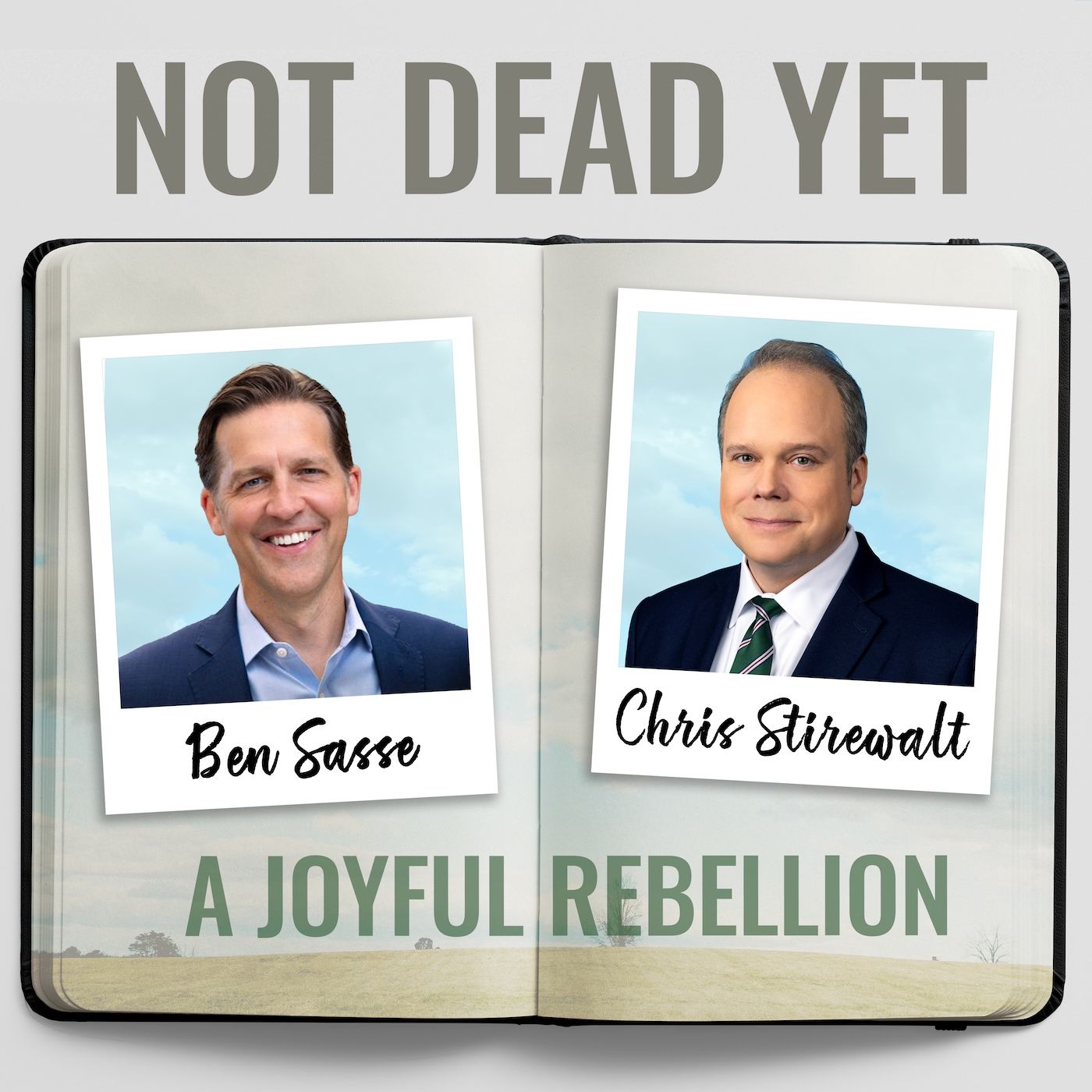
Not Dead Yet
Drew and Ellie Holcomb
01:10:45
Drew and Ellie join the guys to talk about family, art, and soul. Ben has no rhythm, but the musicians talk about art as ache, embodied prayer, and yearning for home. Also, make your kids listen to the Beatles.
Loading summary
Transcript173 lines
- [00:07]
A
Hi, I'm Ben Sasse.
- [00:09]
B
And I'm Chris Styrolt.
- [00:10]
A
And this is not dead yet. We're all dying, but only some of us have been brought face to face with that reality.
- [00:16]
B
However long each of us have to do it, though, we all want to
- [00:19]
A
live a good life, one with meaning, love and joy. And our guests are here to help us do exactly that.
- [00:26]
B
All right, Ben says, I'm mad at you. I'm mad at you because. Well, I'm mad at you because you're dying of cancer, and it is super annoying. I find that. Yeah, you're b. But I'm also mad. I'm mad. No, I'm mad at myself because I read your interview with Ross Douthat, and I was like, oh, I keep saying that what I want to do is not politics, but then. And I'm like, we're going to talk about because being better people and living a good life. And then I'm reading this interview, and I'm like, but that's, like, what I've devoted my entire. My vocational life to. And you and I, we don't even talk about that offline because we talk about other things. And so I was full of a deep, anchovy, like, resentment towards Ross Douthat for getting to have the conversation with you that I don't get to have. But it is better. I know that it is better to not have this be a political podcast, but I would just like to air my grievance. You wanted Festivus. There's my grievance.
- [01:35]
A
Well, I think you and I both believe in analytics and synthetics, right? Like, I think we believe deeply that great welding matters a lot. Theology matters more, but poetry matters a lot. Road construction matters a lot. Architecture matters a lot. Like, there are many, many, many, many things that matter. And one of the reasons capitalism works so well can have plural callings and plural vocations, and they don't have to be your whole life. I know. And so I think what's fun is that you and I actually agree that politics matter, but it's one to one and a half cheers for politics, not three. And so the problem is, so many people in politics want to make it the center of life, and that's why we don't want the podcast to be about politics. We're also not going to make it about welding, though. We brought Mike Row on and celebrated welding.
- [02:22]
C
I know.
- [02:22]
B
And we may do it about welding. And I know this is better. I'm just in the. In the emotional blabber that is requisite in the podcast medium. I'm. I was offering my emotional blabber. Let me ask you a question. Why does music matter?
- [02:42]
A
I don't know, but it's surely deep in the structure of our souls, right? There's, there's profound connection between music and math, eights and fives. And we don't know why, but there's something in our soul that yearns to tell the truth, tell the truth communally and also tell the truth aesthetically, beautifully. And so I'm glad, I'm thinking you're giving me a big softball because, you know, I'm high. To get Drew and Ellie's names surfaced for us here. I'm glad to have these friends, Drew and Ellie, who are married and, you know, make music together as well, make babies together as well. But they have really different musical styles and purposes. And Ellie sometimes performs with Drew. Drew has never really performed with Ellie. Ellie's a contemporary Christian music artist and Drew is kind of Americana and they have, they're fun for me both as friends and I enjoy their, their work. But I enjoy the nerd stuff behind their lyric writing as well because it gets at a little bit of this question that we don't really know. What is the smell of the number 7? Why is music so deep in our soul?
- [03:56]
B
But it is okay. Drew Holcomb is the frontman for Drew Holcomb and the Neighbors. He is a four time Grammy Award nominee. He is, and this is very cool. Their song Tennessee is one of the now one of the official state songs of the Volunteer State, which I find to be super dope. He and his group have carved out a, I think you said, did you say Americana?
- [04:29]
A
That's what I think of it as somewhere between Petty and Cash.
- [04:32]
B
I, I, I'm going to, I'm going to go the folk side of country, but there are some rock elements in it and these are all fungible categories. So that's who he is. And he's a big deal in that way. As you'll hear when we talk with them, their marriage, their family and all of that is very central. Her story is she is the daughter of one of the most important, influential Christian music producers in the universe. And she has been a chart topper and a dominant force in that genre for a decade or more. She is author of children's books and they have a devoted, loyal following on the Socials. Is there anything else that you think that America needs to know about them before we begin?
- [05:29]
A
Let's rock and roll.
- [05:30]
B
Let's rock and Roll.
- [05:31]
A
They're, they're a ton of fun and they have lived on and off a bus a lot of life. And there is a nomad in my soul to whom that appeals. So I like that part of their, their story too.
- [05:40]
B
All right, let's rock.
- [05:42]
A
Ellie. Drew, it is so good to see you. We have already introduced you, so we will not say flattery, embarrassing stuff again in front of you. But thank you for making time. So good to see you.
- [05:55]
D
Good morning. We are, we're thrilled to be on and appreciate the invitation.
- [05:58]
E
It's good to see you too.
- [06:00]
A
So, I mean, as you can see, I am an ugly mess, but I have been able to regrow some skin on my face this week, which is a first in a month.
- [06:09]
D
So I was noticing the good looking gray beard you have going on.
- [06:13]
A
Yeah. Thank you. I am prohibited from letting blades touch my face because the skin just falls straight off. So it is, it is good to see you and hopefully it is half good to hear me. Chris looks good as always. And this is suspenders. So we've got about a dozen topics we want to get through that are about a half an hour each. So we plan to presume on only six hours of your day. But let's start with the weird nature of a marriage with two performers who also take real seriously your family life. What are kind of the ground rules for who tours when, where and when you bring the whole caravan with you. How does life work when you have tours? So many options for how to spend your time every day, week, month?
- [06:58]
D
Yeah, I mean, it's obviously sort of a moving target. We, we, we, we sort of have figured out rhythms that work for us over time. I mean, basically Ellie has sort of a hard and fast rule that for her to touring alone, she's basically only allowed to be gone from her own rules, you know, two or three nights a month. We also have, you know, a great team around us. We've got family, we've got a nanny, but we, it's a little bit of, we kind of go hard in the paint with work and play. So we work hard, but then when we're home, we go really hard with our kids and make a lot of time and make a lot of intentional, you know, things that we like. For instance, we both try to do something one on one with each kid every month. And that might be as simple as walking down to the ice cream stored, you know, half mile from our house. But it's honestly, it's chaos and it's a lot of grace in each other's direction and a lot of gratitude for the people that help us make it work. But it's. It's. It's. Is the number one challenge in our life.
- [08:01]
E
I'll say this. We mainly do it because Drew is a logistical ninja.
- [08:07]
A
I've seen this at work.
- [08:09]
E
It is crazy. Like, he. He's one of the most intentional humans that I know, and I am not necessarily that. I am in my own way, I guess.
- [08:19]
D
You're very lovely in many ways. That's not one.
- [08:21]
E
That is not one of my gifts. And so it is. I am just, like, so glad we're on the same team.
- [08:29]
D
Well, let me.
- [08:29]
B
Let me ask you guys to go back, so. But the way I understand it, you all met at UT in Knoxville when you were both undergraduates, and at that point, Drew, I assume you were already musician guy, right? You were. Were you already there?
- [08:49]
D
You know, it's interesting. I. I think if you'd asked most of my friends in college what I would have done for a living, I don't think a single one of them would have chosen Drew's gonna be the music guy. I was playing music. I loved music. I was a big fan of concerts. I played guitar. I led music at young life and stuff like that, but I wasn't really writing songs until my junior year. So it was a bit of a surprise to everybody that this was the path that I chose. I think everybody thought I was headed to graduate school. I had other sort of dreams and visions for my life that I. I put on hold for this, and. And never really looked back. And also, at the same time, Ellie was not anything more than a friend. I. I was hoping for more than that, but that was not her.
- [09:30]
B
Talk about hang around in the paint. Right? You were hang. You were hanging around in the paint. Tip in. Yeah, see, see, See if things would break your way. But, Ellie, you. You came from a music family that was in your house. It was in your life. Did you know when you guys met at that age that you were going to be a music person?
- [09:50]
E
No. It's actually always say that God has a sense of humor, because I swore I would never be a musician. I swore I'd never marry a musician. And I actually got my master's in education, so I was singing and rapping in my classroom, and I just thought that was going to be the extent of it.
- [10:11]
B
So you guys meet, Neither of you intending to be musicians? You meet because you are both intentional Christians. It sounds like when you were in your undergraduate days and you both were Serious about that and you shared values and you start your courtship. At what point do you guys come to understand that this is going to be the. Be at the center of your vocational life?
- [10:33]
D
Yeah. So when I graduated, we were just friends at the time. She was actually dating someone else. So I moved back to Memphis. The quick versions. I moved back to Memphis, got a job at a student studio, was. Was sort of encouraged by a handful of mentors to put graduate school on hold for two years just so I could figure out exactly what I wanted to do. And I got a job at a studio, started playing cover songs at bars on weekends. That developed around the same time Ellie was, was finishing her undergrad. We started, we started talking more, sort of intentionally started dating. I moved back to Knoxville a year and a half later when we started dating. She was now at this point, a first year school teacher. And we got married. She was teaching, I was touring. It was again, it was very tenuous. And then in a deer blind in Texas on her family's ranch six months after we got married, we were talking about how I was gone 50% of the time. She was working 80 hours a week as a first year school teacher. We said, this is not why we got into this. I said, I'll either quit music or you need to quit teaching and come on the road with me. And, and she said, let's give it a try. And that was in the fall of 2006. And, and, and never looked back. But we, we fully thought she was going to be back teaching within a year, year and a half because we weren't making any money. But
- [11:57]
E
I literally called my principal. I was like, I'll be back probably next year because, you know, y' all are our insurance and our steady income. So we're gonna go have fun on the road for a year and for five years. Yeah.
- [12:11]
B
Oh, really?
- [12:12]
E
He called me every. Because I loved, I really love teaching. And if you're a teacher listening to this, thank you for the work that you do.
- [12:19]
B
It's nice to know you can fall back on it. Nice to know. Thanks. You know, it's good.
- [12:24]
A
Good to know it doesn't work out for you.
- [12:25]
B
This doesn't work out for you.
- [12:27]
A
So I have taken dozens of guests to your concerts, I don't know, five, six, seven times. And I have a shorthand when I explain to people who didn't know who you were before we invited them. That might be wrong, but let me tell you my shorthand and you fix it. I said, they're both super talented artists. They're both talented songwriters. Ellie's a nice person, and Drew is a logistical ninja. And I. Because Ellie's used that term before, and I've said that Drew kind of has two jobs. He wishes he could make it as a musician, but he's married to somebody who really did, and so he's also her business manager. I mean, it's just. It's. It's easy to insult the dude. It's more. It's more fun. You're mean in the locker room. You know, you like a guy if you. If you insult him. Right. If you don't like the guy, you ignore him. So explain the I'm Ellie's business manager side of your life, Drew, and did this. If that's accurate. I'm not sure if it's accurate, but that's what I tell people. And when you persuaded her to stop being a teacher for a couple years, must have done a terrible sales job if she was telling the principal, obviously, this isn't going to work out. I'm being managed by this adult. Walk us through the stages of you managing your career, because then I want to transition to all the jokes you tell about how different your writing styles are.
- [13:53]
D
Yeah, yeah, for sure. I mean, while I don't technically manage Ellie, my managers sort of jumped in on that train. But there was definitely. My favorite story to tell is right after Ellie left the band, she had been writing all these songs, and sort of my running joke, and it's very true, is that she was supposed to be writing songs for Drew, Hulk, and the neighbors. Instead, she kept writing songs about Jesus. And we were like, that's so great, but you have to start your own band, because that's not exactly what we do. So she. This is right around the time that Kickstarter was. Was like a sort of a new, you know.
- [14:26]
B
Yeah, yeah, yeah.
- [14:26]
D
New fad. So we had. We had set up her Kickstarter, and we were going to try to raise $30,000 for her to make and market this album that. That she had already recorded, that we had bootstrapped. And the night before the Kickstarter, Ellie says, I don't want to do it. I don't call it off. Like, there's just, like an innate sort of, I think it would be fair to say, fear that Ellie had of starting her own career and this. This sort of lack of belief that people wanted to hear what she had to say. The rest of us are kind of literally rolling our eyes like, this is insane. You're so talented. These songs are so good. We know this is going to be a home run. So it's one of those nights where I was like, can you please just take this glass of chardonnay and go to bed? You know, we're launching this thing at 10am it's happening. And sure enough, it launched at 10am and it reached its goal by midnight of the first day in the 30 day campaign and ended up tripling the. The number and ended up allowing her to not sign with a record label and launched a career. But I think more than anything, I've just been sort of the instigator of like, hey, you're really good. You should do this. You should keep doing this. And it's allowed us to do it. To your original question, Ben, you know about our family. We've made it a key part of the, the enterprise that we've never lived on Ellie's income. And we've always said you're. Anything that you make is extra. It's for, maybe it's for private school or it's for vacation or it's for, you know, building a lake house or retirement. But we don't, we don't live lines. That's allowed her to be free to, to make the music she wants to make, write the kids book she wants to make. And, and, and our team is always. We call it. She's like the. She's. I've never met a more successful person who's less ambitious than Ellie Halpert.
- [16:08]
B
That's kind of the point though, right? There's something very appealing people respond to when you're not being thirsty, right? When you, when you don't. When it doesn't seem like you need it.
- [16:19]
D
Yes, exactly.
- [16:20]
B
Right. So the, this. So Drew and I may be wrong, but as I came to know your career and the neighbors, it's 2008 or so 2007 that you, you guys start to break through and Ellie's in the ban and you guys go and start to have success. Talk about what success looks like. Looked like in at the end of the aughts in a rapidly changing music industry. What was the breakthrough like? What was the early success like for the band?
- [16:59]
D
This producer that we worked with early on said this thing to me that used to piss me off until it came true. And he said, if you write the right song, it'll do most of the work for you. And at that point I was like, well, that can't be true because I have all these great songs and they're not with. It's not working and he's like, kind of give me like the. Maybe your songs aren't as great as you think they are. I've never had much of a confidence problem, as you could tell. So that we wrote this song or I wrote this song that we recorded called Live Forever that came out in sort of late 08, early 09. And that's. That's when we noticed this thing happening where all of a sudden the song was what people were falling in love with. And all of a sudden at shows when we played that song, the crowd sort of really, you know, kind of came alive and our numbers were doubling, which MEANT Instead of 80 people, it was 160 people, you know, so still a slow burn. But what happened with that song and that record is. Is it sort of went into different sort of cultural zeitgeist, whether it was being used on tv. Like, it was, you know, the season one closing song of the first season of Parenthood. And you got this NBA commercial. And then bands started to hear about us and asked, you know, ask us to open for them. And so there was all these. We always say that that late aughts early, you know, 2010, 2013, was. We were like the best single hitter on the team.
- [18:30]
B
Yes.
- [18:30]
D
But yeah, yeah, we were not having a lot of home runs. Nothing was going like, really, really, really well. But there were a lot of things going. Going well over time that sort of, you know, all of a sudden you look back and you go, wow, we've got a real career.
- [18:44]
B
And that was, by the way, I should just point out for our audience, I asked the question because maybe there has not been a more difficult time. Maybe there has never been a more difficult period to break into. Making a living and having a career as a. How for both of you, how much was like, I assume the business model then always, now is heavily dependent on touring. When did you realize that you were. That. That a bus was part of your. Going to be part of your life for a while?
- [19:18]
E
Can I back up for just one second?
- [19:20]
B
You can do anything you want.
- [19:21]
E
So literally, I just want to, like, be clear that before that song Live Forever was placed on that show, Parenthood, we. Our van had broken down and we could not afford to fix it. So, like, we were. We were a little bit like, okay, we gotta keep our commitments that we've already made. We don't want to leave bitter. We are so grateful we've been able to do this music journey. And I was planning on going back to teaching. He Drew had actually started having conversations with The Marine Corps.
- [19:55]
B
Oh, really?
- [19:57]
D
Well, I was going to try to. I wanted to go to law school. That was my backup plan. And that was my only way to pay for it was to go sort of through the jag, you know, program. I've got a lot of military family in my, in my life. And that was, that was my other path as a high schooler was potentially going to the Naval Academy. So it was always kind of a parallel what if? And as since the career wasn't working, it was like, well, what's my, what's our way to pay for this and, and start a family? Yeah, so.
- [20:22]
E
So he had started physically training, you know, for that. And I think we were like, hey, we have each other. We have Jesus. We've won the lottery already. Like, we're so grateful we want to leave. Grateful. And then this, this Parenthood placement comes through and the sink fee paid enough money that we could fix our van and we were like, well, I guess we'll keep going.
- [20:45]
A
I want to stay on Live Forever for a minute in my, in my new cancer fighting life, I've lost so much weight that I have no pec muscles left. And so, you know that time when you, like, something happens, you see your kids have a really special moment and you get that kind of quiver in your chest and you think, oh, that's, that's emotional. But you don't just start balling like a fool. It turns out I don't have whatever chest muscles are left to suppress that quiver. So I just cry all the time. I'll be honest, I've always been kind of a crier. You know, lots, lots of funerals, every national anthem, you know, 4 by 400 relay at every track meet. I cry like a small child for no obvious reason. I mean, I know I couldn't run the anchor leg of the 4x4, but I will admit I've always been a career, but now I can't really stop at all. And there are a lot of your lyrics, both of yours, that drew, for whatever reason, on an old ipod I used to have on my weekly commute between rural Nebraska and D.C. good life and a few other of your albums were just on cycle. And Live Forever was a song that you could kind of hear. Maybe it's because of the dad regret of having been gone four nights that week or five nights that week, but I can hear Live Forever and just start crying on the drop of a hat. You know, Like, I, I can see how that song could carry your mentor's advice that it could Do a lot of heavy lifting for you. Explain to us a little bit what it's like to have. I know it wasn't just that one song, but give five examples like that of how weird it is to live at a time where artists 40 years ago, 50 years ago, put together an album as a story. You had a dozen songs that you were fitting together in a way, and now people get to dabble, drop in and out of individual things that you do. That's like three minutes. And it may work or it may not work. It's got to change the sense of what you're doing artistically. And I don't have any of your skills, but it seems to me the words content and art mean different things. What's the difference? How does it work? Work? How does it affect your creative.
- [22:50]
D
Well, one of the great benefits of being independent, which we both are in terms of, you know, sort of our enterprise, you know, how we're set up, is that we are allowed to kind of create in seasons. And while we are sort of subject to the single song, sort of zeitgeist of, you know, that started without the Apple Store that, you know, is now continued into streaming, we both tend to still kind of create albums in seasons. And the writing does sort of, you know, coagulate around a certain set of experiences and perspectives that happen in a season of time. And then the way we. We both kind of record in the old school way where we get a band together and go into the studio for a week or two and get, you know, the basic 80% sound of a record done all together. So each of our albums does sort of have a time stamp. A lot of it is sort of through both. Both through the writing and the. In the production style. That said, people do listen to music primarily, you know, sort of pick and choose. And so I think we both, you know, we don't love that, but it is kind of. It is what it is. What the cool thing about that is, though, like a great example would be what would I do without you on Good Light was it's song number 11, which, you know, if it's song number 11 on an album, you don't think it's going to go well. You know, you're kind of burying it. Song doesn't even. The song doesn't even really have a. A traditional chorus.
- [24:21]
E
But you. If you're an artist, but you wanna. It's still special as the last song. You just know it's not.
- [24:27]
D
Yeah, it's not the last song, but yeah, it's towards the end.
- [24:31]
E
Towards the end, yeah. Yeah.
- [24:33]
D
But the, the interesting thing about the. The way things go now with social media and streaming all this is that people will find a song, and all of a sudden you have a song that you didn't think would do anything. And it comes the, the. The. The anthem of the record or the, the most sort of, you know, stream song on the record. And that's happened to both of us. And, you know, while there are certain things about the current music business that we. We sometimes go, man, what, what if we'd been making music in the 70s? Would it have gone differently? Would it have been easier with the hustle of things? Not as intense, but at the same time, we're really grateful for. You know, I wouldn't have gotten signed in the 70s for my. With my first few records because they weren't very good. So it gave the, you know, the, this era gave us the space and time to get good enough to. To sort of find ourselves, find our voices.
- [25:23]
B
You would have had uglier clothes. Certainly. Certainly if you'd have been the 70s, the clothes would have been. You had Pearl snaps. It would have been the whole thing. I don't want to do the journalistic thing and try to impose an external narrative on your life, because it's your life, but here's what I see and tell me where I'm wrong and tell me where I'm crazy. You guys put an album out last year together. Memory Bank. The success of, I think, was Passenger Seat. What was the breakthrough? What was the album where it was
- [25:59]
D
like Chasing Someday was the one that really kind of started the career. But the real breakthrough was Good Light.
- [26:05]
B
Okay, so in what year is Good Light?
- [26:08]
D
Good light was 2000 to shoot. 2011.
- [26:12]
E
11.
- [26:13]
D
Okay, so 2013.
- [26:17]
E
Because we. We recorded it when Emilio was in my belly. That's right, because it would put her to sleep.
- [26:23]
B
You named your daughter after Emmylou Harris. Say it was after Emmy Lou Harris.
- [26:26]
E
It was after Emily Harris.
- [26:27]
B
Okay, that's. Then we're good then. You and I are friends.
- [26:30]
A
This.
- [26:33]
C
So.
- [26:33]
B
And does she have a sister named Crystal? No, I'm not going to. I'm not going to say that. Okay, so the story that I'm hearing here is that you hit it, the neighbors hit it. It starts to really happen, and then it looks like. I'm sure it didn't feel like 30 seconds later, Ellie, the solo career takes off almost contemporaneous. Right. And the solo career begins. Then you come back together, 2025, and you do this album in that dozen years. And I'm asking all of this because I want to be a better husband and I want to be better at the most important jobs that I have as father and husband. How do you let each other shine? How do you handle the work of going back and forth? Because sometimes it's your moment and other times you're standing outside of the spotlight with your partner. Talk about how you work the. The alchemy of staying supportive and holding each other up.
- [27:43]
D
I can't. I can only speak to, you know, my side of the story on it, but how do I start this? So it was a learned art. I was, I. I'll be honest, when Ellie left the band, I had a lot of fear of two things happening simultaneously. One, that me and the neighbors would fade off into oblivion since she was everyone's sort of favorite member of the band. And then two, that, you know, all the hard work and that I had put into sort of putting myself on the line as a writer and creative in a way that was a bit of exposing my own sort of deconstruction, reconstruction of my own faith would lose out to Ellie's much more sort of devout memoir, esque, writing about her faith. And those were fears that I had to sort of, you know, in. In a lot of ways, sort of taken for the throne of God. And. But what was really cool was, and Ellie could probably speak to this better than me, but we really, really have an intense amount of respect for each other. And if. If I had one sort of thing that I would say I'm proud of is I'm really proud of how much I respect Ellie. I think a lot of my peers don't send that same respect towards their spouses, especially when, you know, when there's both working and things like that. And so that's not necessarily an attaboy. It's something that I've had to do because Ellie's so good at what she does and she makes it easy. She makes it easy for you to respect her. Yeah, she does, she does. But some of it, some of it is very natural. Like, I like touring, I like being on the road, I like doing shows. That's an easy fit for me. Ellie doesn't necessarily like it as much, so it's easy for her not to. To go out on the road as much. But.
- [29:37]
A
And is your rhythm, Drew? Do you still do kind of a four day weekend every other week? Is that that the baseline, the changing
- [29:44]
D
economics of touring have made it where it's more like we. We Go out for more like 10 to 15 days, and then, you know, do that instead of going out for four days. Fifteen times a year. We go out for ten days four times a year.
- [29:56]
E
Yeah, we had one season where we missed almost every soccer game, you know, because it had been. Your kids were out of school.
- [30:04]
B
Soccer's overrated, you know, and then they
- [30:06]
E
get in school and they're busy, and I'm like, we don't see them during the week. We got to be. We got to be back on the weekend, so we got to consolidate this.
- [30:14]
A
Gotcha.
- [30:15]
B
Your husband said something pretty profound, not to put words in his mouth, which is that he had to acknowledge two fears that when you went solo, and one was that you would. That one was that you would fail, and the other was that you would succeed, that. That you were going to outshine him and that you were going to have massive success, and the neighbors would rumple up and die. And then the other fear, of course, is that you would try it and fail, and it would be a disaster for the family, and it would be bad. So he had to, like, wrestle with both of those things, and as he said, take it to the throne of God and say, like, relieve me of this. How did he do at that? Did he do.
- [30:57]
D
Was he. Was he successful?
- [30:59]
E
Oh, man. Knocked it out of the park. You talk about in singles, I'd say that'd be a home run. And honestly, you know, it's so interesting because I'm such a. Not now, but for years, every record I made, I'm, like, probably not going to do that again. Like, loved it. That's. I think I've said everything that I need to say, but it's been a really sweet thing, I think, over the years to. To get to cheer each other on. I have a massive amount of respect for him, and I really, you know, my fears around doing music felt, you know, the. I guess the lie or the fear that I had to kind of wrestle with was if you do this music thing that you sort of feel called to do, it will destroy your family. I grew up in Nashville. I watched it happen. It's hard. I guess. I know the cost. I was not walking into starting another music career, you know, blind to the cost of that. And what I love is sort of with this North Star of. It's us and our family and this bigger story of faith that we have that we get to be a part of living into a bigger story than just our own. Actually, with that navigation system in place, it has been. I think I'M surprised at what a delight the journey has been, how much we've enjoyed it and gotten to bring our kids on the road with us and along, along the way. But I was the one that. I was on bed rest when Drew's opening first of three for need to Breathe. And he. I watched him stand in front of a room, sold out crowd, I mean, maybe a thousand people, and just with him, an acoustic guitar. And I was watching side stage and I just thought he was going to invite me out there and I didn't. I had not watched him perform alone without being on stage in years. And I just had the thought, please don't invite me out there. I just, I want to watch you do this because I think we're great together. But it is something different when we're together than just him. And so I remember when I asked him the question, you know, I'm writing all these songs, working out my faith. You know, when you write a song and I'm going to be on stage that people automatically think the song's about me. Like, it just feels like, do you ever feel hemmed in with me up there? And, man, it just started this beautiful kind of of our counselor called it. You know, we were like, our career's at the highest point it's ever been and I'm thinking about quitting. Are we idiots if he, you know, cry? He just, he got tears in his eyes and he was like, no. He said, you're just individuating. You're each being who, exactly who you're made to be and you're supporting each other in that. And he was like, it takes a lot of people a lot longer to do that. And he was like, you know, there's cost to that with anything, with any change, even if it's a good change, there's always a funeral. You know, it's like the end of an era and even if, you know, it's the next right thing. But man, it's been such a joy and I think it's deepened our respect for each other getting to make music kind of side by side. And then it's been a delight, kind of a surprising delight to make music together again.
- [34:18]
B
Okay, I have a question for Ben Sasse. No, no, no. I have a question for Ben Sasse. Who. He has to answer this question.
- [34:24]
A
When I'm writing a song, what I
- [34:25]
D
usually feel is, go ahead, Chris.
- [34:30]
B
That's just a dodgy Runza. Okay, so I have a. I have a.
- [34:37]
A
A poet's heart, but a German voice.
- [34:40]
B
And sense of humor, but I'm not. We won't. We won't get into all of that. The. Ben, when you. When we were talking about music for this podcast, we were agreed completely of which artist we would be using, but we had different ideas about which songs that we thought would be better. And one of my anthem tracks is the Dragons. Right. Which is just a great, simple. And it's. As a father of boys, I'll get choked up talking about it right now, but it's a great song and I love it.
- [35:24]
A
You pansy ass. You don't have no cancer. Shrinking.
- [35:27]
B
I know I'm not allowed. I'm not allowed to be emotional in this situation. I understand. But the song was very meaningful to me in an important chapter of my life. You wanted Shine Like Lightning. Why did you want that? Actually, can we listen to a little of it right now? Are we able to actually listen to a little of it right now?
- [35:49]
A
Let's do it.
- [35:51]
C
10 years dancing to the music 8 years dancing with a girl I love cynics hearts and critics plunder Take something beautiful and make it feel, feel small Even when the rain pours down Even when the light seems like it's fading Even when your heart aches Feels like it's going to break that's when you sing out loud we're going to shine like lightning Even if I fight against the wall we're gonna shine like lioness like we've got nowhere to go I never was much for small talk.
- [36:54]
A
So good I'm. If I. If I start overwhelming it with Ben in the Shower voice, we'll lose all of our audience. There are so many places to go from here, but let's just start by saying that's like Petty's Won't Back down meets a real love story to me. I mean, I want 79,000 people screaming that in a stadium together. I had so many questions, but let's just start with this. How did you write that? Why did you write it? What did it mean to you then? And how different is it to have gone through the artistic phase of, I assume, the loneliness of childbirth as you write some of this stuff? And then later you realize how an audience is gonna respond to it. It has to have this nostalgic feel of joy once you perform it over and over and over again, versus the first time when you're unsure whether or not the reception is gonna be what you felt and wrote. What's going on here?
- [37:55]
D
So this was on an album called Medicine, which is the first album we made after Ellie left the band and I knew that I needed to write the best record I had ever written because the pressure was intense with her departure. Around the same time as this was happening, I, I was feeling a lot, a lot of underdog. I was feeling, you know, the, the line, you know, cynics, hearts and critics plunder take something beautiful and make it feel small. I was feeling a lot of, of sort of flippant disregard for us from like, you know, at the time there was a lot of press still really, really moved the needle and late night tv and we were getting sort of none of that stuff and watching a lot of our peers, you know, who had come to the game a lot later, getting a lot of sort of opportunity and accolade that we were just couldn't get. And so I was just, I was feeling this song was, was a bit of. There's a bit of anger and disappointment, frustration in it, but also sort of, well, let's, you know, look around and make. Make our own way like we always have, you know, and it could be anything from not getting booked at festivals to not getting late night tv. There was just a lot of not happening that I thought I felt should have been happening based on what was going on with our fans. And, and so it's a storytelling song about. Well, they can, they can, you know, disregard us all they want, but we still know that what we have is, is beautiful and we're going to build something from it and we're going to make this anthem. Because what I've learned is that at the end of the day, while people may be interested in your personal life through social media, the reason we have fans is because of the songs and then the recordings of how we deliver those songs to them. And so they become a part of people's soundtracks to their life. And this song for me is soundtracking a moment where the career is going well, the dream has come true, but I'm still not comfortable in my own skin and still feeling like an underdog. And I know that my audience probably feels that way too. No matter if they're a plumber or stay at home mom or business owner, everybody feels this, this thing that I've got to take the broken pieces of my life and make them, make them into something. And. And we're going to do that. We're gonna do that together and shine like lightning even when, you know, even. Even when everything's going wrong. So it's a bit of. Yeah, I mean, it's definitely a Petty esque. It's One of our most petty esque sounding songs with a capital P. Capital. Petty, yeah. Tom Petty, yes, to be clear.
- [40:34]
A
Gainesville Zone, Tom.
- [40:36]
B
Ben says answer the question. I put a question before you. Ben says answer the question. Why was that the song that you knew you had to have tell me.
- [40:44]
A
Well, I think I could accidentally get way too theological here where we don't have enough clock for it. But you know, one of the things in the Pauline epistles that you hear that characterizes Christians is perpetual gratitude, characterized by ongoing singing, which is a way of expressing gratitude, grief as well, but gratitude, collective singing that people get together and sing and a desire for others to be higher than you are. It's a weird four part thing to say, let's be grateful, let's sing, let's sing together and let's recognize that we're small. I think there's something about Shine Lightning that has. I mean, who am I to tell the songwriter what it could also mean? Let's go full, you know, deconstructionist, postmodern. But I think it isn't just an anthem about people making it in a worldly sense. It's also a sense that I'm not really going to put the pieces back together. And the. The Shine Like Lightning is something that's done to me and I think that that would just be a really, really, really great stadium song. And so at a time when we were looking for intro music and we had already. Chris and I had already decided that we wanted it to be something from you guys, and we were debating three or four or five different candidates. That one was just winning the day during really crappy chemo that shined like lightning as something you might scream with your family and friends. Seemed pretty dang redemptive. It's not. I won't back down in the sense of the experience of having sung it with tens of thousands of people, but man, it's a we that need to be singing it. And it has a greater aspiration than just, you know, stand me up at the gates of hell and I won't back down. It's. It's better than Petty.
- [42:40]
D
Petty. That's my praise.
- [42:43]
B
Okay, I have one. I have one more question, Ellie, for you, which is you were six more. Well, you pick, pick, pick, your pick your favorite. The. You worked with your dad and please correct me in real time wherever I'm wrong, you worked with your dad producing most of your solo albums, is that right? Okay, that's right. In 2017, you brought an album out, Red Sea Road, and he Was struggling with. Is it true that he was struggling with cancer at that time?
- [43:17]
E
Correct. Yes.
- [43:19]
B
So for Ben and for our audience, and we have a lot of people who are listening to this who are dealing with cancer in their families. Just do us the favor of, if you will, talk a little bit about the experience of doing that, the work of doing it, how you did it with your dad. Anything that you're willing to share with us about that work.
- [43:40]
E
Yeah. I will never forget such a unique way to make a record, because we'd really started the whole process, and then kind of very suddenly, you know, I always say, like, nobody's ever ready for that phone call. Ben, I know you know this well, and anybody who's walking through a cancer journey does. It's like that the test came back positive. And it's like, you. You're on a journey that you didn't sign up for, that you didn't know was going to be there. And I remember feeling really scared. And we had. But we had already started kind of the process of the. The records. We had a lot of the songs written and started recording them. And he had to full stop, you know, go fight. Go slay the dragons. You know, he's just like, on that. The journey of radiation and chemo and surgery. So I will never forget my mom when this happened. It was about to be her birthday in January, and she was like, for my birthday, I want to worship night. And so, Ben, to your point, singing together. So she invited everyone in there in our community, including, I think, the guy that, like, sprayed their house for bugs that day. She was like, come, you know, later, the guys at the grocery store. And there was a worship night. And I had the privilege of watching my mom and my dad run into a journey that carried certain darkness and pain with no guaranteed outcome, you know, with their hands raised in the air, praising God, which is just backwards and upside down. And I started off on the edge of the room. I remember my son Huck was a baby. I had him strapped to me, just scared and so sad. And I ended up in the center of the room, right next to my mom and dad, kind of experiencing a peace that made no sense to have, considering the circumstances. And it was a. It marked me. It will mark me for the rest of my life. And I went home and I wrote a song called Find. You'd hear about just that piece from Philippians that we hear. Rejoice in the Lord always. I'll say it again. Rejoice. Let your gentleness be evident to all the Lord is near, so don't worry about anything but in everything, with prayer and petition, with thanksgiving, present your request to God. And the peace of God that transcends our understanding will guard your hearts and minds in Christ Jesus.
- [46:27]
F
It's not the news that any of us hoped that we would hear. It's not the road we would have chosen, no. The only thing that we can see is darkness eyes ahead but you're asking us to lay our worry down and sing a song and stay And I didn't know I'd find you here in the middle of my deepest fear but you were drawing near you were overwhelming me with peace to my voice and say me you're gonna carry us through everything you draw near you're overwhelming all my fears with peace you say that I should come to you with everything.
- [47:28]
A
Amen.
- [47:29]
E
A backwards and upside down peace that doesn't make sense when your air's falling out and your skin's falling off and you feel terrible and I just. I love.
- [47:40]
A
You smell great, though. You smell really, really good.
- [47:42]
E
So good.
- [47:42]
A
Yeah, you sm.
- [47:44]
E
But I just love. I recorded the song, and it was wild. I got to play it for my dad for the first time in the hospital right after he had a pretty major surgery. And I just think the mystery that I can't shake about faith is that it gives you a reason to sing, even in hospital rooms, even outside of a grave, because it's a story of a love that beats death. And man, what an honor it's been to. To. To sing my way through along with so many others. To sing my way through the sorrow. You know, I think both of us have done that in. In ways. And, man, when people say they love Red Sea Road, I'm just usually grab their shoulders and I'm like, I'm so sorry for whatever. You're walking through
- [48:34]
A
graves into gardens, baby.
- [48:36]
E
Yeah.
- [48:39]
A
I know we're gonna have to fall relatively soon, but I still want to try a few more popcorn rounds. What is the connection between music and the soul? Why. Why is it that there's something that causes our voice to want to dance? When you say true stuff in the face of a bunch of bad, like. Like, there's a lot that's really, really, really, really broken in the world. And there's something in us that isn't just voice, but it's a musical voice that wants to announce truths over that. Why?
- [49:10]
E
I love that.
- [49:12]
D
I. I think the fact that I can't answer that question is one of the reasons I still love this job, because it's the, the, the, the magic of it, the mystery of music. And I'm sure there's, you know, sociologists and people who can try to explain where it comes from, but I, I can't, I don't want to listen to it because it'll take it. And I want anything to take away how it makes me feel when I hear a song that connects with my story, with my soul. And our kids are at this really fun age where now they're, they're like wanting to listen to music that has, you know, real heft to it. And I remember recently playing Stephen Wilson Jr. Is my father's son for my 10 year old son. And I was kind of walking through why the song matters. It's a song, you know. Stephen Wilson wrote an album called Son of Dad about his dad, his dad's death and, and he's a junior and he's talking about that. There's a whole line in the song where he says, I used to hate being called Junior, but I don't mind any longer, as he sort of like deals with the mortality of, of his dad and now his own, his own self. And I think there's something about music that just the fact that it can make you want to dance at a wedding and sob at a funeral and everything in between, it's, it's, it's just, it's universal. Now obviously people's tastes and genres are not universal, but everybody loves music. It connects with everybody's story, no matter who they are, where they're from and what they have and what they don't have. And I don't, I don't know why it connects to the soul, but it does and I love it.
- [50:52]
A
I have a theologian friend who, 30 years ago, and I won't name him because I'll bastardize the quote too badly. And he would have said what he said was elegant. He was critical of a lot of what he called Christian art because it fell off one of two cliffs of too much despair or too much hope. Which felt strange to me when he first said it. And over time I thought, how could you have too much hope? It was the saccharny nature of not really telling the truth but just saying something that would be easy. Short term dopamine hit comfort. Given how different your writing styles are, you've used phrases here. Write about your faith or work out your faith. Those are slightly, maybe significantly different things. Ellie, you perform for audiences who come, I assume, regularly looking for. They want a therapeutic relief a lot, I assume when they're coming to your shows and at Drew's. He's a darker soul. There. There probably is a broader range. How does that affect your writing?
- [52:04]
E
You know, when I. Whenever.
- [52:06]
A
Maybe I'm wrong, maybe the assumption's wrong.
- [52:08]
B
Beat it up.
- [52:09]
D
No, no.
- [52:10]
E
I mean, I think that I love. I actually love that I get to play in places where there's sort of a presumed, like, you know, like, oh, people. These are people of faith. These are people who are working out their faith. And then we play in clubs and bars and theaters. And I think my favorite thing about music is that it's a bridge builder. Like, it connects our sorrow, it connects our joy, it connects our. Our hope. And. And I don't. I don't know that. I don't know. I guess when I write, I call myself a selfish songwriter because I'm usually, like, working out my faith in song. And so I generally am writing what I've seen to be true or what I hope is true. And when I sing, it helps me believe it. It feels like embodied prayer for some reason. So I. I think there is. There is a sense of. I guess the, like, the introductions to the songs feel maybe shift a little bit when I'm in, depending on the environment. But I love being all kinds of places with all kinds of people and singing the same song together. It's like. It is so good.
- [53:35]
D
I found that my audience. Because Ellie's music is not prescriptive. It is. It is sort of more descriptive of her experience. So people can't argue, you know, when she sings Red Sea Road. While they may not share a theological sort of point of view with her, they. They do respect her telling her story.
- [54:05]
B
Hit it, dad.
- [54:08]
E
Yeah.
- [54:12]
F
We buried dreams Laid them deep into the earth behind us Said our goodbyes at the grave but everything reminds us God knows we ache when he asks us to go on how do we go on? We will sing to our songs. We won't bury our hope where he leads us to go There's a red sea rose Go. When we can't see the way he will part the waves and we'll never walk down
- [55:08]
D
And I've become more comfortable with that in my own journey of faith. I mean, for a long time,
- [55:16]
E
you
- [55:16]
D
know, and you and I have talked about this a number of times, but by.
- [55:19]
A
I like.
- [55:20]
D
I don't call myself a deconstructed Christian because I feel like that has so many negative connotations. And it. It. I. I reconstructed, you know, a lot of respect and love for the world that I grew up In. But it's not necessarily where I find myself as an adult, but I still. I think that as long as we are telling the truth in a. In a way that doesn't alienate people and doesn't tell them how to. How to feel or how to, you know, how to respond, we're just sharing our music, then that typically is. Is received well because I think it respects the audience, regardless of where they're coming from. I don't think we necessarily write with our audience, either one of us in mind. We certainly want to respect and acknowledge that they are the reason we have this job. But at the same time, I think the reason they come to our music is because we've done it. It authentically and without chasing their. Without chasing their attention.
- [56:19]
A
Really interesting. I mean, I. If we had an hour, I'd want to ask you if AI is going to ever write a good love song. And I assume the answer is edge of no.
- [56:30]
B
But I don't.
- [56:31]
A
I don't exactly know why. And I. I kind of feel like there's something in your phrase there. Embodied prayer. I mean, what a. What a. What a great term. Good art is beautiful and true and. Or good. But maybe not all at the same time, but all beauty is reflecting something about God's beauty. And so it kind of makes me wonder what the best embodied prayer is that wasn't really written as a praise song. I don't know that that's a tight enough question. But in my mind, I now want to parse genres about embodied prayer. And is all of that song, or what are the parts that are not song?
- [57:12]
E
Oh, I love that. Well, I. You know, there's this incredible. He's a professor of theology at Duke in Cambridge, as well as a classical pianist. His name. Pianist. His name is Dr. Jeremy Begbie. And he talks about how the whole structure of music actually tells the human story. You start off, you know, in music, you have like, your. Your key, your home, you know, like. And then you go away from home and you return back home. And he does this by playing Mary had a Little Lamb. So, you know, Mary had a little lamb, little lamb, little lamb, Mary had a little lamb Whose fleece was white as go home snow. So he said, even just playing that melody, there is something in us when. When a key is not resolved, when it's away from home, that literally leans forward and longs that resolve. And it explains kind of like your. It kind of taps into that earlier question that you asked, I think, because I believe that we all come from where Every good thing comes from. From the heart of God. We're made in the image of God and we are currently. And that is our home and our true identity and our belonging. But we're all kind of away from home and we longing to return back to that place where we know that we're loved and we know that we belong. And so music does that so beautifully without even words to, to answer your question, plays that out in a way that we can feel in our souls and in our bodies. And I'm so grateful, I'm so grateful for the way that it sort of names something with. Even without words that's so good.
- [59:02]
A
I want to see the IMAX movie of the neuro biochemical brain transmitters that yearn for that resolution.
- [59:10]
B
Right?
- [59:10]
A
Like there's clearly some dopamine hit in the structure of the universe that's echoed in the structure of our brains that need that last note, that need that resolution. It can't be totally chaotic, but it also can't be incomplete. There's something that is. There's. I don't want to say there's trinitarian relationality in it, but there's definitely something about the structure of time in that music isn't done until that future note is coming. And it's against a backdrop of grief and brokenness and yet an anticipation of hope and reconciliation.
- [59:45]
E
It's beautiful. It's really beautiful.
- [59:48]
A
Close us out on this for young parents, since you all are both artists and moms and dads and frankly, I'm a little sad that you don't get to do the every other week bus trip anymore. But I'm glad for the struggle structure of hitting more youth sports and having that cadence to 10 out of 90 days on the road instead of 4 out of 14.
- [60:07]
B
But.
- [60:07]
A
But as you think about what you're introducing your kids to, both in your vocation and you're calling on the road, but also just at wanting them to. To understand and love good music. Where do you start?
- [60:18]
D
What are the.
- [60:18]
A
What are the best bands to introduce kids to good music?
- [60:22]
E
Oh, I love that.
- [60:23]
D
I mean, you gotta play the Beatles for kids so they can understand the last, you know, 65 years of. Of music making. Because it's sort of all. They changed the game in so many ways. We play a lot of like classic soul music. You know, Bill Withers and Otis Redding, great singers. You know, we both have this word that we've come up with that how we define great music is that it has ache and. Yeah, it can be, you know, a Katy Perry song. Like fireworks, Work has ache. It's a big. It could be a big pop song, a dance song, Bruno Mars. But it can also be, you know, a solo piano piece, you know, by some composer from Europe that doesn't speak English. So we play a lot of music, but I think more than anything, we just play them whatever we're listening to. I think the one thing mistake I think a lot of parents make is they let their kids choose all the music in the car. And so we do. We do a rotation where if there's all five of us are in the car, the playlist is each person gets one song in a circle over and over and over again. And a couple. Couple ground rules. You can't pick the same artist twice. So it keeps. You know, that way you don't listen to. You know, our daughter can't pick Taylor Swift every fifth song. All due respect to Taylor Swift, but that's a. You know, that way they. They feel respected in what they like. But also we get to introduce them to things that we love. But I think at their age, too, a lot of Broadway connects that we just took them to see Les Mis Miz and that. That opened up a whole, like, piece of their hearts that was. Felt really important.
- [62:03]
E
Yeah.
- [62:03]
A
And the pursuit of Javert forever. And it just becomes a part of the family grammar.
- [62:09]
E
Oh, it's so. It's so good. Huck, our most introverted child really loves, like, his. He's an old soul, you know, and so. But he will just burst out into one day more very often. Right. Which is really awesome.
- [62:26]
A
That's really great. Great. Music has ache. Music is a yearning for home. Music has embodied prayer. Life here is a pilgrimage. And we sing it out, longing for that home. It's great. I love you guys. Learned a lot. Thanks for making time.
- [62:42]
D
Thanks for the invite.
- [62:43]
E
So grateful for you.
- [62:45]
A
To be continued. Peace.
- [62:47]
B
All right, professor, what did we learn?
- [62:50]
A
I still want to go on the road with them more. This new thing of them touring 10 out of every 90 days instead of 4 out of every 14. I don't know how I feel about it. I kind of like, when you were a kid, did you ever want to be a fireman?
- [63:00]
D
No.
- [63:01]
A
I went and not just because it was cool, but, like, because it seemed great to work 24 on, 72 off. I kind of want to go on the road with them, but what I. What I really want to do while drinking whiskey with them on the road is talk more about this midpoint of musical storytelling that's neither sacchariny nor despairing. And I really enjoyed hearing them start to reflect a little bit on that. I wish we had more time.
- [63:31]
B
So the. The challenge in authentic music, whether it be folk or Christian or whatever, but the music that's supposed to be about something is balancing production value, performance, and like a lot of things in life, balancing the real with the performative. Because you gotta have some. You gotta put something in there so that people feel the feels, but then you tip over into sacchariny or manipulation. And I don't see that in either of their music. Right. I don't hear that in. And I say this with appreciation for a lot of Christian artists. A lot of it is terrible, right? A lot of contemporary Christian music is super extra bad Jesus is my boyfriend kind of music, and she doesn't do that. And he and the neighbors, could I refer to it as the creased cowboy hat. That country that can easily tip over into where it's like, it's dumb. And I respect and admire their ability to navigate a difficult space and. Well, I guess the question I have for you is if who we are, if the person who God made us to be, if we are always moving toward or away from that, but who we are at any given moment is always changing, staying true and evolving at the same time is really hard, right? If you're an artist, if you're performing, if you're a writer, if you're a politician, if you're a whatever, being true to yourself and authentic, but at the same time leaving room to grow and develop, that's pretty tough. How do you do it?
- [65:28]
A
I mean, wow, that's. That's big for our clothes. Because I know I want to. I want to parse our categories of, you know, justification is being declared righteous, though I'm not. Sanctification is something I actually get to cooperate with. I'm dead in my sins before justification, but sanctification, I get to cooperate in trying to die to self and become who we're supposed to be. But you're still navigating on this pilgrimage, a really, really broken world, and we're inevitably be learning a lot. And you're going to be learning about the diversity and complexity of a world where people are suffering in lots of different ways. And so to your point, how do you be true to who you want to become and yet be humble in that journey? It feels to me like parsing out the old good, true and beautiful categories is useful because there's a lot of stuff that is true and not beautiful. And it's still useful to reflect on it. Lots of stuff that is good, you see almost none of it yet, but eventually the ugliness is going to be undone. And so how you can be hopeful, but not just on Hopium is is got to be a real challenge to be a good songwriter.
- [66:45]
B
Okay, I dig that. I will. I will accept. I will accept that as an answer.
- [66:49]
A
And how powerful that little in the cut that Scott dropped in of her singing to her dad in the hospital. I like her. I'm sure Joan Jett isn't the right analog, but I like her throaty voice. And thinking about that in a hospital telling her dad that his the death he's headed toward, isn't the whole story pretty dang great?
- [67:14]
B
The I I've received many blessings undeserved in my life, but probably, well, certainly among the very greatest was the fact that propitious timing worked out so that I would be with my father as he was almost dead. He was not dead yet, but he was almost dead. But he still had the strength and the presence of mind that we could share poetry that we had memorized with each other. And I want to tell you, doing Ulysses with your dad on his deathbed. Highly recommend. And that's where I learned about joy. I learned about the difference between happiness and joy in that moment. So that was that. She made me think of that powerful brother.
- [68:03]
A
My 14 year old comes with me to the hospital occasionally and I love that somehow my wife, his mama, has gotten him to be just no insecurity whatsoever about just sitting down at a piano. And in a hospital lobby there's regularly a piano, nobody's ever playing it right. My kid just goes and sits down and starts cranking Pachelbel's cannon or something. And it's pretty great because you just see all these sick people in wheelchairs drawn like magnets to the edge of music.
- [68:37]
B
Art does something amazing and I'm glad to know that Breck is not just a future MLB star, but also a future concert pianist. This is good to know.
- [68:47]
A
Yeah, with my genes. Let's keep bringing this.
- [68:50]
B
Well, we know he won't be a comedian.
- [68:53]
A
5:11 Hopes about playing on Sundays as a wide receiver. Good to be with you brother. Thanks for the time.
- [68:58]
B
Okay, that's it for this week's episode. We hope you'll like review and subscribe and tell a friend. Feel free to email us with your thoughts, corrections, questions, or whatever else is on your mind. You can write us at sass and styrewalt gmail.com this podcast was produced by Scott Immergut with the help of our colleagues at the American Enterprise Institute. The music, as you know, is from Drew Holcomb and the neighbors. Thanks for listening and keep living the good life.
- [69:25]
C
10 years dancing to the music. 8 years dancing with a girl I love cynics, hearts and critics plunder Take something beautiful and make it feel small Even when the rain pours down Even when the light seems like it's fading Even when your heart aches Feels like it's gonna break that's when you sing out loud we're gonna shine like lightning Even if our back's against the wall we're gonna shine like lightness like we got nowhere to go I never was much for small talk Born with a heart that felt heavy as stone But I still love the sound of laughter it's the sound of hope keeping us alive Even when the rain pours down.